
UNA MUNIZVIEGAS Splits a São Paulo House into Concrete and Air on a 10-Meter-Wide Plot
In Jardim Paulistano, a 360 m² residence keeps half its width free for vegetation, light, and the blur between indoors and out.


A ten-meter-wide lot in São Paulo's Jardim Paulistano neighborhood is not generous. Most architects would fill it. UNA MUNIZVIEGAS did the opposite: they surrendered half the width to planting, pushed the house against one boundary wall, and let climate do the rest. The result is Juquiá House, a 360 m² residence that reads less like a building and more like a sectional argument about what needs to be enclosed and what doesn't.
What makes this project worth studying is its commitment to dualities that never collapse into mere gesture. Concrete and porous, heavy and aerial, opaque and transparent: these pairings are not slogans on a concept board but structural and material realities built into every floor. The intermediate bedroom level hangs from a metallic structure while the roof sits on concrete. Gardens, terraces, and a rooftop landscape extend the domestic program vertically into São Paulo's temperate air. The house does not simply open to the outside. It organizes itself so that the outside is always already inside.
Street Presence and Urban Camouflage
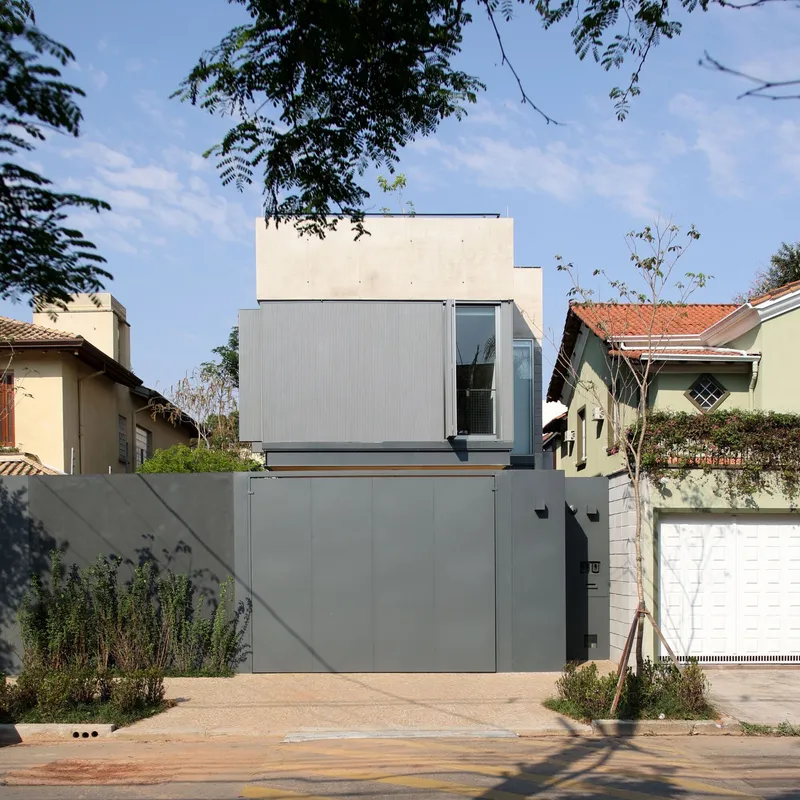
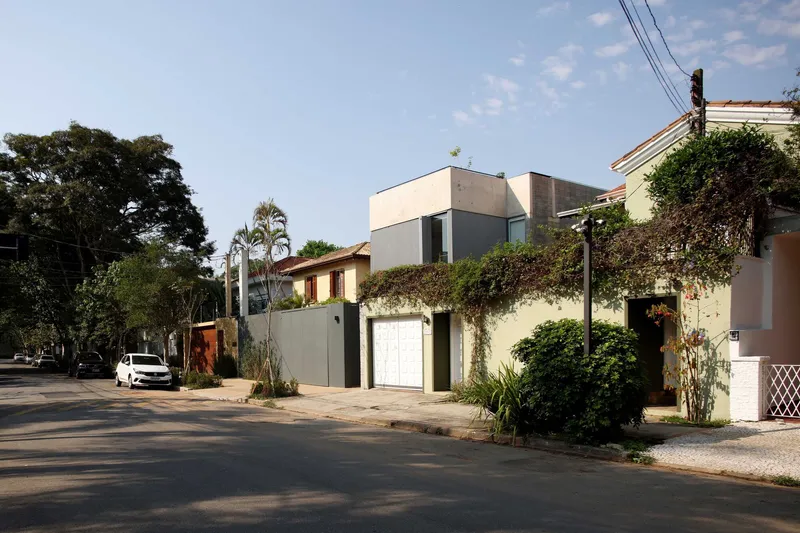
From the street, Juquiá House is deliberately reticent. A grey stucco wall, a garage door, climbing vines, and stacked concrete volumes are all the neighborhood gets. There is no heroic cantilever aimed at the sidewalk, no floor-to-ceiling glass broadcasting domestic life. The facade stacks grey volumes beneath a white concrete upper level, fitting comfortably between neighboring tile-roofed houses without mimicking them.
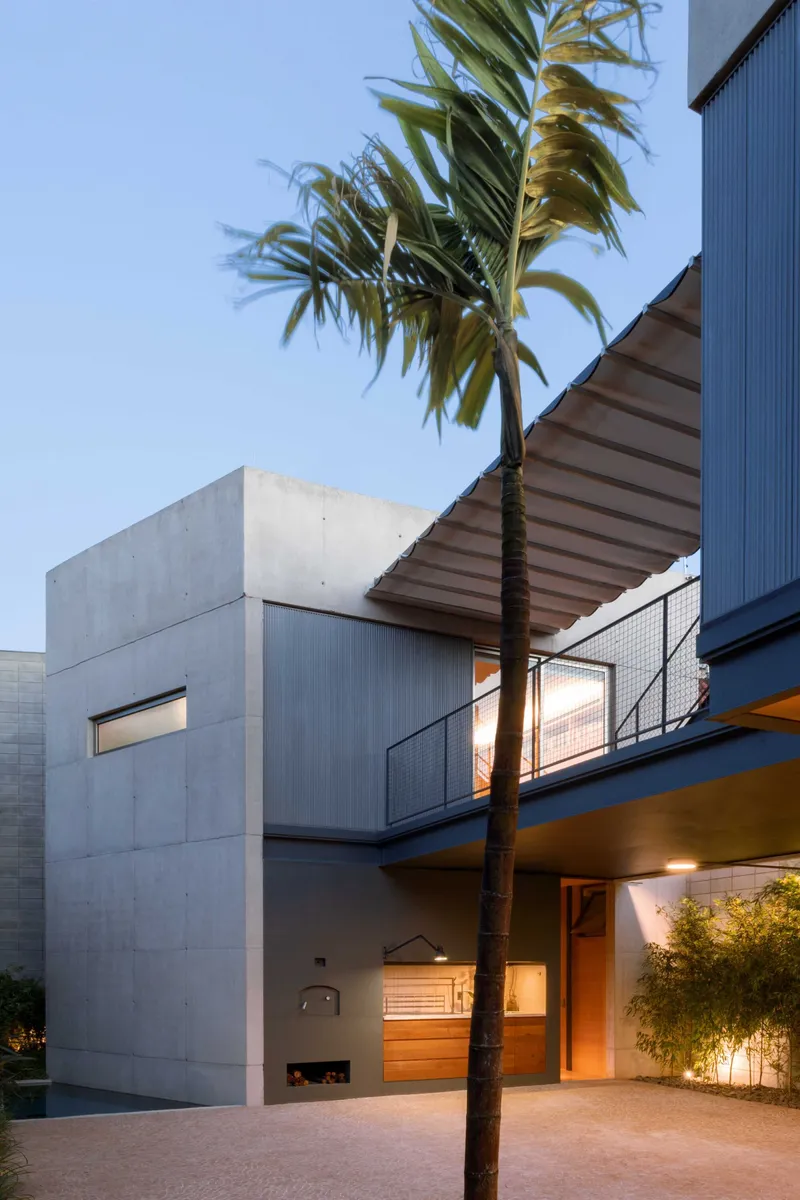
At dusk the strategy reveals itself more clearly. Horizontal window openings glow, and a palm tree catches the last light, but the boundary wall remains a quiet civic gesture. The house saves its drama for the inside.
The Courtyard as Engine
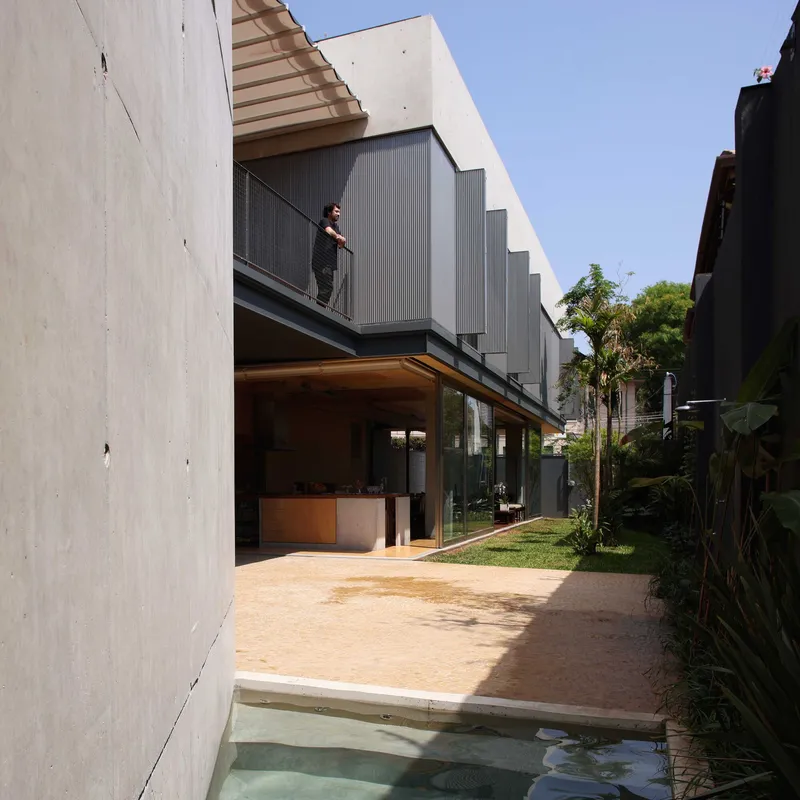
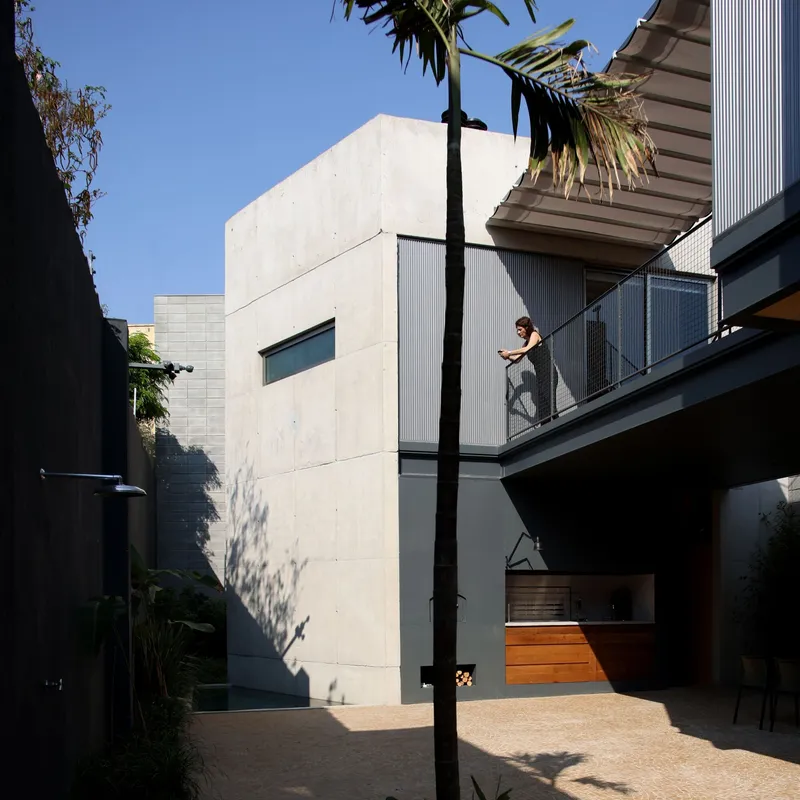
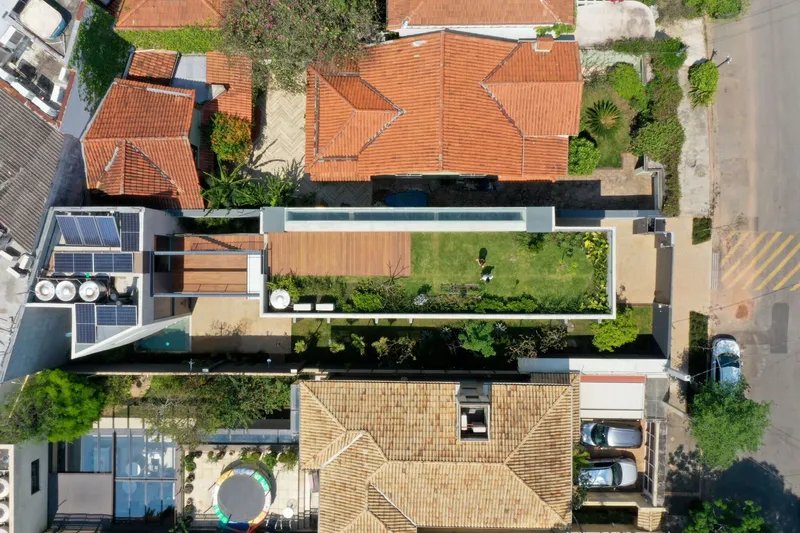
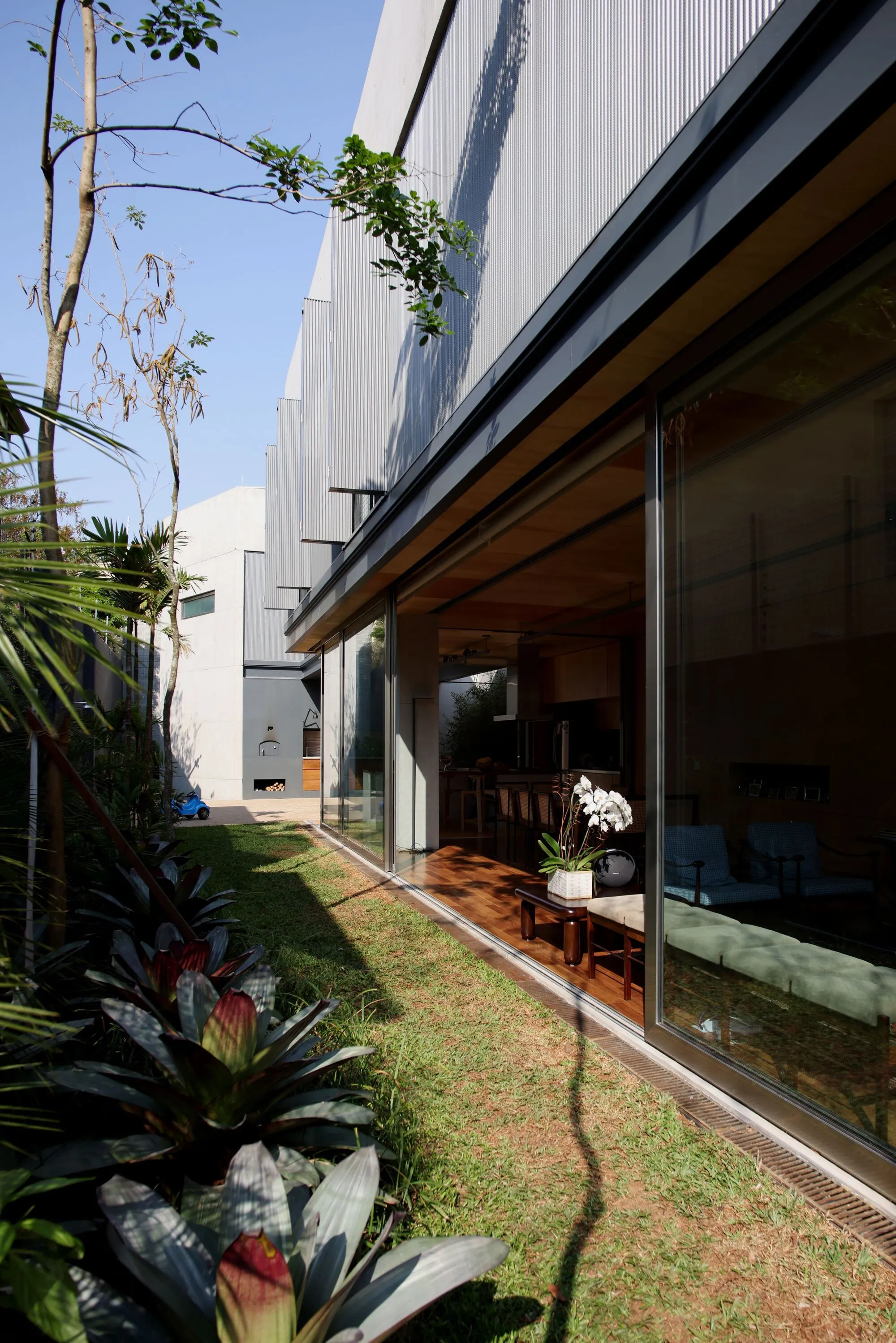
That five meters of freed-up width becomes the project's thermodynamic and spatial engine. Vegetation occupies the northern portion of the plot, providing a sunlight buffer and permanent cross-ventilation. The courtyard is not decorative. It is the reason the house can keep its living spaces open to the air year-round. A concrete paver terrace with a shallow water basin anchors the ground level, while a lap pool stretches along the lot in plan, visible from the aerial view like a blue incision in the urban grain.
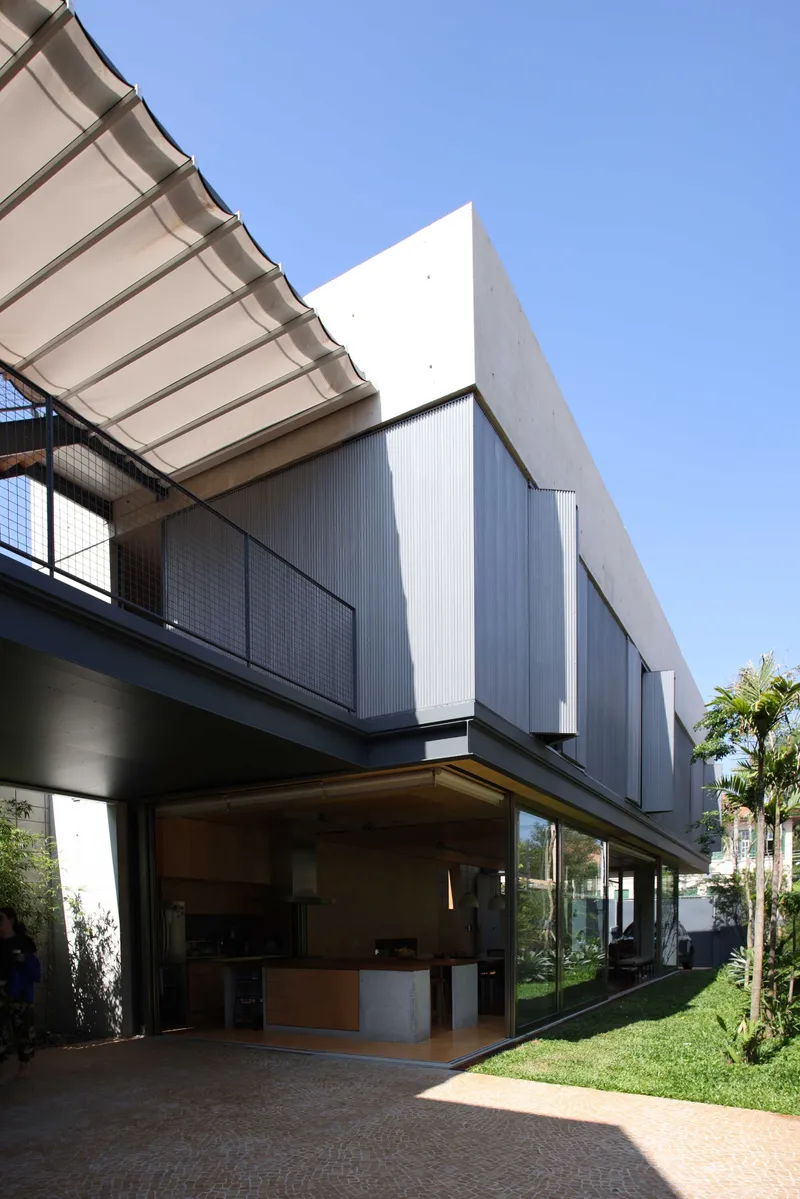
The corrugated metal cladding on the upper volume catches light differently from the concrete below, reinforcing the visual split between grounded and floating elements. A person standing on the upper terrace is simultaneously inside the house and above the garden, an ambiguity the architects clearly cultivated.
Living Beneath Timber and Glass
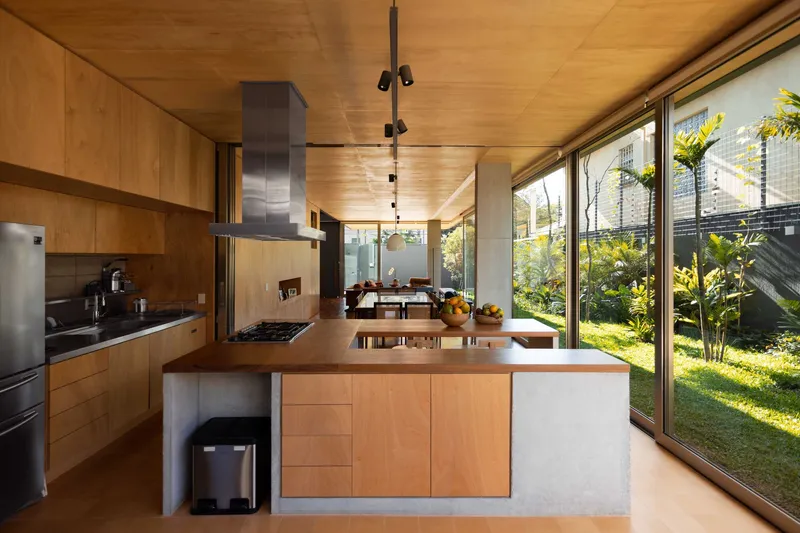
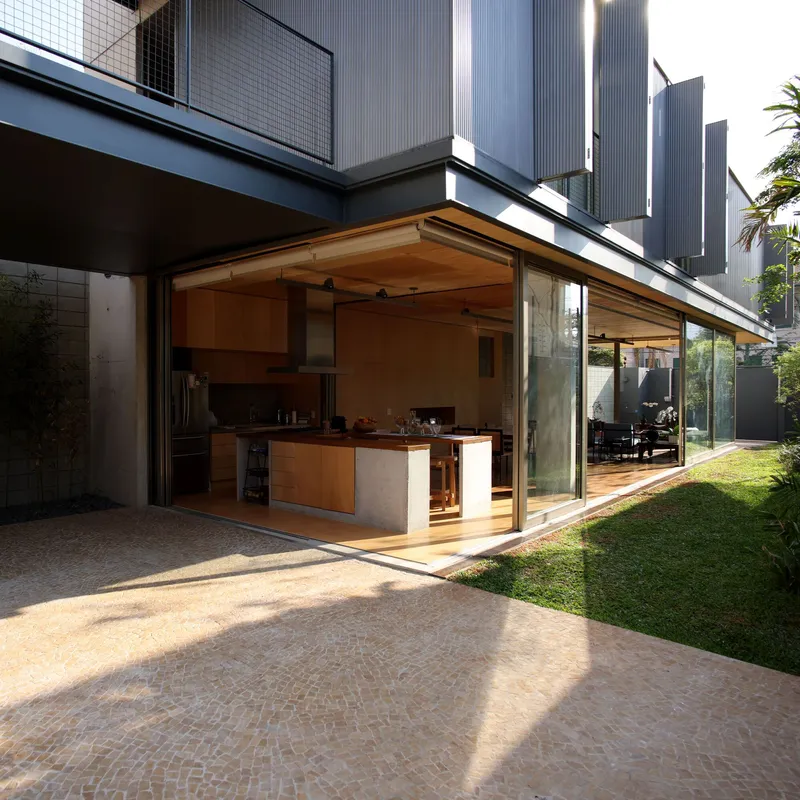
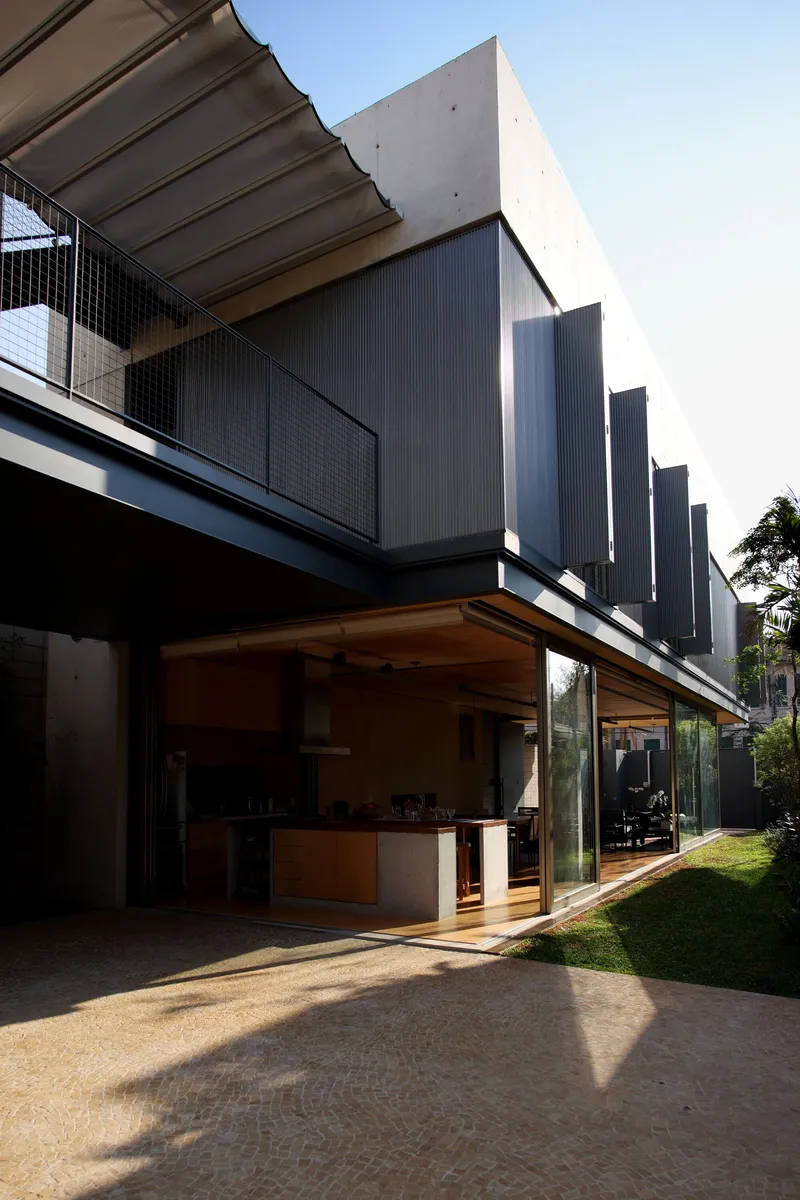
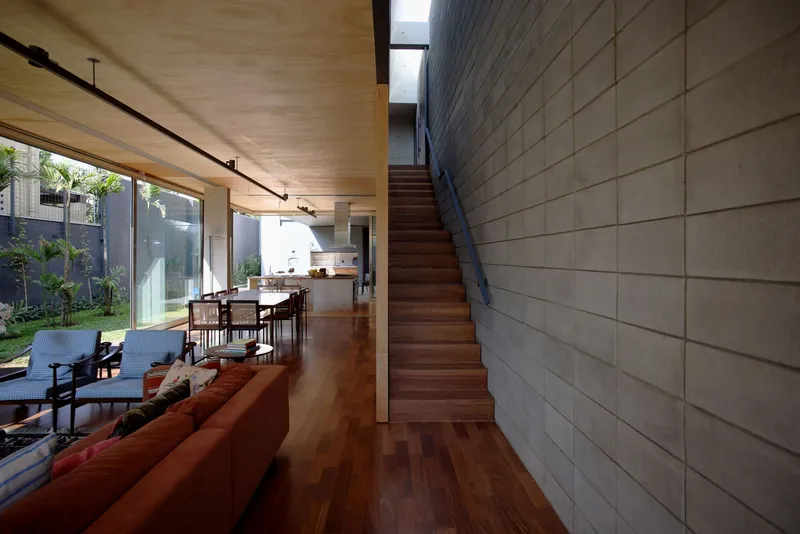
The kitchen and living zones at ground level operate as a pavilion. Full-height glazing dissolves the boundary between the timber-ceilinged interior and the planted garden. A kitchen island beneath a stainless steel hood sits under a plywood-lined canopy that extends from the glass walls out to a brick-paved terrace. The material continuity of the timber ceiling, running from indoors to out, is a practical move: it unifies the spatial reading so that the garden feels like another room rather than an exterior yard.
At dusk, the open kitchen pavilion takes on a lantern quality, its warm timber tones amplified by low light. The lawn in afternoon shadow becomes a foreground for the corrugated metal facade above. These are not accidental compositions. The longitudinal arrangement of the house along the plot makes every view a sectional slice through layers of material and vegetation.
Interior Texture and Light Control
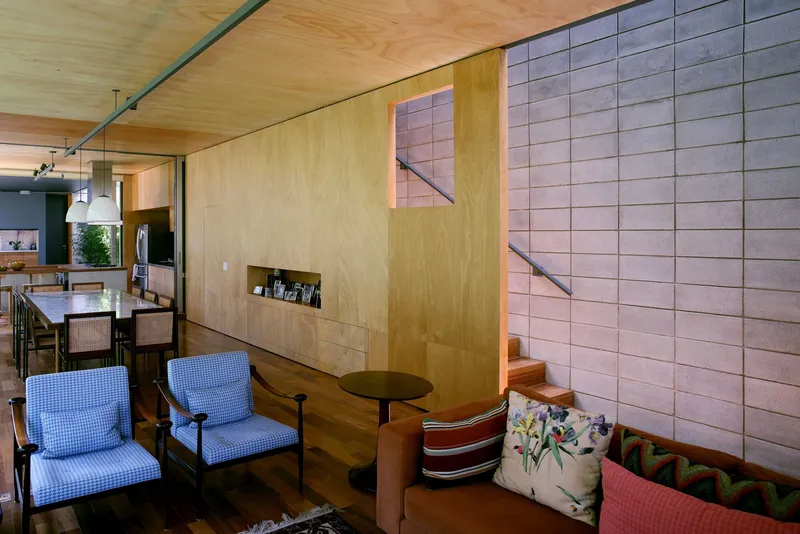
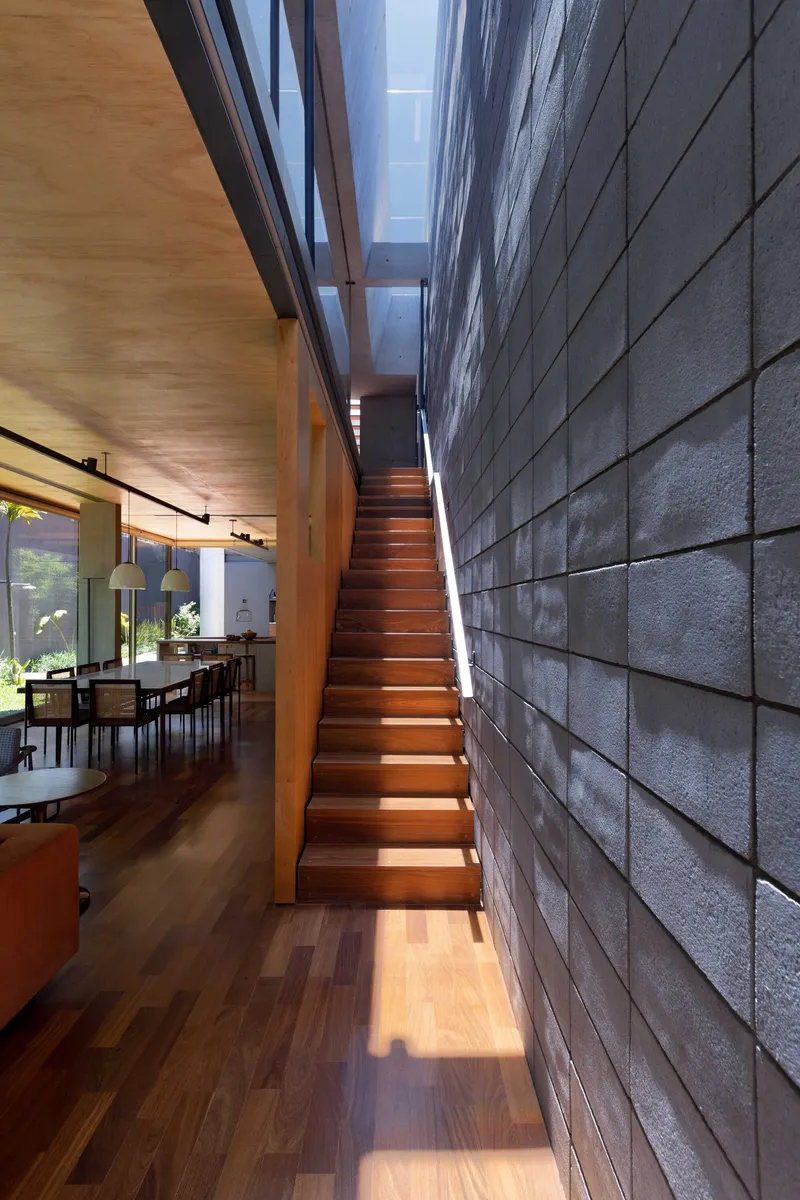
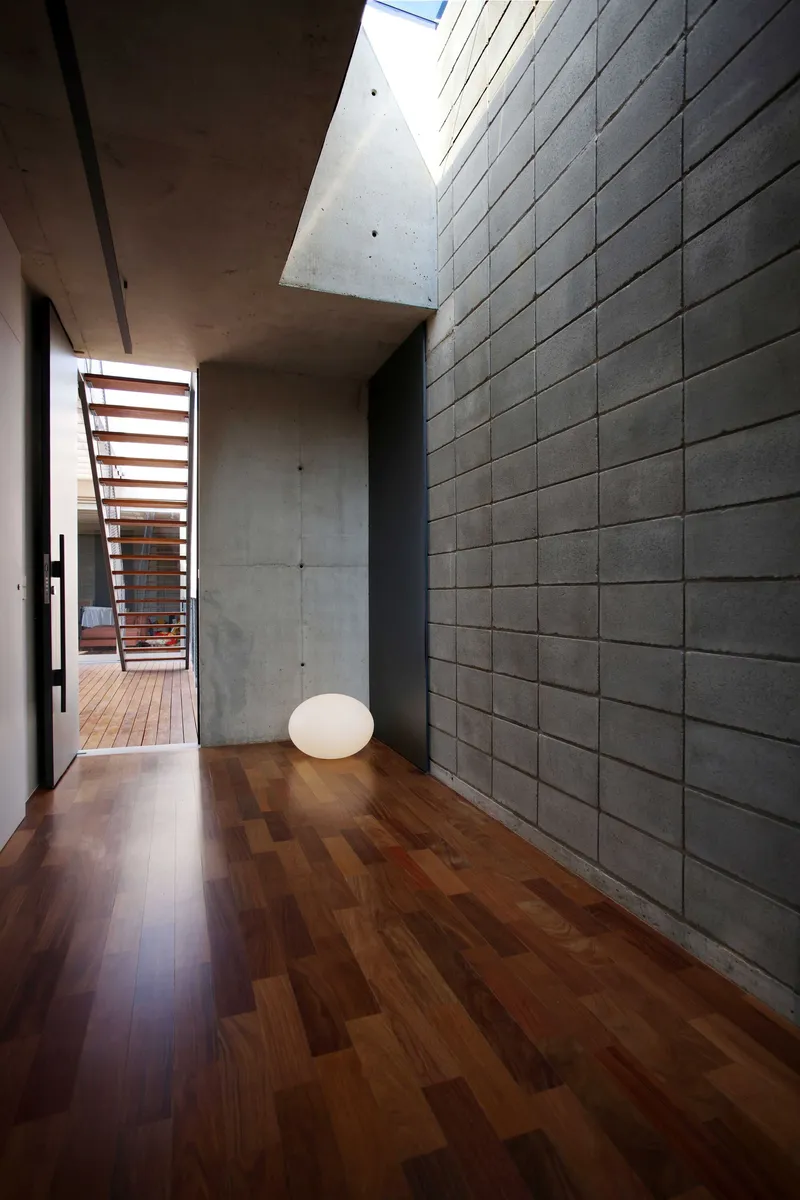
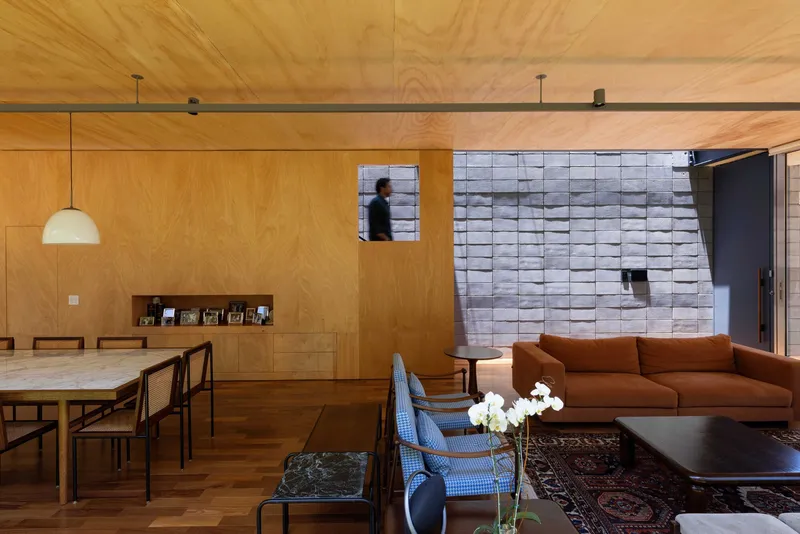
Inside, the material palette is deliberately limited but texturally rich. Plywood walls and ceilings wrap the living spaces in a warm, consistent tone, punctuated by a pink tile accent wall that catches afternoon sunlight in a way that transforms a flat surface into a color event. A continuous skylight running next to the boundary wall lights the internal circulation, so even the hallways and stairs receive natural light without relying on the courtyard alone.
The staircase between a textured grey concrete block wall and a plywood partition is one of the house's most resolved moments. Overhead light washes the treads while the gridded blocks provide a rough counterpoint to the smooth timber. It is a small space that demonstrates the architects' fascination with dualities: rough and delicate, gravitational and aerial, played out at the scale of a single flight of stairs.
The Upper Realm: Bedrooms, Corridors, Private Balconies
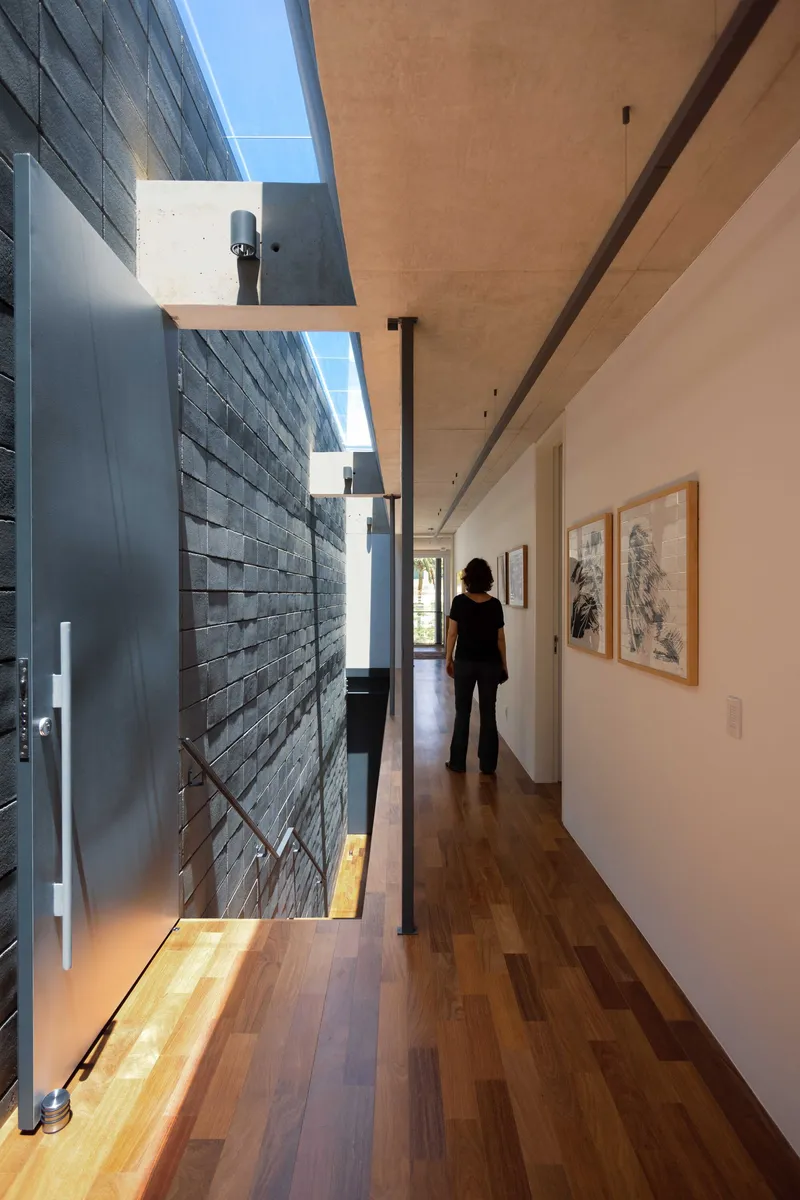
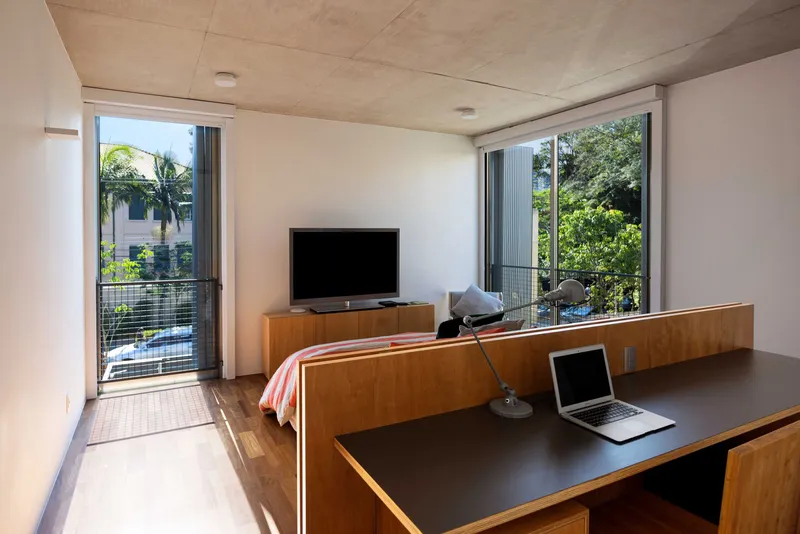
The intermediate floor, hung from its metallic structure rather than stacked on columns in the conventional sense, houses the bedrooms. The structural decision is not decorative: by suspending this floor, the architects free the ground level from an excess of vertical supports, allowing the living pavilion to be as open as it is. Upstairs, corridors display framed artwork along white walls while continuous glazing beside the textured grey tile facade keeps the boundary wall visible as an interior surface.
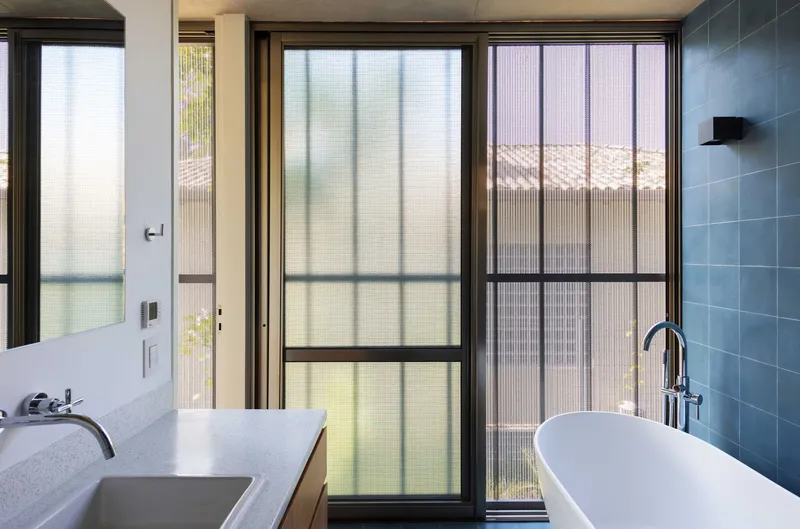
Bedrooms open to balconies thick with greenery, and a bathroom with a freestanding tub looks through translucent glass doors toward the courtyard beyond. The private spaces are not sealed boxes. They participate in the same logic of transparency and vegetation that governs the public zones below, scaled down to the intimacy of a bath or a bed.
Rooftop as Fifth Elevation
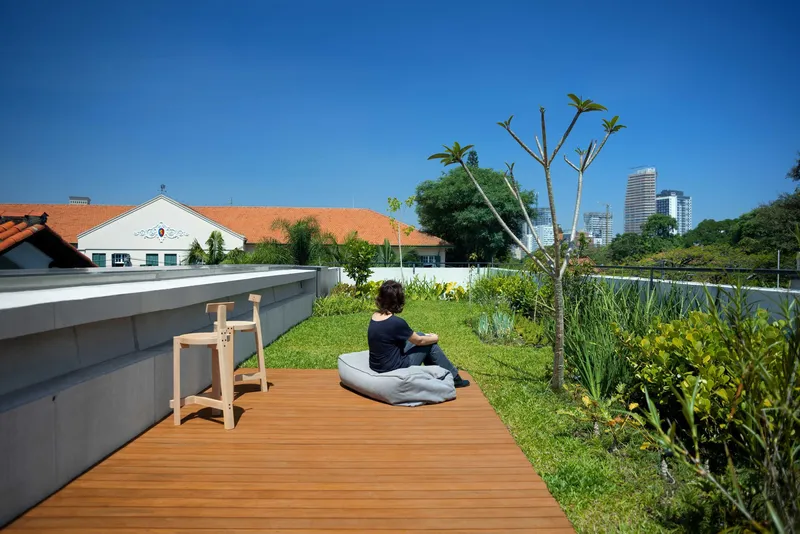
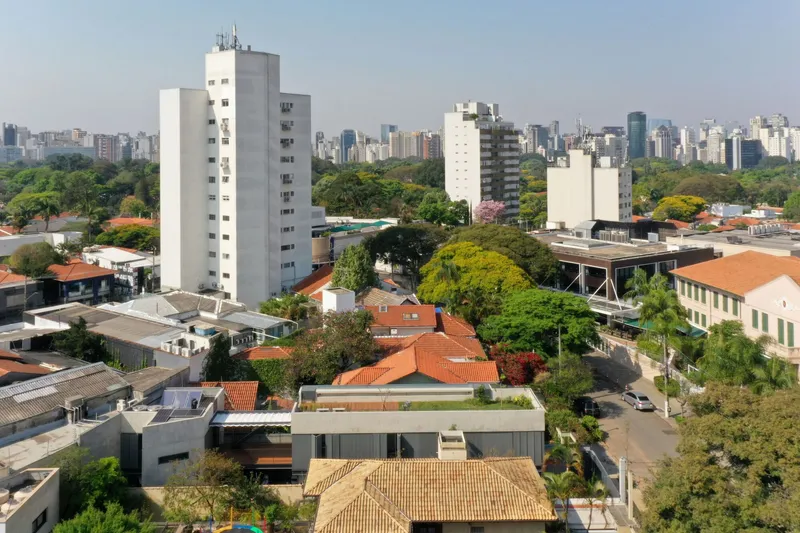
The roof garden is the project's most convincing argument that São Paulo's climate permits a different kind of domestic life. A timber deck, planted beds, and a person sitting in the open air under a clear sky: this is not a decorative green roof but a usable room with no ceiling. The aerial view confirms that within the dense urban fabric of Jardim Paulistano, the flat roof terrace reads as a green island, associating the house with the broader urban landscape and the city's geography.
Below, the cantilevered upper volume with its corrugated metal cladding and retractable awning over the open ground floor makes the connection between levels legible from the courtyard. The house stacks its outdoor spaces vertically: garden, terrace, balcony, rooftop. Each is distinct in character but connected by external staircases that keep the vertical circulation in the open air.
Joinery, Thresholds, and the In-Between
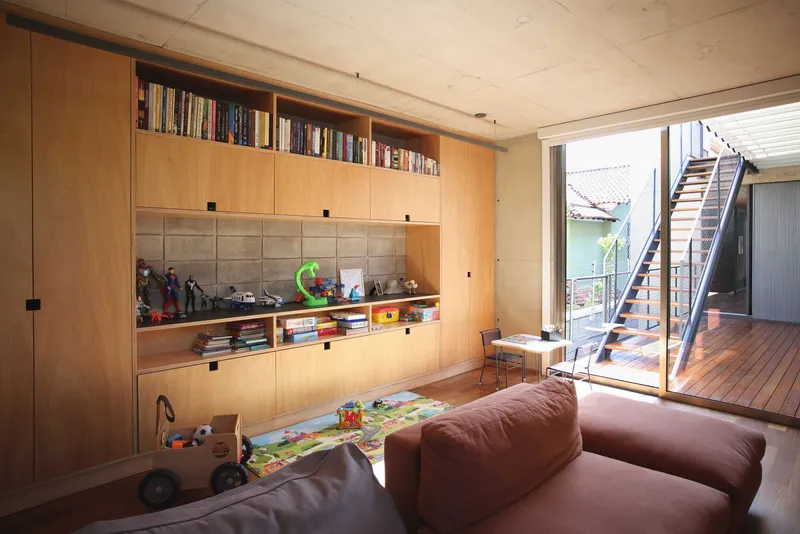
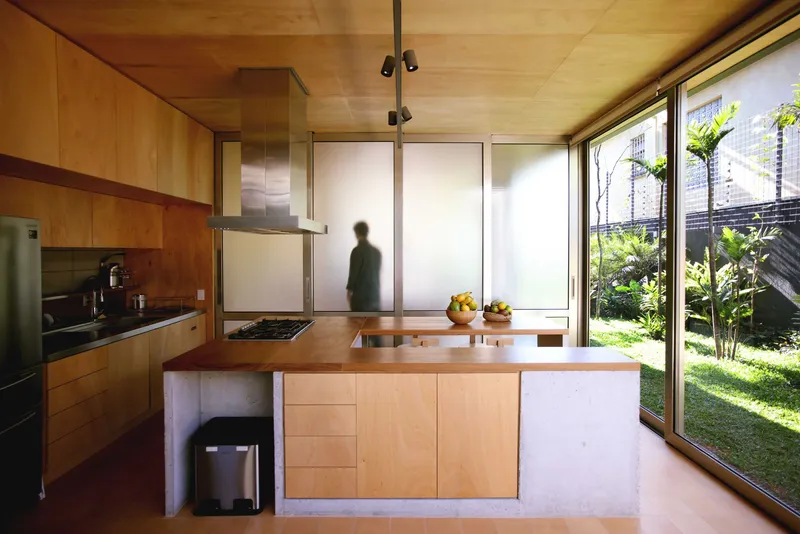
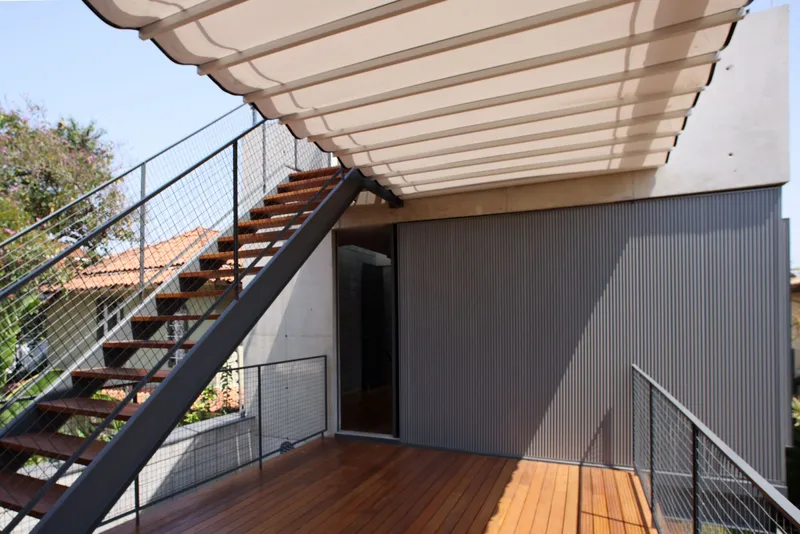
The detail work throughout Juquiá House reveals a consistent preoccupation with threshold conditions. Built-in plywood shelving frames open doors that lead to a timber deck and exterior stair. Translucent sliding panels in the kitchen filter views to the courtyard garden without eliminating them. Slatted timber canopies overhead modulate sunlight beside corrugated metal walls. Every transition between inside and outside passes through at least one intermediate condition: a screen, a canopy, a sliding panel, a translucent door.
This layering is what elevates the project beyond a simple open-plan house with big windows. UNA MUNIZVIEGAS understand that blurring boundaries requires more than removing walls. It requires building new thresholds that belong to neither side.
Plans and Drawings
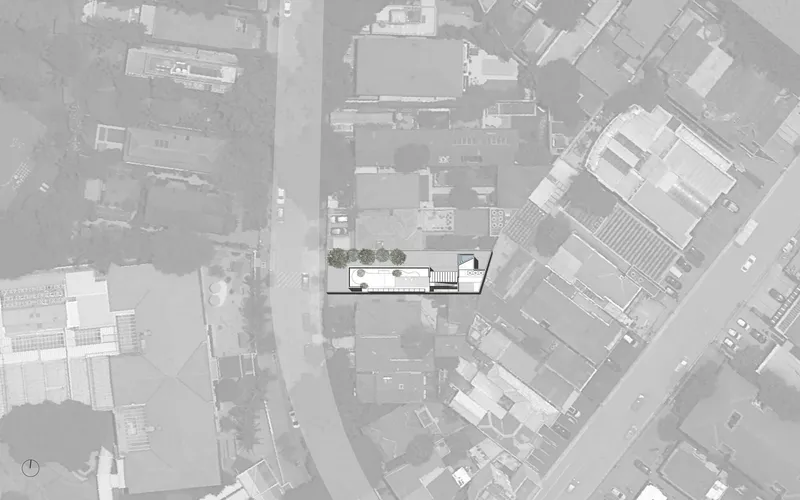
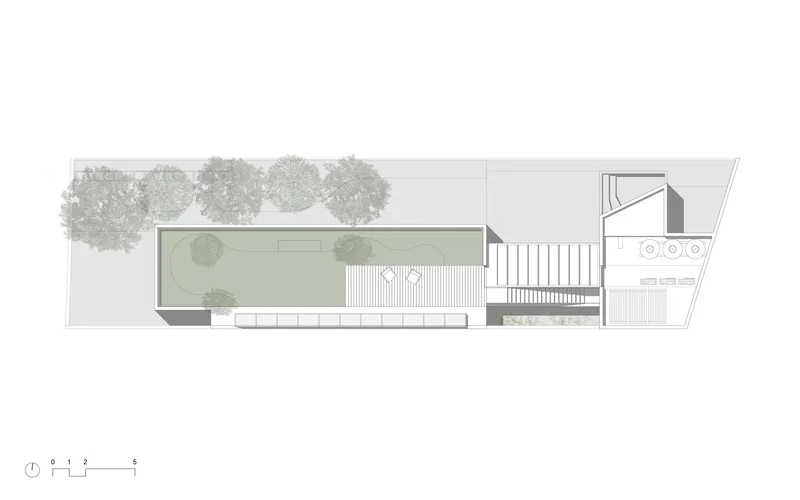
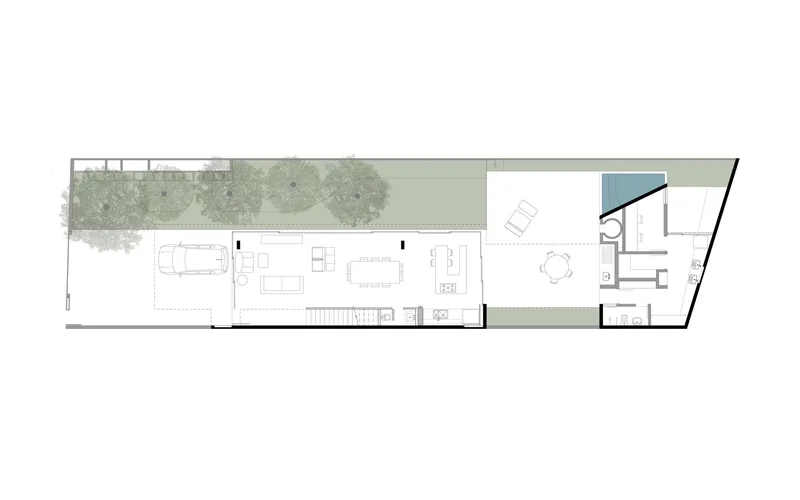
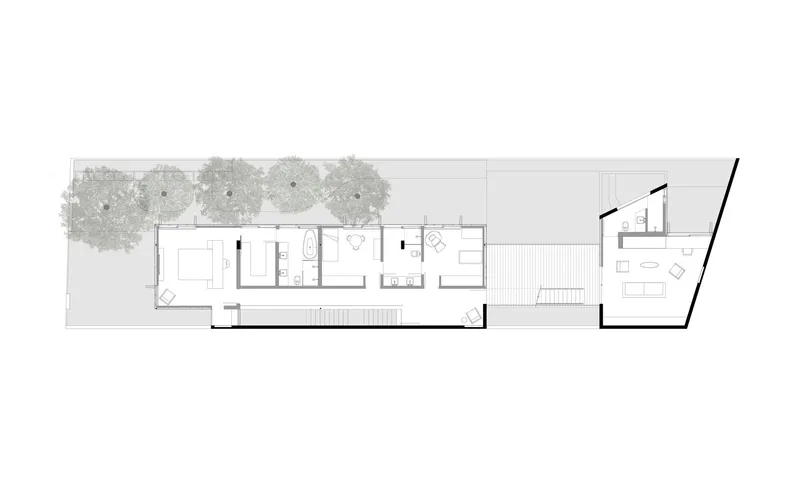
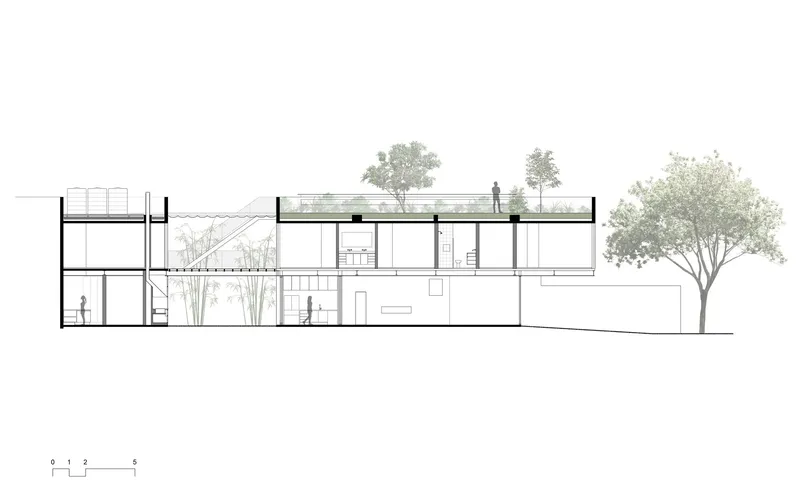
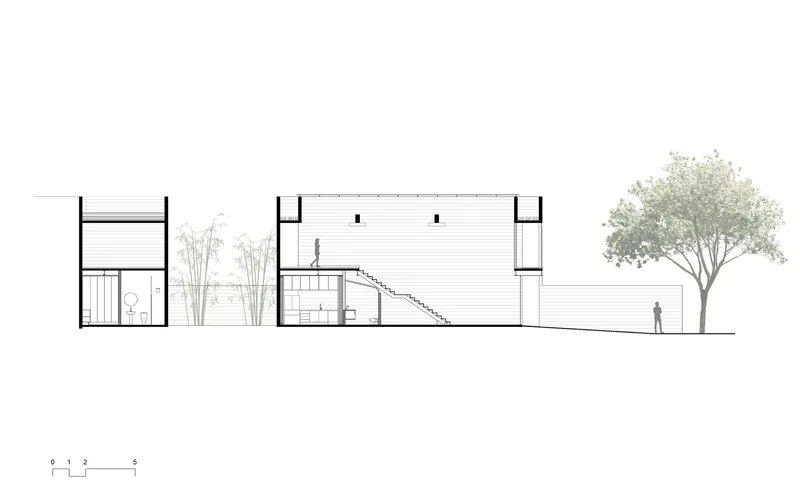
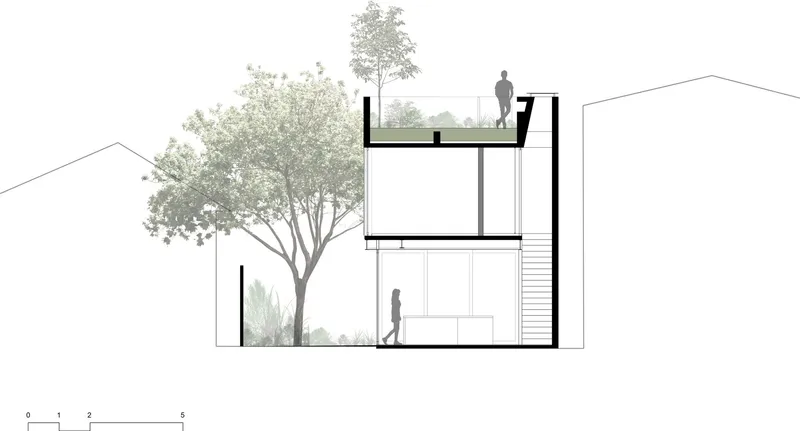
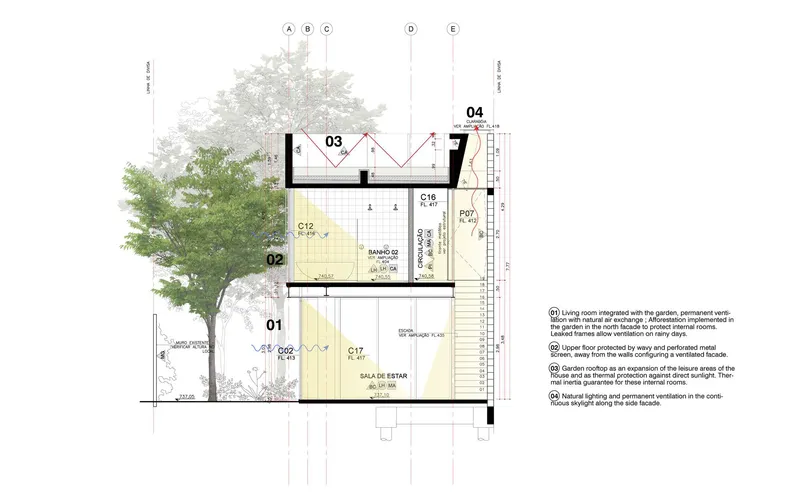
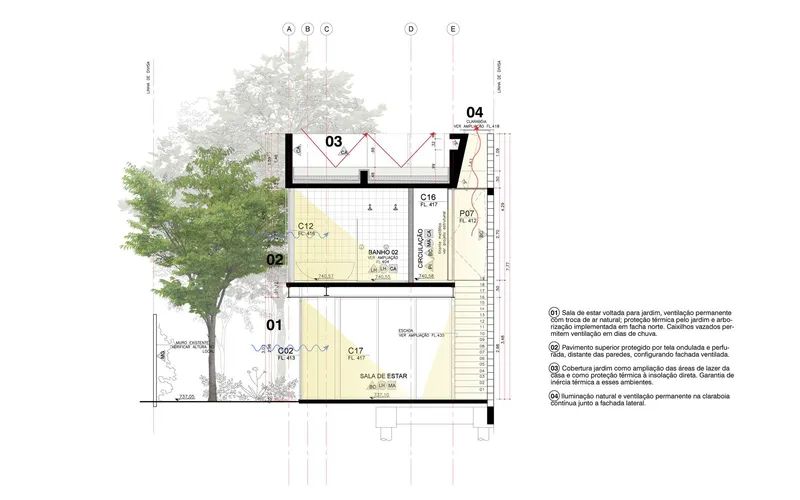
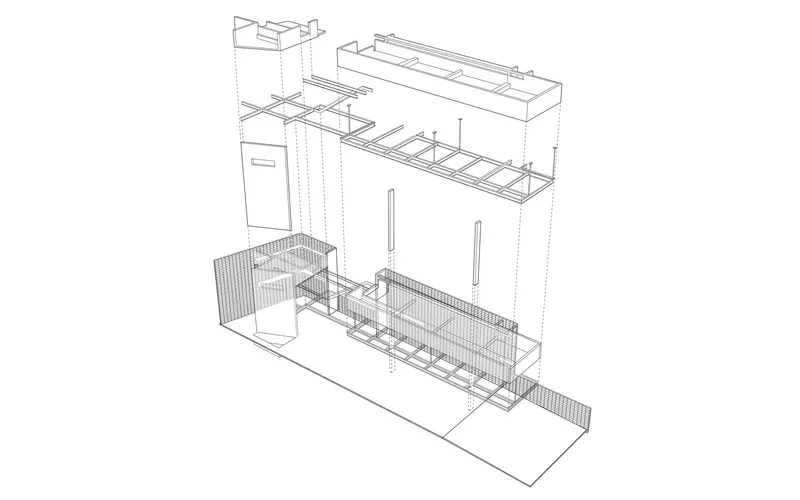
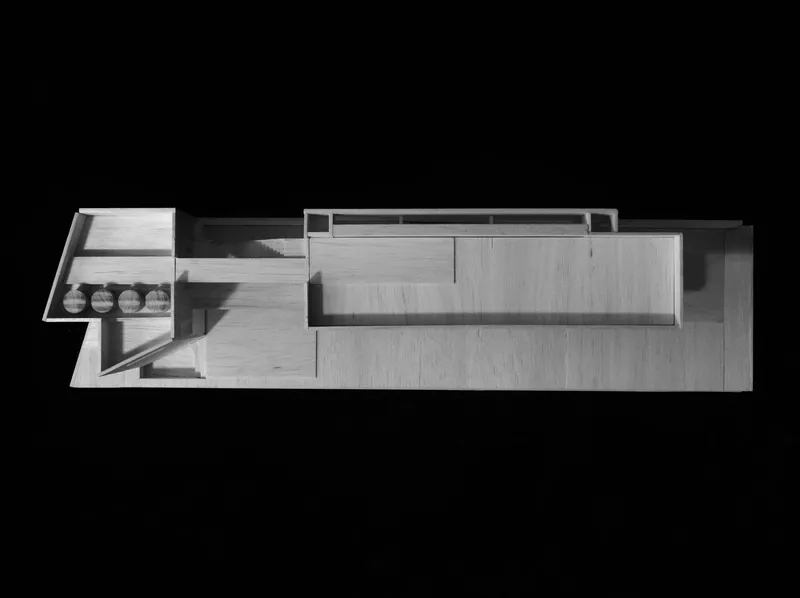
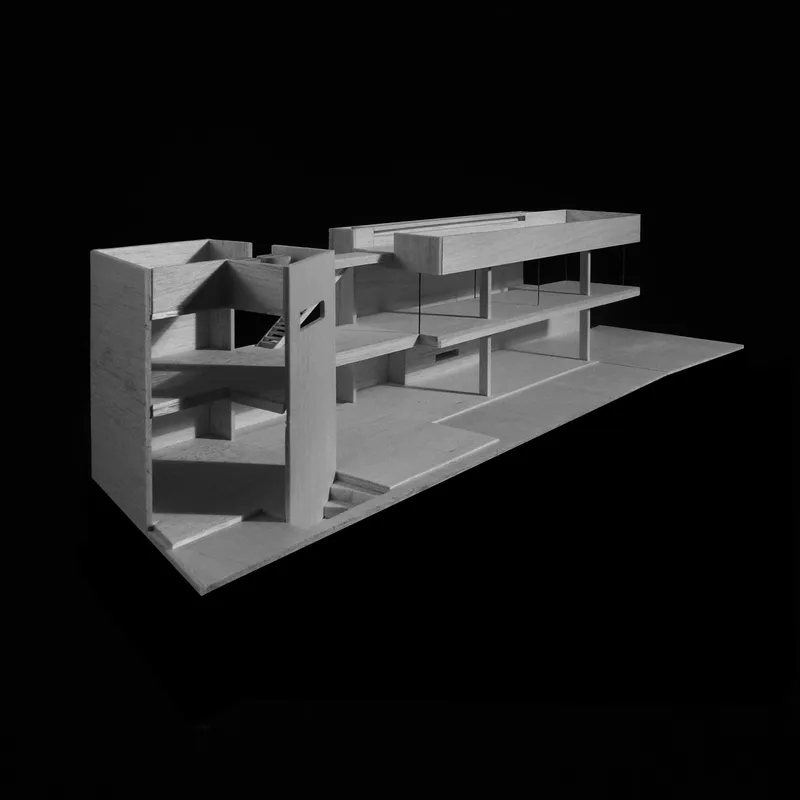
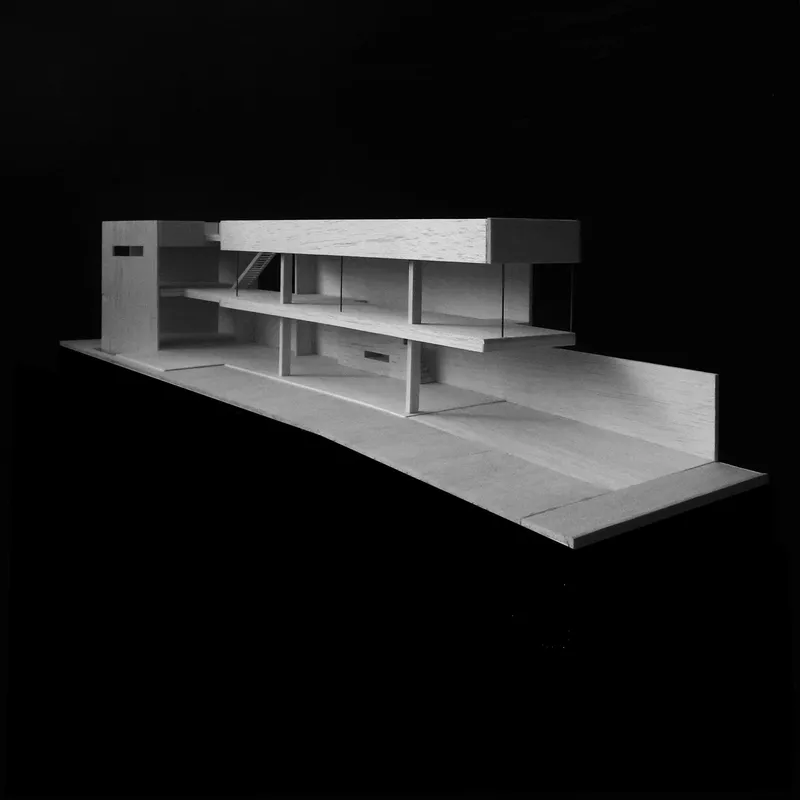
The plans confirm the longitudinal strategy: the house stretches along the plot with the linear garden courtyard, pool, and exterior stairs organized along the freed northern edge. The ground floor plan shows how radically the living spaces depend on the garden for light and air. Moving up, the bedroom wing compresses, and the rear terrace angles to capture tree canopy views. The sections are where the project's ambition is most legible. Split levels, roof terraces, planted areas, and figures at different heights map out a vertical landscape that is as complex as any hillside section.
The annotated sections with ventilation paths and the axonometric drawing of the structural framework reveal the rigor behind the apparent ease. Two columns and a boundary wall support the upper floor. The metallic structure from which the bedroom floor hangs is clearly legible in the axonometric. The physical models, with their interlocking volumes and stepped terraces, show how the architects tested the massing before committing to the final stacking. These are the drawings of a house that was designed in section first and plan second.
Why This Project Matters
Juquiá House matters because it refuses the false choice that narrow urban lots impose: fill the site or build small. By giving half the width to vegetation, UNA MUNIZVIEGAS gain more than they sacrifice. They gain daylight, ventilation, a garden that works as an outdoor room, and a spatial richness that a wall-to-wall footprint could never produce. The structural gymnastics of hanging the bedroom floor from a metallic frame are in service of this spatial generosity, not performed for their own sake.
More broadly, the project is a convincing case study for designing with climate rather than against it. São Paulo's temperate conditions are not a given; they are a resource that this house exploits through permanent aeration, northern vegetation buffers, skylights, and rooftop gardens. In a city where dense neighborhoods often produce dark, airless interiors, Juquiá House demonstrates that a modest plot can yield a house that is more open than most suburban villas. That lesson travels well beyond Jardim Paulistano.
Juquiá House by UNA MUNIZVIEGAS, Jardim Paulistano, São Paulo, Brazil. 360 m², completed 2021. Photography by Marcelo Jun.
About the Studio
Share Your Own Work on uni.xyz
If projects like this are the kind of work you want to make, uni.xyz is a place to publish your own, find collaborators, and enter design competitions.




Popular Articles
Popular articles from the community


Conexión: Biophilic Design Reimagines High-Rise Living in Hong Kong
Conexión reimagines high-rise living in Hong Kong through biophilic design, green facades, shared spaces, daylight, water and nature within.

The Ocean Hive: Sustainable Architecture for a Self-Sufficient Civilization at Sea
The Ocean Hive imagines sustainable architecture at sea, where modular habitats, algae, wave power and ocean waste sustain a growing colony.

Riyadh For All: Intergenerational Urban Design for Active Aging in Rabat
Riyadh For All reimagines urban design in Rabat with intergenerational co-living, adaptive courtyards, and Moroccan cultural exchange today.

Lunar Spiral: Space Architecture Shaped by the Mathematics of the Universe
Lunar Spiral reimagines space architecture through Fibonacci geometry, lunar regolith, levitating habitats, and self-sustaining Moon living.


Similar Reads
You might also enjoy these articles

Bao Huynh Watercolor Atelier: A Serene Art Retreat in Hội An
Bao Huynh Watercolor Atelier in Hội An blends multifunctional art spaces, sustainable design, local materials, and family-friendly living in a serene environment.

Atelier Macri Concept Store Interior Design by CASE-REAL
Atelier Macri store features a "ko" counter, walnut wood details, cork displays, blending retail, gallery, and seamless customer experiences.

Manuel Vargas Izquierdo Stadium and High-Performance Sports Center: Architectural Excellence in Jalpa de Méndez
The Manuel Vargas Izquierdo Stadium blends sustainable design, inclusive sports facilities, and cultural-inspired architecture, revitalizing Jalpa de Méndez’s public spaces.

KAKR Buluh Awar Hall: Revitalizing Community and Ecology Through Bamboo Architecture
Community built bamboo hall revitalizes Buluh Awar village, empowering youth, restoring ecology, celebrating vernacular craftsmanship through sustainable architecture and culture.




Comments (0)
Please login or sign up to add comments
No comments yet. Be the first to comment!