

Uncertain Memory: A Pavilion That Rewires Itself Around the People Inside It
At the B.I.G. Carnival, translucent corrugated panels and motion-reactive filament lighting turn a simple rectangular volume into a living organism.


A rectangular box should be the least interesting thing at a carnival. But when its translucent corrugated panels shift from amber to turquoise to deep pink in response to the bodies moving through it, the box stops being a box. It becomes something closer to a nervous system, one that reads the crowd and answers in color. "Uncertain Memory" is an installation that collapses the distance between architecture and emotion, treating light not as an afterthought but as the primary material of spatial experience.
Designed by Hao Li and presented at the B.I.G. Carnival (Banana IP Galaxy Carnival), the pavilion was submitted to the Architecture on the Clock competition on uni.xyz. The brief asked entrants to engage with the concept of ephemeral and interactive structures, questioning how transient experiences shape our relationship with built space. Li's response is a direct provocation: architecture does not need permanence to be powerful. It needs presence.
Chambers of Color: Walking Through a Shifting Interior
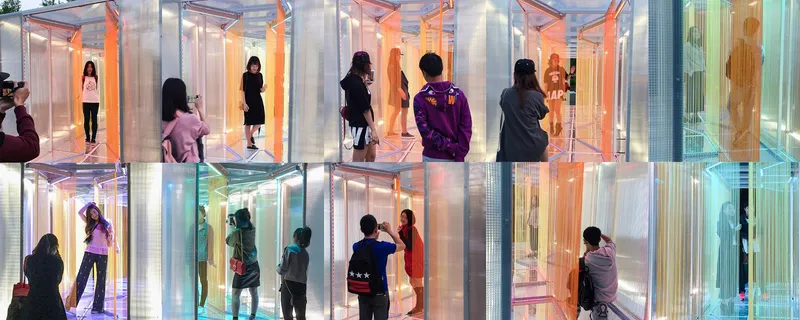
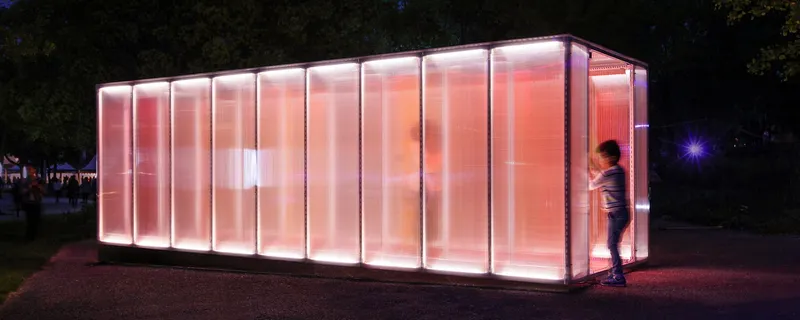
From the inside, the installation reads as a series of translucent panel chambers that visitors walk through freely. Filament lighting embedded within the structure responds to human movement, cycling through a spectrum of vibrant hues. The result is that no two moments inside the pavilion look the same. A visitor pausing at one threshold triggers a warm amber wash; a child running past the exterior, as captured in the nighttime shot, pulls the whole volume into glowing pink and orange. The architecture is static in form and radically unstable in atmosphere.
At night, the pavilion becomes a beacon. The translucent panels act as diffuse screens, projecting the interior light show outward to the carnival grounds. What is private sensation from the inside becomes public spectacle from the outside, and that dual reading gives the project a generosity that purely inward-looking installations often lack.
Translucent Skin: Corrugated Panels as Light Modulators
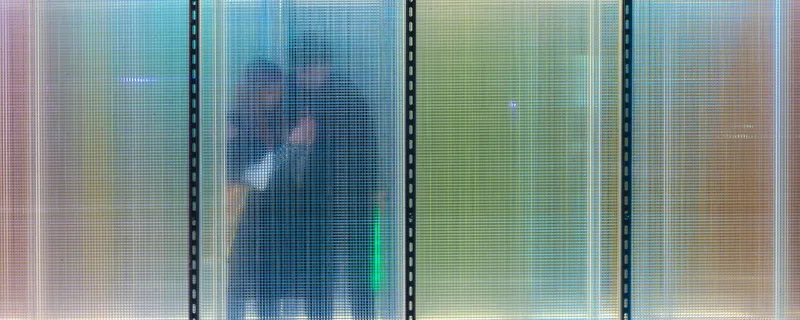
The close-up view of the corrugated translucent panels reveals the material logic at work. These are not flat surfaces; their ribbed texture fragments and scatters the colored light, creating soft gradients rather than hard-edged washes. A blurred figure standing behind the surface becomes an abstraction, stripped of detail and reduced to silhouette. The panel system effectively anonymizes occupants while broadcasting their presence, a paradox that sits at the heart of the project's name.
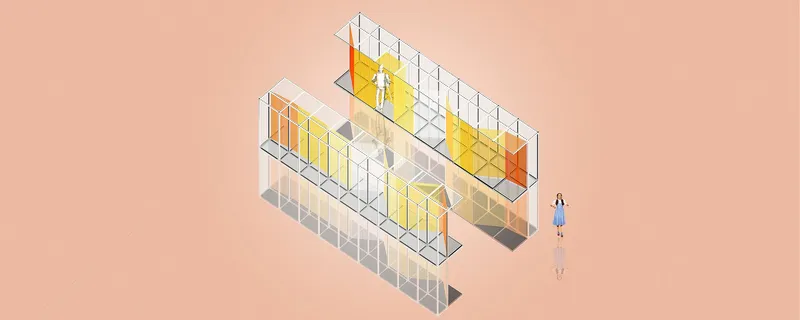
The axonometric drawing clarifies the organizational strategy. Color-coded zones within the rectangular plan correspond to different lighting conditions, with a single figure included for scale. The simplicity of the overall volume, just a box, is the point. It puts all the architectural energy into the material behavior of the envelope rather than formal complexity.
Threshold and Frame: Entering Through Warm Light
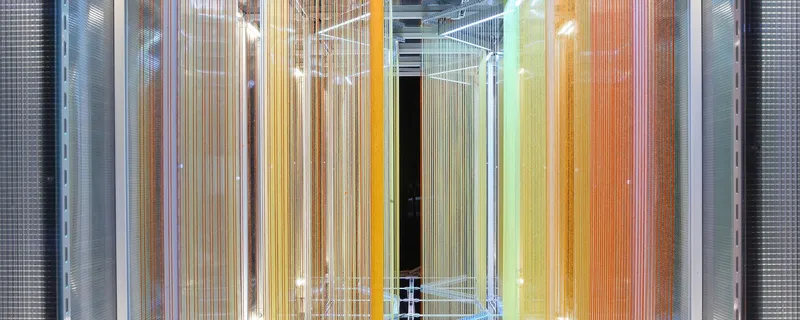
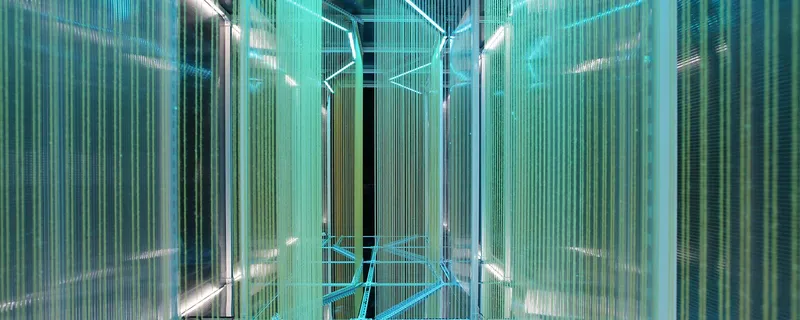
The head-on entrance view shows vertical translucent panels in warm amber and green tones framing the threshold. There is no door, no gate, just a gap between panels that draws visitors in through color alone. The transition from carnival noise to this luminous corridor is immediate and total, a shift in register that architecture achieves here without any of the usual spatial tricks of compression and release.
Looking up from the interior, the structural steel frame becomes visible, suspended within turquoise and blue translucent panel walls. The steel is honest and exposed, doing its job without pretension. The contrast between the industrial skeleton and the soft, shifting color field around it gives the space a tension that prevents it from tipping into pure spectacle. There is real construction here, real weight, holding up an experience that feels weightless.
Structure and Surprise: Timber Trusses and Suspended Bicycles
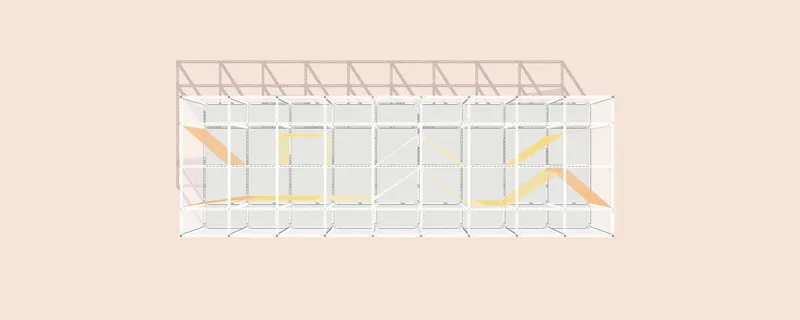
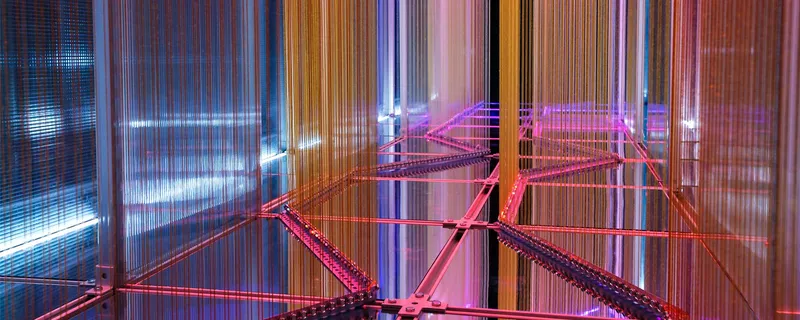
The second axonometric drawing reveals the structural frame in more detail: timber roof trusses span the rectangular plan, and colored circulation ramps guide visitors through the interior sequence. The hybrid structure of steel and timber keeps the construction lightweight and demountable, appropriate for a carnival installation designed to be temporary.
Then there are the pink bicycle frames suspended behind polycarbonate panels, illuminated by colored light. This is the moment where the project reveals its playfulness. The bicycles are carnival artifacts turned into art objects, frozen behind the translucent skin like specimens in a luminous vitrine. They introduce a layer of found-object narrative that enriches the purely sensory experience of the light and color.
Overhead: The Ceiling as Fifth Elevation
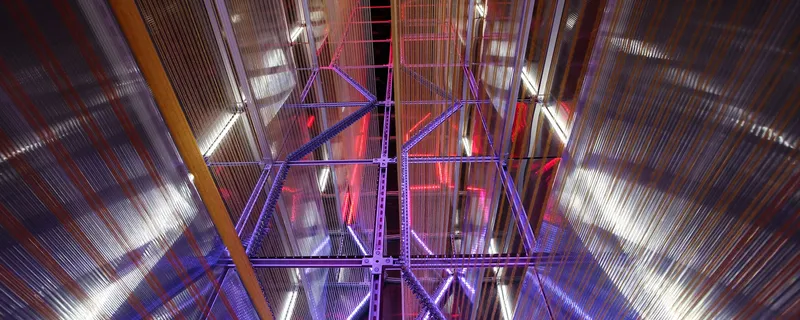
Looking straight up at the steel truss ceiling, purple and pink lighting washes through ribbed panels to create an overhead canopy of color. The ceiling is treated as a fifth elevation, not a leftover surface but an active participant in the immersive environment. Every direction a visitor looks offers a different chromatic composition, reinforcing the idea that the pavilion has no dead zones, only varying intensities of experience.
Why This Project Matters
"Uncertain Memory" challenges a persistent bias in architecture: that seriousness requires permanence. Li's pavilion is temporary, playful, and built for a carnival, yet it engages fundamental questions about how space affects emotion. The interactive light control system is not a gimmick layered onto a structure; it is the structure's reason for being. Without the visitors who trigger its color shifts, the box is inert. With them, it becomes a collective instrument played by the crowd.
For the Architecture on the Clock brief, this is a precise answer. Ephemeral architecture succeeds not by trying to outlast time but by making the present moment so vivid that it imprints on memory. The title says it all: the memory is uncertain because it was never fixed, never static. It was a color you saw once, in a box at a carnival, that somehow stayed with you.
View the Full Project
About the Designers
Designer: Hao Li
Enter a Design Competition on uni.xyz
uni.xyz runs architecture and design competitions year-round that reward proposals with spatial conviction and real site intelligence.
Project credits: Uncertain Memory by Hao Li Architecture on the Clock (uni.xyz).


Popular Articles
Popular articles from the community


Opera on the Sea: Driftwood Logic Shapes a Timber Opera House on Estonia's Coast
Trevor Orgill's opera house translates the entangled drift of floating timber into a civic building where wood, water, and music converge.

The Amber Palace Opera: A Geological Fiction Surfaces on Tallinn's Baltic Waterfront
Pierre Brillard reimagines a Baltic legend as a public landscape, opera house, and waterfront promenade rooted in Tallinn's coastal identity.

Temporary Home for Dogs: A Reversed Zoo Rethinks Animal Shelter Architecture
In Bucharest, a sinuous corridor and freed landscape flip the logic of containment, designing a shelter that works to make itself unnecessary.

Cloaked Colonization: A Mobile Underwater Habitat That Moves Like a Fish
Micah Abaya's shortlisted EHC Pacific entry reimagines ocean settlement as a dispersed network of self-sustaining architectural organisms.

Similar Reads
You might also enjoy these articles

Shakur's House: Exposed Brick as an Interior Organiser in a 168 m² Mashhad Residence
Brick moves indoors in this Mashhad residence, where masonry walls, glass partitions and teal planes sequence a compact home without closing it off.

Day and Night Park: A Time-Based Urban Newsstand in Beijing
A temporary urban newsstand in Beijing blending travel, light, and reading through poetic colors, compact form, and community-focused design.

Modernist Patio Renovation in El Masnou, Barcelona by Oliver Segura Arquitectura + Cebrià Arquitectura
Modernist patio renovation blending tradition and innovation with a movable pool, leveled floors, and Catalan materials in El Masnou.

Alto Residencial Coop: Cooperative Housing Development in Santiago de Compostela by Carbajo Barrios Arquitectos
A linear cooperative housing complex blending white volumes and perforated metal façades, enhancing community living, natural light, privacy, and urban integration.

Explore Interactive Art Competitions
Discover active competitions in this discipline

Challenge to design a portable theatre

Challenge to design a portable music platform

Challenge to design lighting inspired by nature

Challenge to design an open learning module for the elderly
Comments (0)
Please login or sign up to add comments
No comments yet. Be the first to comment!