
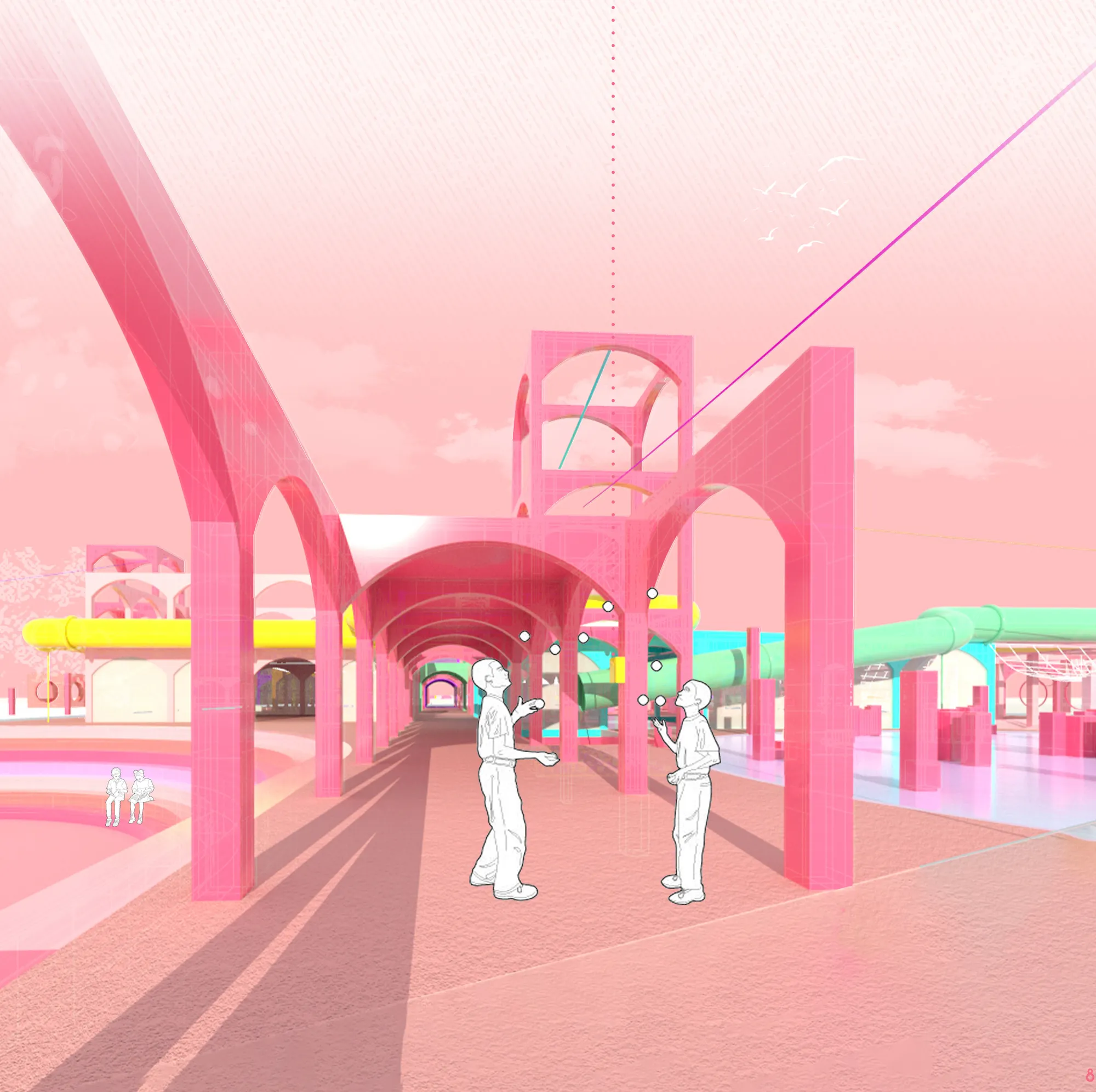
Universal Playground
Factory of Play | Factory of Unity
Purpose: Educational pavilion complex with a focus on learning about safe debate and open dialogue through PLAY. The idea is to deal with social problems and politics with a creative and humoristic point of view, with an aim of educating and bringing people together.
Goal Idea
The current climate of hostility and dismissiveness is detrimental to our collective growth and progress. By establishing dedicated spaces for constructive discourse, education, and the development of effective communication skills, we can foster an environment where individuals feel empowered to express their thoughts and concerns without fear of retribution or judgement. Such initiatives could bridge the gap between the public and the government, facilitating a more open, transparent, and inclusive dialogue that addresses the concerns of all segments of society. Through promoting empathy, active listening, and respect for different viewpoints, we can foster a culture of constructive debate and cooperation, leading to a more harmonious and stable society where every voice is valued and heard.
In a research study by Aaron Betsky, the focus is on redefining safety in public spaces without resorting to traditional physical security measures. The author explores how design can foster a sense of belonging and openness, arguing against a one-size-fits-all solution and recognizing the complexity of achieving familiarity in a multicultural context. He advises embracing a deeper form of vernacular, advocating for architecture that reflects the diversity of our society.
We need something that isn’t unique to any particular culture. An universal element that can serve as a bridging point and develop that wished sense of unity and acceptance. Starting point of the research is every human being and by this one similarity is crucial: We were all once children.
Space envisioning concept
Children learn through play. By doing so they often learn about empathy, cooperation, and compromise. Although disputes may arise over trivial things like toys, these situations provide a fertile ground for children to grasp the essence of sharing, understanding, and respecting differing perspectives. Playground is a space either materialised or envisioned by children. The nature of a playground is thus a space for learning and growth. Similarly, we want to create a space that is dedicated to honing public speaking, conflict resolution and active listening. Because safety and security are relative we must tend to create it through universality, familiarity, fun, interactive elements and bring back child-like honesty, purity, playfulness and innocence. All that for individuals to cultivate the courage to voice their convictions and engage in constructive social and political activism, and be educated about how to navigate complex societal debates through constructive discourse.
By leading my research towards the language and communication, I recognised four differing types of conversations in sociolinguistic theory: Discourse, Dialogue, Debate and Diatribe. In relation to the characteristics of each type, specific universal playground elements have been selected, each assigned a function and features corresponding to one of the conversation types. The process of connection relates to the nature of individual elements and the relationships that children build during play. Swings, for example, are thus associated with debate, envisioning children competing to swing higher or jump farther, while the seesaw represents cooperative dialogue and teamwork. All activities and designed spaces in the project are in correspondence of these types, with an emphasis on educating users about their respective functions.
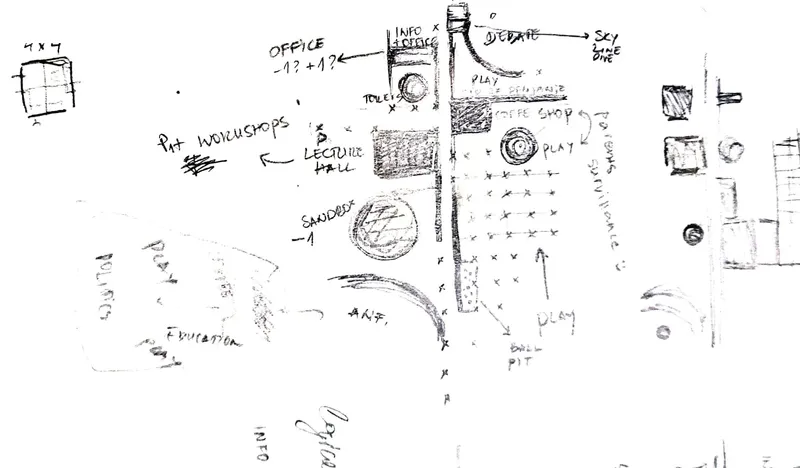
Start of the design process was inspired by ready-made geometric shapes such as cuboids, cylinders, cubes and arches. By placing these shapes on a grid within the site I tried to design a distinctive layout and structure for the pavilion. The design mirrors the imaginative creation of children, capturing the lively and unconstrained ambiance of a playground.
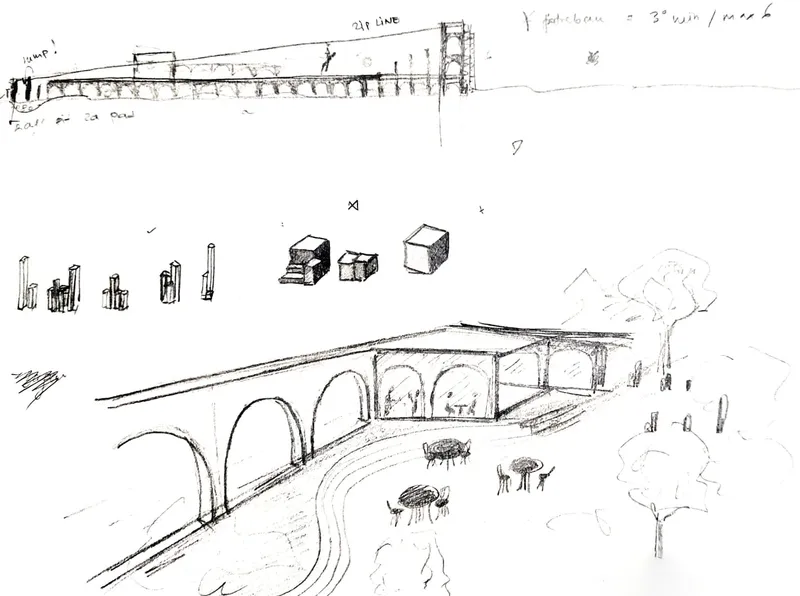
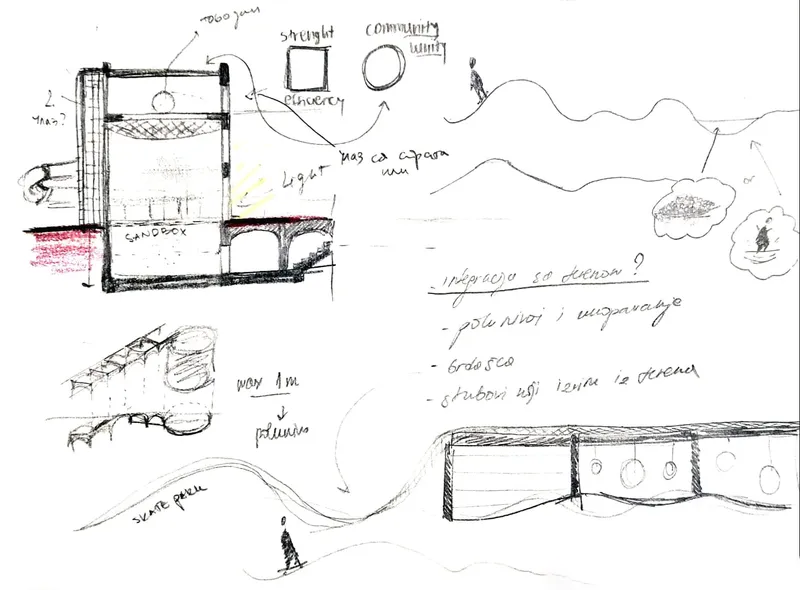
A series of arcades, forming the main communication pathways, are interconnected yet open, inviting users to freely explore the pavilion. The spaces in between create zones where volumes were elevated for additional functions. The terrain is modelled to enhance opportunities for play and interaction, creating a dynamic connection between the complex and the site. To enhance a playful and creative atmosphere, colours were used as the primary visual language creating a unique and eye-catching structure within the park landscape. While researching colours for the design, I assigned each one a unique meaning based on emotions and behavioural traits. Each colour indicates distinct knowledge related to safe debate, tolerance, and the values that this pavilion represents.
Zoning and activities
Spaces for play are envisioned to enhance the social and physical activity of children, with a focus on interaction. Everything is accessible to everyone. Suggestion is to organise team-building activities and other events that can benefit larger groups. Workshops are planned for children and parents, featuring educational events that foster empathy, understanding, and family relationships. Additionally, the pavilion would offer workshops on open debates and oratory for older users. A meeting room is envisioned for lectures on political sciences, sociology, psychology, and debating, but it can also serve for conferences and meetings of various associations, businesses, as well as government and non-government organisations. An outdoor amphitheatre with approximately 200 seats is designed for various musical and theatre events, open lectures, public speaking, debates, etc. The coffee shop can serve for seemingly ordinary socialisation and relaxation, but it can also be used for free discussions, stand-up comedy, and other events themed within the political and social context. It was crucial during the design of these elements and zones to ensure that each space can be used for both play and learning and for the progress of both children and adults.
The goal was to address challenging topics in a context that brings fun, ease, and openness to everyone, thereby creating a sense of security and safety in society. It aims to show people various ways they can engage in social life and function as a community.
Concept sketches


Popular Articles
Popular articles from the community


EW PARK: Sustainable Architecture Reimagines the Future of Urban Parking
EW PARK reimagines city parking as a modular wooden tower combining automation, solar energy, electric mobility, and adaptable urban design.

Conexión: Biophilic Design Reimagines High-Rise Living in Hong Kong
Conexión reimagines high-rise living in Hong Kong through biophilic design, green facades, shared spaces, daylight, water and nature within.

The Ocean Hive: Sustainable Architecture for a Self-Sufficient Civilization at Sea
The Ocean Hive imagines sustainable architecture at sea, where modular habitats, algae, wave power and ocean waste sustain a growing colony.

Hill & Cross Opera: Sculptural Opera House Architecture Shaped by Tallinn’s Landscape and Identity
Hill & Cross Opera reimagines opera house architecture in Tallinn through its sculptural hill, civic plaza, glass wave and a luminous cross.

Similar Reads
You might also enjoy these articles

The Musturak Paradise: Senior Living Architecture for a Connected Future in Temara, Morocco
The Musturak Paradise reimagines senior living architecture in Temara via private homes, social spaces, culture, community, and shared care.

The Leaf Center: Cultural Center Architecture for Social Integration in Amsterdam
Cultural center architecture becomes a bridge at The Leaf Center, connecting international students with Amsterdam through art and exchange.
Conexión: Biophilic Design Reimagines High-Rise Living in Hong Kong
Conexión reimagines high-rise living in Hong Kong through biophilic design, green facades, shared spaces, daylight, water and nature within.

Wander to Wonder: Modular Playground Design for Children in Kutupalong Refugee Camp
Wander to Wonder uses modular playground design to create flexible, imaginative play spaces for children in Kutupalong refugee camp.


Explore Playground Competitions
Discover active competitions in this discipline




Challenge to reimagine the Iron Throne


Photograph architecture without architects


Illustrate the lost glory of Angkor Wat - Render Challenge


Design challenge to reuse E-waste
Comments (0)
Please login or sign up to add comments
No comments yet. Be the first to comment!