
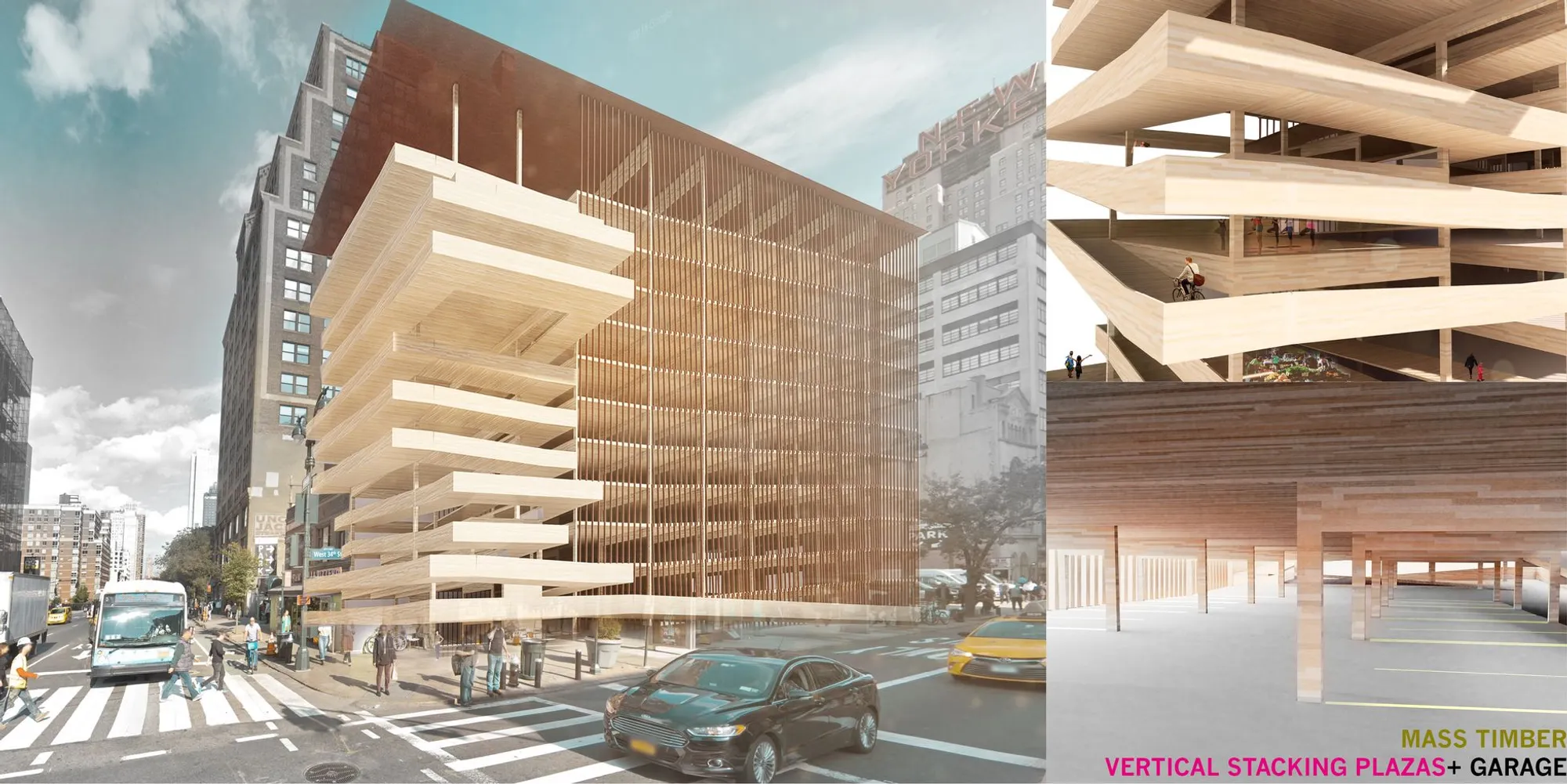
Mass Timber Vertical Stacking Plazas: Rethinking the Parking Garage as Public Space
A 12-story mass timber structure layers urban plazas and parking with ramp-based circulation for pedestrians, cyclists, and cars alike.


What if the most reviled building type in any city could become one of its most generous? The parking garage sits at the bottom of architecture's prestige ladder, yet it occupies prime urban real estate, consumes enormous material resources, and shapes the ground-level experience of entire blocks. This proposal flips the script: a 12-story mass timber structure that interleaves vehicular parking with vertically stacked public plazas, connected by a continuous ramp system open to pedestrians and cyclists as much as to cars.
Designed by Yimeng T and recognized with a Jury Commendation in the Yo Parking 2019 competition, the project treats parking infrastructure not as a necessary evil but as an opportunity for ecological and social investment. By building in mass timber rather than reinforced concrete, the structure stores carbon instead of emitting it. By weaving plazas into the section, it gives back public space at every level rather than reserving it solely for the ground floor.
A Section That Reads Like a City
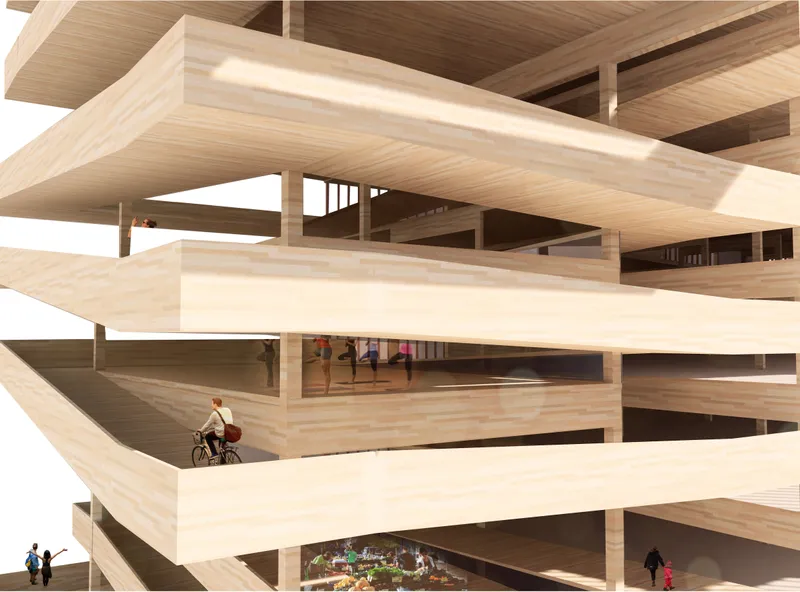
The sectional model reveals the project's core logic: stacked timber floor plates of varying depth create a vertical sequence of occupied terraces. Miniature figures populate the interior spaces, making visible the idea that this is not a hollow shell for cars but a building thick with human activity. Exposed timber structure doubles as spatial character, its warmth and grain legible even in model form. The accompanying physical model, placed beside a site plan overlay, clarifies how parking entry and staging areas occupy the lower levels while public program migrates upward.
What makes the section compelling is its refusal to separate functions into clean horizontal bands. Plazas and parking levels are juxtaposed rather than segregated, with the continuous ramp network threading between them. The result is a building where you might park on level four, walk up a ramp to a plaza on level five, and encounter cyclists descending from level eight. Circulation becomes social infrastructure.
Timber at Urban Scale: Facade as Filter
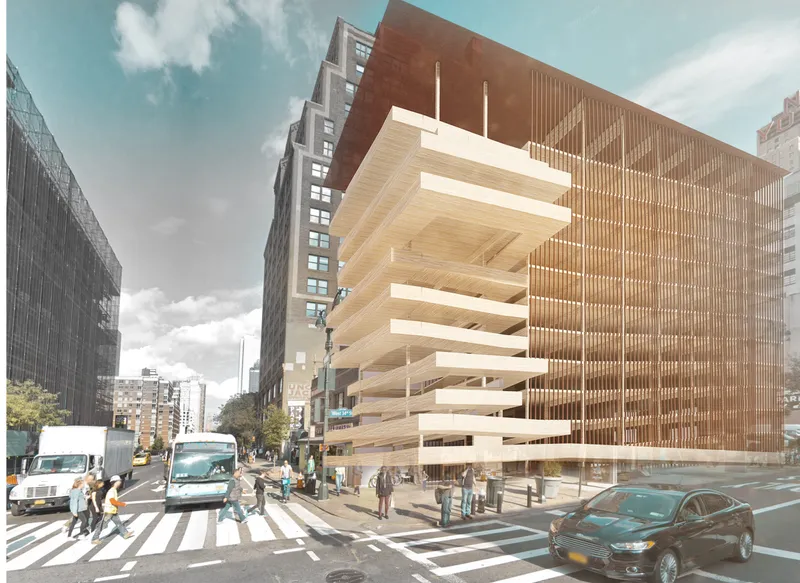
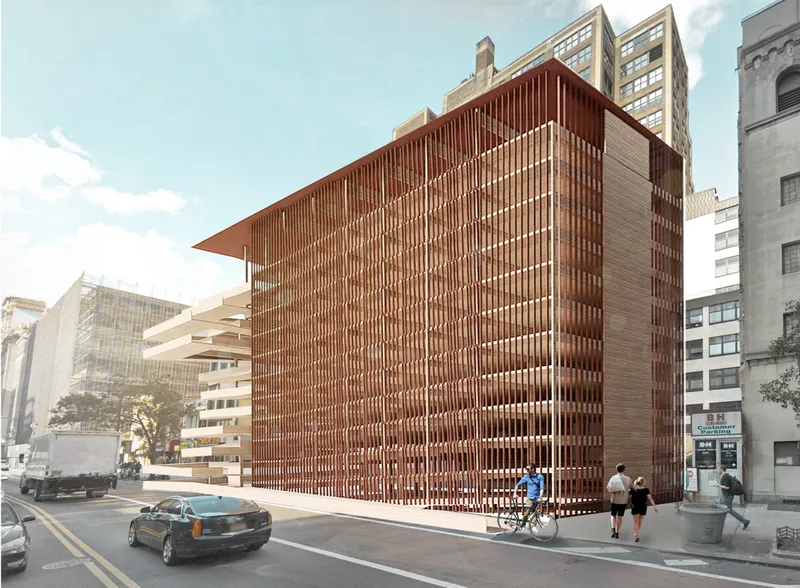
The street-level renderings show how the building meets its neighborhood. Vertical timber slat screens wrap the facade, filtering light and views while giving the structure a texture far removed from the blank concrete walls of a typical garage. Cantilevered floor plates extend beyond the screen, creating sheltered zones at the sidewalk and signaling that the building's program reaches outward. Under overcast skies, the timber reads as warm against the gray, a material argument that sustainability does not require austerity.
The corner view is especially telling. Pedestrians and cyclists occupy the base of the building comfortably, with the louvered facade overhead providing a sense of enclosure without oppression. The cantilevers step in and out, breaking the volume into a stack of distinct levels rather than a monolithic block. It is a building that wants to be walked around, not driven past.
Program Distributed Vertically
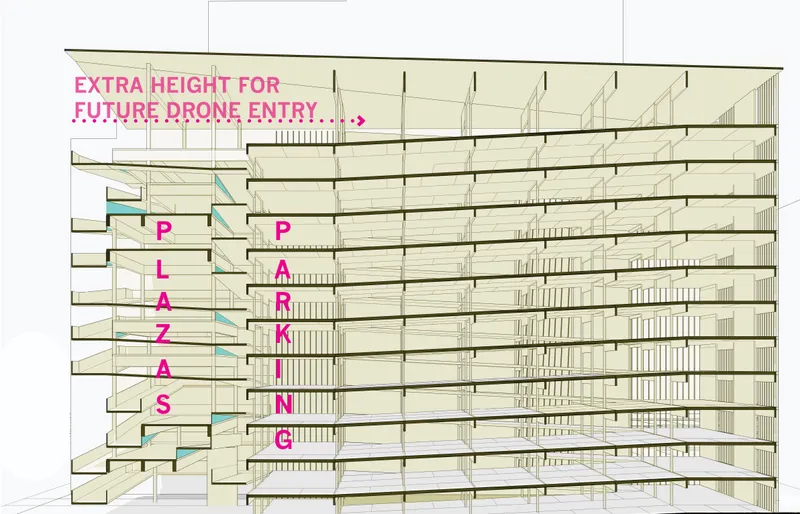
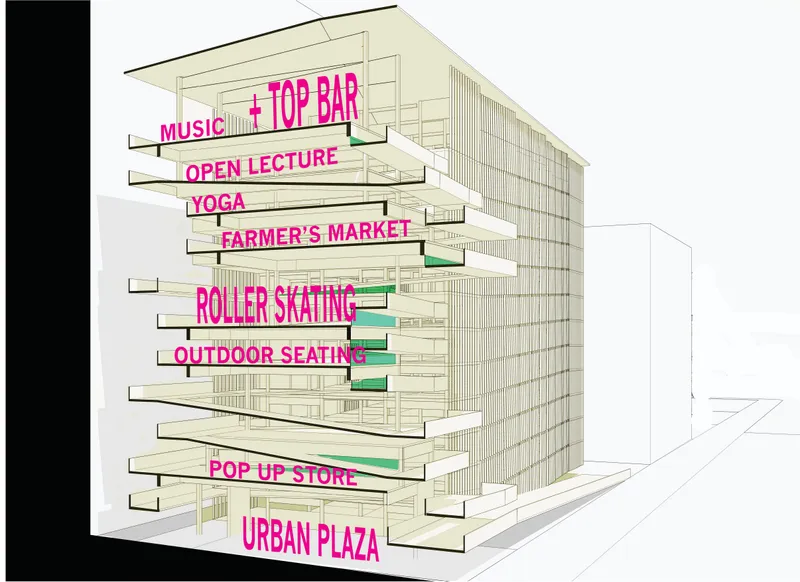
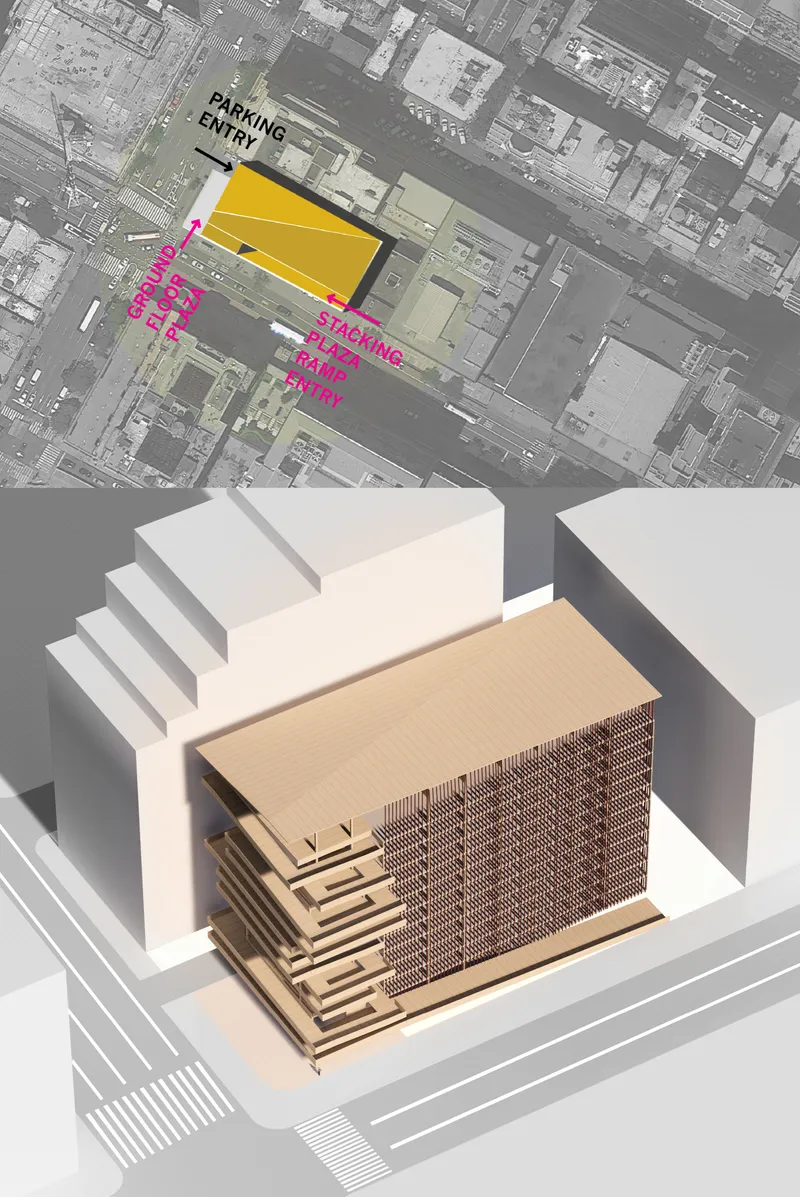
The section drawing annotates what the models suggest: program spaces and circulation paths are distributed across the full height of the building. The ramp system is not merely a vehicular helix but a multimodal path, accessible to pedestrians and cyclists, that connects parking levels to public plazas at regular intervals. This strategy optimizes vertical spatial allocation without sacrificing structural integrity, a critical consideration for a 12-story timber building.
The axonometric drawing labels each cantilevered level, revealing how the building's massing is driven by program rather than arbitrary form. Each projection corresponds to a specific use, whether a plaza, a staging area, or a terrace that extends the public realm vertically. The drawing makes a quiet but forceful argument: the section is the plan in a building like this. Vertical stacking is not repetition; it is curation.
Why This Project Matters
Parking garages are among the most carbon-intensive, least-loved building types in contemporary cities. They consume steel and concrete in vast quantities, they deaden street frontages, and they are designed for obsolescence as autonomous vehicles and shifting mobility patterns threaten to render them redundant within decades. Any serious rethinking of urban infrastructure has to confront this typology head on. Yimeng T's proposal does so by substituting a renewable, carbon-sequestering material for conventional construction and by insisting that every level of the building contribute to civic life.
The project's strength lies in its refusal to treat sustainability and public generosity as separate agendas. The mass timber structure sequesters carbon while creating spaces that are warmer and more tactile than their concrete equivalents. The ramp system provides multimodal accessibility while generating social encounters between pedestrians, cyclists, and drivers. It is a compact demonstration that parking infrastructure can be reimagined as a scaffold for urban life rather than a barrier to it.
View the Full Project
MASS TIMBER VERTICAL STACKING PLAZAS +GARAGE
View the full project with all boards on uni.xyz.
uni.xyzAbout the Designers
Designer: Yimeng T
Enter a Design Competition on uni.xyz
uni.xyz runs architecture and design competitions year-round that reward proposals with spatial conviction and real site intelligence.
Project credits: MASS TIMBER VERTICAL STACKING PLAZAS +GARAGE by Yimeng T Yo Parking 2019 (uni.xyz).


Popular Articles
Popular articles from the community


Conexión: Biophilic Design Reimagines High-Rise Living in Hong Kong
Conexión reimagines high-rise living in Hong Kong through biophilic design, green facades, shared spaces, daylight, water and nature within.

Play: Fragments of Their World
Familiar architecture becomes modular playground design, creating safe spaces where displaced children can learn, connect, imagine and play.

Hill & Cross Opera: Sculptural Opera House Architecture Shaped by Tallinn’s Landscape and Identity
Hill & Cross Opera reimagines opera house architecture in Tallinn through its sculptural hill, civic plaza, glass wave and a luminous cross.

The Ocean Hive: Sustainable Architecture for a Self-Sufficient Civilization at Sea
The Ocean Hive imagines sustainable architecture at sea, where modular habitats, algae, wave power and ocean waste sustain a growing colony.


Similar Reads
You might also enjoy these articles

Day and Night Park: A Time-Based Urban Newsstand in Beijing
A temporary urban newsstand in Beijing blending travel, light, and reading through poetic colors, compact form, and community-focused design.

Modernist Patio Renovation in El Masnou, Barcelona by Oliver Segura Arquitectura + Cebrià Arquitectura
Modernist patio renovation blending tradition and innovation with a movable pool, leveled floors, and Catalan materials in El Masnou.

Alto Residencial Coop: Cooperative Housing Development in Santiago de Compostela by Carbajo Barrios Arquitectos
A linear cooperative housing complex blending white volumes and perforated metal façades, enhancing community living, natural light, privacy, and urban integration.

Vil Genis School by BPA ARCHITECTURE – Massy, France
Vil Genis School in Massy, France, features sustainable design, south-facing classrooms, community integration, accessible spaces, and modern educational architecture.

Comments (0)
Please login or sign up to add comments
No comments yet. Be the first to comment!