

Urban Hammock: Biomimetic Street Furniture Woven from Concrete and Hemp
A bench, hammock, and planter fused into one piece of urban furniture inspired by the vascular network of a leaf.


What if a park bench could photosynthesise? Not literally, but functionally: filtering stormwater, purifying air, and channeling the structural logic of a leaf's vein system into a single piece of street furniture. The Urban Hammock collapses three distinct urban objects (a bench, a hammock, and a flower pot) into one continuous form made from recyclable concrete and hemp rope. It is a compact argument that public furniture should do ecological work, not just occupy space.
Designed by Aleksandra Chmiel, Magdalena Mazurkiewicz, and Alicja Karnas, the project takes its conceptual cue from the overlap between city grid structures and the nervous system of a leaf. That biomimetic starting point is more than metaphor: it directly informs the material layering, drainage strategy, and seating geometry of the final object.
From Leaf Veins to City Grids
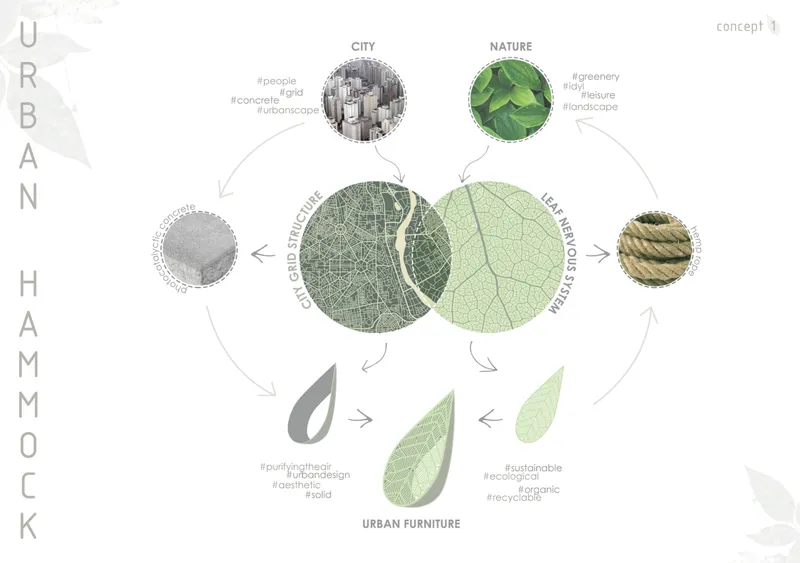
The concept diagram maps a clear lineage from natural circulatory systems to urban material cycles. On one side, the vascular network of a leaf distributes nutrients and supports growth. On the other, a city's infrastructure distributes people, water, and resources. The Urban Hammock sits at the intersection, using this analogy to justify a design where every material serves double duty. Concrete provides urban solidity and structural permanence; hemp rope provides resilience, breathability, and a tactile connection to organic matter. The diagram frames the project not as decoration but as infrastructure at the scale of a single object.
Anatomy of a Boat-Shaped Bench
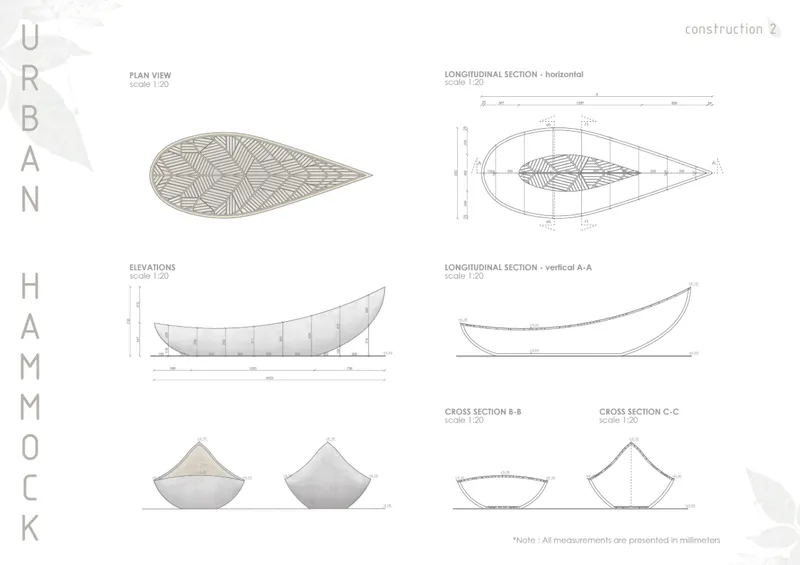
The technical drawings reveal a boat-shaped profile in plan, with longitudinal sections, elevations, and cross sections that clarify how the form cradles the body. The curved concrete shell tapers at both ends, creating a hull-like geometry that naturally invites reclining. It is wide enough for multiple users and contoured to support different postures: upright sitting, lounging, or something closer to the sway of an actual hammock.
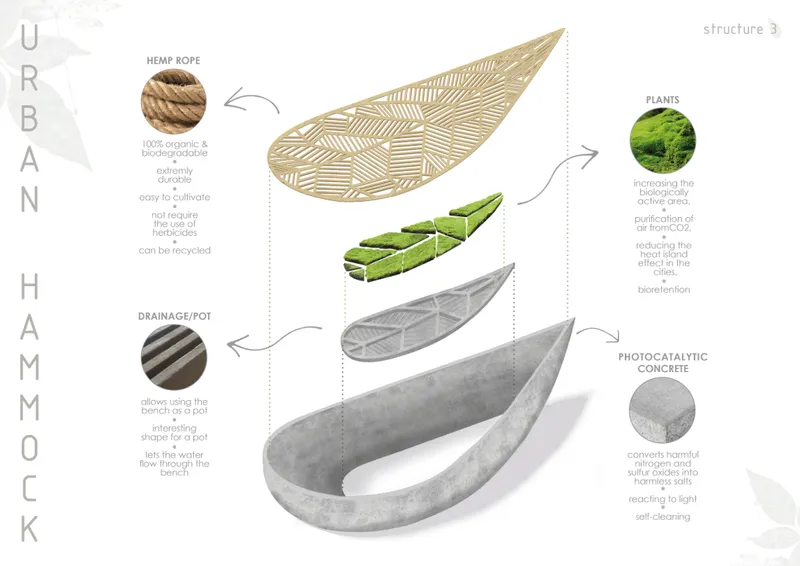
The exploded axonometric is where the real intelligence becomes visible. Four distinct layers stack upward: a photocatalytic concrete base, a plant layer, a drainage pot, and the hemp rope seating surface stretched across the top. The photocatalytic concrete is a deliberate choice; it actively breaks down airborne pollutants when exposed to light. The drainage pot captures stormwater and channels it to the planted zone, making the bench a small-scale bioretention device. The hemp rope, biodegradable and organic, forms a woven surface that flexes under body weight while allowing air and light to reach the greenery below.
Comfort Tested at Human Scale
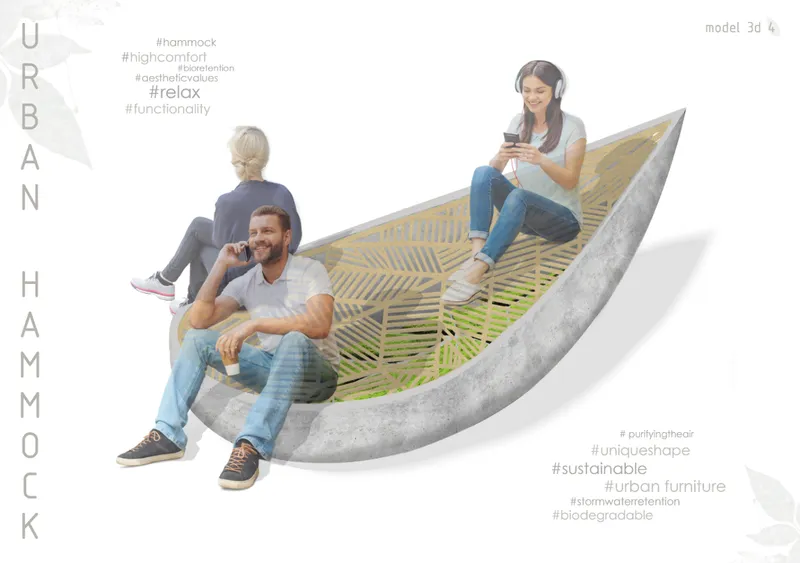
The rendered scene places three people on the bench simultaneously, each in a different posture. One leans back, one sits upright, one perches at the edge. The curved concrete form and the give of the hemp weave accommodate all three without forcing a single "correct" way to sit. The ergonomic range is the point: this is furniture designed for lingering, not just waiting. The warm tone of the rope against the cool grey of the concrete creates a material contrast that reads as inviting rather than austere, pulling the object away from the typical municipal bench aesthetic.
Two Modes: Reading Nook and Urban Meadow
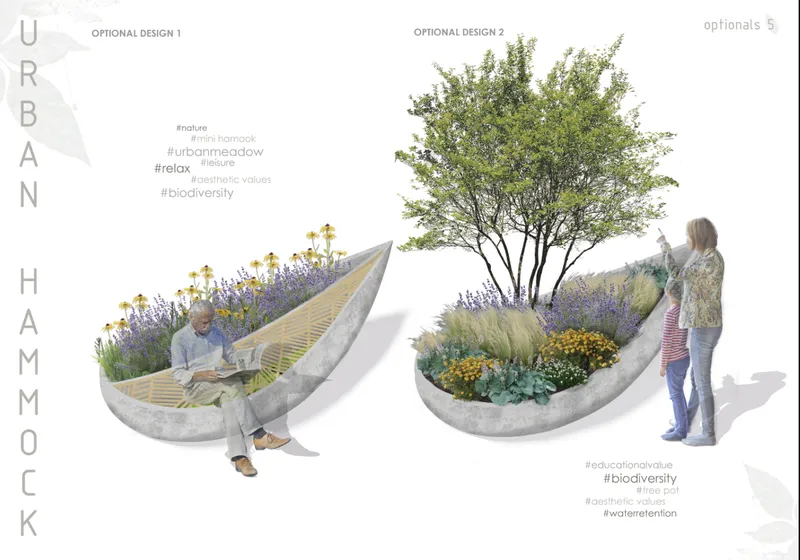
The final image presents two configuration options side by side. In one, a person reads on the bench while the planter remains minimal. In the other, wildflowers and a small tree emerge from the integrated pot, transforming the object into a fragment of urban meadow. This flexibility is key to the project's viability: cities could deploy the same unit in vastly different contexts, from a plaza reading corner to a streetside green pocket, simply by adjusting what gets planted. The biophilic integration is not ornamental. The plant layer contributes to air purification and stormwater management, making each bench a micro-scale ecological actor.
Why This Project Matters
Most urban furniture asks nothing of the environment and gives nothing back. The Urban Hammock challenges that inertia by embedding ecological performance into an object small enough to fit on a sidewalk. Photocatalytic concrete that cleans air, drainage systems that manage stormwater, hemp rope that biodegrades at end of life: these are not speculative technologies. They exist now, and the designers have assembled them into a single, buildable proposition.
What makes the project persuasive is its refusal to separate comfort from responsibility. The same form that lets you recline in a public park also filters pollutants and grows wildflowers. Chmiel, Mazurkiewicz, and Karnas demonstrate that sustainability in the public realm does not require grand gestures. Sometimes it requires a bench that does more than hold weight.
View the Full Project
About the Designers
Designers: Aleksandra Chmiel, Magdalena Mazurkiewicz, Alicja Karnas
Enter a Design Competition on uni.xyz
uni.xyz runs architecture and design competitions year-round that reward proposals with spatial conviction and real site intelligence.
Project credits: Urban Hammock by Aleksandra Chmiel, Magdalena Mazurkiewicz, Alicja Karnas.


Popular Articles
Popular articles from the community


Lunar Spiral: Space Architecture Shaped by the Mathematics of the Universe
Lunar Spiral reimagines space architecture through Fibonacci geometry, lunar regolith, levitating habitats, and self-sustaining Moon living.

Hill & Cross Opera: Sculptural Opera House Architecture Shaped by Tallinn’s Landscape and Identity
Hill & Cross Opera reimagines opera house architecture in Tallinn through its sculptural hill, civic plaza, glass wave and a luminous cross.

Conexión: Biophilic Design Reimagines High-Rise Living in Hong Kong
Conexión reimagines high-rise living in Hong Kong through biophilic design, green facades, shared spaces, daylight, water and nature within.

Little Red Riding Hood: Architectural Design as a Journey Through Fear, Light, and Storytelling
Little Red Riding Hood reimagines the fairy tale through architectural design shaped by fear, light, scale, memory, uncertainty, and choice.

Similar Reads
You might also enjoy these articles

ALGAL REALM: A Bio-Integrated Lunar Habitat Design for Life Beyond Earth
ALGAL REALM reimagines lunar habitat design with algae-powered life support, 3D-printed regolith, and vertical living for a lunar future.

Cinema Futurismo: Futuristic Architecture Reimagining the Future of Cinema
Cinema Futurismo merges futuristic architecture, holographic projection, intimate seating, and landscape into a new social cinema.
Little Red Riding Hood: Architectural Design as a Journey Through Fear, Light, and Storytelling
Little Red Riding Hood reimagines the fairy tale through architectural design shaped by fear, light, scale, memory, uncertainty, and choice.

Playducation: Modular Architecture That Turns Play Into a Space for Learning
Playducation transforms modular architecture into a flexible world of play, learning, and healing for children in refugee settlements.

Comments (0)
Please login or sign up to add comments
No comments yet. Be the first to comment!