
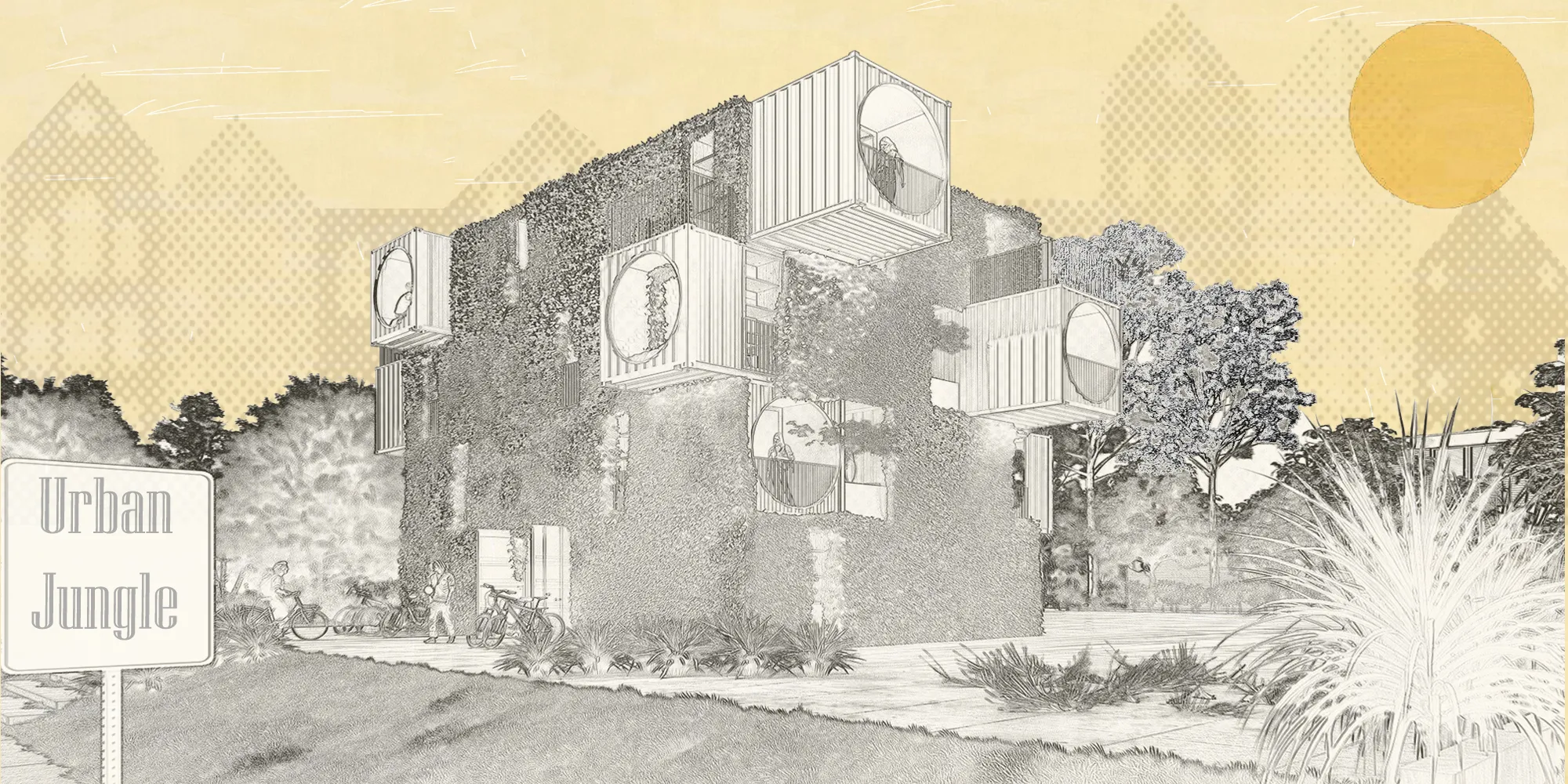
Urban Jungle
Let's go back to nature

Concept: The idea for designing such a project is based on the urgent need to take concrete steps regarding the climate change that our planet is going through. This model is conceived in the principles of ecological and sustainable architecture. The elements that make this design special are: the reuse of transport containers, the way they are treated with living facades (green architecture) and the quality of the living spaces that have been created with this design.
Quality: During the treatment of this student dormitory, two basic things were taken into account for each student: their private space (bedroom with all the necessary functions) as well as common spaces for social and intellectual interaction with other students. These two are analyzed thus creating: single residential units, double units (for couples), common spaces for reading, learning and daily stay as well as the atrium as a pavilion where students can gather for various activities, movies, discussions professional, various parties and events. Adding to this the architectural treatment with greenery, increases even more the quality of the spaces of this building, both in terms of aesthetics, energy efficiency, psychological but also in relation to the surrounding environment.
Goals: Every building we design is just a small unit of our common home (Earth), so we must first consider the impact we have on our planet and then look for our needs. Ecological and sustainable buildings are one of the best ways to advance the need for action on climate change.
The Urban Jungle aims to be experienced as a green space and to fit into any urban environment built, as they look more like a forest than a building. Living buildings in addition to improving air quality, they change over time, making urban spaces more attractive and therefore, are needed for many cities around the world to escape the stressful urban routine.
Urban Environment: Urban greening’ has been proposed as a way to mitigate the effects of human health from rising temperatures coming from climate change. Most studies have investigated air temperatures inside parks and under trees and are widely supportive that green spaces may be cooler than non-green ones. Facades of buildings are under permanent environmental influences, such as sun and acid rain, which age and can ultimately destroy them. Living wall systems can protect facades and offer benefits similar to those gained from installing a green roof. A look back at history shows that vegetated facades are not new technology but can offer multiple benefits as a component of the current urban model. Since the potential of green facades to improve the urban microclimate and ecological footprint of buildings is high, research has been conducted on issues such as the insulating effects of plants on facades, the ability of plants to soften dust, the evaporative cooling effects of plants and habitat creation for urban wildlife, including birds, spiders and beetles.
Shipping Containers: The re-use of existing containers in buildings solves simultaneously the environmental issues of steel container waste and reduced embodied energy for construction materials. Container buildings are cheaper than most modular building systems.
Some permanent building types: student accommodation and budget hotels have a shorter life-cycle than commercial and residential buildings. Contributing factors include unplanned urban expansion, extreme climate events, and transitory worker populations. This has led to some clients taking a greater interest in building adaptation and the possibility for de mountability and relocation; qualities offered by containers.
Modularity: Modular architecture is based on the design and use of systems composed of separate repetitive elements (standard units), which are similar in size, shape and functional nature. These can be linked up to each other, be replaced or added. It is a tremendously versatile architecture and allows personalization. Versatile in the sense that can be used in permanent and temporary installations; Besides, it reaches remote places in which building a conventional home is not possible. It allows personalization because its constructive system admits adding, replacing and removing the standard units and it accepts every kind of finishing.
Green Facades: A green façade is a wall completely or partially covered with greenery. Green façades with climbing plants usually do not require any extra structural requirements. They are most commonly attached to concrete walls, but can attach to almost anything, or even be free-standing. To provide support for plants, twining or clinging self-climbers can be used. Green façades with climbing plants are both low-cost and low maintenance in comparison to other greening options and also get the recovery of the investment between the 5 and the 10 years.
Like other forms of green infrastructure, they are increasingly being considered as a design feature to cool internal building temperatures, reduce building energy consumption and facilitate urban adaptation to a warming climate.




Popular Articles
Popular articles from the community


Lunar Spiral: Space Architecture Shaped by the Mathematics of the Universe
Lunar Spiral reimagines space architecture through Fibonacci geometry, lunar regolith, levitating habitats, and self-sustaining Moon living.

The Musturak Paradise: Senior Living Architecture for a Connected Future in Temara, Morocco
The Musturak Paradise reimagines senior living architecture in Temara via private homes, social spaces, culture, community, and shared care.

Co-Life: Senior Housing Design That Reconnects Older Adults With the City
Co-Life reimagines senior housing design through healing gardens, shared streets, workshops, and a sustainable community across generations.

Hill & Cross Opera: Sculptural Opera House Architecture Shaped by Tallinn’s Landscape and Identity
Hill & Cross Opera reimagines opera house architecture in Tallinn through its sculptural hill, civic plaza, glass wave and a luminous cross.


Similar Reads
You might also enjoy these articles

Day and Night Park: A Time-Based Urban Newsstand in Beijing
A temporary urban newsstand in Beijing blending travel, light, and reading through poetic colors, compact form, and community-focused design.

Modernist Patio Renovation in El Masnou, Barcelona by Oliver Segura Arquitectura + Cebrià Arquitectura
Modernist patio renovation blending tradition and innovation with a movable pool, leveled floors, and Catalan materials in El Masnou.
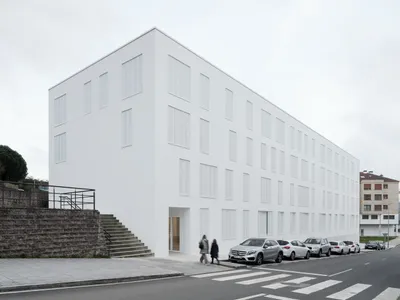
Alto Residencial Coop: Cooperative Housing Development in Santiago de Compostela by Carbajo Barrios Arquitectos
A linear cooperative housing complex blending white volumes and perforated metal façades, enhancing community living, natural light, privacy, and urban integration.
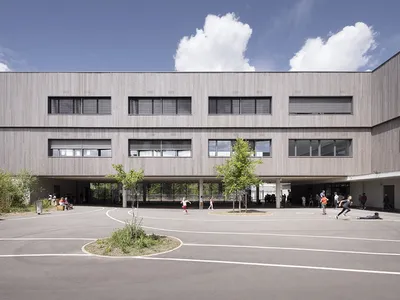
Vil Genis School by BPA ARCHITECTURE – Massy, France
Vil Genis School in Massy, France, features sustainable design, south-facing classrooms, community integration, accessible spaces, and modern educational architecture.

Explore Urban Jungle Competitions
Discover active competitions in this discipline




Challenge to reimagine the Iron Throne


Photograph architecture without architects


Illustrate the lost glory of Angkor Wat - Render Challenge


Design challenge to reuse E-waste
Comments (0)
Please login or sign up to add comments
No comments yet. Be the first to comment!