

An Artistic Community Hub: A Paris Railway Cutting Reworked as an Open-Air Studio in Montmartre's Shadow
Christina Varriano turns a residual rail corridor in the 18th arrondissement into a linear sequence of play, plein air painting and a convertible market.


Montmartre built its reputation on painters who left the studio and worked outdoors, in daylight, in full view of the street. A short distance from the hill, a disused railway corridor sits largely forgotten. An Artistic Community Hub asks a simple question: what if that abandoned strip of track became the outdoor studio Montmartre once was? The proposal does not insert a building. It puts down a light, adaptable framework that lets painting, play and trade take over a piece of infrastructure the city has stopped using.
Designed by Christina Varriano, the project is set in the 18th arrondissement and draws on the area's long association with artists such as Pablo Picasso and Pierre-Auguste Renoir. Its organising idea comes from the tradition of en plein air painting, which depends on direct exposure to light and landscape. Instead of an enclosed gallery, Varriano proposes open-air creative space laid out along the length of the cutting. The corridor is divided into three zones: a Kid's Zone, a Creative Zone and a Marketplace.
The Tracks Become a Market Street After Dark
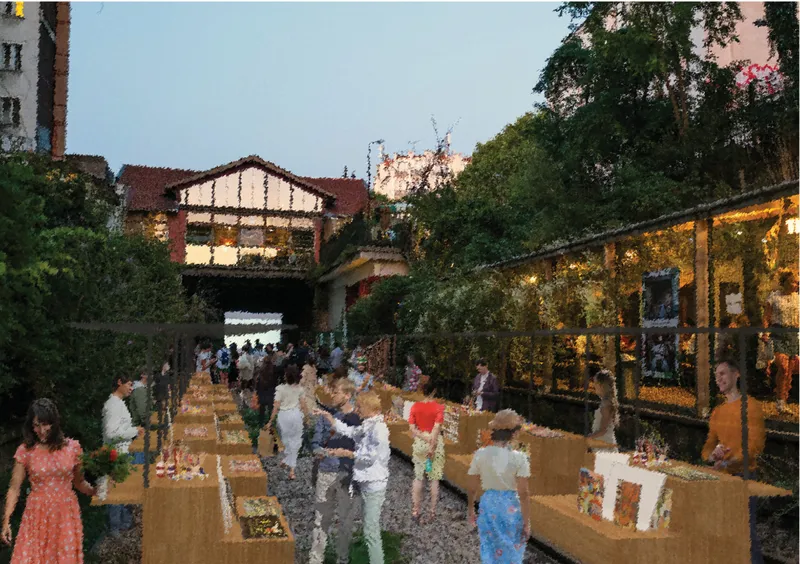
The evening view shows the project's most important move. The rails stay where they are. Timber market tables run along the old tracks, and the crowd moves in a single direction under a gabled bridge building toward a glowing glazed pavilion. Varriano does not fight the site's linearity; she uses it as a spine. A long, thin void that could feel like a leftover gap becomes a natural route for browsing, and the existing tracks act as a guide for the line of stalls.
This is also where the Marketplace starts working economically. The brief lets artists sell their work, rent equipment and host small events here, so the corridor can support the people who use it as well as hold them. The lighting and density in this image suggest a space that stays busy after the painters leave, and that is the outcome the scheme depends on.
Easels in the Cutting: Plein Air as Public Programme
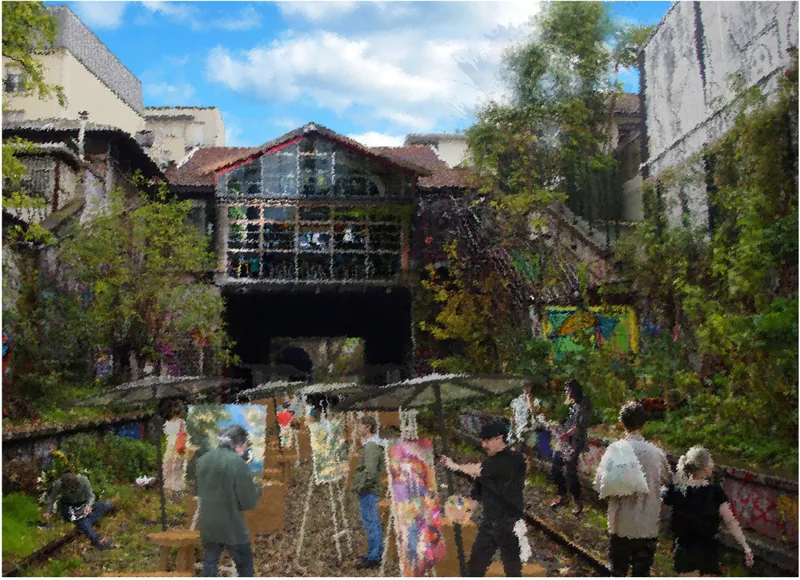
The Creative Zone sits at the centre of the site. Here the Montmartre reference becomes literal: painters work at easels along the cutting, with graffiti-covered retaining walls behind them and an open sky above. The equipment is modest. The text lists easels, movable seating and informal gathering spots that can support workshops, exhibitions or unplanned sessions. Because the cutting is sunken, it works like an outdoor room. It is sheltered from the street above, yet it stays fully open to light.
The rendering also points to a smart decision about context. The graffiti stays. Varriano does not clean the walls into a neutral backdrop. She lets the corridor's existing layer of informal art sit alongside the new easel culture. That leaves the line between artist and audience, which the designer explicitly wants to remove, open in both directions: people walking past are watching work being made, while the walls show work that was made without anyone's permission.
Red Frames and Straw Platforms for the Youngest Users
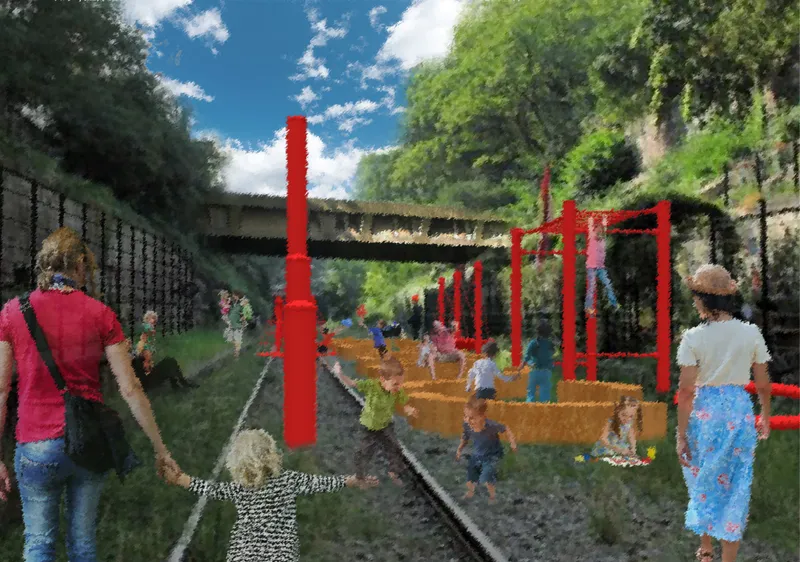
The Kid's Zone uses the same light approach for play. Children climb around red steel frames and straw-coloured platforms set among the rails, with a concrete bridge crossing the green cutting behind them. The frames are open and easy to read, so it stays clear what each piece is for. The colour makes the zone easy to spot from further along the corridor. The text describes the area as a mix of playground and creative installation, meant to introduce art to children early and give families a reason to come regularly.
Placing children at one end of the sequence is a sensible piece of programming. Families bring the steady daytime presence that a linear park needs if it is not going to empty out between events. The stated priorities of safety, openness and interaction come through in how open the frames are. Parents can see across the zone, and the play structures do not wall off the cutting.
Canopies That Fold Back Into Seating
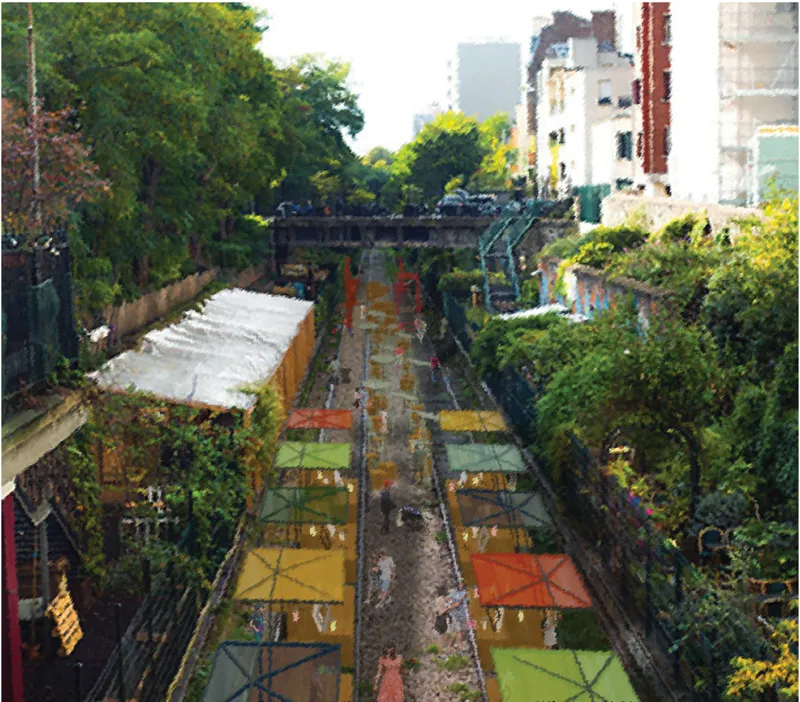
The elevated view shows the full system. Coloured canopies run in a line down the cutting, with trees and apartment blocks on both sides. The parts are few and repeated: folding canopies, display surfaces and built-in seating, combined into modular stalls. The key detail is in the text. When the market is closed, the stalls convert into seating and social space, so the corridor never has a dead period between trading hours.
From above, the design's restraint is clear. Set against the scale of the residential blocks, the canopies read as a light layer of activity rather than as buildings. That is deliberate. Varriano keeps the architectural vocabulary minimal so that the users set the character of the place. The colour comes from the canopies and the people under them, not from any heavy form.
Why This Project Matters
Regeneration schemes for old rail corridors often end up as either a carefully designed promenade or a destination building. This proposal takes a different route. It treats the void as a sequence of occupied zones and places design effort in small, movable elements rather than large structures. That makes the project a credible model for cities with leftover linear land. It is cheap to try, easy to change and quick to fill with people, and the convertible stalls address one of public space's hardest problems: what happens when the main programme stops.
The strongest part of the project is how it reads its context. Christina Varriano does not cite Montmartre's artistic history as a style to imitate. She treats it as a way of working: painting outdoors, in public, close to daily life. By building infrastructure for that practice and leaving the rails, walls and graffiti in place, she produces a proposal that feels rooted in the 18th arrondissement rather than imposed on it. It shows that a light intervention can still carry a clear and convincing idea.
View the Full Project
About the Designers
Designer: Christina Varriano
Enter a Design Competition on uni.xyz
uni.xyz runs architecture and design competitions year-round that reward proposals with spatial conviction and real site intelligence.
Project credits: An Artistic Community Hub by Christina Varriano.


Popular Articles
Popular articles from the community


David Ortega Stacks a Two-Story Mexico City Penthouse Around a Steel Stair and a Pergola-Shaded Roof Terrace
In Colonia Roma, a 300 m² penthouse uses oak joinery, a planted steel stair and a slatted roof pergola to make a new-build apartment feel like a house.

Cube Design Draws an Ecological Corridor Between Two Shenzhen Hills with the Nankai Building
Beside Shenzhen's container docks, the Nankai Building pairs stacked balconies with a climbing green screen to connect two hillsides across its height.

GROUP A Strips a 1969 Rotterdam Harbor Headquarters to Its Frame and Wraps It in Timber Louvers
In Rotterdam's M4H harbor district, Ferro Offices reuses a 1969 frame, adds one timber storey and reaches BREEAM-NL Outstanding.

Architekt Andreas Gruber Scatters 23 Dark Timber Chalets Across a South Tyrolean Forest Edge
In Molini di Tures, Amonti Chalets breaks a resort into a hamlet of gabled timber houses, with parking, storage and services pushed into the slope.

Similar Reads
You might also enjoy these articles
Healing Façade: A Modular Chapel System That Restores Ethiopia's Sacred Forests
Winner of the Eco-Chapel competition, this circular timber façade collects water from air to rebuild soil and reforest degraded Ethiopian landscapes.
Kaffeebühnen: Where Coffee Shop Architecture Becomes a Civic Stage in Vienna
A linear sequence of timber boxes, transparent shells, and open yards turns the Viennese café tradition into a public performance space.
Eco Chapel: A Modular Forest Pavilion That Grows Like the Landscape It Protects
Hexagonal timber modules weave through existing trees, turning a chapel into a living system for prayer, education, and reforestation.


Urban Forest: A Vertical Ecosystem for 5,000 Workers in Singapore's Changi Business Park
Radially stacked pods and layered green decks turn a 7-acre plot into 47 acres of ecological workspace projected for 2040.


Comments (0)
Please login or sign up to add comments
No comments yet. Be the first to comment!