
Valentino Architects Thread a Glazed Walkway Through Three 16th-Century Stone Houses in Malta
The Mill House in Attard stitches listed limestone volumes together around a courtyard pool, letting glass mediate between rough heritage and crisp modern


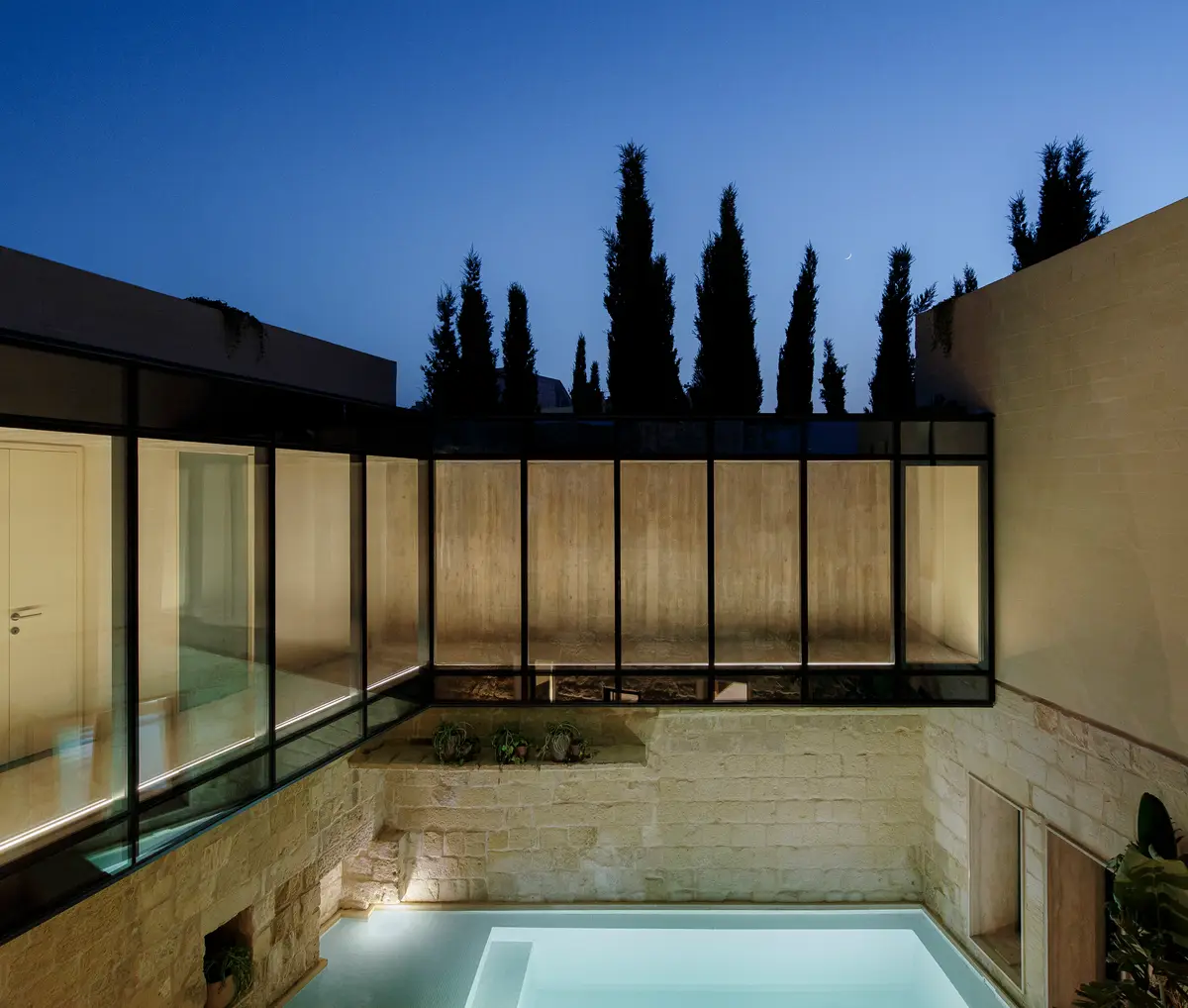
Most heritage conversions frame the old building as a container and pour the new program into it. The Mill House in Attard, Malta, works differently. Designed by Valentino Architects and completed in 2022, it treats the space between three Grade I and II Listed structures as the real architectural project. A cluster of limestone volumes dating to the mid-to-late 16th century, including a mill room, receives a single binding gesture: a glazed walkway that runs along two internal courtyard facades at first-floor level, connecting three bedrooms that sit atop the original blocks.
What makes the scheme genuinely interesting is its refusal to choose sides in the old-versus-new debate. The walkway is invisible from the street, hiding behind weathered limestone walls while announcing itself boldly to the courtyard below. By day its glass panels oscillate between reflection and translucency depending on the sun's angle; by night it becomes a lantern, flooding the pool terrace with warm light. The architecture does not restore the old buildings or overwhelm them. It occupies the gaps they left behind.
Limestone and the Weight of Time


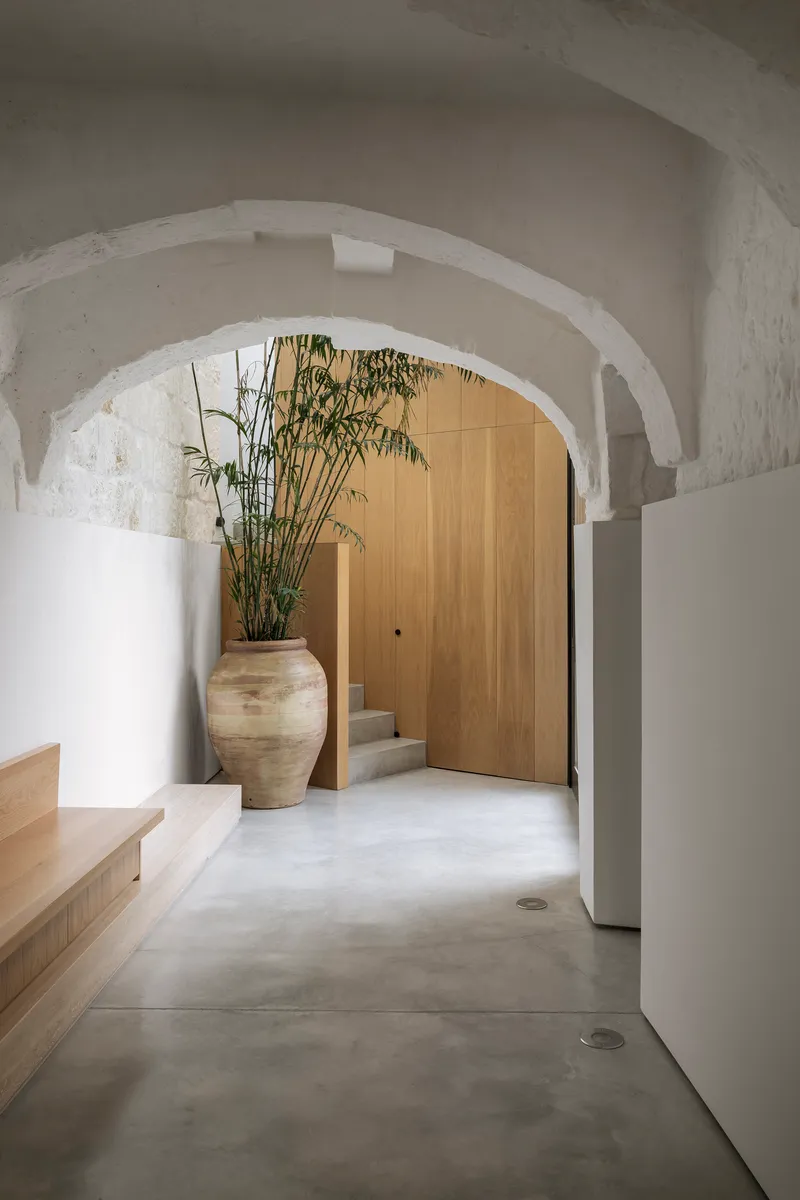
The exteriors remain nearly untouched. Weathered limestone walls, hand-cut from the ground centuries ago with rudimentary tools, carry the full structural load as they always have. A smooth rendered upper storey above one arched doorway is the only visible tell that anything has changed. This restraint matters in Attard, a community that forms part of Malta's "three villages" and sits in what was largely agricultural land. The street-facing elevations honor that grain.
Passing through the arched entry, the visitor moves along a pale stone corridor framed by rough masonry on both sides. Terracotta planters and timber stair doors signal domesticity without diluting the mineral character. The architects clearly understood that the patina of these walls is not a cosmetic asset to be preserved under glass; it is the structural reality of the building, and they let it work.
The Courtyard as Connective Heart


The courtyard is the project's organizing principle. It sits at the center of an irregular pentagonal footprint, open to the sky and fitted with a plunge pool, banana palms in large terracotta pots, and a seating area. The dining room occupies the north end of the ground floor, the living room and kitchen sit to the east, and the entrance hall opens directly onto this sun-soaked outdoor room. Every internal space either looks into the courtyard or passes through it.
At dusk, the courtyard transforms. The pool becomes a dark mirror reflecting the backlit glass pavilion above, and the cypresses beyond the walls gain a theatrical silhouette. This is not a garden bolted onto a house; it is the hinge that makes three separate buildings behave as one dwelling.
The Glazed Walkway: Reflection and Translucency
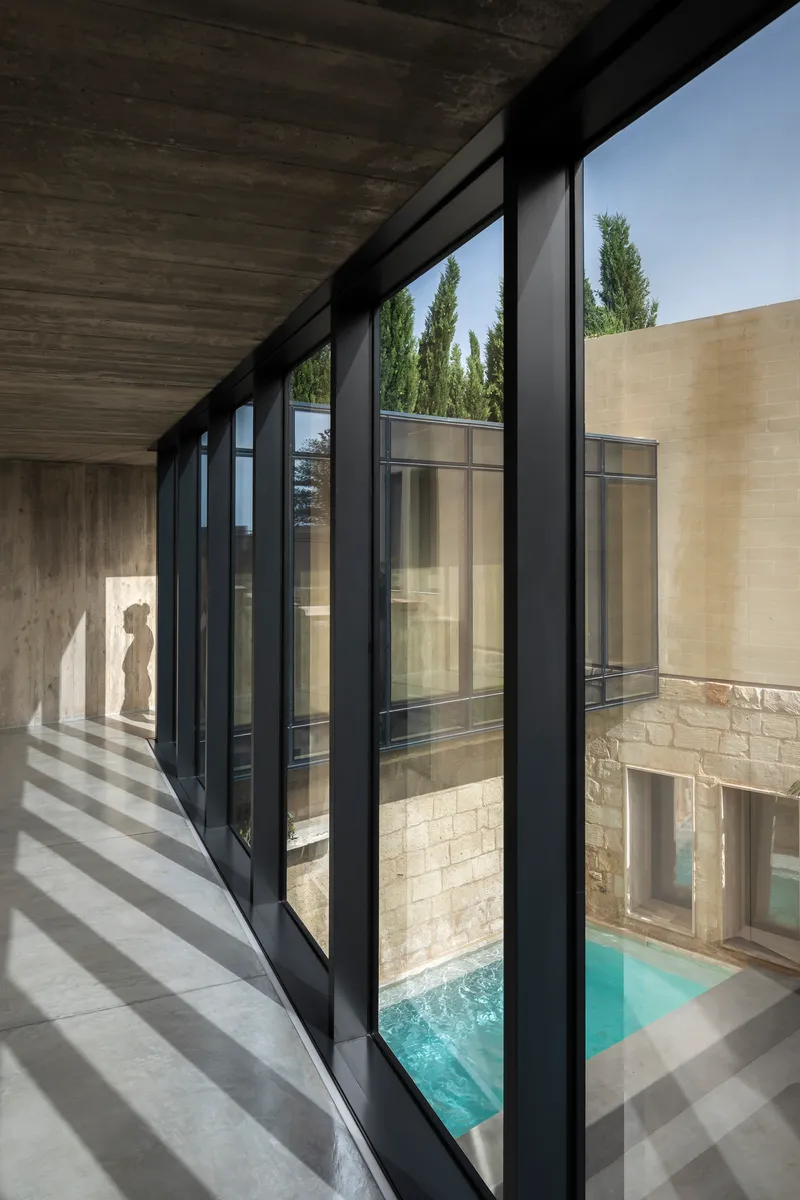
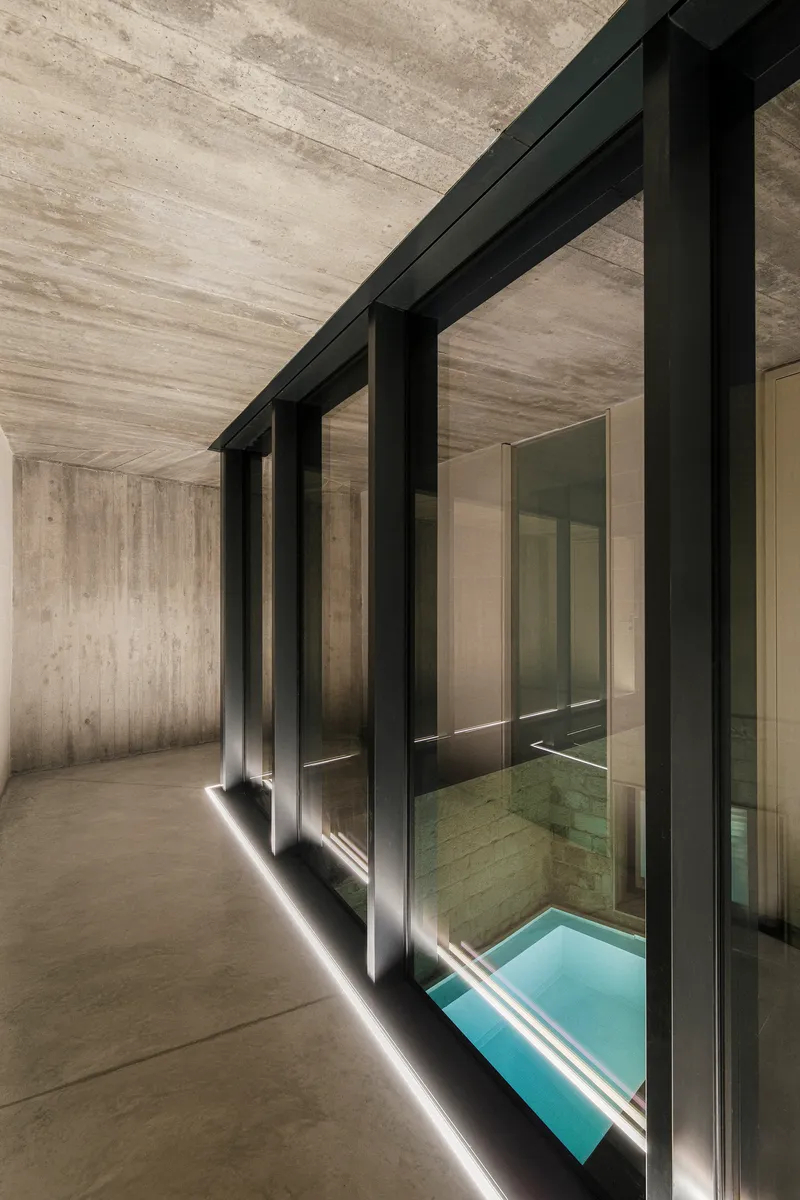
The walkway is the single most assertive move in the project, and it earns its boldness. Black steel frames hold glass panels that run along two courtyard facades at first-floor level, binding the three bedroom volumes into a continuous circuit. From inside, the corridor offers framed views of the stone facades opposite and the pool below. Strip lighting along the floor edge turns the passage into a luminous threshold after dark.
Its opacity shifts throughout the day, moderating with the sun's changing angle. In the morning it reads as a reflective skin, doubling the limestone texture; by midday it becomes nearly sheer. The architects conceived this as a "reflective layer of contrast between old and new," and the description is precise. The walkway does not compete with the stone walls. It registers them, refracts them, and occasionally disappears behind them.
Living Under the Arches

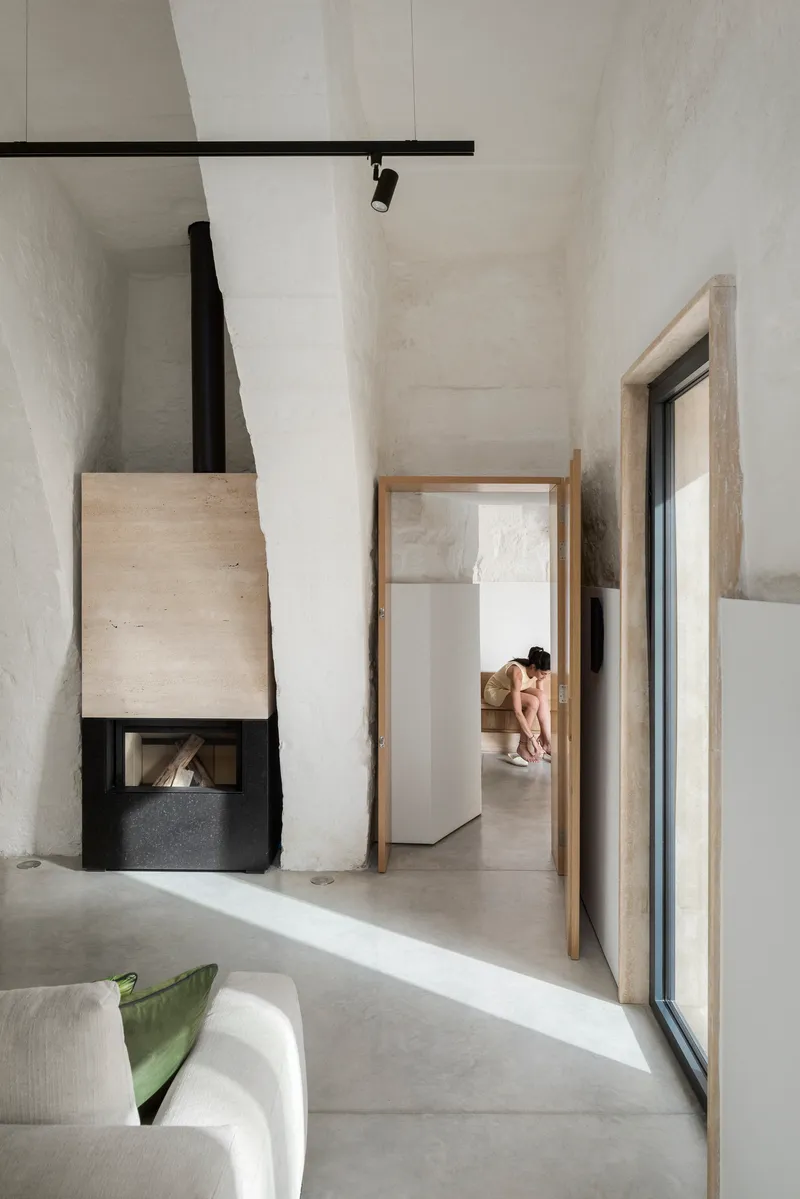
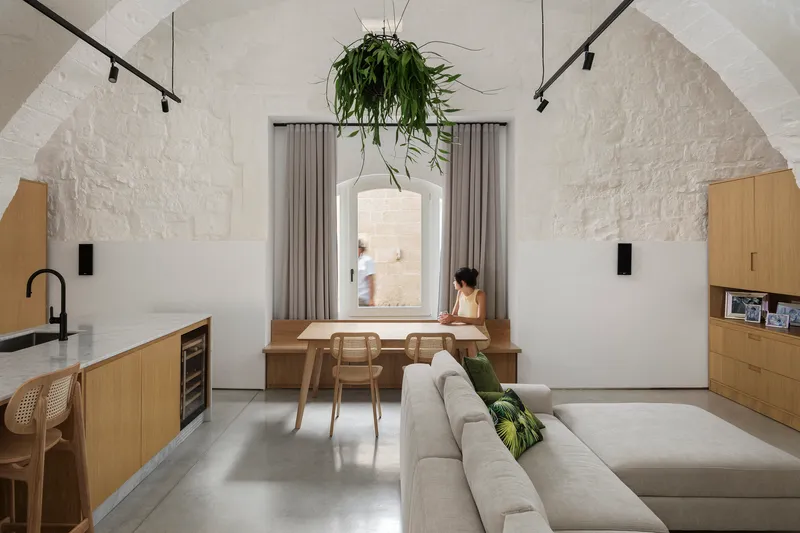
Inside the ground-floor living spaces, the architects slot modern cabinetry between the building's original stone arches. The kitchen island, finished in light oak with a stone countertop, sits beneath a whitewashed vaulted ceiling where the arches are left fully exposed. A corner fireplace with a black metal hood and timber surround frames a view through an open doorway, layering depth without demolishing walls.
The treatment of wall surfaces is worth noting. Rough stonework is left exposed above a line of white-painted panels that wrap the lower wall sections. These panels provide a clean surface for fittings, switches, and outlets without requiring any cutting into the original masonry. It is a smart, respectful detail that avoids the common trap of either hiding heritage fabric entirely or leaving it so raw that the house feels like a museum.
Bedrooms and Bathrooms: Material Calibration
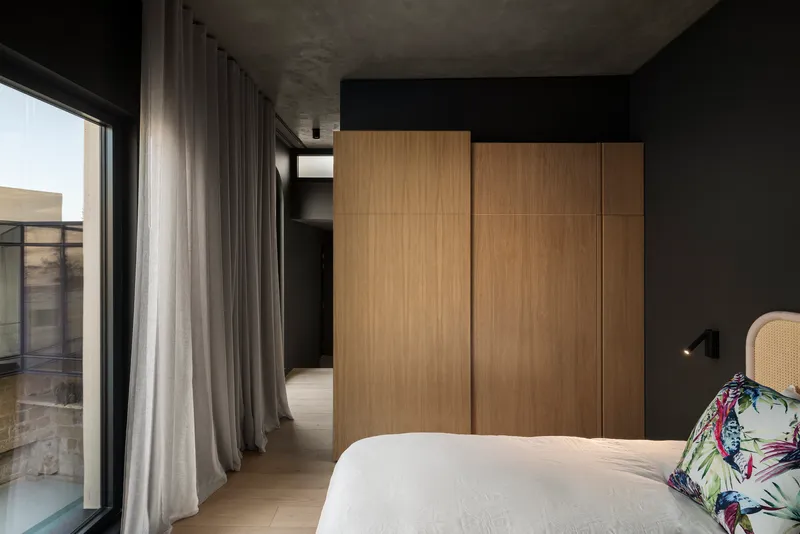
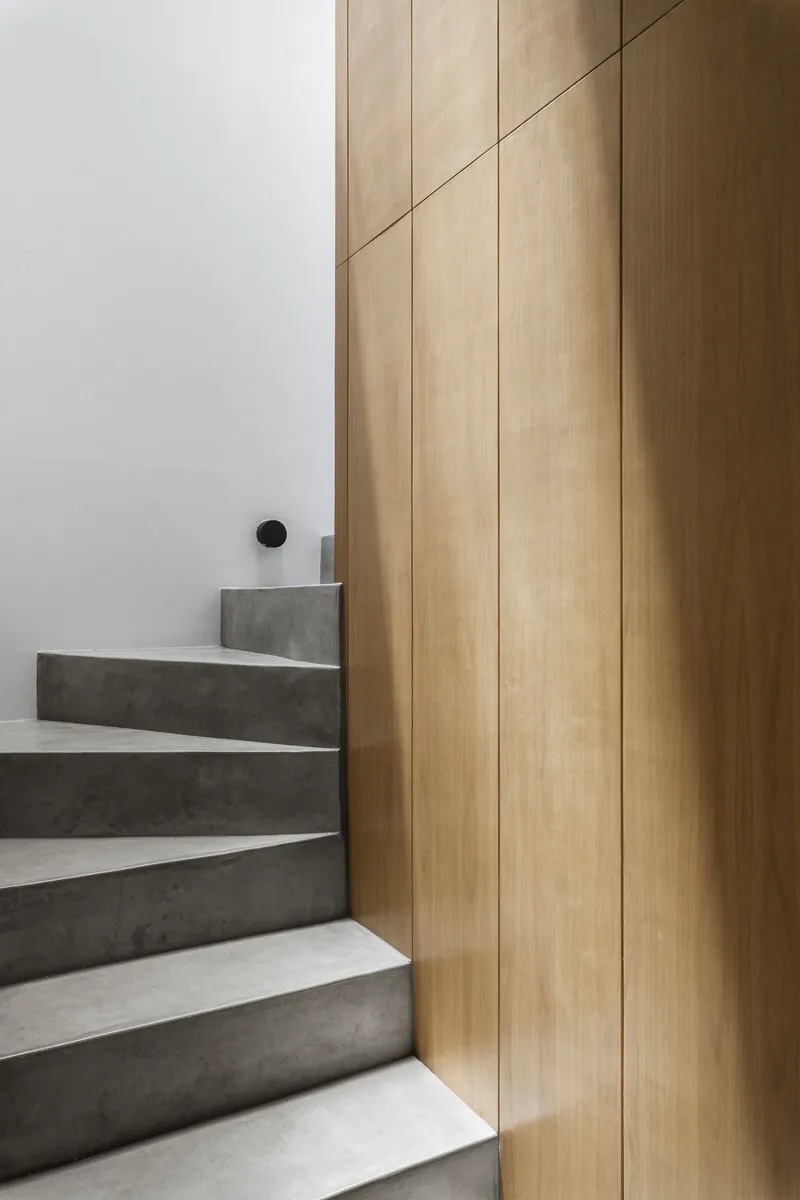

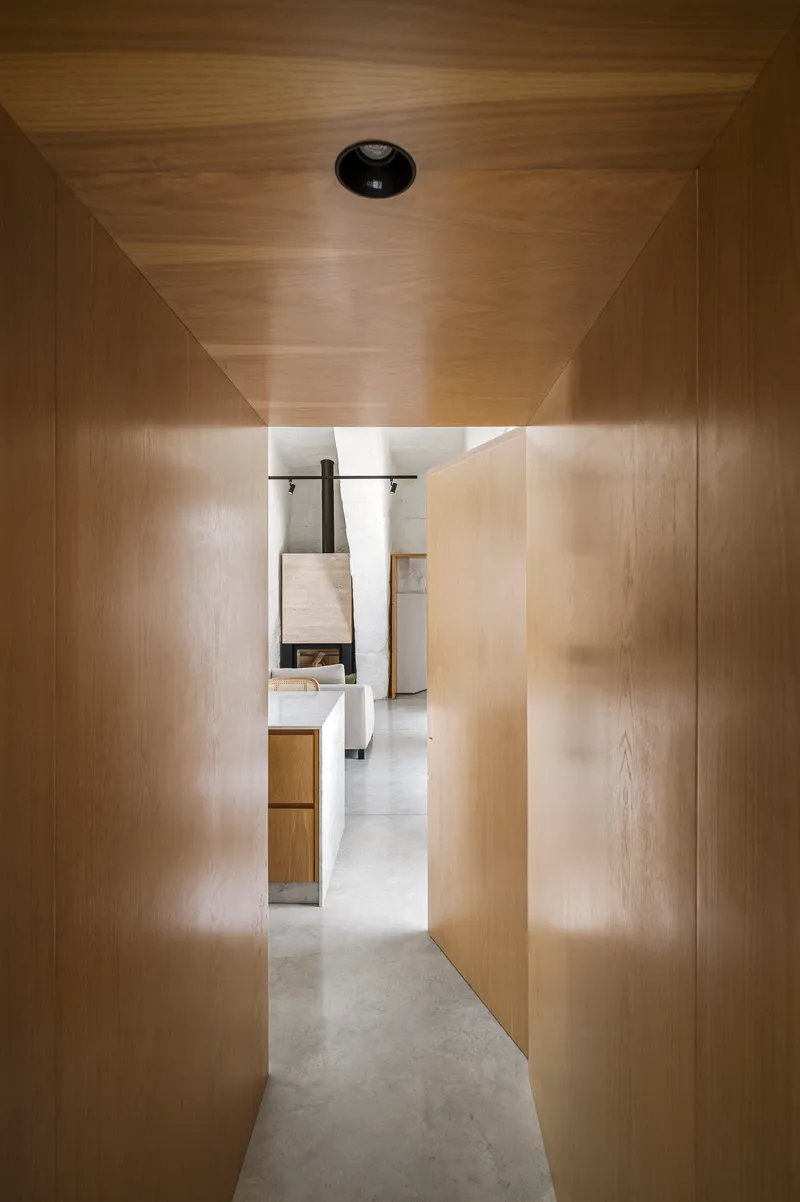
Each of the three bedrooms sits on top of one of the original living blocks, constructed as a new layer above the heritage fabric. Here the material palette shifts: exposed concrete ceilings, pale wood wardrobe panels, and grey curtains replace the rough limestone below. A concrete staircase with white risers meets a vertical oak panel wall, signaling the transition from historic ground floor to contemporary upper level.
Bathrooms continue the calibration. White marble vanities flanked by oak cabinetry sit beneath arched corridors where palm fronds spill in from adjacent planters. The tiled showers are simple and clean. The architects avoid the temptation to carry the rough stone aesthetic into every room; the bedrooms and bathrooms are clearly new, and the honesty of that distinction strengthens both halves of the project.
Corridors and Thresholds
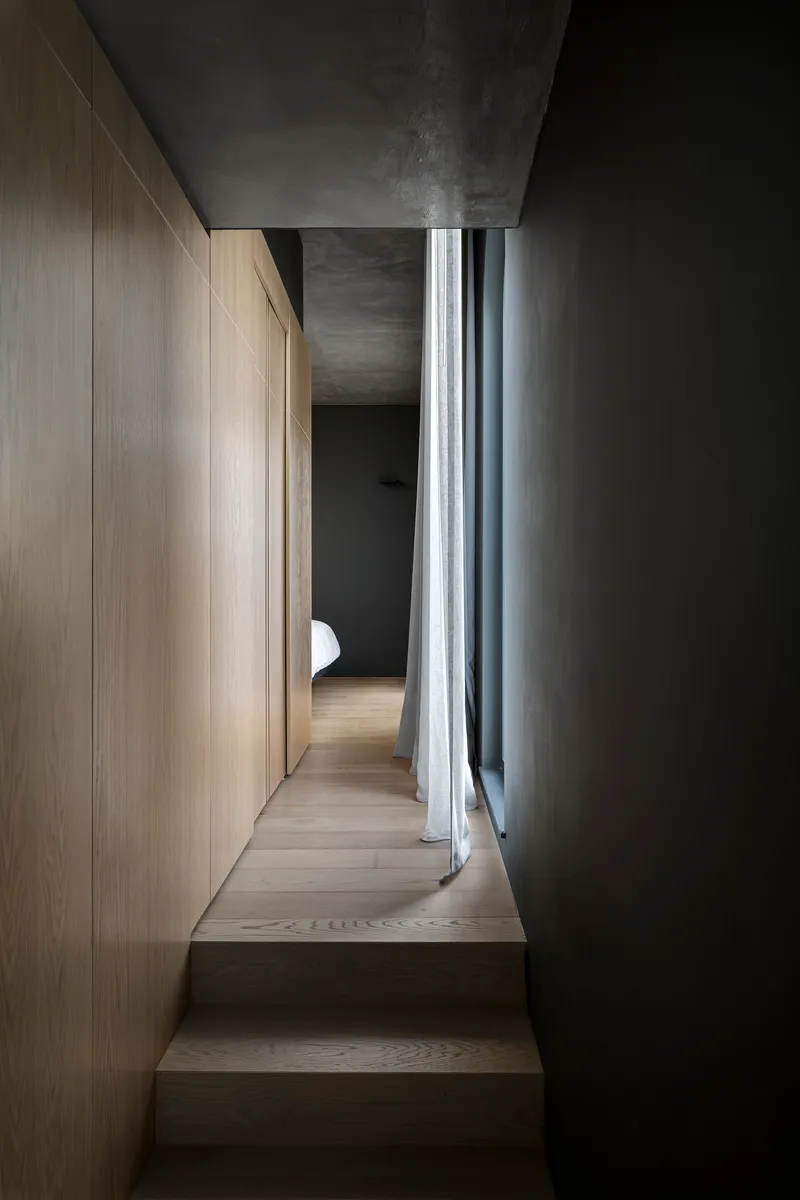

In a house made of three separate buildings, the corridors do serious work. Narrow hallways finished in oak paneling with grey curtains filter daylight and manage the transitions between public and private zones. Timber steps ease level changes between the blocks. The backlit translucent panels in the upper corridor leading toward a bathroom at the far end show the architects thinking about light as a material, not just an amenity.
These in-between spaces are where the project's logic becomes most legible. You are constantly aware that you are moving between distinct volumes, and the shifts in ceiling height, floor level, and light quality reinforce that reading without making the house feel fragmented.
Plans and Drawings

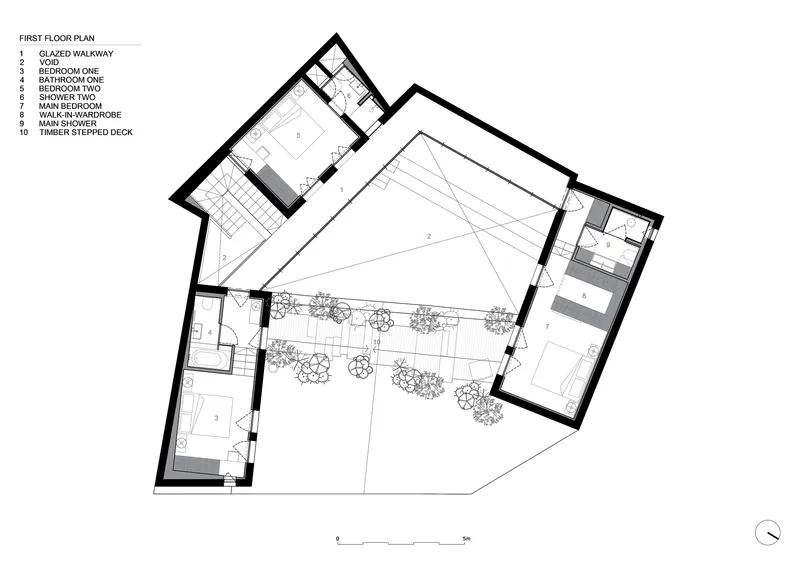
The ground floor plan reveals the irregular pentagonal footprint and shows how the entrance hall, living spaces, and courtyard pool relate to one another. The first floor plan makes the walkway's binding role explicit: it traces a continuous path along two courtyard edges, connecting three bedroom volumes and a timber-stepped deck with a planted edge. Reading the two plans together, you can see how the architects treated the courtyard as the organizational engine and the walkway as the structural ligament.
Why This Project Matters
The Mill House matters because it demonstrates that heritage conversion does not have to be an exercise in deference or domination. Too many projects in listed buildings either tiptoe around the old fabric with invisible interventions or flatten it with conspicuous insertions. Valentino Architects found a third position: occupy the gaps, let the new element be frankly modern, and use materiality and light to negotiate the relationship in real time rather than in a single frozen composition.
The glazed walkway is the project's thesis statement, but the quieter moves are just as instructive. The white-painted panels that protect the original walls, the concrete ceilings that declare the upper bedrooms as additions, the courtyard that refuses to be secondary. At 385 square meters, the house is not large by contemporary standards, yet it feels generous because every square meter has been thought through. For architects working in historically sensitive contexts, this is a project worth studying closely.
The Mill House by Valentino Architects, Attard, Malta. 385 m², completed 2022. Structural design by Perit Ivan Muscat. Photography by Ramon Portelli.
About the Studio
Share Your Own Work on uni.xyz
If projects like this are the kind of work you want to make, uni.xyz is a place to publish your own, find collaborators, and enter design competitions.


Popular Articles
Popular articles from the community


The Ocean Hive: Sustainable Architecture for a Self-Sufficient Civilization at Sea
The Ocean Hive imagines sustainable architecture at sea, where modular habitats, algae, wave power and ocean waste sustain a growing colony.

Play: Fragments of Their World
Familiar architecture becomes modular playground design, creating safe spaces where displaced children can learn, connect, imagine and play.

Co-life: Sustainable Architecture for Age-Friendly Community Living
Co-life reimagines sustainable architecture for seniors through courtyards, rammed earth, shared gardens, and spaces designed for belonging.

The Musturak Paradise: Senior Living Architecture for a Connected Future in Temara, Morocco
The Musturak Paradise reimagines senior living architecture in Temara via private homes, social spaces, culture, community, and shared care.

Similar Reads
You might also enjoy these articles

Bao Huynh Watercolor Atelier: A Serene Art Retreat in Hội An
Bao Huynh Watercolor Atelier in Hội An blends multifunctional art spaces, sustainable design, local materials, and family-friendly living in a serene environment.

Atelier Macri Concept Store Interior Design by CASE-REAL
Atelier Macri store features a "ko" counter, walnut wood details, cork displays, blending retail, gallery, and seamless customer experiences.

Manuel Vargas Izquierdo Stadium and High-Performance Sports Center: Architectural Excellence in Jalpa de Méndez
The Manuel Vargas Izquierdo Stadium blends sustainable design, inclusive sports facilities, and cultural-inspired architecture, revitalizing Jalpa de Méndez’s public spaces.

KAKR Buluh Awar Hall: Revitalizing Community and Ecology Through Bamboo Architecture
Community built bamboo hall revitalizes Buluh Awar village, empowering youth, restoring ecology, celebrating vernacular craftsmanship through sustainable architecture and culture.
Explore Power Generation Competitions
Discover active competitions in this discipline

Challenge to design mud housing for contemporary communities

Challenge to reimagine the Iron Throne

Photograph architecture without architects

Illustrate the lost glory of Angkor Wat - Render Challenge
Comments (0)
Please login or sign up to add comments
No comments yet. Be the first to comment!