
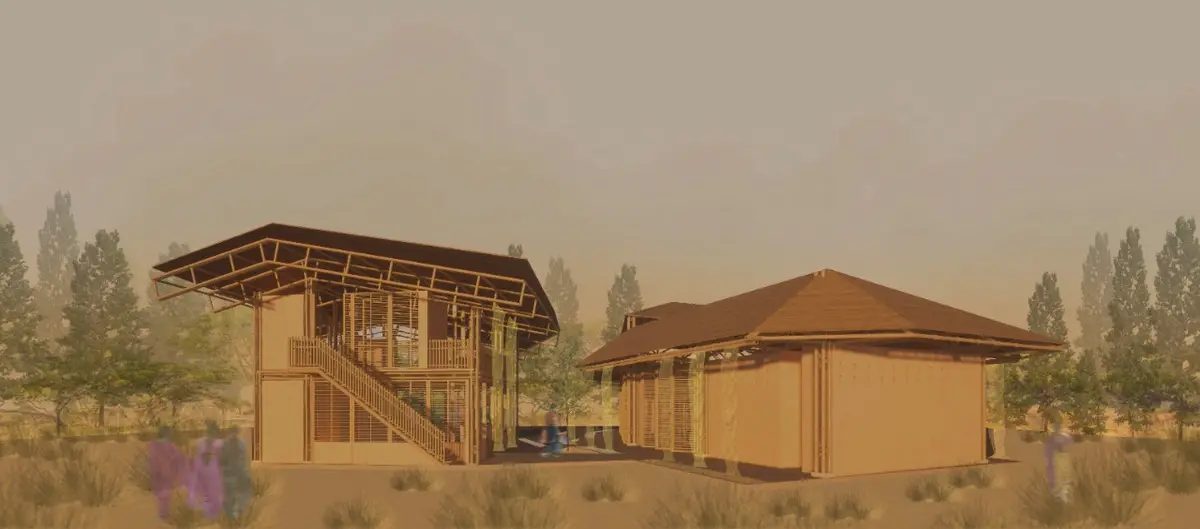
Versatile spaces for a dynamic community
Versatility as a tool for development

Our project begins with the idea of forming dynamic spaces that can potentially have multiple purposes that adapt to the needs of the local women’s community based on India’s tradition of weaving knowledge and practices. This has the objective of creating a community around the act of weaving: threading the textile, drying the fabric, designing a cloth, wearing it, and celebrating around it. Therefore, the activity becomes a source of income from a local tradition that empowers women’s existing skills, encouraging leadership and teamwork, whilst socializing and entertaining. All these possibilities generate a demand for a program that aims for flexibility in uses within a set limited number of spaces, creating a safe environment for women to develop financially and educationally.
Settling on the site
Observing the site, we noticed features that would serve as a tool to determine the disposition of elements. The terrain, although not particularly challenging, could be a guide to positioning the project on the site. This could be articulated with potential flows of people created by the surrounding trees, buildings, and, especially, roads. We had to include gestures that facilitated the flow of people, particularly from west to east or vice versa. The availability of the building area south of the site also suggested that we had to open the building to have a dialogue with a possible future building that could come after. Hence, there were forces from most of its sides trying to shape the project. Interacting with activity taking place in all its surroundings, we considered it appropriate to have a project that allowed for more intimate and protected spaces to exist towards its center and social spaces on its perimeter. Initially, we thought of patio typology as the solution, but as we progressed, this was transformed into a more open and terrain-aware distribution of space.
Researching
We come from a country distant from India and its culture, so it was important for us to understand the context through research. We investigated local materials, through information posted by the local botanical garden, but our main objective was to find opportunities in the culture and local business activities. We understand that Waghai is a place known for its agriculture. It even hosts important agricultural schools, and the region has been recognized for its sustainable vernacular farming methods. However, we thought it would be redundant to have a coworking environment built around agriculture since this was already very well established. We saw opportunities in providing spaces to work with textiles, since local women probably already have at least some basic knowledge in this area and it could be articulated with the agricultural industry, obtaining the materials from locally produced resources. This could be very attractive, from a business perspective, in a market interested in sustainably produced goods sourced from local traditions.
Iterating
Initially, after discussing to have a common understanding of the context of the project, we decided to split up and have each of the team members come up with solutions to distributing the building. This created a quick method of iterating and brainstorming. Through this, we noticed that we had some similarities in how to solve the project; mainly morphological. We identified that we wanted to have most of the activity happening on the ground floor, that way we could achieve an accessible and inclusive community center for everyone, including people with impaired mobility. Additionally, although the program suggests having a 0.8-floor area ratio, we considered that meeting this would not be necessary to include all demanded uses for the local population, considering that the town is small and space versatility was our concept.
Defining the program
We finally divided the project into 2 blocks, one dedicated to services and social spaces and the other to work. These 2 would be linked through a patio that would also serve as the primary way of accessing the project. At the center of the social block, we placed the main room which would also be the most versatile space. Although the workshop is very important, we wanted the activity of gathering and celebrating to be the protagonist in the program distribution.
Choosing materials
We chose the materials after we found that vernacular architecture uses adobe for small, single-floor buildings. This could be useful since it met some of our project characteristics. Additionally, we wanted to have a light structure for the roof, not built with industrial materials but with a locally grown product that could quickly and affordably be replaced by locals if it was needed. Hence, we picked bamboo for it. We understand that this material is already used for vernacular building in other parts of India, and it happens to be a common plant in the Dang province.
How is the objective met?
The elements that allowed for versatile, flexible spaces to exist were mainly related to the choices for walls and doors, and the structure of the project. The main room is defined by sliding doors that are placed on most of the perimeter. These not only allow much-required ventilation but also allow the room to expand from its boundaries and merge with other rooms or blend with the exterior part of the project. The structure allows for this to happen as it does not interfere with the space inside the room and it makes it possible to not have structural walls. The workshop has similar features which make it possible to change the type of workshop if desired.
Future of the project
We aim for the project to be adaptable in the future. The space versatility goal allows for the built environment to quickly change its use. And it can be repurposed by the community if needed. Even the workshop can have a different use since it does not have use specific features that hinder the space’s ability to adapt to the people who use it but furniture. The project might change over time, especially considering that there is space for new buildings right next to the site. We expect the choice of materials to be important when it comes to adapting and expanding to the project. The bamboo structure has the potential of being disassembled and rebuilt, unlike other more industrial materials. Additionally, we think that the distribution achieved allows the project to become a central node in further development as it considers an active environment as its surroundings.


Popular Articles
Popular articles from the community


Juan García Correa, John González and Claudia Rueda Sink a Circular Amphitheater into a Manizales Engineering Building
On the La Nubia campus in Manizales, Colombia, the S1 Building folds labs and offices into a hillside of ramped lawns that double as a campus route.

David Ortega Stacks a Two-Story Mexico City Penthouse Around a Steel Stair and a Pergola-Shaded Roof Terrace
In Colonia Roma, a 300 m² penthouse uses oak joinery, a planted steel stair and a slatted roof pergola to make a new-build apartment feel like a house.


Singing Woman: An Opera House That Performs Before the Curtain Rises
Ovidiu Cristian Pavel's conceptual opera house translates Estonia's choral identity into a sculpted waterfront landmark facing the Baltic Sea.

ETEH Reworks the Shared Spaces of São Domingos School in Brazil Around Timber, Color and Hanging Plants
At São Domingos School in Brazil, 436 m² of hall, refectory and library are recast with timber joinery, a yellow and blue code and trailing greenery.

Similar Reads
You might also enjoy these articles

The Rhythm of Seasons
A Farmers' Market Connecting Nature and the City

More Than a Building-Designing a Living System
More Than a Building-Designing a Living System
Base Beyond
DESERT COMPOUND ARID: TOURISM OF ABSENCE AND ABUNDANCE

Comments (0)
Please login or sign up to add comments
No comments yet. Be the first to comment!