

Vertical Green: Turning Obsolete Parking Garages into Modular Living Systems
A shortlisted Plugin Housing entry that retrofits multistory garages with prefabricated modules, vertical gardens, and community infrastructure.


What happens when the parking garage down the block becomes irrelevant? The rise of autonomous vehicles, ride-sharing, and remote work is draining the purpose from thousands of multistory concrete structures in city cores across the world. Vertical Green answers that question by treating these obsolete structures not as demolition targets but as scaffolding for a new kind of urban life: modular housing complexes wrapped in vegetation, stacked with prefabricated living units, and activated by public plazas and retail at grade.
Designed by Jordan Overton and Edgar Ruiz, the project was shortlisted in the Plugin Housing Challenge 2020. The proposal confronts a staggering baseline statistic: the U.S. generates roughly 750 kilograms of waste per person annually, much of it tied to construction. Rather than contributing to that pile, Vertical Green preserves approximately 65% of an existing parking garage's structure and layers onto it a mixed-use program that reduces embodied energy while multiplying the building's social and ecological value.
Prefab Modules That Lock into Existing Concrete
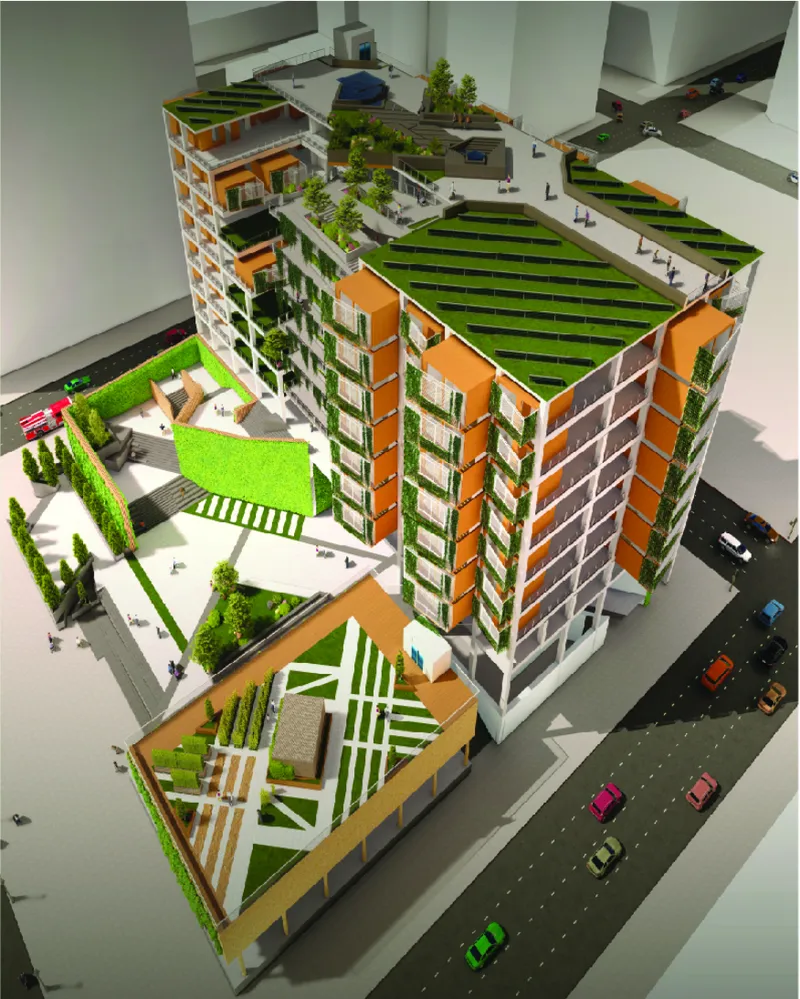
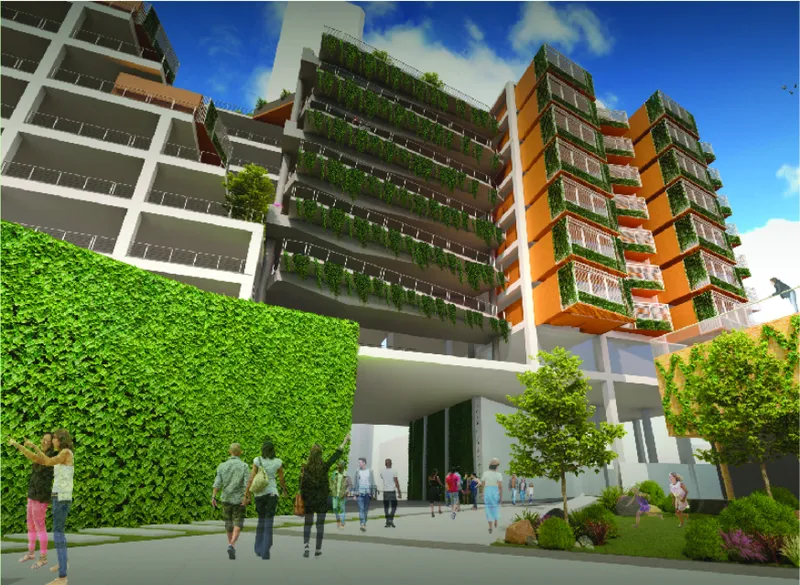
The physical model reveals the project's fundamental logic: compact residential modules, delivered by flatbed truck and lifted by crane, slot into the retained concrete frame of the garage. Available in two configurations (20'x30' and 17'x17'), each module is built off-site to minimize on-site waste and construction impact. The cantilevered volumes push beyond the garage footprint, gaining floor area and creating shaded terraces below. Curtain wall glazing on the module faces draws daylight deep into compact interiors, while planted balconies cascade green across the facade.
At ground level, the rendering shows how the transformation reads from the street. The grey infrastructure of the original garage vanishes behind lush vertical gardens and timber-clad modules. Pedestrians move through a generous public plaza rather than navigating car ramps. The tower's massing breaks down into visible, human-scaled units, each one distinct yet interlocking like a sustainable puzzle, as the designers describe it.
Cutting Through the Section: Transit Below, Gardens Above
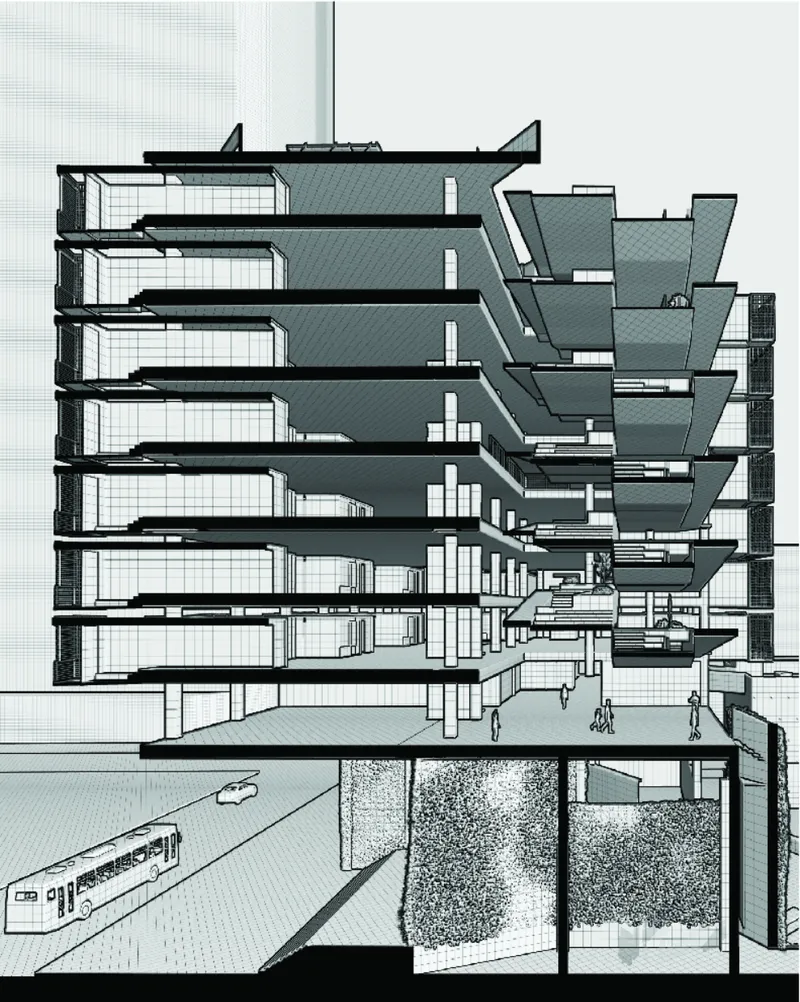
The section drawing is where the full ambition of the project becomes legible. Below grade, an underground transit station anchors the scheme to public transportation, reducing car dependency from the outset. Above, the retained garage structure is partially stripped of its original ramps and vertical columns, replaced by vertical gardens and new circulation pathways for pedestrians. The modules stack within and atop this frame, their balconies creating a staggered profile that admits air and light between units. Retail occupies the lower levels, while residential floors step back as they rise, generating rooftop terraces and communal green space at multiple elevations.
The material palette reinforces the ecological ambitions. Light gauge steel frames provide structural support while keeping weight low, a critical factor when loading new program onto an existing concrete structure. Exterior wood paneling offers warmth against the steel, and OSB sheathing combined with waterproof membranes protects the interior envelope. Aluminum guardrails line the balconies and circulation zones. Every material choice points toward circularity and reduced lifecycle impact.
Rooftop Landscapes That Serve Residents and the City
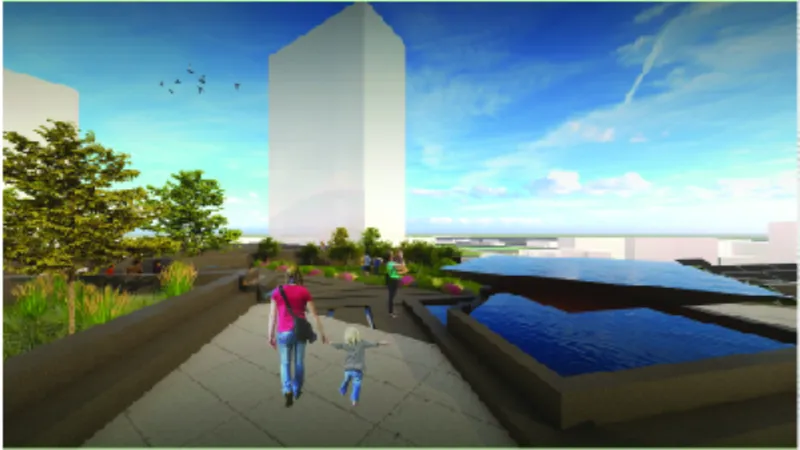
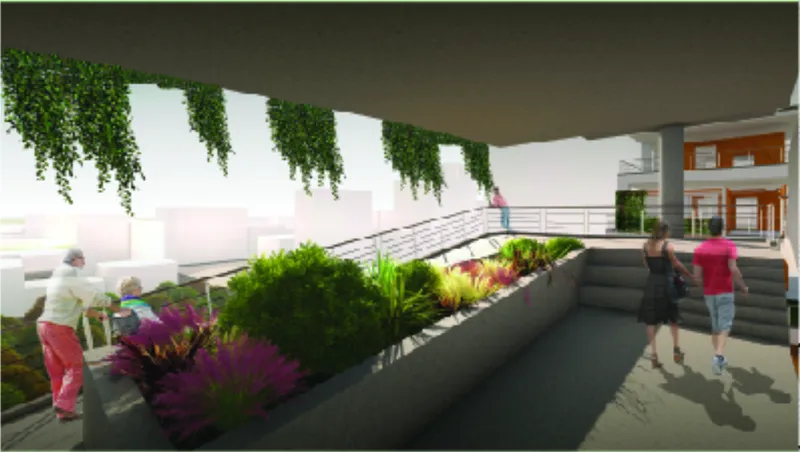
The rooftop terrace rendering captures a moment of quiet domesticity that feels miles from the parking garage below. A reflecting pool sits among planted beds, and a figure walks with a child across the open deck. It is a convincing image of how adaptive reuse can generate new public amenity rather than simply replacing old private function. The covered outdoor terrace at dusk extends this logic: hanging plants and raised planting beds create a sheltered microclimate where residents gather in the transitional space between interior and sky.
These spaces are not decorative afterthoughts. The vertical garden system covering the exterior walls insulates the modules, improves ambient air quality, and softens the building's presence within its urban context. Natural ventilation through the terraces and open balcony corridors reduces mechanical cooling loads. Green infrastructure here is structural strategy, not ornament.
Growing Food Where Cars Once Parked
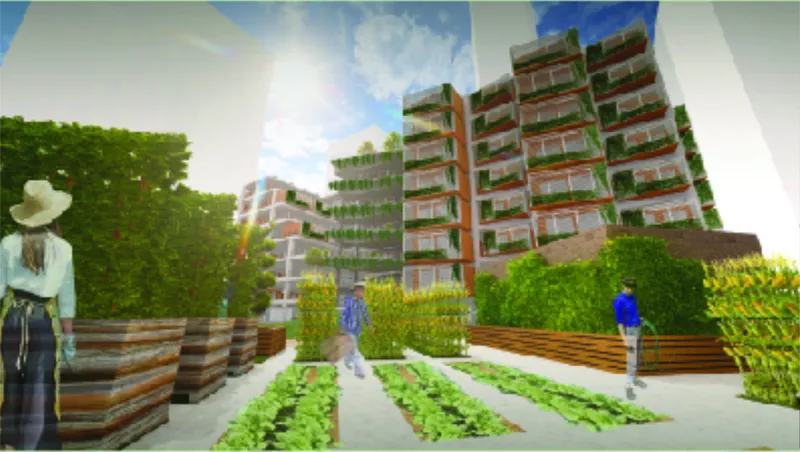
The community garden, with its raised lettuce beds, timber planters, and low hedges, pushes the project beyond housing into the territory of urban food production. Locating food growing within a repurposed parking structure is a pointed statement about shifting priorities. The image is bright, sun-soaked, and productive, a complete inversion of the dim, exhaust-filled garage it replaces. Combined with the green plazas and pedestrian zones at the base of the building, these shared gardens foster the kind of daily, low-key social interaction that knits a vertical community together.
Why This Project Matters
Vertical Green is compelling not because it proposes a single flashy gesture, but because it layers multiple pragmatic strategies into one coherent system. Adaptive reuse preserves 65% of an existing structure's embodied energy. Prefabricated modules arrive ready to install, sidestepping the waste and disruption of conventional construction. Vertical gardens, reflecting pools, and community food plots transform formerly hostile infrastructure into social and ecological assets. Each decision compounds the next.
For cities wrestling simultaneously with housing shortages, aging infrastructure, and climate targets, the project offers a scalable template. Overton and Ruiz demonstrate that the most radical act in sustainable architecture may not be building something new at all. It may be recognizing what is already standing, understanding why it is failing, and systematically reinventing it for a future that demands more from every square meter of urban ground.
View the Full Project
About the Designers
Designers: Jordan Overton, Edgar Ruiz
Enter a Design Competition on uni.xyz
uni.xyz runs architecture and design competitions year-round that reward proposals with spatial conviction and real site intelligence.
Project credits: Vertical Green by Jordan Overton, Edgar Ruiz Plugin Housing Challenge 2020 (uni.xyz).


Popular Articles
Popular articles from the community


Temporary Home for Dogs: A Reversed Zoo Rethinks Animal Shelter Architecture
In Bucharest, a sinuous corridor and freed landscape flip the logic of containment, designing a shelter that works to make itself unnecessary.

Singing Woman: An Opera House That Performs Before the Curtain Rises
Ovidiu Cristian Pavel's conceptual opera house translates Estonia's choral identity into a sculpted waterfront landmark facing the Baltic Sea.

The Amber Palace Opera: A Geological Fiction Surfaces on Tallinn's Baltic Waterfront
Pierre Brillard reimagines a Baltic legend as a public landscape, opera house, and waterfront promenade rooted in Tallinn's coastal identity.

Manzana Morphosis: Stretching Barcelona's Grid into a Living Landscape for 2050
A radical reworking of the Eixample manzana turns density into a tool for generous public space, vertical ecology, and environmental performance.

Similar Reads
You might also enjoy these articles

Shakur's House: Exposed Brick as an Interior Organiser in a 168 m² Mashhad Residence
Brick moves indoors in this Mashhad residence, where masonry walls, glass partitions and teal planes sequence a compact home without closing it off.

Day and Night Park: A Time-Based Urban Newsstand in Beijing
A temporary urban newsstand in Beijing blending travel, light, and reading through poetic colors, compact form, and community-focused design.

Modernist Patio Renovation in El Masnou, Barcelona by Oliver Segura Arquitectura + Cebrià Arquitectura
Modernist patio renovation blending tradition and innovation with a movable pool, leveled floors, and Catalan materials in El Masnou.

Alto Residencial Coop: Cooperative Housing Development in Santiago de Compostela by Carbajo Barrios Arquitectos
A linear cooperative housing complex blending white volumes and perforated metal façades, enhancing community living, natural light, privacy, and urban integration.


Comments (0)
Please login or sign up to add comments
No comments yet. Be the first to comment!