
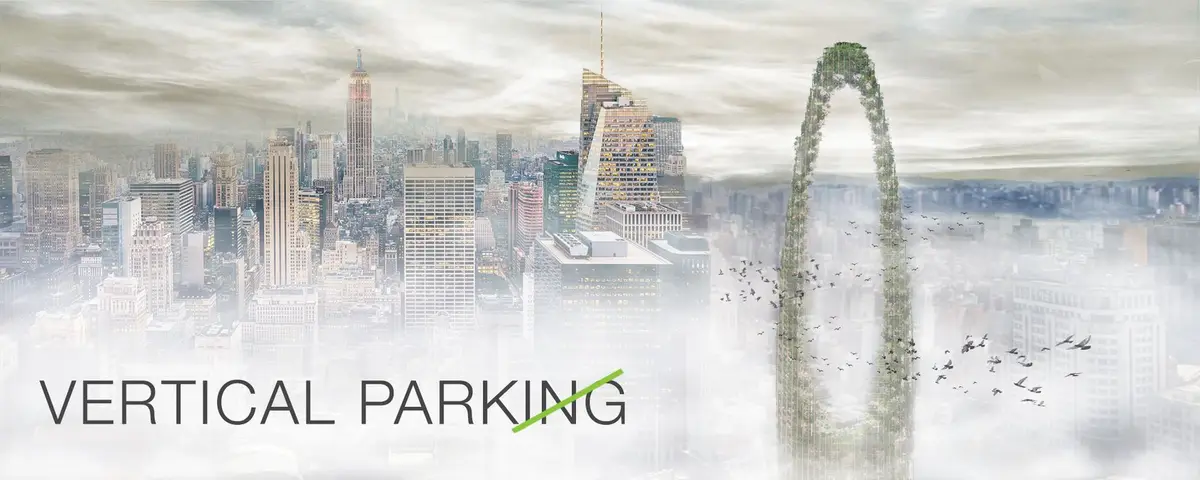
Vertical Park: Turning Parking Towers into Living Urban Ecosystems
A hollow loop of vegetation, vertical farming, and automated car storage reimagines high-density infrastructure as climate repair.


What if the most banal piece of urban infrastructure, the parking garage, could clean the air, grow food, and give a neighborhood a public park? The Vertical Park starts with that provocation and pushes it skyward, replacing the familiar concrete slab tower with a hollow, vegetation-clad loop that merges automated car storage with vertical farming, rooftop water features, and glass observation decks. It is a parking structure that refuses to behave like one.
Designed by Omar El Halfawy and Omar Atef, the project received a Jury Commendation in the Yo Parking 2019 competition. Set within a dense urban skyline, the proposal addresses a familiar tension: cities need more parking capacity, but they also desperately need more green space, cleaner air, and stronger community infrastructure. The designers' answer is to collapse all of those demands into a single vertical figure.
A Hollow Loop Rising Above the Skyline
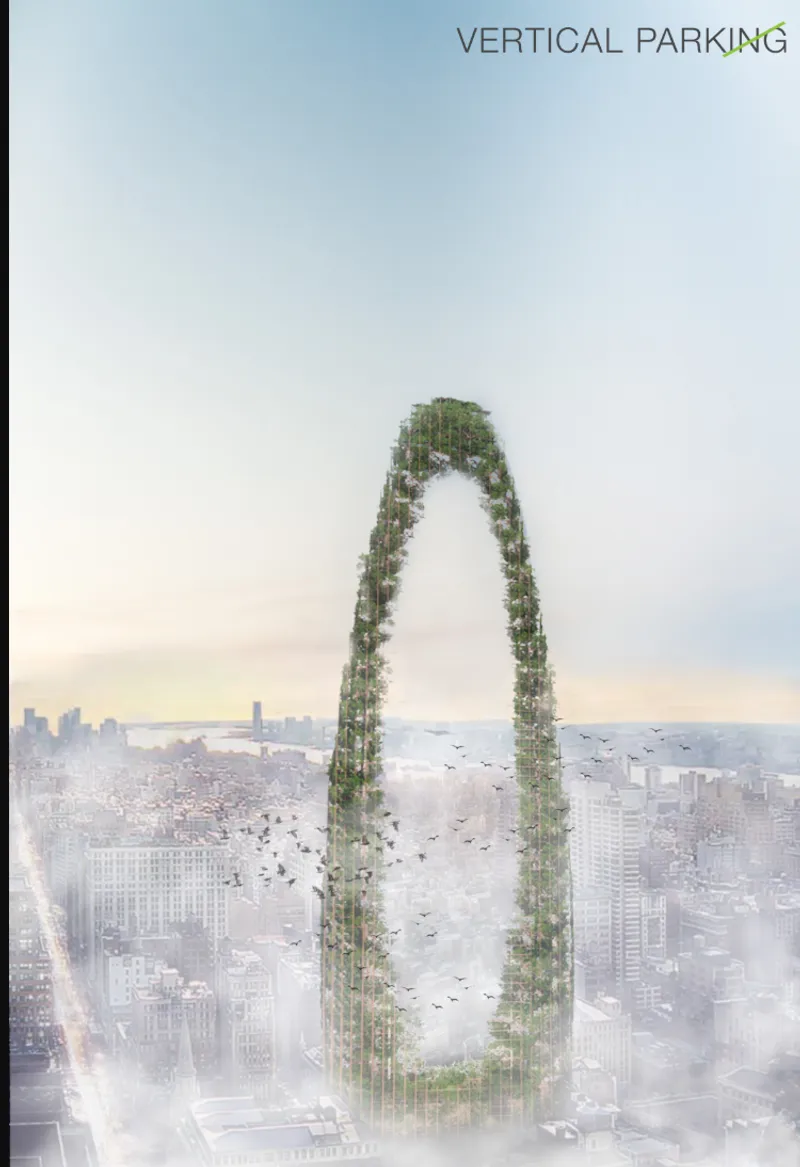

The tower's defining gesture is its form: a slender arch, or U-shaped loop, that rises as two tapering legs and reconnects at the top. The shape is deliberately porous. Rather than presenting a monolithic wall to the city, the hollow center allows natural light and wind to pass through the structure, ventilating the parking bays and farming zones stacked within. The aerial rendering makes this legible instantly: cascading vegetation drapes the exterior while the open core ensures the building breathes.
The programmatic diagram breaks the loop into clearly defined zones. Automated multi-level parking occupies the lower and mid sections, where mechanical slots eliminate ramps and maximize spatial efficiency while integrating EV charging docks. Above that, controlled-environment vertical farming produces food and generates oxygen using significantly less land and water than conventional agriculture. Green roofs, glass floor observation areas, and a rooftop pond and waterfall system cap the structure, creating a microclimate that actively reduces surrounding heat and smog.
A Green Envelope of Oak and Climbing Vegetation
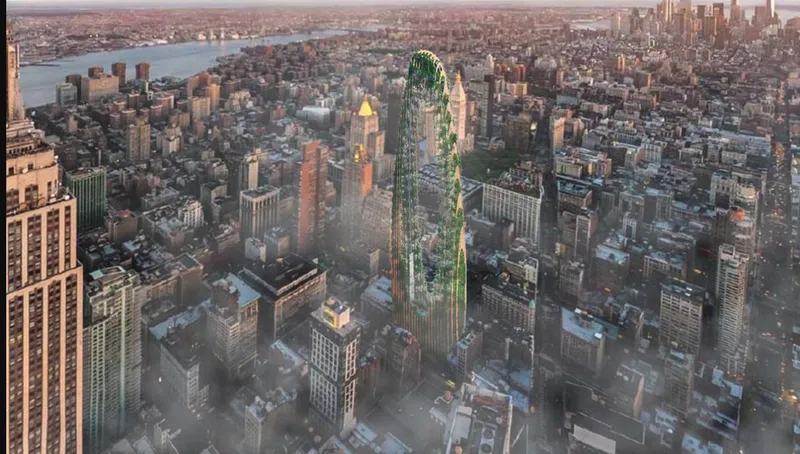

At dusk, the plant-covered arch glows against the waterfront like a second geological formation. The green envelope is not decorative wallpaper; it performs. Climbing vegetation and locally sourced oak wood framing soften the urban skyline while providing insulation and shade. Perforated metal mesh panels sit beneath the planting, handling ventilation and noise control for the parking levels inside. The material palette is deliberately low-tech and climate-responsive, leaning on biophilic principles rather than energy-intensive mechanical systems.
The street-level view is equally telling. Framed by neighboring office buildings, the tower reads not as a parking garage but as a vertical park that happens to store cars. Public accessibility is a core design ambition: teleferics, glass observation decks, and gathering spaces invite citizens into what would otherwise be a closed utilitarian box. The designers argue, convincingly, that parking infrastructure should give back to the city at every level, not just at the ground floor lobby.
Section Logic: Stacking Ecology and Efficiency
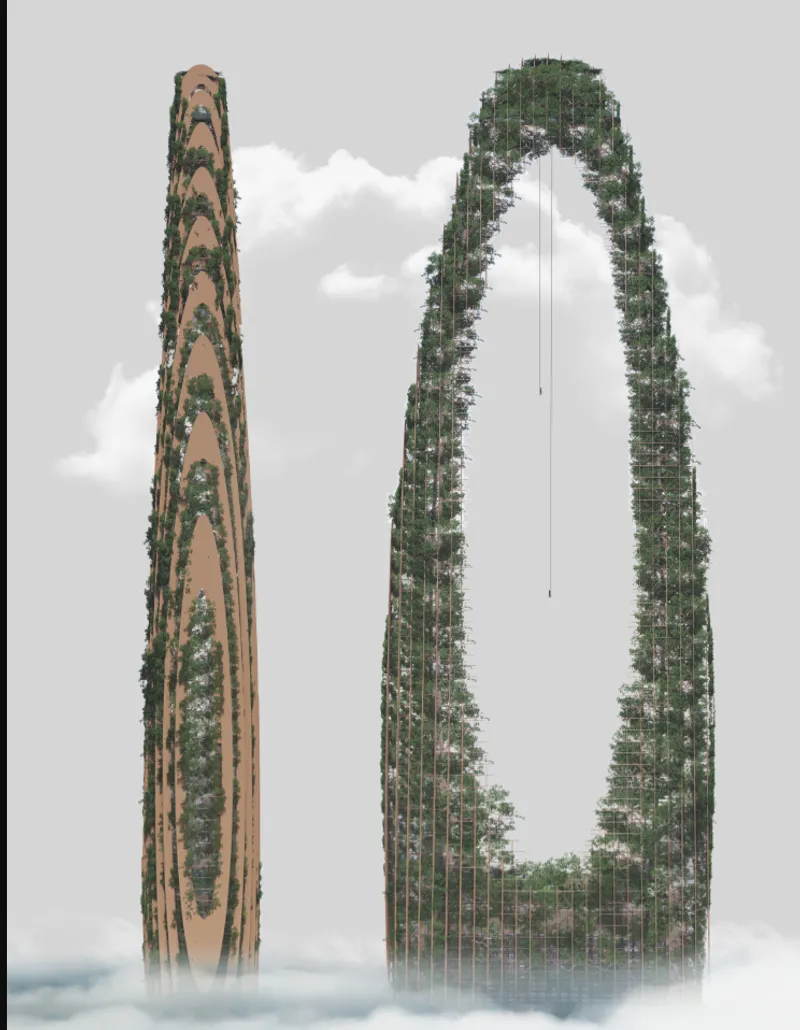
The section drawing strips away the greenery and reveals the structural skeleton: two tapering legs connected at the crown, with planting zones distributed across floors and within the building envelope itself. Internal circulation serves both the automated parking system and the public programme, keeping vehicle movement separate from pedestrian experience. The rooftop waterfall feeds downward through the structure, contributing to a natural cooling cycle that counteracts the heat island effect typically generated by concrete-heavy developments.
What the section makes clear is that every square meter is pulling double duty. Parking bays sit behind farming walls. Structural framing doubles as planting trellises. Glass floors serve both as observation platforms and as daylight conduits for lower levels. The layering is ambitious, and while the concept would face significant engineering challenges at full scale, the spatial logic is disciplined enough to feel plausible rather than purely utopian.
Why This Project Matters
Most parking garage redesigns stop at wrapping a conventional structure in a nicer skin. El Halfawy and Atef go further by questioning the entire program. Their Vertical Park does not merely accommodate cars; it leverages the vertical real estate that parking demands to address food production, air quality, public recreation, and urban cooling simultaneously. The hollow loop form is the key move: it transforms a normally introverted building type into something permeable, visible, and communal.
The project's strength lies in its refusal to treat sustainability as an add-on. The rooftop pond, the vertical farming, the oak and mesh envelope, the automated systems that eliminate ramps and reduce the building's footprint: these are not features bolted onto a parking garage, they are the parking garage. That integration is exactly the kind of thinking high-density cities will need as they retrofit their infrastructure for climate resilience. The Vertical Park proposes that the most mundane buildings in a city could become its most ecologically productive ones.
View the Full Project
About the Designers
Designers: Omar El Halfawy, Omar Atef
Enter a Design Competition on uni.xyz
uni.xyz runs architecture and design competitions year-round that reward proposals with spatial conviction and real site intelligence.
Project credits: The Vertical Park by Omar El Halfawy, Omar Atef Yo Parking 2019 (uni.xyz).


Popular Articles
Popular articles from the community


Cloaked Colonization: A Mobile Underwater Habitat That Moves Like a Fish
Micah Abaya's shortlisted EHC Pacific entry reimagines ocean settlement as a dispersed network of self-sustaining architectural organisms.

Manzana Morphosis: Stretching Barcelona's Grid into a Living Landscape for 2050
A radical reworking of the Eixample manzana turns density into a tool for generous public space, vertical ecology, and environmental performance.

Extended Shell: Retrofitting Kolkata's Balconies as Living Urban Thresholds
A modular retrofit system recovers the social and environmental intelligence of Kolkata's historic verandas for contemporary Park Street residents.
Temporary Home for Dogs: A Reversed Zoo Rethinks Animal Shelter Architecture
In Bucharest, a sinuous corridor and freed landscape flip the logic of containment, designing a shelter that works to make itself unnecessary.

Similar Reads
You might also enjoy these articles

Shakur's House: Exposed Brick as an Interior Organiser in a 168 m² Mashhad Residence
Brick moves indoors in this Mashhad residence, where masonry walls, glass partitions and teal planes sequence a compact home without closing it off.

Day and Night Park: A Time-Based Urban Newsstand in Beijing
A temporary urban newsstand in Beijing blending travel, light, and reading through poetic colors, compact form, and community-focused design.

Modernist Patio Renovation in El Masnou, Barcelona by Oliver Segura Arquitectura + Cebrià Arquitectura
Modernist patio renovation blending tradition and innovation with a movable pool, leveled floors, and Catalan materials in El Masnou.

Alto Residencial Coop: Cooperative Housing Development in Santiago de Compostela by Carbajo Barrios Arquitectos
A linear cooperative housing complex blending white volumes and perforated metal façades, enhancing community living, natural light, privacy, and urban integration.

Comments (0)
Please login or sign up to add comments
No comments yet. Be the first to comment!