

VIASCAPE Design Transforms the Underside of a Shanghai Light Rail into a Technicolor Public Park
A formerly blighted stretch beneath Metro Line 3 in Shanghai becomes a vibrant, color-coded landscape of sport, play, and repose.


Beneath Shanghai's Metro Line 3, a stretch of concrete columns and leftover asphalt once served as informal parking lots and a dumping ground for illegal sheds. Starting in 2022, VIASCAPE design, led by Sun Yijia, began converting these residual strips into something the Caoxi Road neighborhood had never really had: a proper public park. Completed in March 2025, the project spans 3,540 square meters and does something deceptively simple. It assigns bold, unmistakable colors to distinct programs, ping pong in pink, basketball in teal, children's play in yellow, then threads them all together with planting beds that climb the very piers holding the railway overhead.
What makes the project more than a colorful facelift is its frank acceptance of the infrastructure above. The viaduct is not hidden or apologized for. Instead, its rhythm of columns and its deep concrete soffit become the spatial framework within which courts, gardens, and walkways sit. Vines colonize the piers, softening them without disguising their scale. The result is an urban interior that feels both sheltered and open, a room whose ceiling happens to be a railway. It is a legible argument for treating infrastructure not as an obstacle to public life but as the scaffolding for it.
Pink Zone: Sport as Street Theater

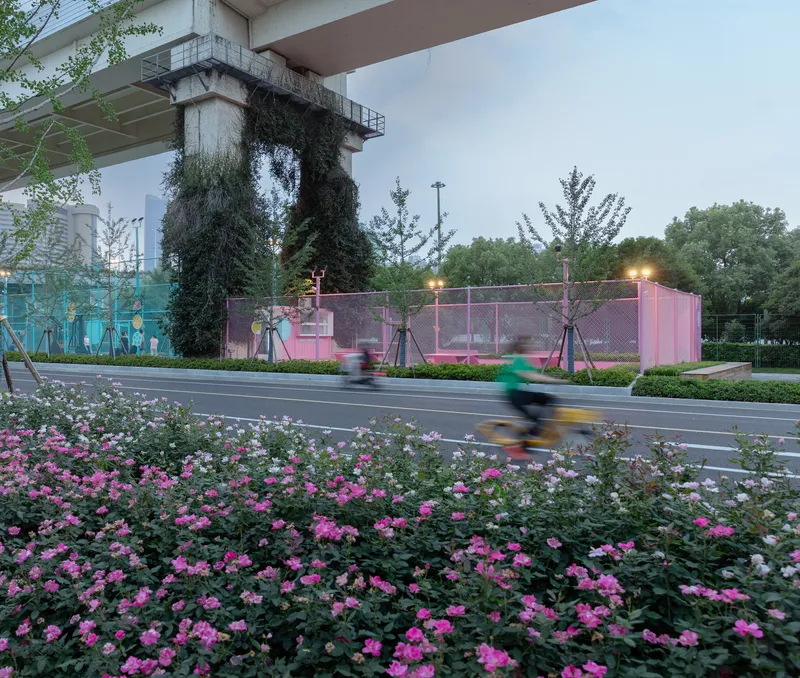

The pink mesh enclosures are the project's calling card. Stretched between slender frames, the fencing defines ping pong courts and small recreational zones while remaining porous enough to let passersby see in. Cyclists on the adjacent road catch flashes of neon through the gaps. At dusk, the concrete above turns a warm grey against the synthetic color below, and the whole assembly reads less as a sports facility and more as a pop-up stage set. Flowering beds at the base of the vine-covered piers reinforce the sense that the harsh infrastructure corridor has been domesticated without being erased.
The graphic motifs printed onto the mesh panels are worth noting. Rather than generic athletic branding, they seem calibrated to make the enclosures register as objects with personality from the street. In a neighborhood of grey apartment slabs and elevated roadways, that kind of deliberate visual warmth matters.
Teal and Yellow: Courts That Sort Themselves

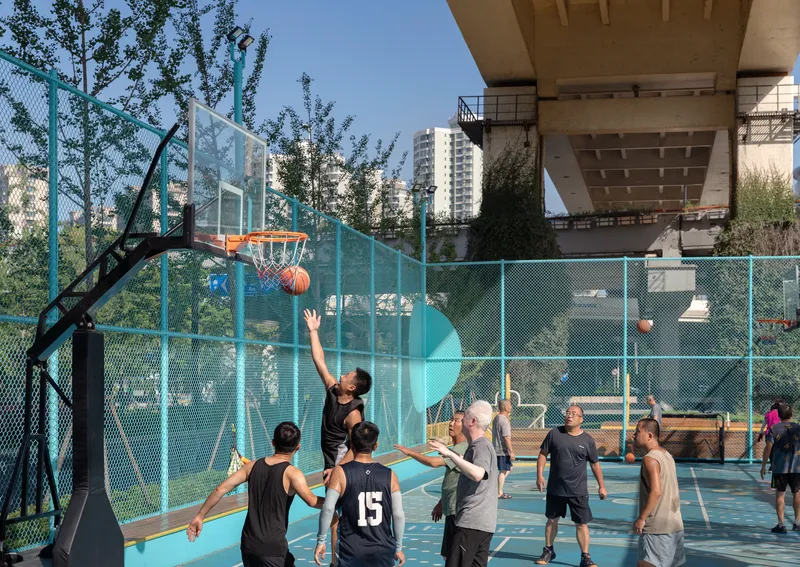

Basketball occupies the teal zones, the deepest color in the palette and the one that absorbs the most shadow from the viaduct above. On overcast days the courts almost glow against the concrete soffit. Players spill across surfaces painted with crisp white markings, and the turquoise mesh fencing keeps balls in play while maintaining sightlines to the surrounding streetscape. The effect is of an outdoor gymnasium that feels surprisingly generous for a leftover strip of land.
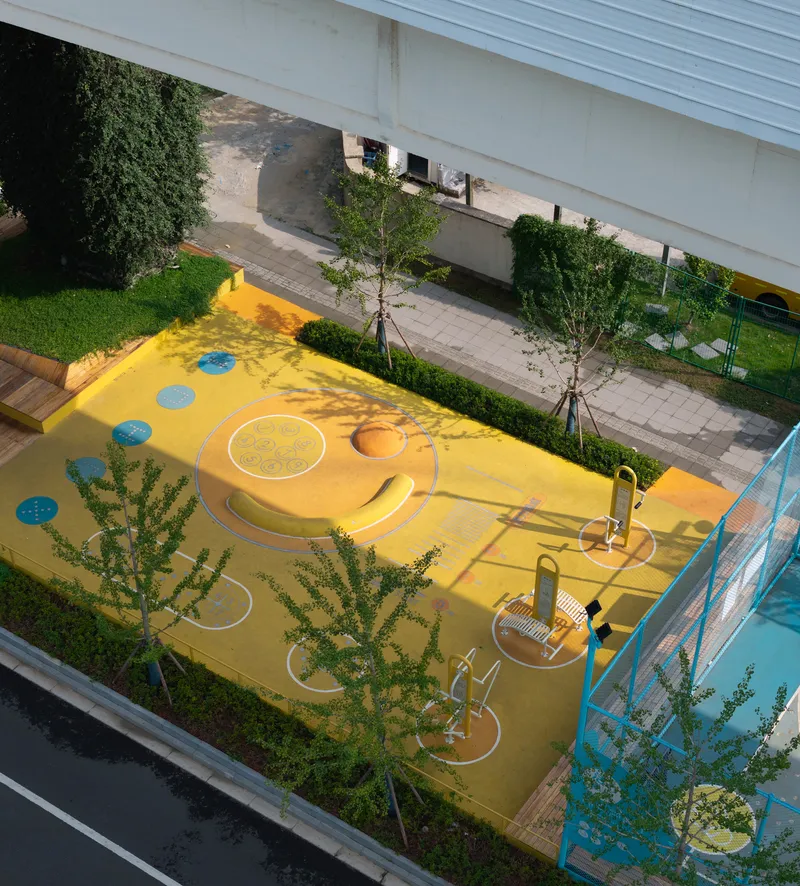

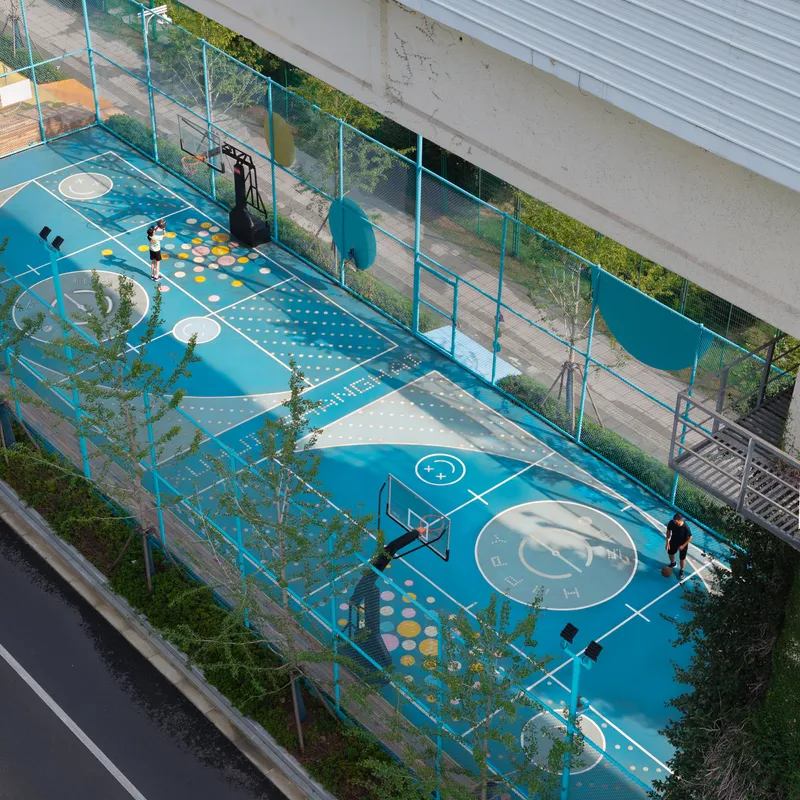
The yellow play zones pivot toward younger users. Circular mounds of varying heights create a miniature topography beneath the columns, encouraging climbing and exploration rather than the prescribed routines of a conventional playground. Young trees planted within the courts cast real shadows that will deepen year by year, a quiet acknowledgement that this project is designed to age. The overhead view reveals how tightly these colored zones interlock, separated by planted buffers that double as stormwater filters and pedestrian corridors.
Landscape as Infrastructure Repair
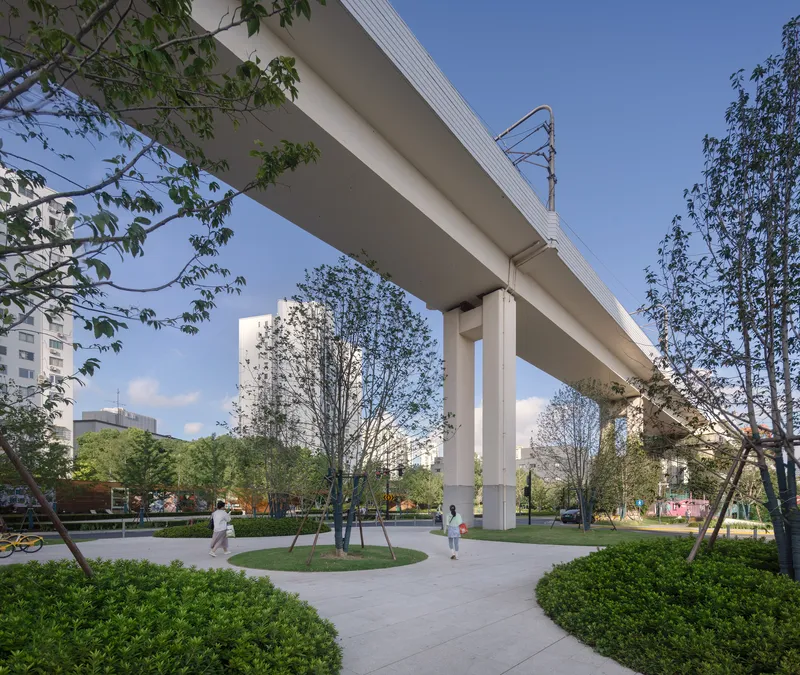
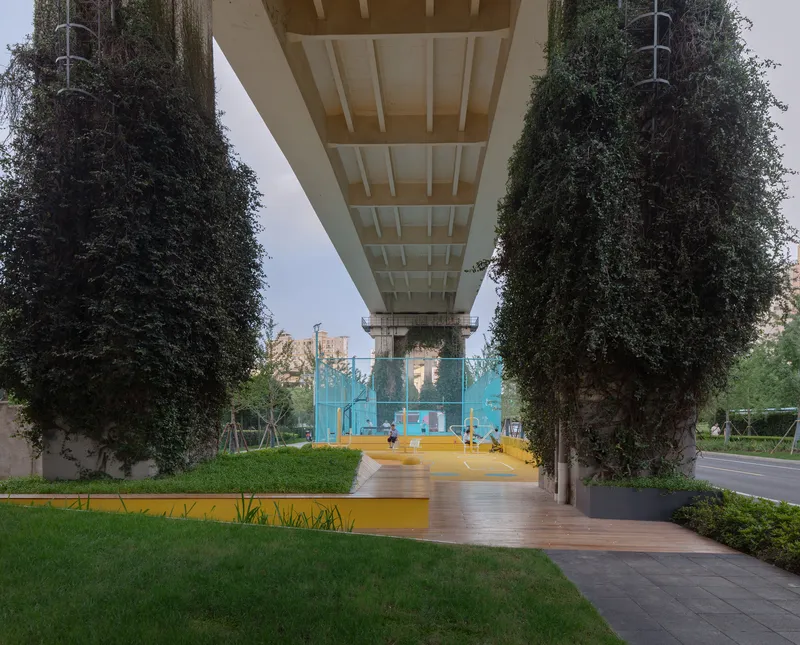
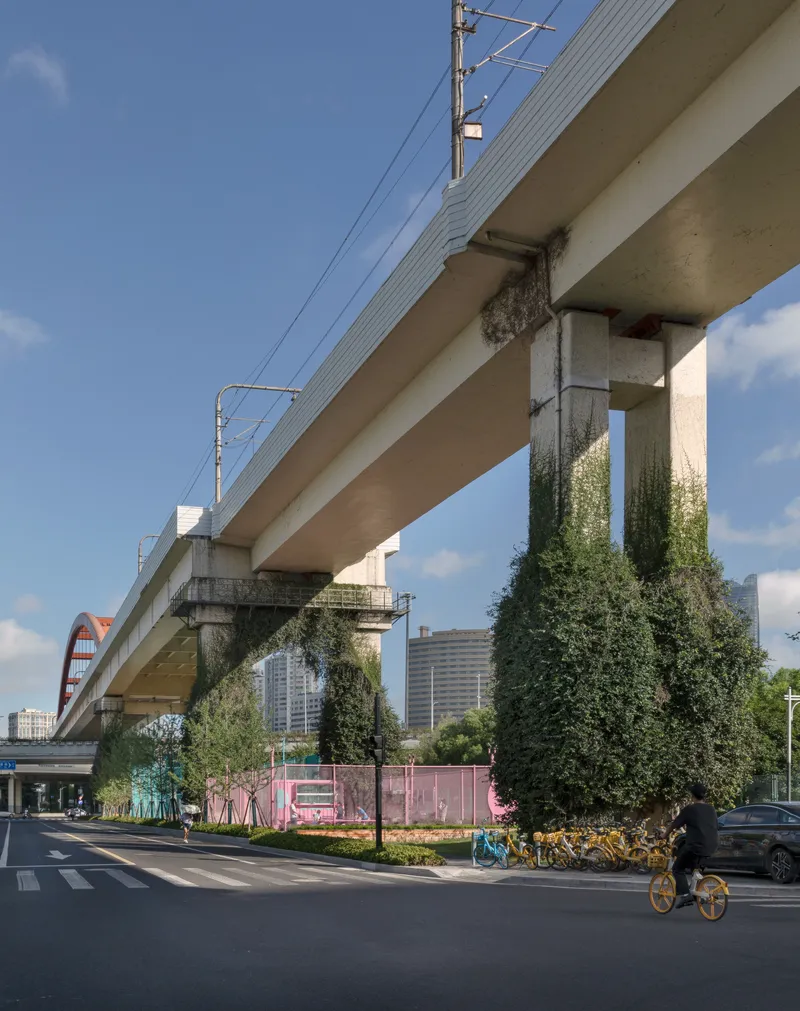
The most patient move in the project is the planting strategy. Vines wrap the highway columns, tall grasses border the walkways, and hedges separate zones without walls. Beneath the viaduct, timber pathways wind between piers that are slowly disappearing under greenery. The landscape is doing heavy lifting: softening acoustics, reducing the visual mass of concrete, and creating microclimates that make lingering under a highway feel surprisingly pleasant.
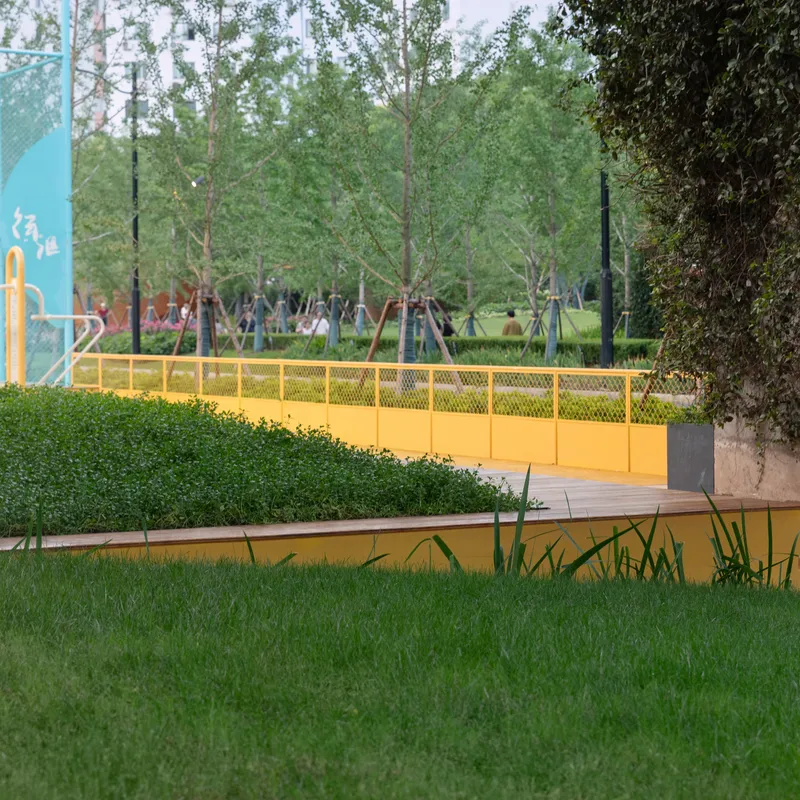
A yellow mesh bridge crossing a water feature captures the ambition in miniature. The channel, the trimmed hedges, the established trees overhead: none of this reads as leftover space. It reads as a garden, which is exactly the perceptual shift the project aims for. In a city where every square meter of buildable land is spoken for, reclaiming the residual territory beneath infrastructure is not just clever. It is necessary.
Night Presence and the Perforated Pavilion


A perforated white panel, internally lit and surrounded by ornamental grasses, marks one of the park's quieter moments. At dusk it functions as a lantern, drawing attention away from the highway overhead and anchoring the space with a gentle, diffused glow. Nearby, basketball games continue under the viaduct in fading light, the concrete deck above catching warm ambient tones. The project clearly treats nightfall not as an afterthought but as a second program, understanding that in dense Shanghai, public space is used well past sunset.
Street Edge and Urban Legibility
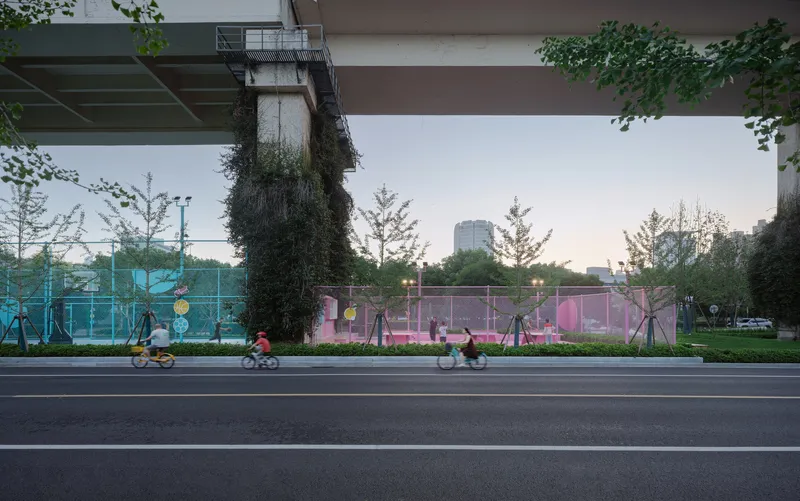
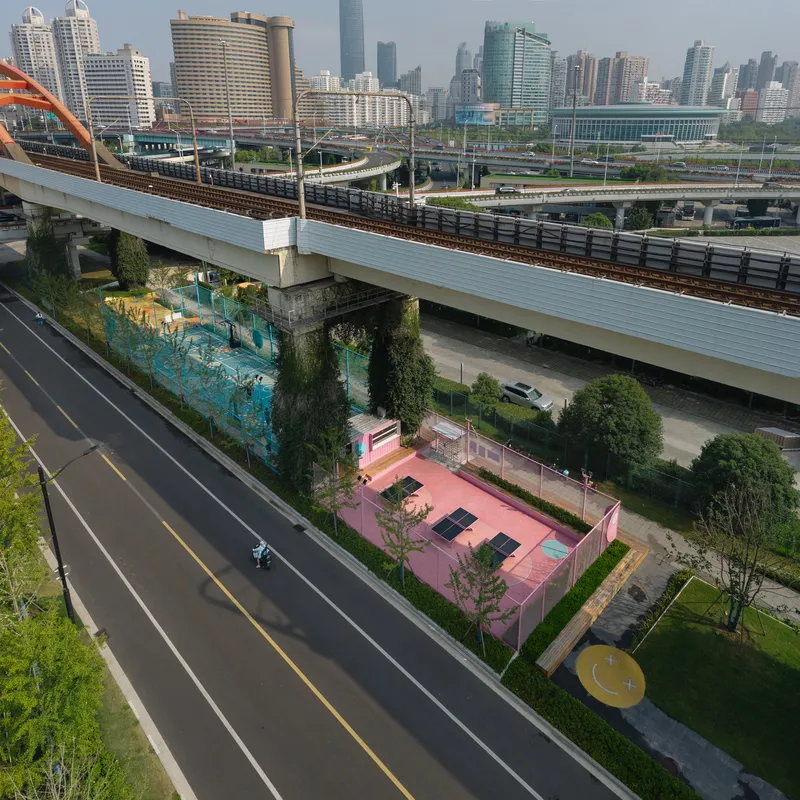
From the street, the park makes itself known through color and mesh rather than monumental signage. Cyclists and pedestrians encounter the pink fencing as a continuous screen that signals activity without blocking movement. The aerial view reveals how the intervention zones slot between highway ramps and adjacent roadways, occupying territory that urban planners would typically label with a shrug as "buffer." That willingness to colonize the seams of infrastructure is the project's real contribution to the discipline.
The yellow mesh bridge adds a pedestrian link across a water channel, stitching together areas that would otherwise require a detour. It is a small gesture, but in a project built from small gestures stacked together, it matters. Every element earns its square meter.
Plans and Drawings
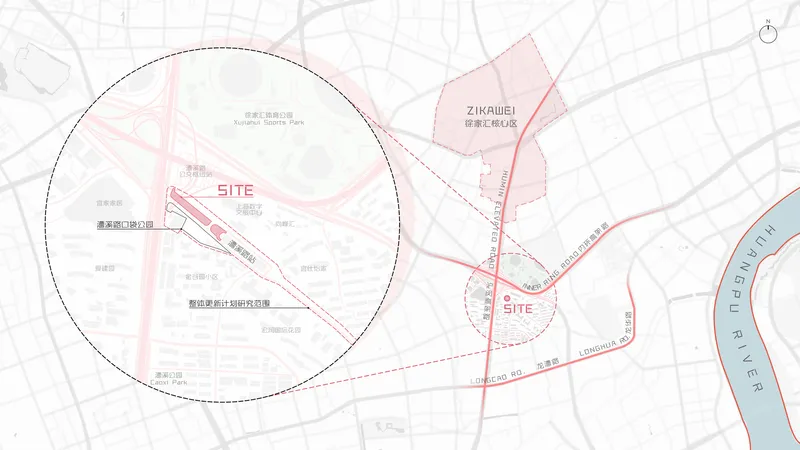

The site plan locates two distinct intervention zones within the surrounding street grid, making clear how the project leverages a linear corridor that runs directly beneath the elevated line. The exploded axonometric breaks the scheme into four stacked programmatic layers, from ground-level planting through sport courts to the viaduct soffit above, illustrating the vertical negotiation at the heart of the design.
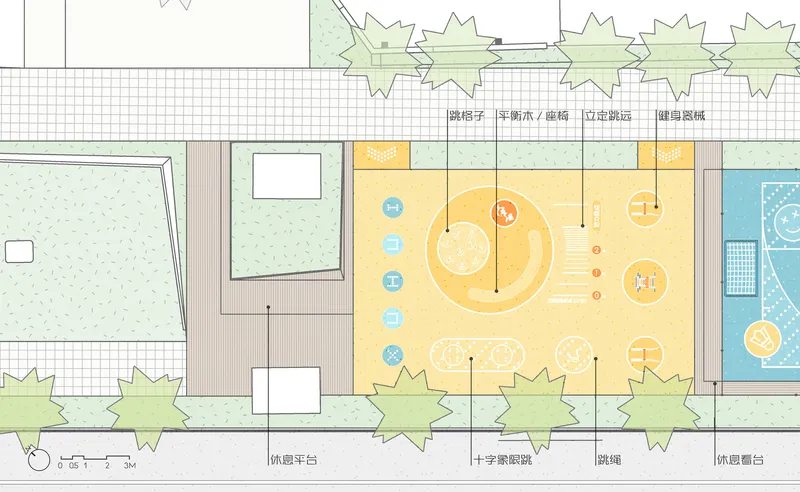
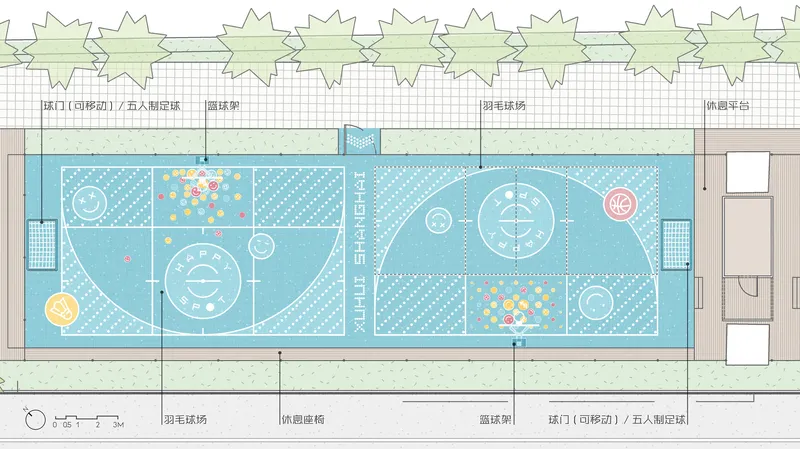
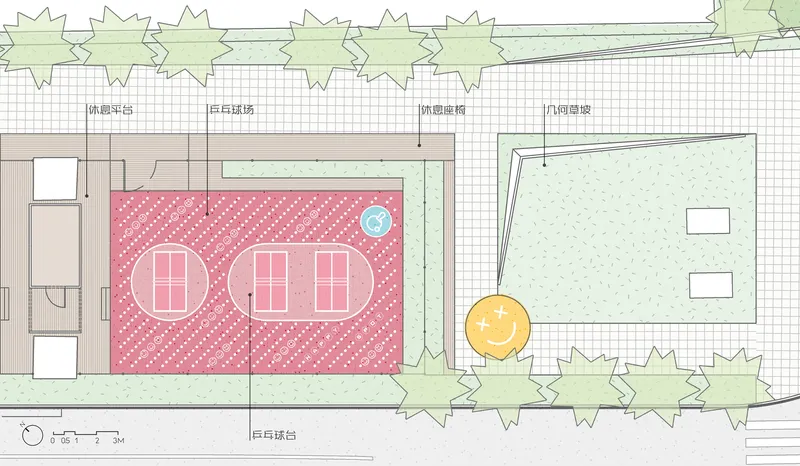
Individual court plans reveal the tight dimensional logic. The orange sports court sits adjacent to planted buffers and a neighboring play zone, while the full basketball court drawing shows how the teal surface and white markings are calibrated to fit precisely between columns. A third drawing positions tennis courts alongside a green courtyard and tree-lined street edge, confirming that the palette of programs extends further than the photographs alone suggest. Collectively, the drawings demonstrate that what looks spontaneous on the ground is the product of careful spatial choreography.
Why This Project Matters
Cities around the world are sitting on thousands of hectares of residual land beneath elevated roads, railways, and flyovers. Most of it is fenced off, colonized by cars, or simply abandoned. VIASCAPE's work in Shanghai offers a replicable model: accept the infrastructure, use bold color to claim territory for public life, and let planting do the long-term work of making the space feel inhabitable. It is not a megaproject. It does not require heroic engineering. It requires the design intelligence to see dead space as opportunity.
The Happy Spot under the Light Rail also raises an honest question about urban equity. The neighborhoods served by this stretch of Metro Line 3 were, by all accounts, underserved by parks. Turning the highway's underbelly into a functioning public landscape does not solve structural inequality, but it puts 3,540 square meters of free, colorful, well-lit space into daily rotation for residents who had none. That counts for something. In a discipline that often chases spectacle, this project chases utility, and finds joy along the way.
The Happy Spot under the Light Rail, designed by VIASCAPE design with lead architect Sun Yijia. Located in Shanghai, China. 3,540 m². Completed 2025. Photography by Shan Liang.
About the Studio
Share Your Own Work on uni.xyz
If projects like this are the kind of work you want to make, uni.xyz is a place to publish your own, find collaborators, and enter design competitions.


Popular Articles
Popular articles from the community


David Macias Steps a Doorless Stone and Plaster House Down a Tropical Colombian Hillside
In the humid hills of Colombia, Threshold House replaces the front door with an open void and terraces its 850 m² down the slope instead of fighting it.

U.GA Architects Wraps an Oval Rooftop Pool in Curved Board-Formed Concrete on Busan's Jeollidan-gil
In Busan's Jeonpo-dong, a 454 m² mixed-use block stacks a neighborhood facility, guest rooms and an oval rooftop pool inside spiraling concrete walls.

Jaramillo Van Sluys Arquitectura and Urbanismo Turn a Demolished Registry Lot in Quito into an Orchard Plaza
In Quito's Centro Histórico, a 2,800 m² plaza exposes the San Agustín convent wall and redraws its lost Augustinian orchard in volcanic stone.

Juan García Correa, John González and Claudia Rueda Sink a Circular Amphitheater into a Manizales Engineering Building
On the La Nubia campus in Manizales, Colombia, the S1 Building folds labs and offices into a hillside of ramped lawns that double as a campus route.

Similar Reads
You might also enjoy these articles


LAVA Architecten Gives Vocational Education a Sawtooth-Roofed Face on a Mechelen School Campus
In Mechelen, Belgium, a 2,053 m² STEM school on a 6×6 m grid turns workshops and classrooms into rooms that can be rearranged as teaching changes.

KEMA Studio Turns a Derelict Marvila Attic into a 60 m² Lighthouse Apartment Above Lisbon
In Lisbon's Marvila district, a rebuilt roof, four skylights and two plywood volumes turn an unlivable attic into a bright home facing the Tagus.

Pixel Gardens: One Repeated Module Stacked Into a Terraced Social Housing Tower for Famagusta
Salem Bader's shortlisted housing tower builds a vertical neighbourhood from one repeated module, offsetting units to carve terraces, light and air.

Bao Huynh Watercolor Atelier: A Serene Art Retreat in Hội An
Bao Huynh Watercolor Atelier in Hội An blends multifunctional art spaces, sustainable design, local materials, and family-friendly living in a serene environment.


Comments (0)
Please login or sign up to add comments
No comments yet. Be the first to comment!