

Christian Prasser Architektur Restores Josef Frank and Oskar Wlach's Villa Beer in Vienna as a Public House Museum
In Vienna-Hietzing, a split-level landmark of Viennese Modernism is returned to its original sequence of rooms and opened to the public for the first time.


Villa Beer has long had a reputation that outran public access to it. Josef Frank and Oskar Wlach designed it in 1929 for Julius Beer, co-owner of a rubber factory, and Margarete Beer, a musician. The house was completed around 1931 in Vienna-Hietzing, and within a few years the family had fled to America. For most of the century since, the villa was something you studied in books. That changes in March 2026, when the house opens to visitors after a renovation by Christian Prasser Architektur, completed in 2025 for owner Lothar Trierenberg in close coordination with the Federal Monuments Office.
What makes this project interesting is not that a famous house was repaired. It is the decision about what kind of repair to make. The team set out to reconstruct the original condition, and it backed that goal with research rather than taste. Alexandra Sagmeister led restoration investigations, specialist reports covered wall, wood, rubber, metal, stone and glass, and a room book from December 2022 documented the house space by space. The new program was pushed below grade, which left Frank's route through the rooms as the main event. In practice, the renovation's most important design act is restraint.
A Front Built to Look Self-Assured

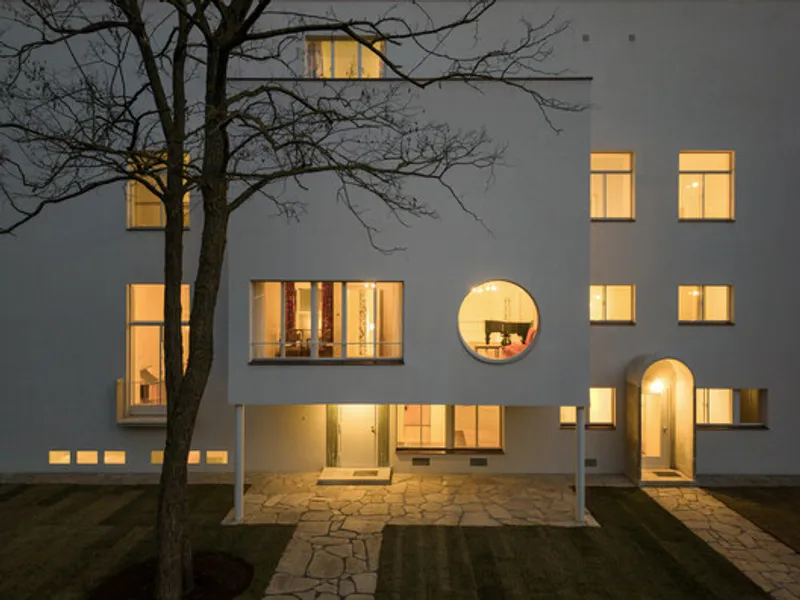
The Beers asked for a house that would look self-confident from the street and feel intimate inside, and the entrance facade delivers the first half of that brief without raising its voice. A projecting volume sits on slim white columns, and a single round window punctures the plane like a deliberate signature. The composition reads as Modernist, but it is not a manifesto. Frank was already skeptical of rigid functionalism, and you can see it in how casually the elements are arranged.
The dusk view makes the point well. Once the windows are lit, the facade stops reading as an object and starts reading as a set of rooms. That shift from image to occupation is what Frank cared about, and the restored openings let it happen again.
Stepped Volumes Toward the Garden


The garden side is where the house loosens up. White stucco volumes step back and forward, terraces and a cantilevered balcony catch the different floor levels, and a glazed bay pushes out toward the lawn. These elevations are the exterior evidence of the split-level plan inside. Each terrace sits where a room happens to land, so the facade records the section rather than hiding it.
The tall window with its arched top is a useful reminder that this house never fully committed to the flat-roofed orthodoxy of its moment. Frank allowed a softer, almost domestic gesture to sit beside crisp cubic massing. A less disciplined restoration might have tidied that tension away. Here it is left legible.
A Landscape That Frames Rather Than Decorates


The plot covers 3,169 m², and the landscape planning by Auböck + Kárász Landscape Architects treats it as the house's setting rather than a separate attraction. The stone arched doorway beside the white wall, the stone paths crossing the lawn and the fenced edges all work to frame the building at walking pace. The approach is a sequence too, which suits a house organized around movement.
Bare winter trees dominate the photographs, and that is no accident of timing. Leafless branches show the massing clearly, and they hint at how much the house depends on seasonal light. We would like to see the same views in summer, when the terraces start doing their real work.
The Hall as the Engine of the House


The heart of Villa Beer is a tall central hall. A stair climbs from it to a living room on a half-level and keeps going to a gallery, where a Bösendorfer grand piano stands. For a household that included a working musician, putting the piano on a raised landing above the main space reads as both stage and acoustic gesture. The music drops into the hall the same way your eye does.
This is the split-level route Frank argued for, and it is why the restoration's focus on the original plan matters. A single round column, the mezzanine railing, a curved stair with white metal balustrades and a timber handrail: none of these is spectacular alone. Together they choreograph a climb in which every half-turn gives you a new view back into the volume you just left. The tall glazed door on the landing ties the sequence to the terraces outside, so the route never seals itself off from the garden.
Rooms for Sitting, Rooms for Looking
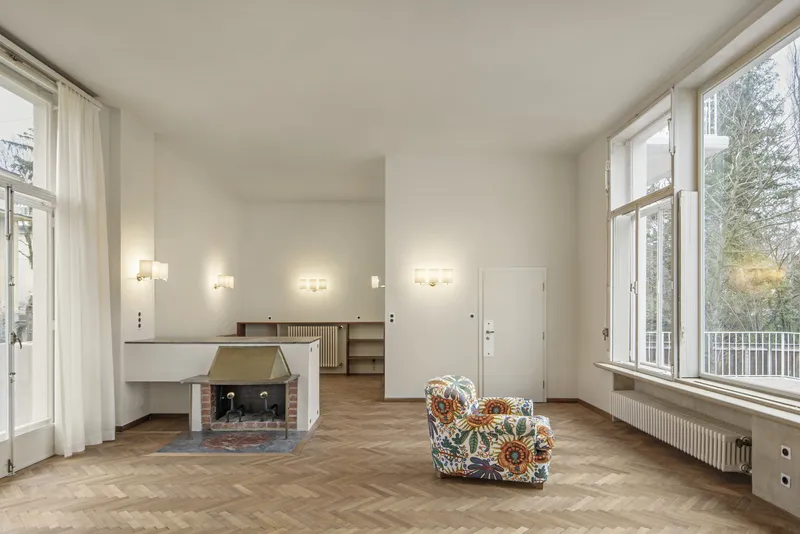


If the hall carries the self-confidence, the smaller rooms carry the intimacy. Herringbone parquet, a brick fireplace, built-in timber benches tucked into a window bay and a large circular window framing the trees give each room a specific place to settle. Frank designed interiors as much as buildings, and his patterned textiles and loose, unmatched seating are part of the architecture here, not an afterthought.
The furnishing is deliberately sparse. That is the right call for a house museum. You can read the proportions, the built-ins and the placement of windows without an inventory of objects competing for attention. The risk with this approach is a house that feels staged. The photographs suggest it avoids that, mainly because daylight and the garden do so much of the work.
Plans and Drawings


The ground floor plan explains what the photographs can only suggest. Rooms spill onto terraces on several sides, stone garden walls extend the geometry into the site, and a curved driveway slips in from the street. The plan is compact, but it is not a box with rooms packed inside; it is a chain of spaces linked to the outdoors at almost every turn.
The drone view during construction is a reminder of how much work hides behind a restoration that aims to look untouched. The renovated existing building provides 893.53 m² of usable floor area from basement to top floor. The only additions are underground: a 50 m² basement terrace now used as an archive and a 30 m² technical room for the ventilation system. Putting the archive and plant below grade lets the house meet museum standards without adding anything above ground that competes with Frank and Wlach's massing. Building services by Käferhaus, building physics by Roland Müller and site coordination by Coordin.at made that discretion possible.
Why This Project Matters
Restorations of Modernist houses often freeze them into white objects for photography. Villa Beer argues for a different standard: recover the experience of moving through the rooms, document the materials thoroughly enough that reconstruction is grounded in evidence, and hide the new infrastructure where it cannot distort the original. Christian Prasser Architektur's main contribution is mostly invisible, which is exactly what a careful restoration should aim for.
The house also carries a history that cannot be restored, only acknowledged. It was built for a Jewish family in interwar Vienna who were forced to leave within a few years of moving in. Opening it to the public turns a private masterpiece into a shared record of what Viennese Modernism was and what was lost with the people who made it. For architects, it is a chance to walk Frank's route for yourself rather than reconstructing it from plans.
Villa Beer Renovation by Christian Prasser Architektur, restoring the original house by Josef Frank and Oskar Wlach (1929 to 1931). Location: Vienna-Hietzing, Austria. Area: 974 m². Year: 2025. Photographs: Hertha Hurnaus, Stefan Huger and Julius Scherb.
About the Studio
Share Your Own Work on uni.xyz
If projects like this are the kind of work you want to make, uni.xyz is a place to publish your own, find collaborators, and enter design competitions.


Popular Articles
Popular articles from the community


Cube Design Draws an Ecological Corridor Between Two Shenzhen Hills with the Nankai Building
Beside Shenzhen's container docks, the Nankai Building pairs stacked balconies with a climbing green screen to connect two hillsides across its height.

graciastudio Turns a Viewless Tijuana Lot Inward Around a Courtyard of Concrete, Timber and Trees
In Tijuana, Jorge Gracia's GA2 House stacks a timber-clad private floor over exposed concrete and replaces a missing view with a planted interior patio.

ETEH Reworks the Shared Spaces of São Domingos School in Brazil Around Timber, Color and Hanging Plants
At São Domingos School in Brazil, 436 m² of hall, refectory and library are recast with timber joinery, a yellow and blue code and trailing greenery.


Aquadapt: An Underwater Habitat That Rewrites Its Rooms by the Hour
Curved modules ring the seabed while one shell shifts from breakfast room to cinema, farm and football pitch as residents' needs change.

Similar Reads
You might also enjoy these articles
Cube Design Draws an Ecological Corridor Between Two Shenzhen Hills with the Nankai Building
Beside Shenzhen's container docks, the Nankai Building pairs stacked balconies with a climbing green screen to connect two hillsides across its height.

Praksis A and Studio Sted Bend a Red Timber Cabin Across the Granite of Norway's Southern Coast
On the southern Norwegian coast, a 105 m² cabin follows the rock on slender posts, pairing red cladding outside with pine, brick and plywood within.

David Ortega Stacks a Two-Story Mexico City Penthouse Around a Steel Stair and a Pergola-Shaded Roof Terrace
In Colonia Roma, a 300 m² penthouse uses oak joinery, a planted steel stair and a slatted roof pergola to make a new-build apartment feel like a house.

PARALELA and LB2 Thread a Public Walkway Through the Base of a Las Condes Residential Tower
In Las Condes, Santiago, the Hamlet Building gives its fenceless ground floor to a 70-metre wooded passage linking two streets and the metro.

Explore Blocs Competitions
Discover active competitions in this discipline

Challenge to design luxury tourism on rails

Challenge to reimagine the Iron Throne

Photograph architecture without architects

VR headsets Storefront design competition
Comments (0)
Please login or sign up to add comments
No comments yet. Be the first to comment!