
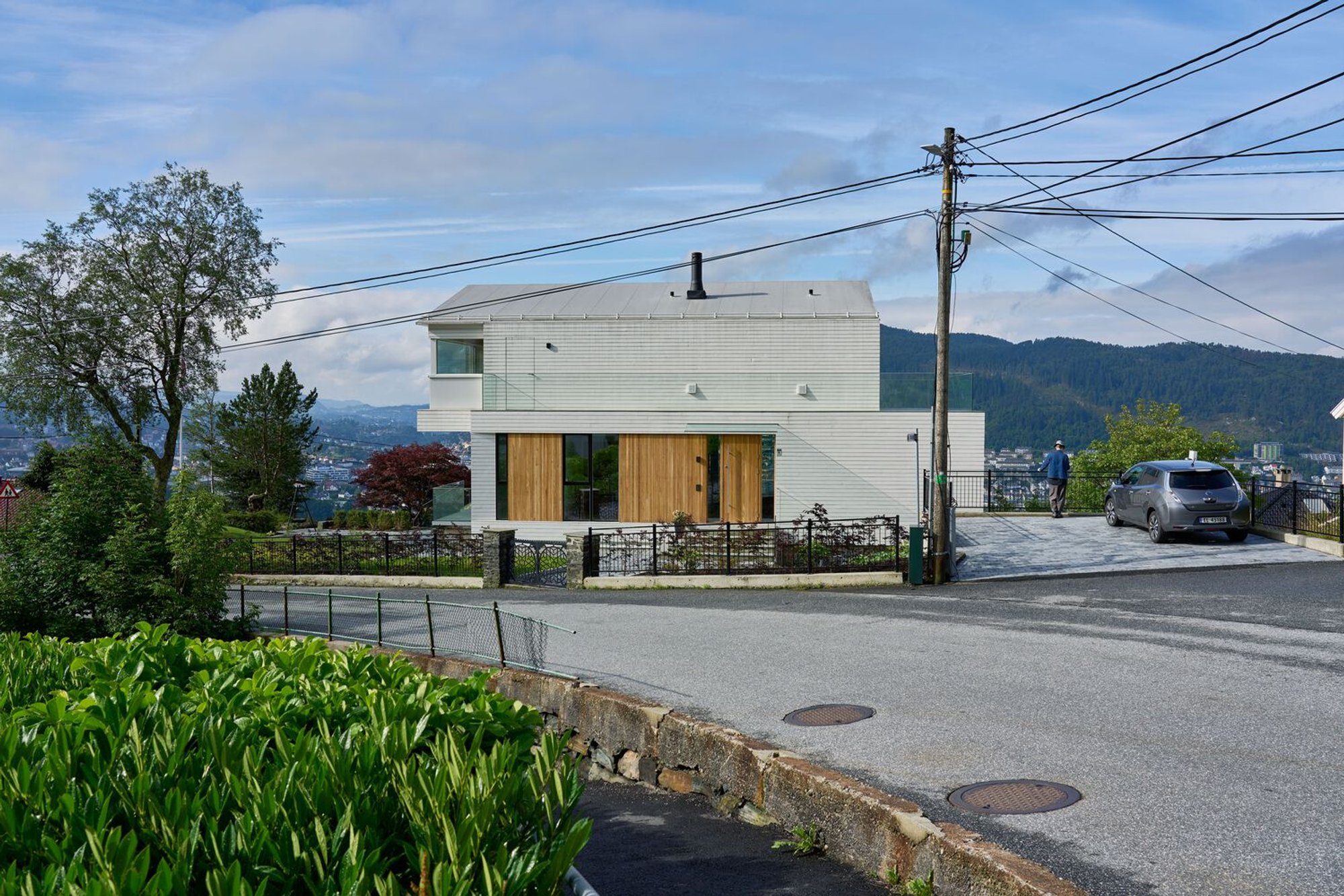
Villa Refsnes by Saunders Architecture: A Contemporary Hillside Home Framing Bergen’s Landscape
Contemporary Bergen villa featuring cantilevered design, open-plan interiors, timber materials, and panoramic views blending modern living with natural surroundings.

Set against the dramatic natural backdrop of Bergen, Villa Refsnes by Saunders Architecture stands as a refined example of contemporary Scandinavian residential architecture. Designed by Todd Saunders, the 384 m² home thoughtfully integrates with its steep hillside site while offering expansive views of the city, surrounding mountains, and waterways. The project is not only a response to its exceptional location but also a careful reinterpretation of an inherited family property, balancing memory, materiality, and modern living.
Context: Living Between City and Nature
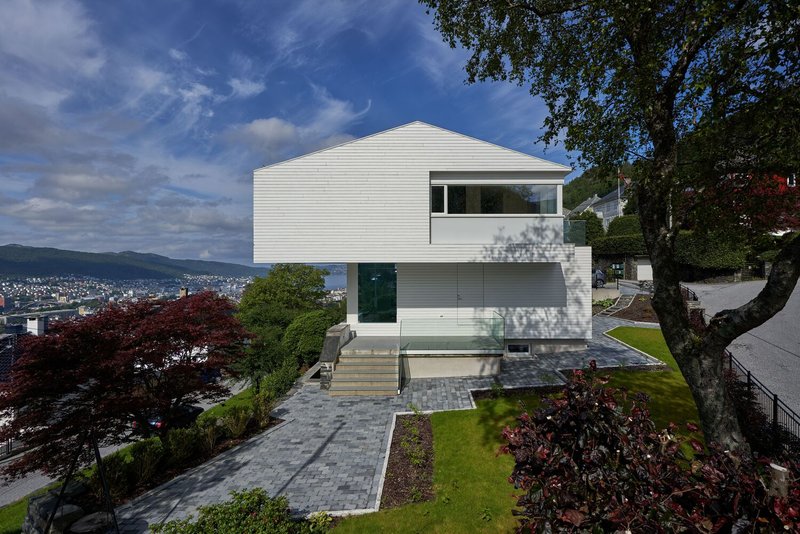
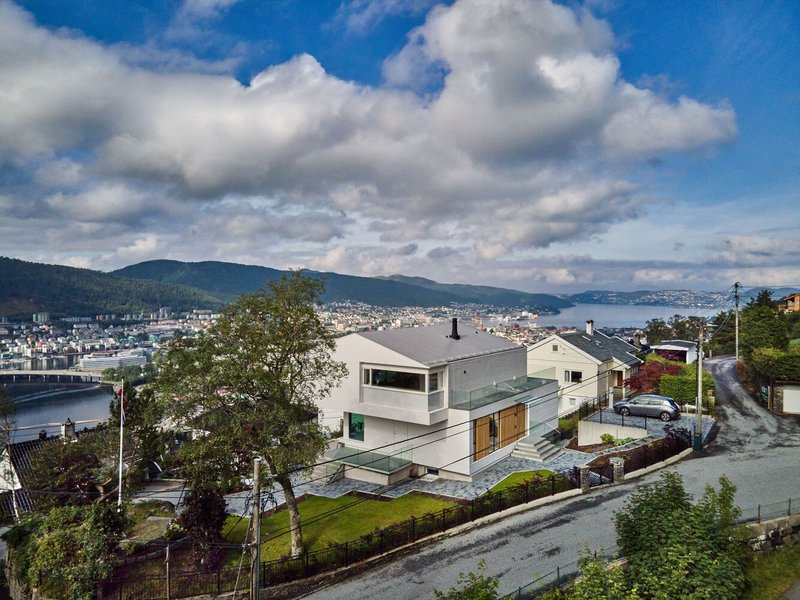
Bergen is often celebrated for its unique geographic condition: an urban environment nestled between mountains, forests, and the sea. In neighborhoods like Starefossen, this duality becomes especially pronounced. Homes are perched along the hillsides, offering both proximity to the city center and immediate access to nature. Villa Refsnes benefits from this privileged setting, with panoramic views stretching across Bergen’s historic urban fabric and out toward its winding fjords.
The site itself is embedded within a quiet residential enclave, yet it maintains strong visual and physical connections to nearby hiking trails, lakes, and natural reserves. This relationship between built form and landscape became a central driver in the design process, informing everything from spatial organization to material selection.
Reinterpreting the Existing Structure
The project began with a house inherited by the clients, a modest 1940s structure that had belonged to their family for generations. While rich in emotional significance, the building presented several challenges. Its configuration limited natural light and views, and its internal layout did not align with the needs of a contemporary family.
Initially, the clients explored the possibility of renovating the existing house. However, it quickly became clear that such an approach would involve significant structural intervention, high costs, and limited design flexibility. Instead, a more radical yet ultimately more rewarding strategy emerged: to rebuild the house while preserving select elements of the original structure.
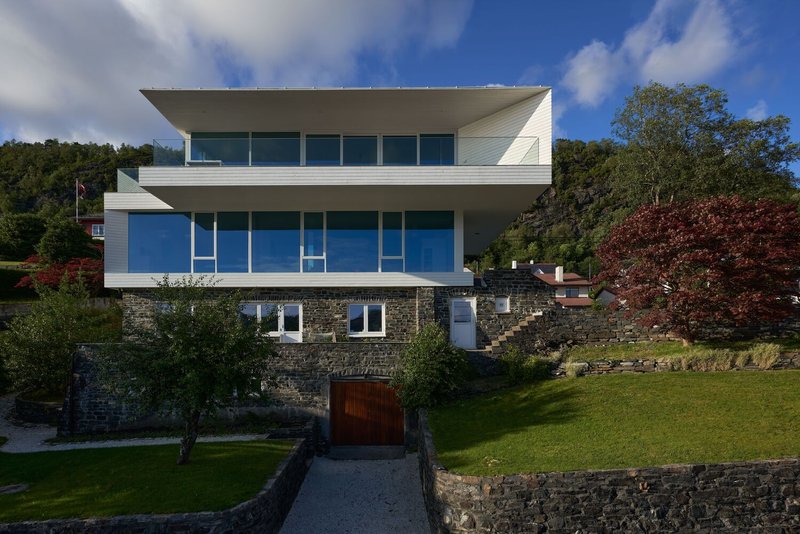
The most important of these was the stone plinth at the base of the building. This robust foundation, embedded into the hillside, was retained and repurposed. It now accommodates a self-contained apartment at the basement level, providing additional living space while anchoring the new structure to the site. This decision reflects a broader architectural approach, one that respects the past without being constrained by it.
A Clear and Expressive Architectural Form
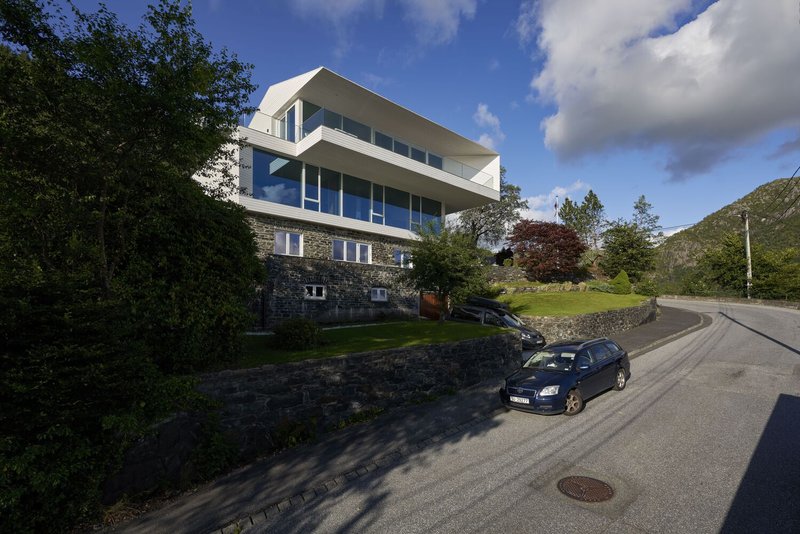
Above the retained stone base, the new house rises as a lightweight and precisely detailed volume. Constructed using a steel framework and clad in white spruce, the building presents a clean and contemporary exterior that contrasts subtly with the heavier, more tactile base below.
One of the defining features of the design is the treatment of the upper level. Rather than simply stacking volumes, the architects introduced a gentle cantilever, allowing the southeast-facing portion of the house to extend outward over the level below. This move is both formal and functional. Visually, it adds dynamism and depth to the building’s silhouette. Spatially, it creates opportunities for terraces and balconies that maximize exposure to sunlight and views.
The result is a composition that feels both grounded and elevated, rooted in the landscape yet reaching outward toward the horizon. This balance is characteristic of Saunders Architecture’s work, where simplicity of form is often paired with subtle gestures that enhance spatial experience.
Spatial Organization and Living Experience
The internal layout of Villa Refsnes is carefully structured to respond to both the topography of the site and the daily rhythms of family life. Entry to the house occurs at the uppermost point of the terrain, leading directly into the ground floor. This level contains more private and functional spaces, including a media room and family areas.
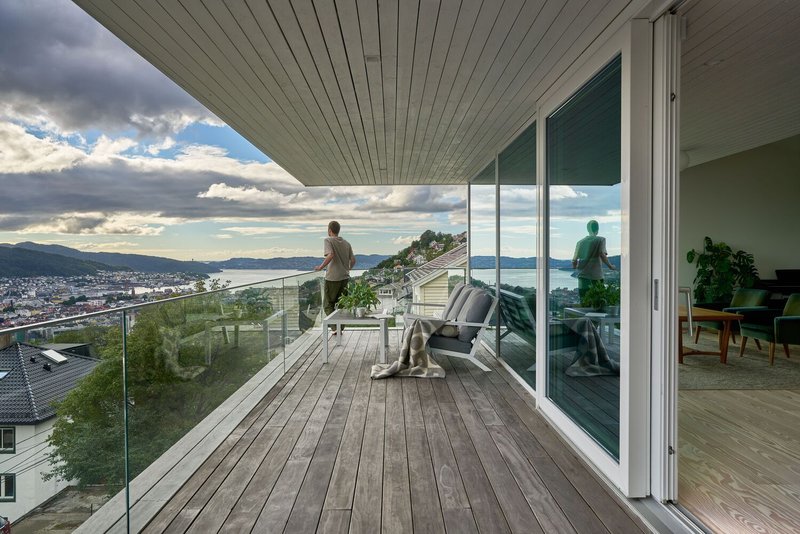
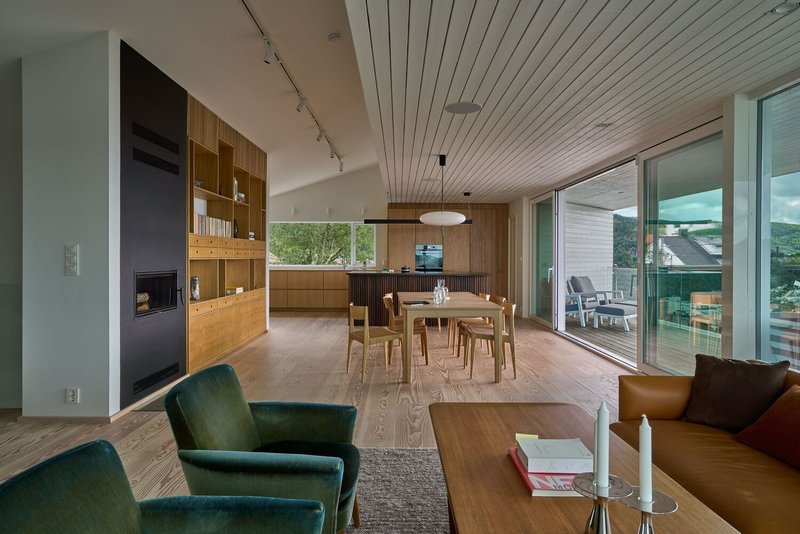
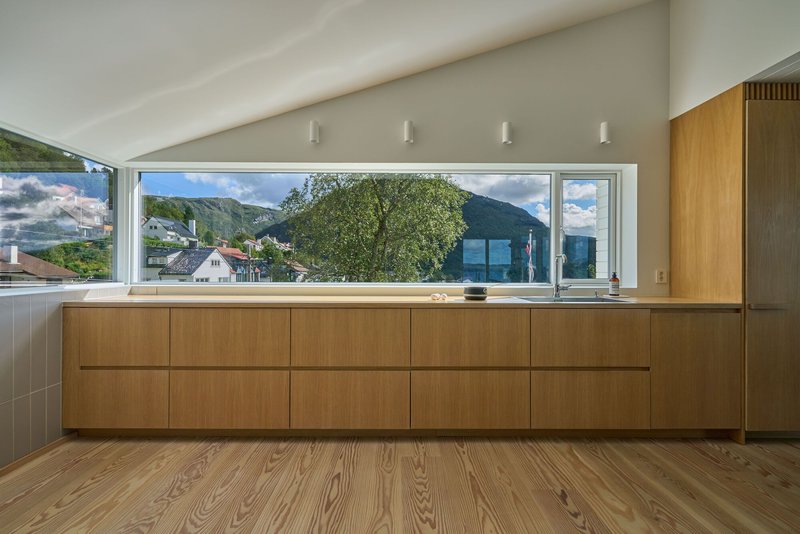
However, it is the upper floor that serves as the true heart of the home. Here, the architects have created a generous open-plan “great room” that brings together living, dining, and kitchen functions within a single continuous space. This arrangement not only promotes social interaction but also allows the entire area to benefit from the same panoramic views.
Large sliding glass doors line the façade, dissolving the boundary between interior and exterior. These openings lead to a semi-protected balcony, extending the living space outward and creating a seamless connection with the surrounding landscape. The experience of moving through the house is thus one of gradual revelation: spaces unfold in relation to light, view, and orientation.
Materiality and Interior Atmosphere
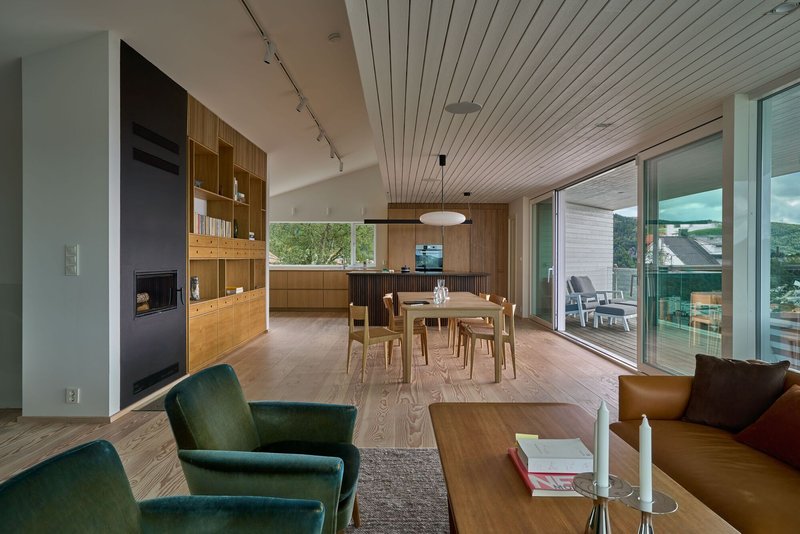
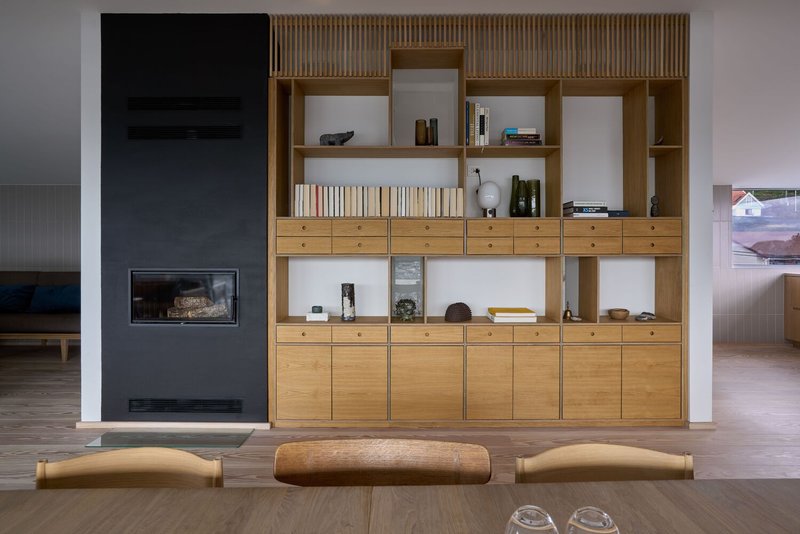
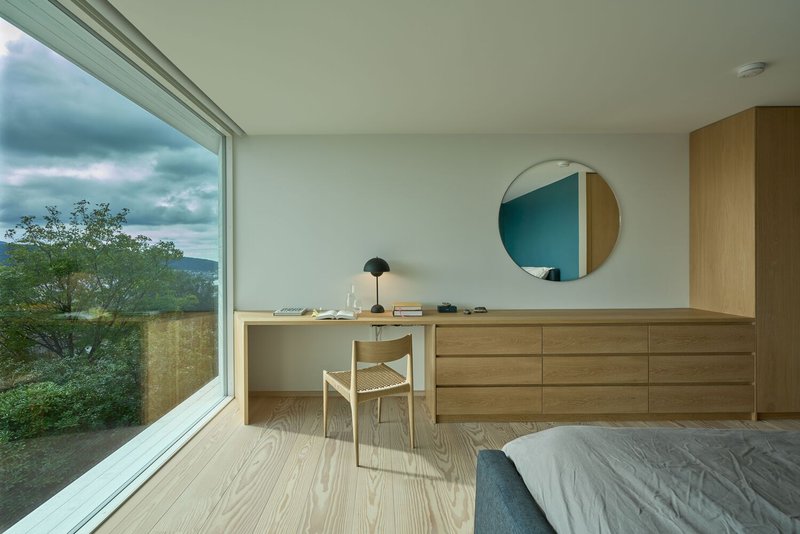
Material selection plays a crucial role in shaping the atmosphere of Villa Refsnes. The use of natural wood, both externally and internally, creates a sense of warmth and continuity. Douglas fir flooring runs throughout the main living areas, providing a unifying surface that enhances the openness of the plan.
Custom-designed elements, including the kitchen and built-in furnishings, contribute to a cohesive interior language. The detailing is precise and restrained, avoiding unnecessary ornamentation in favor of clarity and craftsmanship. This approach aligns with the broader Scandinavian design tradition, where simplicity and functionality are closely intertwined.
At the same time, the palette remains deliberately neutral, allowing the changing light and landscape outside to become the primary visual focus. Seasonal shifts, weather patterns, and time of day all play an active role in shaping the interior experience.
Architecture as Reduction
A key conceptual underpinning of the project is the idea of architectural reduction. Rather than adding layers of complexity, the design process involved a careful editing of elements, removing what was unnecessary and refining what remained. This strategy is evident in both the external form and the internal organization of the house.
Externally, the building reads as a series of clean, well-proportioned volumes, free from excessive articulation. Internally, spaces are clearly defined yet fluidly connected, creating a sense of order and calm. This reduction does not result in austerity; rather, it enhances the clarity of the design and allows essential qualities: light, space, and material, to come to the forefront.
Engaging with the Landscape
One of the most compelling aspects of Villa Refsnes is its ability to engage with its surroundings. From its elevated position, the house offers uninterrupted views of Bergen’s urban and natural landscapes. At the same time, it maintains direct access to nearby outdoor amenities, including trails leading to Svartediket lake and the slopes of Mount Ulriken.
This dual relationship, visual and physical, reinforces the idea of the house as a mediator between city and nature. It provides a comfortable and contemporary living environment while encouraging an active engagement with the outdoors.
A Contemporary Nordic Home
Villa Refsnes ultimately represents a thoughtful synthesis of context, program, and design philosophy. It demonstrates how contemporary architecture can respond to complex site conditions while creating spaces that are both functional and inspiring.
By preserving elements of the past, embracing modern construction techniques, and prioritizing spatial clarity, Saunders Architecture has created a home that is deeply connected to its environment and attuned to the needs of its inhabitants. The project stands as a testament to the enduring relevance of simplicity, precision, and sensitivity in residential design.




Popular Articles
Popular articles from the community

RDTH architekti Rips Out Nearly Every Wall in a Prague Apartment and Replaces Them with Furniture
A 101-square-meter post-war flat in Prague trades rigid partitions for a single rotated furniture block, curtains, and glass concrete.

20 Most Popular Office Building Projects of 2025
From biophilic workspaces in India to net-positive energy offices in New Delhi, 20 office building projects that defined architecture in 2025.
20 Most Popular Furniture Design Projects of 2025
Modular street systems, parametric benches, and insect hotels: the furniture design projects that captivated architects on uni.xyz in 2025.
HCCH Studio Wraps a Shanghai High-Rise Office in Curved Walls of Translucent Glass
A 1,000 square meter fit-out in Lujiazui replaces the typical tech-office palette with layered glass, micro-cement, and quiet rigor.


Similar Reads
You might also enjoy these articles

Kokaistudios Wraps a Shanghai Retail Podium in Horizontal Louvers That Echo Its Foster + Partners Neighbor
A four-storey glass-roofed gateway links an underground commercial valley to the revitalized north bank of Shanghai's Suzhou River.
Fausto Terán and Toro Fuse Japanese Craft with Mexican Tradition in a Lakeside Retreat
Nakamura House pairs Shou-Sugi-Ban charred pine with handmade clay tile at the foot of Atlangatepec Lagoon in Mexico.
RDTH architekti Rips Out Nearly Every Wall in a Prague Apartment and Replaces Them with Furniture
A 101-square-meter post-war flat in Prague trades rigid partitions for a single rotated furniture block, curtains, and glass concrete.

SWA Group Spirals a Landscape Memorial into the Woods of Sandy Hook
A 1.8-acre clearing in Newtown, Connecticut, honors 26 lives lost with water, stone, and a single sycamore tree.


Explore Architecture Competitions
Discover active competitions in this discipline




The International Standard for Design Portfolios


The Global Benchmark for Architecture Dissertation Awards


The Global Benchmark for Graduation Excellence


Challenge to reimagine the Iron Throne
Comments (0)
Please login or sign up to add comments
No comments yet. Be the first to comment!