
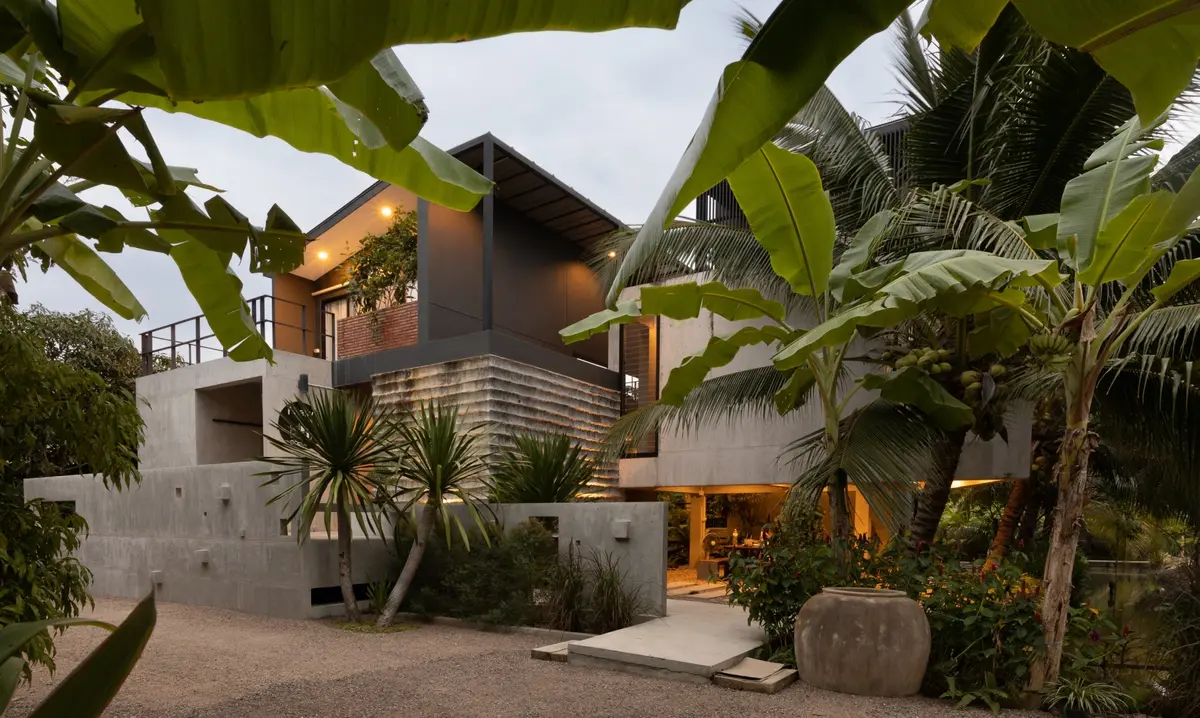
Volume Matrix Studio Builds a Retirement Home Among Fireflies and Coconut Palms in Amphawa
A 350-square-meter family house on a coconut garden near Thailand's Mae Klong River doubles as a gathering place rooted in local memory.


A kilometer from the Amphawa floating market, where longtail boats drift past stilted shopfronts and tourists gather at dusk to watch fireflies pulse along the Mae Klong River, Volume Matrix Studio has planted a 350-square-meter house inside the very coconut garden that once sustained the owner's family. The mother who spent decades harvesting those coconuts and selling them at the market now has a retirement home that treats the plantation not as backdrop but as primary architecture. Palms and banana plants press against every elevation, threading through courtyards and spilling into sight lines from nearly every room.
What makes Firefly House genuinely interesting is its refusal to clear the site. The building reads less as an object placed on land and more as a series of concrete and timber volumes negotiated between existing trees. Courtyards absorb the garden inward, rooms open onto planted gravel beds, and the upper terraces sit at canopy height among the coconut fronds. The result is a house where the boundary between cultivated landscape and domestic interior barely exists, an approach that honors both the family's agricultural livelihood and Amphawa's identity as a place where nature and human settlement are inseparable.
Arriving Through the Garden
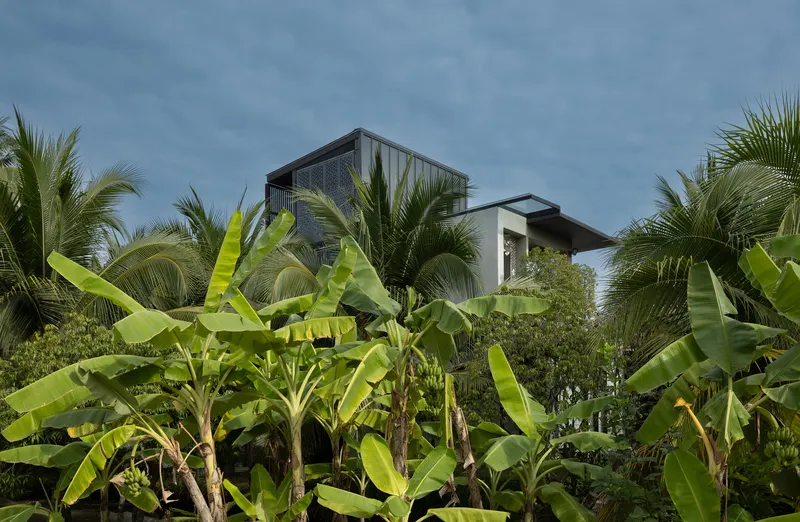
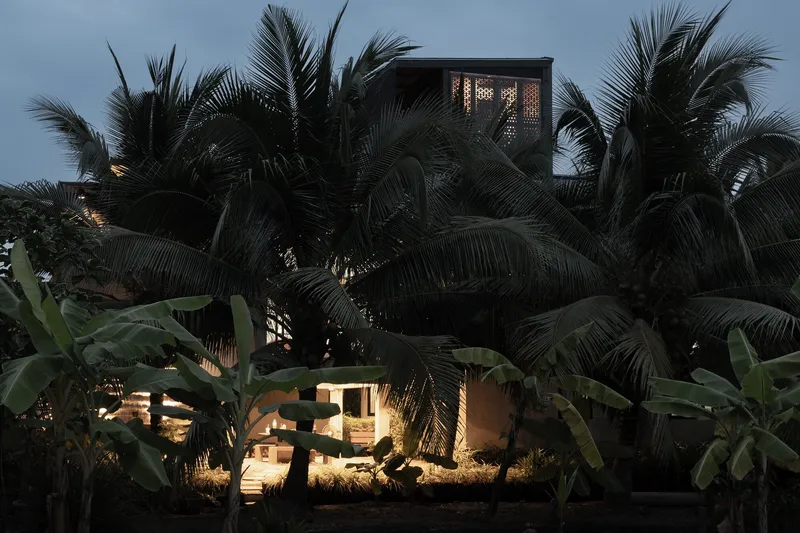
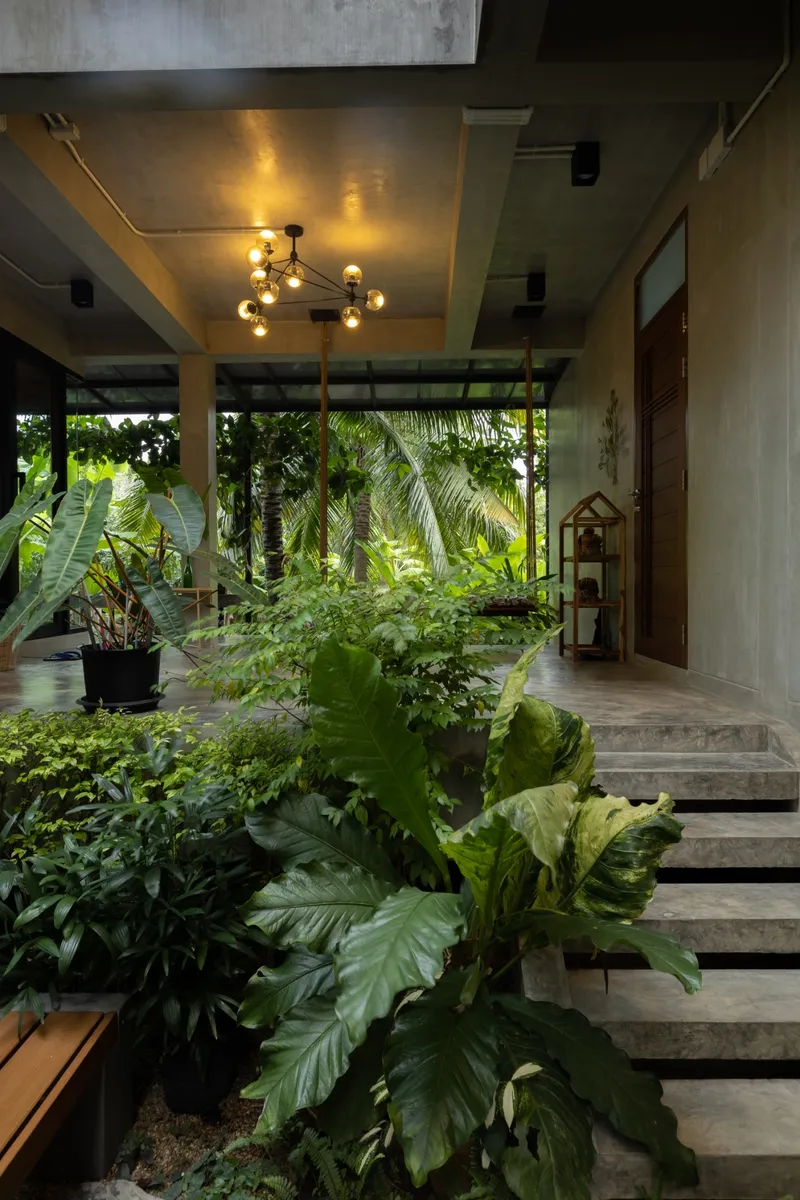
The house does not announce itself. From the perimeter of the coconut garden, layered volumes emerge only partially through the dense tangle of palms and broad banana leaves. There is no manicured lawn, no driveway axis, no clean facade composition waiting to be photographed. Instead, approach paths wind through gravel and planted beds, with concrete steps rising beside clusters of tropical foliage. The architecture reveals itself in fragments, a corrugated metal gable here, a horizontal slit window there, the warm glow of an interior court somewhere behind the leaves.
This sequenced arrival does two things. It slows you down, matching the pace of the rural district. And it makes the garden the protagonist, which is exactly right for a family whose income and identity were built around it.
Concrete and Timber as Quiet Infrastructure
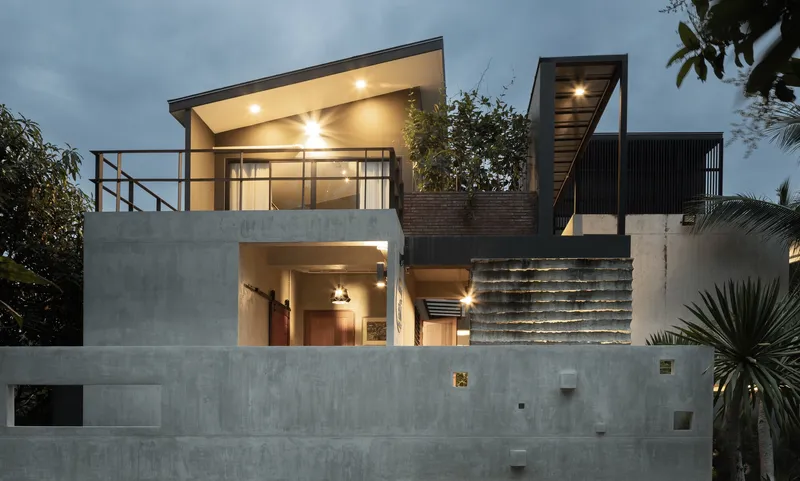

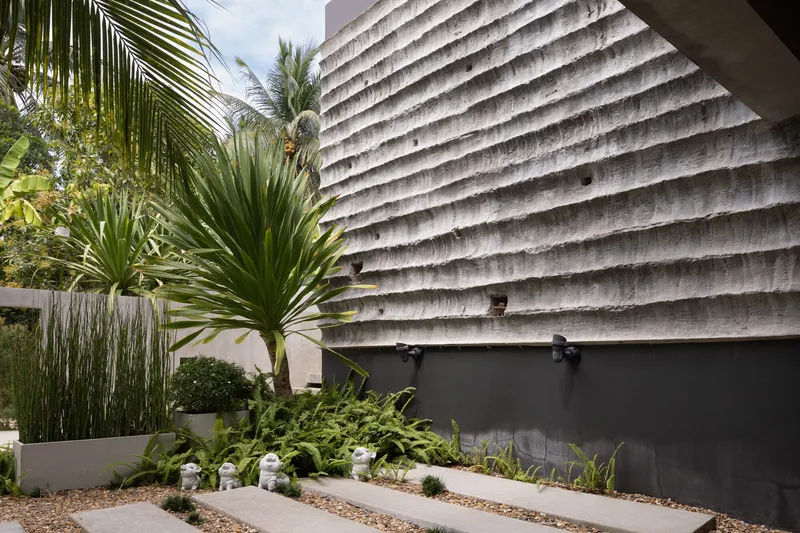
The material palette is deliberately restrained: board-formed and ribbed concrete for walls and retaining elements, timber cladding on upper volumes, and corrugated steel (supplied by Bluescope) for roof planes. Nothing here tries to compete with the garden. The concrete carries a raw, almost utilitarian quality, with horizontal window openings punched through thick walls to frame specific views of palms while controlling solar gain. Ribbed concrete surfaces along planted beds add texture without decoration, catching raking afternoon light in ways that shift through the day.
Timber appears where the house wants to feel lighter, particularly on the upper floors and around sleeping areas, softening the scale and reducing the visual mass of the volumes as they rise toward the palm canopy. The contrast between the heavy concrete ground plane and the lighter timber upper floors creates a clear reading of the house as rooted below and porous above.
Courtyards That Breathe
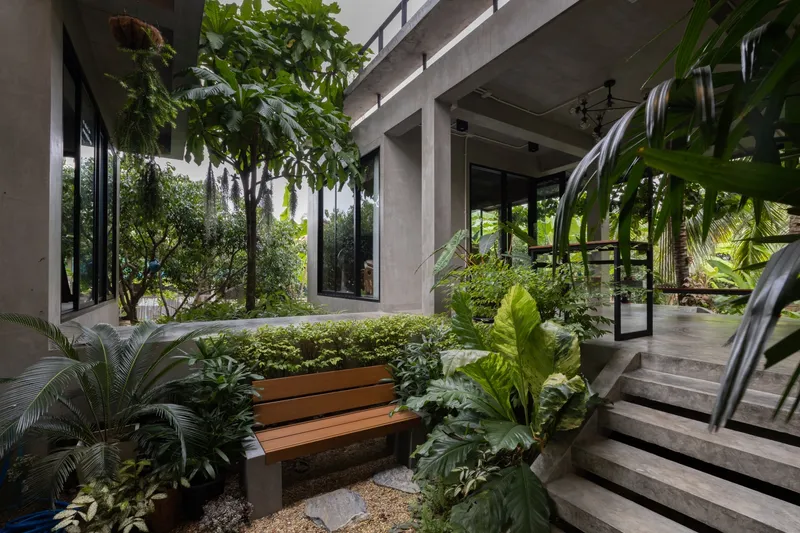
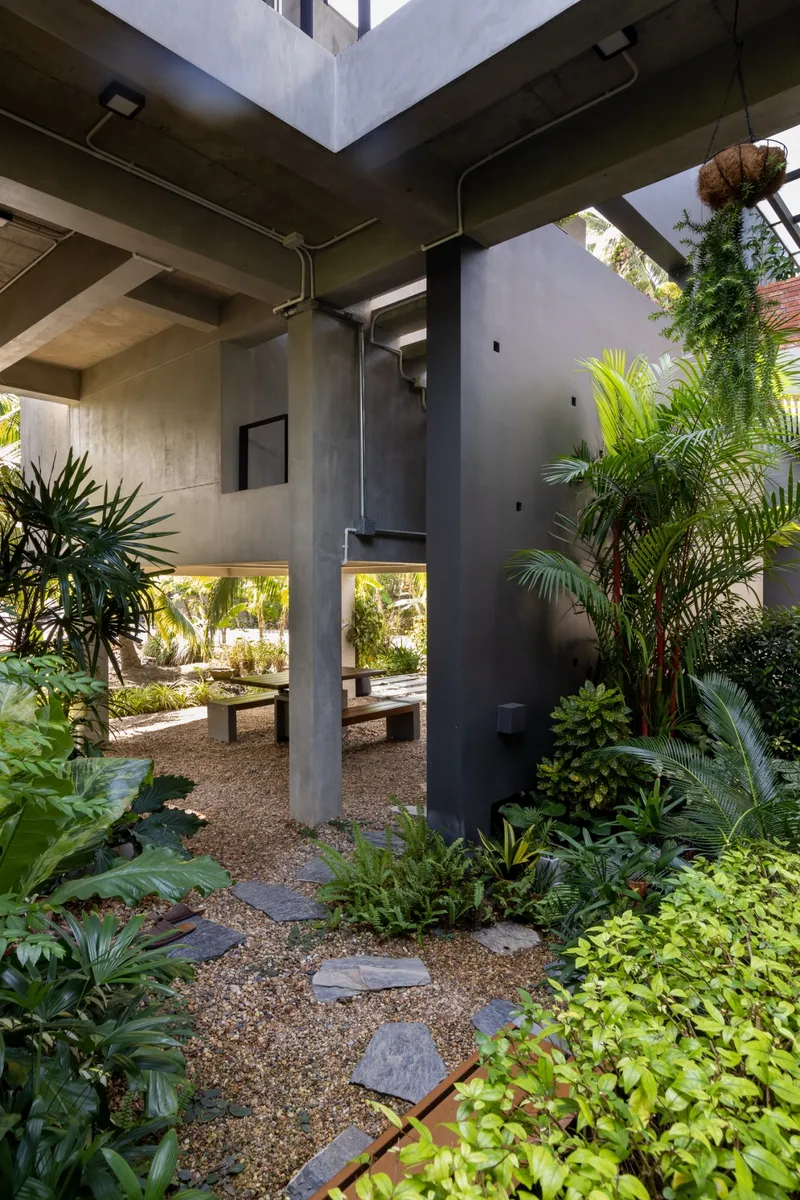
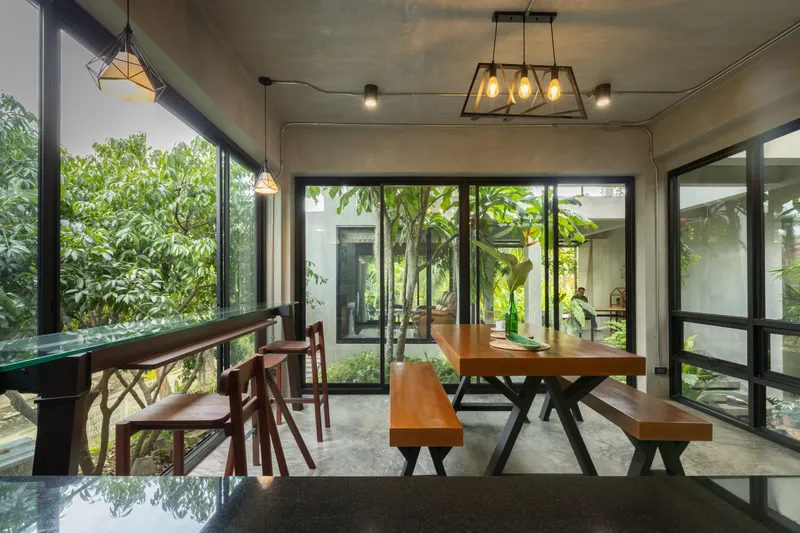
The plan organizes rooms around open courtyards that function as both thermal chimneys and social anchors. One courtyard, visible from the dining area through floor-to-ceiling glazing, contains a timber bench, stepping stones through gravel, and a curated cluster of tropical plants. It is not ornamental. In Thailand's humid climate, these voids pull cross-ventilation through the plan and allow the building to exhale heat rather than trap it. The exposed concrete beams overhead define outdoor circulation paths without enclosing them, creating covered walkways that work in monsoon rains and dry season alike.
The dining space benefits most directly. Sitting at the timber table, you look straight into a planted court that feels simultaneously interior and exterior. The glazing wall dissolves the edge, and the concrete ceiling plane extends continuously from inside to out, reinforcing the ambiguity. This is climate-responsive design achieved through plan organization rather than mechanical systems.
Sleeping Among the Trees
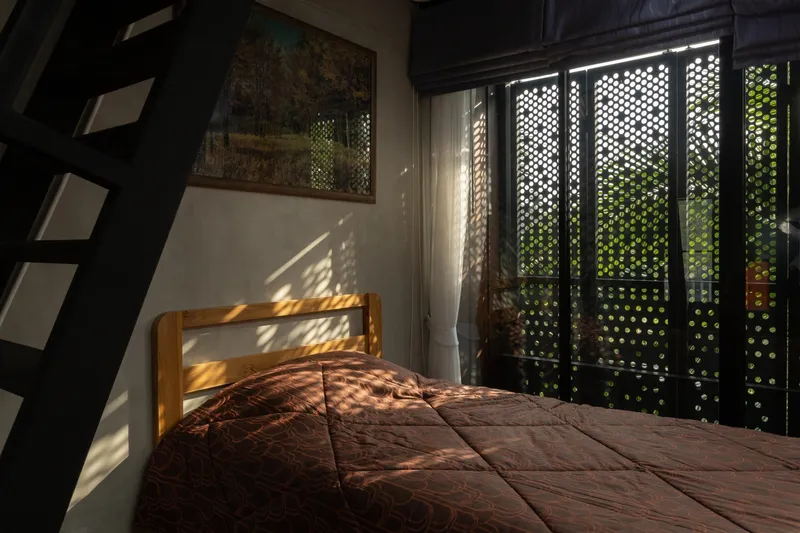
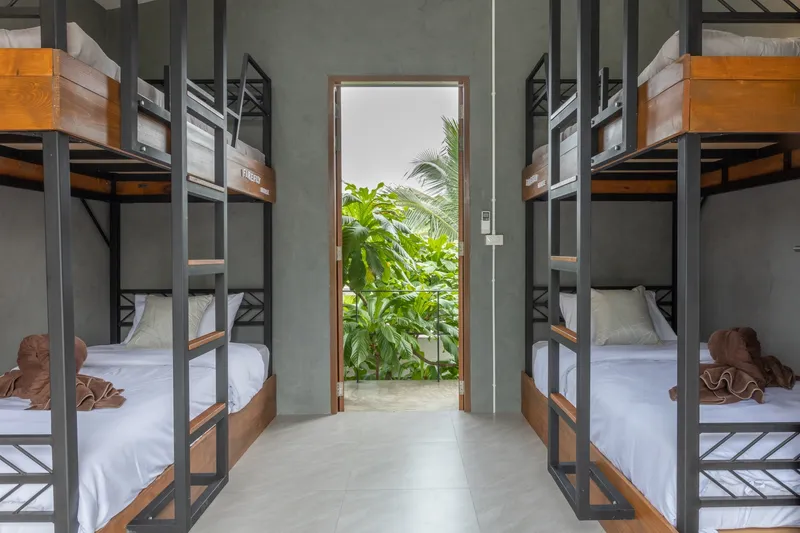
The private rooms show a careful modulation of light and privacy. One bedroom uses perforated black screens that filter morning sunlight into a soft geometric pattern across the timber bed frame, controlling glare while maintaining connection to the exterior. The effect is atmospheric without being theatrical. In the dormitory room, timber and steel bunk beds flank a central doorway opening directly to a planted courtyard, suggesting that even communal sleeping spaces maintain a visual anchor to the garden.
The decision to include a dormitory is telling. This is a retirement home, yes, but also a gathering place for extended family. The bunk room accommodates visiting children and grandchildren, reinforcing the house's role as a generational anchor rather than a private retreat.
Living at Canopy Height
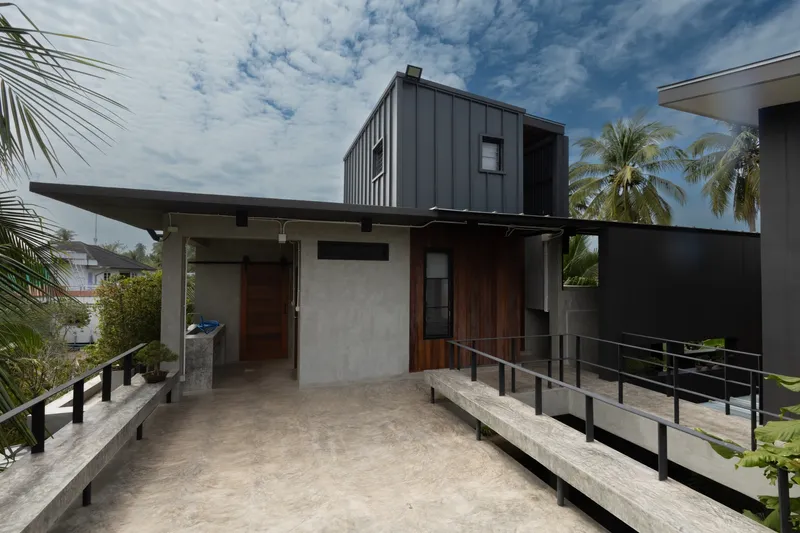
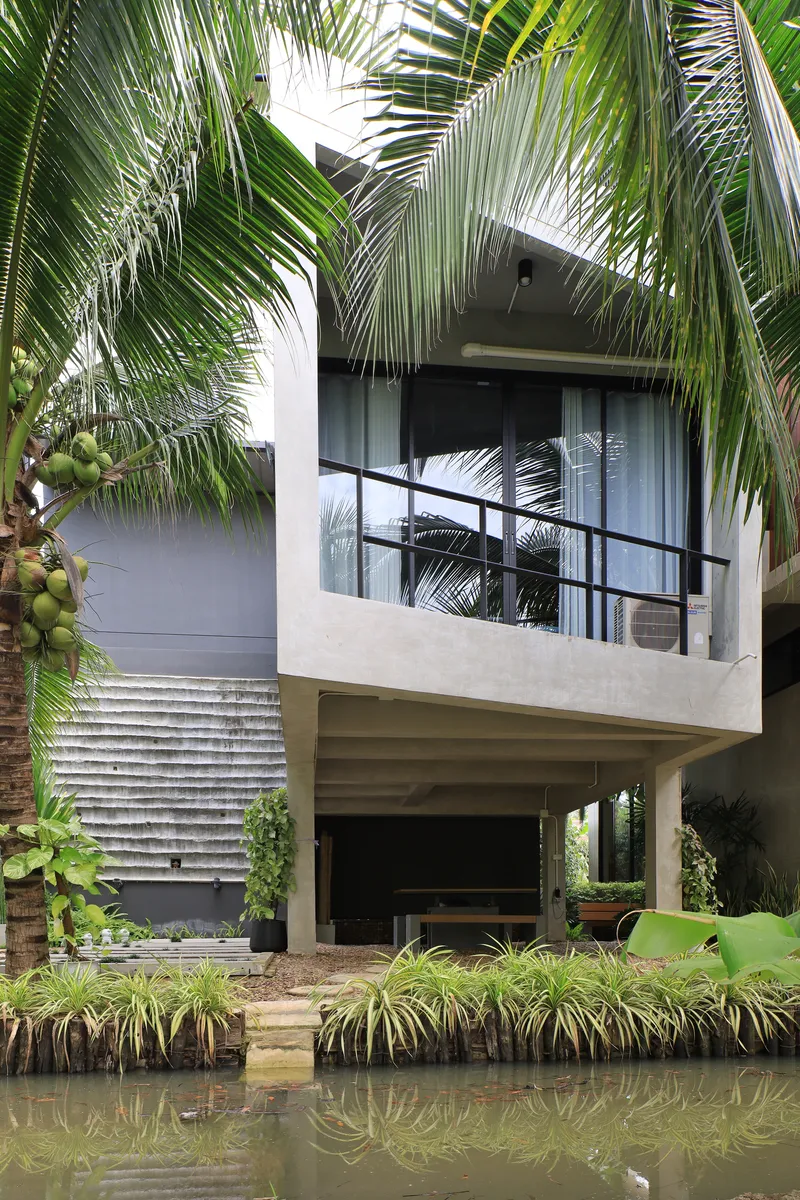
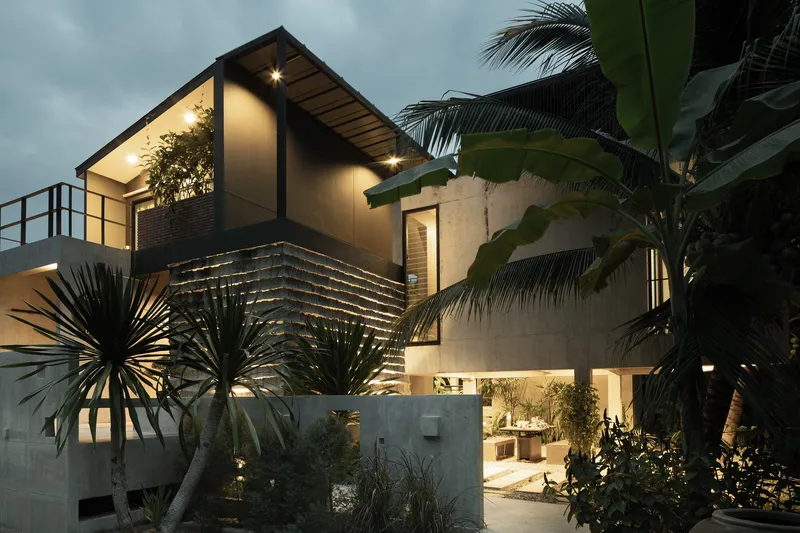
The upper terrace places you at the height of the coconut palms, a position that reframes the garden entirely. From below, the palms are obstacles and shade providers. From the terrace, they become companions, their fronds at arm's reach, their trunks receding into a vertical forest below. A cantilevered balcony extends over a still water canal, its metal railing the thinnest possible barrier between the house and the landscape. The corrugated metal volume overhead provides shade without enclosure.
The gabled facade, with its horizontal slat screening and timber surfaces, reads almost vernacular at twilight, recalling the pitched-roof houses of rural Samut Songkhram province. Volume Matrix Studio borrows the silhouette but reconstructs it in contemporary materials, maintaining cultural legibility while delivering the performance characteristics of steel and concrete.
Plans and Drawings
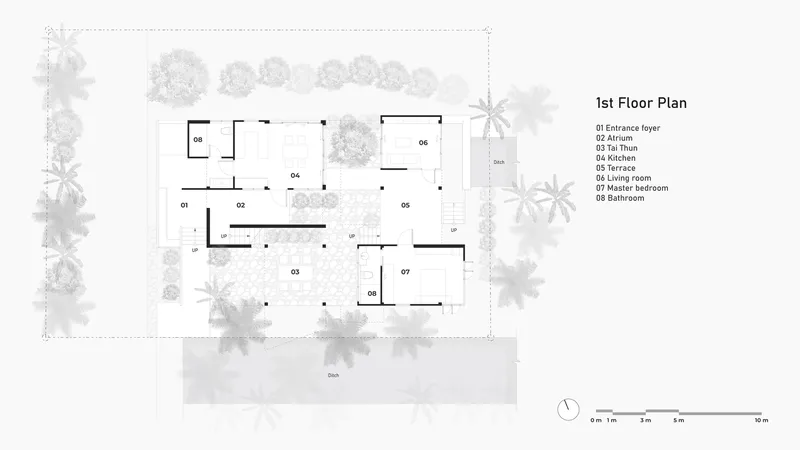
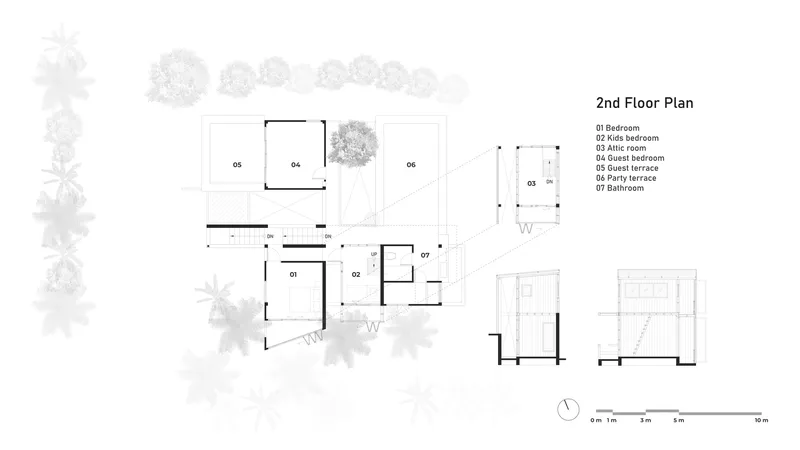
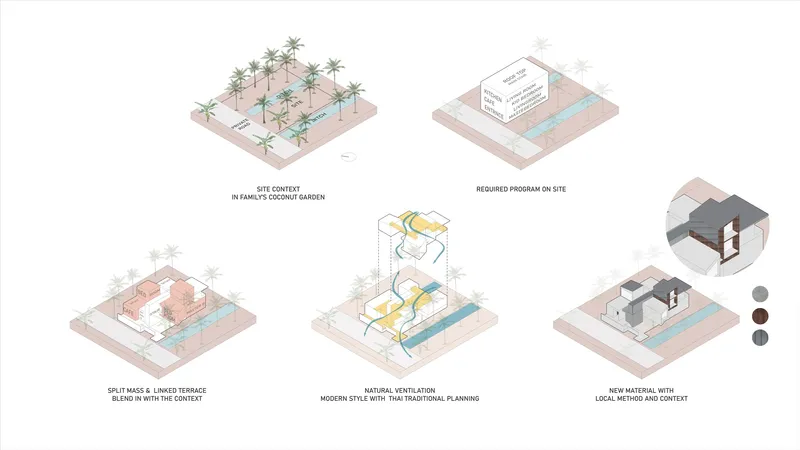
The floor plans confirm what the photographs suggest: rooms wrap around open courtyards in an L-shaped or fragmented arrangement, with the surrounding coconut trees drawn as part of the plan rather than erased from it. The first floor distributes living and dining areas along courtyard edges, while the second floor pushes bedrooms and terraces to the perimeter where they can engage the canopy. Section drawings reveal the double-height voids that connect ground-level courtyards to upper terraces, establishing the vertical airflow that keeps the house habitable without heavy reliance on air conditioning.
The isometric diagram sequence is particularly revealing. It walks through site context, program requirements, and natural ventilation strategies in a clear graphic language, showing how prevailing breezes are captured by courtyard openings and expelled through upper-level gaps. The diagrams also illustrate how the building's footprint was shaped around existing tree positions, a claim that the photographs corroborate thoroughly.
Why This Project Matters
Firefly House matters because it demonstrates a posture toward site that most residential projects claim but few actually execute. The coconut garden is not preserved as a decorative setback or a view to be consumed from behind glass. It is woven into the spatial logic of the house, shaping plan geometry, driving ventilation strategy, and defining the experiential quality of every room. The architecture defers to the landscape without becoming invisible.
There is also something quietly powerful about the narrative behind the commission. A woman who spent her working life harvesting coconuts from this garden now lives inside it in a fundamentally different way, sheltered by the same trees that once represented labor. Volume Matrix Studio understood that the garden was not just a site condition but a biography, and they built accordingly. In a region where rural land is increasingly sold off for resort development, choosing to inhabit a productive landscape rather than replace it is both an architectural and a cultural statement.
Firefly House by Volume Matrix Studio, Amphawa, Thailand. 350 m², completed 2021.
About the Studio
Share Your Own Work on uni.xyz
If projects like this are the kind of work you want to make, uni.xyz is a place to publish your own, find collaborators, and enter design competitions.


Popular Articles
Popular articles from the community


David Ortega Stacks a Two-Story Mexico City Penthouse Around a Steel Stair and a Pergola-Shaded Roof Terrace
In Colonia Roma, a 300 m² penthouse uses oak joinery, a planted steel stair and a slatted roof pergola to make a new-build apartment feel like a house.

Jaramillo Van Sluys Arquitectura and Urbanismo Turn a Demolished Registry Lot in Quito into an Orchard Plaza
In Quito's Centro Histórico, a 2,800 m² plaza exposes the San Agustín convent wall and redraws its lost Augustinian orchard in volcanic stone.

Cube Design Draws an Ecological Corridor Between Two Shenzhen Hills with the Nankai Building
Beside Shenzhen's container docks, the Nankai Building pairs stacked balconies with a climbing green screen to connect two hillsides across its height.

LT2A and OPEN Architectes Thread a Brick and Glass High School Through a Wooded Belgian Campus
In Braine-l'Alleud, a 3,000 m² wing for Collège Cardinal Mercier pairs pale brick with a glazed colonnade, deferring to a small chapel and a dense wood.

Similar Reads
You might also enjoy these articles


LAVA Architecten Gives Vocational Education a Sawtooth-Roofed Face on a Mechelen School Campus
In Mechelen, Belgium, a 2,053 m² STEM school on a 6×6 m grid turns workshops and classrooms into rooms that can be rearranged as teaching changes.

KEMA Studio Turns a Derelict Marvila Attic into a 60 m² Lighthouse Apartment Above Lisbon
In Lisbon's Marvila district, a rebuilt roof, four skylights and two plywood volumes turn an unlivable attic into a bright home facing the Tagus.

Pixel Gardens: One Repeated Module Stacked Into a Terraced Social Housing Tower for Famagusta
Salem Bader's shortlisted housing tower builds a vertical neighbourhood from one repeated module, offsetting units to carve terraces, light and air.

Bao Huynh Watercolor Atelier: A Serene Art Retreat in Hội An
Bao Huynh Watercolor Atelier in Hội An blends multifunctional art spaces, sustainable design, local materials, and family-friendly living in a serene environment.


Comments (0)
Please login or sign up to add comments
No comments yet. Be the first to comment!