

WaCa Design and Julia Kosciuk Build a Guest House from Its Own Hillside in Southern Brazil
Rochas Floridas Guest House quarries its granite on site and salvages childhood memories to anchor a coastal retreat near Florianópolis.


There is a particular confidence in a building that refuses to import what it can dig up from beneath its own footprint. Rochas Floridas Guest House, completed in 2023 on Brazil's southern coast facing Calheiros Beach, is one of four structures in a beachside compound outside Florianópolis, and it may be the most materially committed of the group. Designed by WaCa Design (led by Walter Cain) and Julia Kosciuk, the 224 m² house extracts granite directly from the rocky site, sources slate blocks from a nearby quarry, and wraps everything in Brazilian hardwood. Even the doorknobs were designed without metal. The result is not rustic posturing but a disciplined geometry set into a steep, boulder-strewn slope.
What makes the project genuinely interesting, beyond its low-embodied-carbon ambitions, is the way it braids autobiography into structure. Salvaged materials from the owner's childhood home, including the front door, floor tiles, and plumbing fixtures, reappear throughout the building in transformed roles: closet doors become headboards, old flooring becomes a dining room table, and repurposed metal details become railings and rain chains. The building is not a nostalgic reconstruction. It is a new spatial proposition that carries the weight of lived experience in its material DNA.
Rooted in the Rock
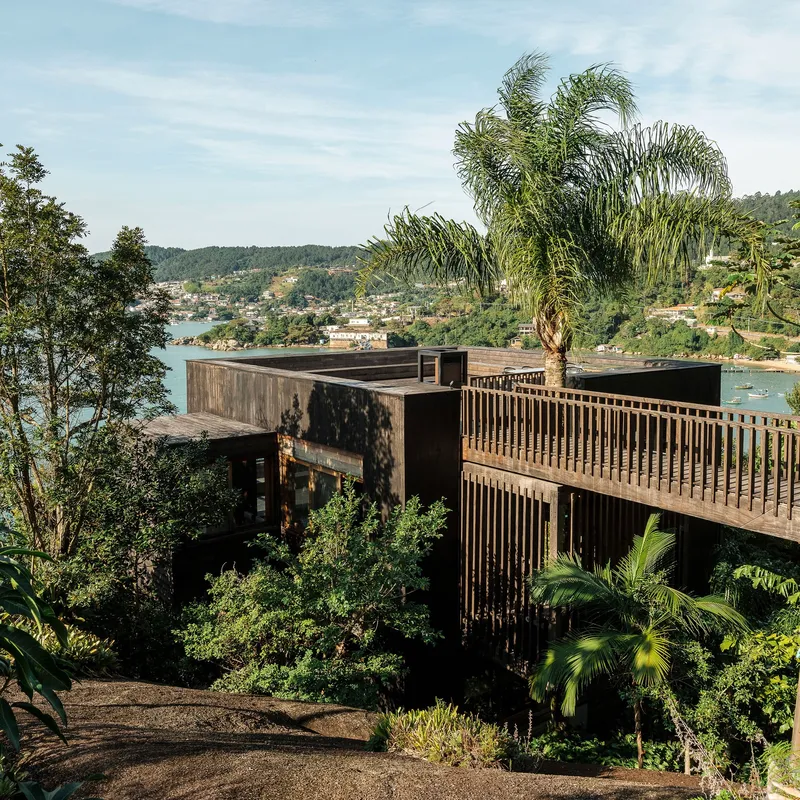
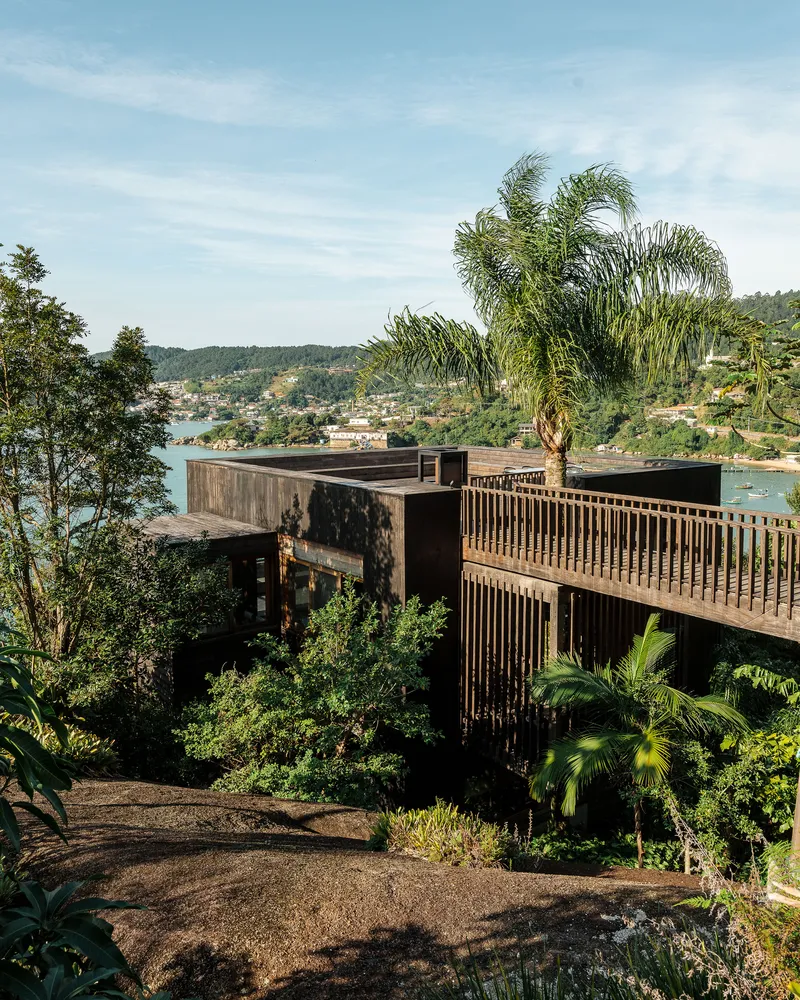

The house reads differently depending on your vantage point. From the bay, it appears as a timber pavilion floating above dense vegetation, its vertical slatted screens giving it a lantern quality against the canopy. From the hillside above, it flattens into a long horizontal volume that follows the contour lines with disciplined restraint. The two-story central cube is the organizing principle: volumes are added and subtracted from it to create balconies, overhangs, and terraces that negotiate the slope.
The terracing is not decorative. Stone retaining walls built from on-site granite hold the earth back, creating a series of plateaus that the building occupies without erasing the landscape's original character. Boulders that predate the project by millennia sit comfortably alongside new construction, and the architecture treats them as permanent neighbors rather than obstacles.
Timber as System
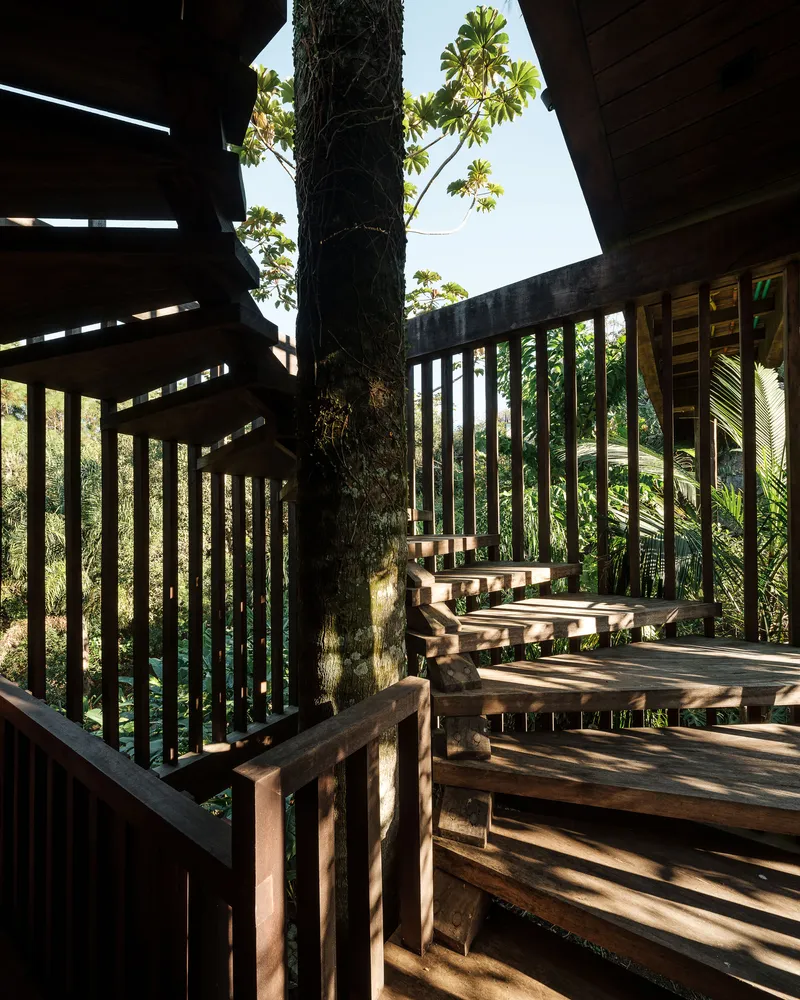
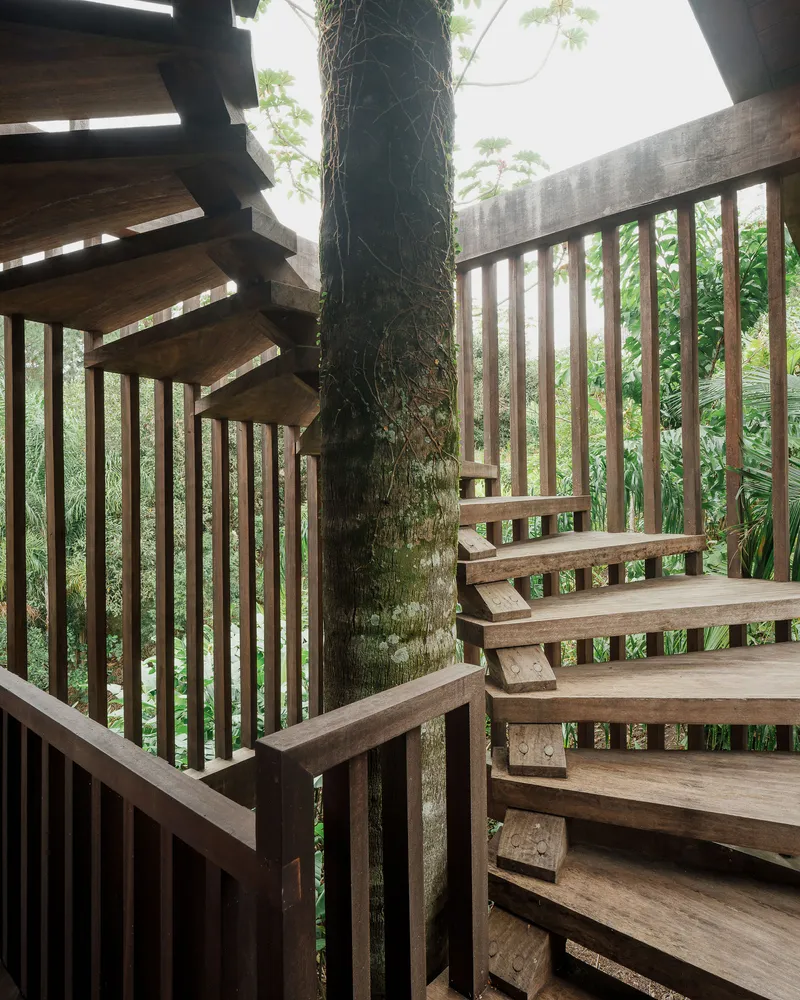

The staircase wrapping around a preserved tree trunk is the house's most photographed moment, and for good reason. It demonstrates the design philosophy in a single gesture: the architecture yields to the existing landscape rather than demanding the landscape yield to it. The tree trunk passes through the structure like a column that was there first, and the vertical slat balustrades echo it with their own rhythm of parallel lines.
All windows are made entirely of wood, a deliberate choice for an oceanfront site where salt air corrodes metal hardware quickly. Recycled plastic rope appears in railings, an unconventional substitution that performs well in marine conditions while keeping the material palette honest about its sources. The vertical timber screening that wraps the upper balconies does triple duty: privacy, ventilation, and solar shading, all without mechanical intervention.
Pathways and Thresholds

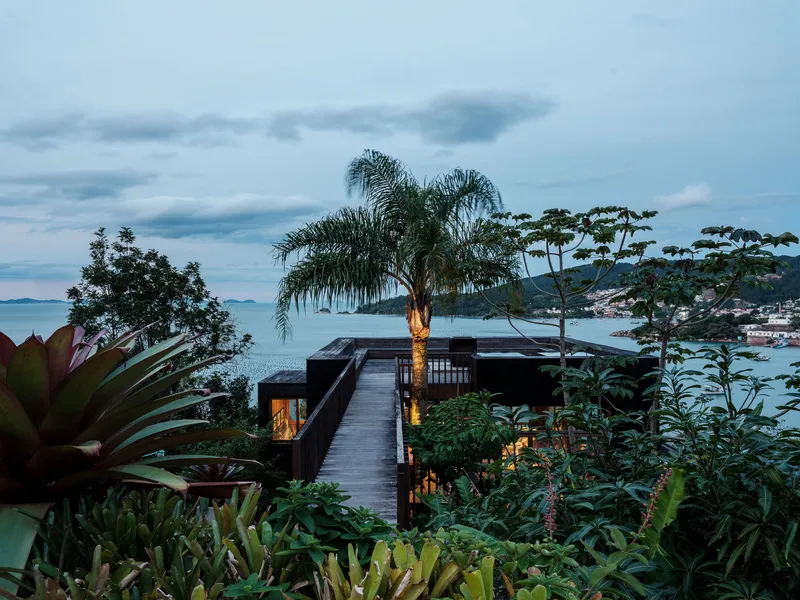
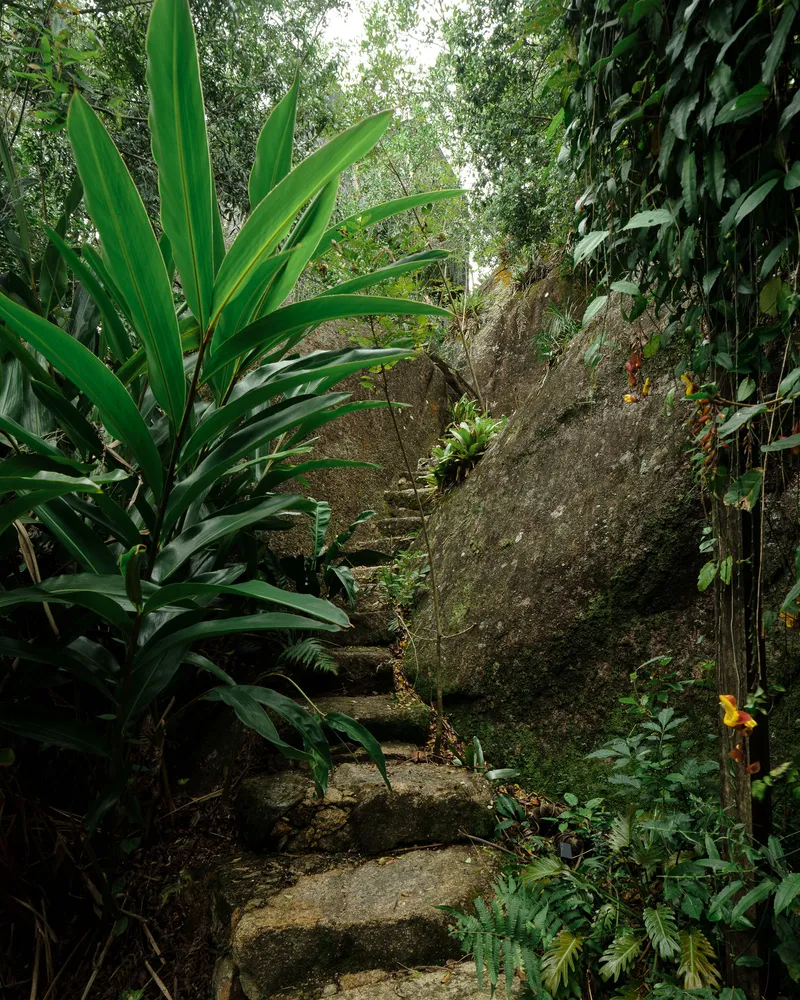
Arriving at the guest house is not a simple act of walking up to a front door. Timber walkways thread through planted slopes thick with agave, palms, and tropical groundcover, turning the approach into a decompression sequence. By dusk, these elevated paths glow against the dark vegetation, bridging between the compound's buildings and framing sequential views of the bay below.
A concrete staircase winds through a hillside garden where mossy boulders and tropical plantings have been allowed to encroach rather than be pushed back. The landscape design here is one of curated wildness: the bones are precise, but the growth is loose. It is a strategy that will only improve with time as the vegetation thickens and the materials weather.
Living Spaces That Frame the Coast
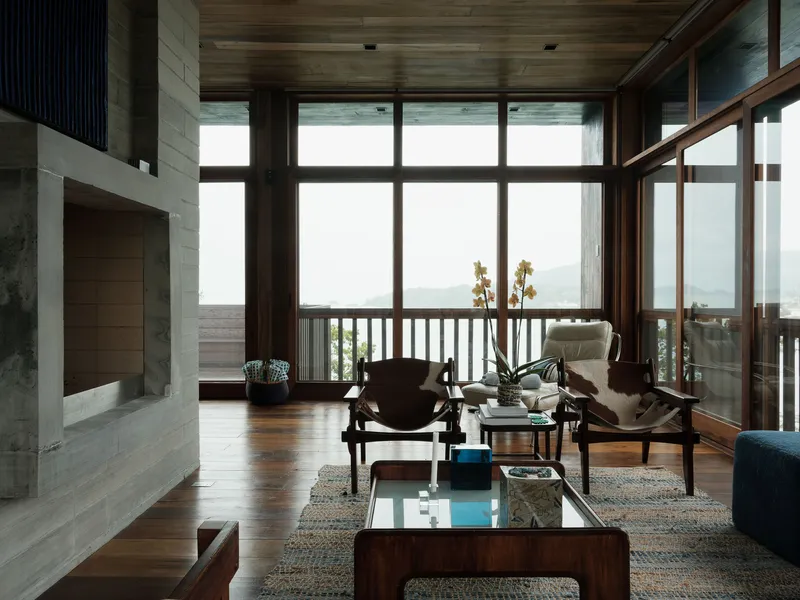
The living room pairs a concrete fireplace with a timber ceiling that channels the eye toward a wide opening framing distant hills. It is a room that knows exactly where it wants you to look. The material contrast, cool concrete mass against warm wood grain, gives the space a gravity that prevents it from feeling like a generic beach house interior.
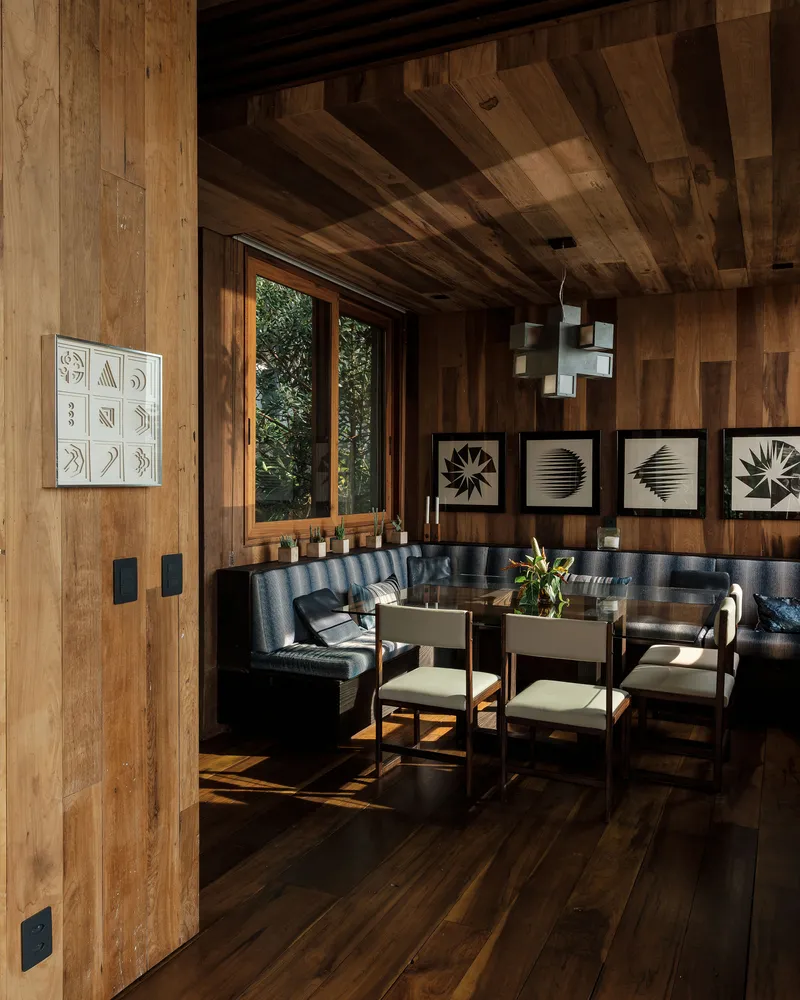
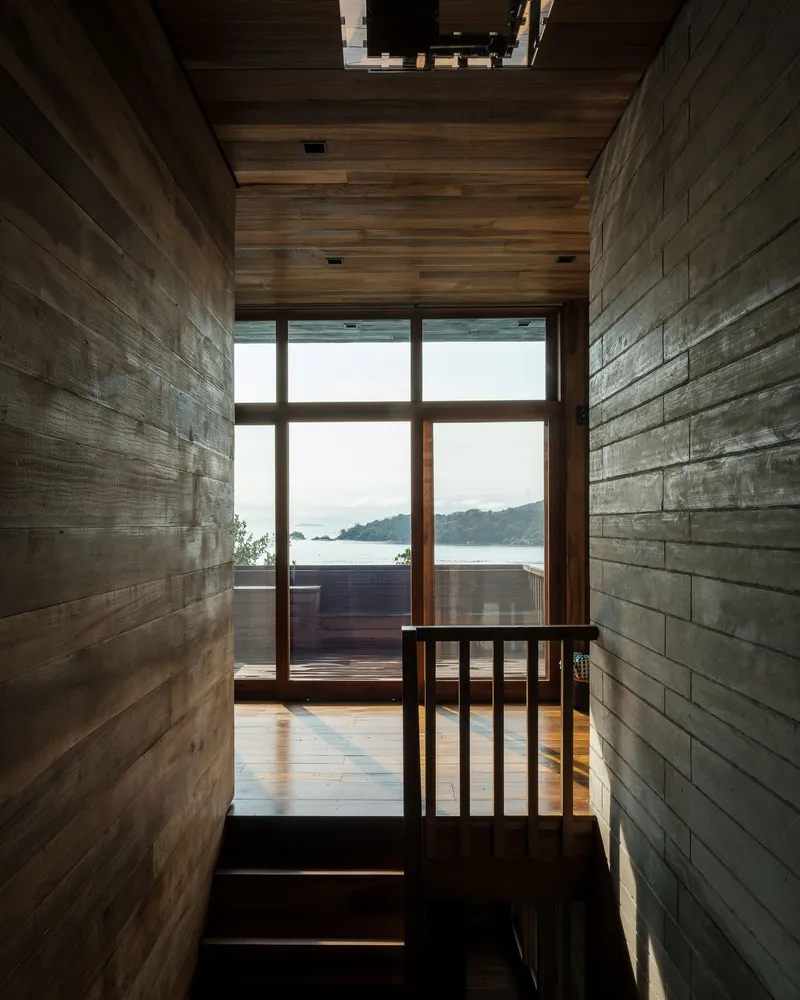
In the dining area, exposed timber ceiling beams run the full length above a built-in banquette, with framed botanical prints mounted along the back wall. The dining table, made from the flooring of the owner's childhood home, anchors the room with a story that no new material could tell. A narrow timber-clad corridor on the upper level acts as a compression point: board-formed walls pinch inward before releasing you through a glazed door to a panoramic view of the coastal bay. These moments of spatial compression and release are handled with the confidence of architects who understand sequence.
Private Quarters and Wet Rooms
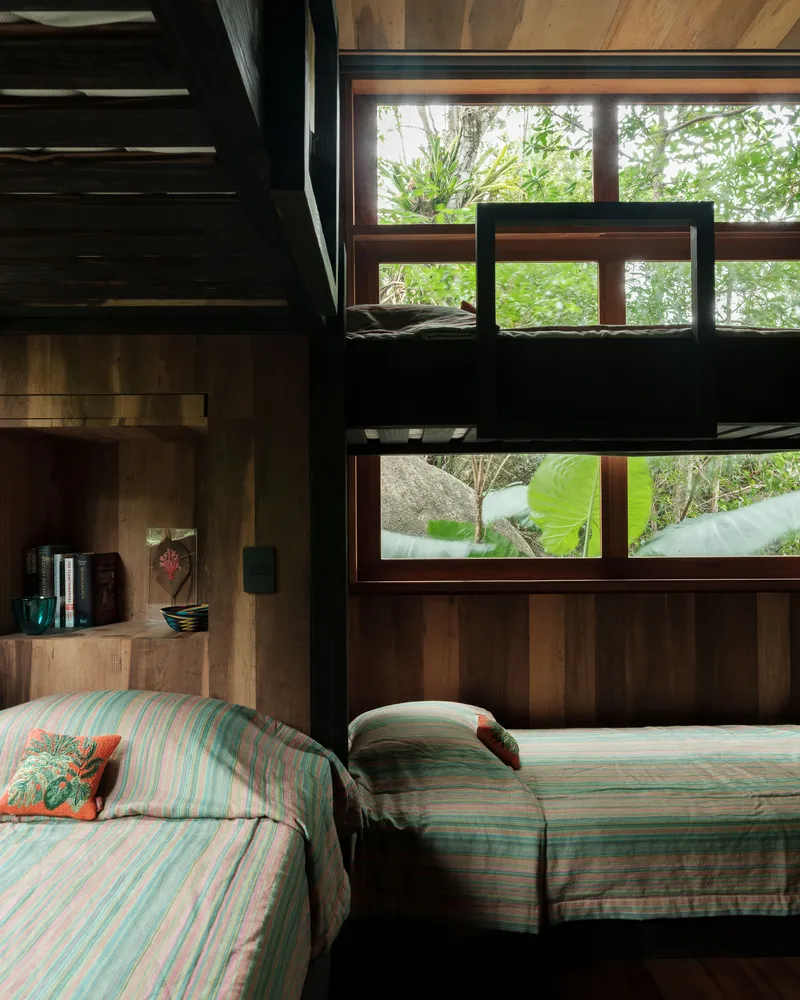
The bedrooms are lined entirely in timber, with staggered horizontal windows that frame tropical foliage in cinematic strips rather than offering a single uninterrupted panorama. The effect is meditative: you are given the landscape in portions, not all at once. Headboards repurposed from closet doors carry a subtle patina that new wood cannot replicate, grounding these rooms in a material history that the guests may not know about but will sense.
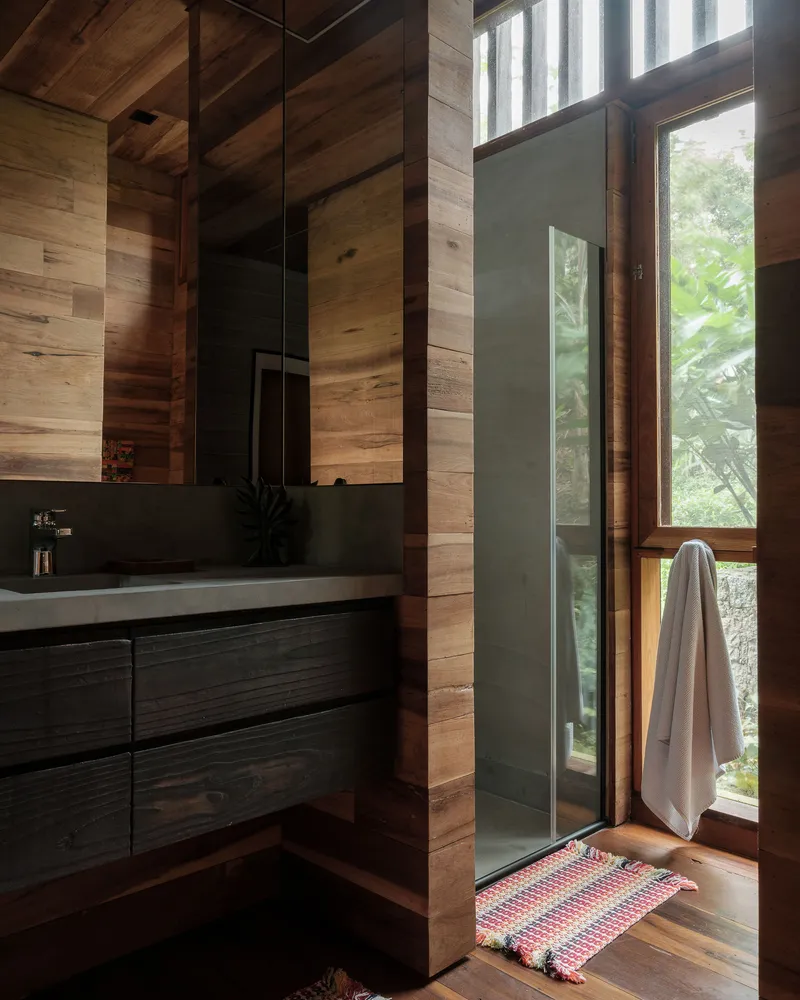
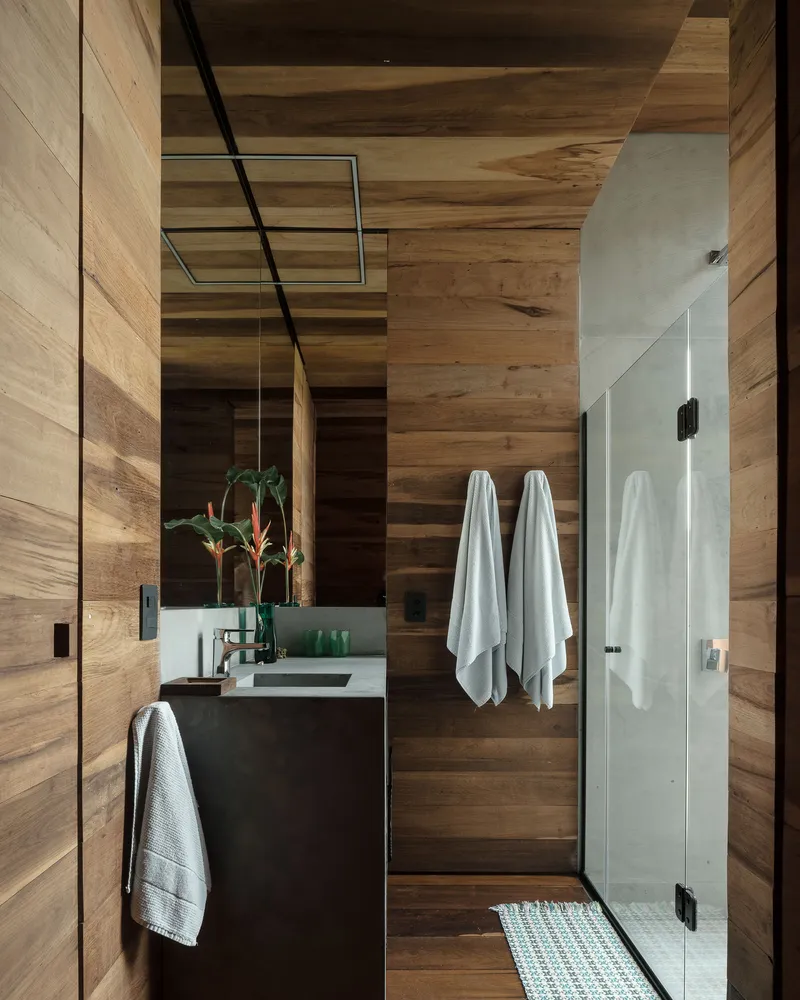
Bathrooms continue the timber plank vocabulary on walls and ceilings. Dark vanities and salvaged plumbing fixtures contrast with the warmth of the wood. Tall glazed doors open bedrooms and bathrooms alike directly to garden views, collapsing the boundary between bathing and being outdoors. The detailing is restrained but specific, and nothing feels like an afterthought.
Courtyard and Covered Ground
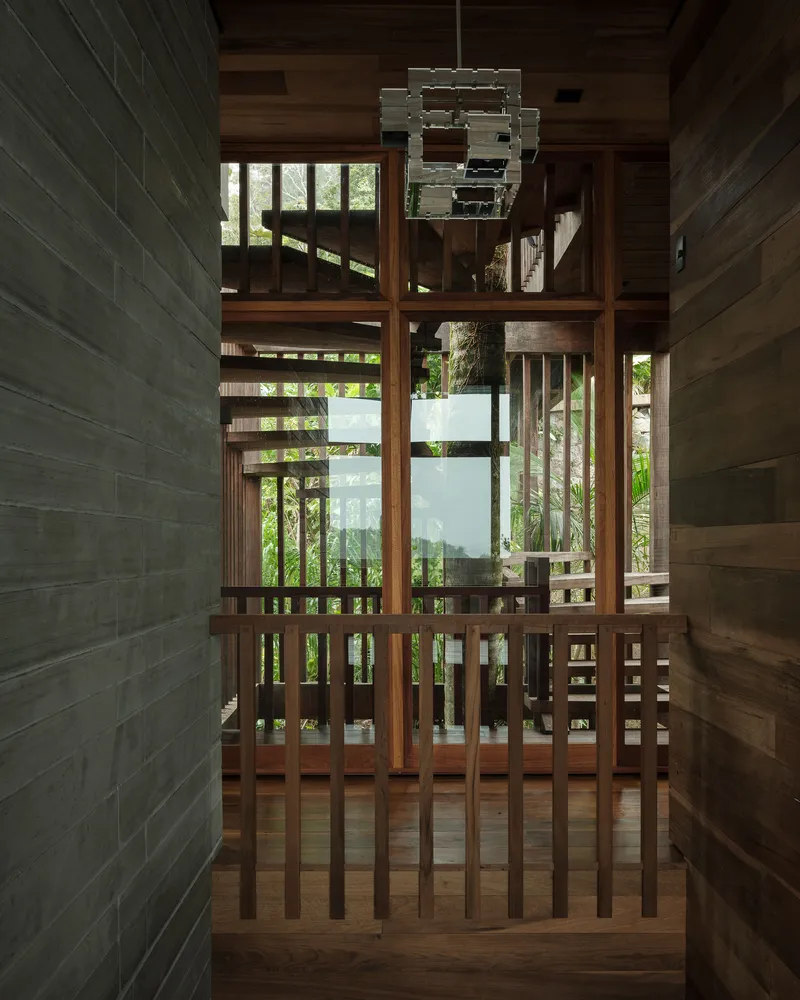
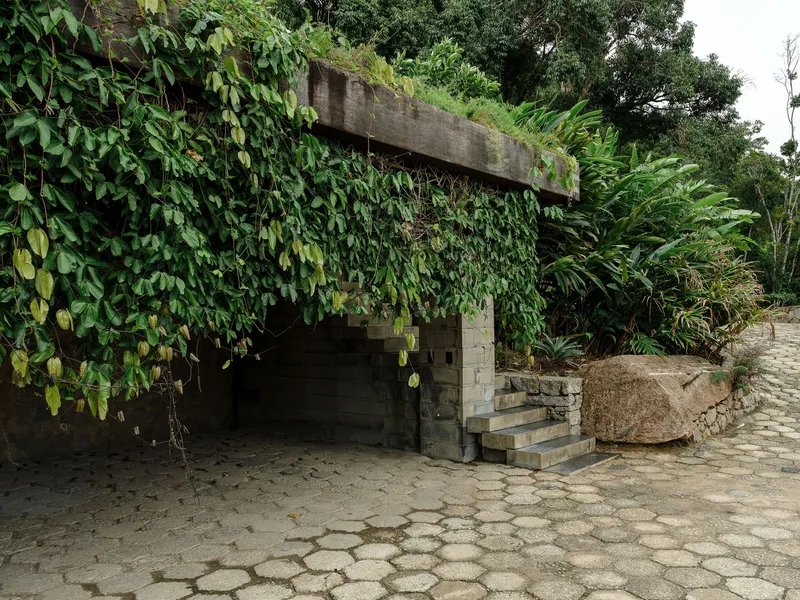

An interior courtyard punctures the plan, pulling light and air deep into the house. Timber screen partitions with vertical slats and glazed doors wrap this void, turning what could have been a dead zone into the social hinge of the building. The courtyard also enables cross-ventilation, a critical passive strategy when large windows are already positioned to capture ocean breezes.
At ground level, a concrete overhang draped with vines shelters hexagonal paving stones and a massive boulder that the architects simply refused to remove. The vine-covered soffit will deepen in character each year, and the boulder becomes a kind of found furniture. Meanwhile, a dark stone countertop in the kitchen catches afternoon sun through timber-framed windows overlooking garden foliage, connecting the act of cooking to the landscape outside.
Plans and Drawings
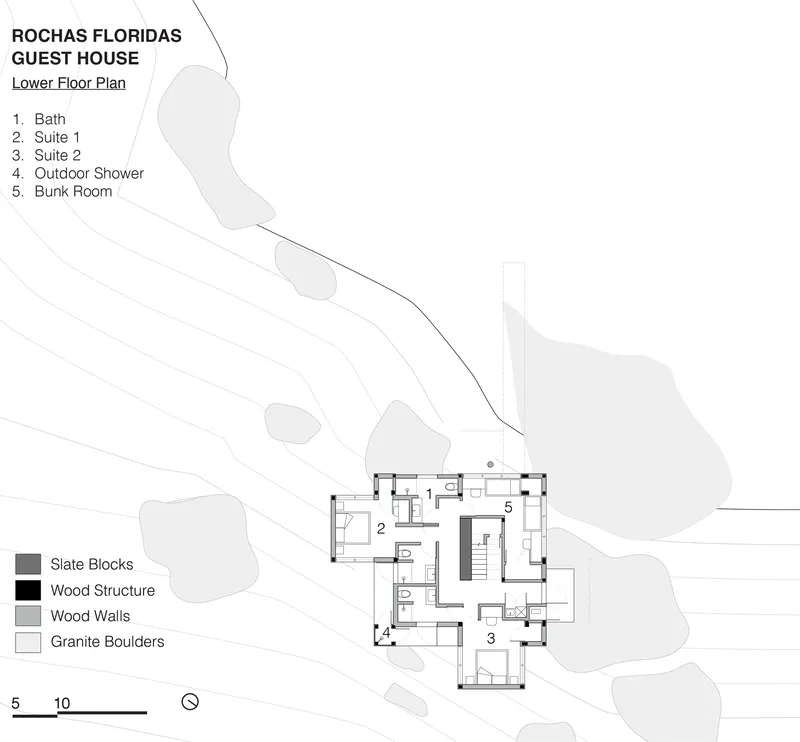
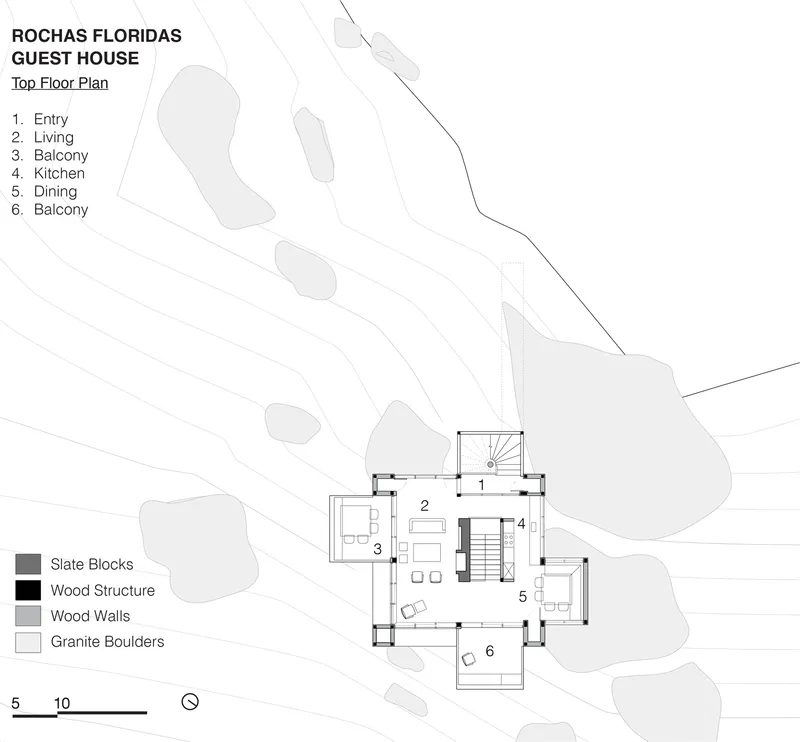

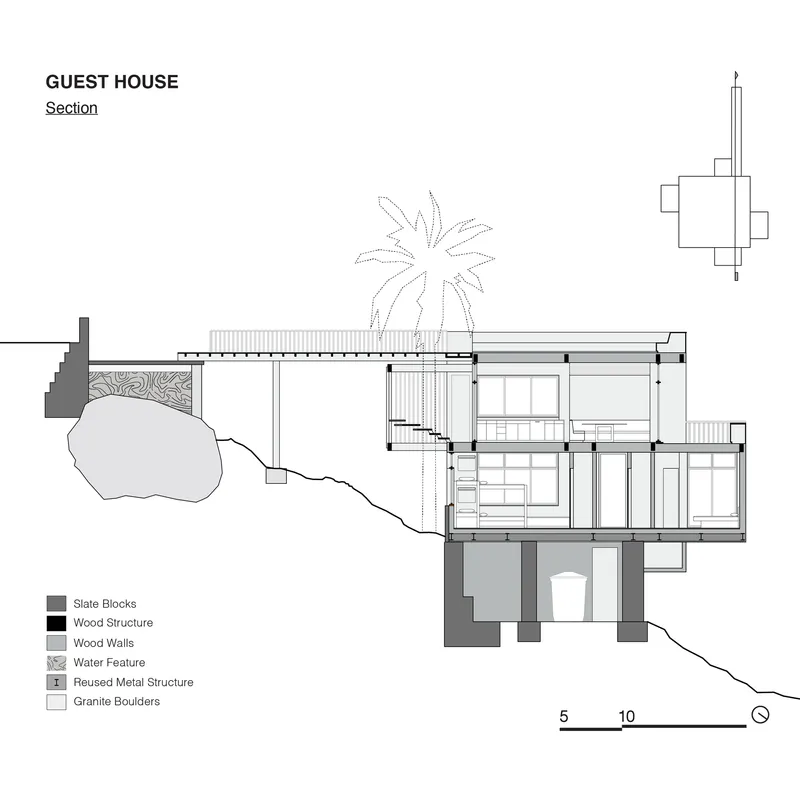
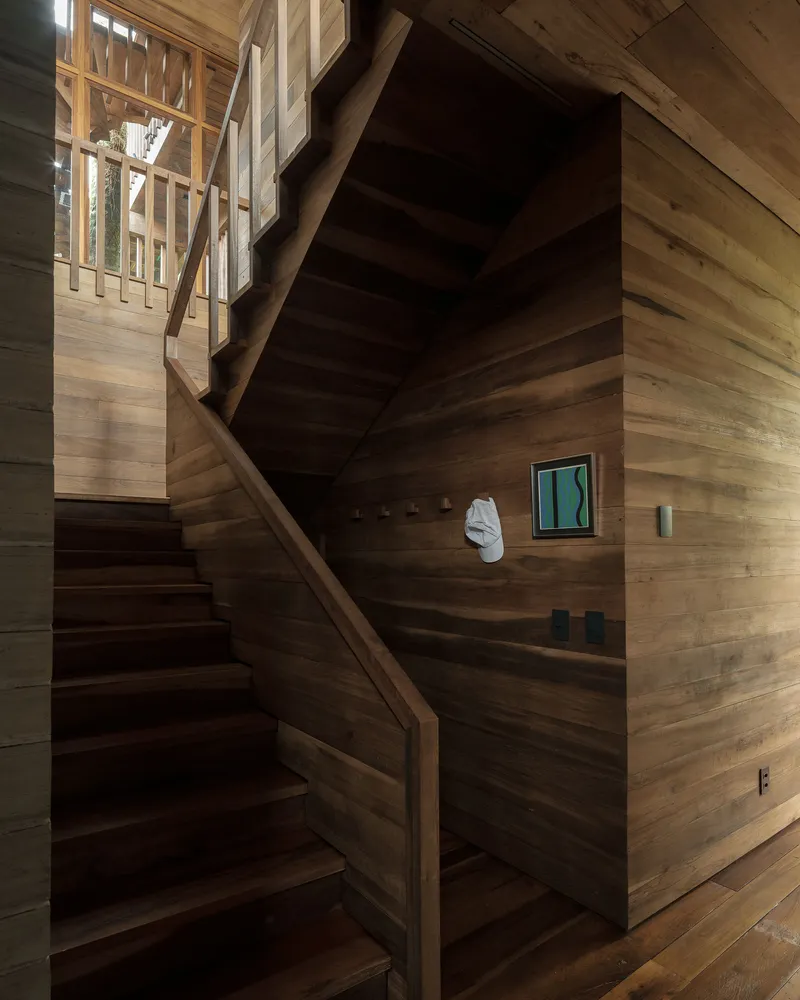
The lower floor plan reveals bedroom suites and a bunk room nestled among topographic contour lines and granite boulders, confirming that the site's geology was treated as a design constraint rather than an inconvenience. The upper plan shows living spaces, kitchen, and balconies organized around the central cube, with a material legend distinguishing wood from slate construction. A roof plan documents the garage, bridge connection, and terrace on the sloped site. The section drawing is perhaps the most revealing: it shows the multi-level structure stepping down the hillside, with a palm tree and water feature integrated into the profile. An interior stair view, clad in horizontal wood planks with a small window punched above, completes the picture of a tightly resolved circulation system.
Why This Project Matters
Low-embodied-carbon construction is talked about incessantly and practiced rarely with this level of specificity. Rochas Floridas Guest House does not merely specify sustainable materials on a spreadsheet; it quarries stone from beneath its own foundations, salvages domestic artifacts from the client's past, and substitutes recycled plastic rope for metal in marine-grade railings. The commitment extends down to the doorknobs, designed without metal. When a building sources this much from its immediate context, it becomes genuinely difficult to imagine it anywhere else, which is perhaps the strongest definition of site-specific architecture.
WaCa Design and Julia Kosciuk have also avoided the trap of letting material piety flatten the spatial experience. The sequence of compression and release through timber corridors, the tree trunk colonnade, the courtyard hinge, and the framed bay views all demonstrate a rigorous command of form. The salvaged elements from the owner's childhood home elevate the project beyond sustainability metrics into something more rare: a building with a biography. In a coastal region saturated with second homes that treat the landscape as backdrop, this guest house treats it as a collaborator.
Rochas Floridas Guest House by WaCa Design and Julia Kosciuk. Governador Celso Ramos, Brazil. 224 m². Completed 2023. Photography by Pedro Kok.
About the Studio
Share Your Own Work on uni.xyz
If projects like this are the kind of work you want to make, uni.xyz is a place to publish your own, find collaborators, and enter design competitions.


Popular Articles
Popular articles from the community


U.GA Architects Wraps an Oval Rooftop Pool in Curved Board-Formed Concrete on Busan's Jeollidan-gil
In Busan's Jeonpo-dong, a 454 m² mixed-use block stacks a neighborhood facility, guest rooms and an oval rooftop pool inside spiraling concrete walls.

Juan García Correa, John González and Claudia Rueda Sink a Circular Amphitheater into a Manizales Engineering Building
On the La Nubia campus in Manizales, Colombia, the S1 Building folds labs and offices into a hillside of ramped lawns that double as a campus route.

David Macias Steps a Doorless Stone and Plaster House Down a Tropical Colombian Hillside
In the humid hills of Colombia, Threshold House replaces the front door with an open void and terraces its 850 m² down the slope instead of fighting it.

David Ortega Stacks a Two-Story Mexico City Penthouse Around a Steel Stair and a Pergola-Shaded Roof Terrace
In Colonia Roma, a 300 m² penthouse uses oak joinery, a planted steel stair and a slatted roof pergola to make a new-build apartment feel like a house.

Similar Reads
You might also enjoy these articles


LAVA Architecten Gives Vocational Education a Sawtooth-Roofed Face on a Mechelen School Campus
In Mechelen, Belgium, a 2,053 m² STEM school on a 6×6 m grid turns workshops and classrooms into rooms that can be rearranged as teaching changes.

KEMA Studio Turns a Derelict Marvila Attic into a 60 m² Lighthouse Apartment Above Lisbon
In Lisbon's Marvila district, a rebuilt roof, four skylights and two plywood volumes turn an unlivable attic into a bright home facing the Tagus.

Pixel Gardens: One Repeated Module Stacked Into a Terraced Social Housing Tower for Famagusta
Salem Bader's shortlisted housing tower builds a vertical neighbourhood from one repeated module, offsetting units to carve terraces, light and air.

Bao Huynh Watercolor Atelier: A Serene Art Retreat in Hội An
Bao Huynh Watercolor Atelier in Hội An blends multifunctional art spaces, sustainable design, local materials, and family-friendly living in a serene environment.

Explore Residential Building Competitions
Discover active competitions in this discipline

Challenge to design a portable theatre

Challenge to design a portable music platform

Challenge to design an open learning module for the elderly

Challenge to design mud housing for contemporary communities
Comments (0)
Please login or sign up to add comments
No comments yet. Be the first to comment!