
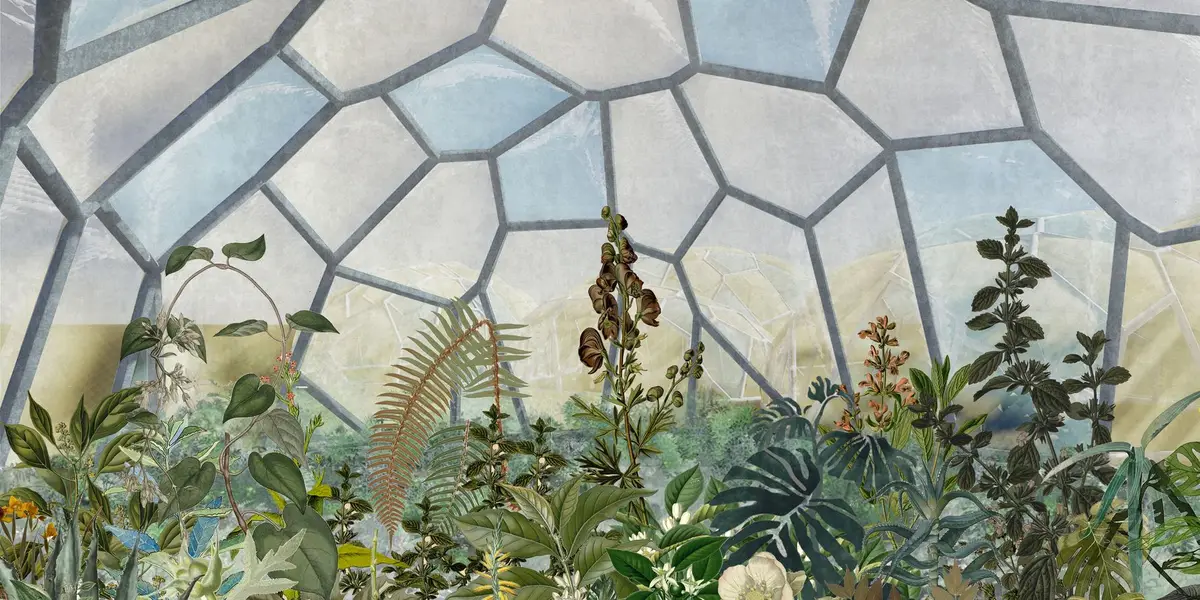
Warm for Elders: Greenhouse Domes and Garden Rooms for Munich's Aging Population
A biophilic park near Munich's English Garden pairs greenhouse domes with intergenerational programming to keep older adults socially active year-round.


Winter in Munich can be isolating, especially for older adults. Cold months shrink the radius of daily life: parks empty, benches go unused, and the social fabric that public space sustains thins out until spring. Warm for Elders starts from that simple observation and builds outward, proposing a park of greenhouse domes, covered pergolas, and sheltered garden rooms that keep outdoor communal life viable through every season. The core argument is spatial, not sentimental: if you give people warm, light-filled places to garden, read, exercise, and sit together, intergenerational contact happens on its own.
The project is a shortlisted entry in the Huddle competition on uni.xyz, designed by 墨 陈 and Ying Lu. Sited near Munich's English Garden and the city's iconic landmarks, the park occupies a position already threaded into daily pedestrian life. The designers layer greenhouse domes, a café, a bookstore, a children's garden, fitness zones, and stepped seating into a landscape of dense tree coverage and rolling topography, producing a destination that reads as parkland first and architecture second.
An Open Plaza Where Generations Overlap
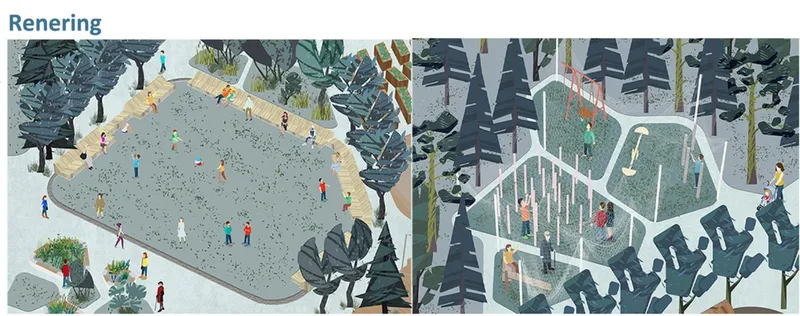
The rendering of the central plaza shows the design's social logic at work. Visitors gather casually among mature trees and planted beds, with no hard boundary separating age groups or activities. Raised planting zones break the ground plane into pockets of intimacy without walling anyone off. The palette is green and gravel, low-key enough that the human activity becomes the focal point. What matters here is the clustering: people drift toward one another because the landscape gives them reasons to pause, not because signage directs them to a "social zone." That restraint is a design decision worth noting.
Dome Clusters That Disappear into the Hillside

The elevation drawing reveals clustered dome structures nestled among rolling hills and tree canopy. These greenhouse domes are the project's most distinctive move: warm, light-filled communal enclosures that extend the usability of the park through Munich's colder months. Rather than asserting themselves as architectural objects, they tuck into the terrain, their rounded profiles echoing the hillside contours. The result is a built environment that feels grown rather than placed.
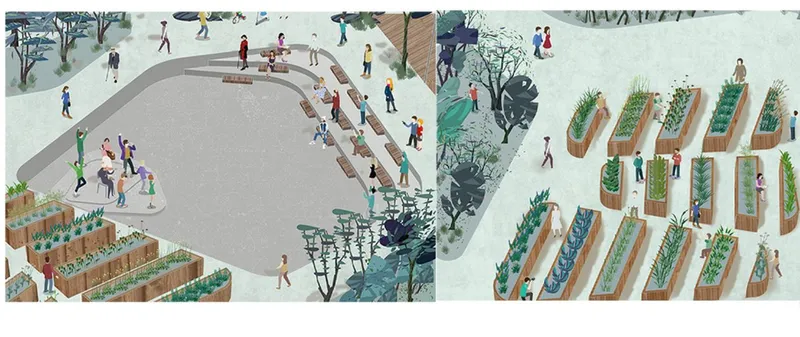
Alongside the domes, the aerial view of the stepped seating amphitheater and raised garden beds shows how the designers calibrate between active and passive program. The amphitheater gives the park a gathering point for events or simply for resting with a view, while the garden beds invite hands-on participation. Pedestrians move through at multiple levels, which keeps sightlines varied and the space from feeling flat or monotonous. For older adults, that variation in grade and seating height is not just aesthetic; it provides options for different mobility levels.
Petal Pavilions and the Logic of a Central Core
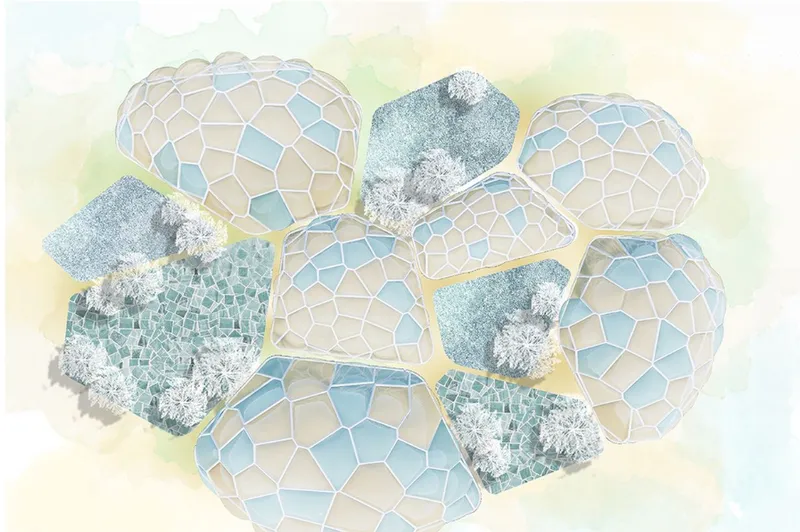
The axonometric drawing makes the organizational logic explicit. Eight petal-shaped pavilions radiate from a central core, each one housing a distinct programmatic element: greenhouse, café, bookstore, children's garden, fitness area, or pergola. Winter trees frame the composition, reinforcing the project's commitment to year-round presence. The petal form creates sheltered courtyards between pavilions, spaces where cross-pollination between activities occurs naturally. An older adult leaving the bookstore passes the children's garden; a family heading to the café walks through the greenhouse. These overlaps are not accidental. They are the mechanism through which intergenerational contact is engineered without being forced.
A Master Plan Rooted in Ecological Layering
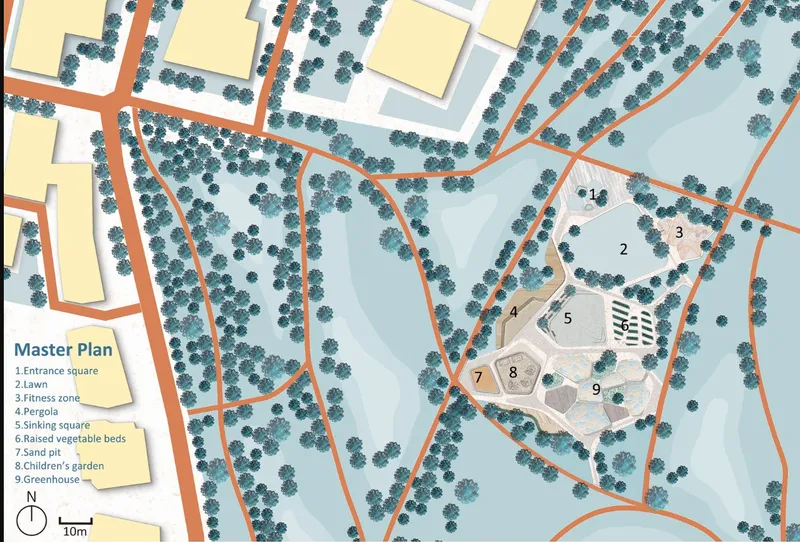
The master plan drawing maps the full extent of the park's zoning, with numbered areas connected by a network of pathways winding through dense tree coverage. The layout encourages a daily circuit of activities: walking, socializing, reading, gardening, exercising. No single zone dominates. Instead, the plan distributes program evenly across the site so that movement through the park is itself an activity, not just transit between destinations. The density of planting reinforces ecological awareness and provides shade, windbreak, and seasonal color, all of which serve the biophilic framework the designers are working within.
Why This Project Matters
Aging populations pose one of the most concrete design challenges of the coming decades, yet the discourse often stalls at accessibility ramps and grab bars. Warm for Elders reframes the question: how does public space sustain social connection for people whose daily range contracts with age and climate? The answer here is not a building but a landscape system, one where architecture dissolves into topography and program dissolves into routine.
墨 陈 and Ying Lu have proposed something quietly radical: a park that treats warmth, light, and proximity as infrastructure. The greenhouse domes are not ornamental; they are the project's civic argument made physical. If a city wants its older residents to remain part of public life, it needs to build the conditions that make showing up easy, comfortable, and worth repeating. That is what biophilic design, done with this kind of programmatic specificity, can actually deliver.
View the Full Project
About the Designers
Enter a Design Competition on uni.xyz
uni.xyz runs architecture and design competitions year-round that reward proposals with spatial conviction and real site intelligence.
Project credits: WARM FOR ELDERS by 墨 陈, Ying Lu Huddle (uni.xyz).


Popular Articles
Popular articles from the community


Manzana Morphosis: Stretching Barcelona's Grid into a Living Landscape for 2050
A radical reworking of the Eixample manzana turns density into a tool for generous public space, vertical ecology, and environmental performance.


David Ortega Stacks a Two-Story Mexico City Penthouse Around a Steel Stair and a Pergola-Shaded Roof Terrace
In Colonia Roma, a 300 m² penthouse uses oak joinery, a planted steel stair and a slatted roof pergola to make a new-build apartment feel like a house.

graciastudio Turns a Viewless Tijuana Lot Inward Around a Courtyard of Concrete, Timber and Trees
In Tijuana, Jorge Gracia's GA2 House stacks a timber-clad private floor over exposed concrete and replaces a missing view with a planted interior patio.

Aquadapt: An Underwater Habitat That Rewrites Its Rooms by the Hour
Curved modules ring the seabed while one shell shifts from breakfast room to cinema, farm and football pitch as residents' needs change.

Similar Reads
You might also enjoy these articles

Vereda Arquitetos Renovates a 40-Square-Meter Apartment Inside Niemeyer's Copan Building
A compact unit in São Paulo's most iconic residential tower gets a material overhaul that pairs exposed concrete with bold blue Formica.

Shakur's House: Exposed Brick as an Interior Organiser in a 168 m² Mashhad Residence
Brick moves indoors in this Mashhad residence, where masonry walls, glass partitions and teal planes sequence a compact home without closing it off.

Day and Night Park: A Time-Based Urban Newsstand in Beijing
A temporary urban newsstand in Beijing blending travel, light, and reading through poetic colors, compact form, and community-focused design.

Modernist Patio Renovation in El Masnou, Barcelona by Oliver Segura Arquitectura + Cebrià Arquitectura
Modernist patio renovation blending tradition and innovation with a movable pool, leveled floors, and Catalan materials in El Masnou.

Comments (0)
Please login or sign up to add comments
No comments yet. Be the first to comment!