
Warren and Mahoney and MJMA Stack an Entire Athletic Campus Vertically in Central Auckland
A 22,280-square-metre recreation centre rises eight floors on a single city block, burying its pool underground and placing courts in the sky.


How do you fit an eight-lane pool, multiple sports courts, a bouldering wall, a running track, dance studios, a rooftop playing field, and spectator seating for 1,500 people onto a site the size of a single city block? You go vertical. Hiwa, the University of Auckland's new recreation centre, is a convincing answer to a question that most campus planners dodge by sprawling across cheap suburban land. Auckland doesn't offer that luxury. The university sits in the dense heart of a 1.8-million-person city, hemmed in by active science buildings and student residences. Warren and Mahoney and MJMA took the constraint literally, stacking 22,280 square metres of athletic program across eight storeys and pushing the aquatic hall below grade.
What makes the building genuinely interesting is not just the density of its program but the way it choreographs movement through that program. Two primary stairs act as fitness loops, social connectors, and daylight conduits simultaneously. The ground plane is freed entirely for a student plaza that stitches east and west campus precincts together. And Te Aranga design principles, the framework for embedding tikanga Māori into the built environment, run through wayfinding, handrail carvings, and spatial narratives rather than being applied as decoration. The result is a building that reads as public infrastructure, not a private gym hidden behind turnstiles.
A Facade That Performs
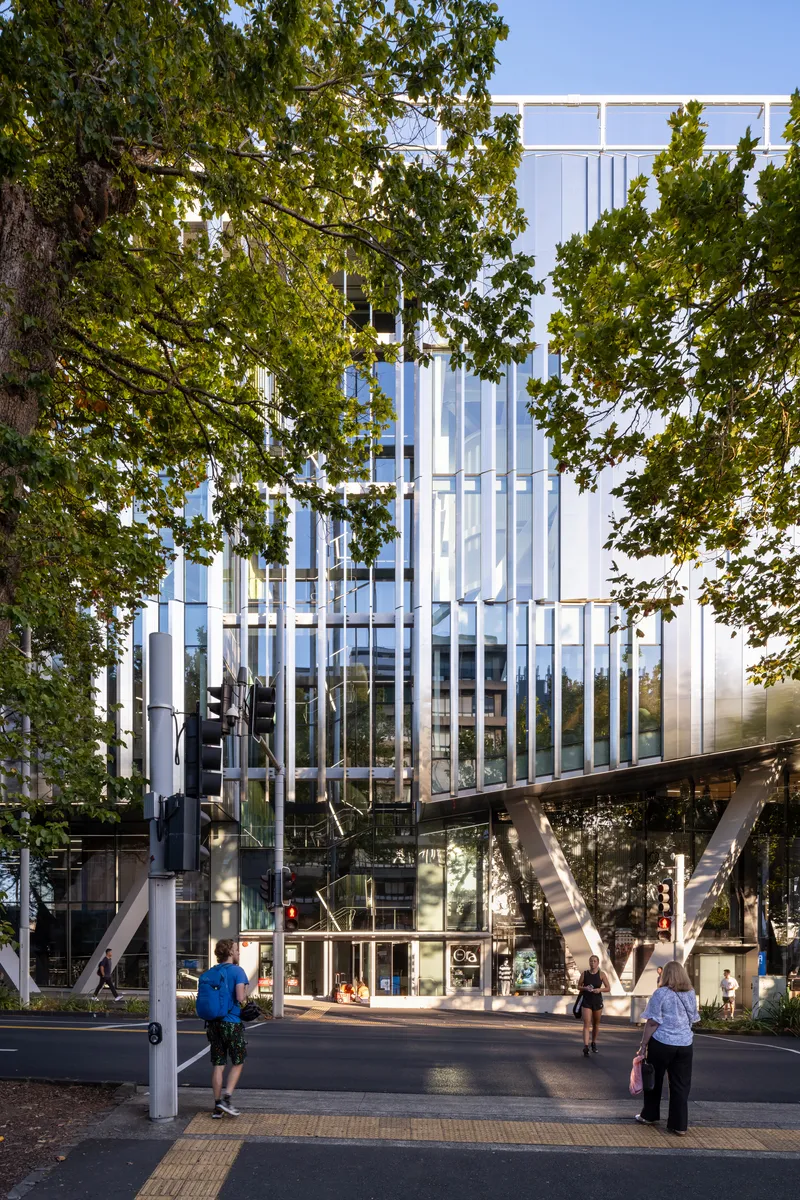
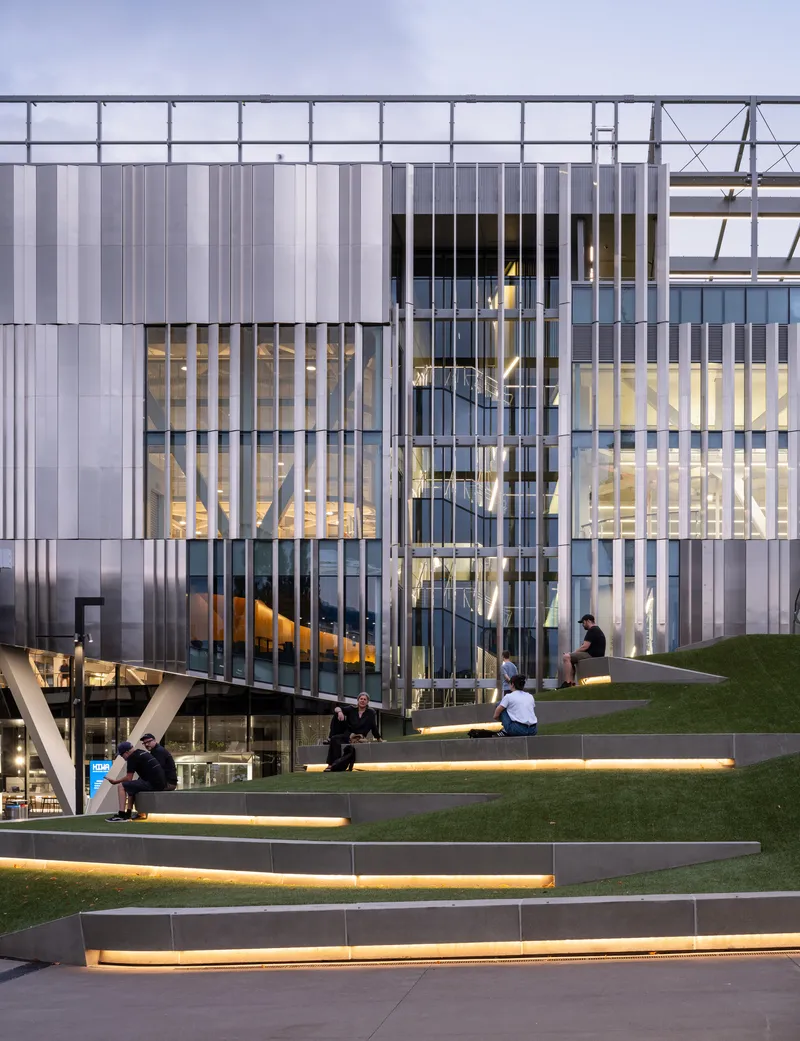
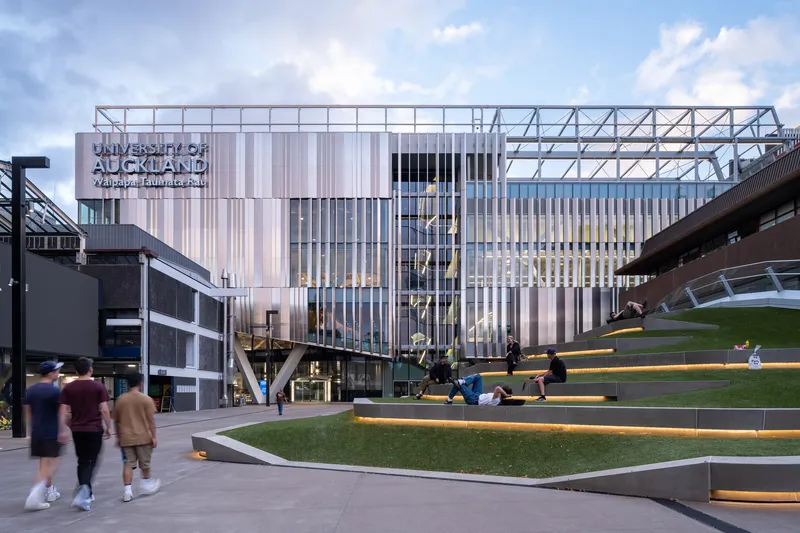
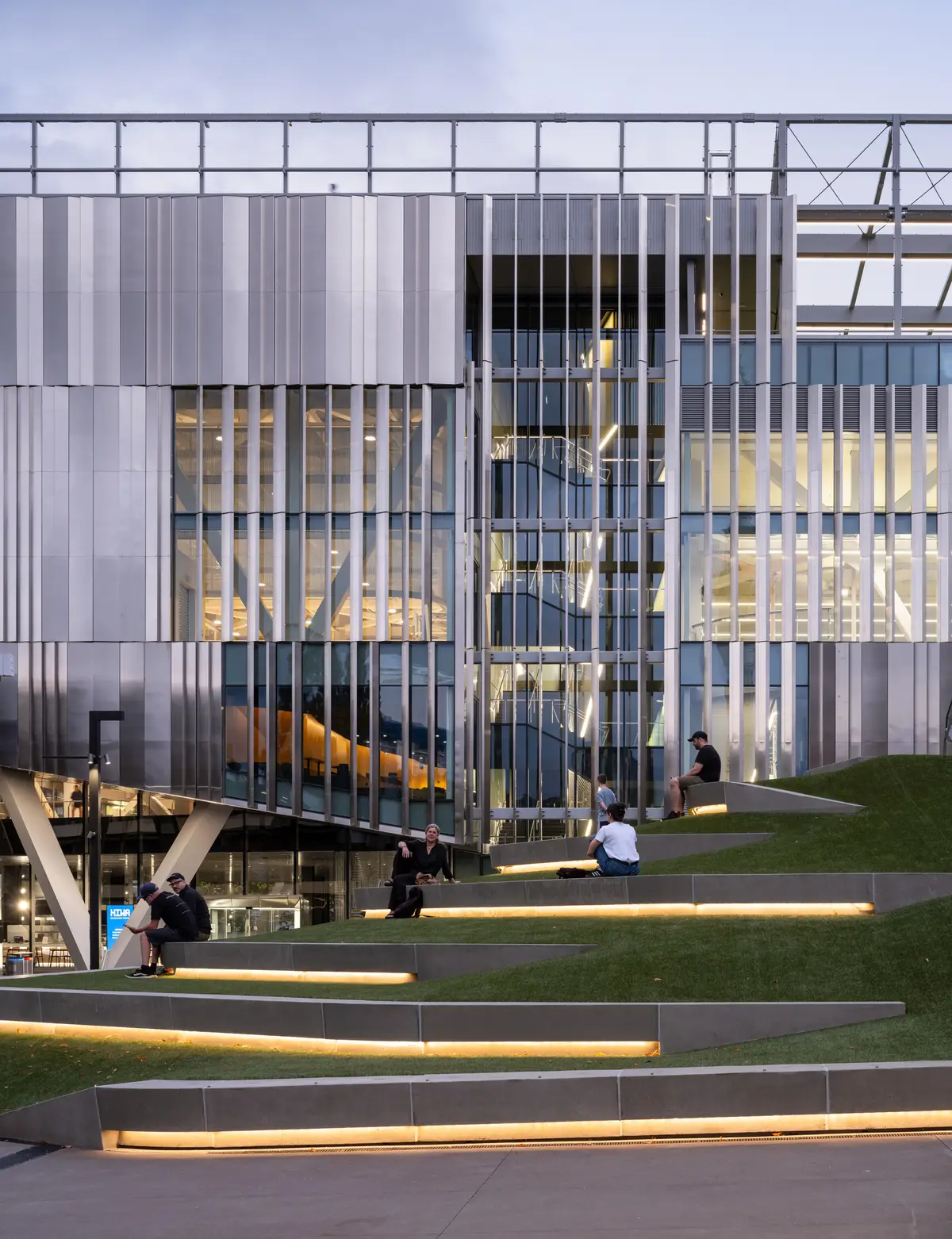
The stainless steel panel cladding and matching louvers give the building a rippling, reflective quality that shifts with the light. At dusk, the translucent curtain walls behind the vertical fins glow from within, turning the entire facade into a lantern that broadcasts activity to the street. During the day, the fins double as sunshades for the glazed walls behind them. It is a facade that does actual work while looking restless and alive.
At ground level, angled structural columns lift the volume clear of the sidewalk and open sightlines into the building. The terraced lawn seating, with its integrated lighting, blurs the boundary between campus landscape and building perimeter. Students sit on the steps as casually as they would on a park bench, which is precisely the point: this is public ground first, athletic facility second.
Below Grade: The Aquatic Hall
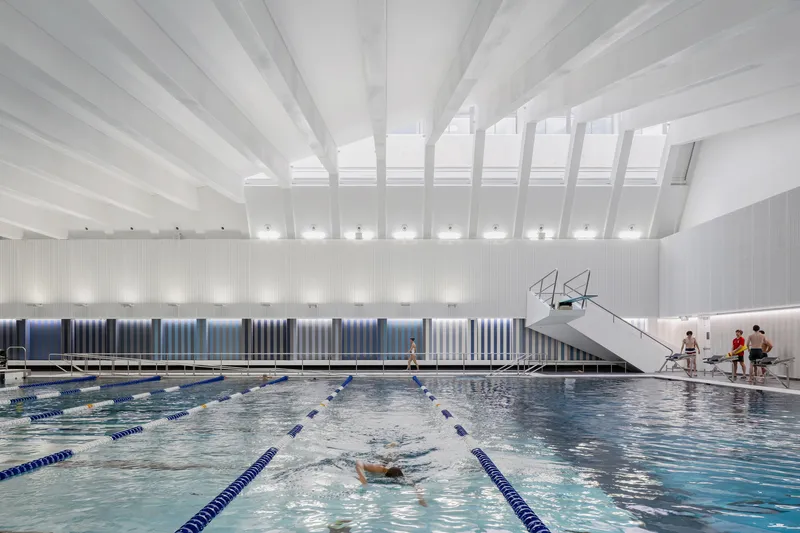
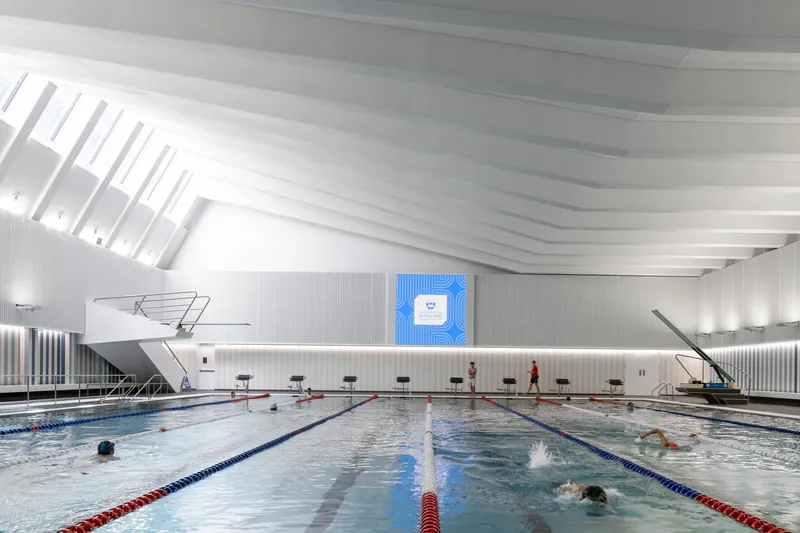
Sinking a 33-metre, eight-lane pool underground is an engineering decision disguised as an architectural one. It frees the ground floor for the public plaza and avoids the colossal column-free span that a pool hall would demand at upper levels. Pre-cast concrete beams, moved into position overnight and on weekends to avoid disrupting campus life, form the pool hall roof. Inside, white ribbed ceiling panels and overhead skylights create a luminous, almost chapel-like atmosphere. The Natare Pool system, imported from the United States, sits in a space that feels nothing like a basement.
The vertical ribbed wall panels that line the aquatic hall pick up the language of the exterior louvers, maintaining material continuity between inside and out. Swimmers look up at a coffered ceiling of long-span beams, and the quality of light, filtered and diffused, keeps the space from feeling buried.
Courts Stacked in the Sky
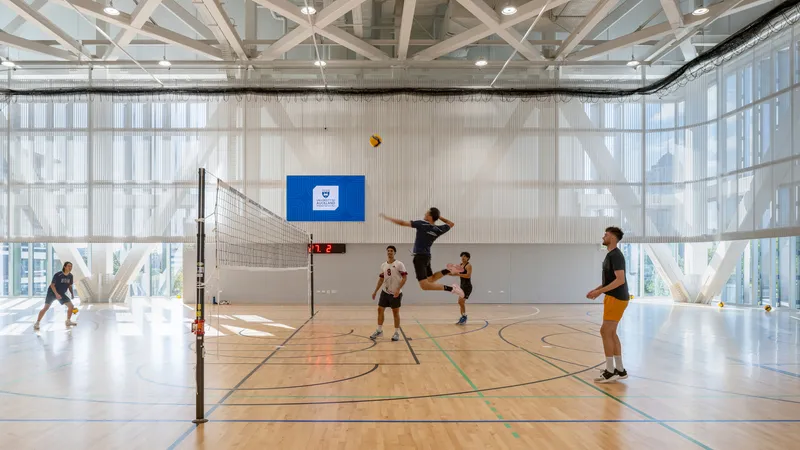
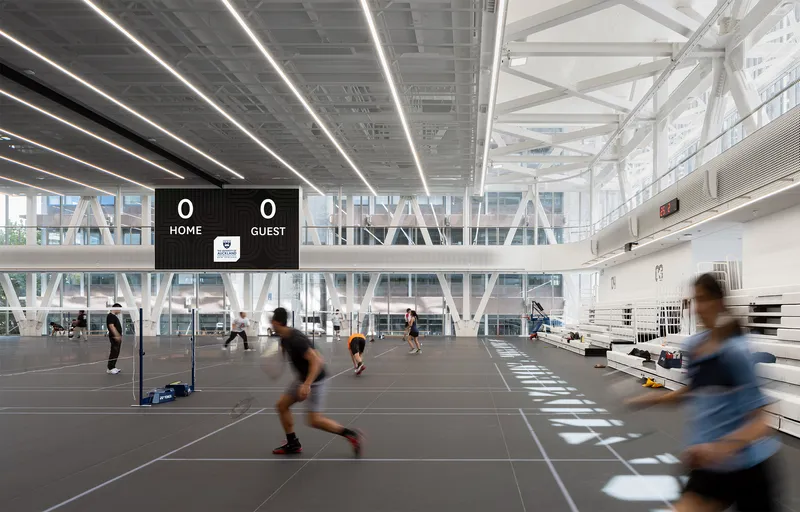
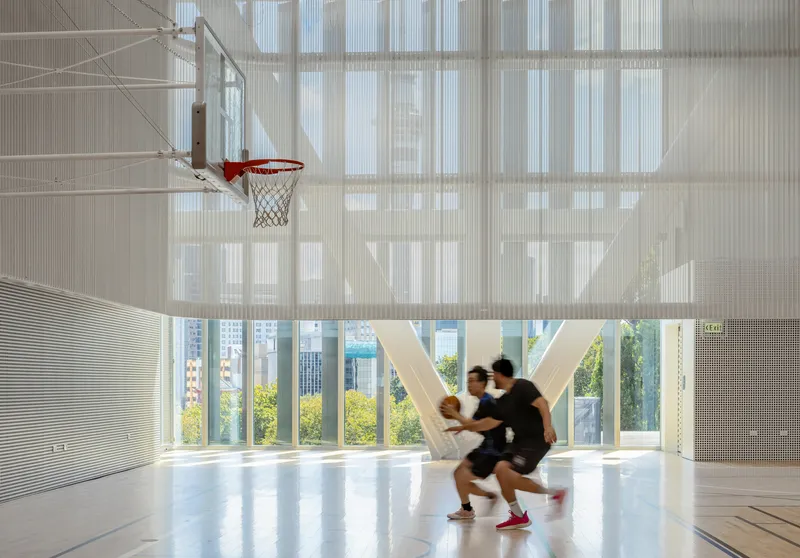
The multi-purpose sports halls occupy the upper floors, supported by 40-tonne trusses and wrapped in a diagrid perimeter structure of 900mm box beams. The exposed steelwork is honest about the structural gymnastics required to suspend column-free playing surfaces at height. One of the standout details: the southern hemisphere's first glass sports floor, an ASB GlassFloor system from Germany with integrated LED markings that can be reprogrammed for six different sports. It eliminates the chaotic rainbow of painted court lines that plague every university gym and replaces them with clean, switchable graphics.
Translucent curtain walls flood the courts with diffused daylight while preventing glare. The diagonal cross-bracing, visible in the show court, gives the interior a tectonic drama that most sports halls lack. With 1,500 spectator seats, this is a venue designed for competition-level events, not just lunchtime pickup games.
Vertical Circulation as Social Engine
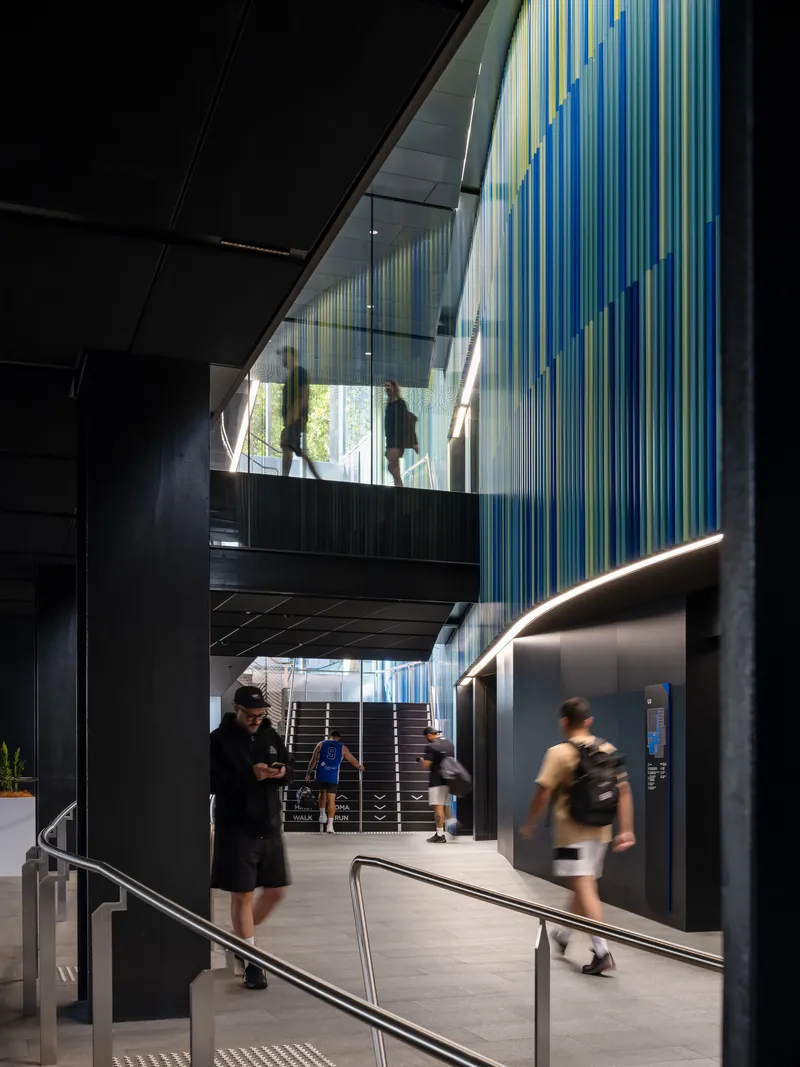
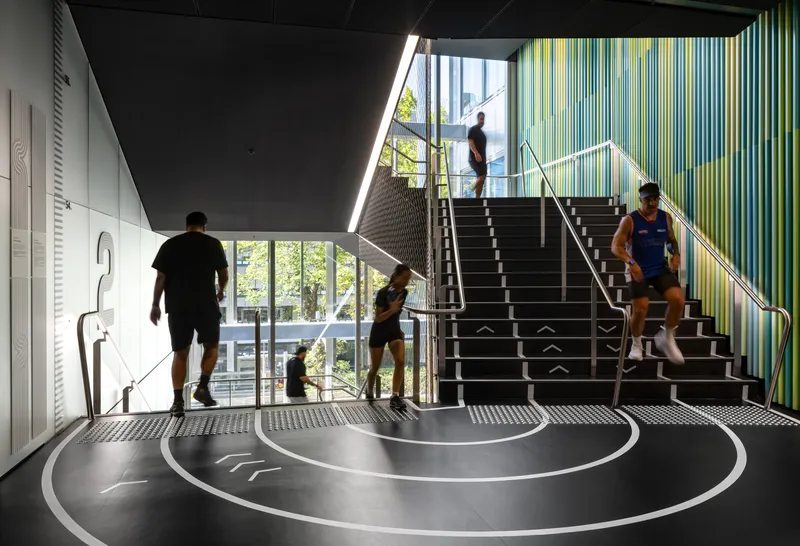
The 600-square-metre atrium, spanned by suspended walkways and lined with multicolored vertical screens, is the social heart of the building. Warren and Mahoney and MJMA treated the two optimized stairs not as fire-code obligations but as the building's primary animation devices. Walking between floors becomes exercise, social encounter, and wayfinding all at once. The concentric circle floor pattern at the entry foyer marks the moment of arrival and orientation before you decide which direction to climb.
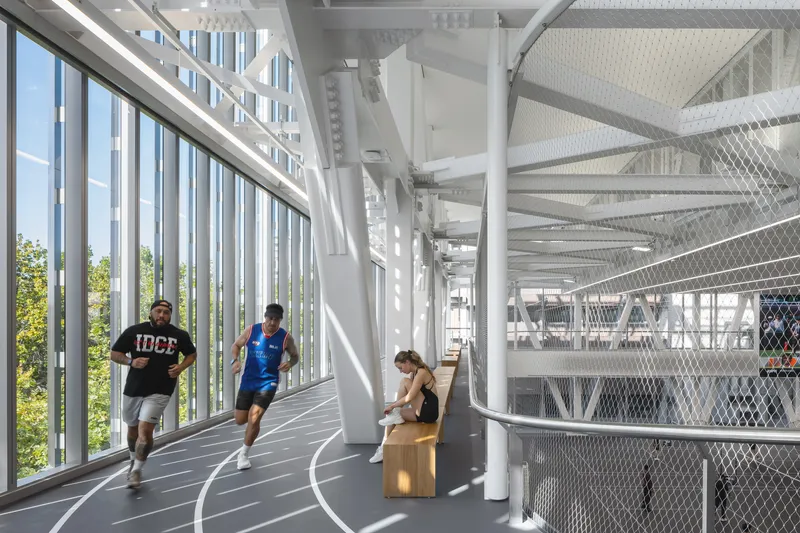
The indoor running track at one of the upper levels wraps past vertical white fins and structural columns, borrowing the rhythm of the exterior cladding. Runners get daylight and views rather than the fluorescent purgatory of a typical indoor track. Advanced fire engineering, including leading-technology fire shutters and smoke evacuation modeling, allows the lobby openings on each floor to remain continuous and interconnected. The building breathes vertically rather than being chopped into sealed compartments.
Cultural Narratives Woven In
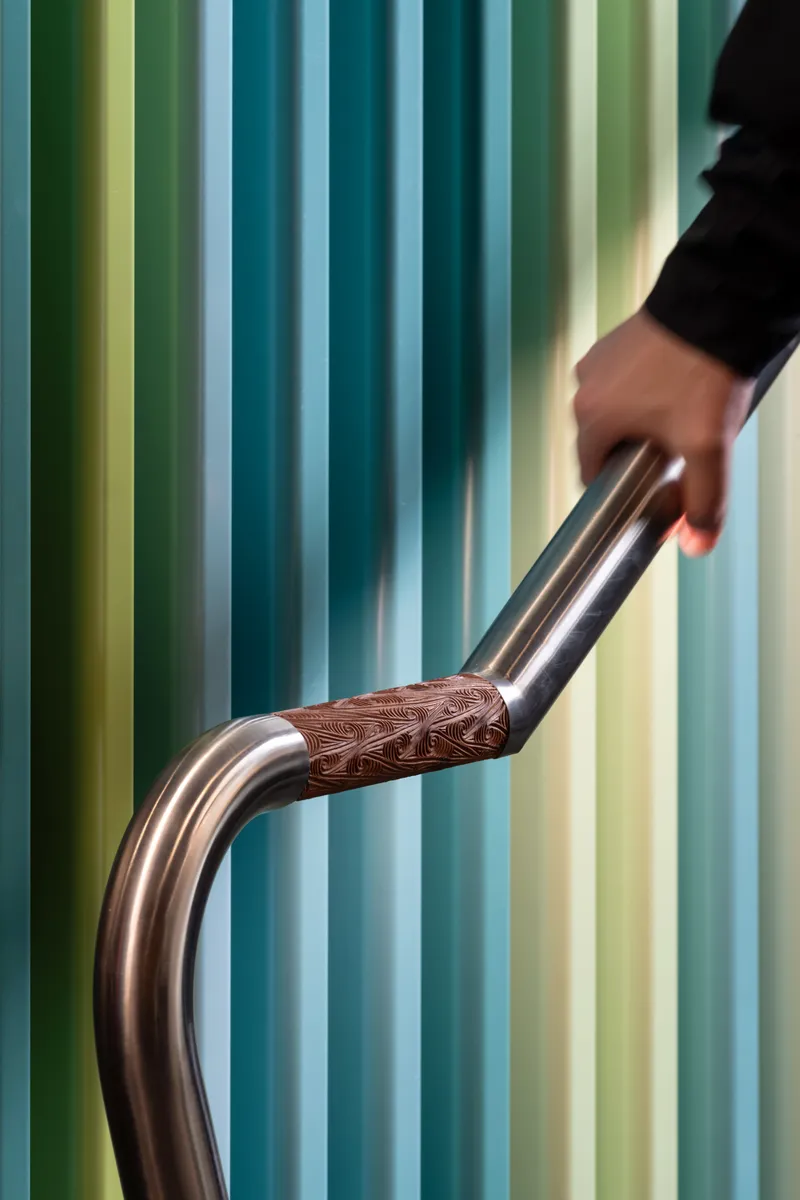
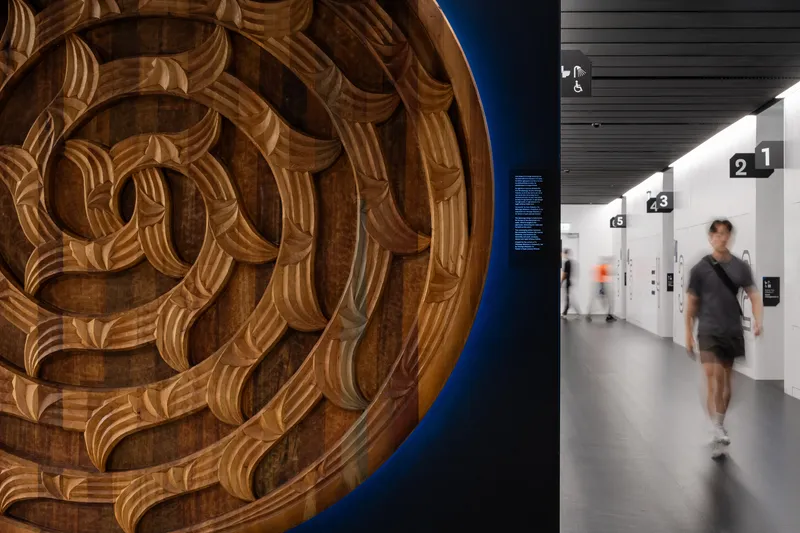
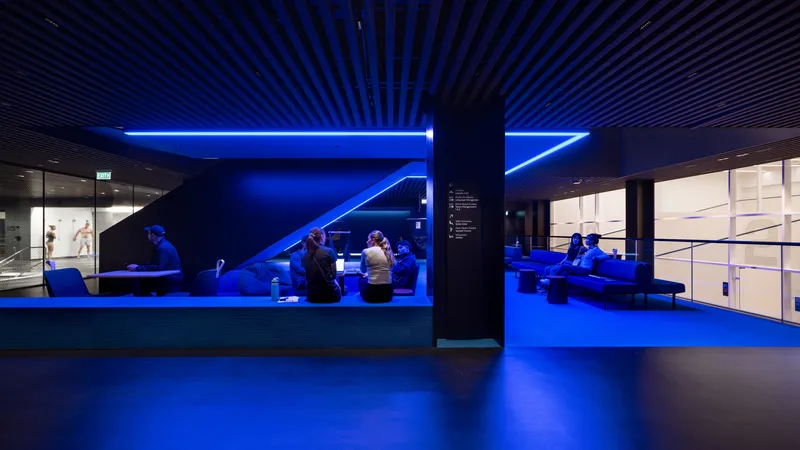
Te Aranga design principles are embedded here with a specificity that goes well beyond a plaque in the lobby. Carved timber medallions mark corridors. The curved metal handrails carry pulsing energy patterning under the grip, a detail you feel before you see. Gradient blue and green wall panels in the lounge spaces evoke the volcanic landscape and coastal geography of Auckland's 53 inactive volcanic centres. Wayfinding and signage features express a unique cultural narrative in which tikanga Māori is structural to the experience, not ornamental.
The blue linear lighting in the interior lounge space creates an atmosphere that feels deliberate and grounded, a counterpoint to the bright, active courts above. These quieter moments, where students sit and rest in colored light beneath angular ceiling slats, are essential to a building that could otherwise feel relentlessly programmed.
The Rooftop and the Ground Plane
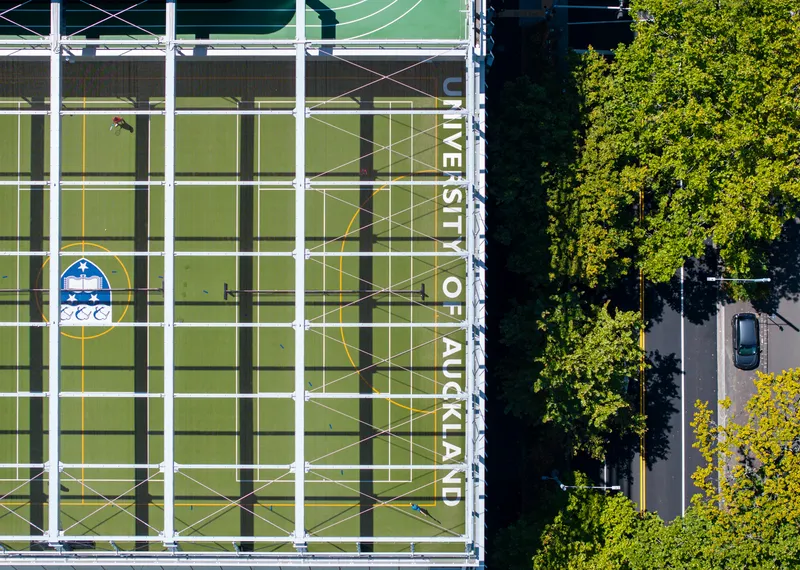
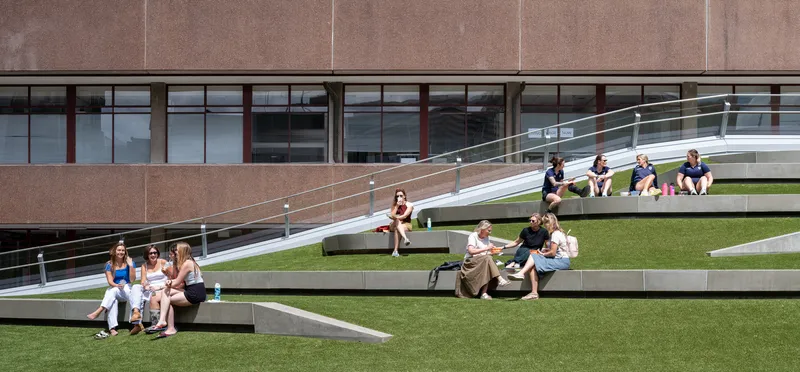
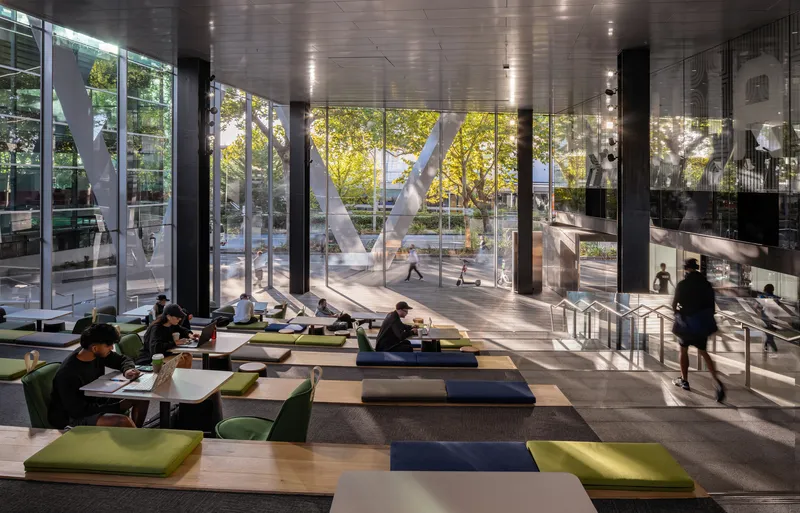
The rooftop turf courts, visible from adjacent buildings and the street, announce the building's purpose from above. White grid markings on green synthetic turf, flanked by circulation zones, turn the roof into productive recreation space rather than the usual wasteland of HVAC equipment. Below, at ground level, a 1,800-square-metre outdoor quad with tiered grass-and-concrete seating operates as an extension of the campus landscape. Students sprawl, study, and socialize on these steps in a way that makes the recreation centre feel like a piece of urban infrastructure rather than a standalone facility.
The ground-floor study space with tiered seating overlooking a glazed courtyard bridges the gap between athletic and academic life. Afternoon light pours through the glass, trees are visible at eye level, and the space reads as a student commons that happens to sit inside a sports building. It is this kind of programmatic generosity, dedicating expensive ground-floor real estate to sitting and looking at trees, that separates a good recreation centre from a great one.
Active Spaces and Specialty Programs
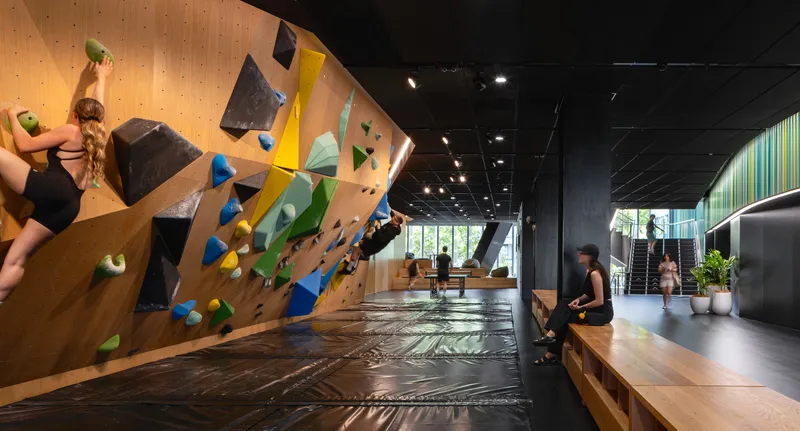
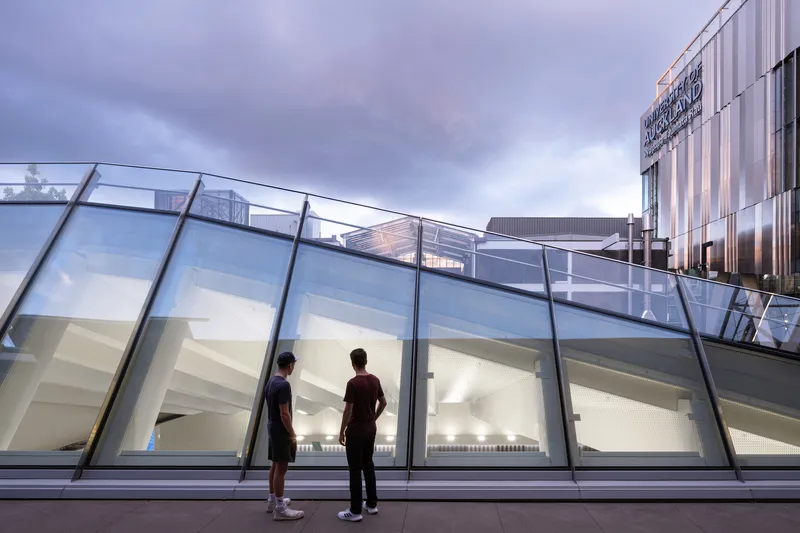
The double-height bouldering wall, lined with multicolored holds and backed by timber paneling, occupies a space that feels generous rather than squeezed in. Crash mats cover the floor, and the wall's height gives climbers a genuine sense of exposure. Squash courts, group fitness areas, dance and yoga studios, and weight and cardio facilities are distributed across the split levels, each with clear access from the central circulation spine. The building replaces a 1970s recreation centre built for roughly 10,000 students; today's university population demands dramatically more, and Hiwa delivers it without feeling overcrowded.
Plans and Drawings
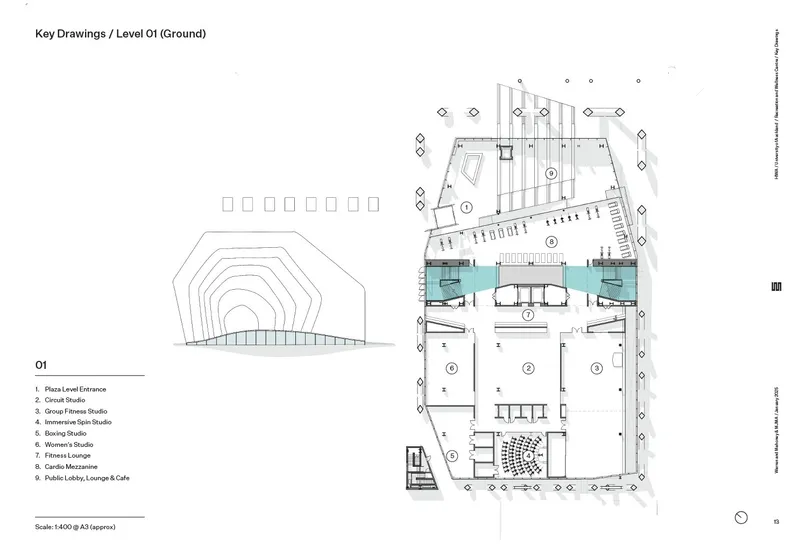
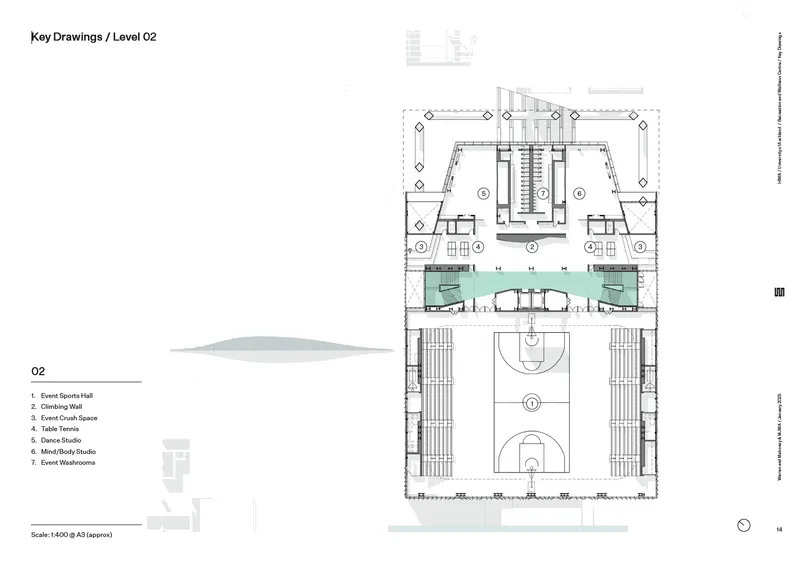
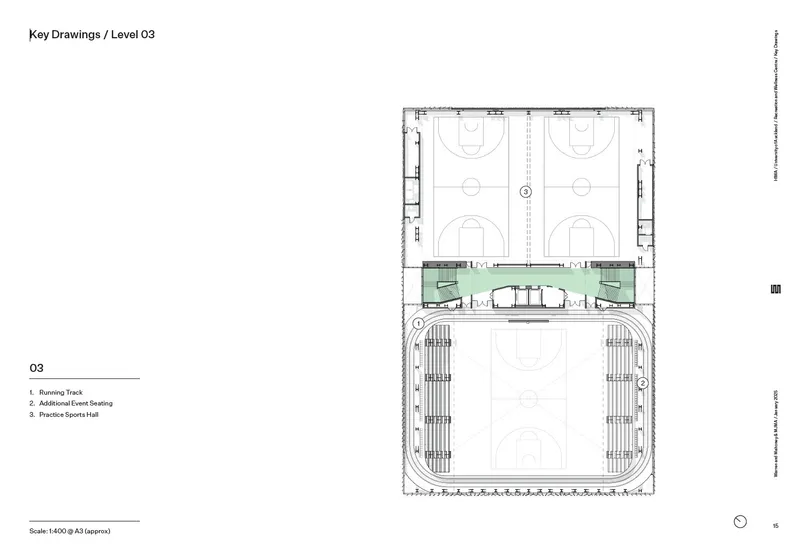
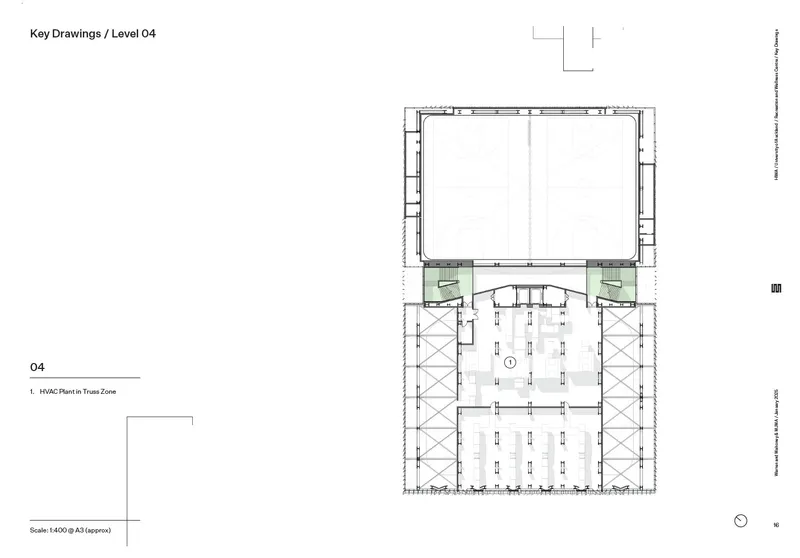
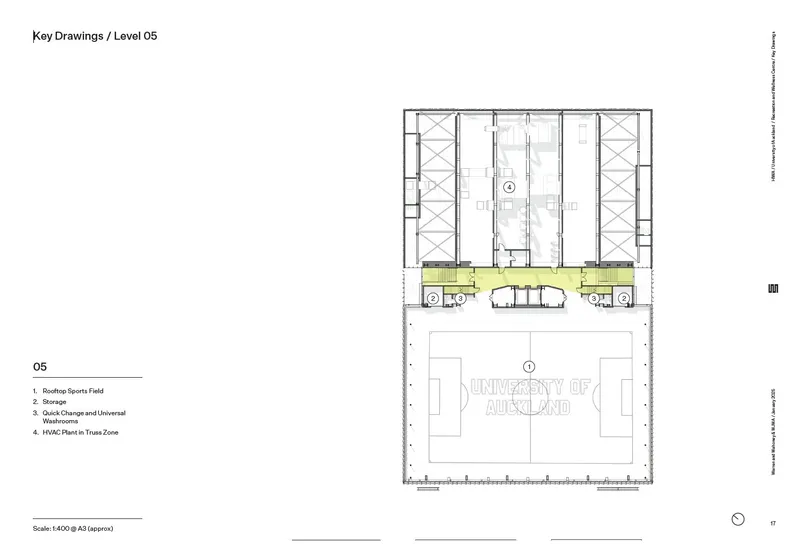
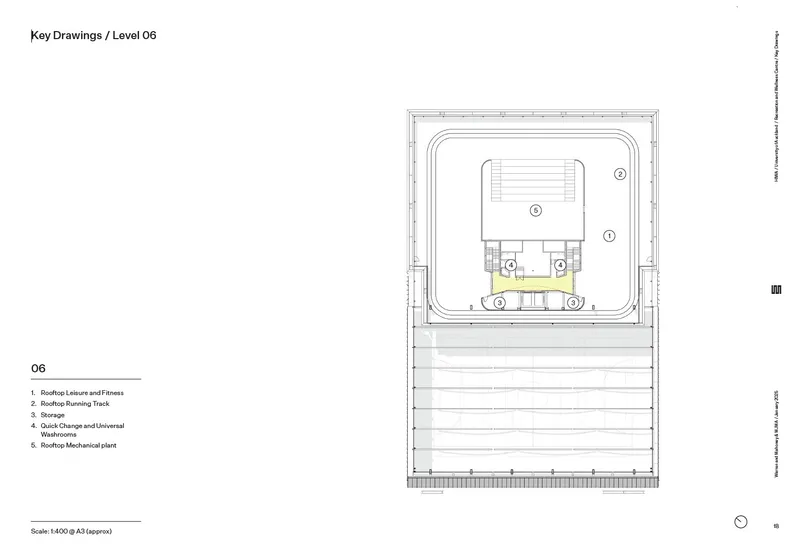
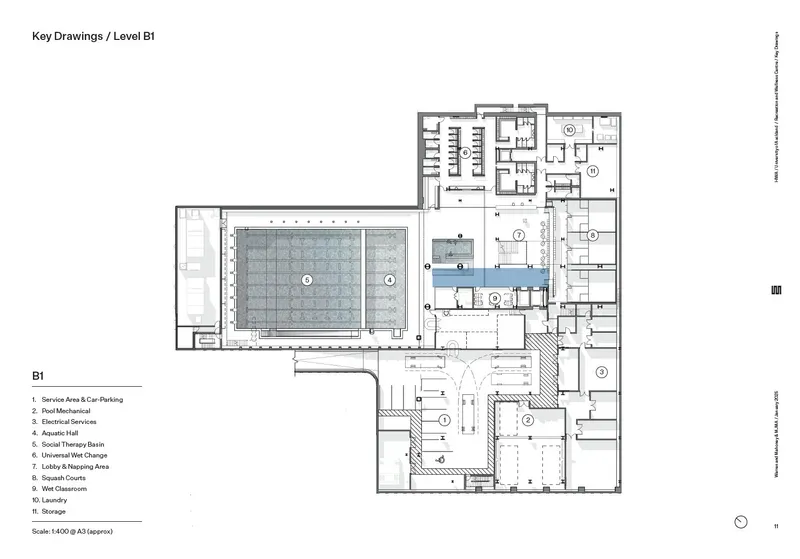
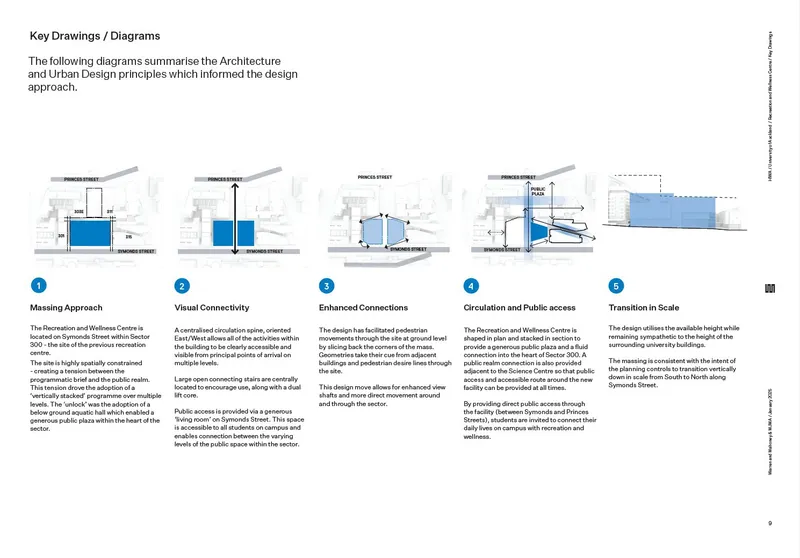
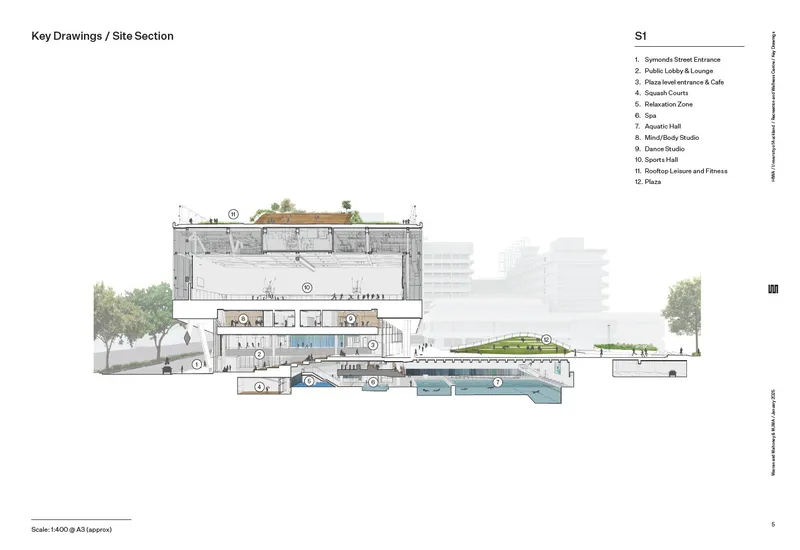
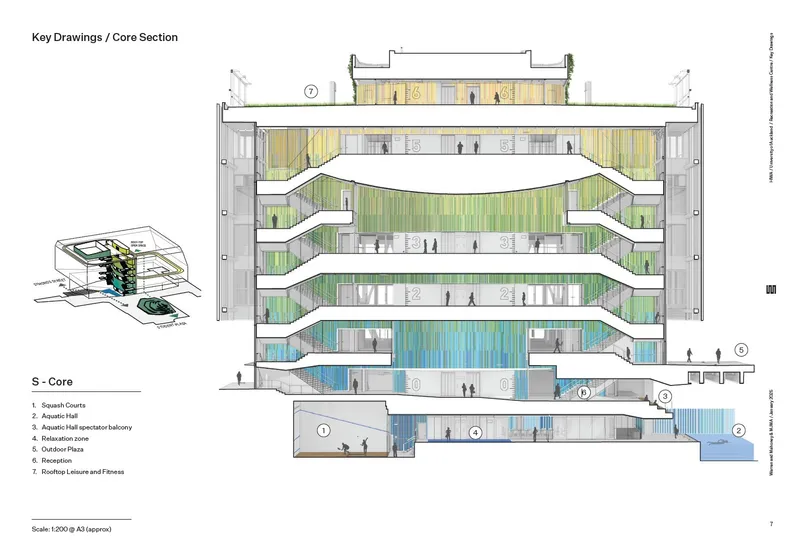
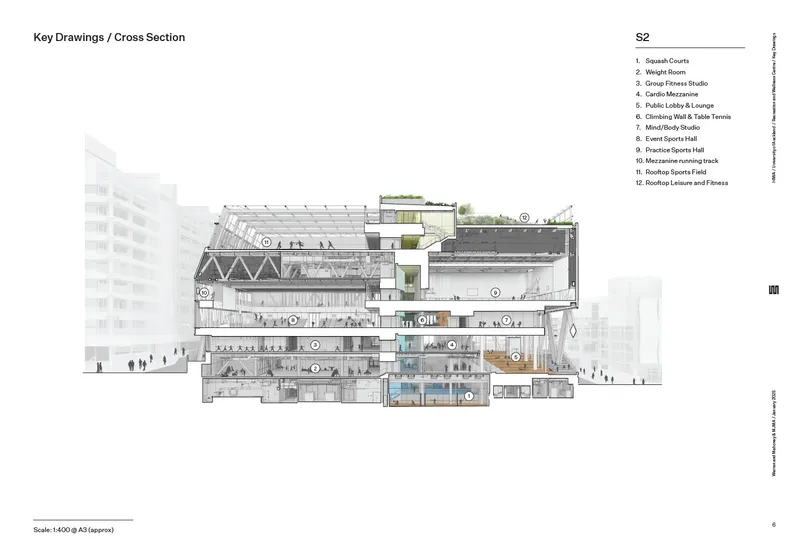
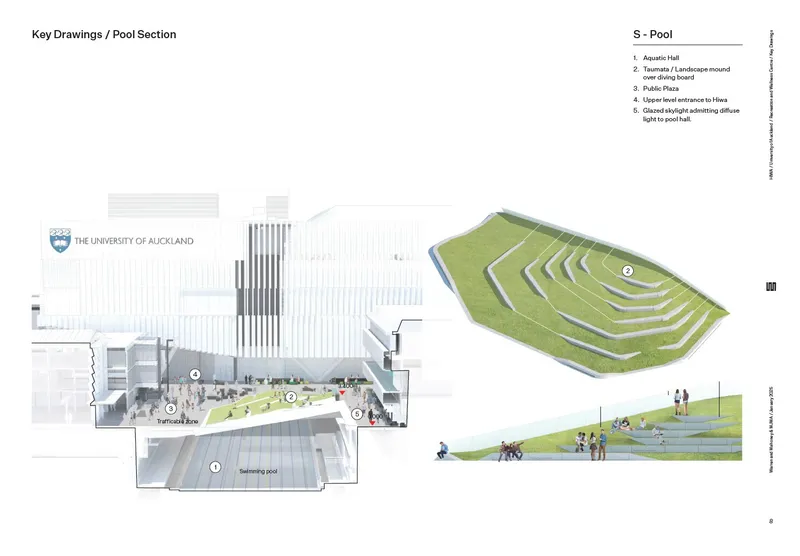
The floor plans read like a puzzle solved with remarkable discipline. The pool sits at the lowest level, highlighted in blue, flanked by squash courts and service zones. Basketball courts and the running track occupy the middle floors. The rooftop level splits between a full outdoor sports field and a running track loop surrounding mechanical plant. The sections are the most revealing drawings: the pool section shows how far below grade the aquatic hall descends, with a landscaped mound rising above it to form the terraced public plaza. The core section illustrates the five stacked program zones, color-coded green and blue, connected by the twin circulation spines that serve as the building's vertical backbone.
The massing diagrams at the bottom of the drawing set lay out the design logic in simple terms: occupy the full block, sink the pool, stack the courts, and free the ground. It is a clear operational sequence, and the built result follows it with almost diagrammatic precision.
Why This Project Matters
Hiwa is a proof of concept for the vertical recreation centre, a building type that most architects and institutions still resist. The default instinct is to build these facilities low and wide, on cheap peripheral land, connected to nothing. Warren and Mahoney and MJMA refused that approach and instead forced every square metre of athletic program to justify its position in section. The result is a building that functions as a public plaza, a cultural institution, a competitive sports venue, and a daily fitness facility simultaneously, all on a footprint that any mid-rise office tower could occupy.
The integration of Te Aranga design principles into the building's bones, its handrails, its wayfinding, its material narratives, sets a standard for institutional architecture in Aotearoa New Zealand. Too many projects treat cultural engagement as a late-stage consultant add-on. Here it is embedded from the start, and you can feel it in the smallest details. For a building that houses a pool, six types of court, a bouldering wall, and a rooftop playing field on a single city block, Hiwa is remarkably legible, generous, and specific. That is the real achievement.
Hiwa, The University of Auckland Recreation Centre, designed by Warren and Mahoney and MJMA. Auckland, New Zealand. 22,280 m². Completed 2024. Photography by Scott Norsworthy.
About the Studio
Share Your Own Work on uni.xyz
If projects like this are the kind of work you want to make, uni.xyz is a place to publish your own, find collaborators, and enter design competitions.


Popular Articles
Popular articles from the community


Singing Woman: An Opera House That Performs Before the Curtain Rises
Ovidiu Cristian Pavel's conceptual opera house translates Estonia's choral identity into a sculpted waterfront landmark facing the Baltic Sea.

Manzana Morphosis: Stretching Barcelona's Grid into a Living Landscape for 2050
A radical reworking of the Eixample manzana turns density into a tool for generous public space, vertical ecology, and environmental performance.

The Amber Palace Opera: A Geological Fiction Surfaces on Tallinn's Baltic Waterfront
Pierre Brillard reimagines a Baltic legend as a public landscape, opera house, and waterfront promenade rooted in Tallinn's coastal identity.


FCC Arquitectura Expands a Portuguese Granite House with a Board-Marked Concrete Wing
In Portugal, JV House pairs a cleaned-up whitewashed and granite dwelling with a timber-shuttered concrete extension, courtyards and a garden pool.

Similar Reads
You might also enjoy these articles

LAVA Architecten Gives Vocational Education a Sawtooth-Roofed Face on a Mechelen School Campus
In Mechelen, Belgium, a 2,053 m² STEM school on a 6×6 m grid turns workshops and classrooms into rooms that can be rearranged as teaching changes.

KEMA Studio Turns a Derelict Marvila Attic into a 60 m² Lighthouse Apartment Above Lisbon
In Lisbon's Marvila district, a rebuilt roof, four skylights and two plywood volumes turn an unlivable attic into a bright home facing the Tagus.

Pixel Gardens: One Repeated Module Stacked Into a Terraced Social Housing Tower for Famagusta
Salem Bader's shortlisted housing tower builds a vertical neighbourhood from one repeated module, offsetting units to carve terraces, light and air.

Bao Huynh Watercolor Atelier: A Serene Art Retreat in Hội An
Bao Huynh Watercolor Atelier in Hội An blends multifunctional art spaces, sustainable design, local materials, and family-friendly living in a serene environment.


Comments (0)
Please login or sign up to add comments
No comments yet. Be the first to comment!