
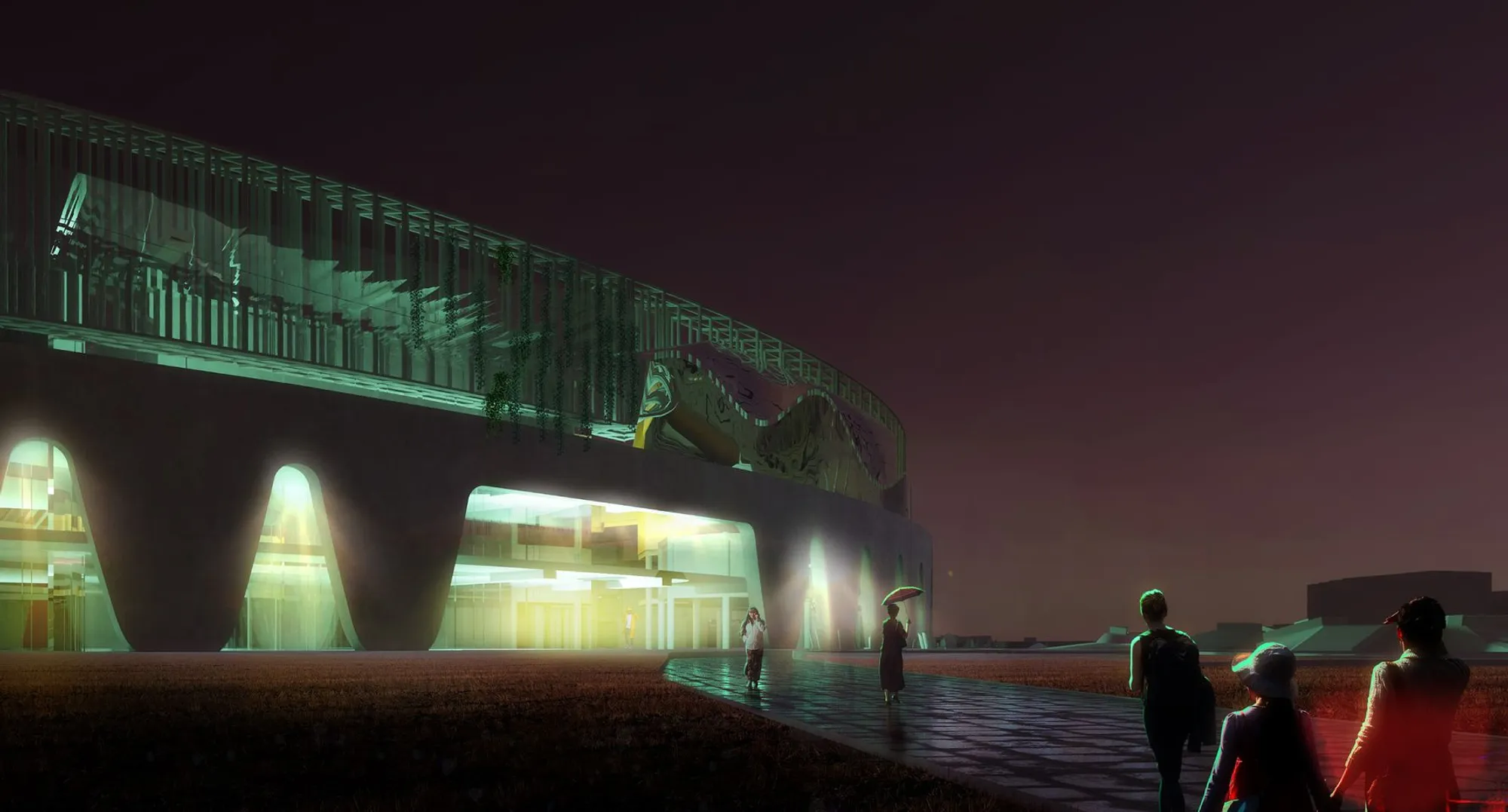
Warsaw Library of Visual Arts: A Cultural Canopy Grown from the Trees
Lilit Hakopyan's shortlisted Libgen 2019 entry elevates a visual arts library into the tree canopy, letting nature shape the architecture.


What happens when a library stops competing with the landscape and starts growing from it? The Warsaw Library of Visual Arts disperses its program into a network of elevated units suspended among existing trees, treating the canopy as both structural logic and spatial experience. Rather than clearing a site and dropping a building onto it, the design lets topography, tree patterns, and pedestrian desire lines generate form through a process the designer describes as morphogenesis.
Shortlisted in the Libgen 2019 competition, the project was designed by Lilit Hakopyan. Set in Warsaw, the scheme reimagines the library as a cultural and recreational destination, integrating pedestrian zones, bike paths, playgrounds, and an open amphitheater into a masterplan that positions reading, making, and gathering within a single continuous public landscape.
Layered Plans That Map Use onto Landscape
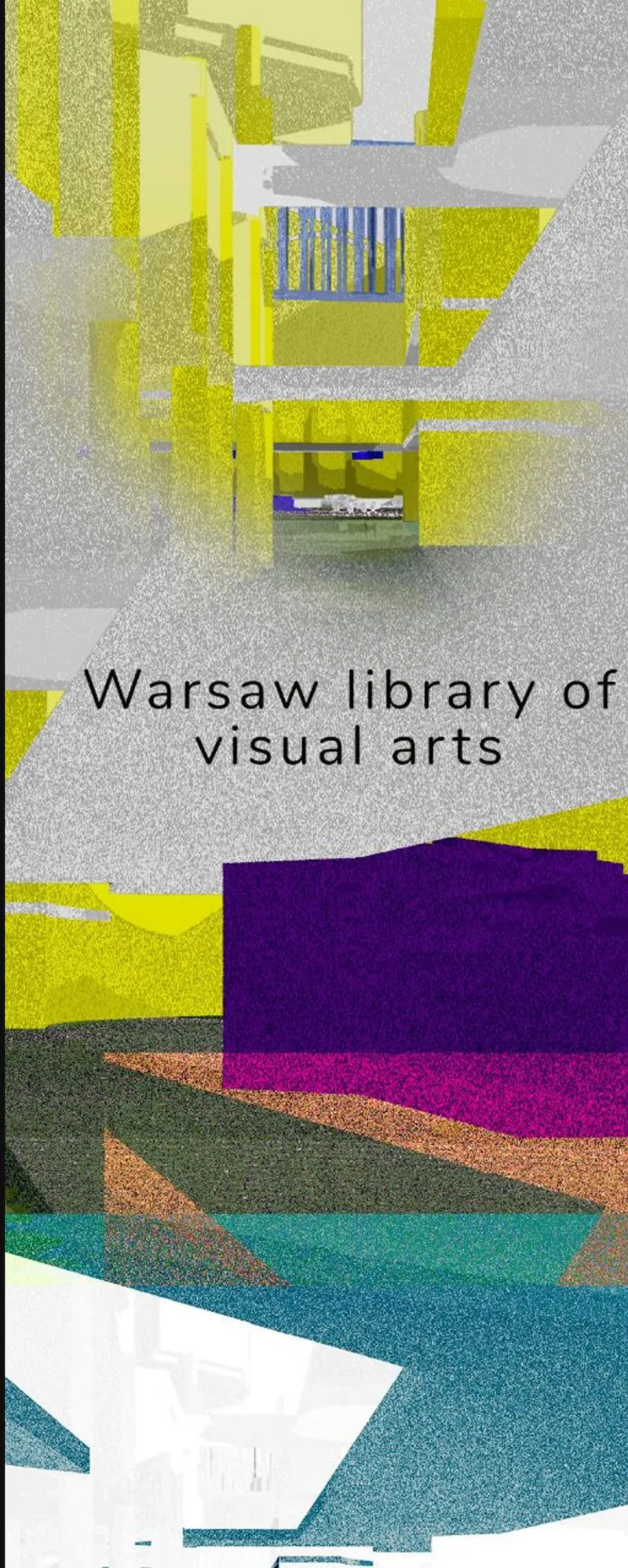
The axonometric drawing reveals how the library's floor plans stack and offset, with yellow highlight zones marking active programmatic areas against textured surface finishes that suggest material variation across levels. The layering is not arbitrary. Each plate responds to the trees and voids it hovers above, creating a different spatial condition on every floor. The result is a building that reads less like a singular volume and more like an ecosystem of interconnected platforms.
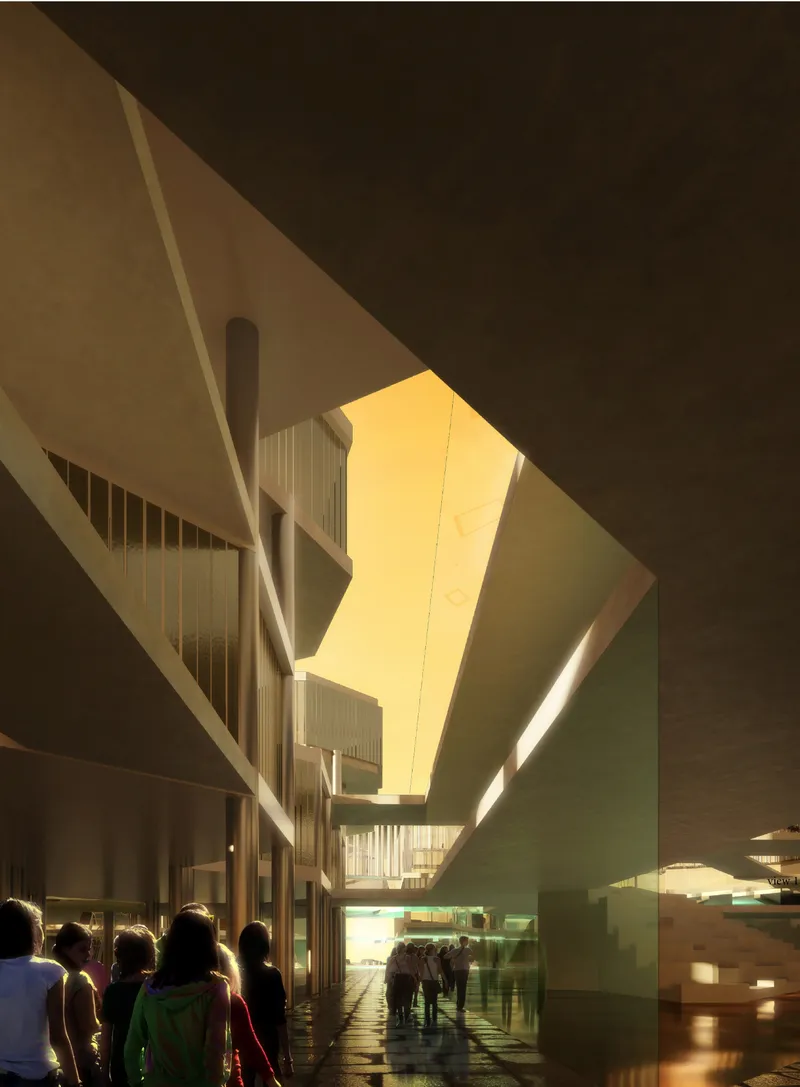
Step inside and the relationship between architecture and site becomes visceral. The interior courtyard, framed by angular concrete walls, channels warm evening light from above in a way that makes the enclosure feel carved rather than constructed. These transitions between openness and compression are central to the design's logic: visitors move through gradients of light and exposure, guided intuitively from public gathering zones to quieter spaces of study and reflection.
Curved Volumes and Terracotta Cantilevers at Ground Level
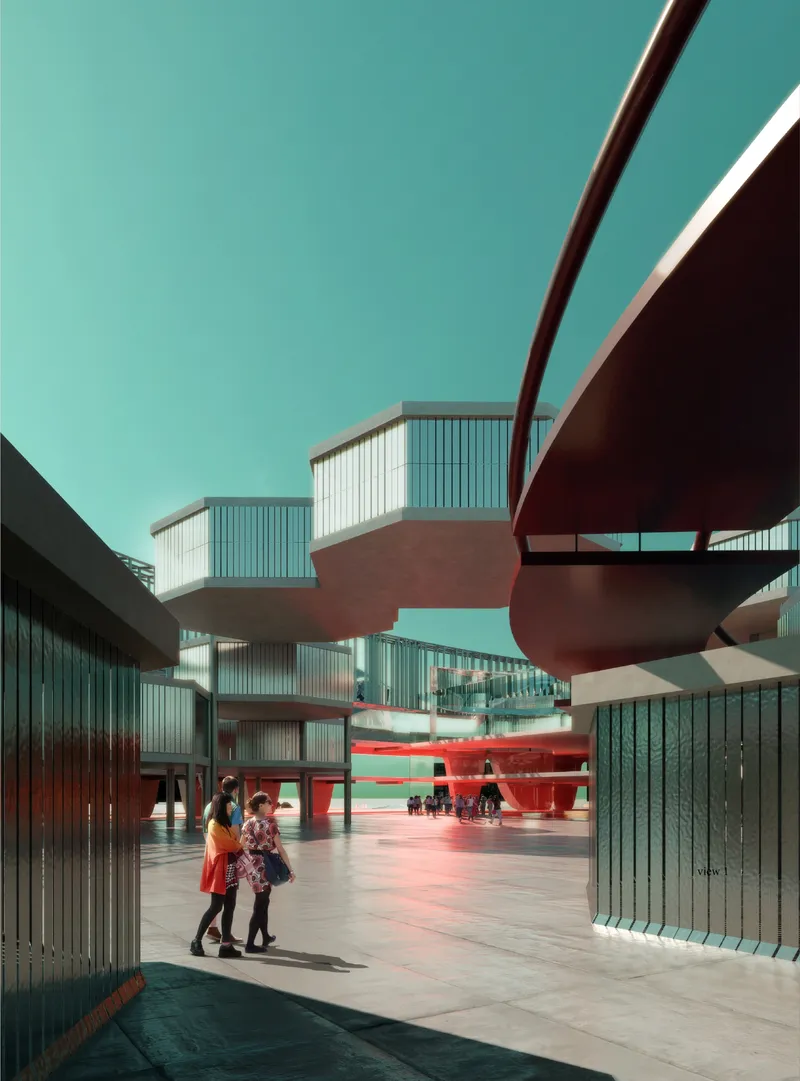
At plaza level, the library presents itself through curved corrugated volumes and overhead terracotta cantilevers that reach out to shelter the public ground floor. The material palette here is deliberate: corrugated surfaces introduce rhythm and shadow, while the terracotta tones warm the concrete structure and root it visually in its setting. Glass walls maintain transparency, collapsing the boundary between interior program and the pedestrian life of the plaza. The public ground floor is conceived as the most porous layer of the building, fostering community engagement before visitors ever step through a door.
A Section That Breathes Around a Central Tree Courtyard
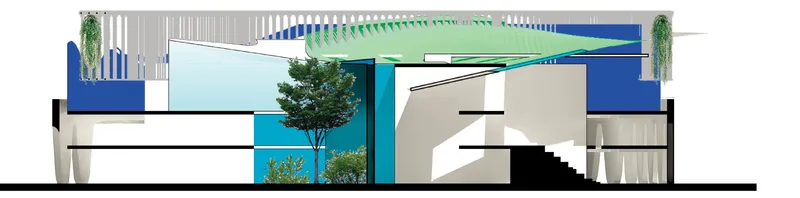
The section drawing is perhaps the most revealing document in the project. It shows stacked interior volumes organized around a central tree courtyard that rises through the full height of the building, with roof terraces capping the composition. The courtyard is not decorative. It is the organizing spine: light, air, and vertical circulation all pass through it, making the retained trees co-authors of the spatial sequence rather than afterthoughts preserved behind glass.
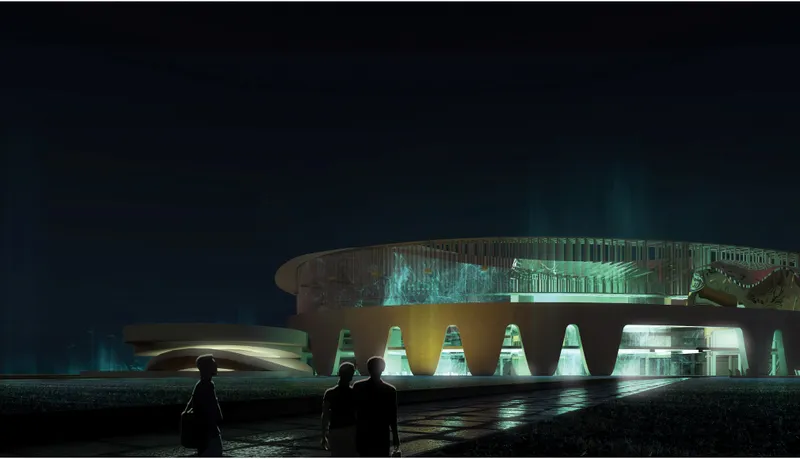
At night, the building transforms. The illuminated circular form glows against the sky, its arched base framing silhouetted figures who animate the threshold between inside and outside. Green roofs, visible in both section and exterior views, complete the ecological loop by blending the building's profile back into the landscape from above. The library becomes legible at two scales simultaneously: as an inviting beacon for the city and as a quiet extension of the park for those already within it.
Exploded Anatomy of a Responsive Organism
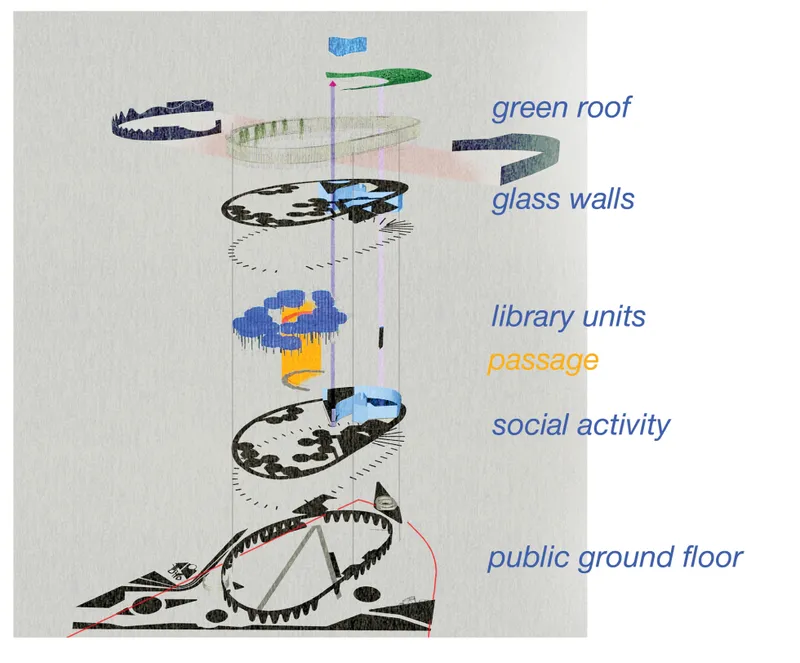
The exploded axonometric diagram pulls the building apart from ground floor to green roof, making the stacked programmatic logic legible at a glance. Each level serves as a collaborative platform and adaptable space for visual arts practitioners and visitors. What the diagram communicates most effectively is the idea of the library as a responsive organism: no single floor repeats another, and the interplay between solid plates and open voids ensures that every level maintains its own relationship with the surrounding canopy and sky.
Interactive circulation paths weave through this vertical stack, connecting knowledge spaces with nature at every turn. The design process, rooted in iterative spatial layering and analysis of public to private transitions, resists the monumental. There is no grand entrance, no singular reading room. Instead, the building offers a constellation of moments, each calibrated to a different mode of working, looking, and being together.
Why This Project Matters
The Warsaw Library of Visual Arts matters because it refuses the premise that a library must be a container. By elevating program into the trees and dissolving the ground plane into public plaza, Hakopyan proposes a model in which cultural infrastructure and urban ecology reinforce each other. The masterplan's integration of amphitheater, playgrounds, and bike paths alongside reading and making spaces argues convincingly that a library's relevance depends on the breadth of life it supports, not just the depth of its collection.
For a shortlisted competition entry, the level of environmental and programmatic thinking here is serious. The morphogenetic design process, drawing form from existing pathways and tree patterns rather than imposing a geometry onto the site, points toward a generation of designers who treat context not as constraint but as collaborator. In a discipline still prone to treating landscape as backdrop, this project treats it as the primary text.
View the Full Project
About the Designers
Designer: Lilit Hakopyan
Enter a Design Competition on uni.xyz
uni.xyz runs architecture and design competitions year-round that reward proposals with spatial conviction and real site intelligence.
Project credits: Warsaw Library of Visual Arts by Lilit Hakopyan Libgen 2019 (uni.xyz).



Popular Articles
Popular articles from the community


Riyadh For All: Intergenerational Urban Design for Active Aging in Rabat
Riyadh For All reimagines urban design in Rabat with intergenerational co-living, adaptive courtyards, and Moroccan cultural exchange today.

Conexión: Biophilic Design Reimagines High-Rise Living in Hong Kong
Conexión reimagines high-rise living in Hong Kong through biophilic design, green facades, shared spaces, daylight, water and nature within.

Co-Life: Senior Housing Design That Reconnects Older Adults With the City
Co-Life reimagines senior housing design through healing gardens, shared streets, workshops, and a sustainable community across generations.

The Earth Pod: 3D Printed Homes for Resilient Refugee Communities
The Earth Pod reimagines refugee housing through 3D printed homes made from clay, combining resilience, self-sufficiency, and rapid shelter.

Similar Reads
You might also enjoy these articles

Day and Night Park: A Time-Based Urban Newsstand in Beijing
A temporary urban newsstand in Beijing blending travel, light, and reading through poetic colors, compact form, and community-focused design.

Modernist Patio Renovation in El Masnou, Barcelona by Oliver Segura Arquitectura + Cebrià Arquitectura
Modernist patio renovation blending tradition and innovation with a movable pool, leveled floors, and Catalan materials in El Masnou.

Alto Residencial Coop: Cooperative Housing Development in Santiago de Compostela by Carbajo Barrios Arquitectos
A linear cooperative housing complex blending white volumes and perforated metal façades, enhancing community living, natural light, privacy, and urban integration.

Vil Genis School by BPA ARCHITECTURE – Massy, France
Vil Genis School in Massy, France, features sustainable design, south-facing classrooms, community integration, accessible spaces, and modern educational architecture.
Explore Library Architecture Competitions
Discover active competitions in this discipline


Challenge to design locus for the upliftment of human rights


Challenge to design public laboratory


Design challenge to reuse E-waste
Comments (0)
Please login or sign up to add comments
No comments yet. Be the first to comment!