

Water Drop: A Freshwater Oasis on the Bosphorus Strait
A ribbed shell monument housing a closed-loop water system, waterfalls, and lush terraces that confront the global freshwater crisis head on.


A single drop of fresh water falling into the ocean: it is a simple image, almost poetic, but it carries the weight of a planetary crisis. Water Drop takes that metaphor and builds it at architectural scale, placing a ribbed glass canopy on the edge of the Bosphorus Strait that shelters waterfalls, a circular fountain, and a closed-loop water recycling system inside a landscape designed to look like an oasis rising from a lifeless canyon. The result is a monument that does not merely represent water scarcity but actively demonstrates how architecture can reclaim, treat, and celebrate fresh water in the middle of a dense urban waterfront.
Designed by Алексей Шестаков, Water Drop was shortlisted in the Ripple competition on uni.xyz. The project sits along the Istanbul waterfront with views toward the Bosphorus, framed by historic buildings climbing the hillside behind it. Its programme combines a pedestrian ramp, recreational green park pathways, promenades, and planted terraces beneath a striking organic shell structure that reads as both landmark and ecosystem.
A Ribbed Shell Anchored to the Waterfront

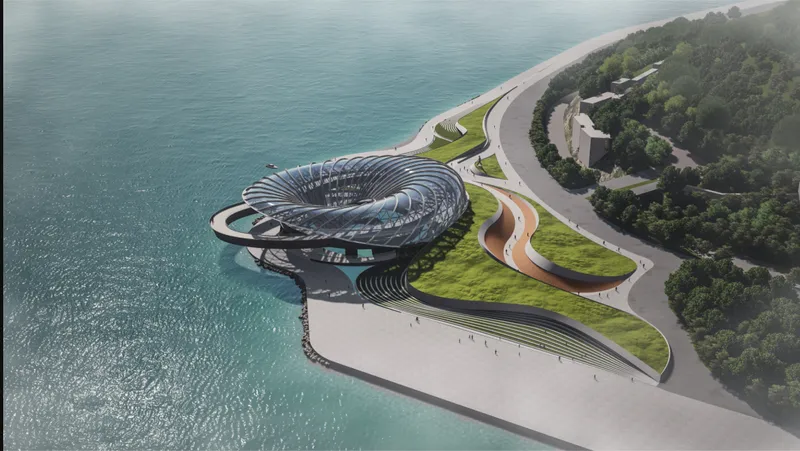
From a distance, the monument registers as a massive organic form jutting into the water, its ribbed structural shell curving upward like a cresting wave frozen mid-break. The distant view reveals how the structure negotiates the scale gap between the historic Ottoman buildings on the hill and the flat plane of the strait below. Rather than competing with the existing skyline, the low, spreading canopy defers to the hillside while claiming the waterfront with horizontal presence.
The aerial perspective clarifies the logic: curved pedestrian pathways spiral outward from the shell's centre, connecting the monument to the forested shoreline and a green roof that merges structure with landscape. The roof itself is not a decorative gesture; it acts as a collection surface, channelling rainwater into the closed-loop recycling system below. Everything about the plan reads as centripetal, pulling visitors and water alike toward the oasis at the core.
Pathways That Pull You In
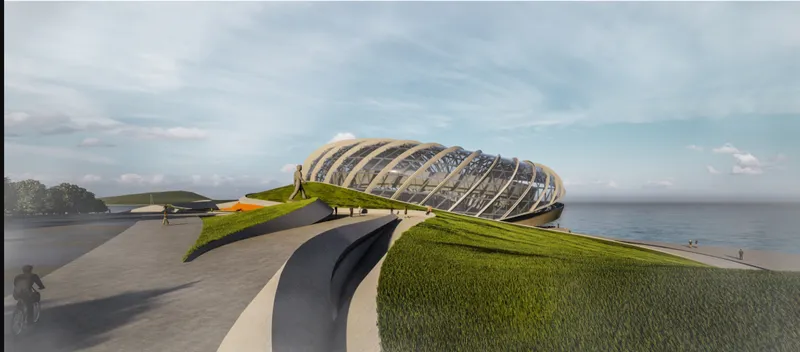
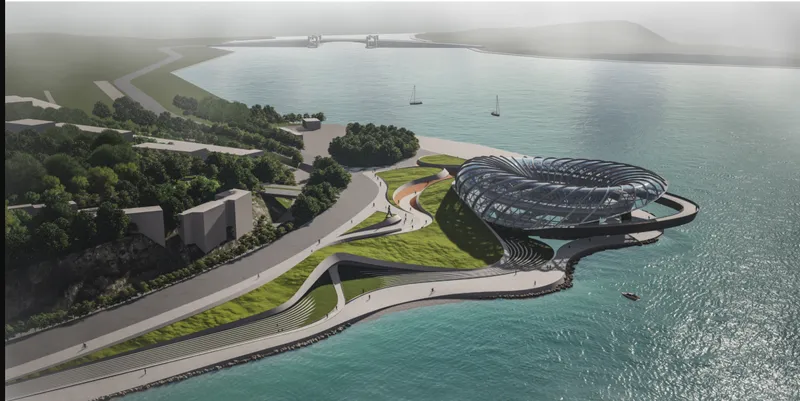
At ground level, the approach sequence is generous and deliberate. A broad plaza extends toward the ribbed shell, populated with visitors whose scale confirms the ambition of the canopy overhead. The overcast Istanbul sky lends the scene a soft, diffused quality that makes the pale structural ribs glow against the grey water beyond. There is no gate, no threshold marker; the ground simply tilts and narrows, and you find yourself inside.
The elevated view from the forested shore reveals how the curved pedestrian paths work as connective tissue between the city and the monument. Under misty light, the walkways read as gentle topographic lines rather than hard infrastructure. Green park pathways and promenades wrap around the structure, offering what the designer describes as panoramic views of the Bosphorus Strait. The transitions between land, structure, and water are deliberately blurred.
A Cantilevered Roof Dissolving into Grass
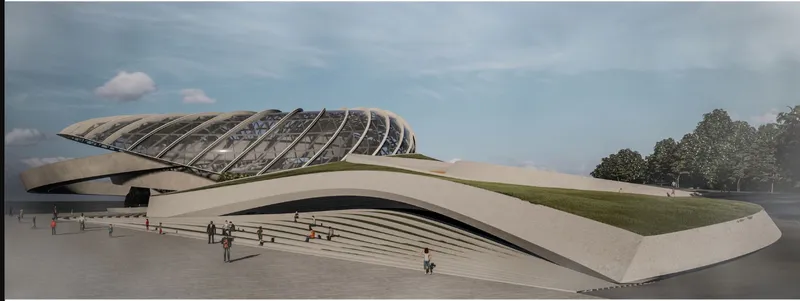


The side elevation exposes the project's most dramatic structural move: a cantilevered entry plaza whose grass-covered roof extends outward without visible support columns at its edge. The ribbed dome rises behind it, and the two elements create a layered section where public ground, planted surface, and sheltered interior stack vertically. The grass roof is not ornamental. It insulates, absorbs rainwater, and visually extends the surrounding parkland over the building's mass.
From the terraced steps, visitors descend toward the water alongside the ribbed shell, the scale of the ribs becoming more apparent with each step. The aerial view of the spiraling green roof confirms the landscape strategy: an orange-toned public pathway carves through the planted surface, guiding pedestrians along the waterfront in a continuous loop. The colour contrast is intentional, making the circulation legible from above and creating a wayfinding device embedded in the topography itself.
The Oasis Within the Canyon
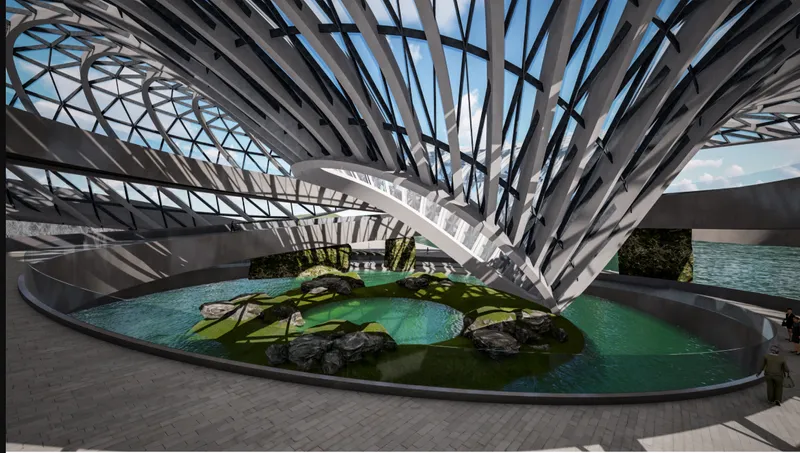
Step inside and the mood shifts entirely. The interior atrium opens beneath radiating structural ribs that fan outward like the veins of a leaf, converging on a circular pool surrounded by rock formations and planted greenery. Waterfalls cascade into the basin, and a fountain anchors the centre of the composition. The designer frames this as an oasis sustained by fresh water, set deliberately against the barren, canyon-like approach to heighten the contrast between lifelessness and renewal.
The closed-loop water recycling system is the invisible engine that makes this interior viable. Storm sewage and wastewater are treated before entering the facility, meaning the waterfalls and fountain run on reclaimed water rather than drawing from municipal supply. It is a compact demonstration of how urban architecture can close its own resource loops, turning waste into spectacle and infrastructure into experience.
Structure as Spectacle from Below
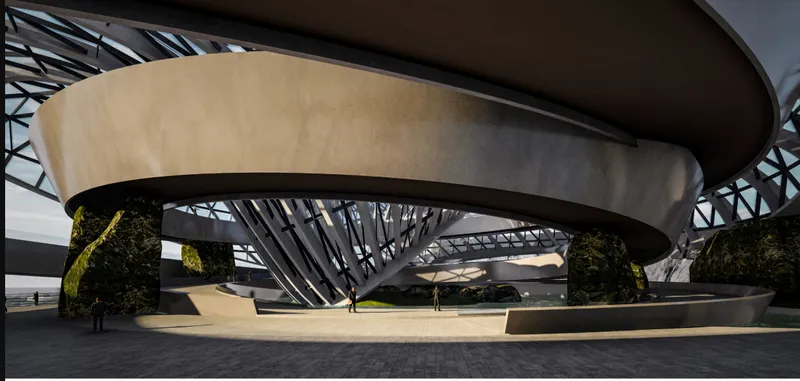
The final image offers the most revealing perspective: a view from beneath the cantilevered roof disc, looking up into an exposed structural web that radiates outward in a dense, almost biological pattern. The open plaza below benefits from full shelter without enclosure, creating a shaded public space that connects the monument's interior to the waterfront promenade. The structural expression is honest and legible; there is no cladding hiding the work the ribs perform.
Why This Project Matters
Water Drop succeeds because it refuses to separate symbolism from systems. The monument is not a sculpture placed next to a water treatment plant; the treatment plant is the monument. The closed-loop recycling infrastructure, the rainwater-collecting green roof, the reclaimed water feeding the interior waterfalls: each technical decision reinforces the project's thesis about freshwater scarcity without resorting to didactic signage or guilt. Visitors experience the argument spatially, moving from a barren canyon into a lush, water-rich interior that exists only because waste was revalued as resource.
For a shortlisted competition entry, the level of resolution is striking. The structural logic of the ribbed shell, the landscape integration of the spiraling green roof, and the programmatic layering of public plaza, pedestrian ramp, and interior oasis all point to a designer thinking across scales simultaneously. Шестаков has produced a project that treats sustainability not as an addendum to form but as its generative principle, and the Bosphorus waterfront is richer for the proposition.
View the Full Project
About the Designers
Designer: Алексей Шестаков
Enter a Design Competition on uni.xyz
uni.xyz runs architecture and design competitions year-round that reward proposals with spatial conviction and real site intelligence.
Project credits: Water Drop by Алексей Шестаков Ripple (uni.xyz).


Popular Articles
Popular articles from the community


Temporary Home for Dogs: A Reversed Zoo Rethinks Animal Shelter Architecture
In Bucharest, a sinuous corridor and freed landscape flip the logic of containment, designing a shelter that works to make itself unnecessary.

The Amber Palace Opera: A Geological Fiction Surfaces on Tallinn's Baltic Waterfront
Pierre Brillard reimagines a Baltic legend as a public landscape, opera house, and waterfront promenade rooted in Tallinn's coastal identity.

Faces of the Soviet Avant-Garde: Turning Moscow's Street Names into an Open-Air Museum
A network of sculptural installations across a Moscow residential district transforms forgotten architect names into spatial encounters with cultural memor

Singing Woman: An Opera House That Performs Before the Curtain Rises
Ovidiu Cristian Pavel's conceptual opera house translates Estonia's choral identity into a sculpted waterfront landmark facing the Baltic Sea.

Similar Reads
You might also enjoy these articles

Shakur's House: Exposed Brick as an Interior Organiser in a 168 m² Mashhad Residence
Brick moves indoors in this Mashhad residence, where masonry walls, glass partitions and teal planes sequence a compact home without closing it off.

Day and Night Park: A Time-Based Urban Newsstand in Beijing
A temporary urban newsstand in Beijing blending travel, light, and reading through poetic colors, compact form, and community-focused design.

Modernist Patio Renovation in El Masnou, Barcelona by Oliver Segura Arquitectura + Cebrià Arquitectura
Modernist patio renovation blending tradition and innovation with a movable pool, leveled floors, and Catalan materials in El Masnou.

Alto Residencial Coop: Cooperative Housing Development in Santiago de Compostela by Carbajo Barrios Arquitectos
A linear cooperative housing complex blending white volumes and perforated metal façades, enhancing community living, natural light, privacy, and urban integration.

Comments (0)
Please login or sign up to add comments
No comments yet. Be the first to comment!