
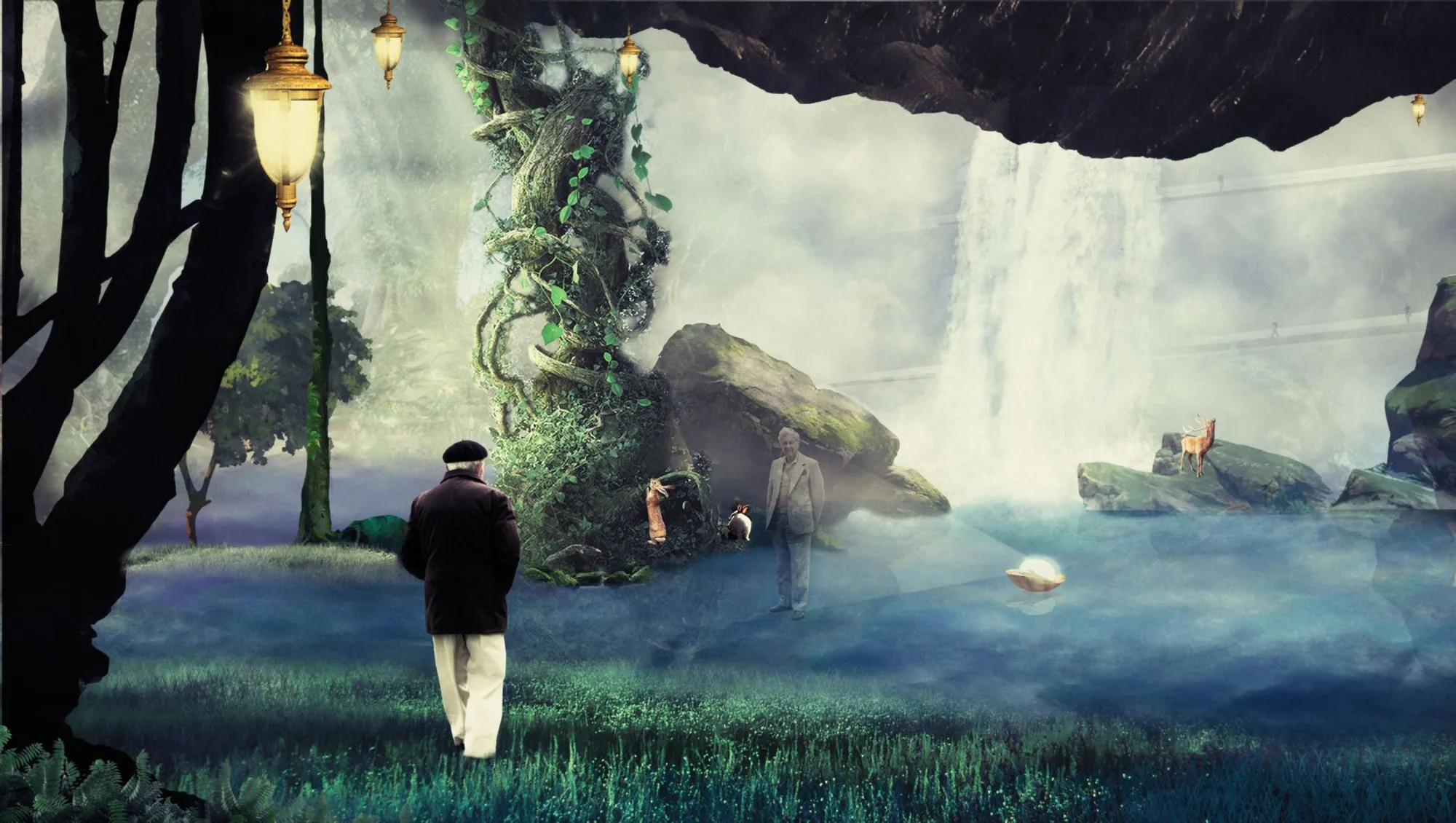
Water Mood: Rethinking Urban Cemeteries Through Water-Centric Vertical Architecture
A vertical memorial concept for Shanghai dissolves ash into water-integrated ecosystems, merging sustainable burial with living urban landscapes.


What if the dead could feed the living city? Water Mood takes one of architecture's oldest programs, the burial ground, and reimagines it as a vertical, water-driven ecosystem where cremated remains dissolve into ecological systems that nourish the surrounding landscape. It is a provocative inversion: the cemetery not as a place apart, but as a productive piece of urban infrastructure that generates green space rather than consuming it.
Designed by D. Ridol, Tian Jia Qi, Dong Zhi, and Tu YunCi, the project responds to the acute land pressure facing metropolitan Shanghai, where rapid urbanization has steadily eroded the space available for traditional cemeteries. Their proposal trades the horizontal sprawl of conventional burial grounds for a modular, vertically stacked architecture organized around water as both memorial medium and ecological engine.
A Three-Lobed Roof Floating Above the Landscape
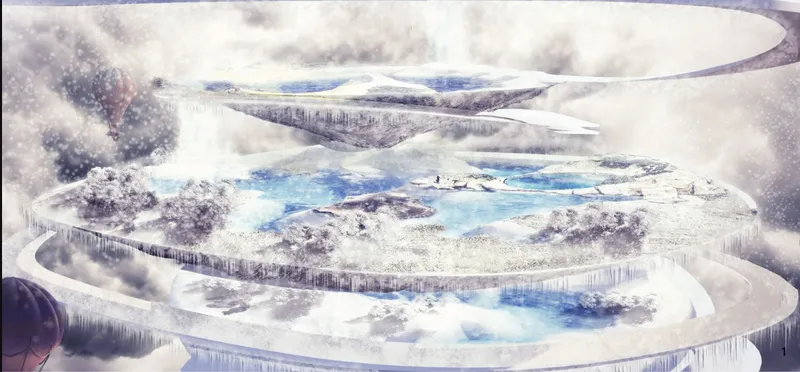
Seen from above, the primary structure reads as three organic lobes sheltering the memorial spaces below. The aerial rendering reveals how the roofscape merges with the terrain, its curvilinear geometry echoing natural landforms rather than imposing a rigid architectural footprint. Surrounding the building, a snow-covered landscape and crystalline formations amplify the sense of stillness and passage, framing the memorial as a place suspended between seasons, between presence and absence.
Terraced Earthworks and the Ritual of Approach
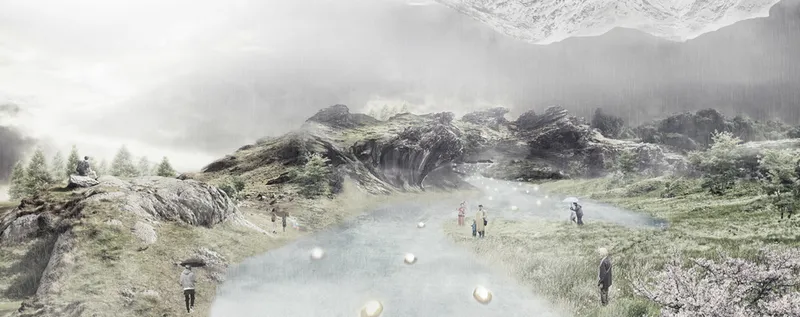
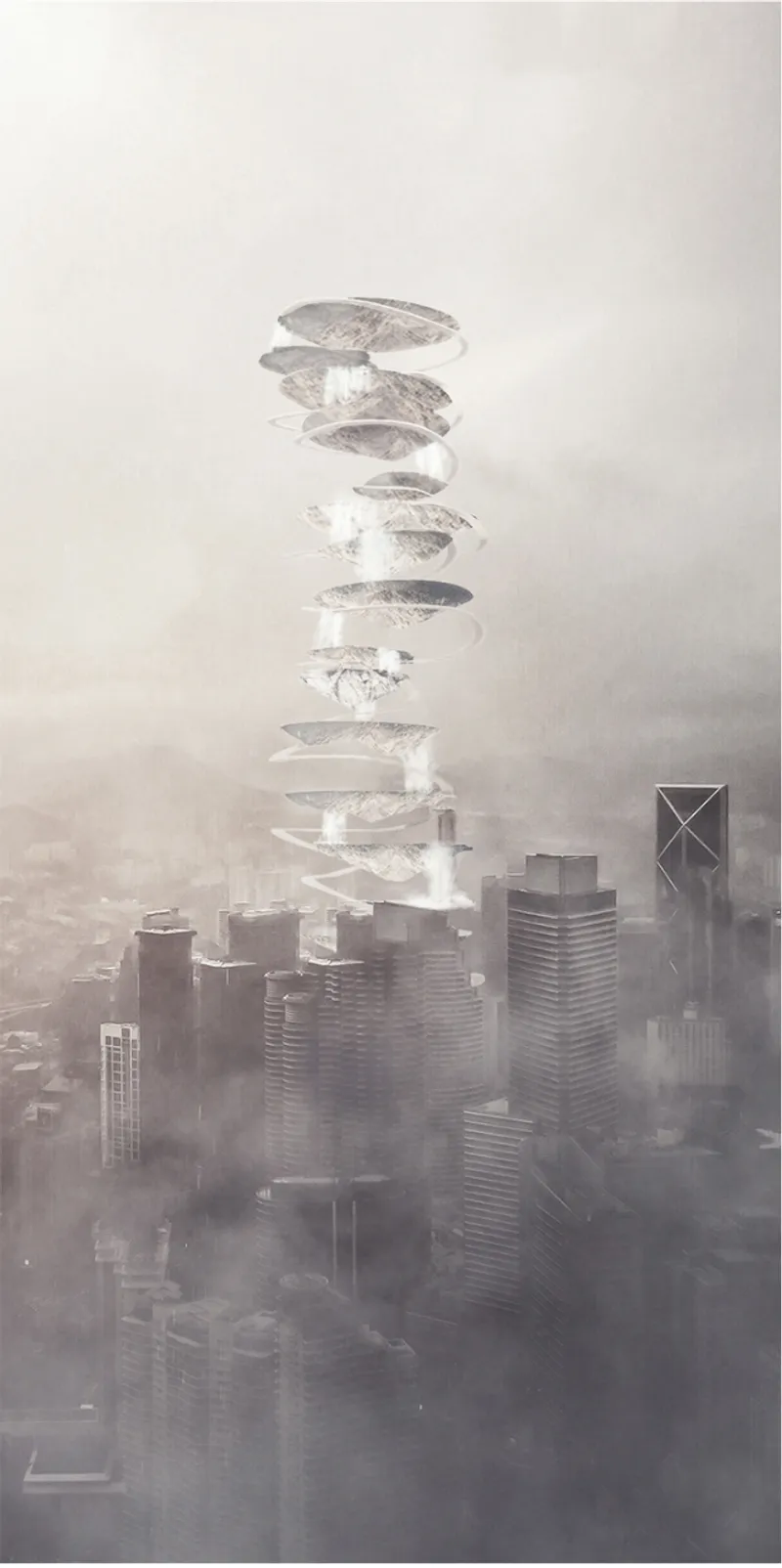
At ground level, the approach sequence is carefully choreographed. Visitors move along a misty path through terraced earthwork structures that rise and fall like geological strata, gradually separating them from the noise of the city. The fog is not incidental; water vapor becomes part of the spatial experience, softening boundaries and slowing the pace of movement. It is architecture working through atmosphere rather than walls.
The vertical tower rises through the fog line as a stack of floating disc-shaped floors, each cantilevered outward to create layered green platforms visible from the city below. This is the project's most assertive formal gesture: a memorial that grows upward rather than outward, its modular floor plates designed for adaptive expansion as urban populations increase. The tower doubles as a piece of vertical greening, its tiered planting turning a functional response to land scarcity into an urban landmark.
Water, Moss, and the Dissolution of Boundaries
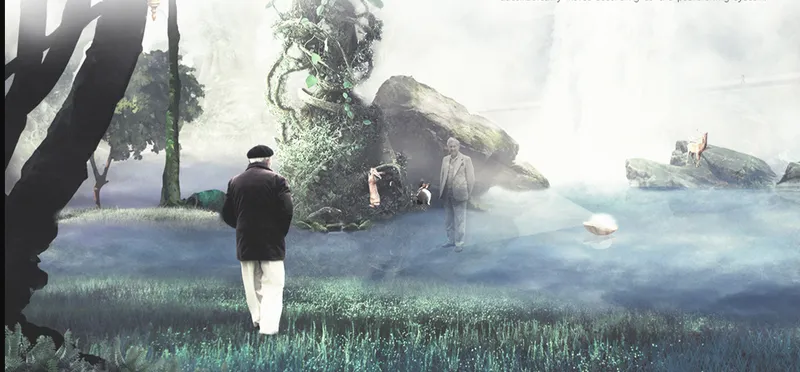
One of the most compelling scenes in the project depicts figures approaching moss-covered rock formations beside a body of water. Here, the line between landscape and architecture dissolves entirely. The ashes of the deceased are stored within water-integrated ecological systems, gradually dissolving and nourishing the surrounding environment. Commemoration takes the form of floating memorials and digital projections rather than headstones, offering a mode of remembrance that is less about permanence and more about cyclical renewal. The rock and moss suggest deep time; the water suggests flow and return.
Organic Plans and Sectional Logic
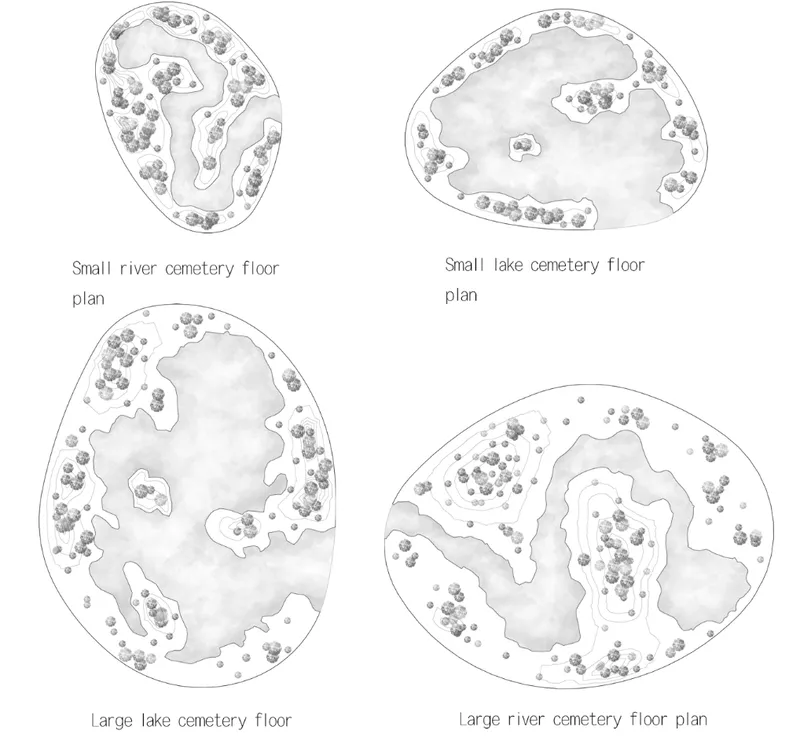
The floor plan drawings reveal four distinct burial ground layouts, each organized around water bodies and tree clusters in organic, non-rectilinear configurations. These are not traditional cemetery plots; they read more like wetland ecologies, with burial zones integrated into living systems of water and vegetation. The plans make the project's ecological argument legible: every square meter serves a dual function, storing remains while sustaining plant life.
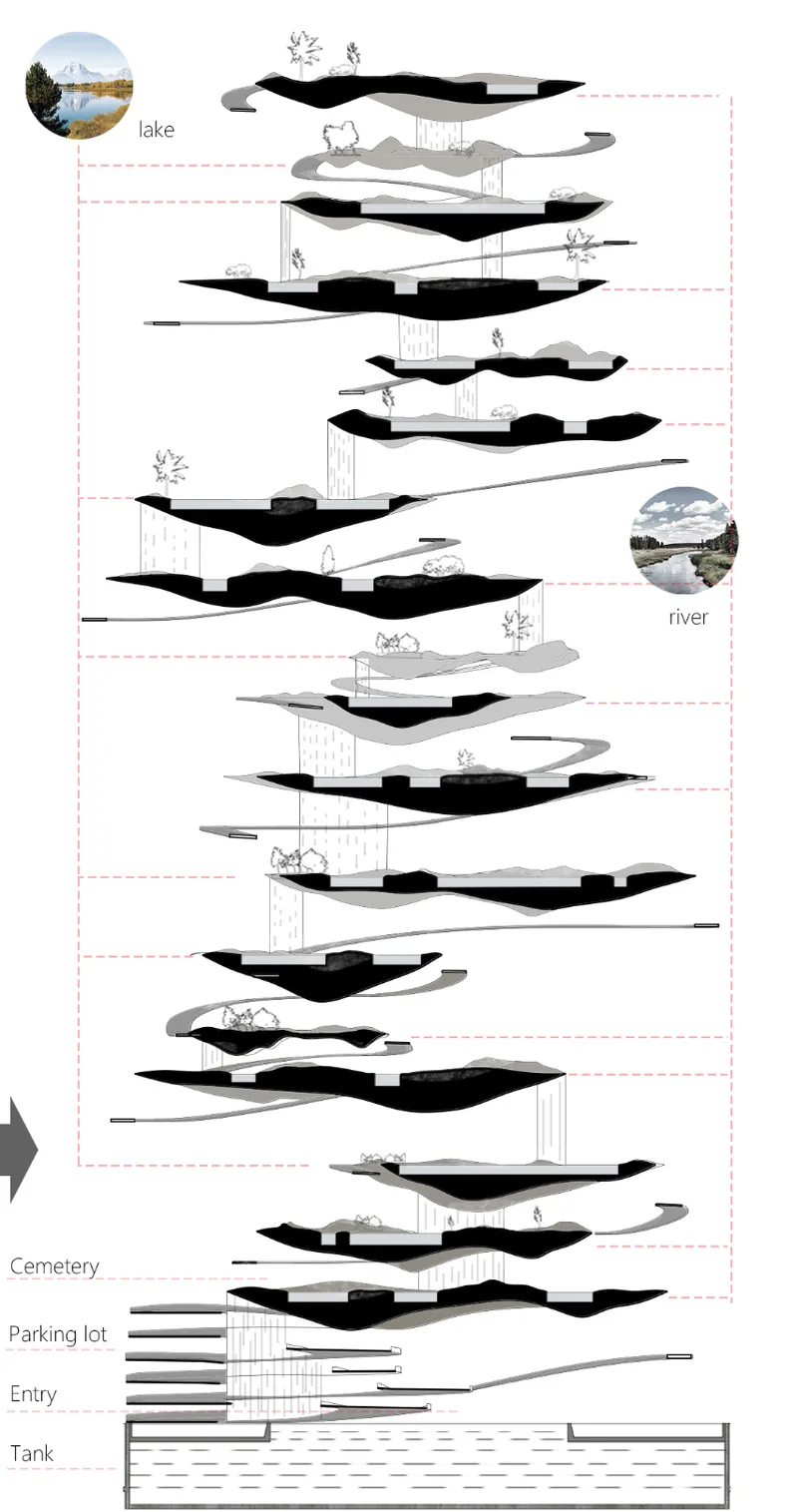
The section drawing cuts through the full vertical extent of the design, showing stacked undulating floor plates descending from lake level to river level. The undulation is structural and experiential, creating varied ceiling heights and intimate pockets within the larger volume. Water moves through the section as a connecting thread, linking the upper memorial levels to the lower landscape and reinforcing the project's central metaphor: water as the medium that carries life from one state to the next.
Why This Project Matters
Urban cemeteries are among the least discussed yet most pressing spatial challenges in rapidly densifying cities. Water Mood confronts this problem head-on, refusing the convenient solution of simply pushing burial grounds to the periphery. Instead, it proposes that memorial architecture can be woven into the fabric of the living city, contributing green infrastructure, water management, and public space rather than extracting land from an already strained urban system.
The strength of the project lies in its integration of concept and technique. The water-based dissolution of remains is not merely symbolic; it drives the spatial organization, the material palette, and the ecological performance of the entire design. By treating death as a form of ecological participation, the team reframes sustainability not as a technical add-on but as a philosophical position. In a discipline still largely uncomfortable with the subject of mortality, that kind of directness is worth paying attention to.
View the Full Project
About the Designers
Designers: D. Ridol, Tian Jia Qi, Dong Zhi, Tu YunCi
Enter a Design Competition on uni.xyz
uni.xyz runs architecture and design competitions year-round that reward proposals with spatial conviction and real site intelligence.
Project credits: Water Mood by D. Ridol, Tian Jia Qi, Dong Zhi, Tu YunCi.



Popular Articles
Popular articles from the community


Riyadh For All: Intergenerational Urban Design for Active Aging in Rabat
Riyadh For All reimagines urban design in Rabat with intergenerational co-living, adaptive courtyards, and Moroccan cultural exchange today.

Co-life: Sustainable Architecture for Age-Friendly Community Living
Co-life reimagines sustainable architecture for seniors through courtyards, rammed earth, shared gardens, and spaces designed for belonging.

Conexión: Biophilic Design Reimagines High-Rise Living in Hong Kong
Conexión reimagines high-rise living in Hong Kong through biophilic design, green facades, shared spaces, daylight, water and nature within.

The Earth Pod: 3D Printed Homes for Resilient Refugee Communities
The Earth Pod reimagines refugee housing through 3D printed homes made from clay, combining resilience, self-sufficiency, and rapid shelter.

Similar Reads
You might also enjoy these articles

Day and Night Park: A Time-Based Urban Newsstand in Beijing
A temporary urban newsstand in Beijing blending travel, light, and reading through poetic colors, compact form, and community-focused design.

Modernist Patio Renovation in El Masnou, Barcelona by Oliver Segura Arquitectura + Cebrià Arquitectura
Modernist patio renovation blending tradition and innovation with a movable pool, leveled floors, and Catalan materials in El Masnou.

Alto Residencial Coop: Cooperative Housing Development in Santiago de Compostela by Carbajo Barrios Arquitectos
A linear cooperative housing complex blending white volumes and perforated metal façades, enhancing community living, natural light, privacy, and urban integration.

Vil Genis School by BPA ARCHITECTURE – Massy, France
Vil Genis School in Massy, France, features sustainable design, south-facing classrooms, community integration, accessible spaces, and modern educational architecture.

Explore Memorial Design Competitions
Discover active competitions in this discipline



Challenge to reimagine the Iron Throne


Photograph architecture without architects


Illustrate the lost glory of Angkor Wat - Render Challenge


Design challenge to reuse E-waste
Comments (0)
Please login or sign up to add comments
No comments yet. Be the first to comment!