
WaterCell Park: Regenerative Urbanism on Istanbul's Continental Edge
A water-recycling public landscape of organic pavilions and coastal promenades bridges two continents along the Bosphorus waterfront.

What does it look like when a park is designed not just to occupy space, but to process it? WaterCell Park proposes a regenerative public landscape on the Istanbul waterfront where every surface captures, filters, or recirculates water, turning a civic amenity into an ecological machine. Curved blue channels thread through plazas, hyperboloid mesh fountains cool children in summer, and organic pavilions shelter visitors beneath canopies that feel grown rather than built. The result is a project that treats water infrastructure as public spectacle rather than hidden utility.
Designed by Andra Gheorghiu, Alexandru Pomazan, Alexandra Burecu, and Irina Panait, the project earned a People's Choice Award in the Ripple competition on uni.xyz. Sited in one of Istanbul's most iconic neighborhoods, the park commands a panoramic view that spans two continents, grounding its ecological ambition in the specific pressures of a dense, historic, and water-scarce city.
A Plaza That Reads as Landscape, Not Pavement
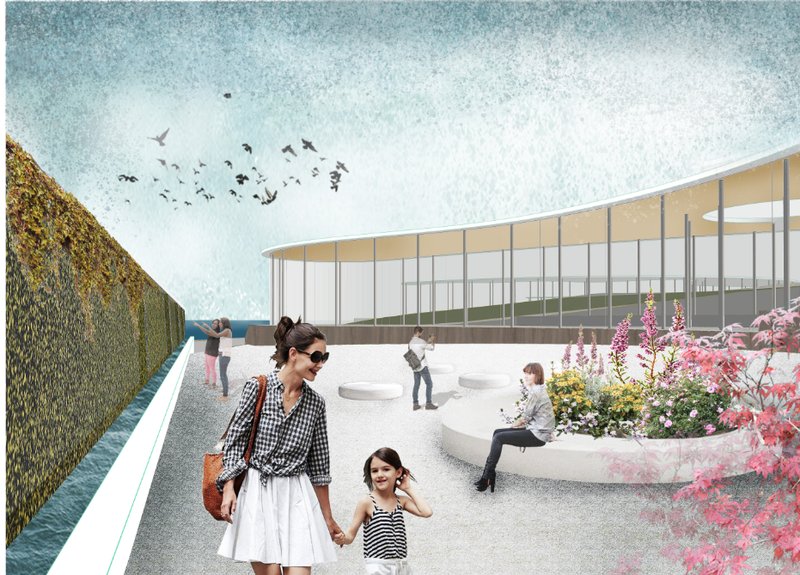
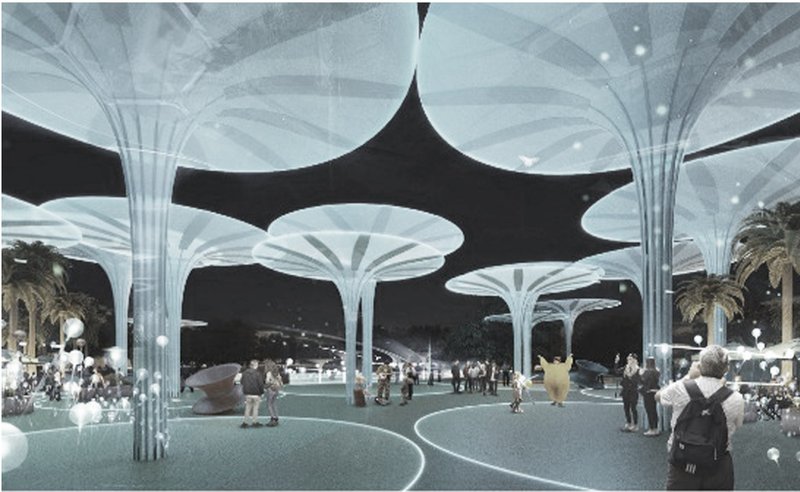
The primary ground plane avoids the emptiness of conventional hardscape. Planted flower beds are set into the plaza surface beneath a lightweight colonnade, giving the space a domestic softness that invites families and casual visitors. At night, the character shifts entirely: branching white columns support a dark fabric canopy that transforms the pavilion into a luminous gathering space, its tree-like structure echoing the organic formal language the designers use throughout the park. The contrast between daytime openness and nighttime enclosure suggests the team thought carefully about temporal use, not just spatial layout.
Water Channels as Civic Armature
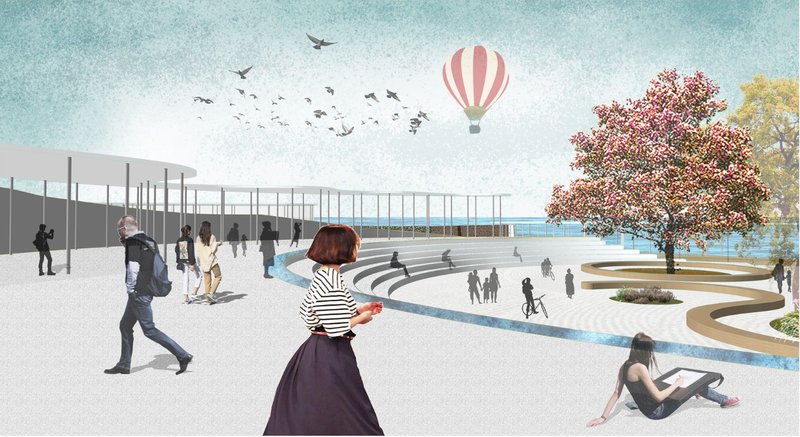
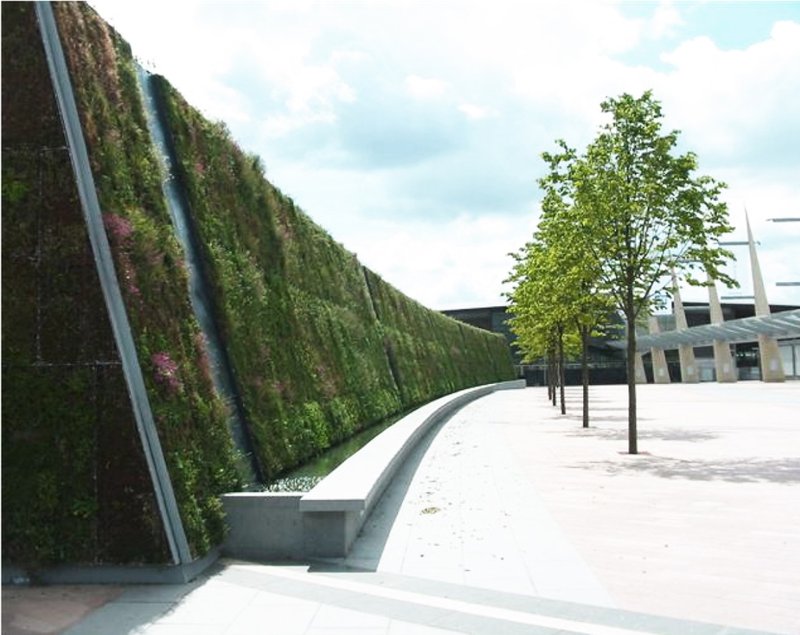
A waterfront plaza presents the project's core idea most directly. Curved blue water channels carve through the ground surface, creating a network that is simultaneously ornamental and functional. The channels feed into the park's advanced water recycling system, which optimizes usage and reduces waste across the site. An elevated colonnade runs parallel to the water's edge, framing views toward the Bosphorus and establishing a clear hierarchy between the ground-level wet landscape and the sheltered dry promenade above.
Flanking the main circulation routes, tall planted green walls rise from concrete planter bases, their dense vegetation improving air quality and supporting biodiversity. These vertical surfaces also act as spatial dividers, screening quieter zones from the active waterfront without relying on opaque barriers. Young trees along the base promise a canopy that will mature over time, adding a temporal dimension to the park's ecological strategy.
Boardwalk, Hammocks, and the Edge of the Sea
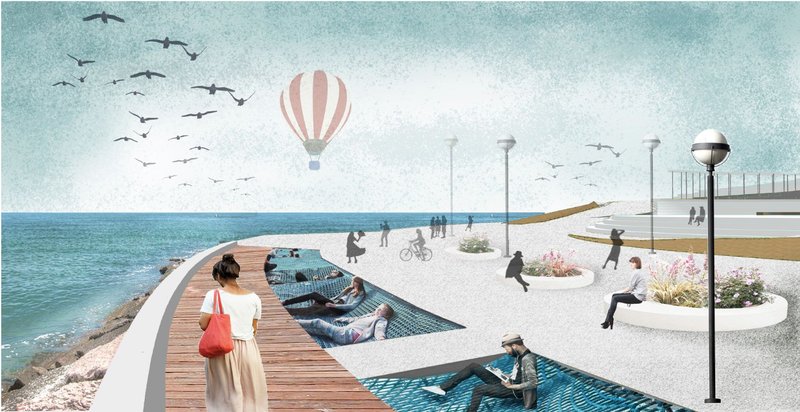
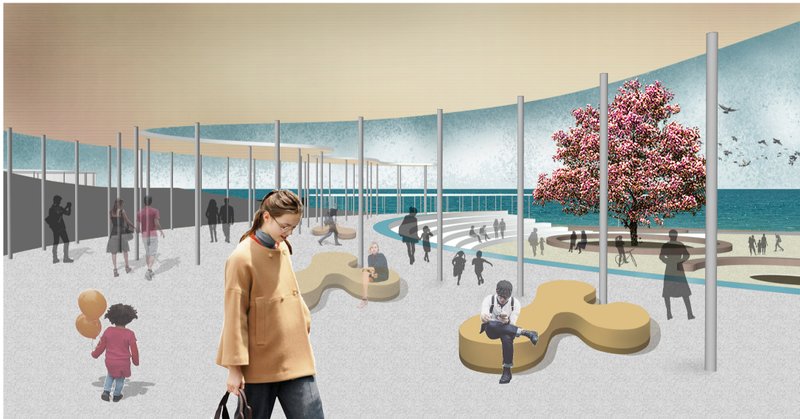
The waterfront promenade is where WaterCell Park makes its most compelling spatial argument. A timber boardwalk extends along the coastal edge, with hammock nets stretched over a reflecting pool beside the sea. The image is leisurely, almost resort-like, but it serves a serious purpose: drawing residents to the water's edge and reestablishing a public relationship with the Bosphorus that denser urban development has eroded. The detail of the hammock nets over water is particularly effective, offering a form of rest that is sensory, with the sound of lapping water below and the horizon ahead.
Interior views through slender columns reveal organic seating elements arranged to face the sea, with a glass perimeter dissolving the boundary between shelter and landscape. The column profiles are kept deliberately thin, refusing to compete with the panoramic views that are the site's greatest asset.
Elevated Walks and Organic Interiors
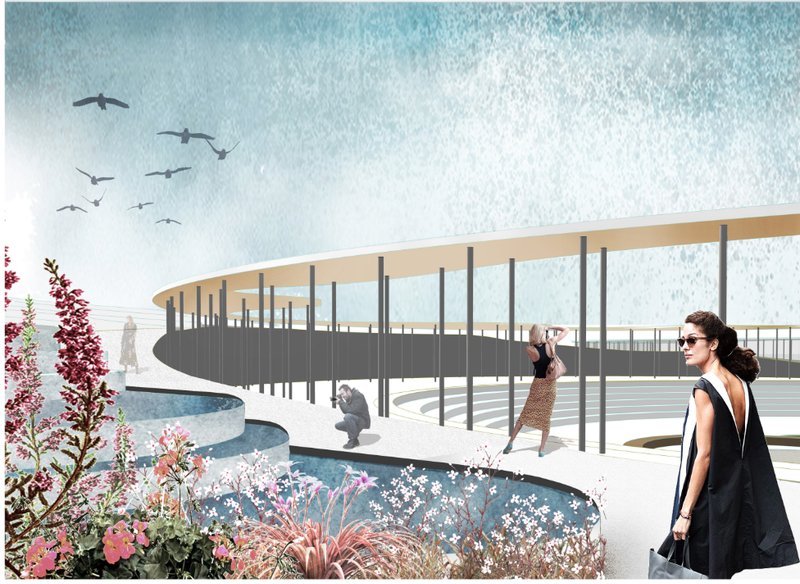
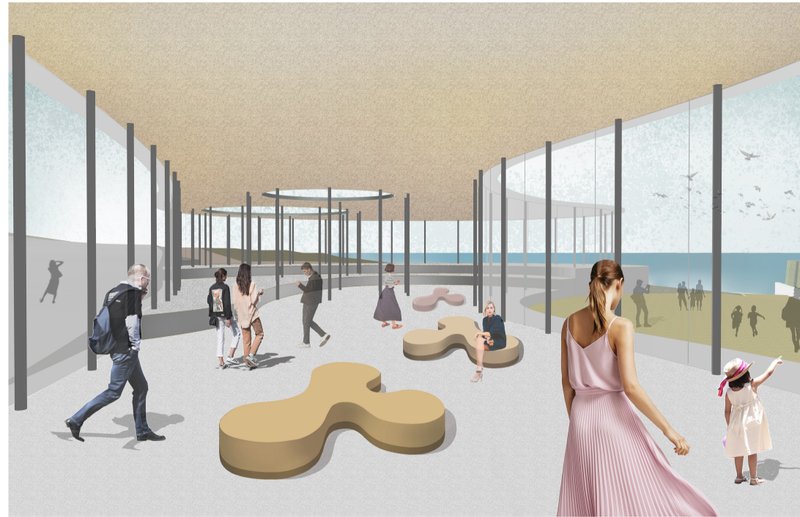
An elevated walkway with a timber soffit floats above planted beds, offering visitors a second register from which to read the coastal landscape. The slender columns supporting this structure maintain the visual lightness that characterizes the entire project. Below, planted beds visible through the open structure reinforce the idea that the park's ground plane is continuous, never interrupted by building mass.
Inside the pavilion spaces, curved seating pods beneath a timber ceiling create intimate gathering zones. Steel columns support the overhead structure while remaining visually recessive, letting the organic geometry of the seating define the spatial experience. The interiors feel hospitable without being enclosed, a balance that is difficult to achieve and essential in a climate where the line between indoor and outdoor living is deliberately blurred.
Water as Play: The Hyperboloid Fountain
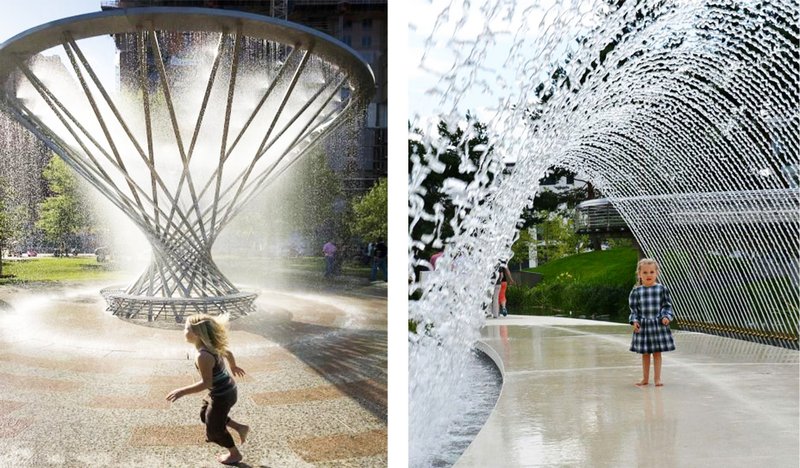
Perhaps the most memorable single element in the park is a hyperboloid fountain structure built from steel mesh. Arcing jets of water trace the geometry of the mesh while children play beneath, turning the park's water management ethos into a tactile, joyful experience. It is a smart piece of design communication: the same water system that handles recycling and waste reduction is also the source of the park's most playful moment. Infrastructure and delight occupy the same structure.
Why This Project Matters
WaterCell Park resists the common trap of sustainability projects that foreground their systems at the expense of spatial quality. Here, the water recycling infrastructure, the green walls, and the planted beds are never separate from the experience of the park. They are the park. The design team understood that a regenerative landscape only works if people want to spend time in it, and the boardwalks, hammock nets, branching pavilions, and play fountains ensure that residents and visitors will.
For a city like Istanbul, caught between the pressures of rapid development and the fragility of its coastal ecosystems, projects like this offer a necessary provocation. The People's Choice recognition from the Ripple competition suggests that the public appetite for this kind of thinking is real. WaterCell Park demonstrates that ecological urbanism does not have to be austere; it can be generous, social, and deeply rooted in the pleasures of water, shade, and the view across the strait.
View the Full Project
About the Designers
Designers: Andra Gheorghiu, Alexandru Pomazan, Alexandra Burecu, Irina Panait
Enter a Design Competition on uni.xyz
uni.xyz runs architecture and design competitions year-round that reward proposals with spatial conviction and real site intelligence.
Project credits: WaterCell Park by Andra Gheorghiu, Alexandru Pomazan, Alexandra Burecu, Irina Panait Ripple (uni.xyz).




Popular Articles
Popular articles from the community

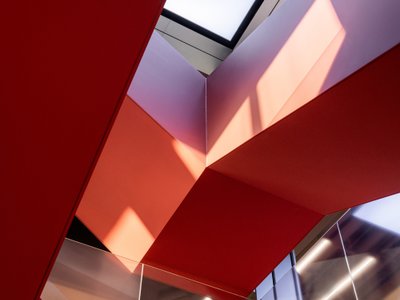
Ippolito Fleitz Group Identity Architects Turn Eight Floors in Shanghai into a Vertical Creative City
Publicis Groupe's new headquarters in Xintiandi reimagines the office as a courtyard-driven urban landscape stacked across eight floors.
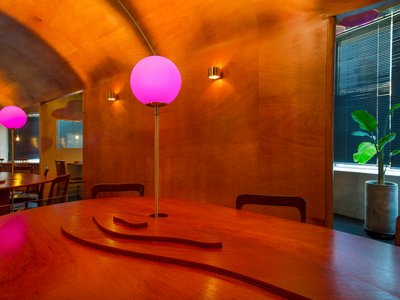
Indiesalon Carves a Plywood Cave into a Seoul Bistro's Second Floor
Munhwa Bistro's second Seongsu branch wraps diners in a laminated timber vault laced with colored light and mirror illusions.
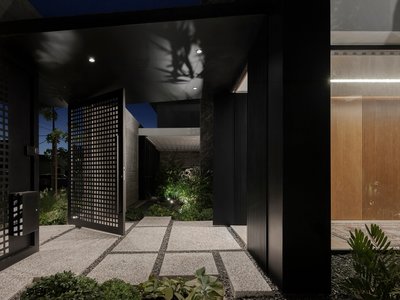
Constanti Architects Builds a Fortress of Privacy in Nicosia with House 345
A concrete and timber residence in Cyprus reinterprets the traditional introverted courtyard house for a new urban landscape.
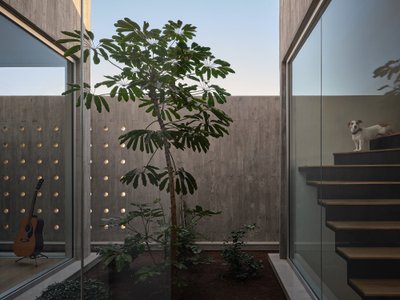
Driss Kettani Carves a Private World from Concrete Boxes on a Tight Casablanca Plot
Villa Polo stacks perforated concrete volumes around courtyards and a rooftop pool to shield a family home from the dense urban fabric.


Similar Reads
You might also enjoy these articles

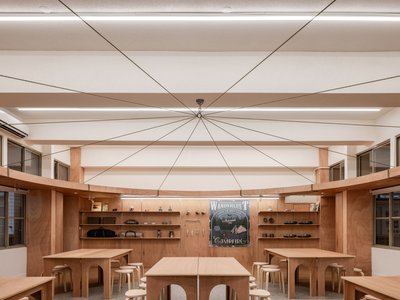
317studio Turns an 87 m² Classroom into a Forest Clearing for Scouts in New Taipei City
A rope canopy, student-made specimens, and campfire geometry replace rows of desks in this Scouting classroom in Xizhi District.
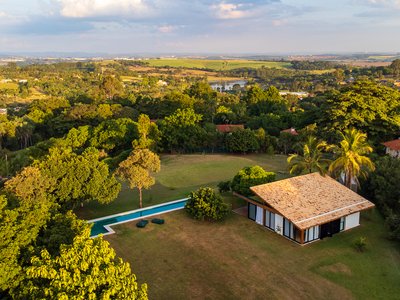
24 7 Arquitetura Builds a Timber Pavilion as a Family's First Act on a 5,000 m² Brazilian Plot
In Jaguariúna, a prefabricated glulam house nestles among mature trees as the opening move of a larger residential masterplan.
1+1>2 Architects Build a School from 900 Blocks of Hmong Stone on Vietnam's Rocky Plateau
On a barren valley in Ha Giang province, a community quarried its own stone to raise a kindergarten and primary school rooted in Hmong identity.
100A Associates Builds a Volcanic Stone Retreat on Jeju Island Rooted in Ritual and Restraint
Watarstay [Wa:Tar] in Bongseong-ri channels Jeju's basalt, reed, and hemp into a 150 m² hospitality space shaped by contemplation.






Comments (0)
Please login or sign up to add comments
No comments yet. Be the first to comment!