
Weilong School by URBANUS: A Contemporary Campus Rooted in Hakka Culture and Community Urbanism
Bakhoor Temple is a sensory pavilion where smoke, scent, clay, and dim light merge to evoke contemplation and gentle resistance.


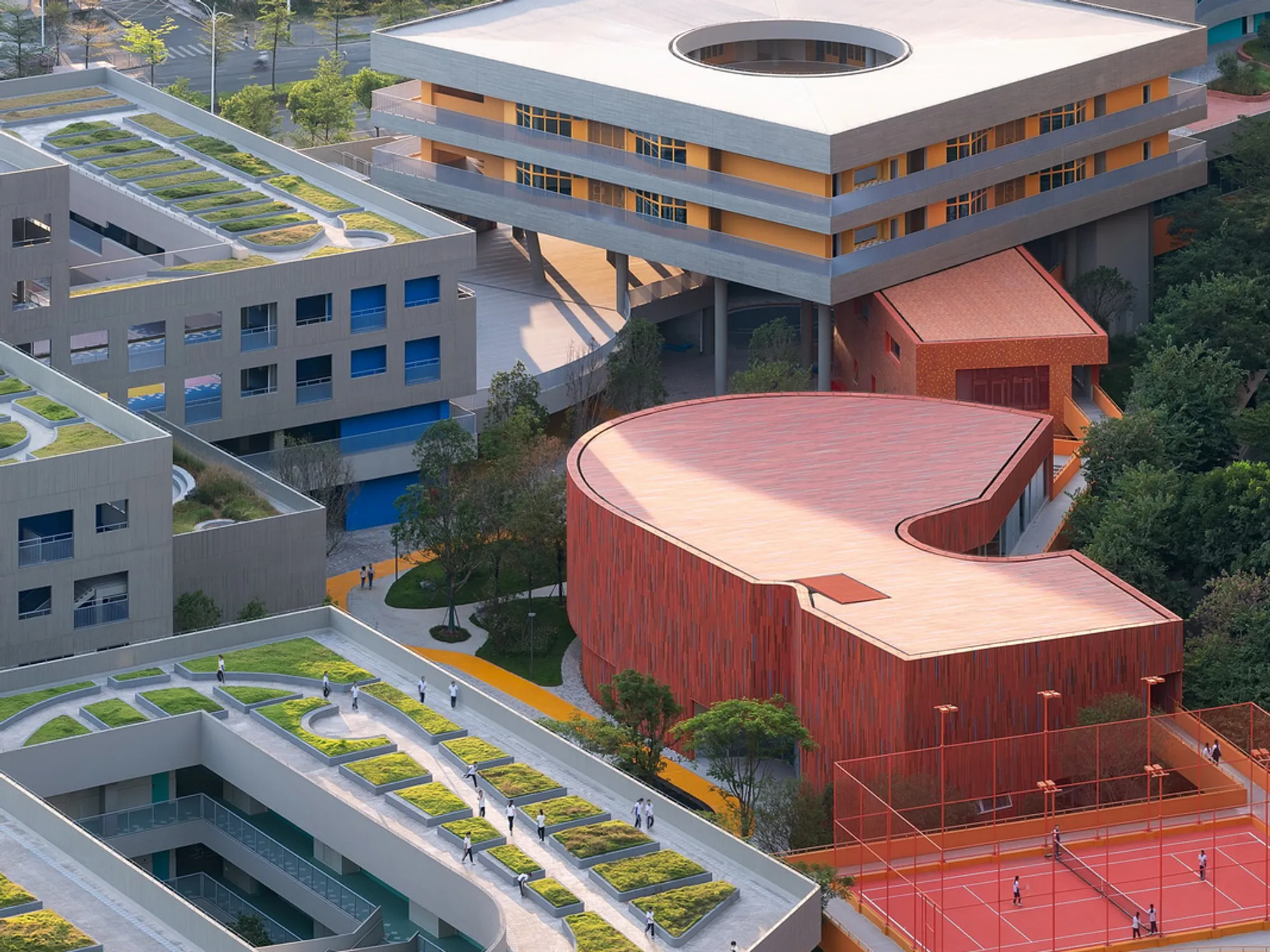
The Weilong School, designed by MENG YAN | URBANUS, is a groundbreaking educational campus in Shenzhen that redefines the relationship between architecture, culture, and the community. Completed in 2024, the 73,511 m² school is more than a learning environment—it is an urban catalyst designed to revive local culture, reconnect fragmented neighborhoods, and reinterpret the spatial beauty of traditional Hakka Walled Houses through a modern, inclusive lens.
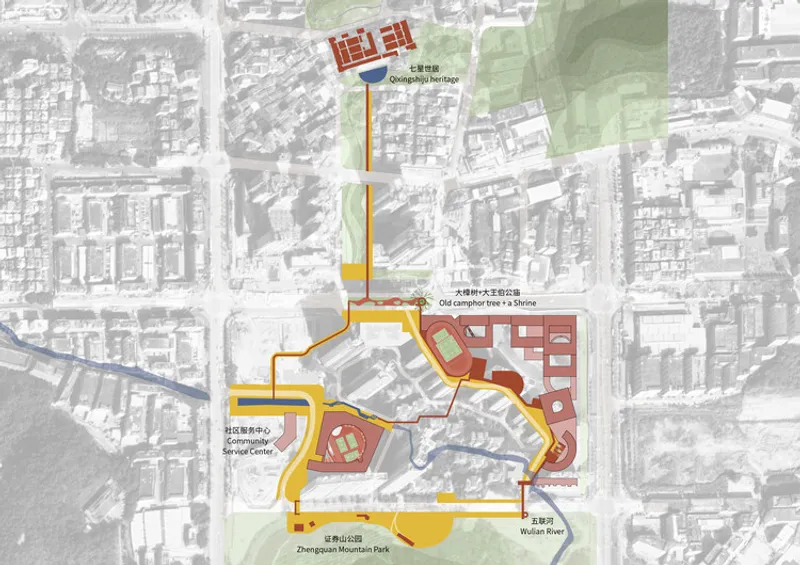
Situated in a richly layered urban context—surrounded by residential blocks, industrial parks, and an old village—the school becomes a bridge between people, heritage, and place. The project embodies URBANUS’ belief that academic buildings can serve as engines for community revitalization, strengthening social fabric through thoughtful design.
A Site Defined by History, Culture, and Nature
The school is located near several important cultural landmarks:
- The Dawang Bogong Temple, where incense burns beneath a century-old banyan tree
- The Qixing Shiju Historic Hakka Residence, a symbol of traditional settlement
- A natural urban axis defined by two hills and a lone tree
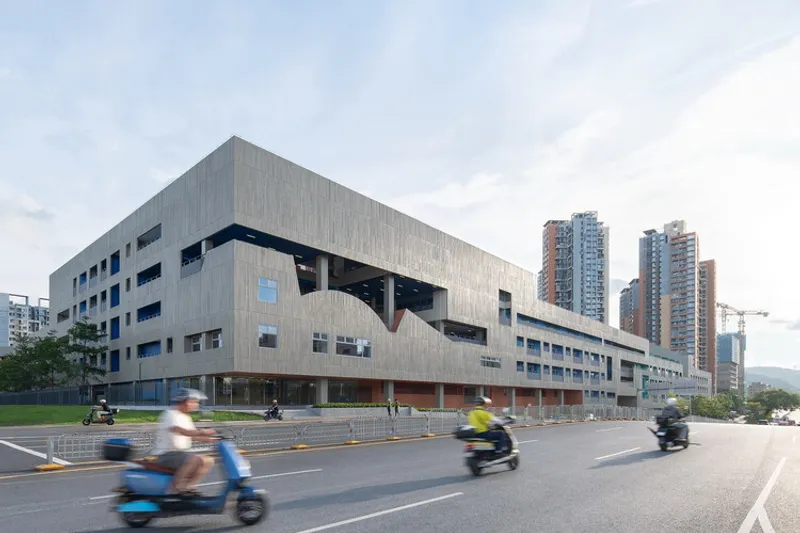
In this layered environment, the Weilong School sits along a major city road, while its sibling campus, Weiwu School, lies across a small river. Instead of isolating students from the city, the architecture builds active connections—honoring heritage while supporting modern educational needs.
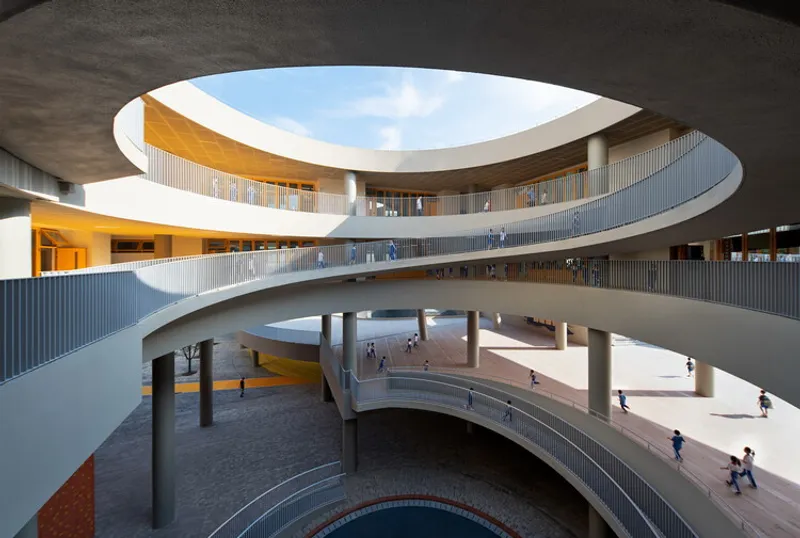
Reinterpreting Hakka Walled Houses Through Modern Architecture
Traditional Hakka settlements are defined by strong boundaries, interior courtyards, and communal living. URBANUS transforms these elements into an innovative and contemporary spatial system:
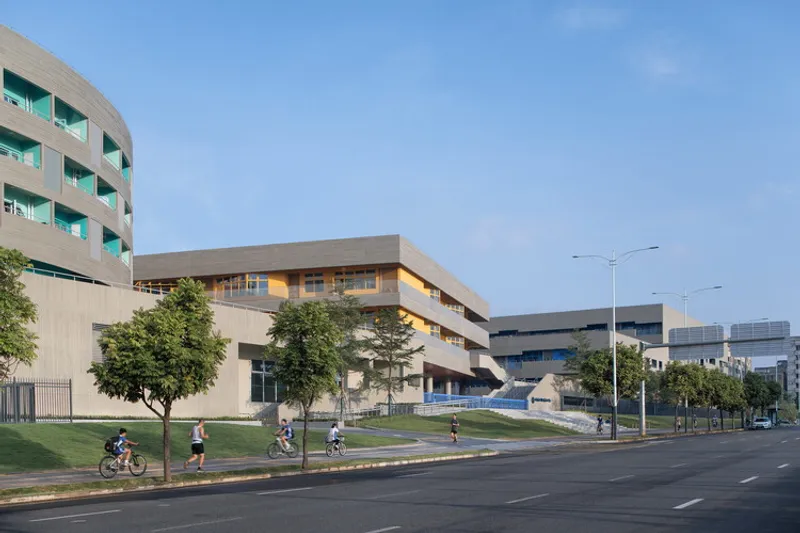
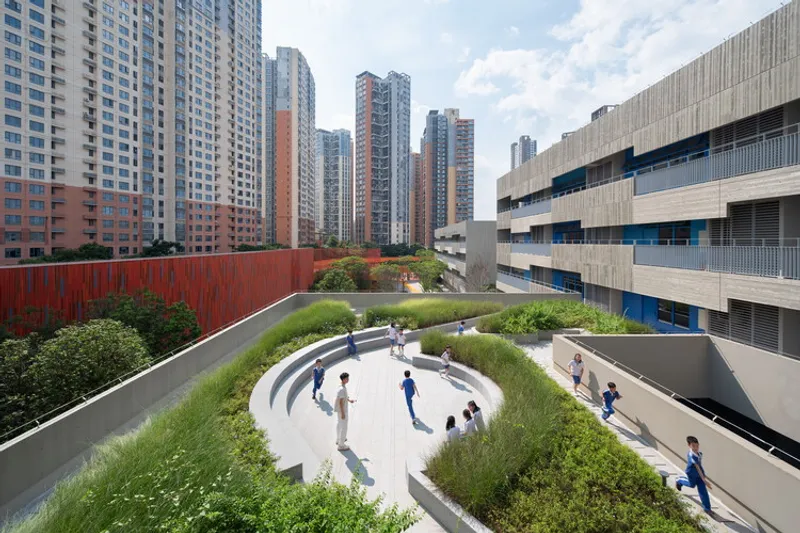
1. Continuous Horizontal Massing
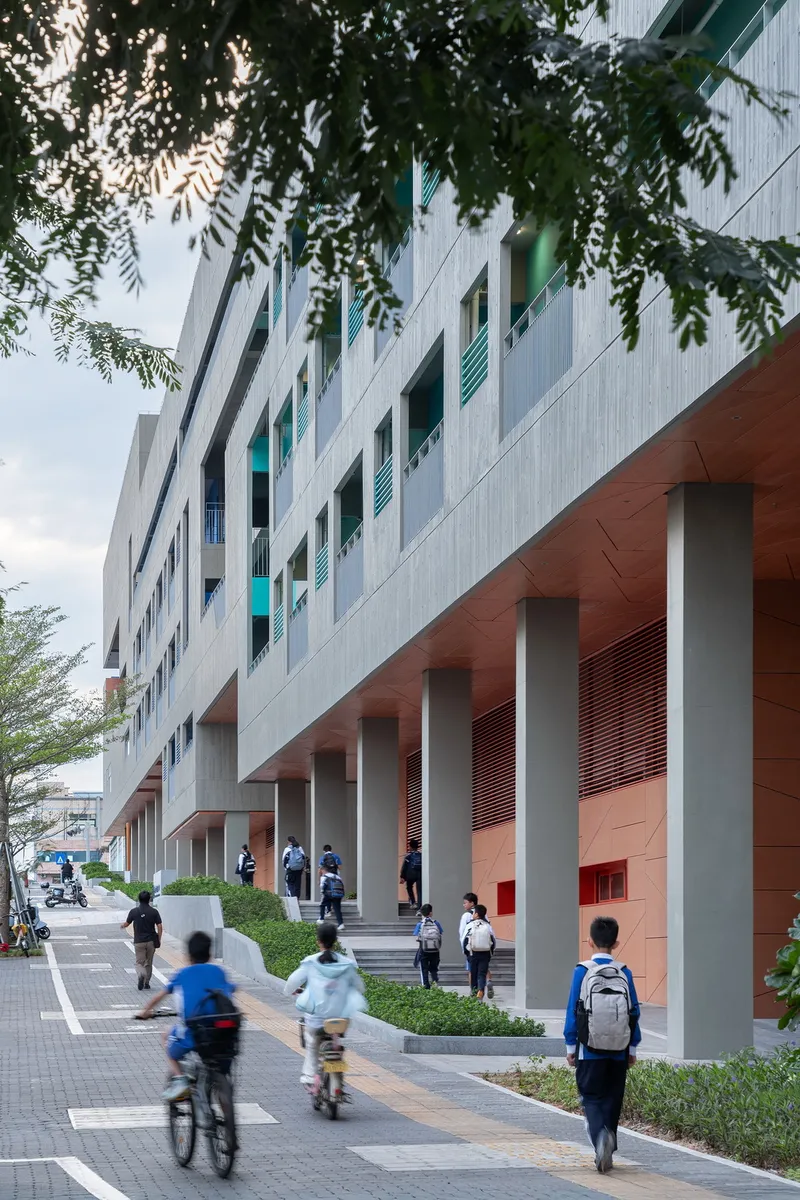
In contrast to the oversized, vertical cityscape surrounding it, the school adopts a low, horizontal profile inspired by Hakka walled compounds. This creates a protected inner world that feels grounding, calm, and communal.
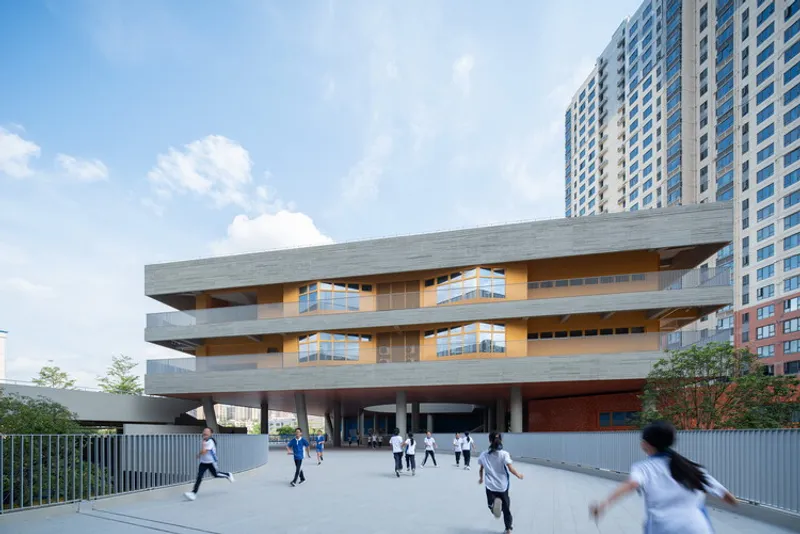
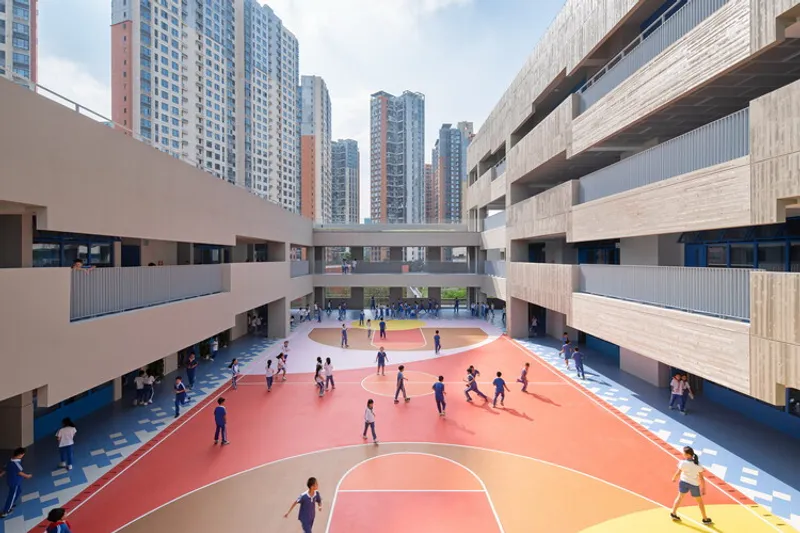
2. Garden Courtyards Inspired by Lingnan Landscape
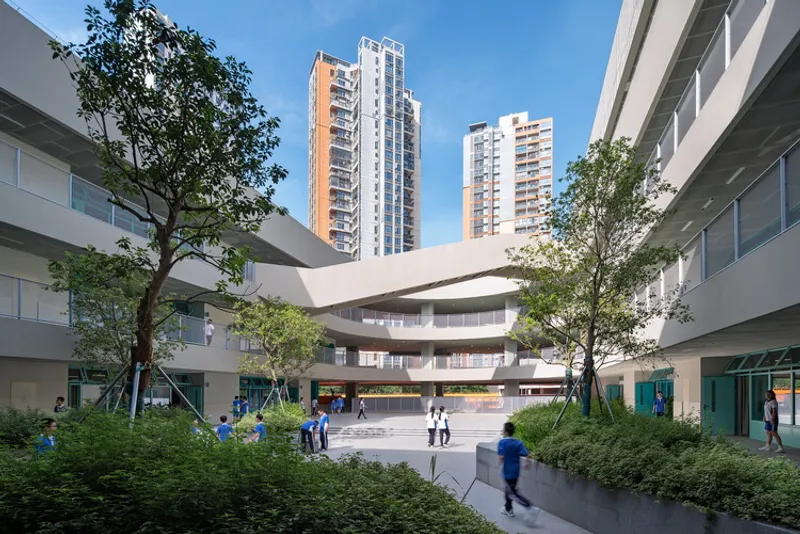
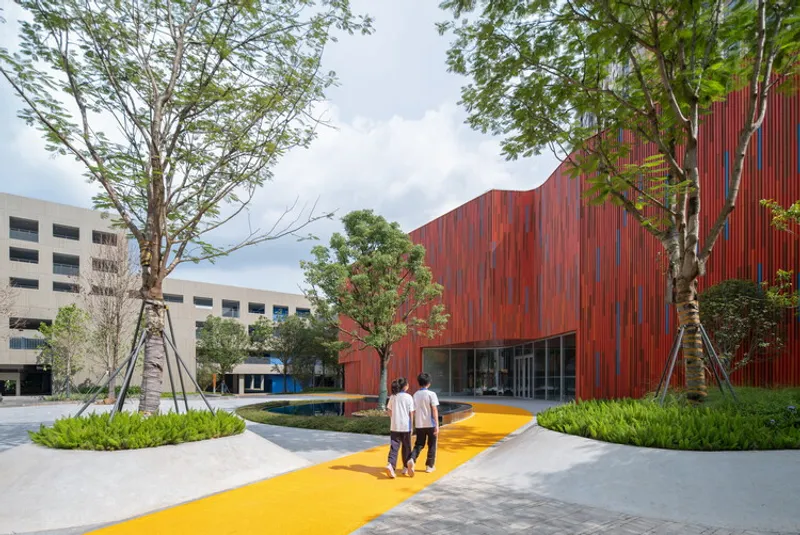
By layering density along the perimeter, the heart of the campus opens into lush, garden-like courtyards—cooling the microclimate and giving students restorative outdoor space.
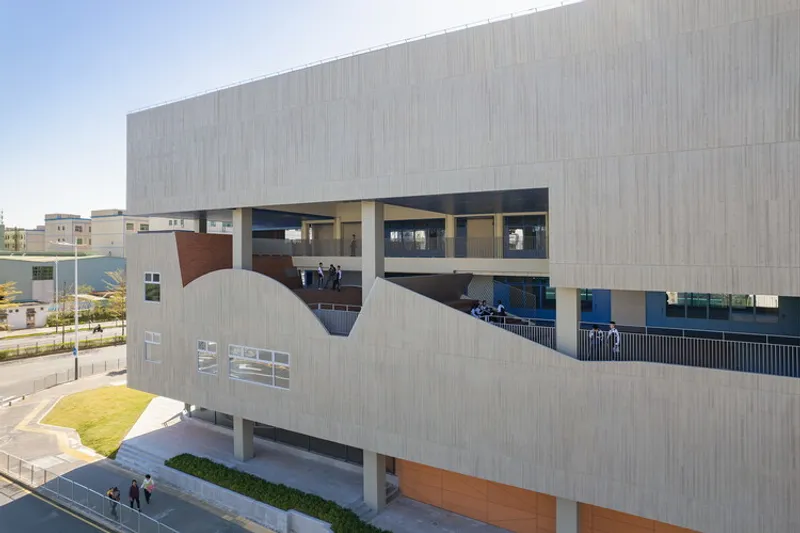
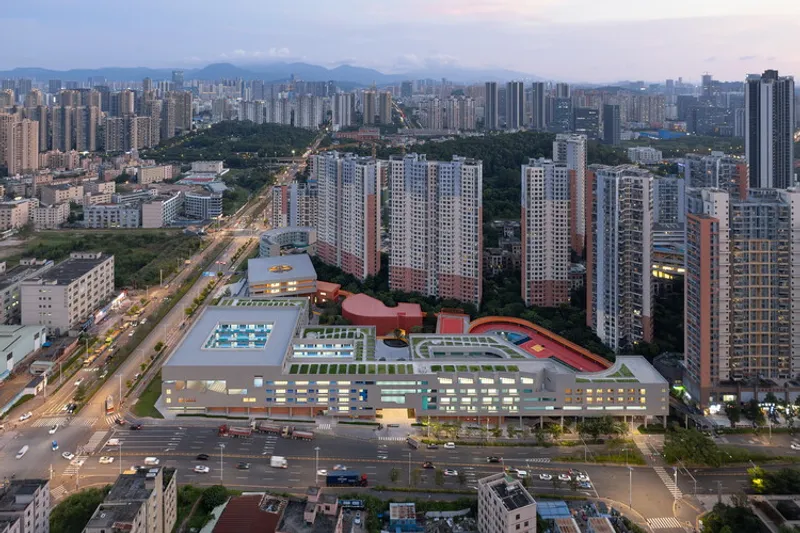
3. A Shared Interface Between School and City
Ground-floor colonnades, open corridors, and transparent edges create a porous connection with the neighborhood. The school becomes a civic resource—not an isolated institution.
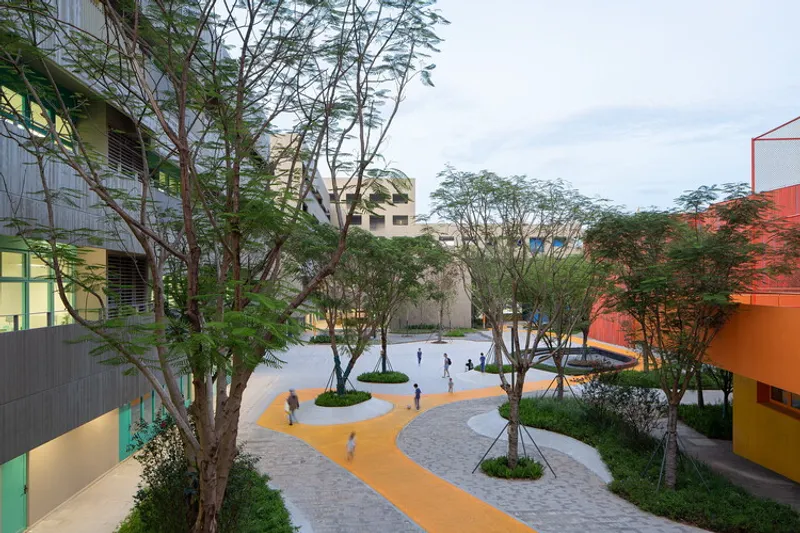
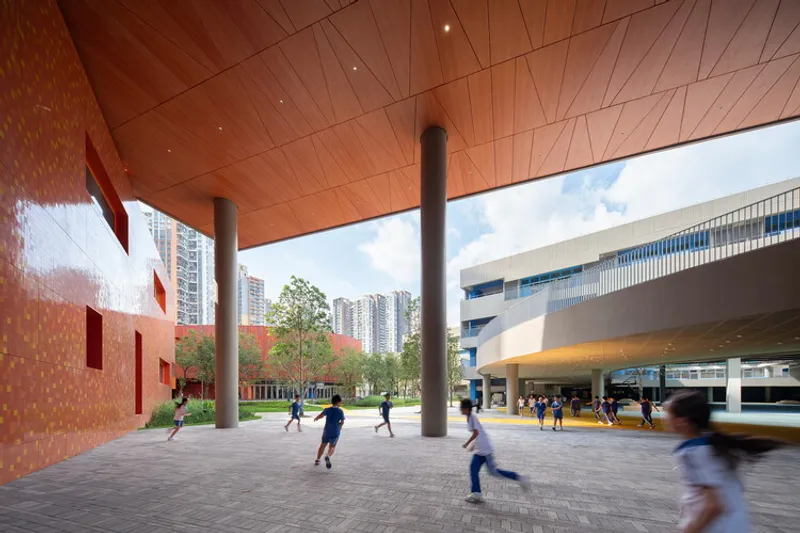
A New Educational Model: “School Units + Corridor Clusters”
URBANUS breaks away from traditional monolithic school blocks by dividing the campus into independent learning units, each tailored to a specific age group. These units are interconnected by multi-level corridors, echoing the circulation of ancient walled settlements.
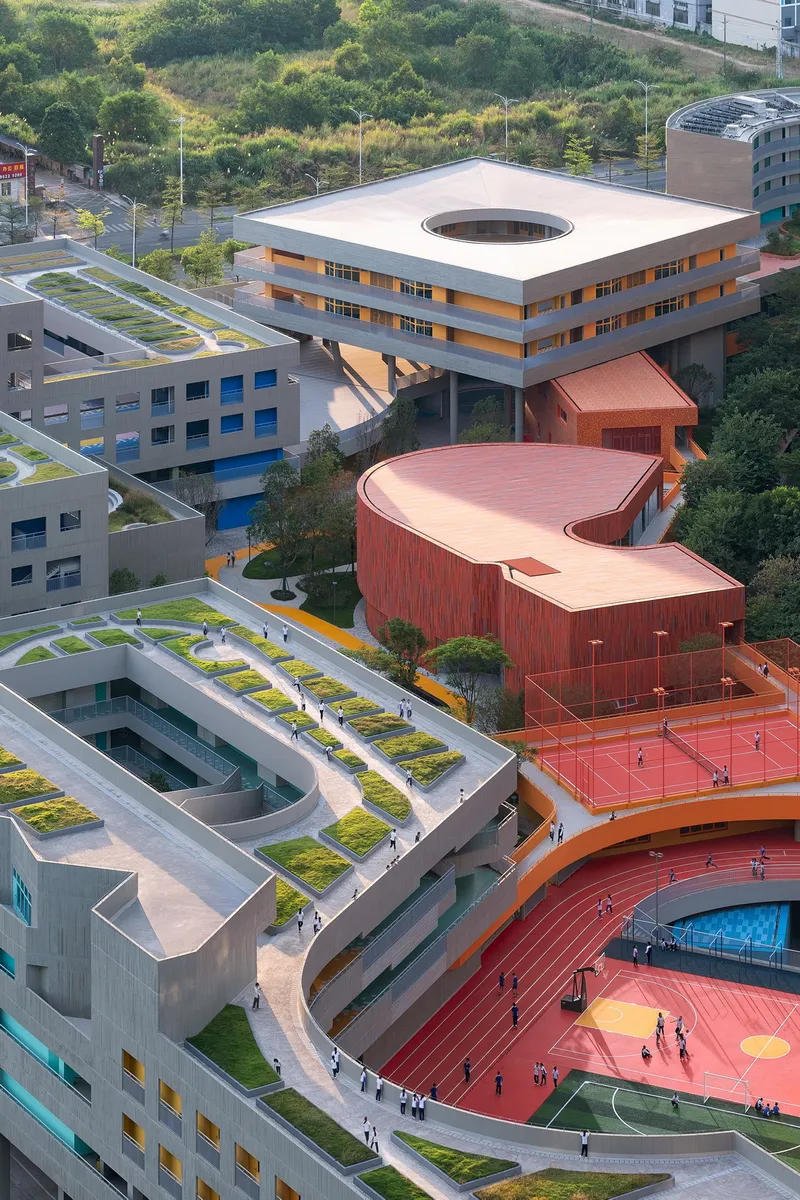
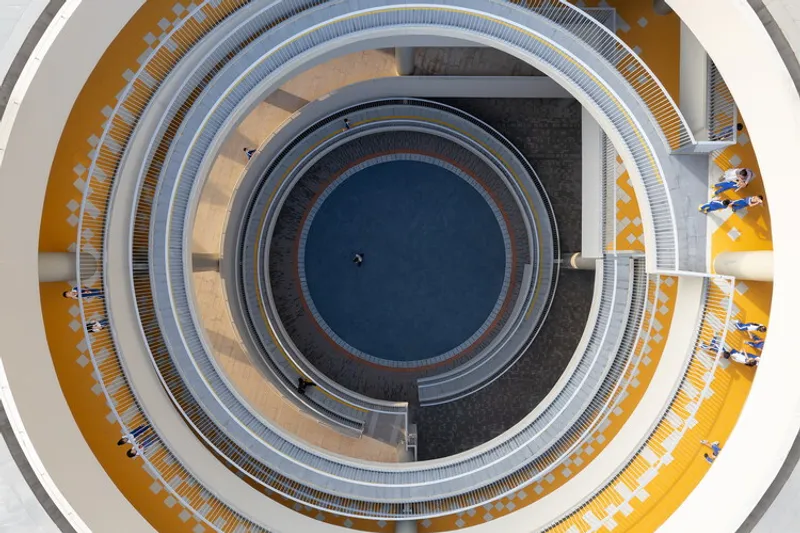
• Lower Grades: Playful Movement + Exploration
Circular ramps, child-friendly passages, and interactive thresholds encourage curiosity and discovery.
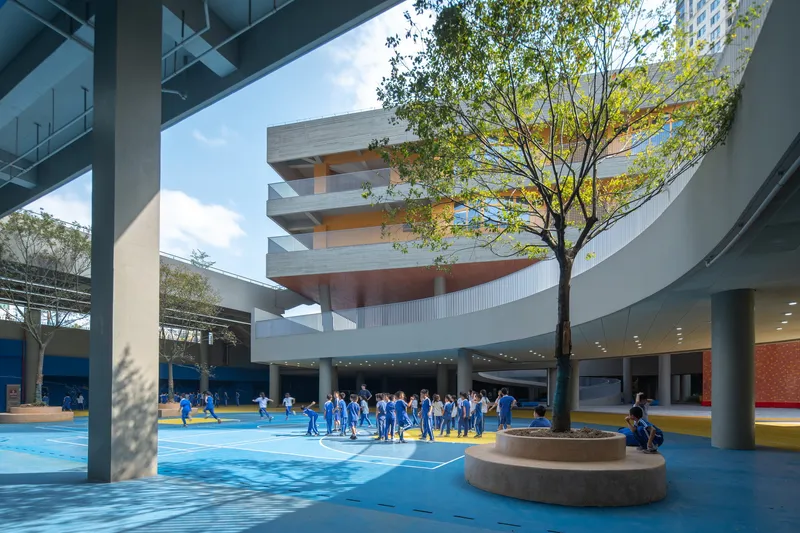
• Middle Grades: Energetic, Open Play Areas
Large, colorful courts support sports, social interaction, movement, and growth.
• Upper Grades: Quiet Gardens for Reflection
Shaded walkways, pocket courtyards, and green terraces foster focus and balanced academic life.
This layered spatial experience creates a campus that evolves with the student—both physically and emotionally.
Architecture as Cultural and Urban Activation
Weilong School is more than a place to study—it is a public, cultural, and ecological landmark. It creates:
- A continuous urban edge with public-facing spaces
- Courtyards that echo traditional Hakka typologies
- A pedestrian-friendly campus that invites community engagement
- A vibrant learning environment infused with local identity
The design shows how architecture rooted in cultural typology can shape a stronger, more connected, and more meaningful urban life.
All the photographs are works of TAL



Popular Articles
Popular articles from the community


Co-life: Sustainable Architecture for Age-Friendly Community Living
Co-life reimagines sustainable architecture for seniors through courtyards, rammed earth, shared gardens, and spaces designed for belonging.

Riyadh For All: Intergenerational Urban Design for Active Aging in Rabat
Riyadh For All reimagines urban design in Rabat with intergenerational co-living, adaptive courtyards, and Moroccan cultural exchange today.
AL-JANNAH: Sustainable Architecture and Permaculture for Afghan Widows
AL-JANNAH uses sustainable architecture and permaculture to create resilient oasis of housing, learning, work and renewal for Afghan widows.

Co-Life: Senior Housing Design That Reconnects Older Adults With the City
Co-Life reimagines senior housing design through healing gardens, shared streets, workshops, and a sustainable community across generations.

Similar Reads
You might also enjoy these articles


Hodi-Mandai Geram
Project Function: Preservation and revitalization of the Intangible heritage and socio-spatial identity of the Hodi by Housing, Cultural Memory Center, Sacred Grove, landscape, local tourism economy


Olio Towers: A Mid-Rise for Performers That Fuses Housing, Rehearsal, and Stage
Located blocks from Houston's Theater District, this modular tower stacks living units around a central performance atrium.

Oasis: Modular Green Housing Carved into Dhaka's Urban Fabric
A shortlisted Plugin Housing entry reclaims unauthorized settlements in Dhaka with stepped concrete volumes, green roofs, and ventilation-driven design.

Black Hole: A Floating Megastructure for the Post-Physical Era
Emiliano Mazzarotto envisions a spherical, self-scaling arena where e-sports, digital hotels, and holographic stadiums replace traditional public space.

Explore Educational Building Competitions
Discover active competitions in this discipline



Challenge to design public laboratory


Challenge to reimagine the Iron Throne


Photograph architecture without architects


Illustrate the lost glory of Angkor Wat - Render Challenge
Comments (0)
Please login or sign up to add comments
No comments yet. Be the first to comment!