
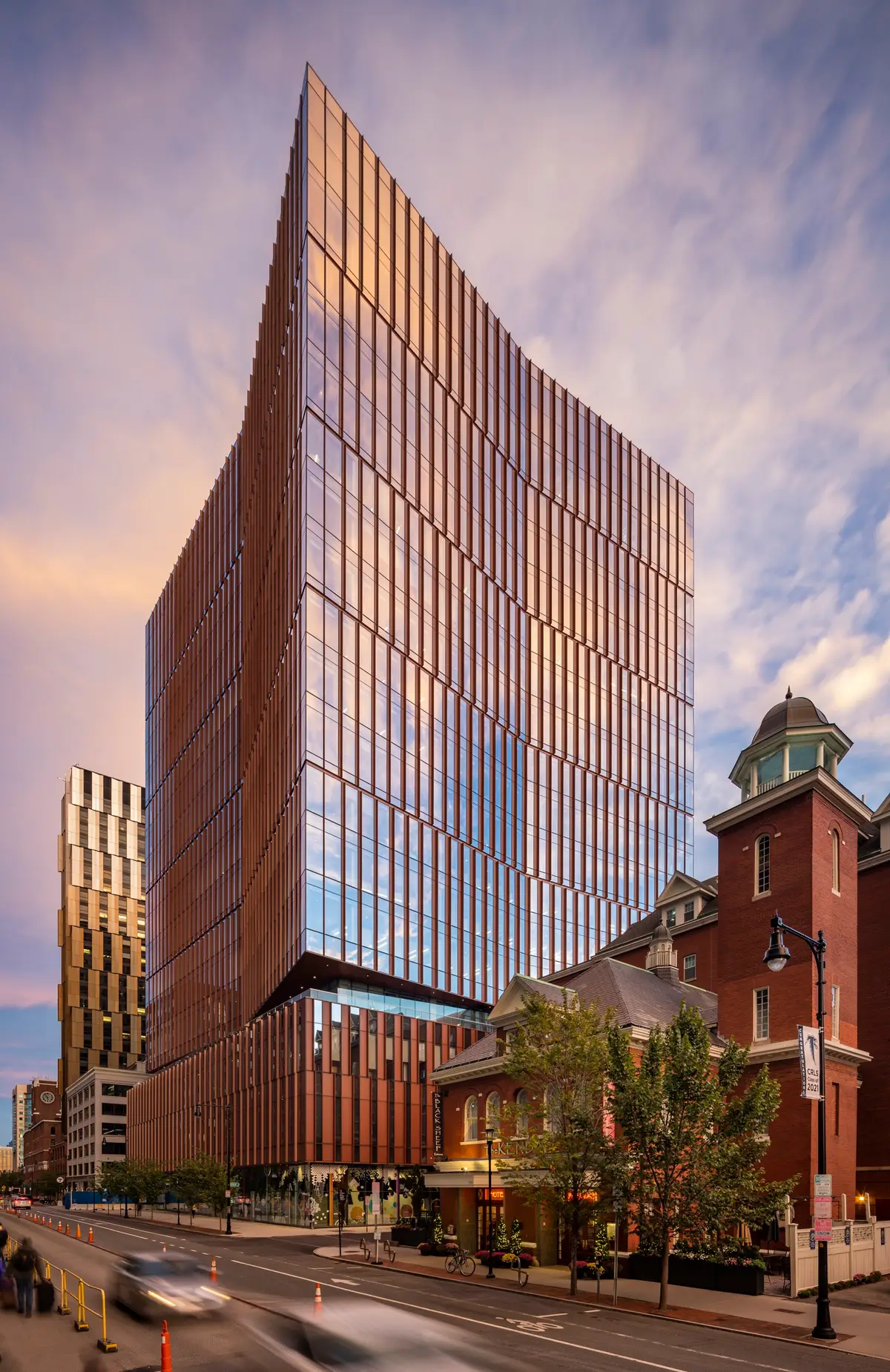
Weiss/Manfredi Gives MIT's Kendall Square a Crystalline Tower Wrapped in Terra-Cotta Fins
A 17-story mixed-use building in Cambridge bridges MIT's campus and the city with a faceted glass-and-aluminum facade.


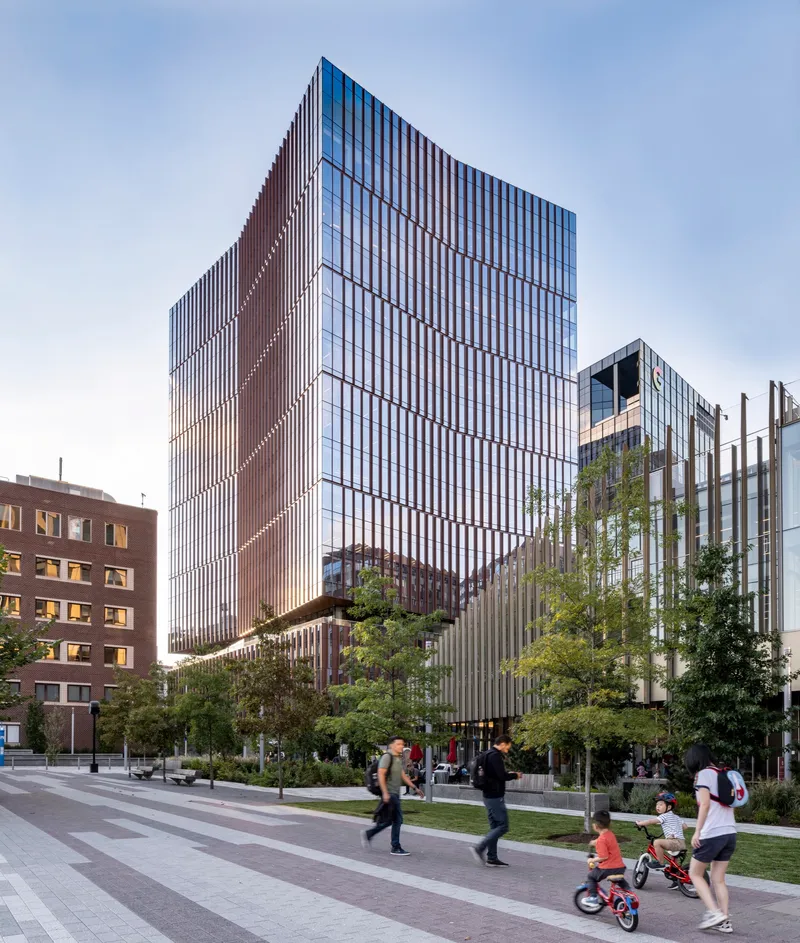
Kendall Square sits at the exact seam where MIT's campus meets the City of Cambridge, a zone that has long resisted a coherent identity. It is a neighborhood of competing scales: low-slung brick warehouses next to glass biotech boxes, subway entrances squeezed between parking structures. Weiss/Manfredi's Site 5 tower does not try to smooth over that tension. Instead, it crystallizes it. The 17-story building rises 85 meters from a four-story plinth that matches the datum of its historic neighbors, then breaks into a faceted volume clad in terra-cotta-colored aluminum fins that shift in hue throughout the day.
What makes this project genuinely interesting is its refusal to separate civic ambition from technical performance. The building houses MIT Press, the MIT Museum, incubator office space, and street-level retail in a single envelope. Its curtain wall is not mere cladding but an active environmental mediator: ceramic frit densities shift floor by floor, aluminum fin depths modulate solar gain, and the whole assembly was unitized off-site and installed in roughly six months. The result is a LEED Gold tower that reads as warm and contextual from the street yet delivers column-free research floors above.
A Plinth That Listens to the Neighborhood
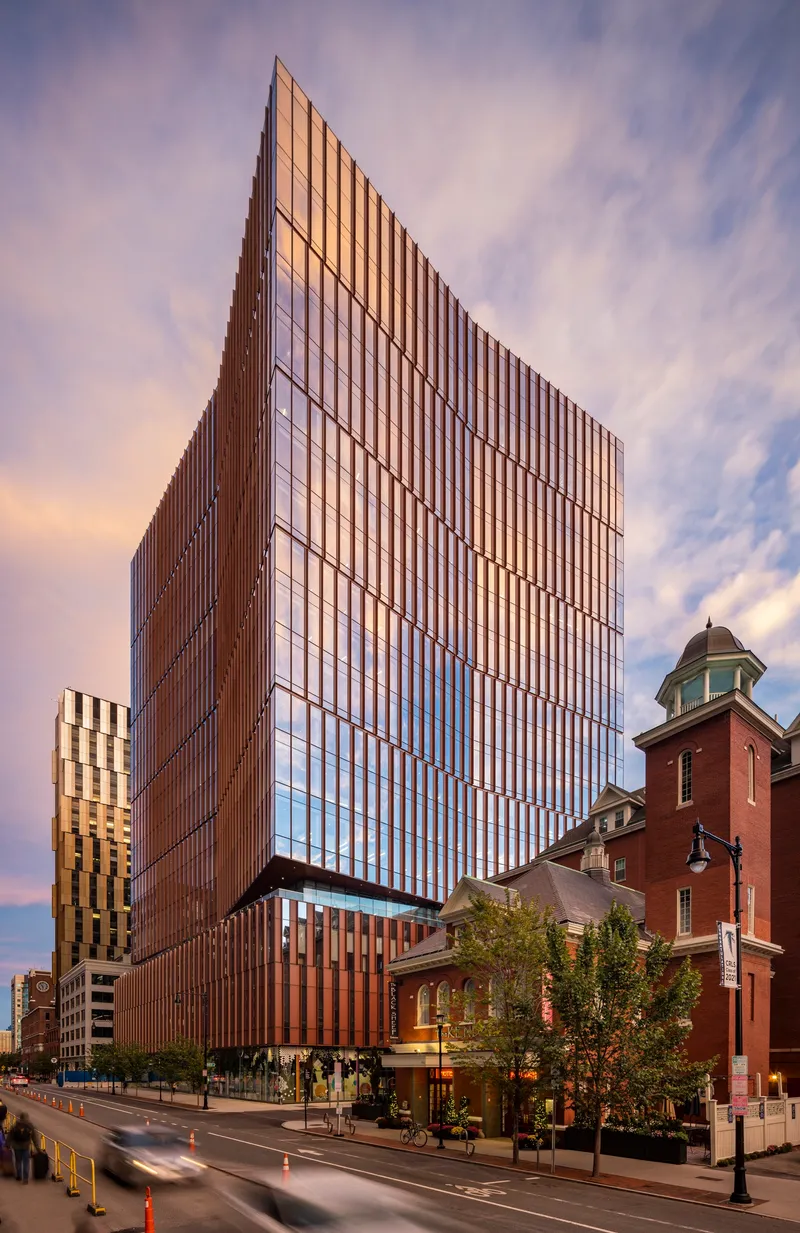
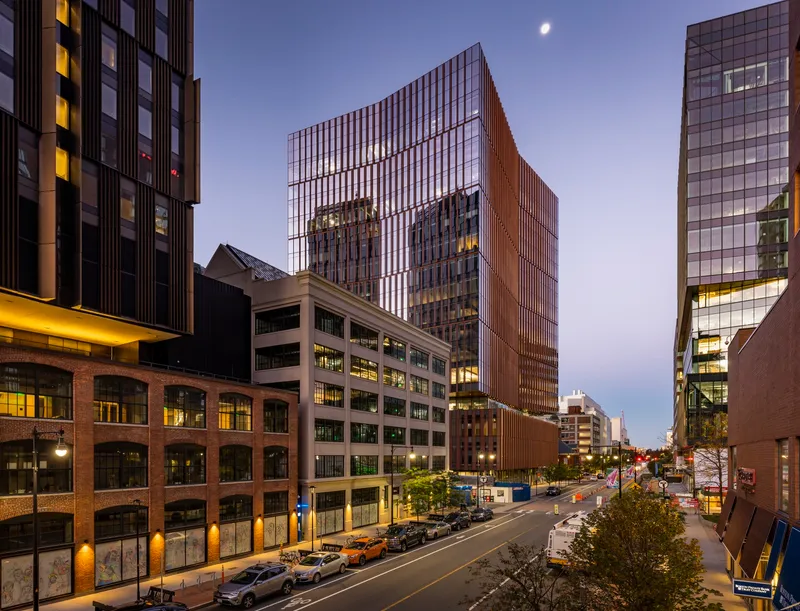
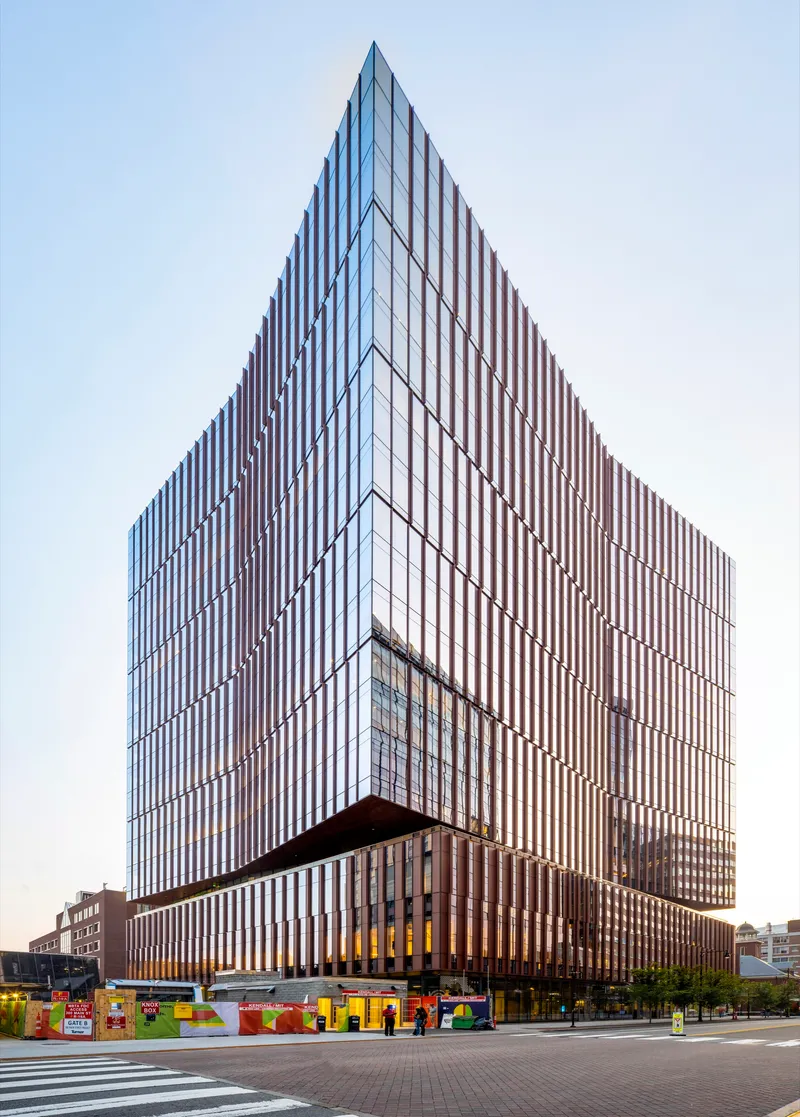
The most disciplined move here is the four-story podium. Rather than planting a glass slab directly on the sidewalk, Weiss/Manfredi set the tower back on a base whose proportions echo the cornice lines and masonry textures of Kendall Square's surviving 19th-century fabric. The dusk view alongside the red-brick building with its cupola makes the dialogue explicit: two eras of Cambridge construction, separated by a century, sharing a street wall without apology.
The cantilevered volume above the plinth creates a bold overhang toward Main Street, marking the building's corner as a gateway. It is a deliberate urban gesture, signaling the threshold between campus and city for pedestrians arriving from the MBTA station. The plinth's fully glazed ground floor erases any ambiguity about public access: you can see the museum lobby, the MIT Press storefront, and the building entrance all at once.
Terra-Cotta Chroma in Aluminum
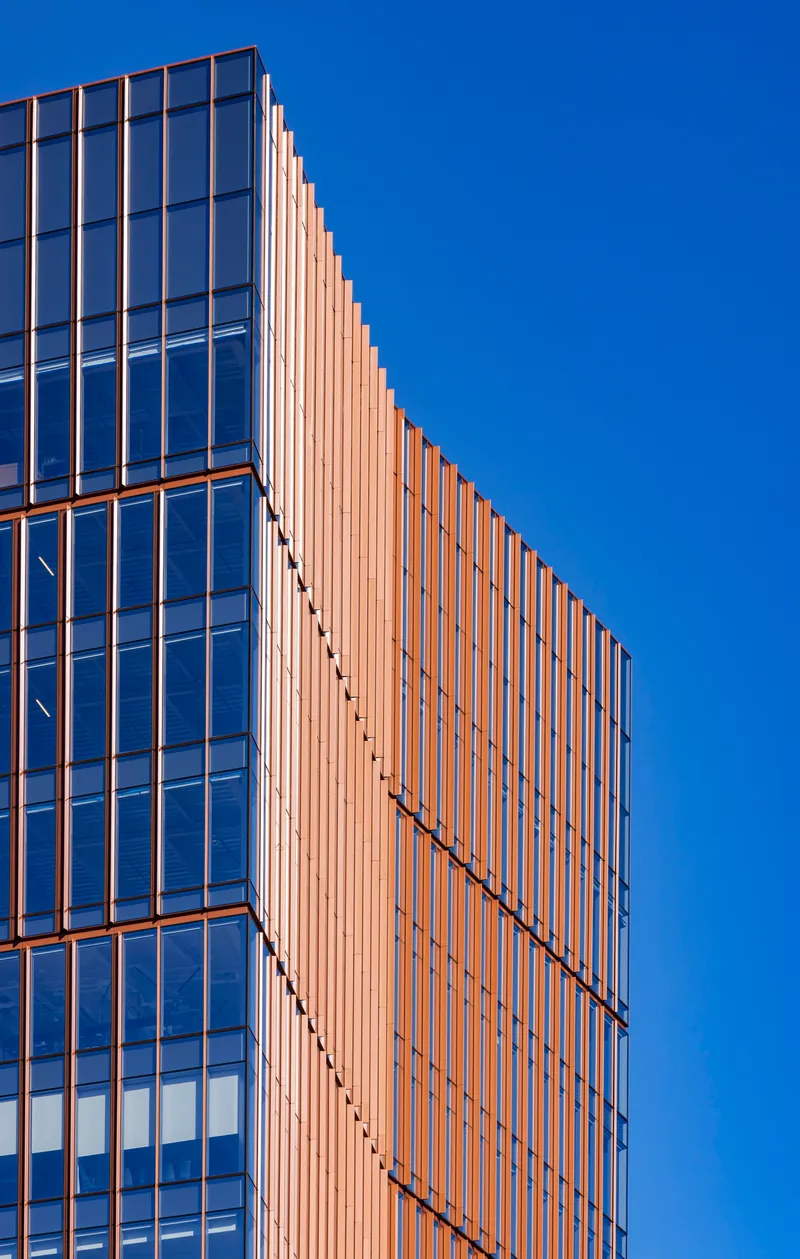
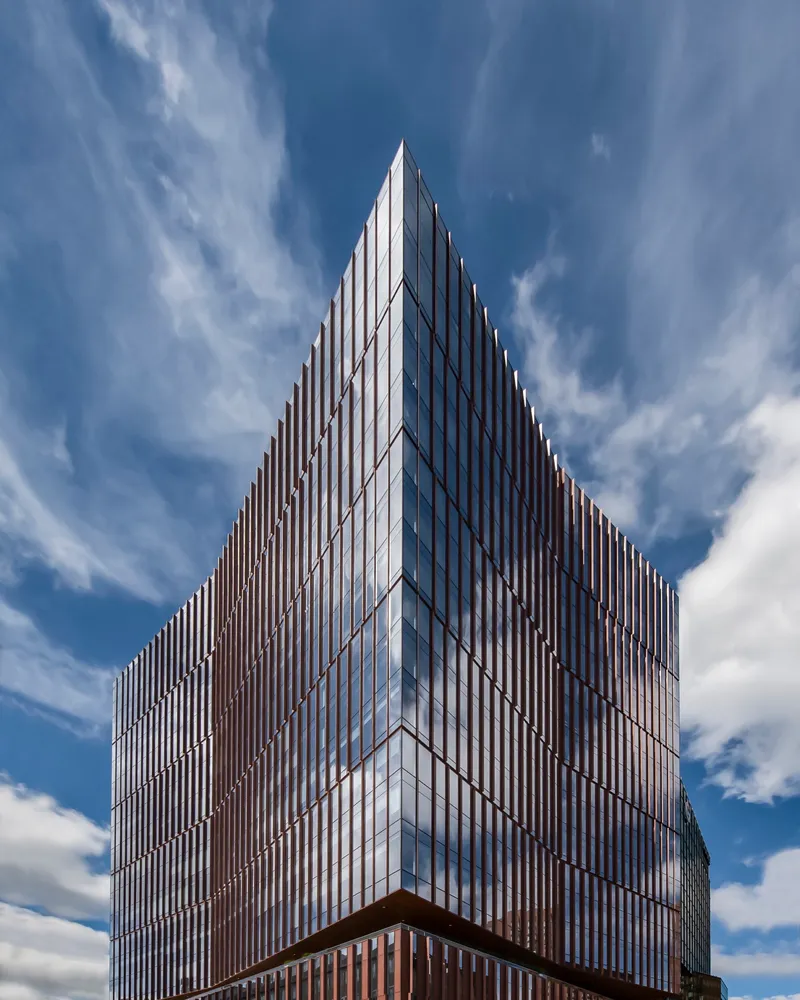
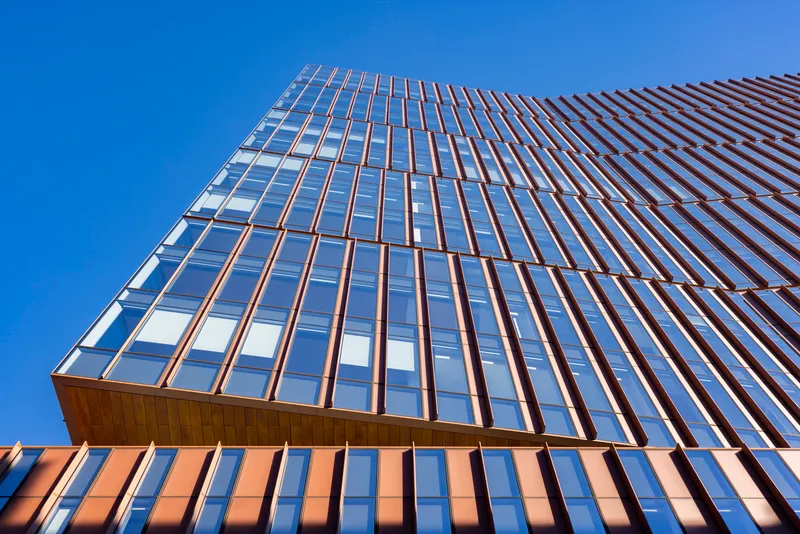
The fin system is the project's signature detail, and it repays close inspection. Each aluminum fin is finished in a terra-cotta tone that ties the tower chromatically to Cambridge's brick tradition without resorting to literal masonry pastiche. The fins are deep enough to produce real shadow lines, which means the facade looks different at 8 AM than at 4 PM. It shifts from warm bronze to a cooler amber depending on the angle of light, giving the tower a temporal quality that flat curtain walls simply cannot achieve.
Technically, the fins double as passive solar shading. Their depth and orientation reduce heat gain on exposed faces while preserving transparency on the upper floors where daylight is most valuable. Combined with thermally broken mullions, low-e coatings, argon-filled insulated glazing units, and opaque shadow-box panels at spandrels, the envelope performs well beyond its appearance. The ceramic frit pattern on the glass itself transitions in density from plinth to tower, mediating the visual weight of the facade as it climbs.
The Curtain Wall Up Close
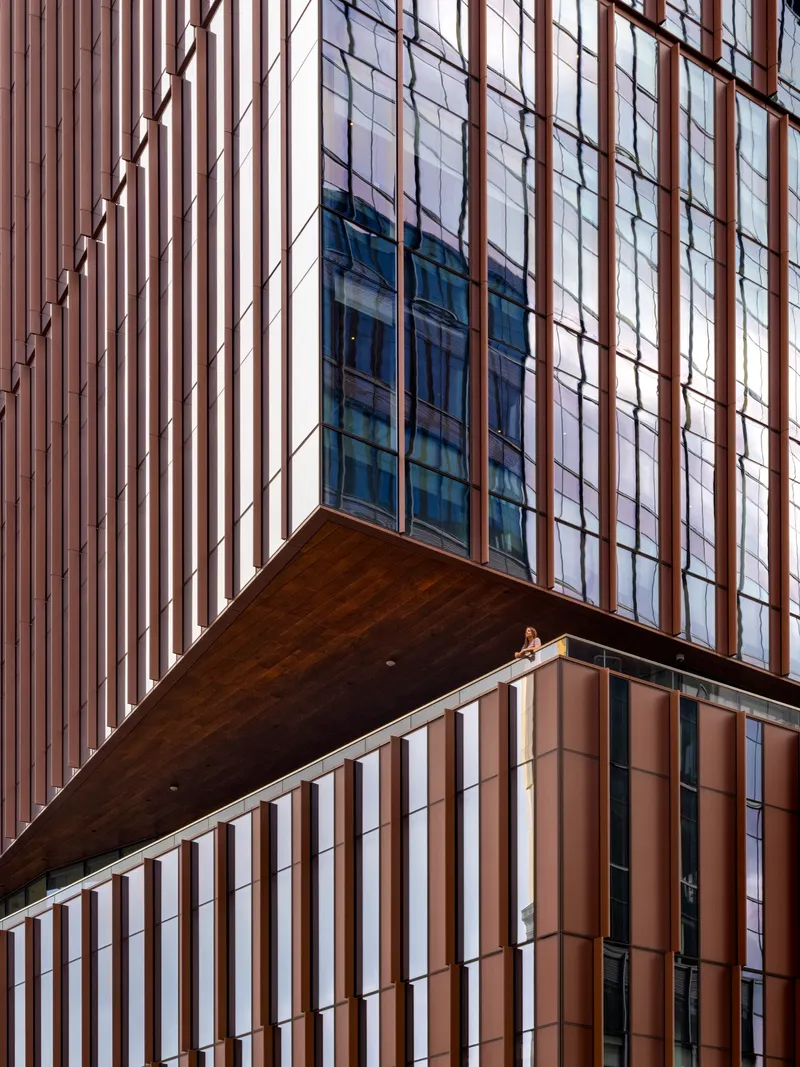
Zooming in on the junction between plinth and tower reveals the care taken in the transition. The timber-clad lower floors give way to bronze fins and acid-etched, color-integral glass above. The curtain wall is organized into seven standard panel types, each roughly five feet wide, which allowed for unitized fabrication and rapid installation. Multiple crews worked simultaneously, and the entire envelope went up in approximately six months, a timeline made possible by bidding the curtain wall and steel packages months ahead of typical schedules.
The result is a level of consistency that hand-assembled facades rarely achieve. Joints are tight, fin alignments are precise, and the overall reading is of a single crystalline volume rather than a patchwork of panels. It is a good reminder that speed and quality are not inherently opposed when the detailing is resolved early and the fabrication is off-site.
Lobby as Threshold
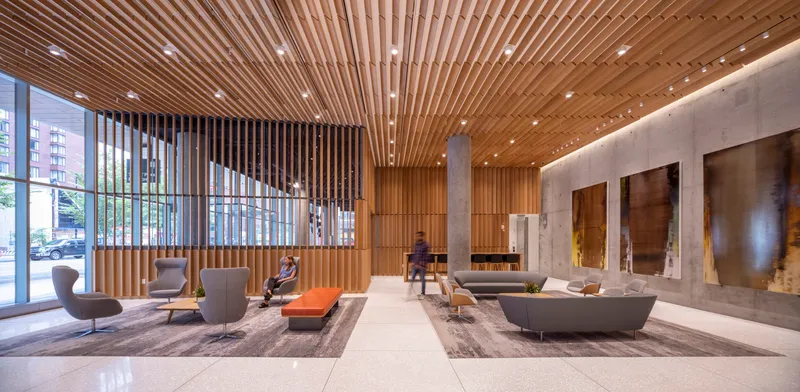
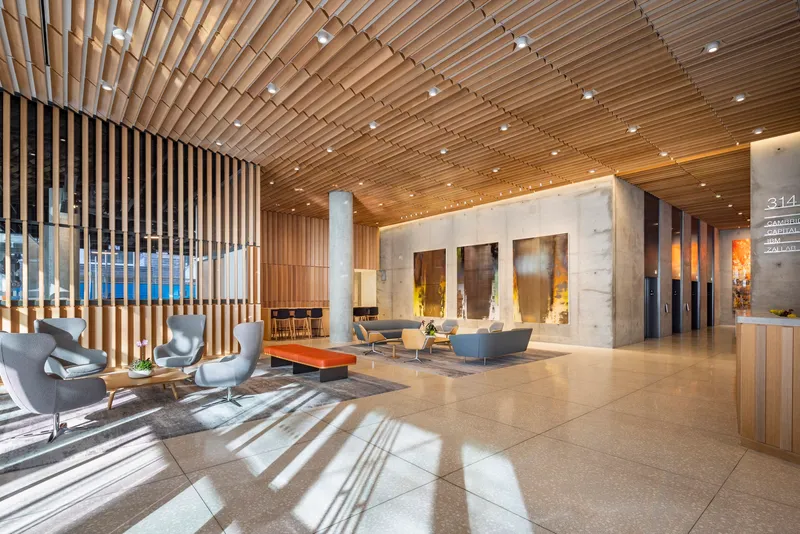
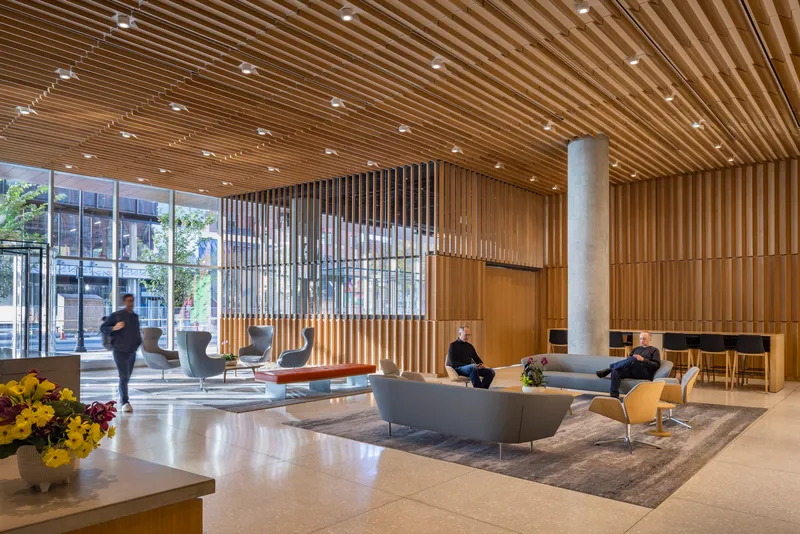
The double-height lobby is where the building's public ambitions land. Slatted timber ceilings run continuously over concrete walls and polished stone floors, creating a warm, acoustically forgiving space that feels more like a university commons than a corporate reception. The material palette is restrained: exposed concrete, marble, and timber slats. No feature walls, no signature art installations competing for attention.
A vertical timber screen divides the lounge seating from the glazed street entrance, filtering light and providing a degree of visual privacy without blocking sightlines. Sunlight patterns from the fins outside play across the polished floor in the afternoon, linking interior and exterior into a single experience. The lobby serves three distinct programs: the office tower, MIT Press, and the MIT Museum. That it reads as unified rather than fragmented is a credit to Weiss/Manfredi's spatial organization of the plinth levels.
Campus and City from a Distance
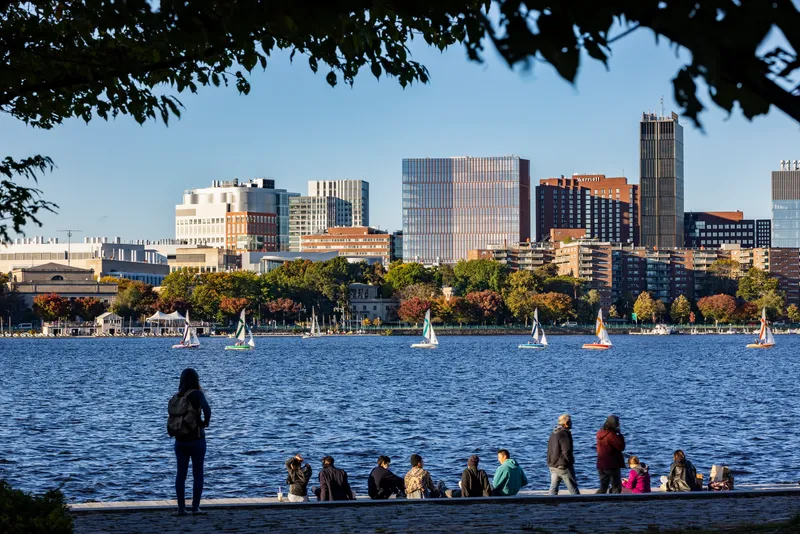
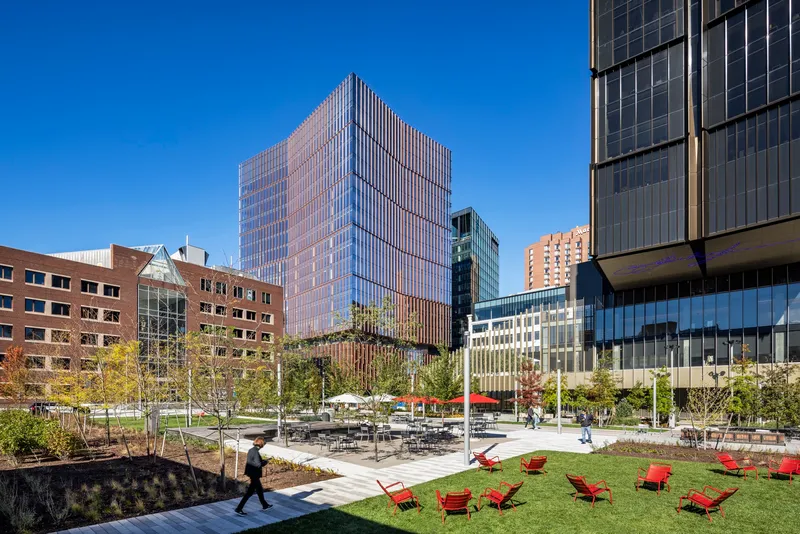
From across the Charles River, Site 5 registers as a warm vertical accent in an otherwise cool-toned skyline. Its terra-cotta hue distinguishes it immediately from the glass-and-steel research buildings that dominate the Cambridge waterfront. The tower is not the tallest thing on the horizon, but its color and faceted massing give it a presence that transcends height.
At ground level, the adjacent public plaza designed by Hargreaves Jones extends the building's civic reach. Red lounge chairs on a manicured lawn, families on bicycles, a subway entrance steps away: the site strategy knits Site 5 into the daily life of Kendall Square rather than isolating it behind setbacks and security lobbies. The building's success depends as much on this landscape interface as on its facade.
Plans and Drawings
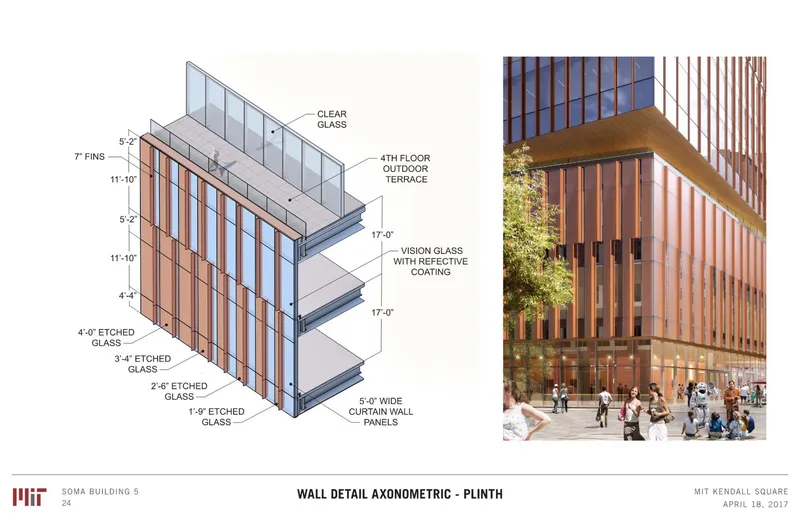
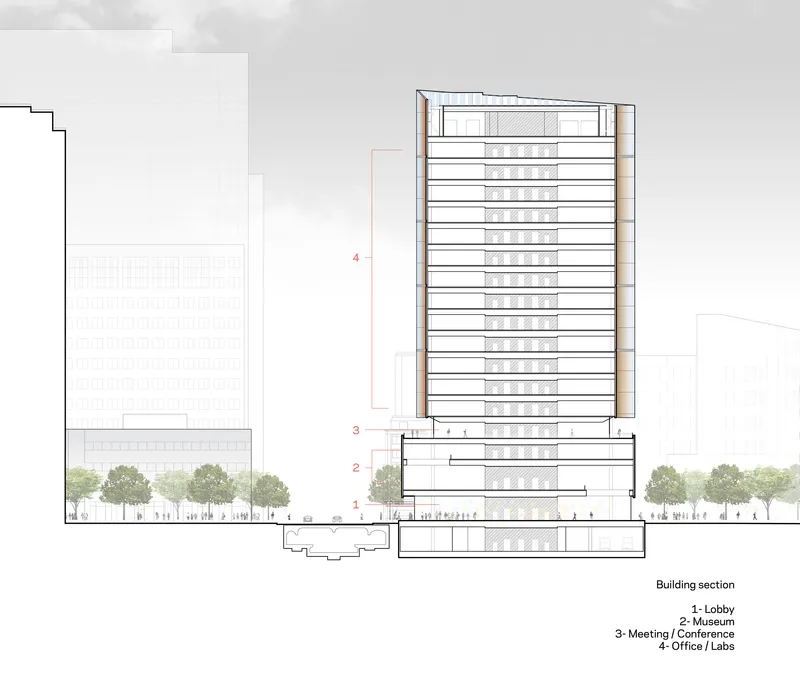
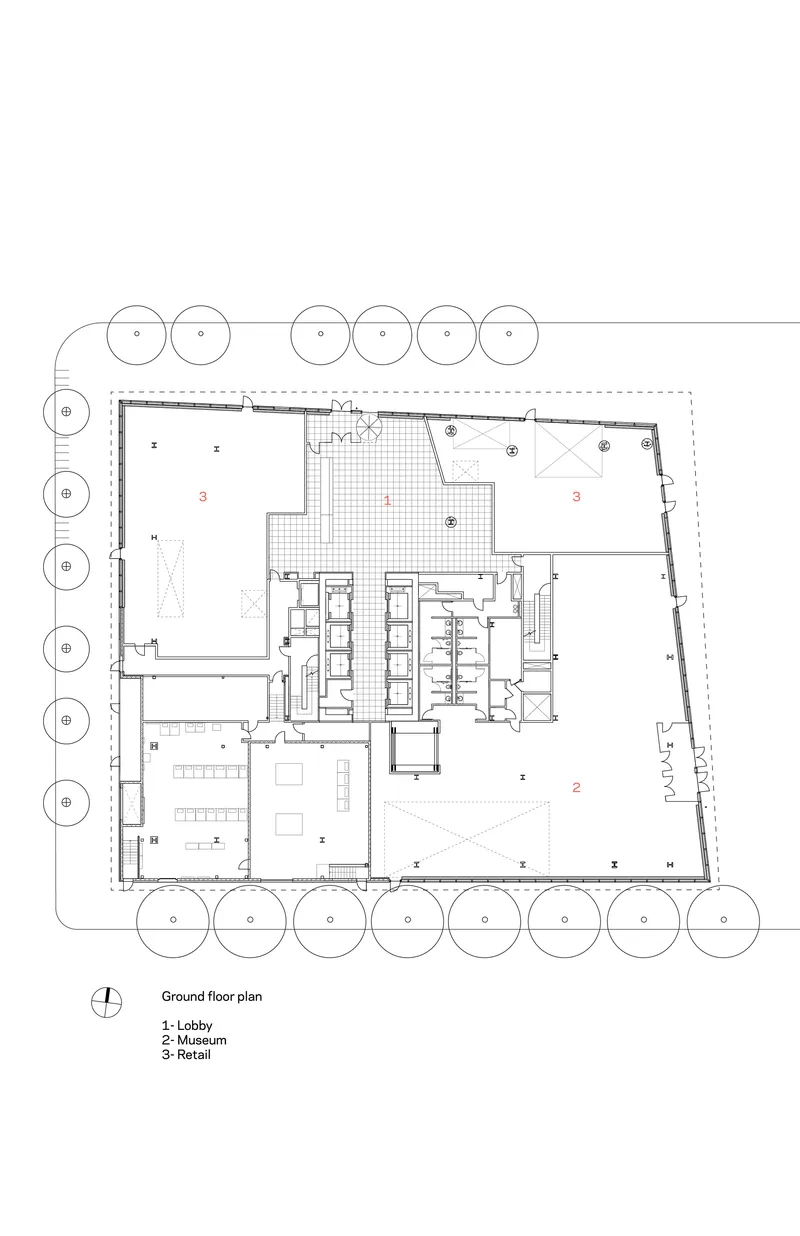
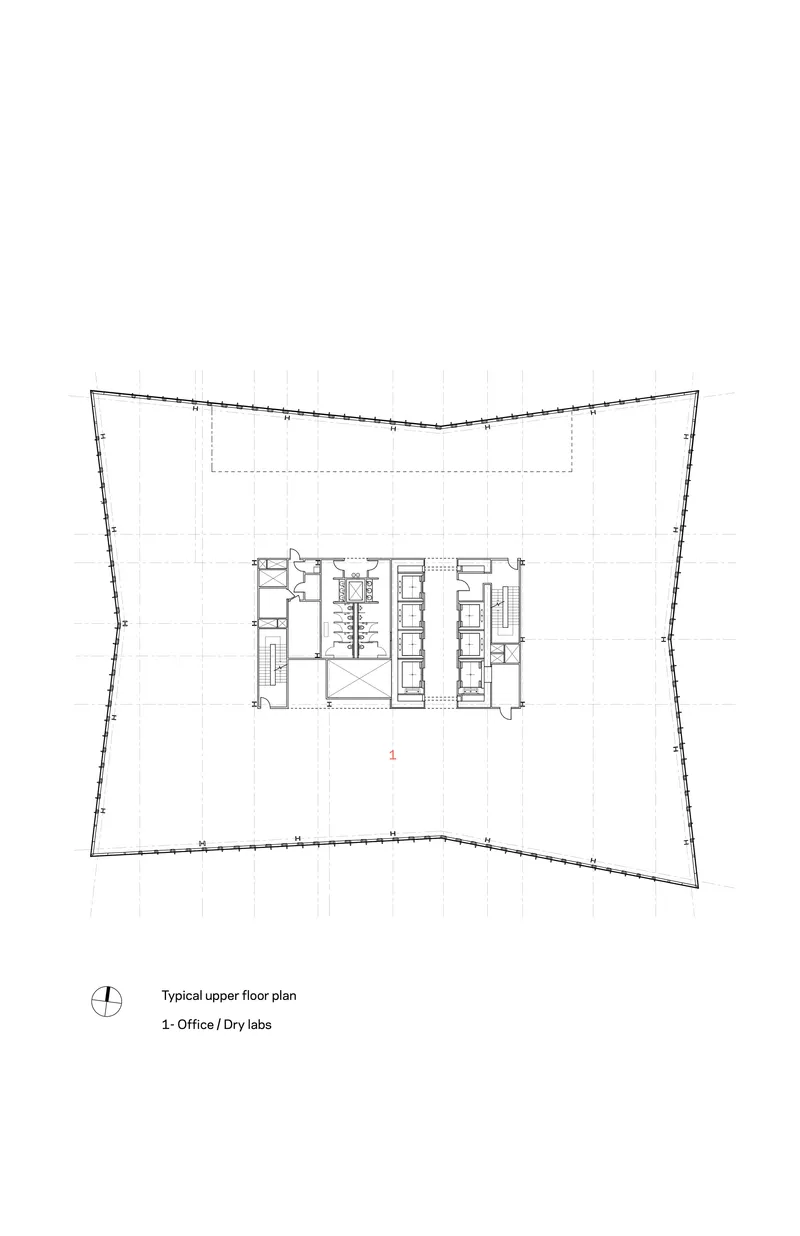
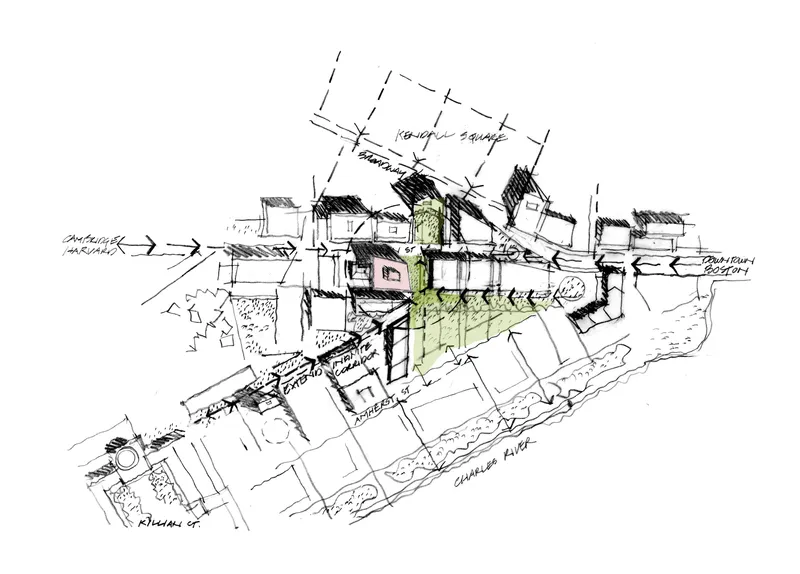
The axonometric drawing of the facade assembly is revealing. It breaks down the layered system of etched glass fins, curtain wall panels, and shadow boxes into a legible diagram that explains how the envelope performs thermally and visually. The section drawing shows the clean break between plinth and tower, with the museum occupying three lower floors and column-free office plates stacking above.
The ground floor plan illustrates the building's civic porosity. The museum and lobby share the footprint, with perimeter trees defining a soft edge between building and plaza. The typical upper floor plan confirms the structural efficiency: a compact central core containing elevators and services frees the entire perimeter for open workspace, exactly what incubator tenants need. The perspective sketch, meanwhile, shows the broader vision for the Kendall Square development, with building volumes clustered around a central green courtyard that gives the district a shared center of gravity.
Why This Project Matters
MIT's Kendall Square development could easily have produced another row of anonymous tech-park towers. Site 5 demonstrates that institutional ambition and urban sensitivity can coexist in a single building. By stacking a museum, a publisher, and research space into one envelope, and by calibrating that envelope to the color, scale, and rhythm of its context, Weiss/Manfredi created a building that serves multiple publics simultaneously. The plinth works for the pedestrian. The tower works for the researcher. The fins work for both.
The project also makes a strong case for treating the curtain wall as a design instrument rather than a commodity product. The seven-panel-type system, the shifting ceramic frit, the deep aluminum fins: these are not decorative gestures. They are integrated responses to solar orientation, fabrication logistics, and chromatic context. In a market saturated with flat glass towers, Site 5 proves that performance-driven envelope design can produce a building with genuine character, one that changes with the light and rewards a second look.
MIT Kendall Square Site 5, designed by Weiss/Manfredi, Cambridge, United States. 458 m² (reported), completed 2019. Photography by Albert Večerka/Esto.
About the Studio
Share Your Own Work on uni.xyz
If projects like this are the kind of work you want to make, uni.xyz is a place to publish your own, find collaborators, and enter design competitions.


Popular Articles
Popular articles from the community


Cube Design Draws an Ecological Corridor Between Two Shenzhen Hills with the Nankai Building
Beside Shenzhen's container docks, the Nankai Building pairs stacked balconies with a climbing green screen to connect two hillsides across its height.

U.GA Architects Wraps an Oval Rooftop Pool in Curved Board-Formed Concrete on Busan's Jeollidan-gil
In Busan's Jeonpo-dong, a 454 m² mixed-use block stacks a neighborhood facility, guest rooms and an oval rooftop pool inside spiraling concrete walls.

longwave studio Reorganizes a 112 m² Tainan Apartment Around the Daily Routines of a Family and Two Cats
In Tainan, Taiwan, birch plywood, rust-red furniture and a freestanding plaster wall link arrival, storage, work and family life in one apartment.

Jaramillo Van Sluys Arquitectura and Urbanismo Turn a Demolished Registry Lot in Quito into an Orchard Plaza
In Quito's Centro Histórico, a 2,800 m² plaza exposes the San Agustín convent wall and redraws its lost Augustinian orchard in volcanic stone.

Similar Reads
You might also enjoy these articles


LAVA Architecten Gives Vocational Education a Sawtooth-Roofed Face on a Mechelen School Campus
In Mechelen, Belgium, a 2,053 m² STEM school on a 6×6 m grid turns workshops and classrooms into rooms that can be rearranged as teaching changes.

KEMA Studio Turns a Derelict Marvila Attic into a 60 m² Lighthouse Apartment Above Lisbon
In Lisbon's Marvila district, a rebuilt roof, four skylights and two plywood volumes turn an unlivable attic into a bright home facing the Tagus.

Pixel Gardens: One Repeated Module Stacked Into a Terraced Social Housing Tower for Famagusta
Salem Bader's shortlisted housing tower builds a vertical neighbourhood from one repeated module, offsetting units to carve terraces, light and air.

Bao Huynh Watercolor Atelier: A Serene Art Retreat in Hội An
Bao Huynh Watercolor Atelier in Hội An blends multifunctional art spaces, sustainable design, local materials, and family-friendly living in a serene environment.

Comments (0)
Please login or sign up to add comments
No comments yet. Be the first to comment!