
Wespi de Meuron Romeo Carve a Concrete Fortress into the Hills Above Lake Maggiore
A three-level family house in Gambarogno, Switzerland, disguises itself as a single-story archaic rock on a sloping lakeside plot.


From the street, the House in San Nazzaro looks like a low, closed volume of rough stone, barely a single story. That reading is deliberate and entirely misleading. Behind the aggregate concrete walls, Wespi de Meuron Romeo architects have buried three full levels into the hillside above Lake Maggiore, threading a family home for four through courtyards, skylights, and carefully punched openings that turn a defensive perimeter into something luminous and habitable.
What makes the project genuinely interesting is the tension between its irregular, almost geological outer form and the crisp rectangular living spaces it conceals inside. The pentagonal footprint is not a formal gesture; it is a direct tracing of the plot boundary. The architects accepted the constraint and turned it into a design principle, using the leftover space between the angled perimeter walls and the rational interior volume to carve out private courtyards on both the valley and mountain sides. You enter at the top and descend, which inverts the typical hillside section and keeps the street facade mute while opening the house toward light and landscape below.
An Archaic Presence on a Steep Street
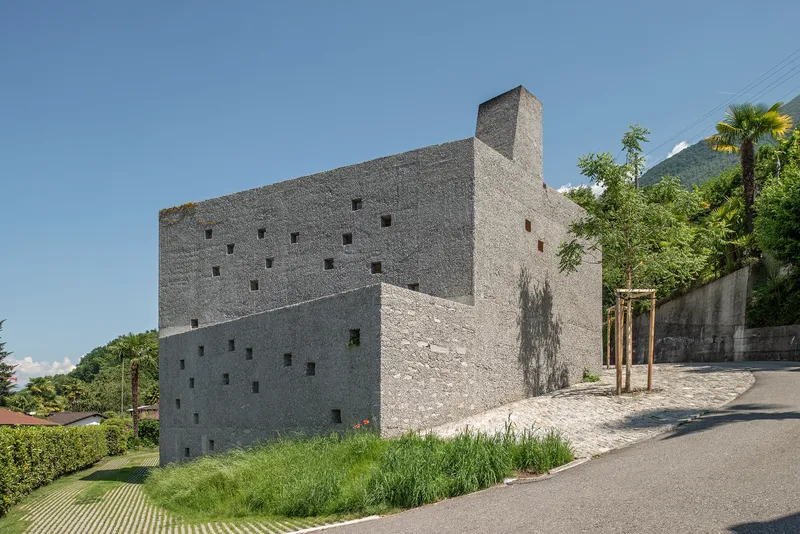

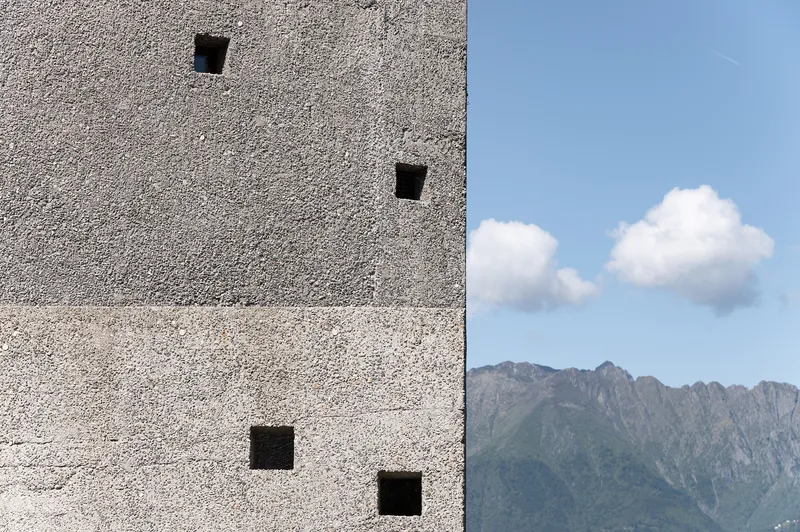
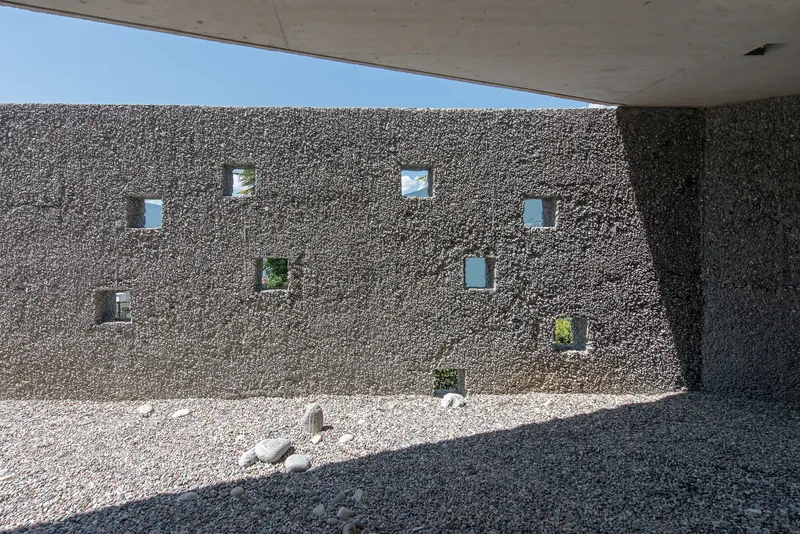
The exterior reads as monolithic, a rough-washed concrete mass punctuated by small square windows of varying size scattered across its faces. The placement of these openings looks almost random, more like erosion patterns in stone than an architectural composition, and that is precisely the point. The building is meant to weather and darken over time, with climbing plants eventually colonizing the facades, reinforcing the idea of a geological object rather than a constructed one.
The chimney tower, clad in oxidized steel panels, rises above the roofline as the only element that departs from the aggregate concrete palette. It signals the fireplace inside and gives the silhouette an almost fortified character, a watchtower surveying the lake below. Against the backdrop of palm trees and the mountain range beyond Gambarogno, the house sits confidently as a thing that has always been there.
Crossing the Threshold
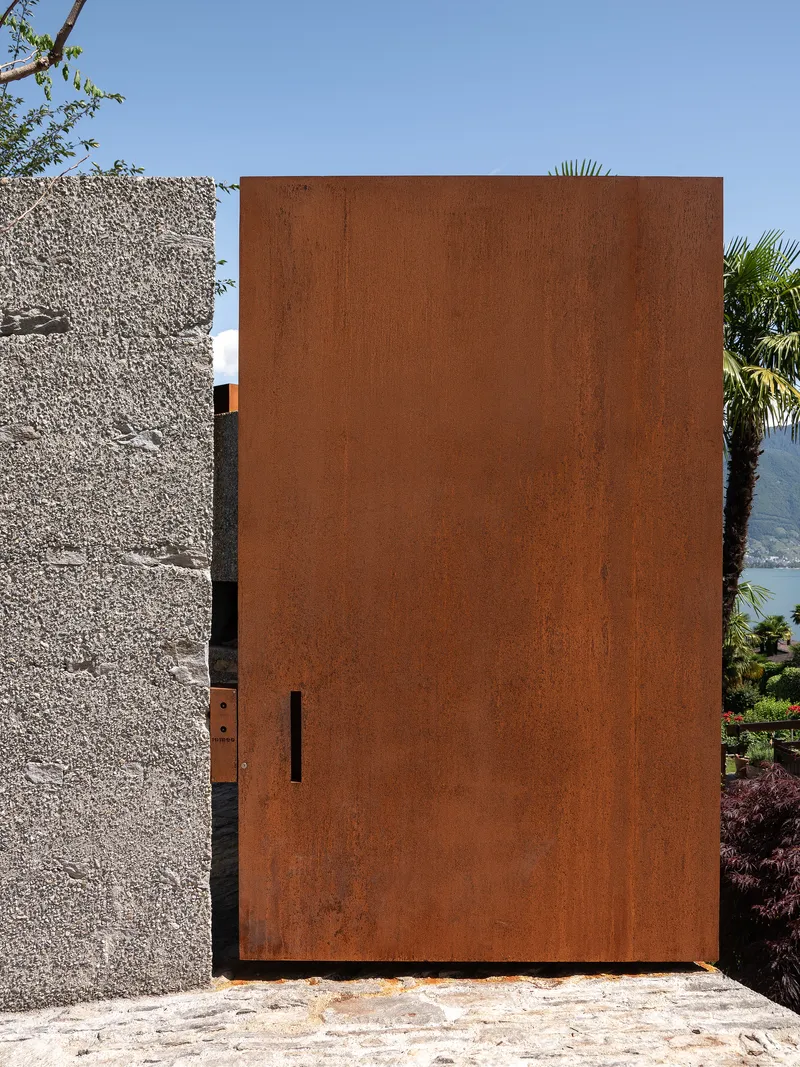


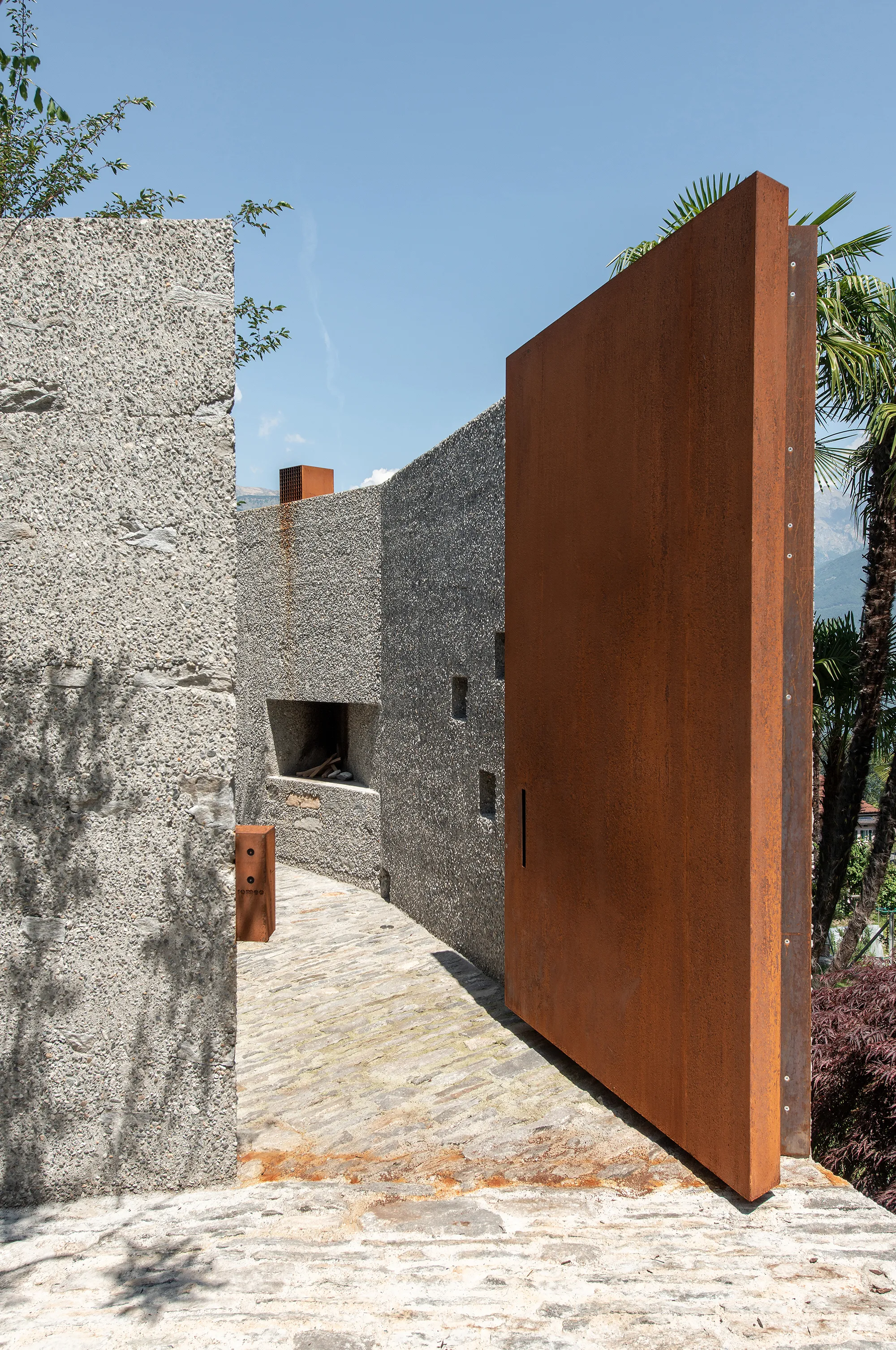
Entry is orchestrated as a sequence rather than a moment. A full-height floating gate in oxidized steel, its surface contrasting sharply with the heavy stone walls flanking it, swings open to reveal a narrow passage between textured concrete surfaces. Overhead, trailing vines filter the light. Underfoot, traditional natural stone paving connects the forecourt to the street, grounding the threshold in a regional material tradition that the architects clearly respect.
The compressed corridor decompresses at the entrance courtyard, where a large glazed wall suddenly reveals the interior. The transition from the fortress-like exterior to a sun-drenched courtyard wrapped in concrete is the project's most cinematic move: you understand, all at once, that the house is not closed at all but organized around light captured between its own walls.
Courtyards as Light Engines
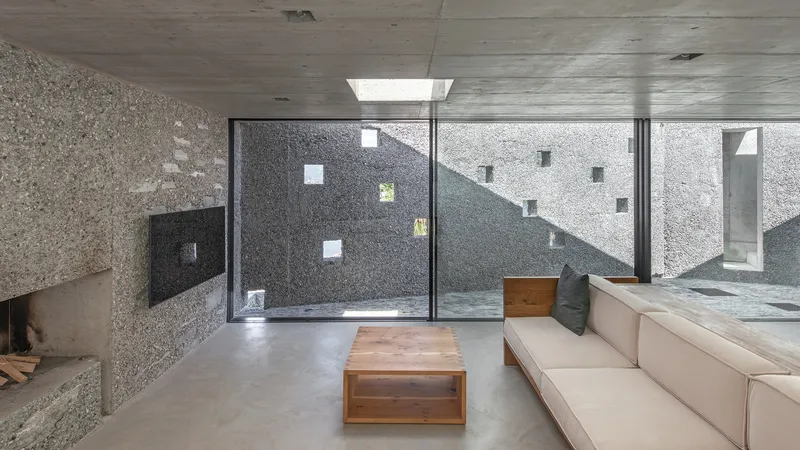
The project's passive lighting strategy depends entirely on the courtyards. The upper floor has two completely closed facades and two fully glazed sides, each facing a different courtyard. On the mountain side, the entrance courtyard captures direct sunlight and channels it into the living and dining spaces. On the valley side, the closed walls of the opposite courtyard act as reflectors, bouncing diffuse light back into the interior. It is a simple mechanism, but it works because the proportions are tight and the concrete surfaces are light enough to amplify rather than absorb.
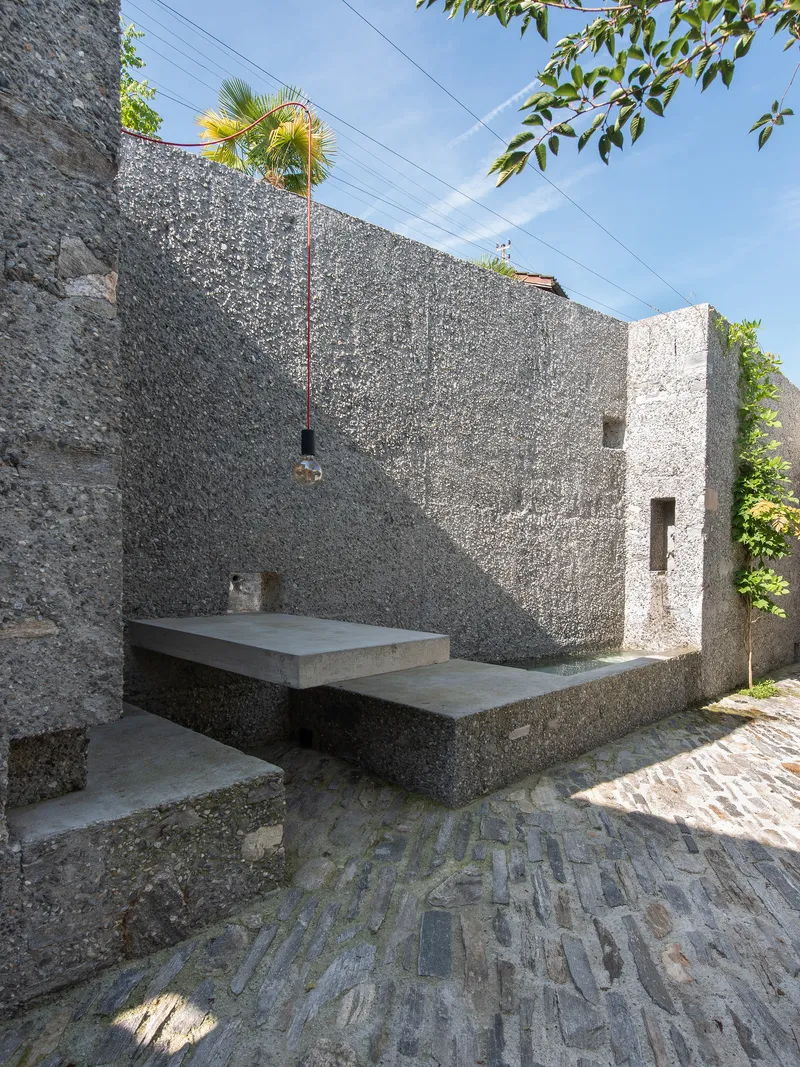
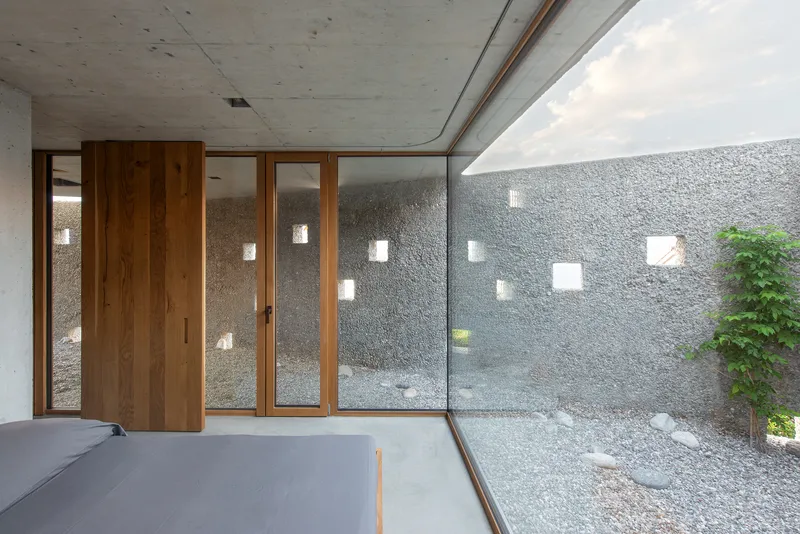
The cantilevered concrete bench in the courtyard, paired with a pendant light beneath palm fronds, suggests the architects intend these outdoor rooms to be occupied as seriously as the indoor ones. The gravel floor courtyard with its scattered square openings operates as a secondary light well for the middle floor below, ensuring that four bedrooms and bathrooms receive natural daylight through carefully positioned windows.
Living at the Top

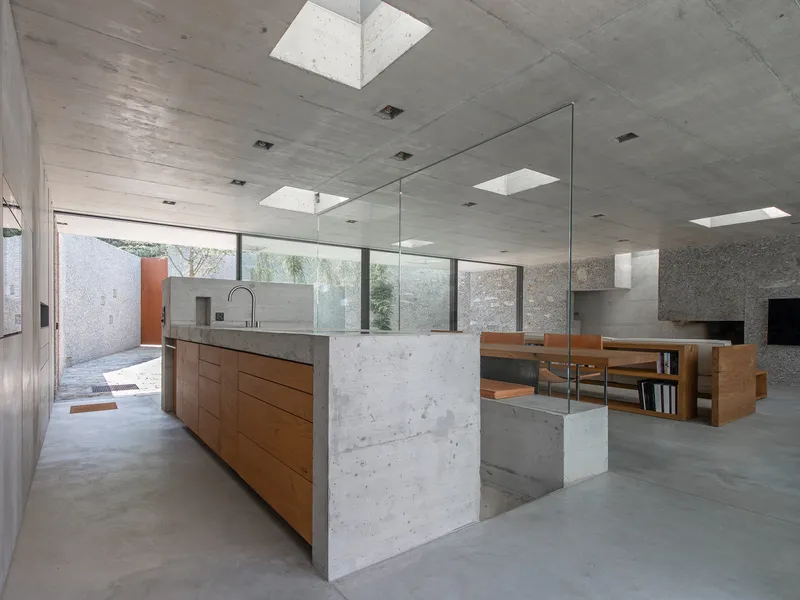
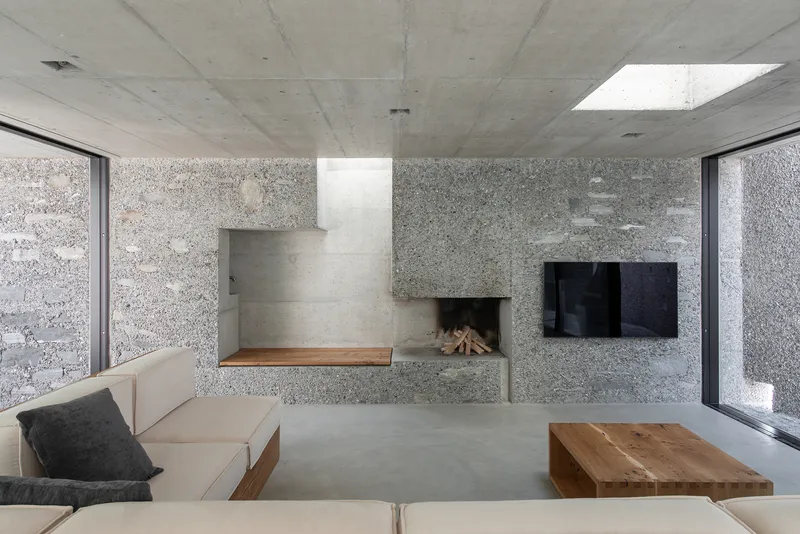
The upper floor contains the communal life of the house: an open kitchen and dining area with a concrete island, a timber table, and skylights that wash the polished concrete floor with shifting light throughout the day. The kitchen island features a concrete waterfall edge with timber cabinetry beneath, a restrained material combination that runs through the entire project. Roof lights overhead do more than illuminate; they convey the changing atmosphere of the sky, connecting the interior to the time of day and weather outside.
The fireplace niche, set into the aggregate concrete wall beneath a skylight, is the room's anchor. A low seating area gathers around it, and the skylight above ensures that even on overcast days the hearth remains the brightest point in the room. It is one of those details that reveals the architects' experience with material and light: the rough concrete catches the overhead illumination and diffuses it across the wall, softening a surface that might otherwise feel oppressive.
Descending Through the Section


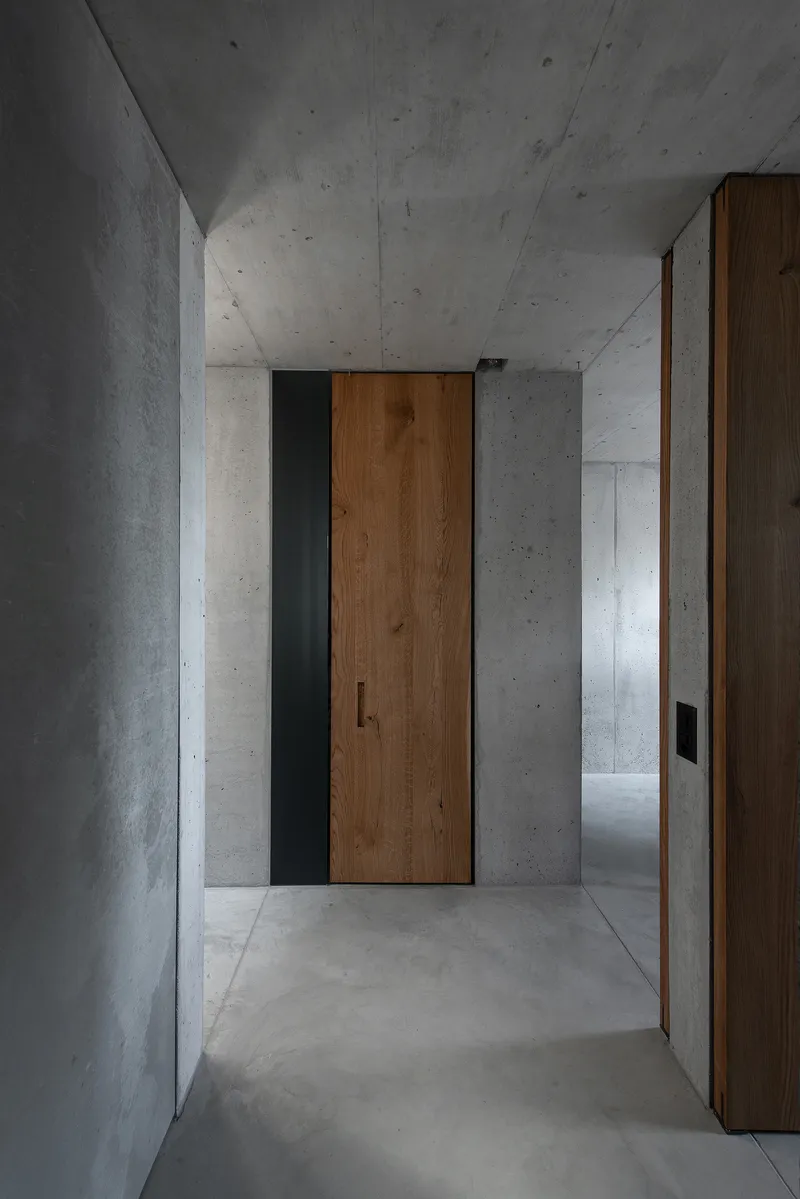
The staircase is board-formed concrete with open risers, a detail that keeps the vertical circulation feeling light despite the heavy material. A clerestory window at the top landing pulls daylight down through the stair shaft, establishing a gradient from bright at the entry level to more sheltered and quiet on the bedroom floor below. The architects understand that a house entered from the top needs to avoid the sensation of descending into a basement, and the clerestory solves that problem neatly.
Corridors on the middle level are narrow, with timber panel walls replacing concrete to signal the shift from public to private. Pivoting timber doors open onto gravel courtyards, giving bedrooms and study spaces direct access to private outdoor areas framed by the perimeter walls. The effect is monastic: each room faces a contained slice of sky and stone.
Material Restraint and Private Rooms
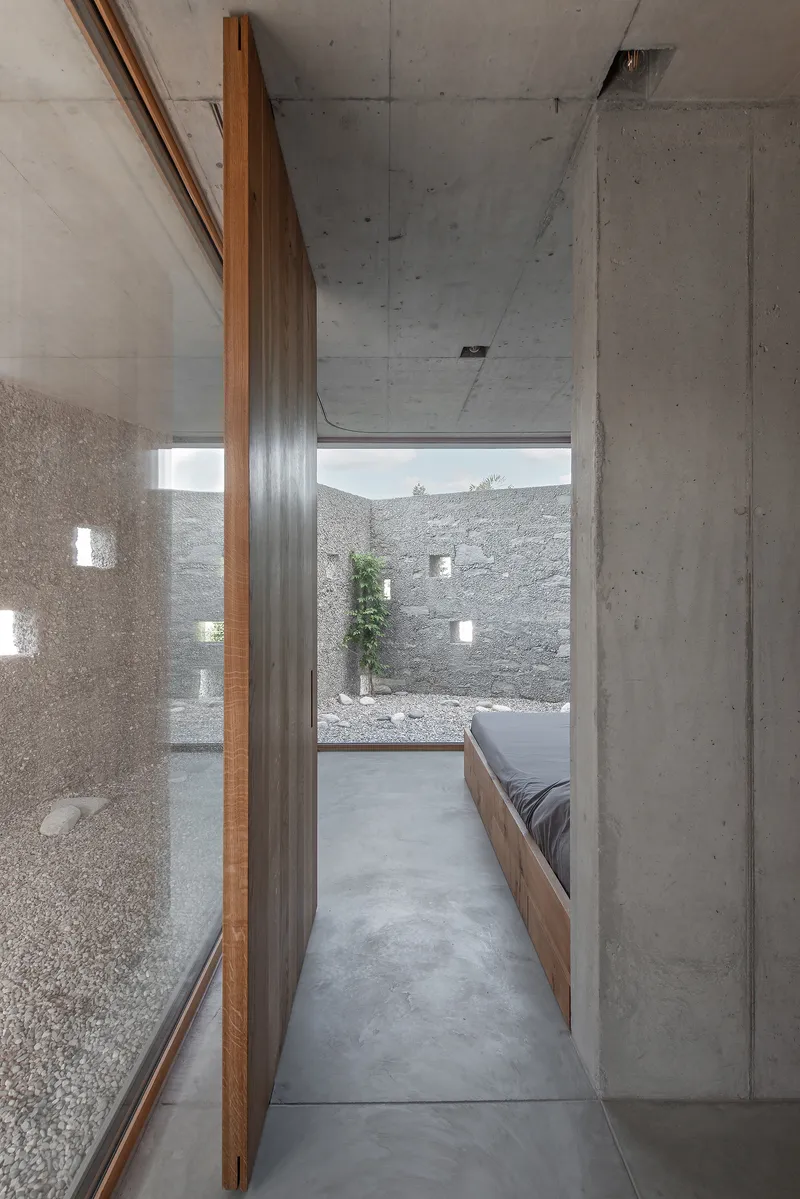

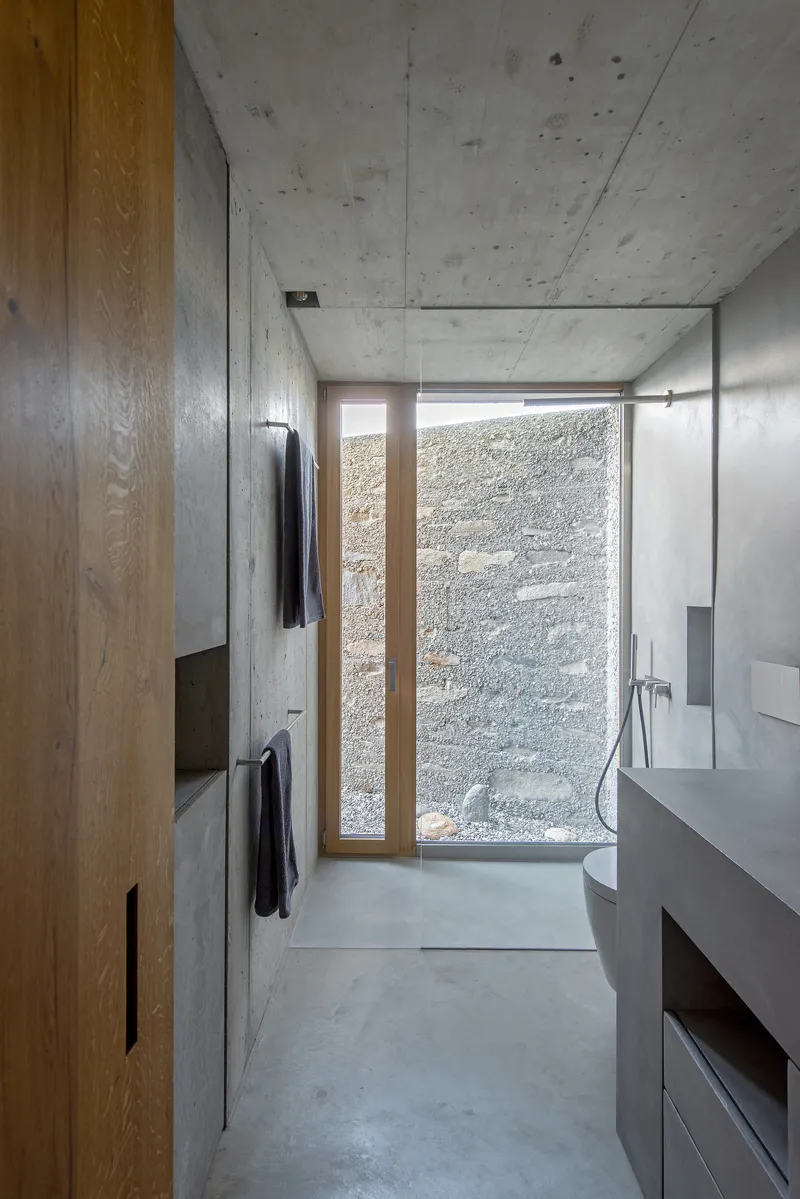
The material palette across the lower floors is deliberately limited: concrete, timber, and gravel. Bathrooms pair concrete walls with timber cabinetry and narrow windows aimed at the textured courtyard walls opposite, so that even the most utilitarian rooms have a composed view. A study space positions a timber desk in front of glazed doors overlooking a planted courtyard, turning what could be a leftover corner into a contemplative workspace.


The bathroom vanity with integrated concrete sinks and wall-mounted faucets beneath wood paneling demonstrates a consistency of detailing that extends from the entrance gate to the smallest fixture. There is no moment where the architects relax their material discipline, which gives the house its sense of inevitability. Each surface has been considered, each junction resolved.
The Street and the Landscape

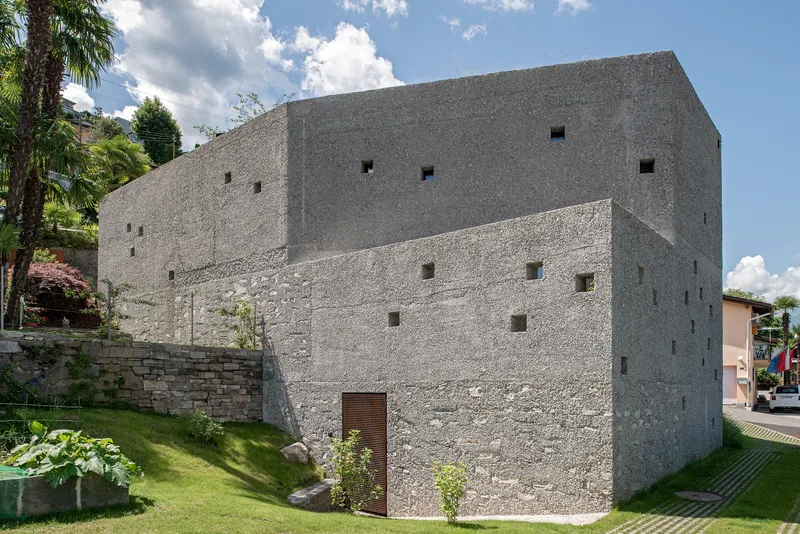

The cobblestone driveway, the newly planted tree, and the 3-meter-wide forecourt establish a modest civic gesture toward the private street. From this vantage, the house reveals almost nothing of its interior life. The two-tone aggregate facade with its scattered square openings and timber door at ground level could belong to a storage building or a retaining wall. That ambiguity is part of the project's charm: it refuses to perform domesticity for passersby.
An external staircase embedded in the thick perimeter wall leads to a small roof terrace, the only point from which the occupants can take in the full panorama of Lake Maggiore and the surrounding mountains. It is a reward earned by climbing, a reversal of the house's prevailing downward movement, and it connects the family to the broader landscape that the rest of the design so carefully frames and filters.
Plans and Drawings


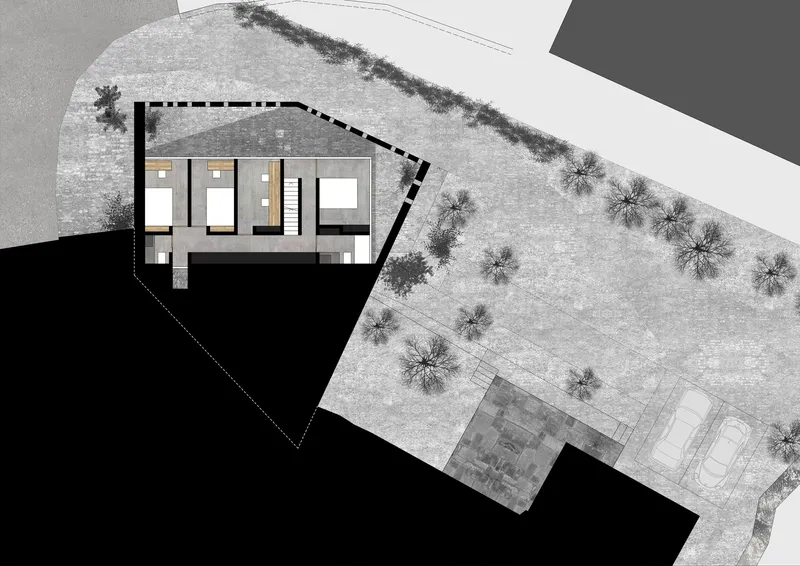
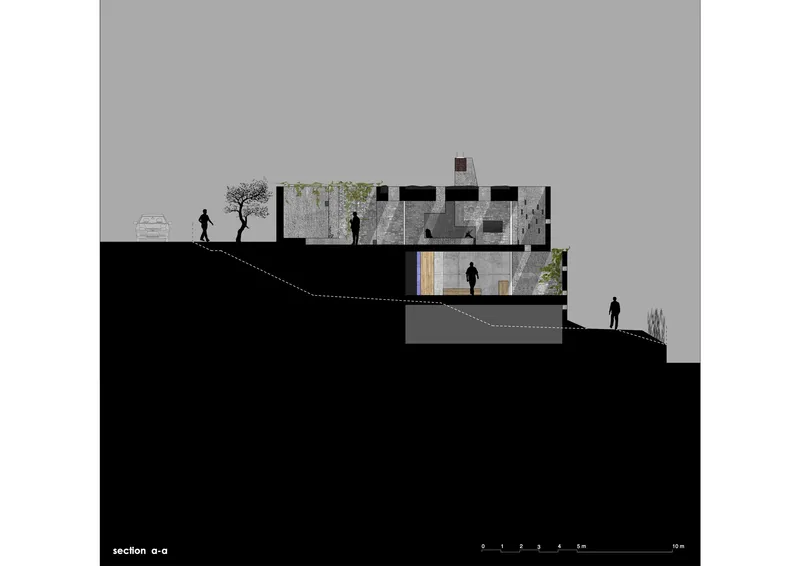


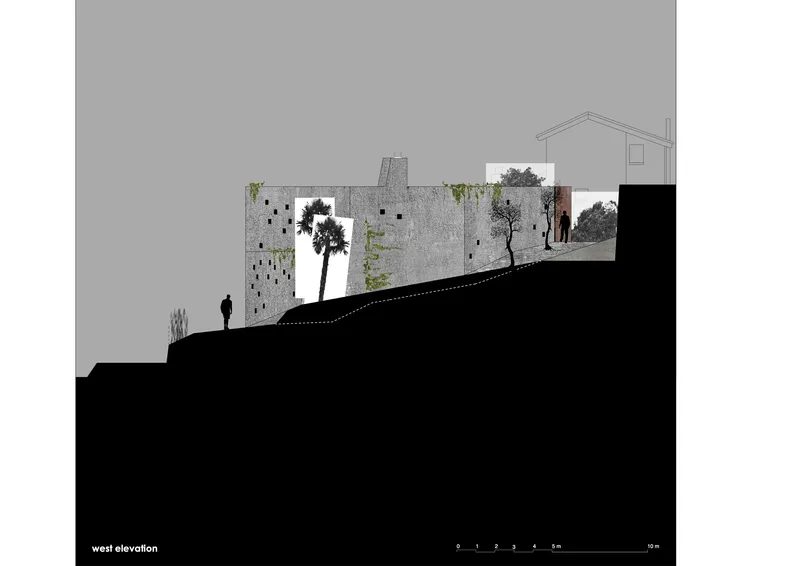
The site plan makes the pentagonal footprint legible: the angled walls track the curved street and the irregular lot boundaries precisely. Inside that polygon, the rectangular living volume sits like a box within a box, with the residual spaces becoming courtyards. The sections are revealing. They show the three levels stepping down the hillside, the planted terraces at the lowest level, and the curved roof profile that is invisible from the street. The east, north, south, and west elevations confirm the strategy of small square openings distributed across otherwise blank surfaces, calibrated to admit light without sacrificing privacy.
Why This Project Matters
The House in San Nazzaro is a lesson in how constraint breeds invention. Rather than fighting an awkward plot, Wespi de Meuron Romeo accepted its geometry wholesale and used the gap between site boundary and living space as the project's primary architectural idea. The courtyards are not decorative; they are the mechanism by which the house breathes, sees, and receives sunlight. The result is a building that feels both ancient and precise, a concrete rock hollowed out for domestic life.
In a lakeside context increasingly populated by glazed villas competing for the best view, this house takes the opposite position. It turns inward, protects its privacy, and allows the landscape to appear only through controlled apertures and a single rooftop terrace. That restraint is more generous than it first appears: by refusing the panoramic cliché, the architects give their clients a home where light, material, and atmosphere are the real subjects, and the lake is a privilege you climb up to earn.
House in San Nazzaro by Wespi de Meuron Romeo architects (lead architects: Luca Romeo, Markus Wespi, Jérôme de Meuron). Located in Gambarogno, Switzerland. 180 m². Completed in 2021. Photography by Giacomo Albo.
About the Studio
Share Your Own Work on uni.xyz
If projects like this are the kind of work you want to make, uni.xyz is a place to publish your own, find collaborators, and enter design competitions.




Popular Articles
Popular articles from the community


Co-life: Sustainable Architecture for Age-Friendly Community Living
Co-life reimagines sustainable architecture for seniors through courtyards, rammed earth, shared gardens, and spaces designed for belonging.

Riyadh For All: Intergenerational Urban Design for Active Aging in Rabat
Riyadh For All reimagines urban design in Rabat with intergenerational co-living, adaptive courtyards, and Moroccan cultural exchange today.

Conexión: Biophilic Design Reimagines High-Rise Living in Hong Kong
Conexión reimagines high-rise living in Hong Kong through biophilic design, green facades, shared spaces, daylight, water and nature within.

AL-JANNAH: Sustainable Architecture and Permaculture for Afghan Widows
AL-JANNAH uses sustainable architecture and permaculture to create resilient oasis of housing, learning, work and renewal for Afghan widows.


Similar Reads
You might also enjoy these articles

Bao Huynh Watercolor Atelier: A Serene Art Retreat in Hội An
Bao Huynh Watercolor Atelier in Hội An blends multifunctional art spaces, sustainable design, local materials, and family-friendly living in a serene environment.

Atelier Macri Concept Store Interior Design by CASE-REAL
Atelier Macri store features a "ko" counter, walnut wood details, cork displays, blending retail, gallery, and seamless customer experiences.

Manuel Vargas Izquierdo Stadium and High-Performance Sports Center: Architectural Excellence in Jalpa de Méndez
The Manuel Vargas Izquierdo Stadium blends sustainable design, inclusive sports facilities, and cultural-inspired architecture, revitalizing Jalpa de Méndez’s public spaces.

KAKR Buluh Awar Hall: Revitalizing Community and Ecology Through Bamboo Architecture
Community built bamboo hall revitalizes Buluh Awar village, empowering youth, restoring ecology, celebrating vernacular craftsmanship through sustainable architecture and culture.


Explore Residential Building Competitions
Discover active competitions in this discipline


Challenge to design mud housing for contemporary communities


Challenge to reimagine the Iron Throne


Photograph architecture without architects


Illustrate the lost glory of Angkor Wat - Render Challenge
Comments (0)
Please login or sign up to add comments
No comments yet. Be the first to comment!