

Michael Flowers and Seth Moran Tuck a Net-Zero Retreat into the Columbia Gorge Forest
A 155-square-meter residence in White Salmon, Washington, pairs weathered metal and timber cladding with off-grid solar resilience.


At just 155 square meters, the White Salmon Residence is not trying to dominate its site. Designed by Michael Flowers and Seth Moran Architects and completed in 2022, the house occupies a flat bench of land wedged between a gentle upslope of firs and hemlocks to the north and the dramatic drop of the Columbia Gorge to the south. The architects treated that asymmetry as their primary design cue: a closed, weathered metal face toward the hillside and an open, porch-wrapped elevation toward the gorge and the sun.
What makes the project worth studying is not simply its net-zero energy performance, though that is impressive for a house of this scale. It is the way every material choice, every spatial decision, and every envelope detail serves double duty, resolving both a comfort problem and an aesthetic one. The result is a small house that feels generous without a single wasted square meter.
Weathered Metal Meets Warm Timber
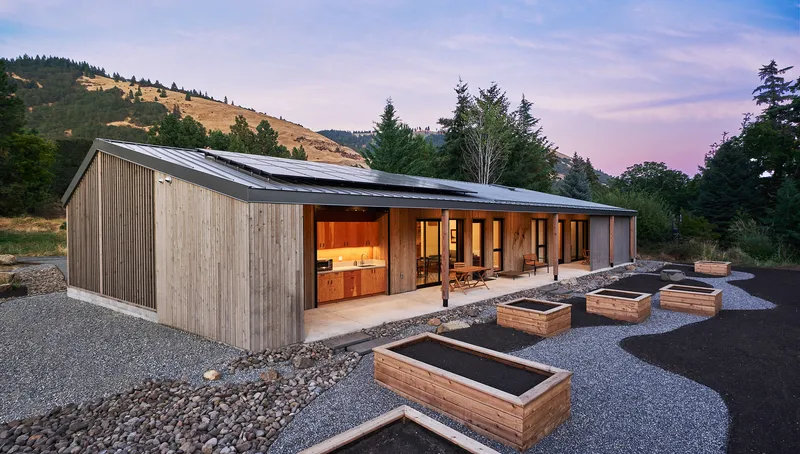
The exterior plays two materials against each other in a conversation about durability and warmth. Weathered metal cladding wraps the roof and northern facade, picking up the grey-green tones of the surrounding conifers and providing a maintenance-light rain screen against Pacific Northwest weather. Where the house turns toward the south, timber cladding takes over, offering a softer texture that reads as an invitation. The material break is not arbitrary: metal faces the weather; wood faces the life lived on the porch.
A cedar-slatted carport anchors the arrival sequence, and raised garden beds at the base of the timber volume blur the line between structure and landscape. At dusk, as captured in the image above, the glazed openings glow against the dark metal roof, making the house read almost as a lantern set into the trees.
The Porch as Primary Room
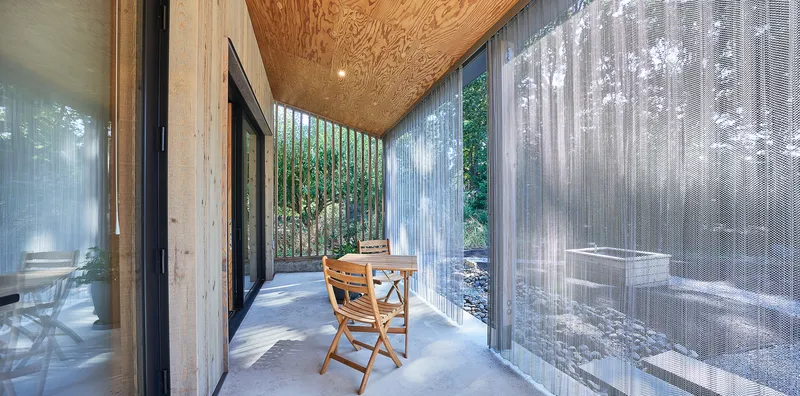
The covered porch that spans the south elevation is arguably the most important space in the house. Its plywood ceiling extends the interior material language outward, while translucent corrugated screens filter daylight into a soft, even glow across the polished concrete floor. The screens do more than modulate light; they provide wind protection during the gusty shoulder seasons that characterize the gorge, extending the usable months of the porch well beyond summer.
Connecting directly to an outdoor kitchen and a cooking garden, the porch collapses the distance between growing food, preparing it, and eating it. In a house this compact, pushing the entertaining program outdoors under a protected roof is a smart spatial trade: the interior can stay tight and efficient because the porch absorbs the overflow.
Interior Economy and Material Continuity
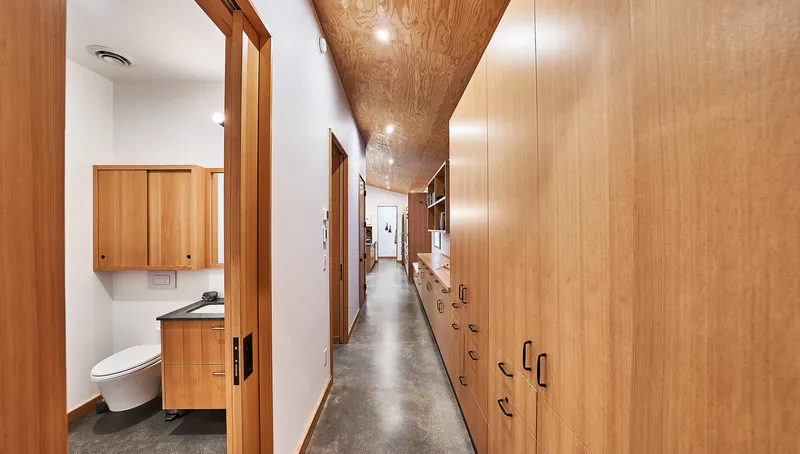
Inside, the hallway functions as spine, gallery, and storage wall all at once. Plywood lines a gently vaulted ceiling that lifts the center of the corridor above what its modest width would otherwise feel like. Wood cabinetry runs continuously along one side, absorbing the clutter that could overwhelm a 155-square-meter house. The polished concrete floor is the same material as the porch slab, reinforcing the sense that inside and outside share a single ground plane.
There is a deliberate restraint here. The palette is limited to plywood, concrete, and the occasional steel detail. No accent walls, no feature tiles. The discipline keeps costs in check and ensures the eye moves naturally toward the real feature: the forest visible through carefully placed Loewen windows at the ends of sight lines.
Net-Zero Without the Sermon
The house achieves net-zero energy performance through a combination of a highly insulated envelope, passive solar orientation, and rooftop photovoltaics paired with battery storage capable of sustaining the household off-grid for multiple days. Advanced air filtration systems address a very specific regional concern: the wildfire smoke events that increasingly blanket the Pacific Northwest each summer. These are not speculative green features bolted on for certification points; they respond to conditions the occupants actually face.
What is notable is how invisible the sustainability strategy is. Solar panels sit on a metal roof that was already chosen for its durability. The insulated envelope results in a tight, quiet interior that simply feels comfortable. Passive glazing placement follows the same logic as the porch orientation. When the performance goals and the architectural moves point in the same direction, neither one needs to announce itself.
Why This Project Matters
The White Salmon Residence is a reminder that net-zero housing does not require a large footprint, a large budget, or a visible parade of green technologies. At 155 square meters, the house proves that spatial generosity comes from smart section moves, continuous material palettes, and the willingness to let the landscape do the heavy lifting. The porch, in particular, demonstrates how much program you can accommodate without conditioning a single additional square meter.
Michael Flowers and Seth Moran have produced a house that takes its region seriously. The weathered metal acknowledges the rain; the battery backup acknowledges the grid's fragility; the air filtration acknowledges the smoke. None of these responses are melodramatic. They are embedded in the architecture the way a good foundation is embedded in the ground: quietly, structurally, and with the expectation that the real test is still coming.
White Salmon Residence by Michael Flowers and Seth Moran Architects, White Salmon, Washington, USA. 155 m². Completed 2022. Construction by Owen Gabbert, LLC. Photography by Gregor Halenda.
About the Studio
Share Your Own Work on uni.xyz
If projects like this are the kind of work you want to make, uni.xyz is a place to publish your own, find collaborators, and enter design competitions.


Popular Articles
Popular articles from the community


ETEH Reworks the Shared Spaces of São Domingos School in Brazil Around Timber, Color and Hanging Plants
At São Domingos School in Brazil, 436 m² of hall, refectory and library are recast with timber joinery, a yellow and blue code and trailing greenery.


Aquadapt: An Underwater Habitat That Rewrites Its Rooms by the Hour
Curved modules ring the seabed while one shell shifts from breakfast room to cinema, farm and football pitch as residents' needs change.

FCC Arquitectura Expands a Portuguese Granite House with a Board-Marked Concrete Wing
In Portugal, JV House pairs a cleaned-up whitewashed and granite dwelling with a timber-shuttered concrete extension, courtyards and a garden pool.

Singing Woman: An Opera House That Performs Before the Curtain Rises
Ovidiu Cristian Pavel's conceptual opera house translates Estonia's choral identity into a sculpted waterfront landmark facing the Baltic Sea.

Similar Reads
You might also enjoy these articles


Hodi-Mandai Geram
Project Function: Preservation and revitalization of the Intangible heritage and socio-spatial identity of the Hodi by Housing, Cultural Memory Center, Sacred Grove, landscape, local tourism economy


Olio Towers: A Mid-Rise for Performers That Fuses Housing, Rehearsal, and Stage
Located blocks from Houston's Theater District, this modular tower stacks living units around a central performance atrium.

Oasis: Modular Green Housing Carved into Dhaka's Urban Fabric
A shortlisted Plugin Housing entry reclaims unauthorized settlements in Dhaka with stepped concrete volumes, green roofs, and ventilation-driven design.

Black Hole: A Floating Megastructure for the Post-Physical Era
Emiliano Mazzarotto envisions a spherical, self-scaling arena where e-sports, digital hotels, and holographic stadiums replace traditional public space.

Explore Architecture Competitions
Discover active competitions in this discipline

Challenge to reimagine the Iron Throne

Photograph architecture without architects

Illustrate the lost glory of Angkor Wat - Render Challenge

Design challenge to reuse E-waste
Comments (0)
Please login or sign up to add comments
No comments yet. Be the first to comment!