

Willaston Harmony School: Bridging Cultures Through Education and Design
A beacon of cultural reconciliation and environmental harmony in Australia


The Willaston Harmony School project created by Jiwon Lee, Hanna jeong, Winner entry of Experiential competition, stands as a testament to the transformative power of architecture and education. Located in Willaston, Australia, this unique institution seamlessly blends the principles of Waldorf education with the rich cultural heritage of the local Indigenous community. More than just a school, it's a symbol of reconciliation, fostering harmony between students, nature, and Indigenous traditions. This article delves into the project's core concepts, design elements, and the profound impact it aims to have on students and the broader community.

Conceptual Foundation: Weaving Together Education and Culture
At the heart of the Willaston Harmony School project lies a profound commitment to fostering a harmonious relationship between students, nature, and the Indigenous community. Inspired by the organic forms found in nature, the design reflects the interconnectedness of life. By integrating Waldorf education principles with Indigenous creation myths, the project creates a learning environment that honors and resonates with nature, promoting a sense of unity and cultural understanding.

Design Elements: An Immersive Learning Landscape
The architectural design of the Willaston Harmony School is a symphony of elements carefully orchestrated to create an immersive and stimulating learning environment:
Stimulation, Communication, and Symbolism: The layout is intentionally designed to encourage interaction and communication. Skylights bathe the spaces in natural light, symbolizing enlightenment and clarity, while the dynamic interplay of light and shadow throughout the day creates a vibrant and engaging atmosphere..
Nature's Embrace: Drawing inspiration from the shapes of plants, the design incorporates variations in column spacing and structural elements that mimic natural forms. This creates a sense of movement and fluidity, blurring the lines between the built environment and the natural world.
A Palette of Nature: Natural materials and vivid colors, reflective of the local landscape, create a warm and inviting atmosphere. This palette not only enhances aesthetic appeal but also promotes a calming and nurturing environment for the children.
Experiential Spaces: The school is designed to evoke a sense of rhythm and movement, with spaces that encourage exploration and discovery. Curved walls and gradually changing columns create an experiential environment that stimulates the senses and fosters a deeper connection with the surroundings.
Cultural Integration: Designated spaces within the school are dedicated to social and cultural activities, promoting integration and mutual respect. These areas serve as hubs for cultural exchange and learning, reinforcing the project's commitment to reconciliation and community harmony.
Geometry in Harmony: The design incorporates a balanced blend of symmetry and asymmetry, creating a sense of order and organic growth. The geometric plan and section designs are meticulously crafted to provide a sense of structure while allowing for flexibility and adaptation.

Design Process: A Journey of Integration
The design process was a meticulous and iterative journey, guided by a deep understanding of the site and its cultural significance:
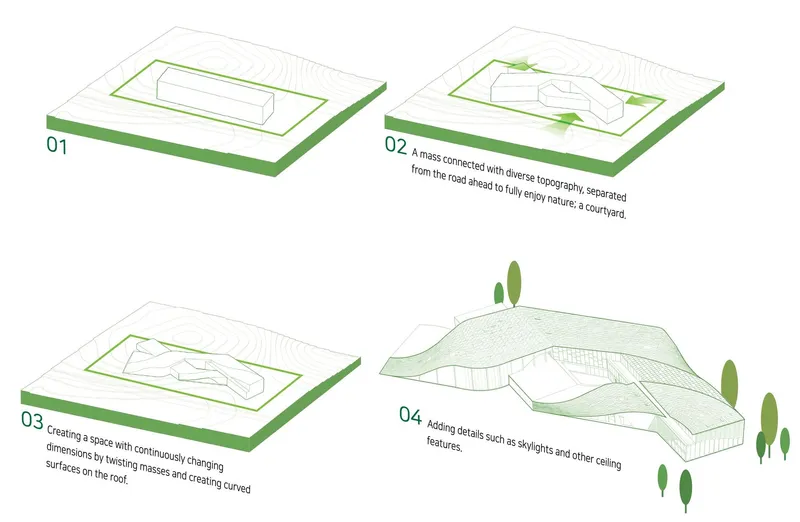
Initial Massing and Site Integration: The initial mass was carefully positioned to integrate seamlessly with the site's topography and to be separated from the road, allowing for an immersive natural experience. A central courtyard was envisioned as the heart of the school, fostering connection with nature.
Detailing Skylights and Ceiling Features: Skylights and ceiling features were strategically incorporated to enhance natural lighting and create a dynamic interplay of light and shadow.
Dynamic Dimensions and Curved Surfaces: The design embraced continuously changing dimensions through twisting masses and curved surfaces on the roof, adding a sense of movement and fluidity to the overall structure.

Design Goals: A Vision for Harmony
The Willaston Harmony School project is guided by six primary design goals:
Creating a Stimulating Environment: Fostering interaction, collaboration, and a strong sense of community among students.. Integrating Waldorf Philosophy and Indigenous Myths: Weaving together the natural learning environment emphasized by Waldorf education with the reverence for nature found in Indigenous creation myths.
Utilizing Site Topography: Seamlessly connecting the school with the surrounding natural environment, promoting exploration and adventure.
Creating an Experiential Space: Engaging the senses and fostering a deeper connection with the surroundings through dynamic and varied spaces.
Embracing Natural Light: Utilizing natural light to create a dynamic and ever-changing atmosphere, enhancing the learning environment.
Fostering Social and Cultural Integration: Promoting community harmony and cultural reconciliation through dedicated spaces for social and cultural activities.

Architectural Impact and Efficiency
The Willaston Harmony School project is designed to be both aesthetically pleasing and functionally efficient:
Energy Efficiency: Maximizing natural lighting through skylights and windows reduces energy consumption and creates a more pleasant indoor environment.
Thermal Comfort: Natural ventilation strategies and thermally efficient materials maintain a comfortable indoor climate, minimizing reliance on mechanical systems.
Sustainable Materials: Locally sourced, natural materials reduce the building's carbon footprint and support the local economy.
Adaptable Spaces: Flexible design allows for future adaptations, ensuring the building can evolve to meet changing needs.
Enhanced Learning Environment: Visually and physically stimulating spaces enhance the overall learning experience, encouraging exploration and discovery.
Impact on Children Over Time
The unique integration of Waldorf education and Indigenous cultural elements promises to have a profound and lasting impact on students:
Enhanced Cultural Awareness and Respect: Immersing students in a setting that celebrates Indigenous culture fosters a deep respect for diversity and encourages empathy.
Stronger Connection to Nature: The emphasis on natural materials and interaction with the environment instills a lifelong appreciation for nature and environmental stewardship.
Holistic Development: The Waldorf philosophy, supported by the school's design, promotes the development of the whole child—intellectually, emotionally, and physically.
Creativity and Imagination: Dynamic and experiential spaces stimulate creativity and problem-solving skills.
Community and Social Skills: Communal spaces and cultural areas foster interaction, collaboration, and the development of strong social bonds.
Resilience and Adaptability: The school's fluid and dynamic environment helps students develop resilience and adaptability, preparing them to navigate change with confidence.

A Legacy of Harmony
The Willaston Harmony School project exemplifies the power of architecture to bridge cultures and create a more inclusive and harmonious world. By weaving together Waldorf education and Indigenous cultural elements, the project fosters a deep connection to nature, a strong sense of community, and a respect for diversity. This unique learning environment will shape the minds of young learners, empowering them to become ambassadors of cultural understanding, environmental stewardship, and holistic development, leaving a lasting legacy for generations to come.


Popular Articles
Popular articles from the community

Tsunami Convergenics: Turning Catastrophic Ocean Forces into Underwater Housing Infrastructure
A speculative underwater settlement off the coast of Onagawa, Japan, treats tsunamis and typhoons as energy sources rather than threats.
Temporary Home for Dogs: A Reversed Zoo Rethinks Animal Shelter Architecture
In Bucharest, a sinuous corridor and freed landscape flip the logic of containment, designing a shelter that works to make itself unnecessary.

The Amber Palace Opera: A Geological Fiction Surfaces on Tallinn's Baltic Waterfront
Pierre Brillard reimagines a Baltic legend as a public landscape, opera house, and waterfront promenade rooted in Tallinn's coastal identity.

Opera on the Sea: Driftwood Logic Shapes a Timber Opera House on Estonia's Coast
Trevor Orgill's opera house translates the entangled drift of floating timber into a civic building where wood, water, and music converge.

Similar Reads
You might also enjoy these articles

Shakur's House: Exposed Brick as an Interior Organiser in a 168 m² Mashhad Residence
Brick moves indoors in this Mashhad residence, where masonry walls, glass partitions and teal planes sequence a compact home without closing it off.

Day and Night Park: A Time-Based Urban Newsstand in Beijing
A temporary urban newsstand in Beijing blending travel, light, and reading through poetic colors, compact form, and community-focused design.

Modernist Patio Renovation in El Masnou, Barcelona by Oliver Segura Arquitectura + Cebrià Arquitectura
Modernist patio renovation blending tradition and innovation with a movable pool, leveled floors, and Catalan materials in El Masnou.

Alto Residencial Coop: Cooperative Housing Development in Santiago de Compostela by Carbajo Barrios Arquitectos
A linear cooperative housing complex blending white volumes and perforated metal façades, enhancing community living, natural light, privacy, and urban integration.

Explore Natural Harmony Competitions
Discover active competitions in this discipline

Challenge to design public laboratory

Challenge to reimagine the Iron Throne

Photograph architecture without architects

Illustrate the lost glory of Angkor Wat - Render Challenge
Comments (0)
Please login or sign up to add comments
No comments yet. Be the first to comment!