

Women’s Bastion: Parasitic Architecture Creating Safe Urban Spaces for Women in Mexico City
A parasitic architecture proposal transforming unused urban spaces into safe, community-driven environments for women in Mexico City.


As cities continue to grow denser, architecture is increasingly challenged to respond to urgent social issues within limited urban space. The project Women’s Bastion, designed by Robin Mueller and Muhamad Ariqyandri, explores how parasitic architecture can become a tool for social protection, community support, and urban intervention. Shortlisted in the Parasitic Architecture 2020 competition, the proposal reimagines overlooked spaces in Mexico City as secure environments dedicated to women’s safety and empowerment.
The project addresses the growing concerns surrounding safety and inequality in Mexico City. Rising crime rates and increasing insecurity in public spaces have created a demand for new architectural solutions that are adaptable, accessible, and deeply integrated into the urban fabric. Rather than occupying new land, Women’s Bastion attaches itself to existing structures, utilizing unused vertical and transitional spaces within the city.
This approach reflects the core principles of parasitic architecture, where lightweight and flexible structures coexist with host buildings while serving independent functions. By inserting compact support spaces into dense urban environments, the proposal demonstrates how architecture can intervene directly within communities that need immediate assistance.
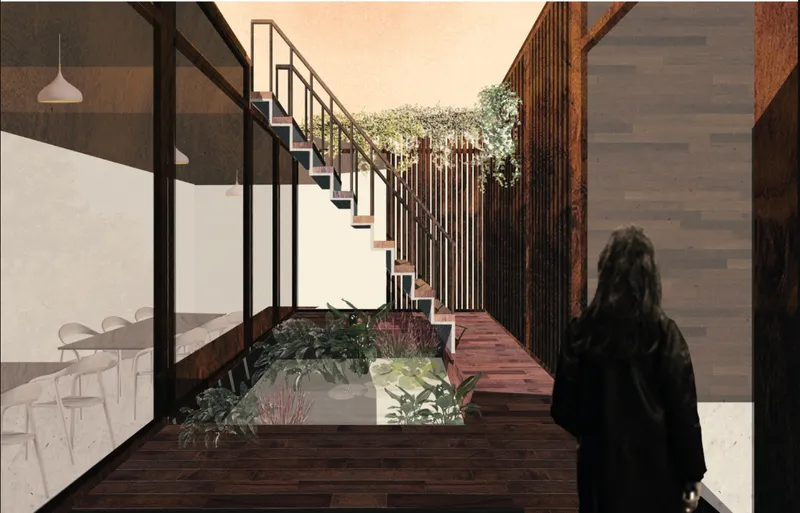
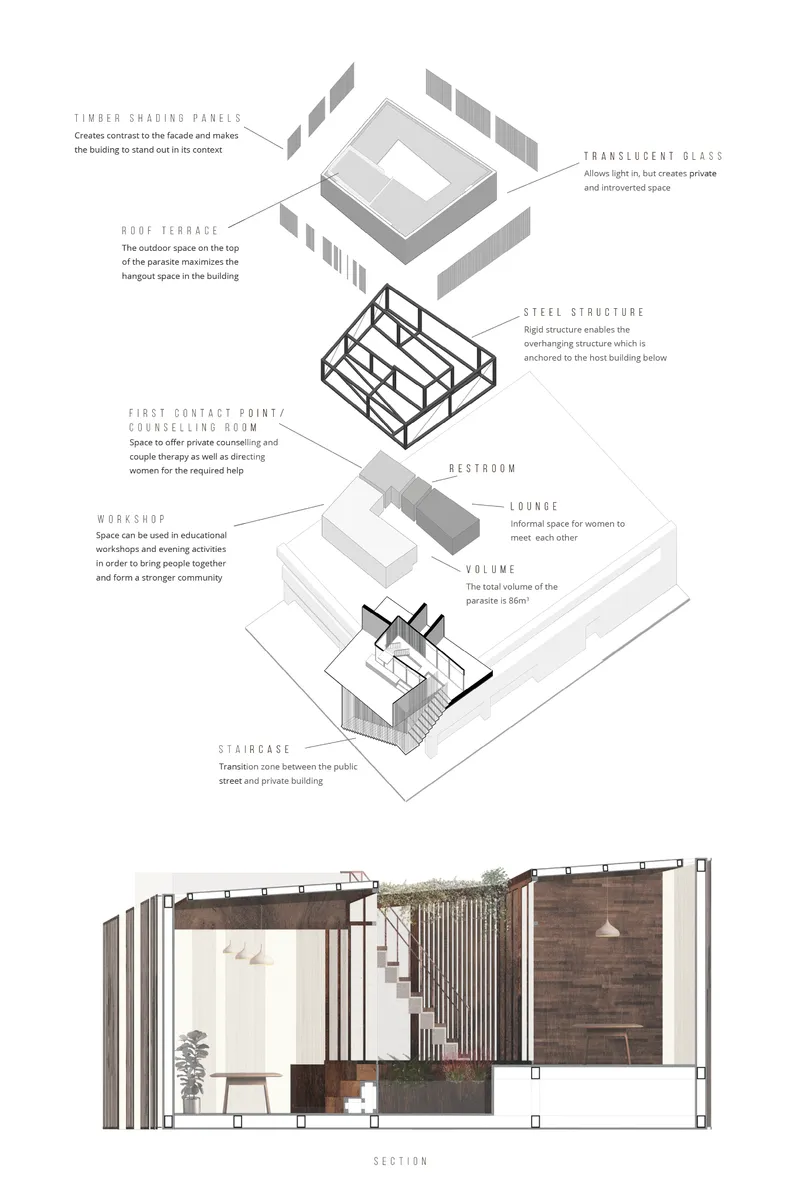
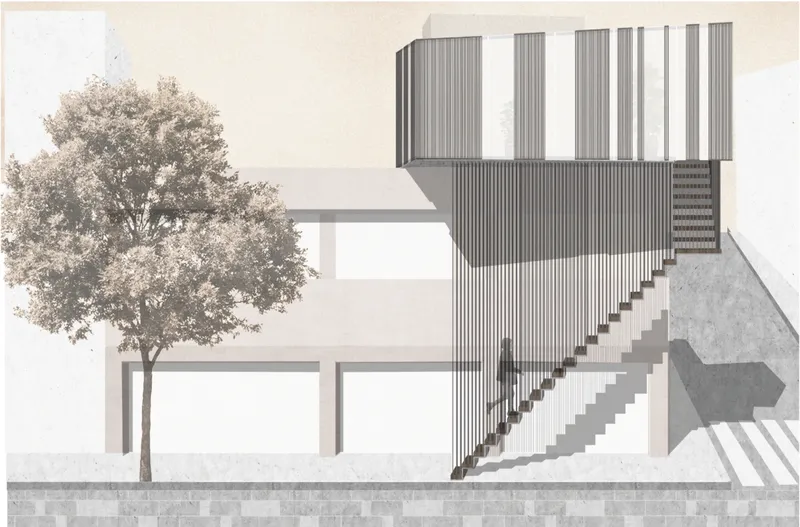
The architectural language of Women’s Bastion is intentionally restrained yet highly expressive. Elevated above the street, the structure creates a visual landmark that captures the attention of pedestrians while simultaneously offering a sense of refuge. Timber shading panels wrap the exterior, filtering light and creating privacy without fully disconnecting the interior from the surrounding city. The translucent facade softens the harsh urban environment and establishes an introverted atmosphere focused on calmness and security.
At the center of the design is a small courtyard that organizes the spatial experience. Natural light enters through translucent surfaces and open voids, creating a peaceful interior environment despite the dense city context. The radial arrangement of spaces around this courtyard encourages interaction while maintaining privacy for users seeking emotional support or counseling.
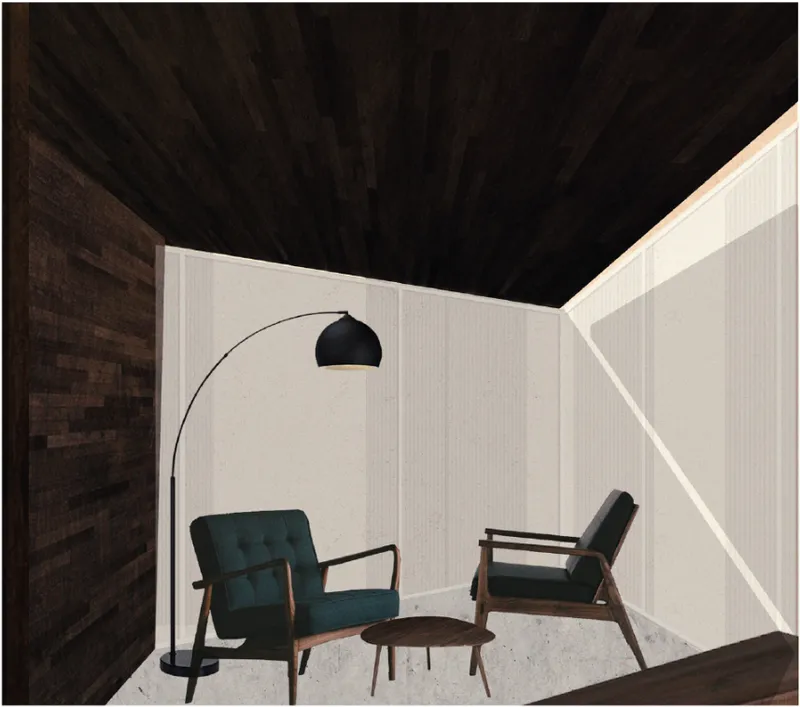
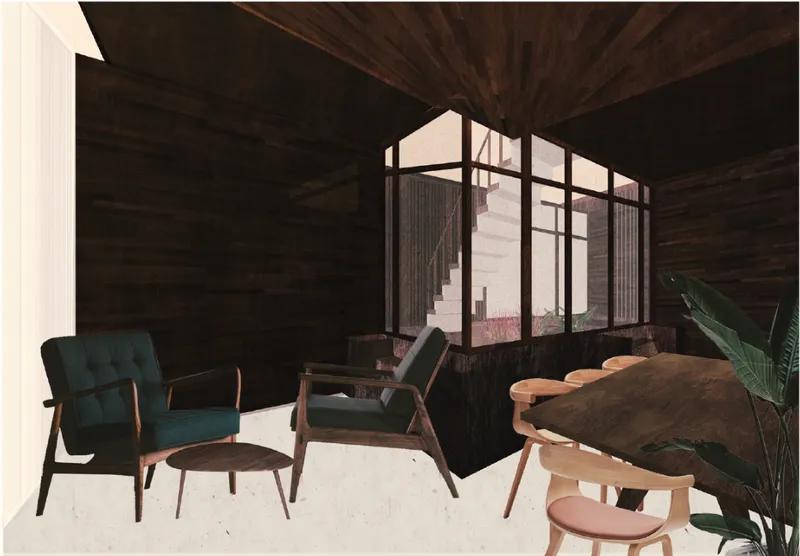
The project is carefully programmed to accommodate different forms of community engagement. The counselling room serves as the first point of contact, offering private spaces for therapy, emotional support, and guidance. Nearby, workshop areas provide flexible environments for educational programs and social activities aimed at strengthening community relationships. Informal lounge spaces encourage women to gather, communicate, and build support networks within a secure setting.
A staircase acts as a transitional element between the public street and the protected interior spaces above. This circulation path reinforces the psychological separation between the chaotic urban environment and the calm atmosphere within the bastion. The movement through the structure becomes an architectural experience centered around safety, enclosure, and gradual emotional transition.
Structurally, the project relies on a lightweight steel framework anchored to the host building below. This allows the architecture to overhang the street while minimizing its physical footprint. The compact volume demonstrates how small-scale interventions can produce meaningful urban impact without requiring extensive demolition or new infrastructure.
The use of timber throughout the interiors introduces warmth and tactility into the project. Dark wooden finishes, filtered daylight, and planted courtyard spaces create an intimate atmosphere that contrasts sharply with the surrounding urban conditions. Instead of appearing institutional, the interiors feel domestic and welcoming, reinforcing the idea of architecture as emotional shelter.
One of the most significant aspects of Women’s Bastion is its adaptability. The modular nature of the design allows it to be replicated across different neighborhoods and urban conditions throughout Mexico City. Its parasitic architectural strategy enables installation on rooftops, side structures, and unused urban gaps, making it a scalable solution capable of reaching vulnerable communities across the city.
Beyond its architectural qualities, the project raises important questions about the role of design in addressing gender inequality and public safety. Women’s Bastion positions architecture not simply as physical construction, but as social infrastructure capable of fostering protection, visibility, and collective resilience.
In an era where urban density often limits opportunities for new public spaces, parasitic architecture offers an alternative model for intervention. By reclaiming overlooked spaces and transforming them into environments of care and support, Women’s Bastion demonstrates how architecture can become an active participant in social change.
Through its compact form, adaptive strategy, and human-centered spatial design, the project presents a compelling vision for safer cities. Robin Mueller and Muhamad Ariqyandri’s proposal ultimately shows that even the smallest architectural insertions can generate meaningful social impact when designed with empathy, purpose, and community at their core.




Popular Articles
Popular articles from the community


Riyadh For All: Intergenerational Urban Design for Active Aging in Rabat
Riyadh For All reimagines urban design in Rabat with intergenerational co-living, adaptive courtyards, and Moroccan cultural exchange today.

Hill & Cross Opera: Sculptural Opera House Architecture Shaped by Tallinn’s Landscape and Identity
Hill & Cross Opera reimagines opera house architecture in Tallinn through its sculptural hill, civic plaza, glass wave and a luminous cross.

The Ocean Hive: Sustainable Architecture for a Self-Sufficient Civilization at Sea
The Ocean Hive imagines sustainable architecture at sea, where modular habitats, algae, wave power and ocean waste sustain a growing colony.

Conexión: Biophilic Design Reimagines High-Rise Living in Hong Kong
Conexión reimagines high-rise living in Hong Kong through biophilic design, green facades, shared spaces, daylight, water and nature within.

Similar Reads
You might also enjoy these articles

Eco Chapel: A Green Architecture Pavilion Designed in Symbiosis with the Forest
Eco Chapel uses green architecture to weave prayer, learning and reuse into a forest pavilion shaped by modular hexagonal canopies for life.
Kaffeebühnen: Coffee Shop Architecture Designed as a Civic Stage Between Vienna’s City and Park
Kaffeebühnen turns coffee shop architecture into a civic stage, linking Vienna’s park edge, urban life, warm timber yards, and coffee craft.
Healing Façade: Sustainable Architecture for Reforestation, Community, and Sacred Ecology in Ethiopia
Healing Façade reimagines sustainable architecture as a living wall that restores soil, catches water and renews Ethiopia's forest churches.


Urban Forest: A Vertical Ecosystem for 5,000 Workers in Singapore's Changi Business Park
Radially stacked pods and layered green decks turn a 7-acre plot into 47 acres of ecological workspace projected for 2040.


Comments (0)
Please login or sign up to add comments
No comments yet. Be the first to comment!