
Wood Marsh Converts a Derelict Caretaker's Flat into a Wellness Centre Inside a 1961 Melbourne Tower
A heritage-listed high-rise on the edge of Melbourne's Royal Botanic Gardens gains a ground-level retreat built on restraint and material precision.


Fairlie is one of Melbourne's earliest luxury high-rises, a nine-storey concrete tower completed in 1961 on the edge of the Royal Botanic Gardens in South Yarra. It replaced a Victorian house called Fairlie House, demolished in the 1930s, and its prefabricated concrete frame and curtain wall system made it a landmark of postwar ambition. At ground level, though, a former caretaker's apartment had been vacant for years and had deteriorated badly. Wood Marsh was brought in to turn this forgotten space into something deliberate: a private wellness centre for the building's residents.
What makes the project compelling is not the program, which is modest enough, but the discipline with which it handles heritage. The building is listed, which demands minimal disruption and clear differentiation between old and new fabric. Wood Marsh responded not with contrast but with quiet embedding. Custom terrazzo was developed to echo the tower's original surfaces. Arne Jacobsen door hardware, contemporaneous with the 1961 building, was specified. A generous skylight was engineered through the existing concrete slab to bring natural light into what was once a dim apartment. The result reads less like an insertion and more like something the building always intended but never finished.
The Tower as Context
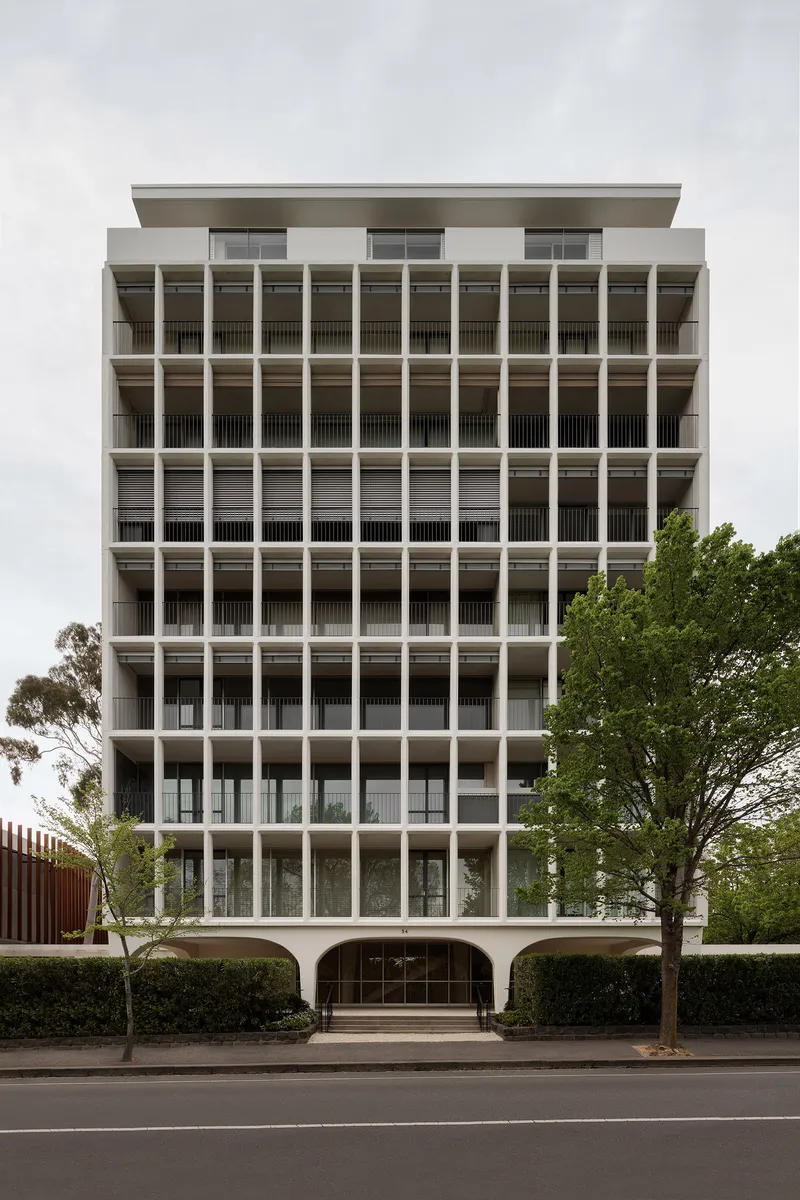
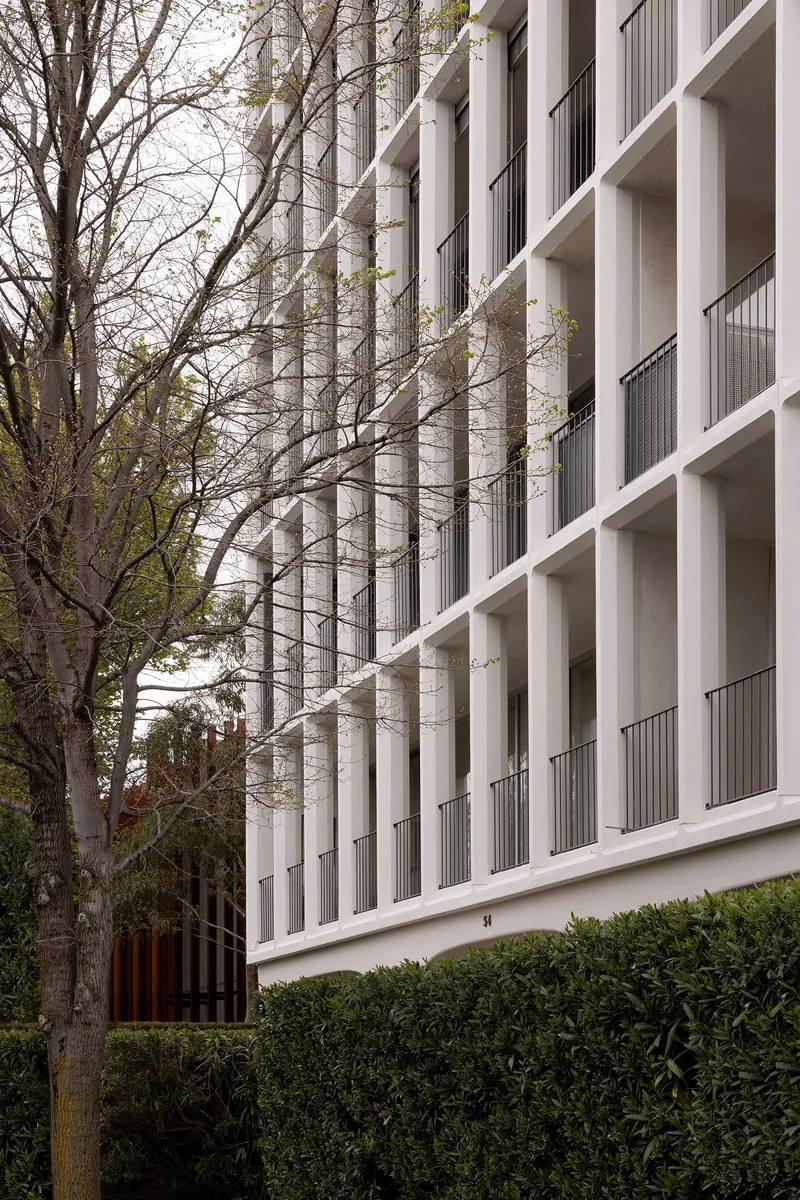
Fairlie's facade is a grid of arched pilotis and precast concrete, a repetitive rhythm that reads as both structural honesty and midcentury confidence. The building's posture on the street is restrained, its balconies recessed behind the column grid, flanked by mature street trees. Understanding this context is essential to understanding why Wood Marsh chose such a quiet hand at ground level. Any intervention that shouted would have been an insult to a building whose whole aesthetic depends on calm repetition.
The Courtyard and the Circular Skylight
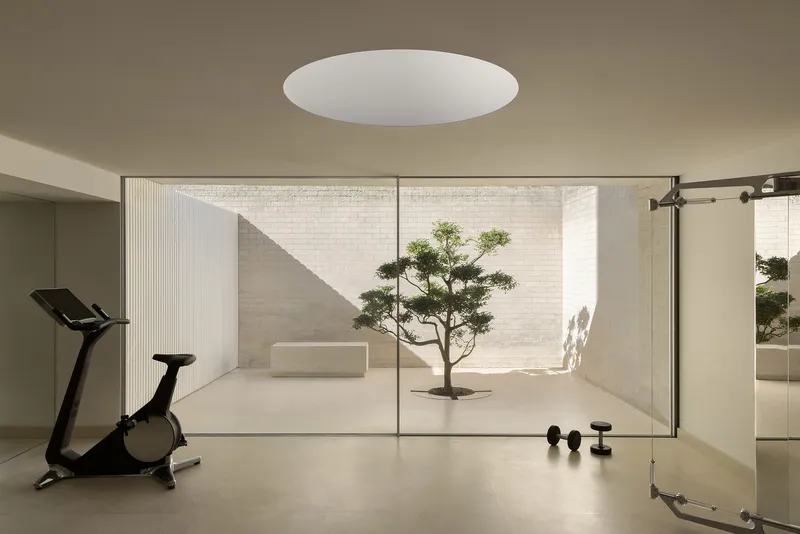
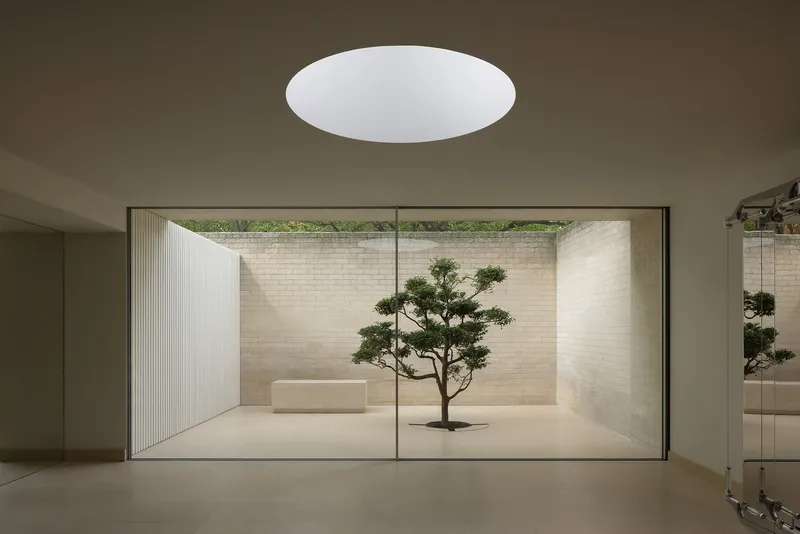
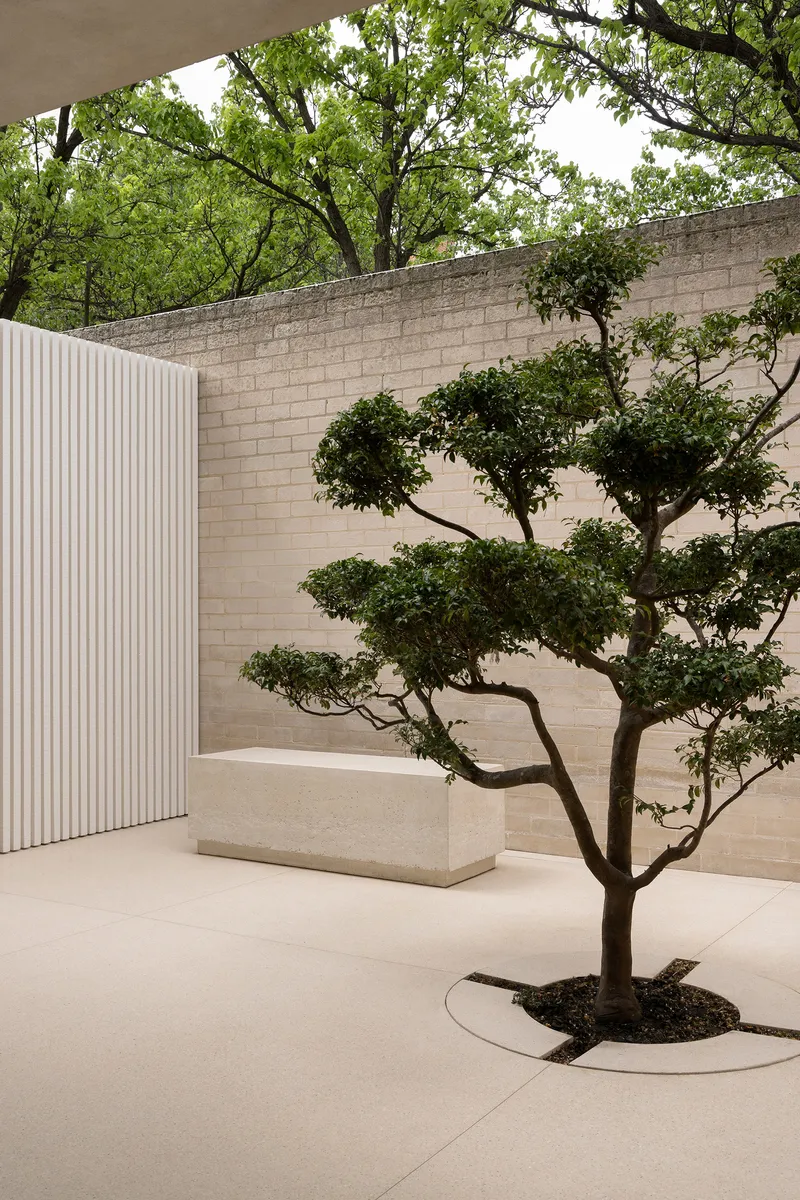
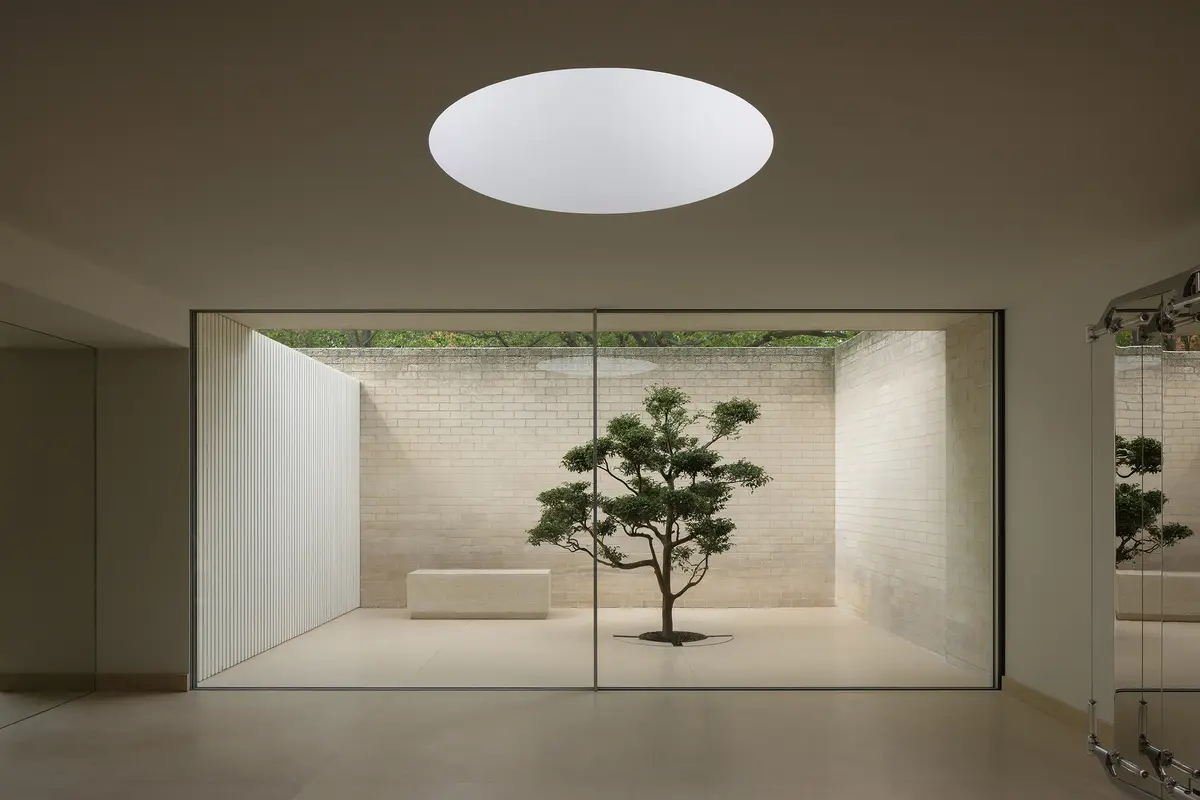
The project's most arresting move is the circular skylight punched through the existing concrete slab, which floods a private courtyard visible through floor-to-ceiling glass. A single carefully pruned tree sits in a circular planter, centered beneath the oculus, turning the courtyard into something between a light well and a controlled landscape. The cream brick walls of the courtyard are original fabric, left exposed and cleaned rather than clad.
From the exercise room, the courtyard is ever-present, a visual anchor that keeps the interior connected to sky and season. The circular geometry of the skylight is the only overtly gestural element in the project, and it earns its drama precisely because everything else around it is understated.
Threshold and Circulation
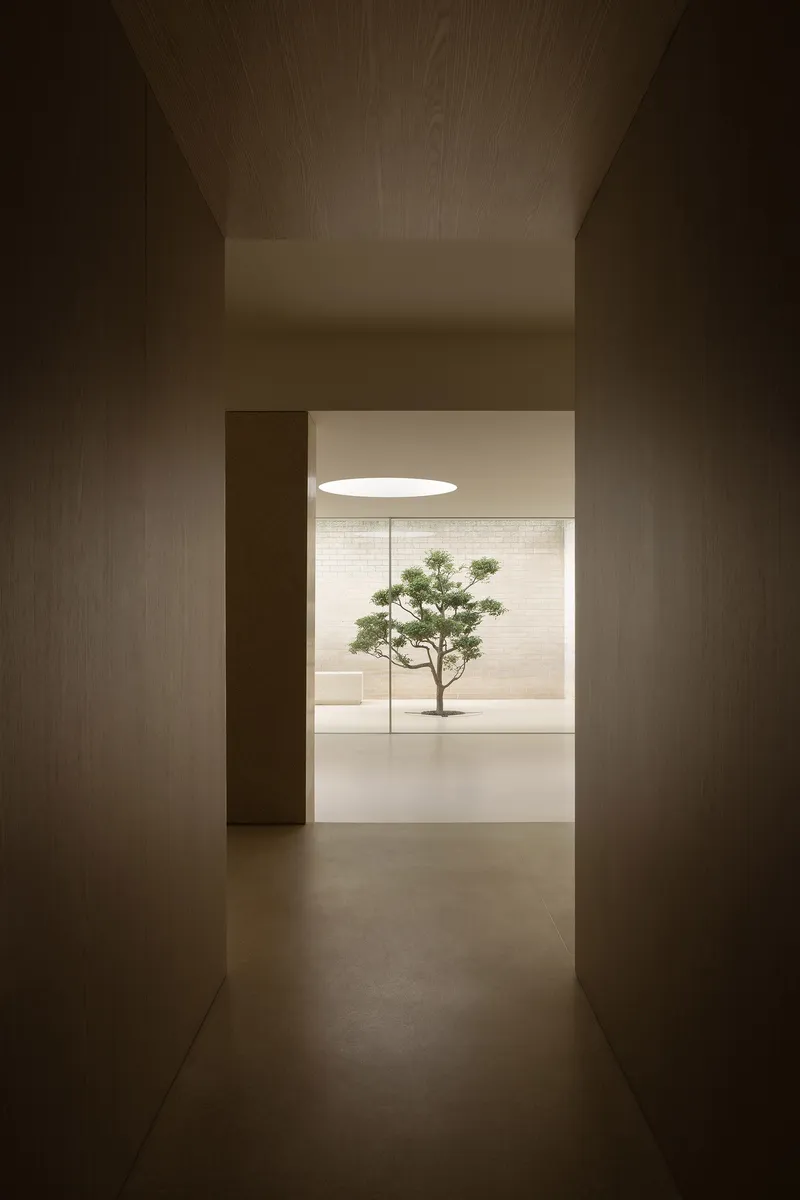
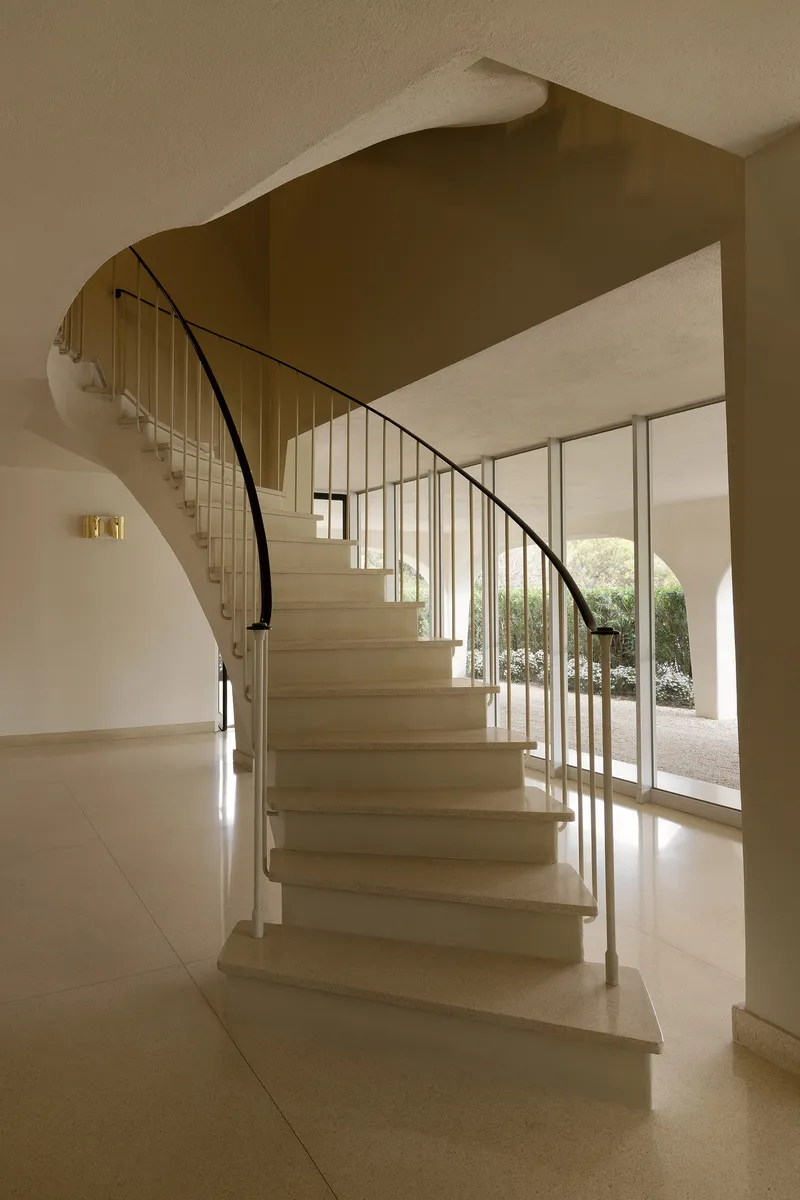
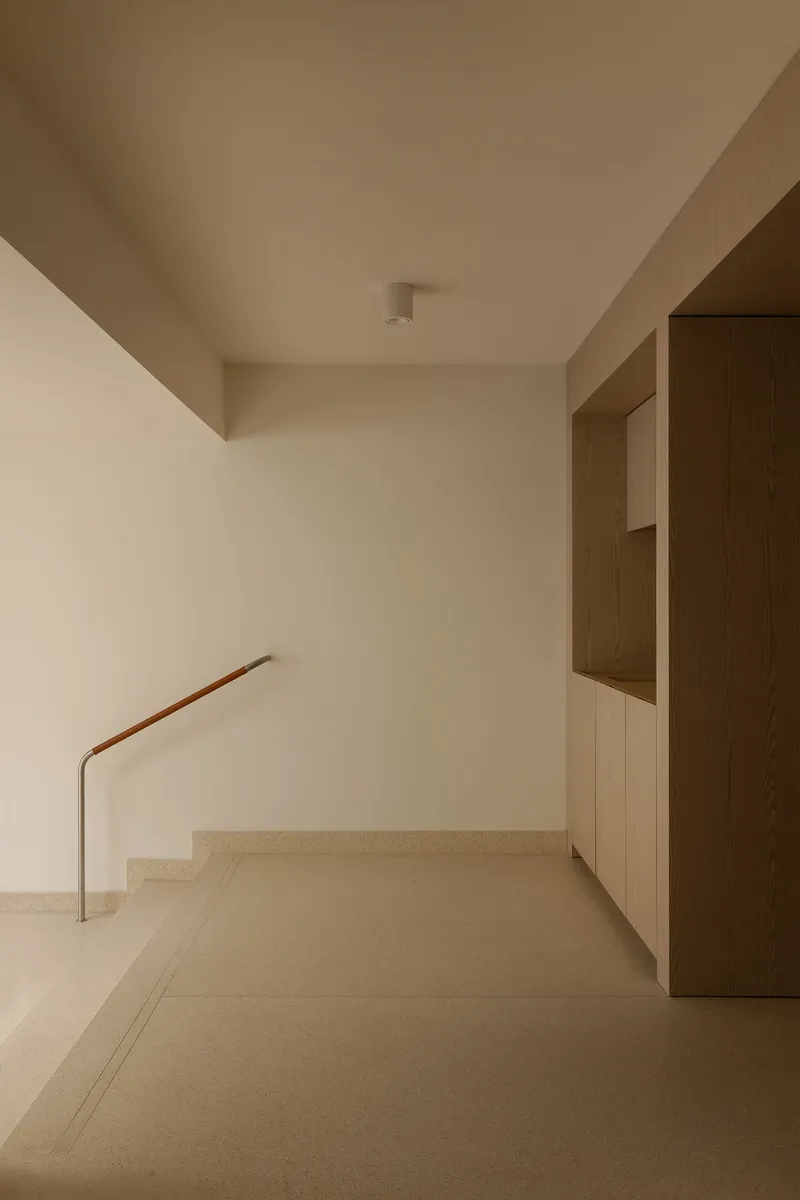
The wellness centre is accessed directly from the building's foyer, a sequence that Wood Marsh has orchestrated carefully. A corridor frames the courtyard tree at its terminus, pulling occupants through the space with a visual reward. The curved stone staircase with its steel rod balustrade and glass doors opening to the courtyard introduces a shift in scale and material that signals arrival without being theatrical.
At the upper landing, pale European oak veneer wraps walls and ceiling continuously, creating a warm envelope that contrasts with the cooler terrazzo below. The transition from stone to timber marks a shift in program, from active wellness spaces to more reflective ones, and it is handled with enough subtlety that you register the change in temperature before you register the change in material.
Material Honesty as Heritage Strategy
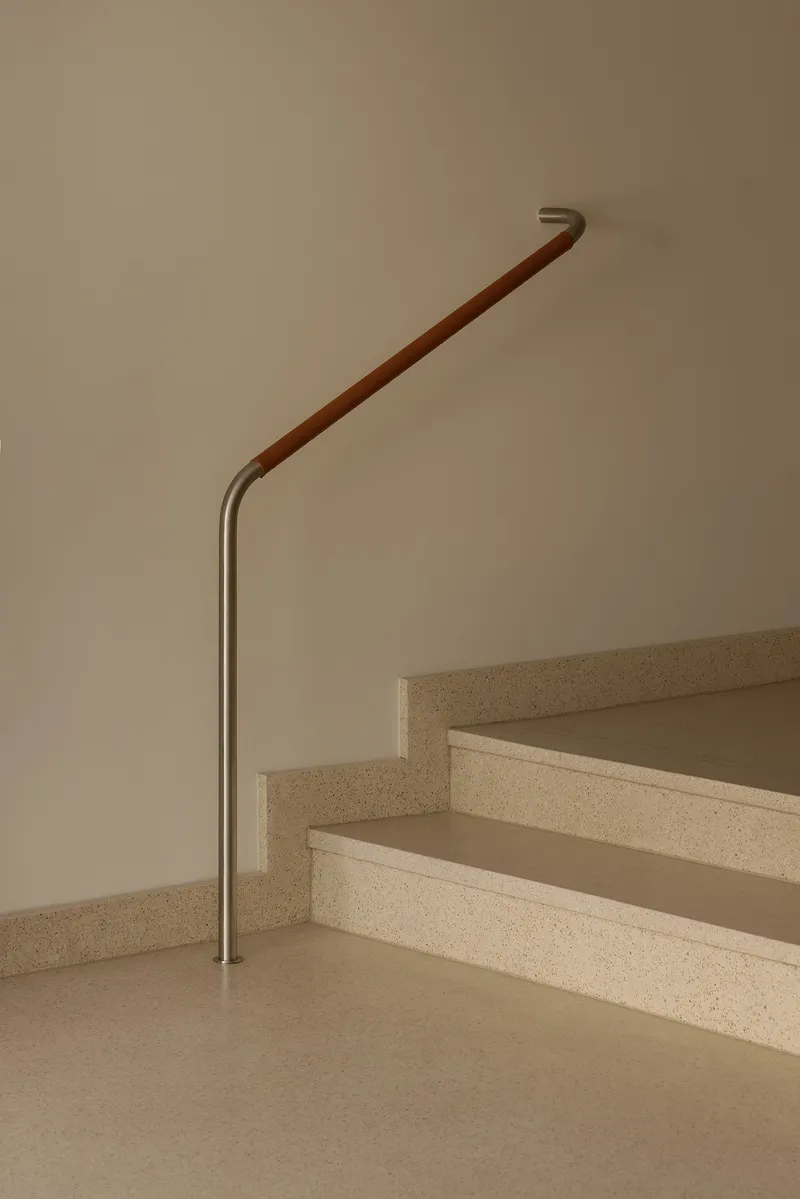
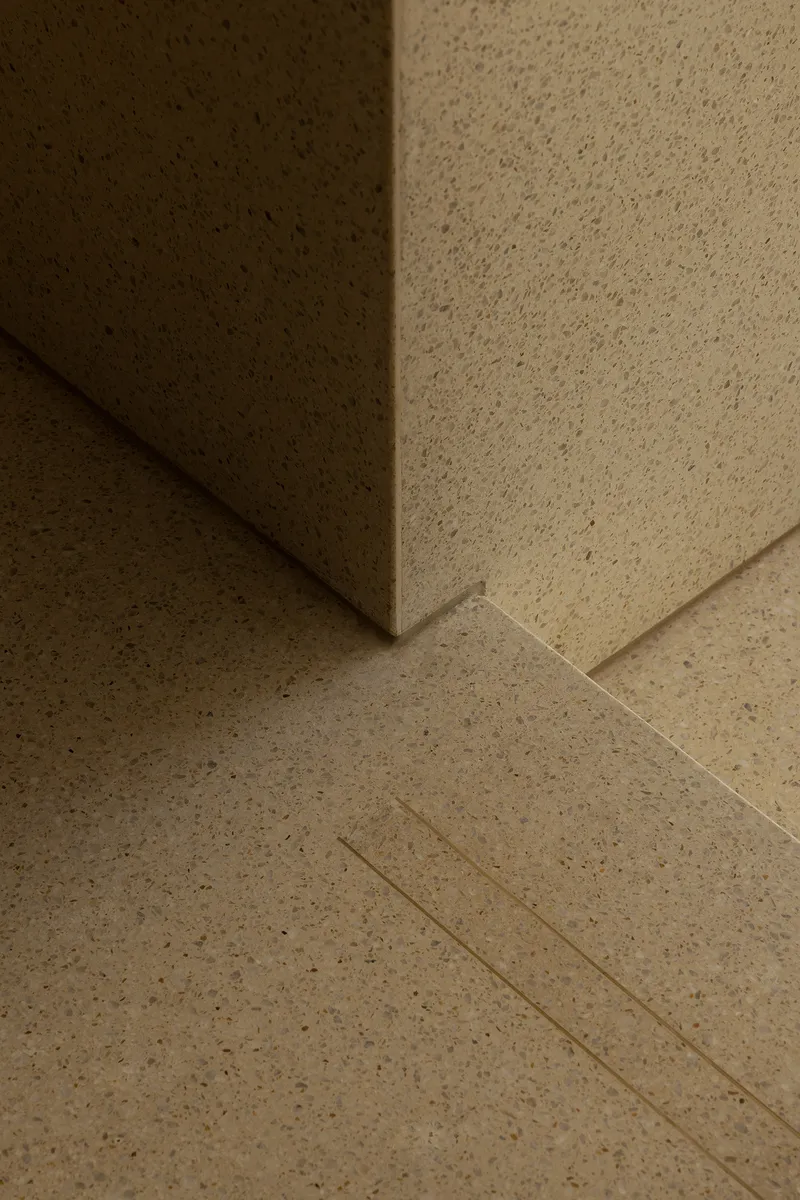
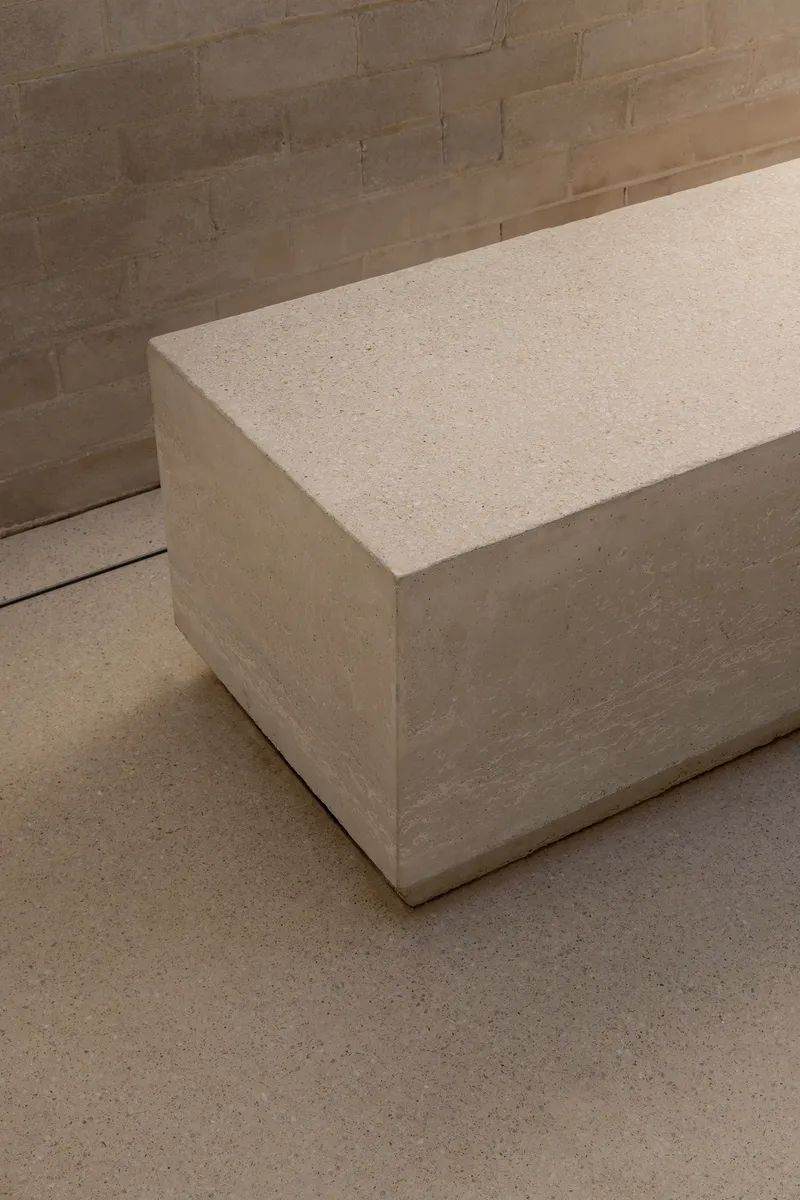
The custom terrazzo is the project's quiet protagonist. Developed specifically to reference the tower's original surfaces, it appears on floors, stair treads, and benches, a material that reads as both new and native. Natural brass floor trims and integrated drainage channels demonstrate a level of detailing that treats every junction as a design problem worth solving. The leather-wrapped handrail terminating at a brushed metal base is a small flourish, the kind of move that rewards attention without demanding it.
The cast stone bench against brick with terrazzo flooring captures the project's ethos in a single frame: a limited palette deployed with precision, where the interest comes from how materials meet rather than from the materials themselves.
Amenities and the Training Space
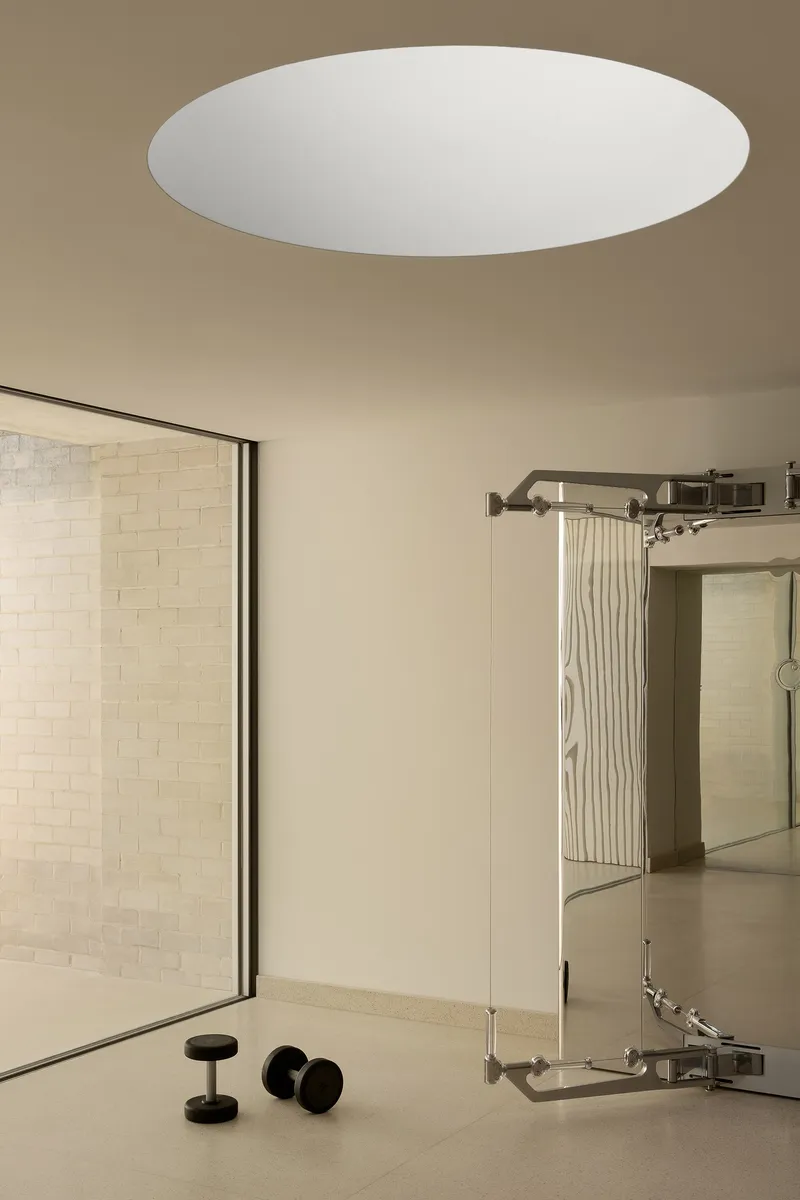
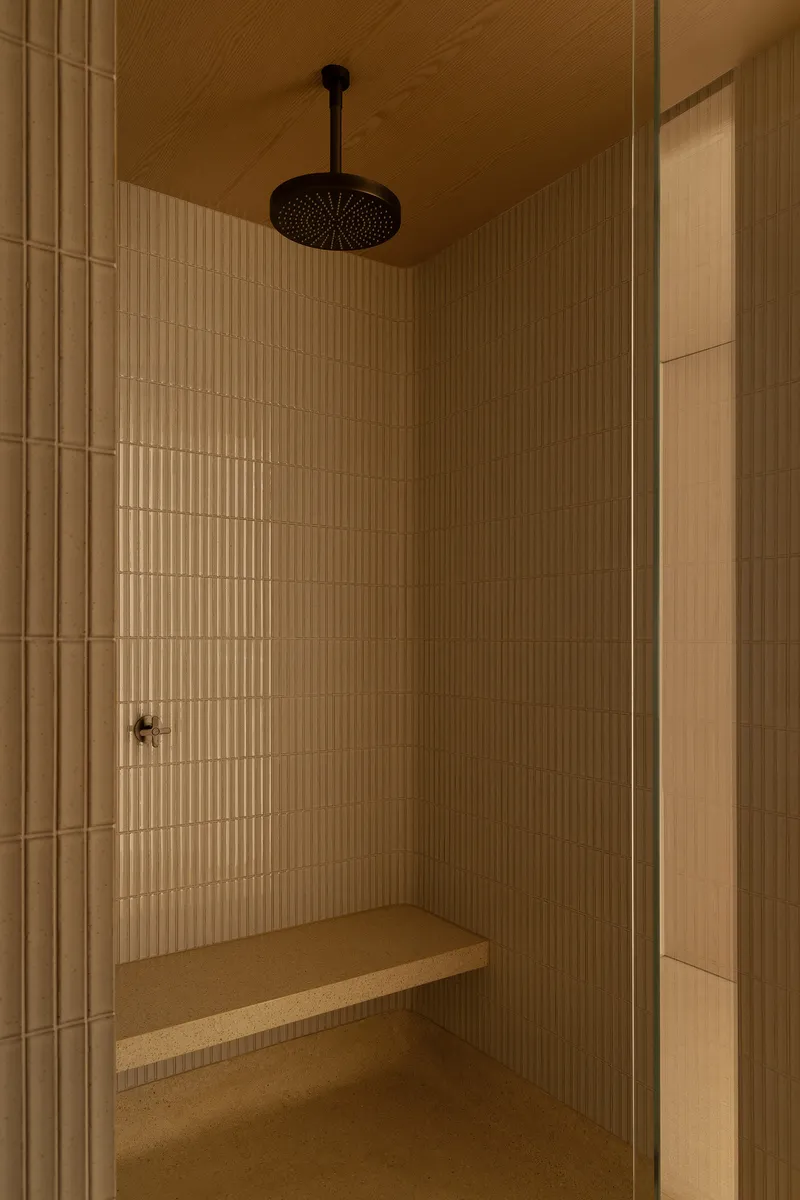
The central open space serves the wellness and training functions with a clarity that avoids the typical gym aesthetic. A sliding curtain track around the exercise area allows the room to be subdivided for personal training or opened entirely to the courtyard view. Amenities are discreetly integrated: the shower enclosure, with its vertical ribbed tile walls, ceiling-mounted rainfall head, and wooden bench, reads more like a spa than a locker room.
The circular ceiling opening above the training area doubles as a light source and a spatial marker. Weights and equipment are present but not dominant. Wood Marsh has managed to make a functional fitness space feel genuinely calm, which is harder than it sounds when barbells are involved.
Plans and Drawings
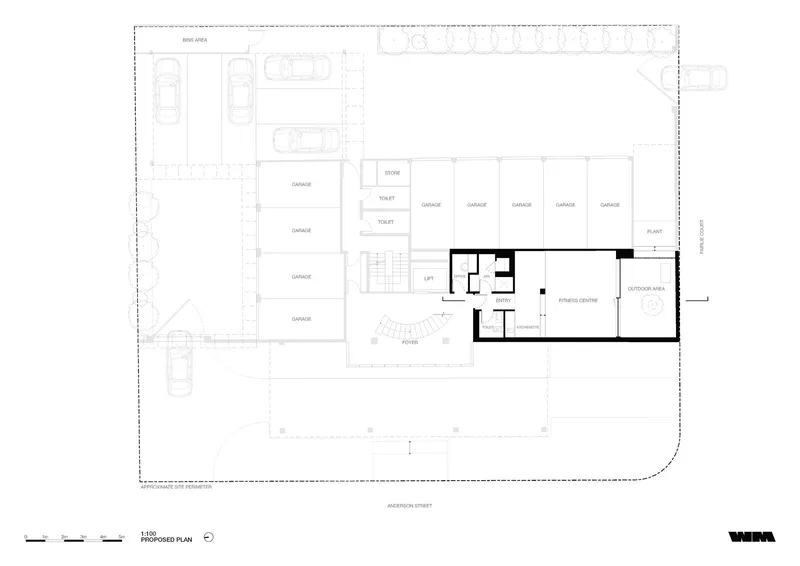
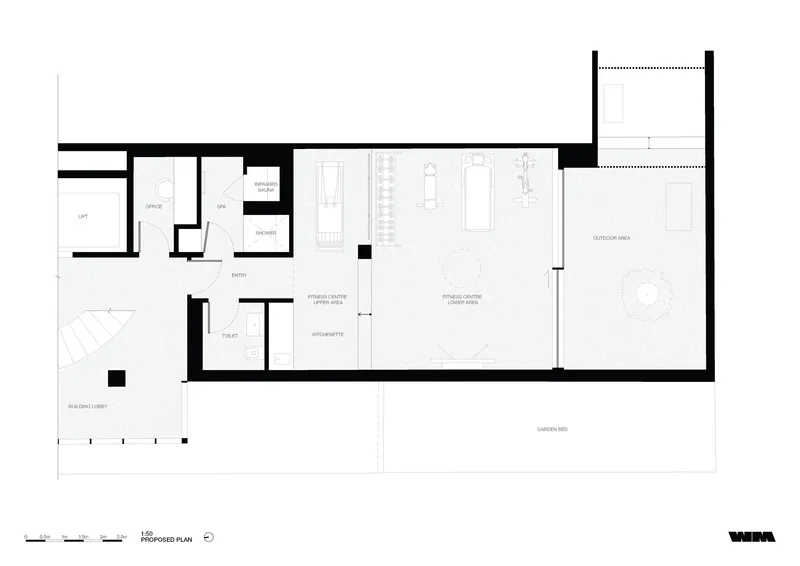
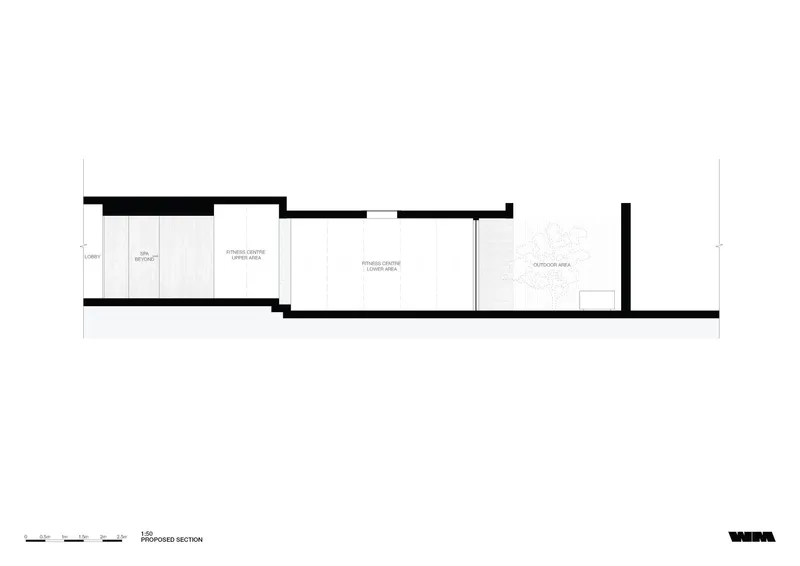
The floor plans reveal how Wood Marsh negotiated the constraints of the existing structure. At ground level, the fitness centre sits between garage spaces and the courtyard, its footprint carved from what was once a utilitarian zone. The upper level adds a library area and outdoor terrace, stacking quieter program above active use. The section drawing makes the skylight intervention legible: you can see how the opening was threaded through the existing slab to connect the planted courtyard to the sky above, creating a vertical relationship that the original building never had.
Why This Project Matters
Adaptive reuse in heritage buildings often defaults to one of two modes: either the new work screams its contemporaneity or it tries to disappear entirely. Wood Marsh has found a third approach at Fairlie, one where the intervention is clearly modern but materially sympathetic, where custom terrazzo and period-appropriate hardware create a relationship with the host building that feels earned rather than imposed. The skylight, the one big structural move, is handled with enough engineering ambition to justify itself and enough restraint to avoid spectacle.
The project also makes a quiet argument about what residential amenity spaces can be. Wellness centres in apartment buildings are too often afterthoughts, finished cheaply and designed generically. Here, the same level of material attention that might go into a penthouse has been directed at a communal space. That inversion of priorities, lavishing care on the shared ground floor rather than the private upper floors, is the kind of value statement architecture can make when architects are given the room to think it through.
Fairlie Wellness Centre, designed by Wood Marsh, South Yarra, Melbourne, Australia. Completed 2025. Photography by Timothy Kaye.
About the Studio
Share Your Own Work on uni.xyz
If projects like this are the kind of work you want to make, uni.xyz is a place to publish your own, find collaborators, and enter design competitions.


Popular Articles
Popular articles from the community

Opera by the Sea Estonia: Three Shells Dissolving Architecture into Tallinn's Coastline
A winning opera house proposal replaces monumental form with interconnected shells that blur the boundary between building, park and Baltic Sea.

Singing Woman: Contemporary Architecture Inspired by Estonia’s Voice and the Sea
Singing Woman turns Estonia’s song culture into flowing opera house architecture, blending public life, landscape, sea, and national memory.

Manzana Morphosis: Stretching Barcelona's Grid into a Living Landscape for 2050
A radical reworking of the Eixample manzana turns density into a tool for generous public space, vertical ecology, and environmental performance.

The Amber Palace Opera: A Geological Fiction Surfaces on Tallinn's Baltic Waterfront
Pierre Brillard reimagines a Baltic legend as a public landscape, opera house, and waterfront promenade rooted in Tallinn's coastal identity.

Similar Reads
You might also enjoy these articles

Bao Huynh Watercolor Atelier: A Serene Art Retreat in Hội An
Bao Huynh Watercolor Atelier in Hội An blends multifunctional art spaces, sustainable design, local materials, and family-friendly living in a serene environment.

Atelier Macri Concept Store Interior Design by CASE-REAL
Atelier Macri store features a "ko" counter, walnut wood details, cork displays, blending retail, gallery, and seamless customer experiences.

Manuel Vargas Izquierdo Stadium and High-Performance Sports Center: Architectural Excellence in Jalpa de Méndez
The Manuel Vargas Izquierdo Stadium blends sustainable design, inclusive sports facilities, and cultural-inspired architecture, revitalizing Jalpa de Méndez’s public spaces.
KAKR Buluh Awar Hall: Revitalizing Community and Ecology Through Bamboo Architecture
Community built bamboo hall revitalizes Buluh Awar village, empowering youth, restoring ecology, celebrating vernacular craftsmanship through sustainable architecture and culture.

Explore Wellness Competitions
Discover active competitions in this discipline

Challenge to reimagine the Iron Throne

Photograph architecture without architects

Illustrate the lost glory of Angkor Wat - Render Challenge

Design challenge to reuse E-waste
Comments (0)
Please login or sign up to add comments
No comments yet. Be the first to comment!