
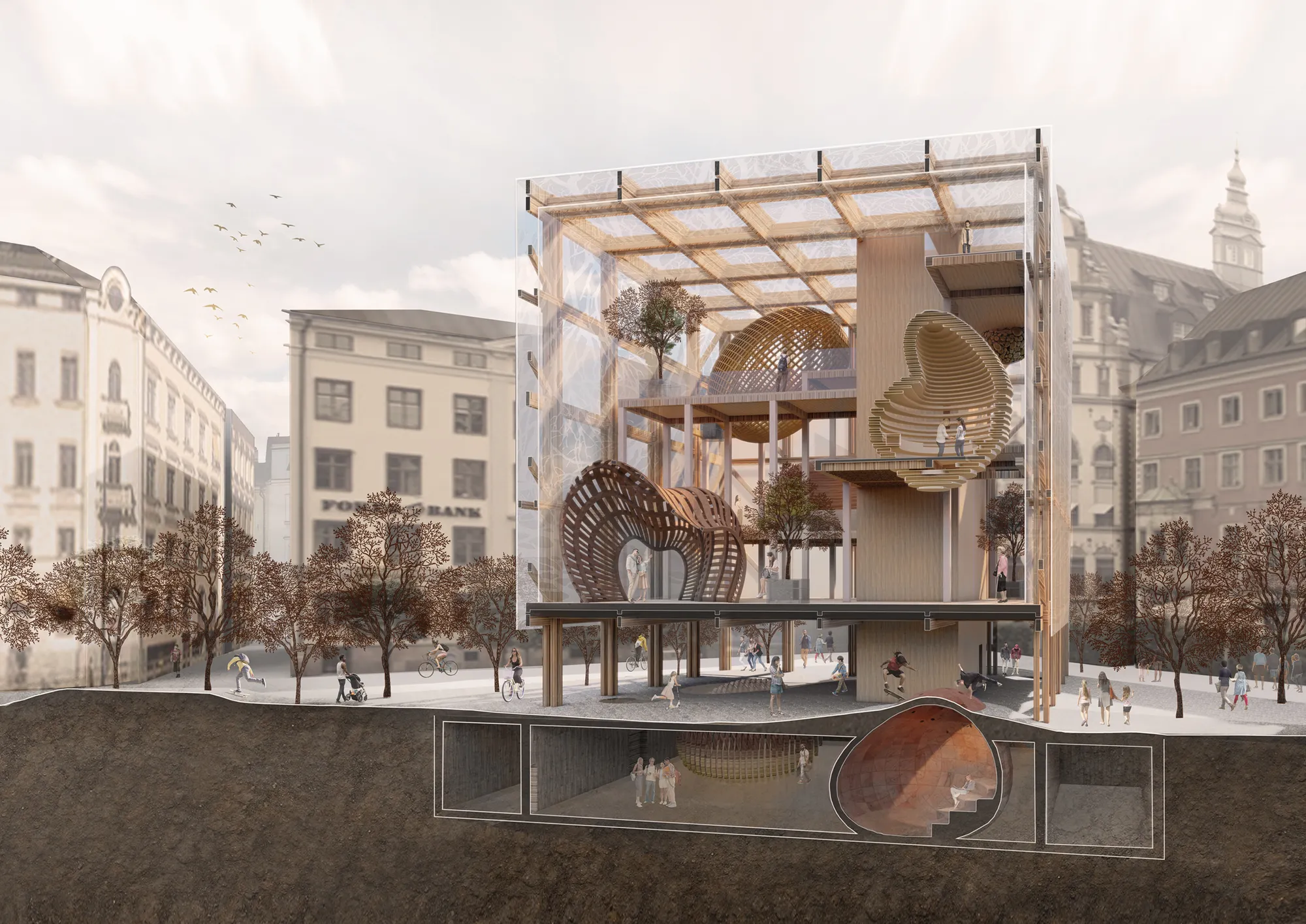
Wood works - Workshop Center in Stockholm
A combination of traditional and modern forms.

The advantages of wooden structures are long-distance and obvious. Wood is light, low-cost, durable and renewable. This material is of particular importance in the Scandinavian countries. While working on the project, I tried to analyze the potential of wood as an architectural material; get to know its advantages and limitations. The process was very inspiring for me: taking into account the variety of wood, the design became a kind of architectural variation on it.
'Wood works' is a building that is itself an exhibition of wood: both in the context of traditional forms and modern applications. The building is located in the old town of Stockholm, on the island Gamla Stan (Korhamnstorg Square).
The idea of duality:
“Creative work requires a twofold perspective: one must focus on the world and oneself, on the outer space and the inner space of the mind. All works of art are an expression of this boundary between subject and world, both in the artist’s experience and in what the viewer/listener/user perceives.”
J.Pallasmaa
“The Thinking Hand: Existential and Embodied Wisdom in Architecture.”
Space is defined as a game of opposites: architecture and nature, orthogonal and organic order, open-closed floor plans, form and structure.
Structure - frame:
The external construction of the building is linked to the local frame construction. It is a further development of the typical Binder-Pfetten system in the frame construction. The traditional shape of the carpenter’s solutions brings an orthogonal, ordered grid on the facade. Inside the object, the frame construction is an innovative approach: the base of the structure is the frame, but in curved shapes. As a result, the “blob” take on organic forms.
Space - function:
The building is divided into two zones: exhibition and workshop areas. The exhibitions are planned on the entresols, the creative work takes place in completely different zones, which are organic forms.
Form - tree:
The meaning of the tree is important. The core of the building is a metaphor for a tree. Entresols - ‘branches’ depart from it. On them there are pots with real trees ensuring continuity with trees on the square.
Continuing the tradition of Scandinavian community homes, the building is meant to unite the community. The building is intended to bring together artists and designers who contribute to the preservation of local traditions, as well as being a tourist attraction.
The ground floor is the core of the building - the entrance hall with circulation. The next floor is a free exhibition space with a cafe area. The next levels are entresols with glass railings. Adjacent to them are separate workshop work zones adapted to work in small groups, and also a space for individual work at the highest level. Each "blob" is made in a different way, from different types of wood. Their openwork form would create unique spaces with a play of light and shadow. There is a loud and vibrating work zone on the underground floor - the carpentry workshop and the auditorium.
The use of glass is also original in the project. Inside the building, laminated glass in liquid crystal technology was used. It is a material with variable transparency that can quickly change from translucent to non-transparent.
The Workshop Center is a continuation of the tradition, combining fundamental values with the sign of the present day. Architecture is to combine with design, art and Nordic heritage, creating a link between the city and cultural life of the capital.



Popular Articles
Popular articles from the community


AL-JANNAH: Sustainable Architecture and Permaculture for Afghan Widows
AL-JANNAH uses sustainable architecture and permaculture to create resilient oasis of housing, learning, work and renewal for Afghan widows.

The Ocean Hive: Sustainable Architecture for a Self-Sufficient Civilization at Sea
The Ocean Hive imagines sustainable architecture at sea, where modular habitats, algae, wave power and ocean waste sustain a growing colony.

Riyadh For All: Intergenerational Urban Design for Active Aging in Rabat
Riyadh For All reimagines urban design in Rabat with intergenerational co-living, adaptive courtyards, and Moroccan cultural exchange today.

The Musturak Paradise: Senior Living Architecture for a Connected Future in Temara, Morocco
The Musturak Paradise reimagines senior living architecture in Temara via private homes, social spaces, culture, community, and shared care.
Similar Reads
You might also enjoy these articles

Day and Night Park: A Time-Based Urban Newsstand in Beijing
A temporary urban newsstand in Beijing blending travel, light, and reading through poetic colors, compact form, and community-focused design.

Modernist Patio Renovation in El Masnou, Barcelona by Oliver Segura Arquitectura + Cebrià Arquitectura
Modernist patio renovation blending tradition and innovation with a movable pool, leveled floors, and Catalan materials in El Masnou.

Alto Residencial Coop: Cooperative Housing Development in Santiago de Compostela by Carbajo Barrios Arquitectos
A linear cooperative housing complex blending white volumes and perforated metal façades, enhancing community living, natural light, privacy, and urban integration.
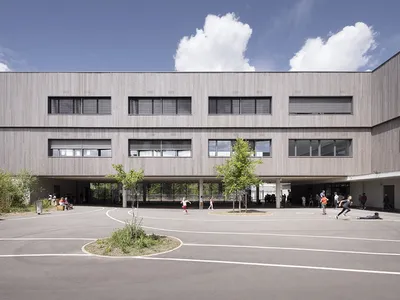
Vil Genis School by BPA ARCHITECTURE – Massy, France
Vil Genis School in Massy, France, features sustainable design, south-facing classrooms, community integration, accessible spaces, and modern educational architecture.

Explore Wood Construction Competitions
Discover active competitions in this discipline



Challenge to design locus for the upliftment of human rights


Challenge to reimagine the Iron Throne


Photograph architecture without architects


Illustrate the lost glory of Angkor Wat - Render Challenge
Comments (0)
Please login or sign up to add comments
No comments yet. Be the first to comment!