
Woodleigh Futures Studio: A Meadow Roof on a School
McIldowie Partners built a regenerative school studio in Victoria, Australia with a native meadow roof, solar canopies, and recycled hardwood courtyards.

Schools are the most unforgiving building type in contemporary architecture. They have to accommodate hundreds of teenagers, survive a twenty-year lifecycle on a tight public budget, and function as advertisements for whatever the school is trying to teach. Most of them fail on at least one of those counts. The Woodleigh Futures Studio, completed in 2025 by McIldowie Partners on the Woodleigh School campus in Victoria, Australia, is one of the rare ones that manages all three.
The brief was to build what the architects and client call a Regenerative Futures Studio. The language is ambitious (a carbon-sequestering, solar-powered living ecosystem that filters pollution, and so on) and the kind of thing that usually leads to a greenwashed glass box with a few planters on the roof. What is unusual about Woodleigh is that the building actually does the things the brief says it does, and it is also genuinely pleasant to be inside.
A Roof That Is Also a Meadow
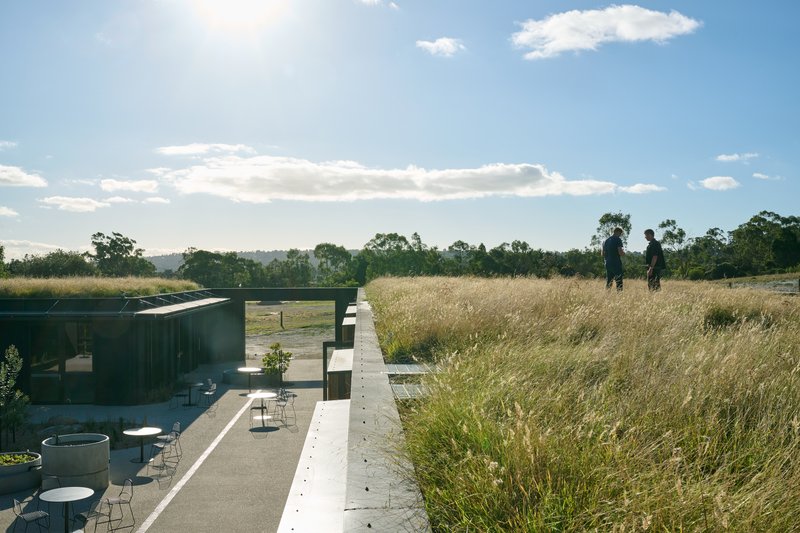
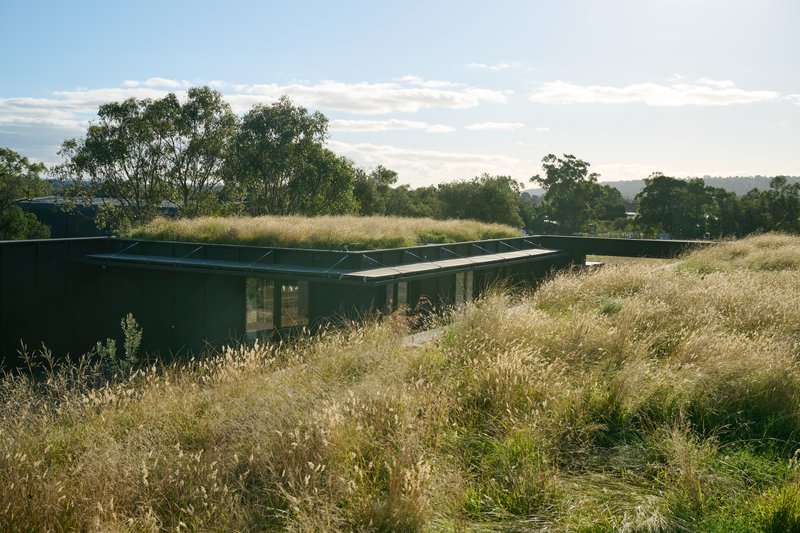
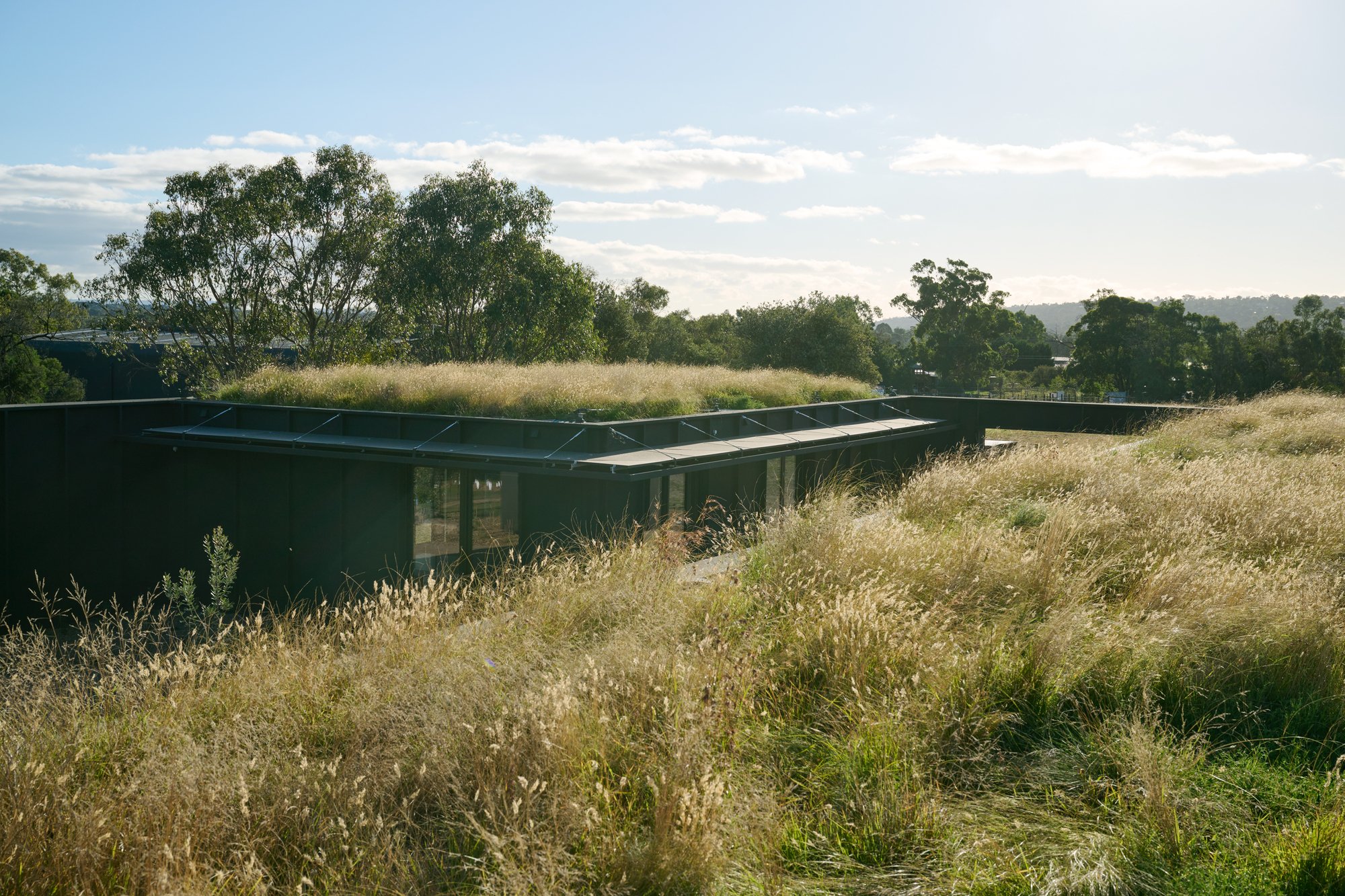
The defining feature of the building is its roof. Rather than a tidy sedum mat, the architects and landscape designer Sam Cox Landscape planted a full meadow of native Australian grasses across the entire roof surface. From above, the building disappears into the surrounding bushland. From the ground, it reads as a low dark line with a band of moving grass hovering above it.
This is harder than it looks. Extensive green roofs of this kind carry a real soil depth, serious irrigation requirements during establishment, and a structural weight that most school budgets would flinch at. The architects pushed the specification through anyway, and the result is a roof that works as both insulation and habitat. It is the building's most visible piece of advocacy, and also the one most worth the money.
A Dark Box in the Bushland
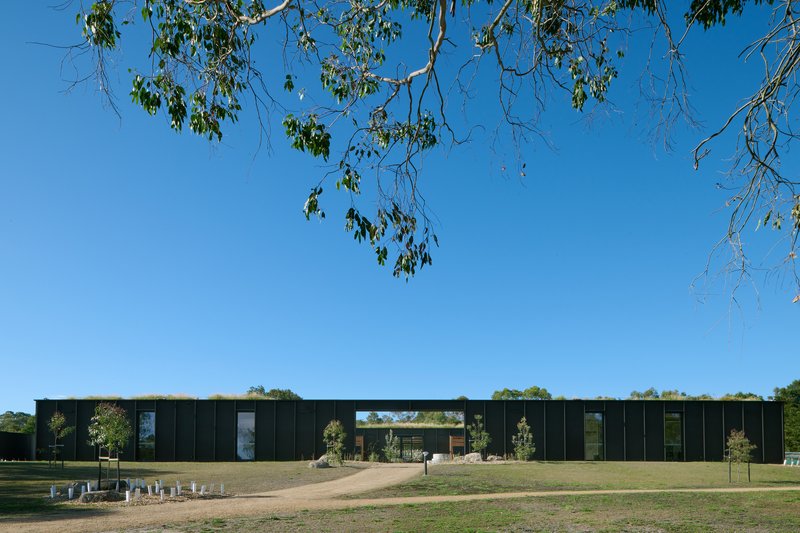
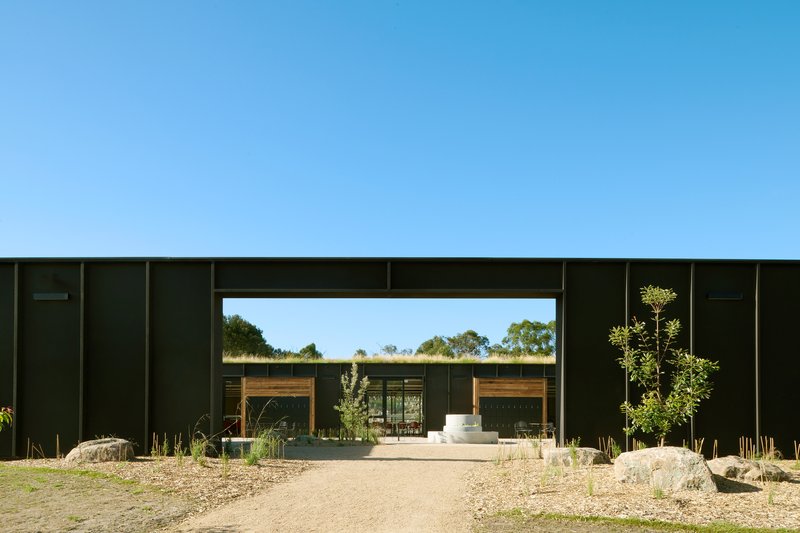
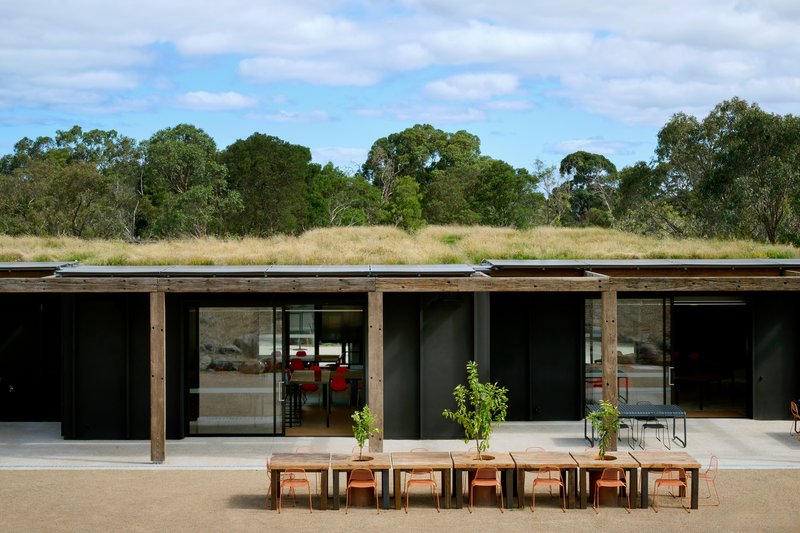
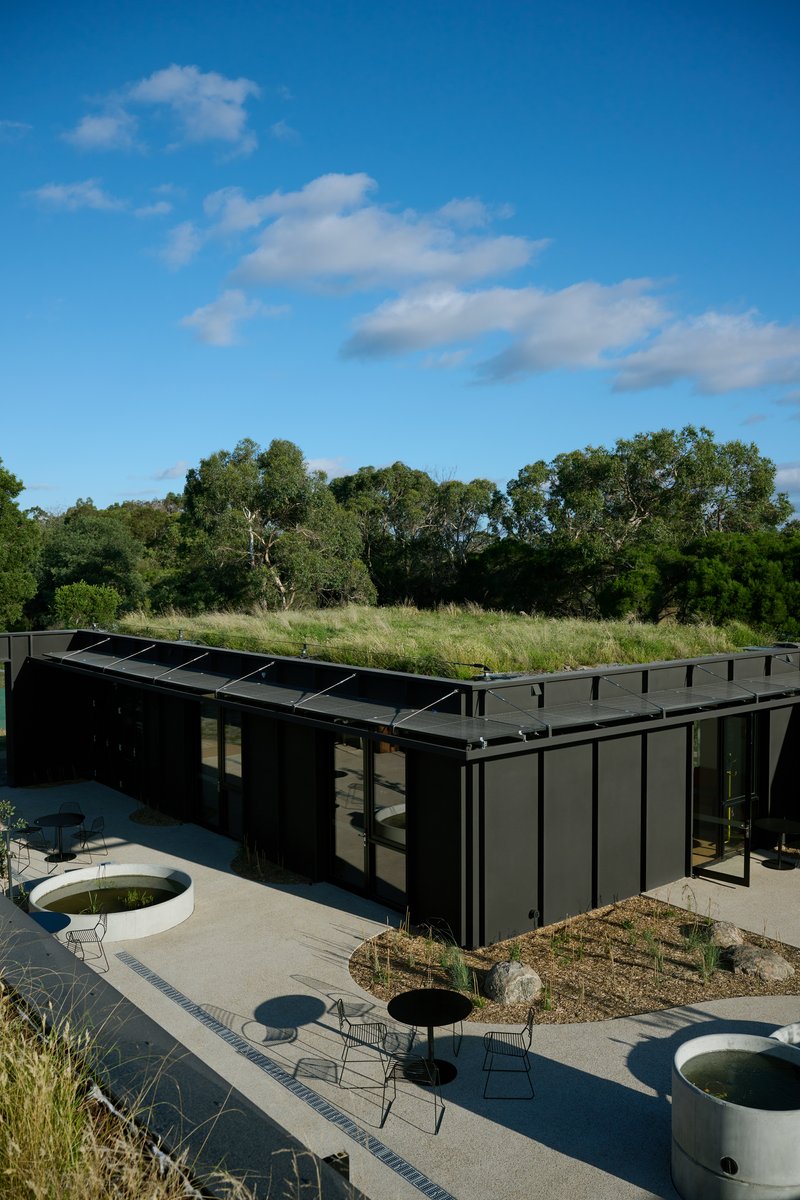
The walls below the green roof are clad in a dark vertical board that reads almost black against the surrounding bushland. This colour choice is deliberate. Bush schools in Victoria have traditionally been painted green, pale timber, or something meant to blend in. The dark cladding at Woodleigh does the opposite: it settles into the landscape by contrasting with it rather than mimicking it. The meadow on top does the blending.
The entry is a single tall rectangular opening cut through the facade. There is no signage, no canopy, no colonnade. You walk through a rectangle in a dark wall and the courtyard opens up on the other side. This is a quiet but confident move. The architects trust the building to announce itself through its geometry rather than through decoration.
The Courtyard and the Solar Canopy
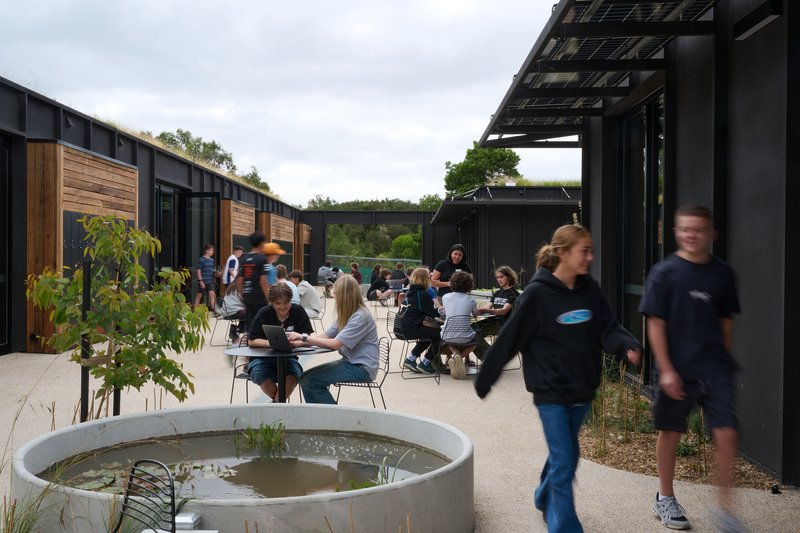
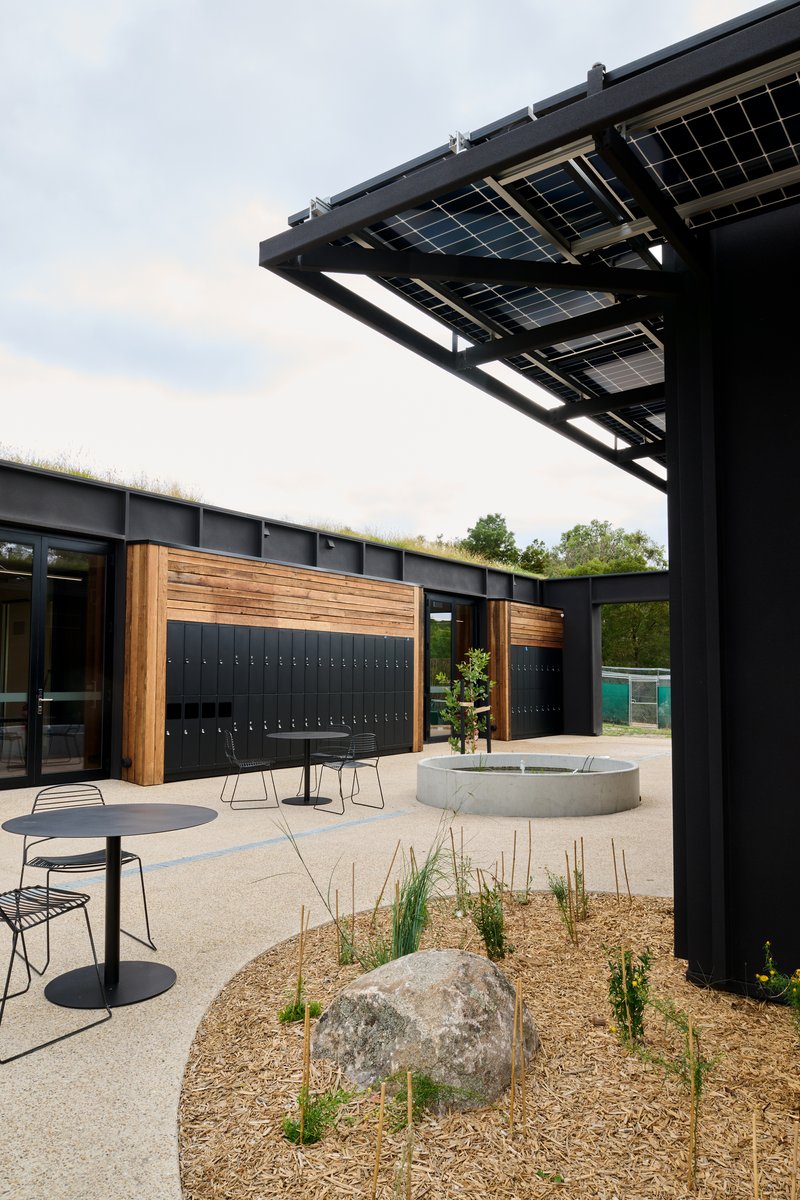
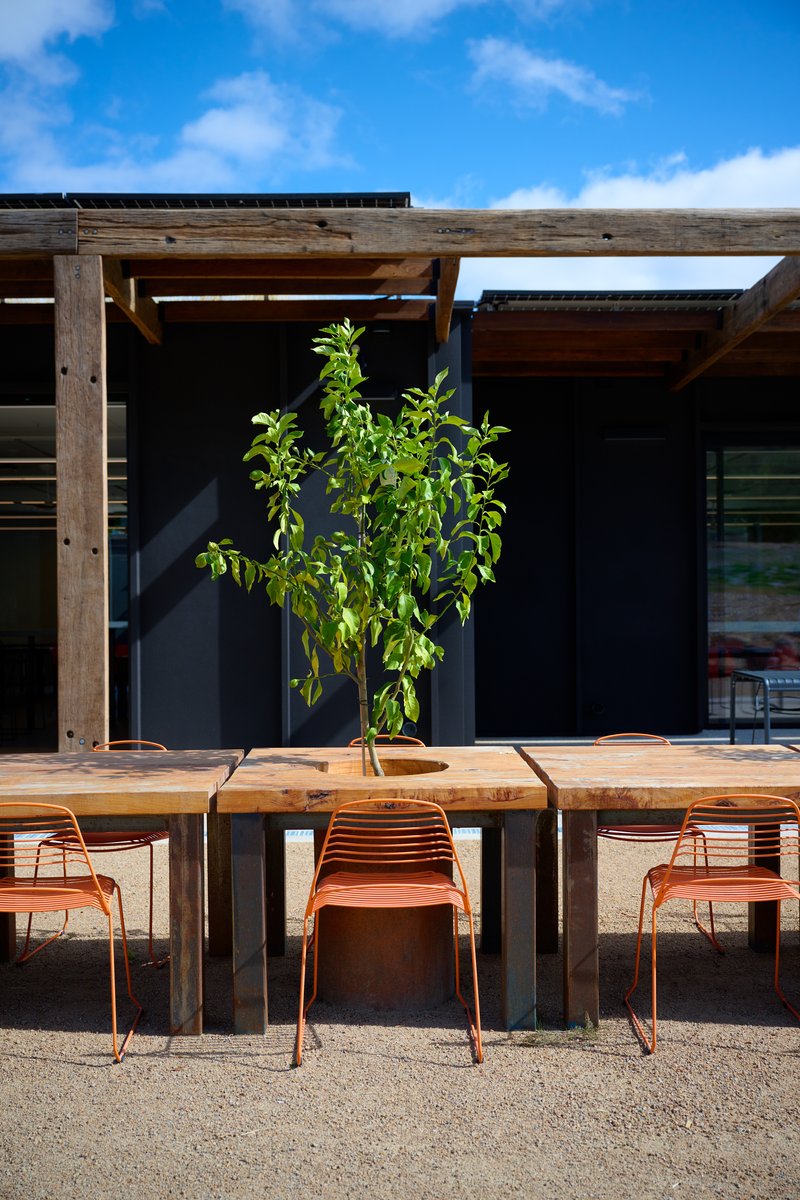
The plan is organised around a central courtyard that collects the sun, the circulation, and the social life of the studio. Photovoltaic panels are mounted on lightweight steel frames that double as pergolas, providing shade for outdoor seating and generating the building's electricity. A round concrete water feature sits at the courtyard's centre and catches rainwater run-off.
This is where the regenerative brief starts to feel real. The PV canopies are not decorative. They cover the outdoor seating zone, which is where students actually eat and work in the warmer months, and they generate enough power to cover the building's operational load. The outdoor tables are made from recycled hardwood and planted with small living trees through cut-outs in the table tops, which is the kind of gesture that could read as a gimmick but at this scale reads as care.
Interiors: Cork, Orange, and Green
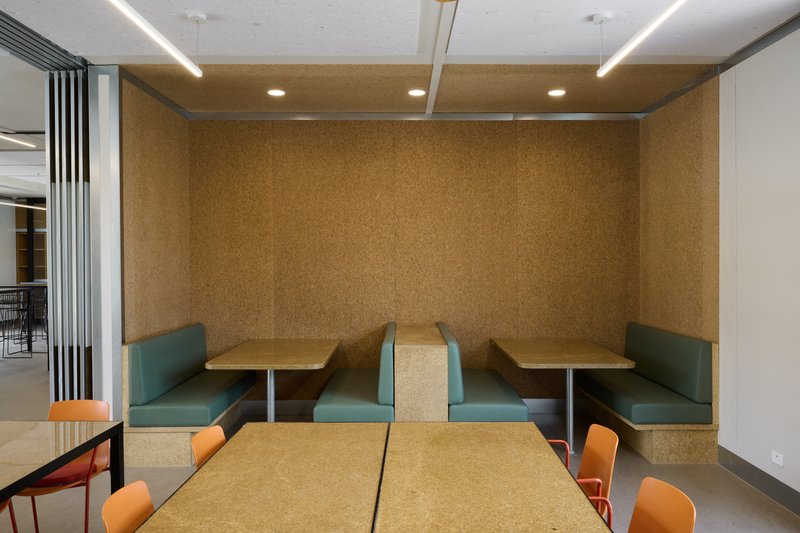
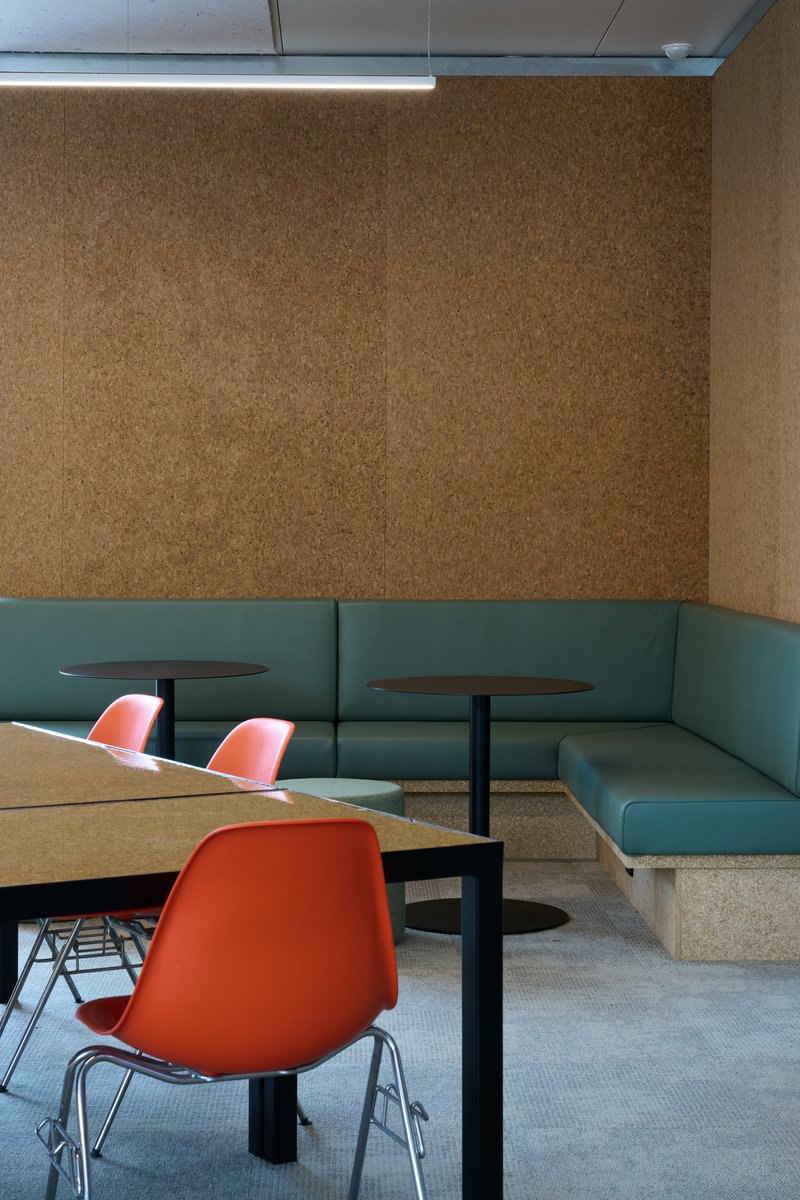
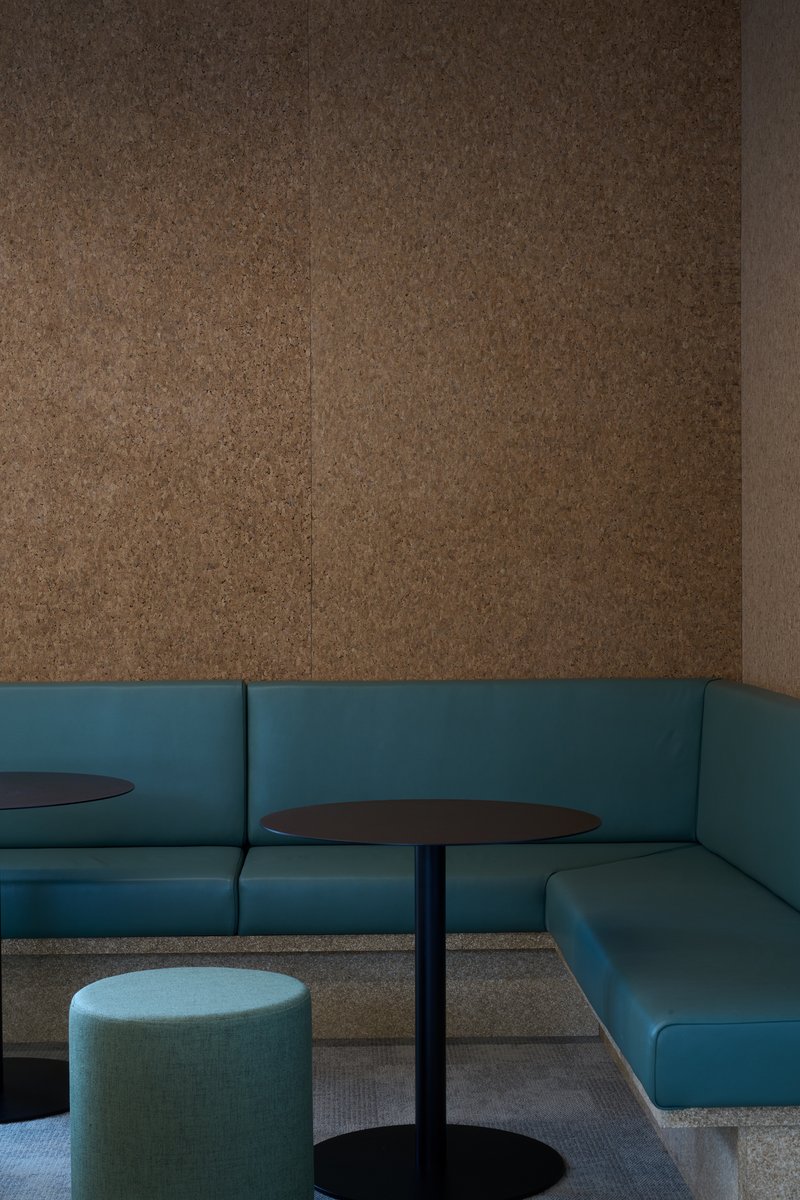
The interior colour palette is strong, specific, and unusual for a school. Cork wall panels run through the breakout nooks and corridors, providing acoustic softening and a warm tactile surface that contrasts with the dark exterior. Teal leather banquettes define the seating zones. Orange moulded chairs, drawn from the mid-century Eames vocabulary, punctuate the classroom spaces.
This is a confident colour story. Most schools default to greys and primary blues because those are the cheapest palette to maintain and the least likely to offend anyone. Woodleigh goes the other way. The cork, teal, and orange are chosen to give every room a distinct atmosphere and to resist the institutional dullness that sinks most educational interiors.
The Classrooms and the Break Spaces
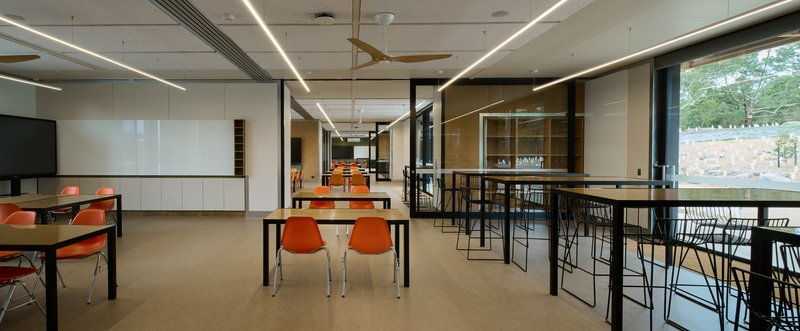
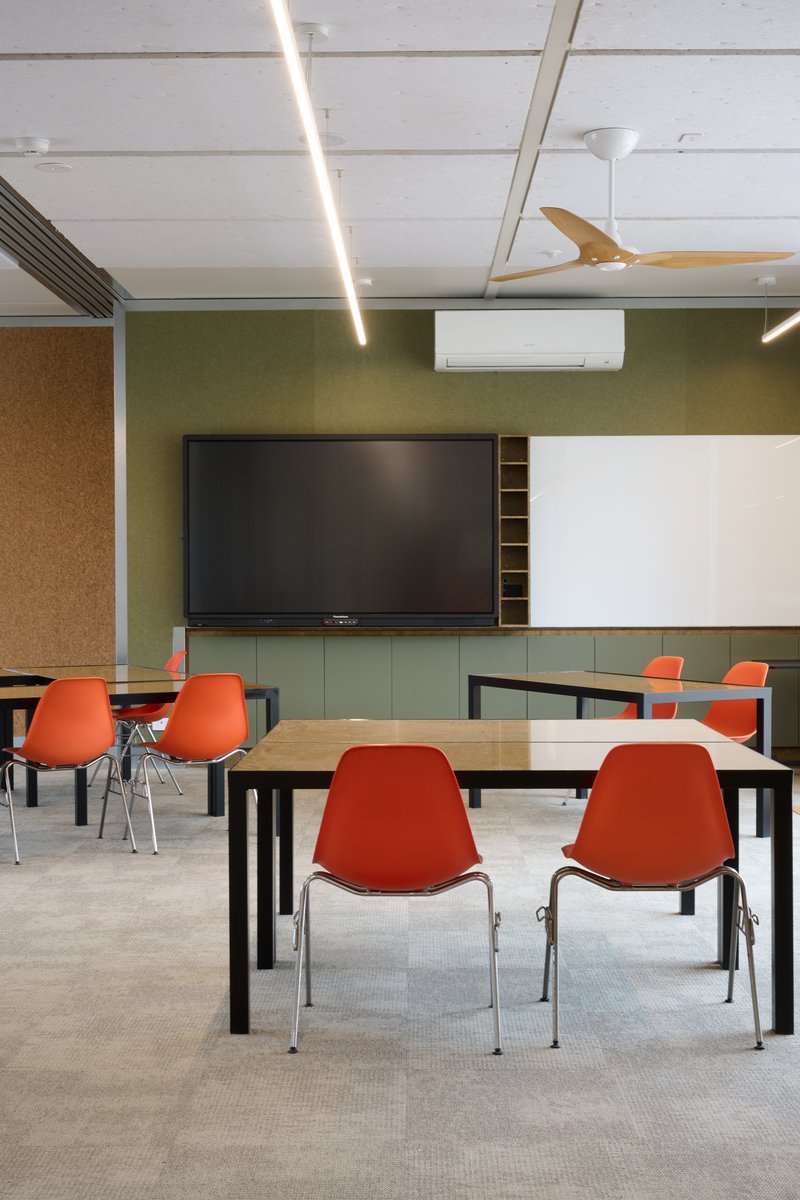
The classrooms themselves are flexible, with long shared tables, a curtain wall onto the courtyard, and enough acoustic treatment to keep a room full of teenagers workable. The green accent wall in the larger classroom, paired with cork pinup panels, is exactly the kind of small decision that changes how a room feels at the start of a day. Ceiling fans, exposed lighting tracks, and simple whiteboards keep the technology visible and replaceable.
The Kitchen and the Shared Table
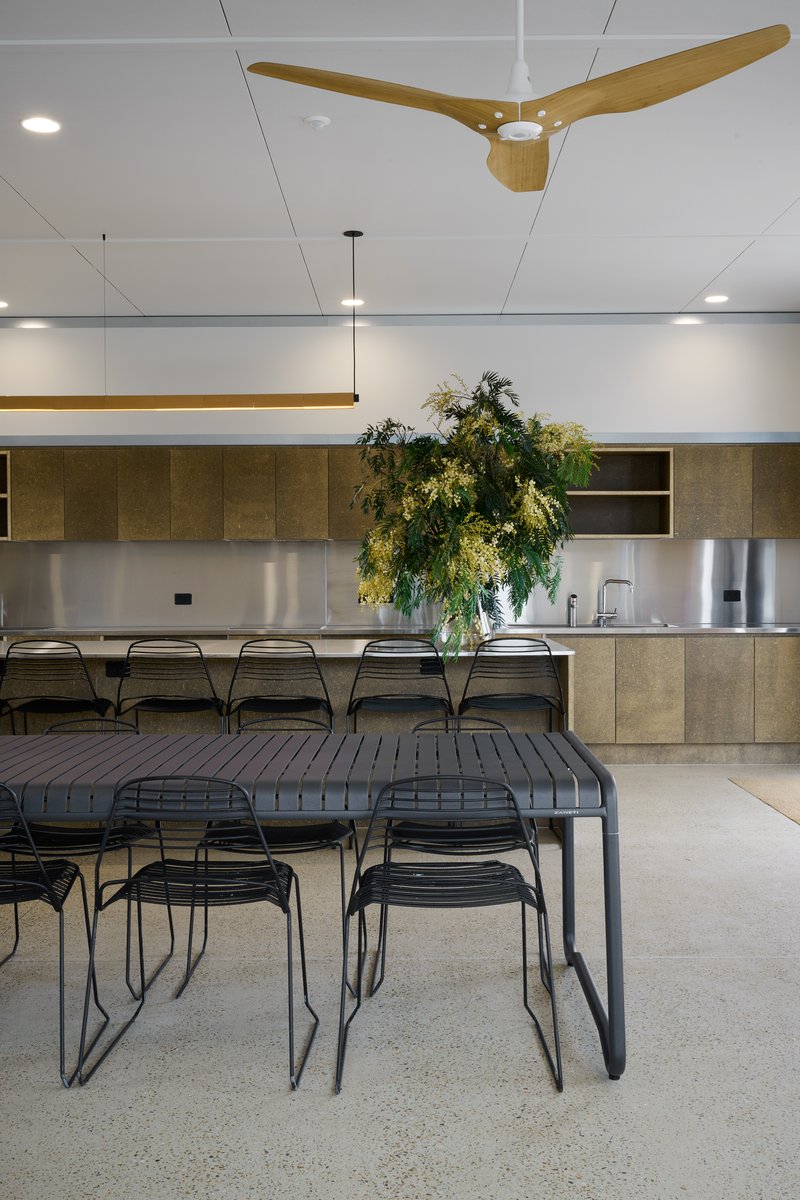
At the centre of the studio's day is a long shared kitchen and dining table with wire-frame chairs and a tall vase of native foliage. The table is the project's most quietly important space. It turns the school into a household for the duration of the day. Students eat here, work here, and meet here, and the decision to give the kitchen real equipment, proper counters, and a generous height suggests the architects understood that food is part of the teaching, not a service added on.
Material Detail at Close Range
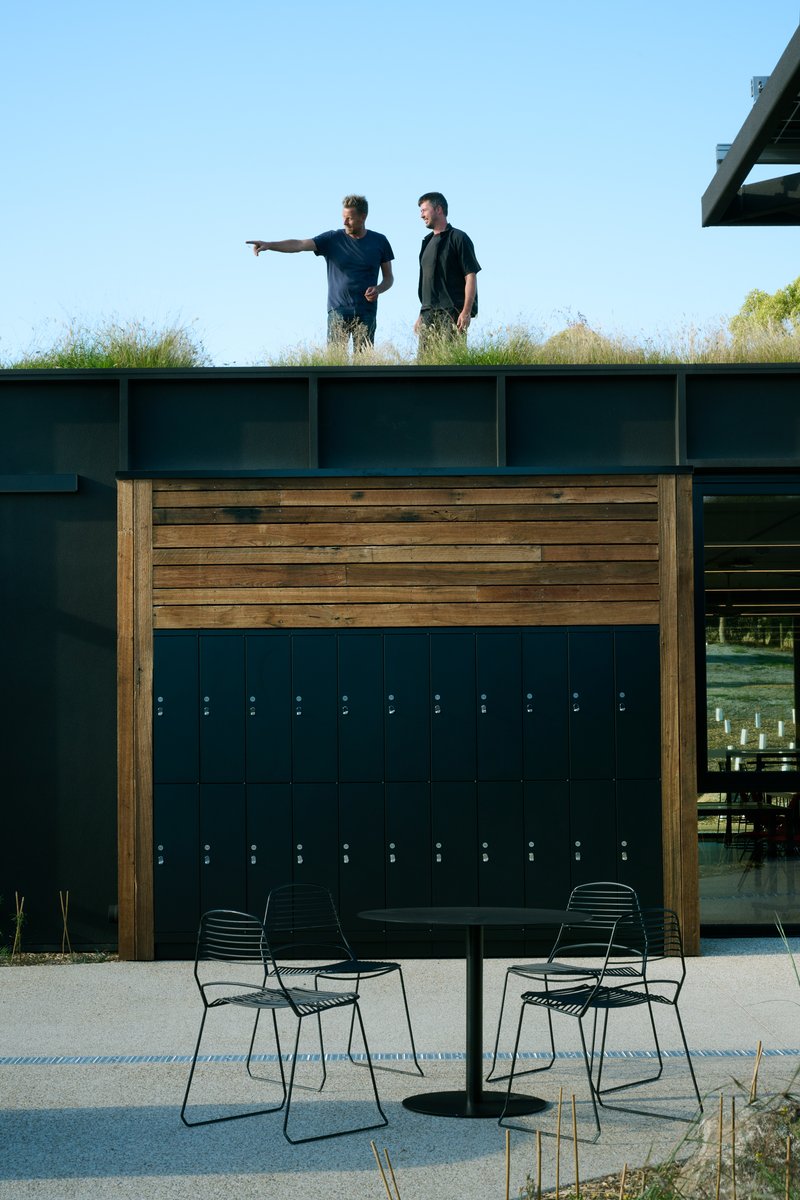
Up close, the materials hold up. The timber locker wall below the green roof is honest and properly detailed, the transitions between the dark boarded facade and the planted roof edge are crisp, and the site furniture (tables, chairs, planters) feels consistent with the architectural language rather than picked from a catalogue. One of the better photographs shows two people standing on the green roof above the locker wall, pointing out to the landscape. It is a small moment but it is the kind of moment a school building should be able to host.
Why This Project Matters
Most sustainability briefs fail because the architects treat them as a constraint to be worked around rather than an idea to be worked with. Woodleigh's architects treated the regenerative brief as the whole point of the project, and the building is organised around it from the plan outward: the meadow roof, the solar canopy, the recycled hardwood furniture, the cork walls, the round water feature, the native planting. Everything contributes to the same argument.
The lessons are transferable to anyone designing for education, or for any other public programme on a tight budget. Spend the green-roof money. Make the renewable-energy infrastructure double as outdoor shelter. Let the colour palette be specific rather than safe. Put a real table at the centre of the building. Trust students to understand the brief better than most architects expect. McIldowie Partners and collaborator Joost Bakker have produced a project that is easier to learn from than most, and the photographs by Earl Carter show what the brief looks like when it is taken seriously.
About the Studio
Share Your Own Work on uni.xyz
If you are working on educational architecture, sustainability-led public buildings, or regenerative design, uni.xyz is a place to publish your work, find collaborators, and enter design competitions.
Project credits: Woodleigh Futures Studio by McIldowie Partners. Victoria, Australia. Completed 2025. Design collaborator: Joost Bakker. Construction: South East Building Services. Landscape: Sam Cox Landscape. Structure: TGA Engineers. Services: BRT Consulting. Photographs: Earl Carter.




Popular Articles
Popular articles from the community

20 Most Popular Office Building Projects of 2025
From biophilic workspaces in India to net-positive energy offices in New Delhi, 20 office building projects that defined architecture in 2025.

Bernardes Arquitetura Stretches a Timber Roof Along a Reservoir's Edge in Minas Gerais
Dam House in Itaúna lets a sweeping wooden canopy dissolve the boundary between hillside terrain and open water.
Rojkind Arquitectos and Think Parametric Build a Glueless Pavilion from 67 Interlocking Panels
A serpentine fiber-cement installation in Chapultepec Park celebrates a decade of architectural media in Mexico City.
Fausto Terán and Toro Fuse Japanese Craft with Mexican Tradition in a Lakeside Retreat
Nakamura House pairs Shou-Sugi-Ban charred pine with handmade clay tile at the foot of Atlangatepec Lagoon in Mexico.


Similar Reads
You might also enjoy these articles

127af Flips a Tiny Bagnolet Rowhouse Upside Down with a Handcrafted Roof Extension
A 55-square-meter terraced house on the edge of Paris gains a luminous upper living floor through lightweight timber and steel.
1.61 Design Workshop Wraps a 600-Square-Meter Café in Vietnam in Sculptural Burgundy Drama
Reden Café & Bistro pairs a helical staircase, mosaic floors, and deep red interiors to rethink Vietnamese hospitality space.
The Unbound Brain: A School Shaped by Cognitive Architecture
Cylindrical learning pods radiate like neurons from a central cortex, turning the floor plan into a spatial model of human thought.
Revival Vernacular Architecture: Rammed Earth Settlements for the Sahara
A modular desert community in Mauritania that fuses passive cooling techniques with earthen construction and local craftsmanship.


Explore Educational Building Competitions
Discover active competitions in this discipline




The Global Benchmark for Architecture Dissertation Awards


Challenge to design public laboratory
Comments (0)
Please login or sign up to add comments
No comments yet. Be the first to comment!