
WORKac Designs a Net-Zero Riverhouse in Rhode Island for Their Own Family
On the banks of the Pawcatuck River, a compact Passive House replaces a weathered retreat with color, craft, and ecological rigor.

When architects design for themselves, the results tend to reveal what they actually believe in rather than what clients ask for. Riverhouse, completed in 2025 by WORKac founders Amale Andraos and Dan Wood, is a 3,200-square-foot home on the banks of the Pawcatuck River in Hopkinton, Rhode Island, built for their family on the footprint of a weathered retreat that once hosted informal architecture camps and communal living. The new house sits inside a state-protected river corridor, elevated above a floodplain, and meets Passive House energy standards while also being one of the more visually idiosyncratic homes we've come across this year.
What makes Riverhouse genuinely interesting is how it refuses to separate its ambitions. It is at once a rigorous net-zero building with 14-inch insulated walls, triple-glazed windows, and photovoltaic panels with battery storage, and a house packed with personality: handmade Lebanese tiles developed with designer Karim Chaya, a sweeping curtain by Petra Blaisse spanning the living room, a custom dining table by MOS Architects, and a blue metal roof that glows against the forest canopy. The house proves that high-performance architecture need not be austere, and that cultural resonance and ecological intelligence can occupy the same compact rectangular plan.
A Blue Object in the Trees
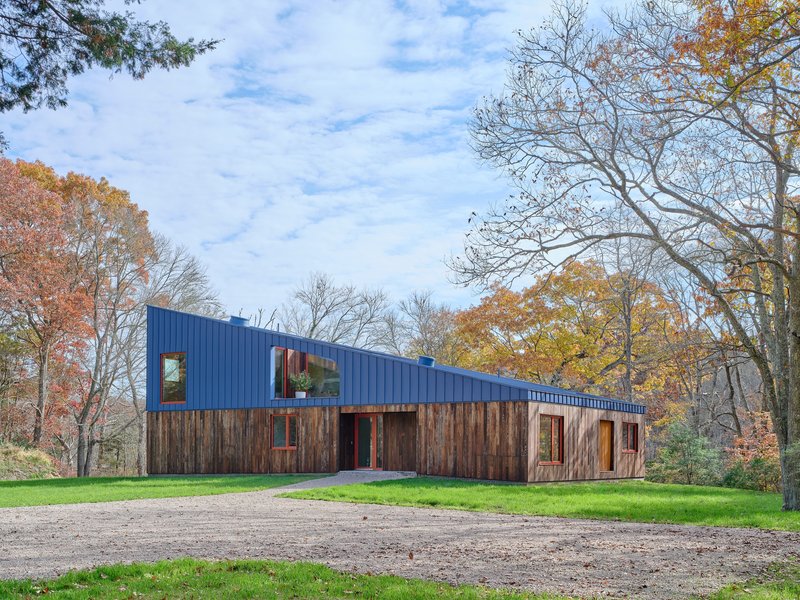
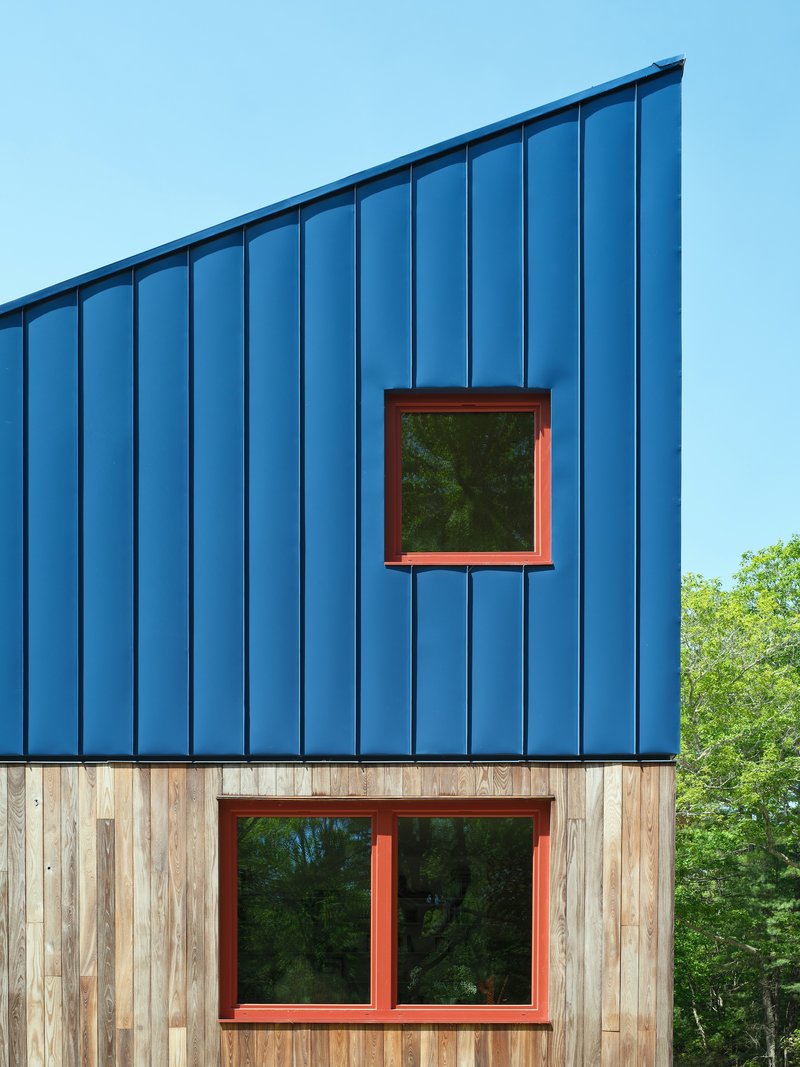
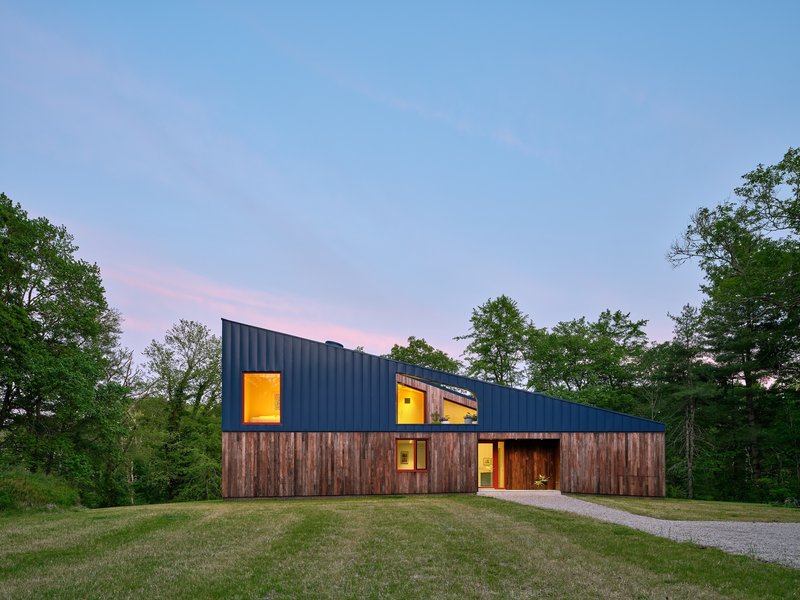
The first thing you notice is the color. A corrugated blue metal roof and upper volume sit atop a timber-clad base of thermally modified ash, and the contrast is immediate: cool industrial geometry floating on a warm, textured plinth. Red-framed windows punctuate the facade, adding a third register that feels deliberate rather than decorative. At dusk, the house becomes a lantern against the pink sky, its lit windows stacking vertically like frames within a frame.
The elevation is not merely aesthetic. Floodplain regulations required the structure to be raised, and WORKac turned this constraint into a spatial strategy. The timber base lifts the living spaces high enough to frame long views across the site toward the river, while the faceted upper volume with its diagonal ridgeline creates a mezzanine bedroom tucked under the roof. The building reads differently from every angle: solid and grounded from the garden, weightless and angular from the creek.
Nestled in the River Corridor
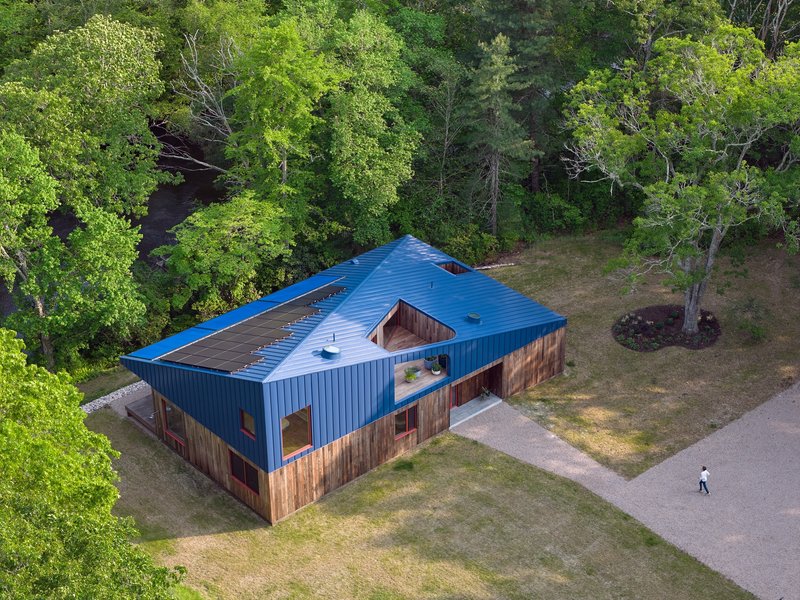
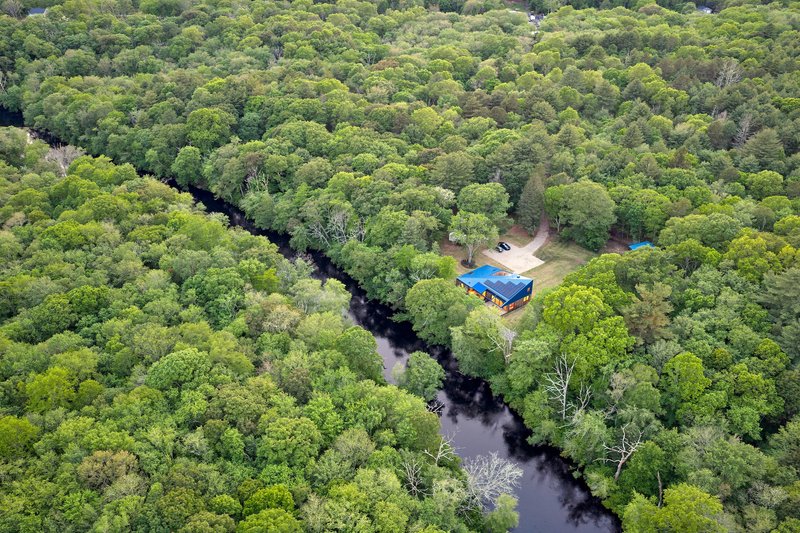
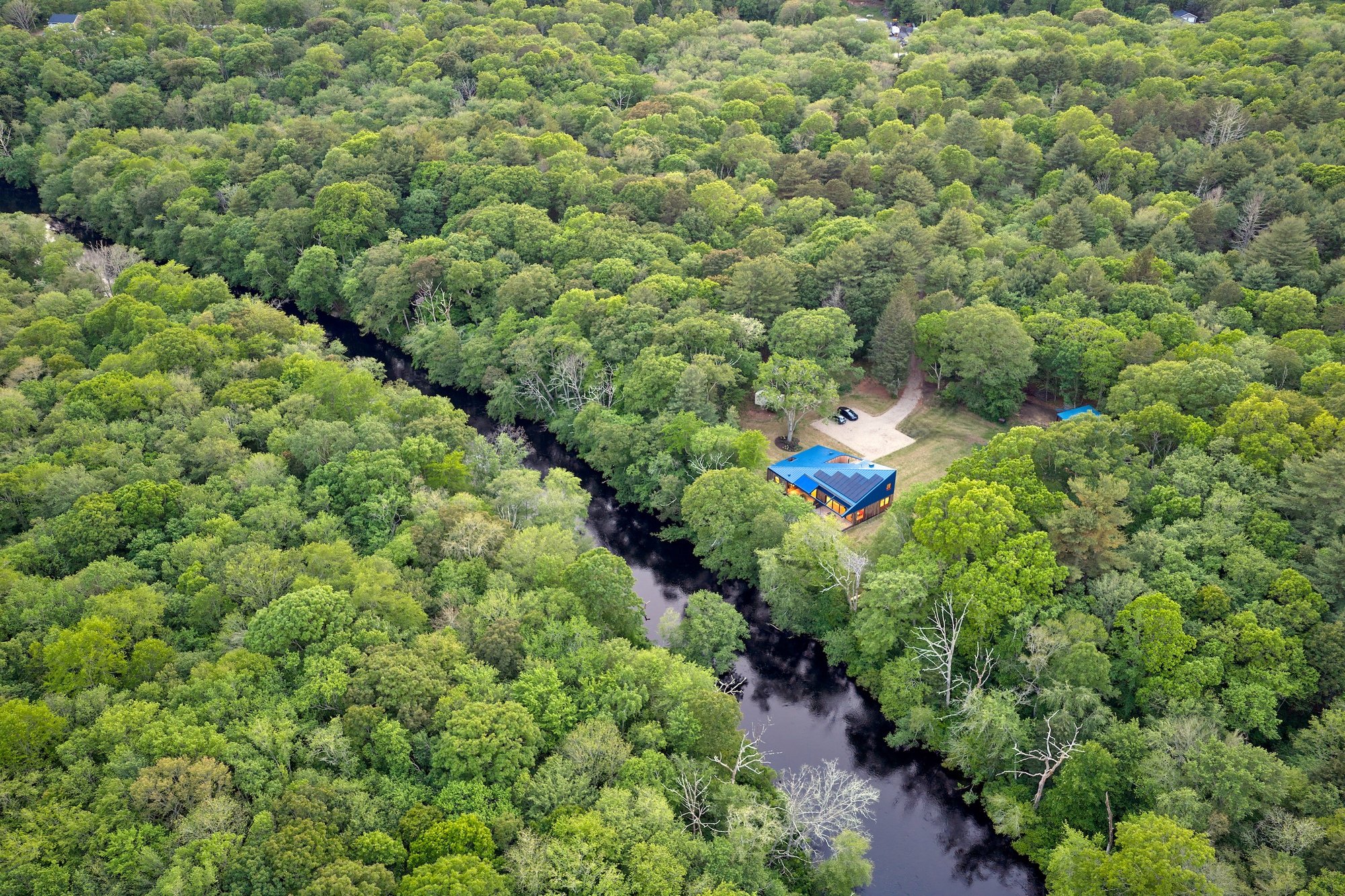
From above, the house nearly disappears. The blue roof merges with the creek's shimmer, and the surrounding forest canopy wraps tightly around the clearing. A central skylight punches through the ridgeline, pulling light down into the double-height living space below. The drone views make the scale legible: this is a compact structure in a vast landscape, carefully positioned on the existing footprint to minimize disturbance within the protected corridor.
Future phases are planned to include a pool, a pavilion, and a garden that will revive the site's history as a gathering place for architecture camps. For now, the house stands alone, a precise insertion that treats the river and forest not as backdrop but as the primary condition to which every decision responds.
The Garden Facade and Entry
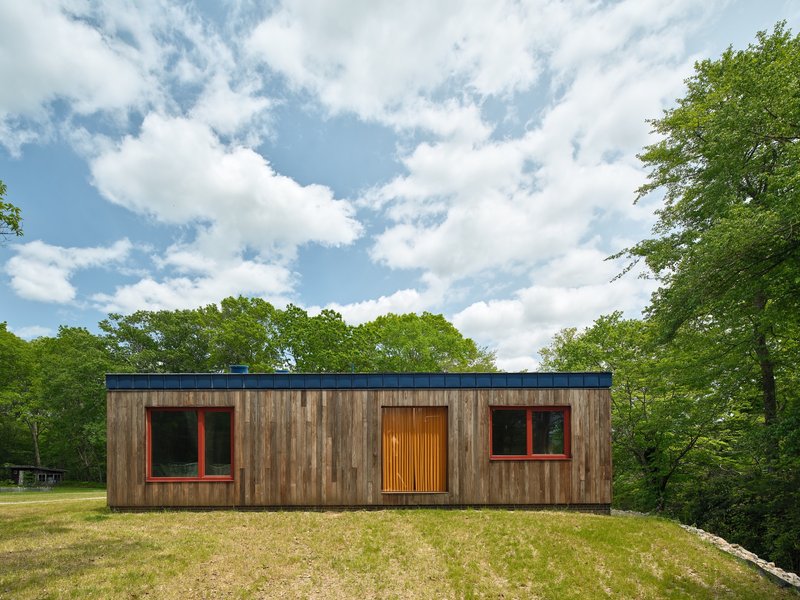
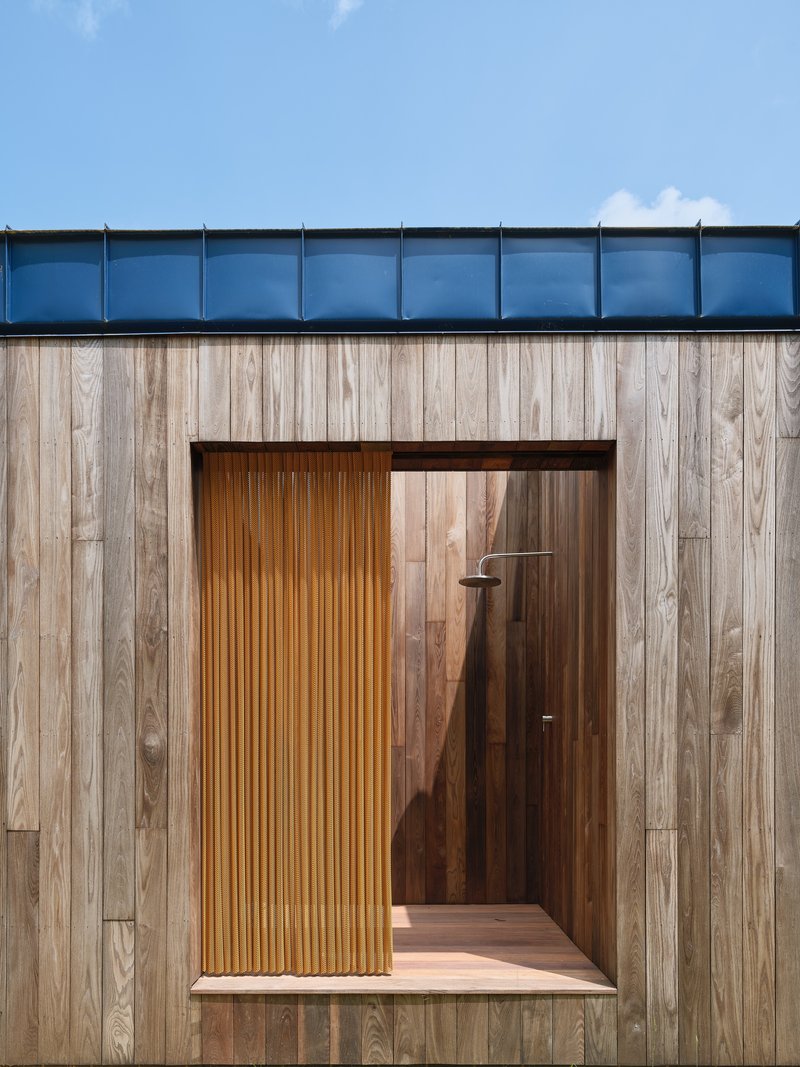
The garden-facing elevation is the most restrained. Thermally modified ash cladding ages gracefully toward silver, and a vertical slat entry door sits recessed within the timber plane, marking the threshold without ceremony. The blue metal parapet above draws a clean line against the sky. There is something almost agricultural about this face of the house, a barn-like simplicity that anchors it in the rural Rhode Island landscape.
Color and texture do the work that formal gymnastics might handle in other projects. WORKac uses material variation to reflect the surrounding tones: the warm ash against autumn leaves, the blue roof against overcast skies, the red window frames as a deliberate accent that signals inhabitation. It is a palette drawn from observation rather than abstraction.
Living Under the Diagonal Ridgeline
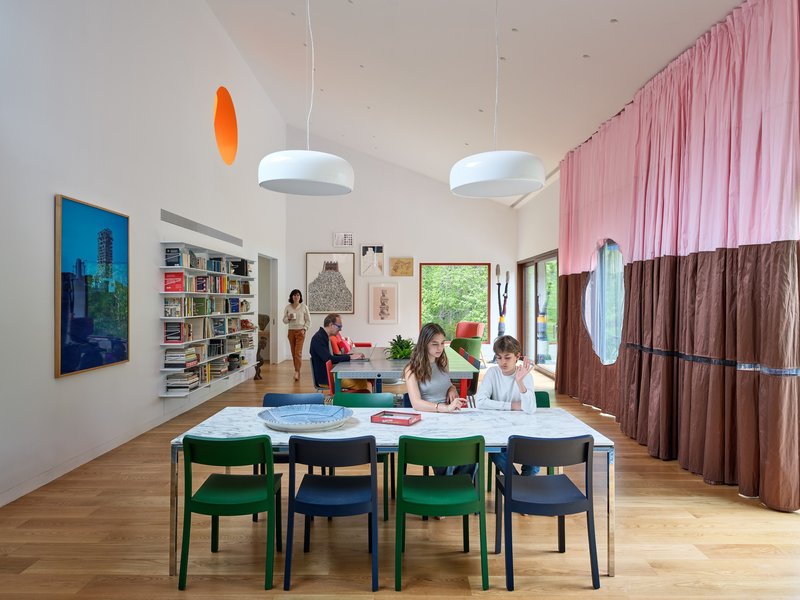
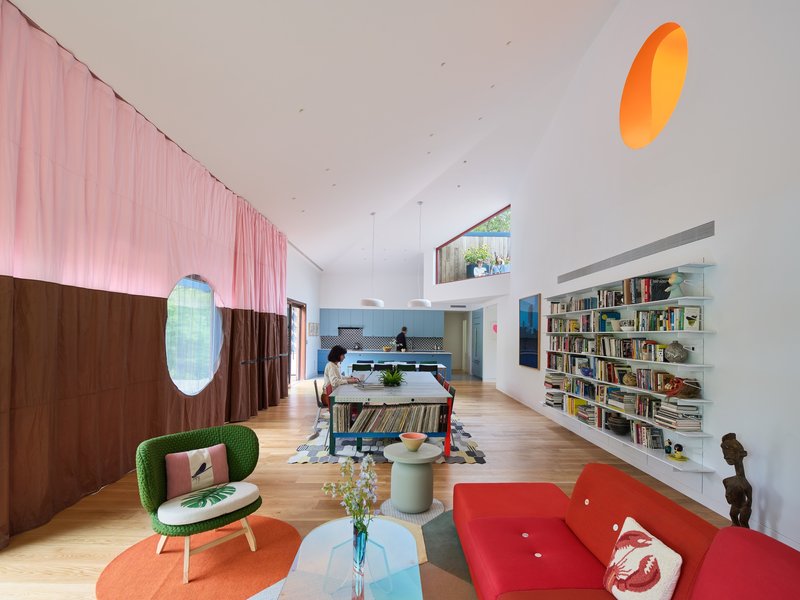
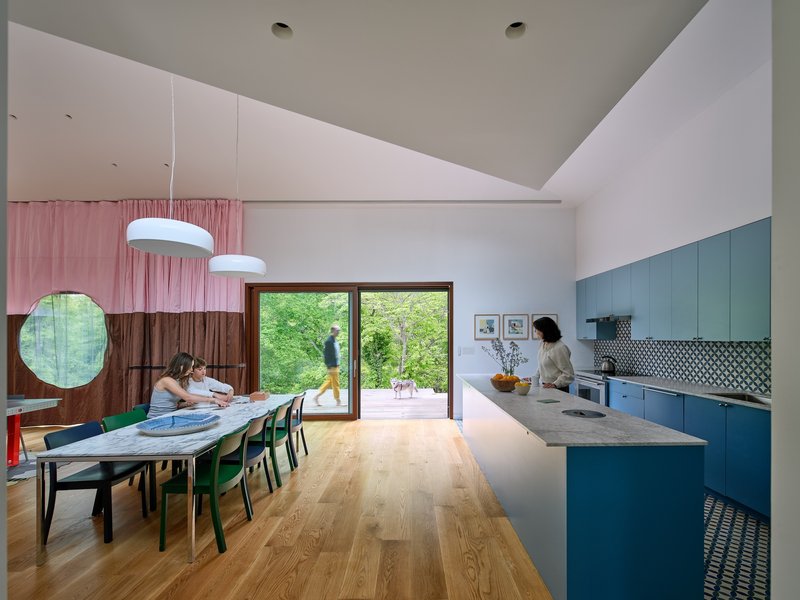
Inside, the angular geometry of the roof becomes the dominant spatial experience. The diagonal ridgeline creates a vaulted ceiling over the open-plan living, dining, and kitchen zone, and the height shifts dramatically as you move through the space. A pink and brown fabric partition by Petra Blaisse divides without enclosing, its circular openings framing views through the house and lending a softness that counters the precision of the architecture.
The kitchen features blue cabinetry that echoes the exterior roof, and glazed doors open to the garden, collapsing the boundary between inside and out. Built-in bookshelves, integrated storage, and oak flooring keep the interior warm and functional. The custom dining table by MOS Architects sits at the center of the plan, a collaborative gesture between practices that underscores the house's identity as a project made within a community of architects and designers.
Cross-ventilation is encouraged by strategically placed windows, and the all-electric, year-round performance means no fossil fuels touch this house. The 14-inch insulated walls and triple glazing do the heavy thermal lifting, while the photovoltaic panels and battery storage handle generation. None of this is visible from the living room. The technology recedes; the space performs.
Outdoor Rooms Above and Below
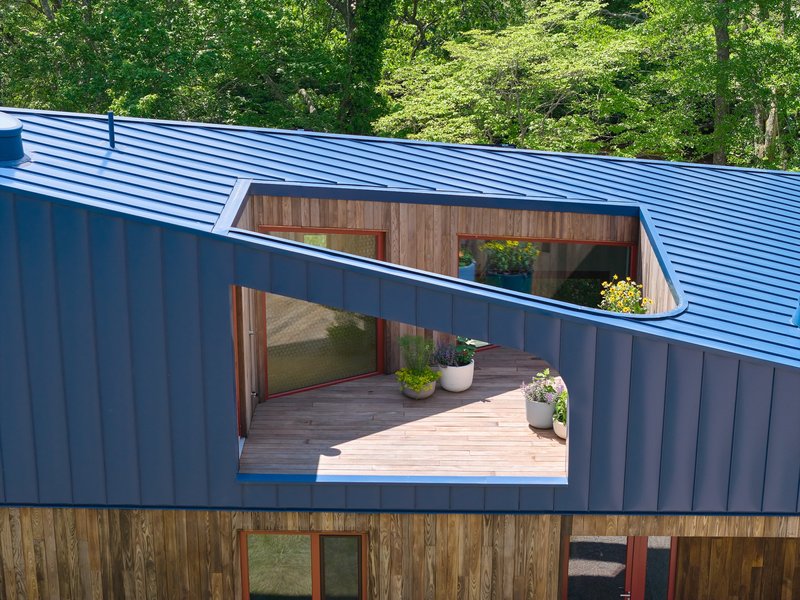
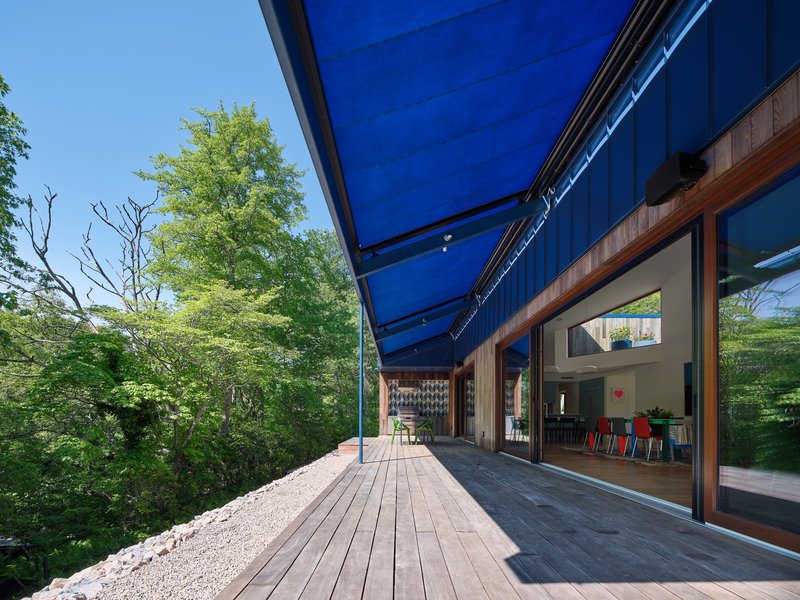
The house extends into outdoor rooms at two levels. A cutout terrace carved from the blue metal upper volume creates a sheltered balcony surrounded by dense foliage, with timber decking and potted plants blurring the line between architecture and garden. Below, a generous deck extends beneath the cantilevered blue roof, offering shade and rain protection while immersing occupants in the leafy spring canopy.
These outdoor spaces are not afterthoughts. They are calibrated to the seasons: the upper terrace catches breezes in summer, the lower deck provides a covered platform during rain. Both reinforce the house's central thesis that living lightly on a floodplain is not a limitation but an invitation to engage with the landscape at multiple elevations.
Lebanese Tiles and Handmade Details
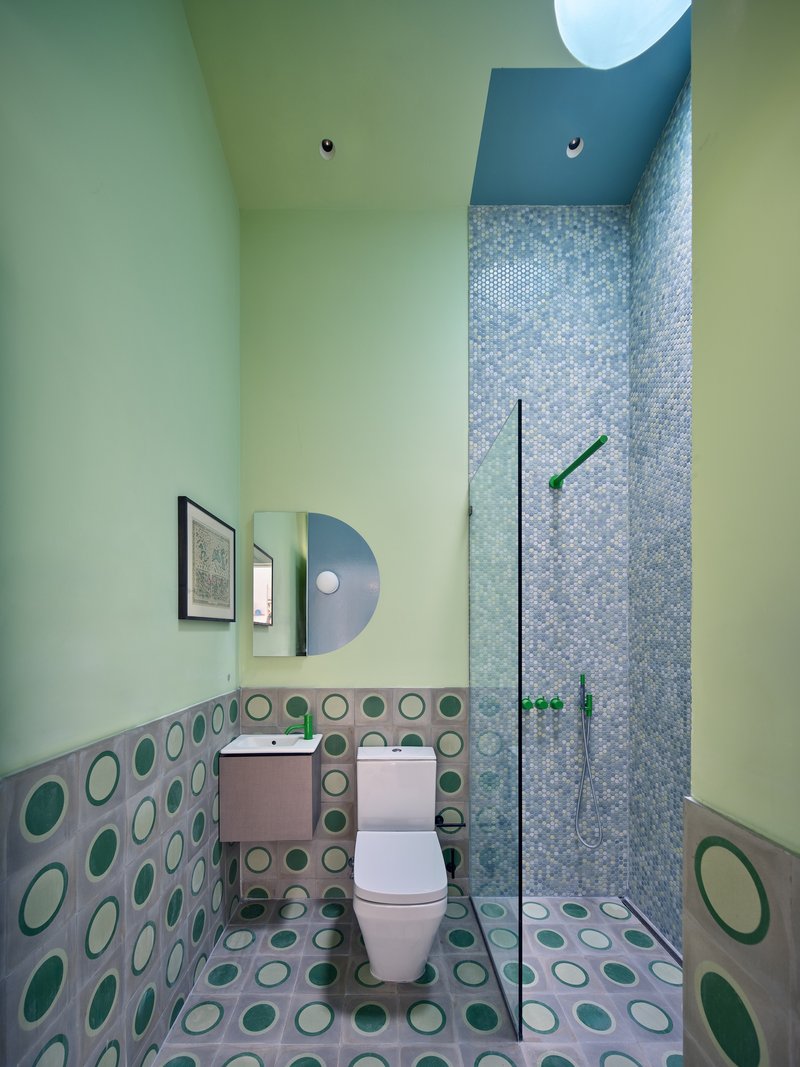
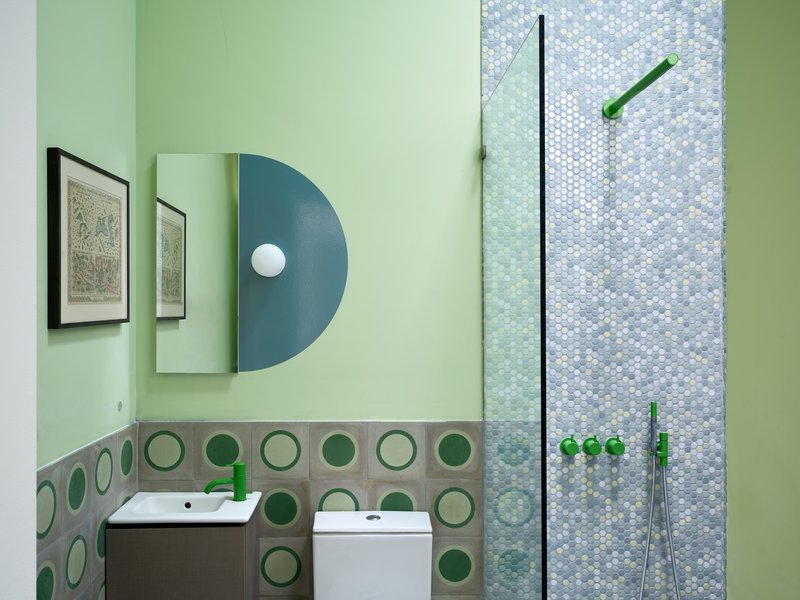
The bathrooms are where the cultural dimension of the project becomes most tangible. Handmade Lebanese concrete tiles, developed in collaboration with Karim Chaya, cover floors and walls in circular geometric patterns that reference traditional Lebanese craft. A half-circle blue-painted vanity cabinet with a round mirror above continues the geometry, and pale green walls provide a quiet backdrop. These rooms feel considered down to the grout line.
For a house designed by architects of Lebanese descent, these tiles carry personal meaning. They root the project in a specific cultural lineage while also functioning beautifully as durable, handcrafted surfaces in a wet room. Linen curtains for the bedrooms by Austėja Walter add another layer of textile specificity. Riverhouse accumulates its identity through these individual commissions and collaborations, each one a deliberate choice rather than a catalog selection.
Plans and Drawings
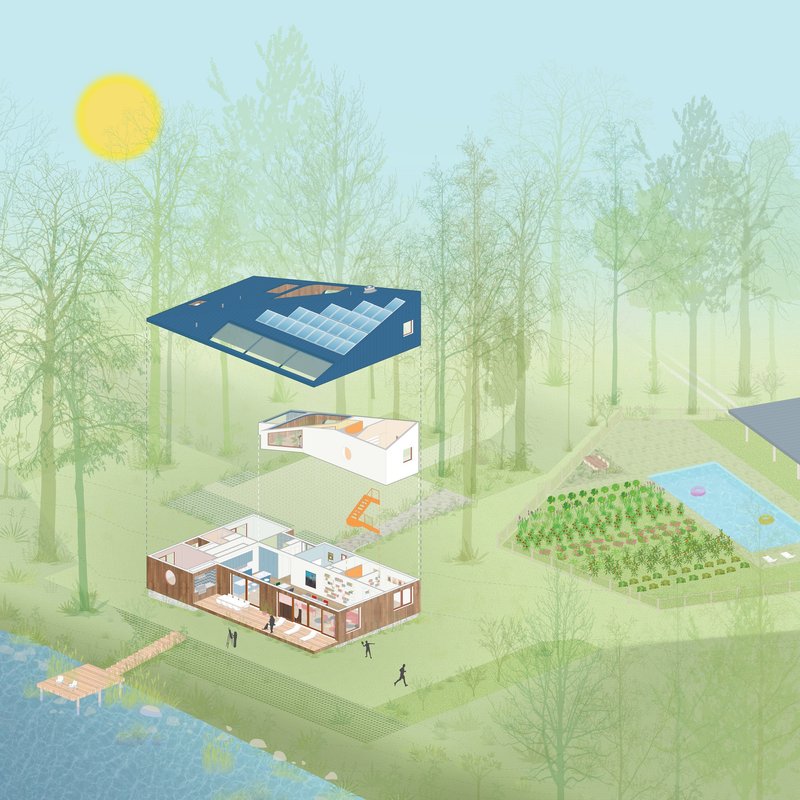
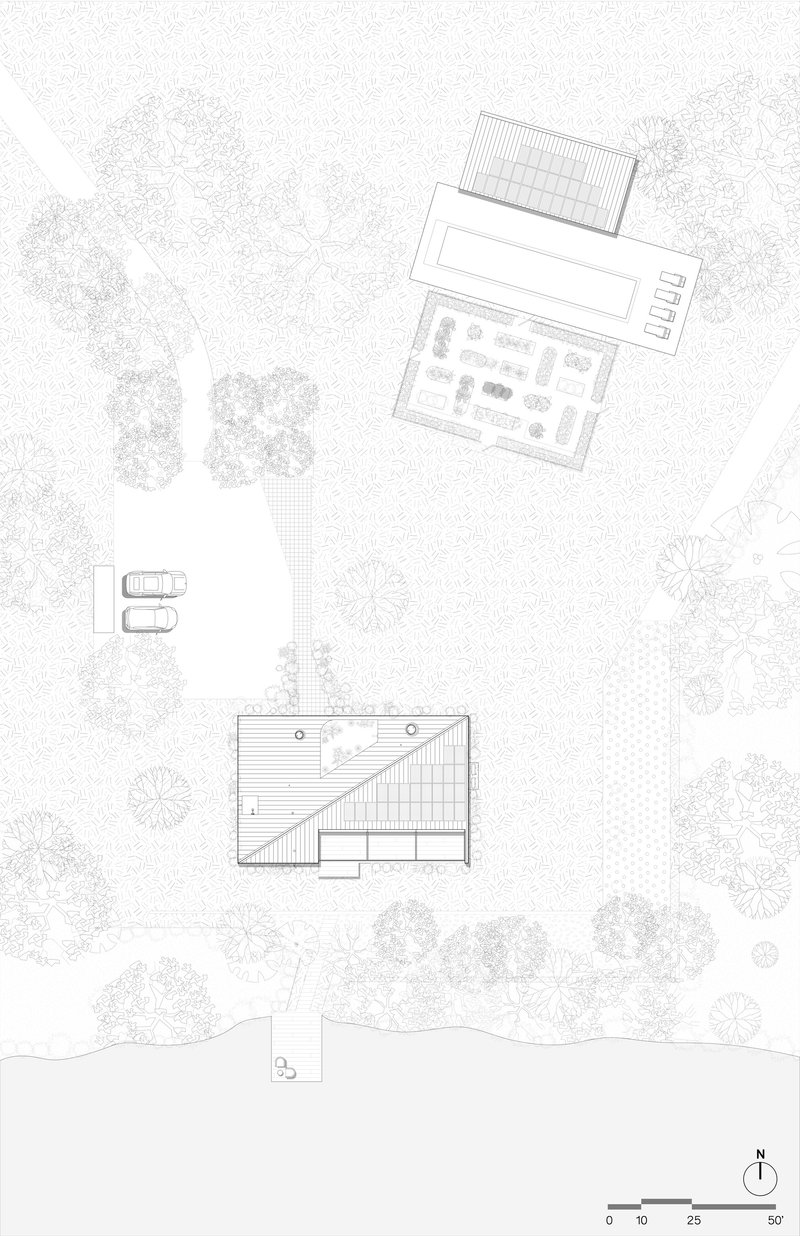
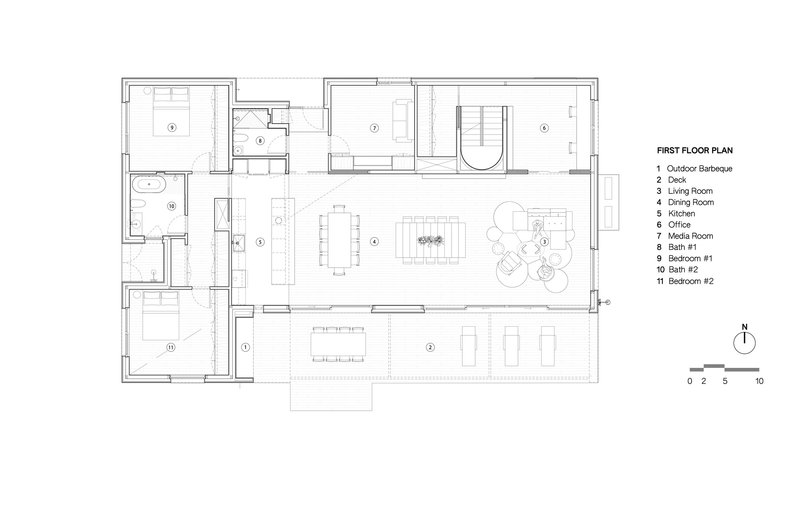
The axonometric drawing reveals the house's compact logic: an exploded view shows roof, floor plan, and site layered together, with the central courtyard and the diagonal ridgeline clearly legible as the organizing moves. The site plan locates the house relative to the river, a pier, parking area, and the dense surrounding tree canopy, making the case for how little ground the building actually occupies. The first floor plan confirms the open living and dining arrangement, with bedrooms and bathrooms pushed to the edges to preserve the central double-height volume.
What the drawings communicate most clearly is restraint. At 3,200 square feet on an existing footprint, this is not a sprawling country estate. It is a tightly organized house that earns its spatial generosity through section rather than plan, using the angular roof geometry to multiply the perceived volume far beyond the modest floor area.
Why This Project Matters
Riverhouse matters because it collapses several false dichotomies that still plague residential architecture. Sustainable versus expressive. High-performance versus handmade. Personal versus rigorous. WORKac demonstrates that a net-zero Passive House can also be a house full of color, pattern, and commissioned craft. The blue roof is not greenwashing; it sits on top of 14-inch insulated walls and triple-glazed windows. The Lebanese tiles are not decoration; they are an assertion of cultural identity within an ecological framework.
There is also something instructive about architects building for themselves on a site with communal history, then planning to reopen it for architecture camps in future phases. The house is simultaneously private and propositional, a testing ground for ideas about how to live in a floodplain, off the grid, surrounded by forest, without retreating into either austerity or nostalgia. In a moment when many families are rethinking where and how they live, Riverhouse offers a model that is specific enough to resist imitation but generous enough to inspire adaptation.
Riverhouse, designed by WORKac (Amale Andraos and Dan Wood), Hopkinton, Rhode Island, United States. 3,200 sq ft. Completed 2025. Photography by Bruce Damonte.
About the Studio
Share Your Own Work on uni.xyz
If projects like this are the kind of work you want to make, uni.xyz is a place to publish your own, find collaborators, and enter design competitions.




Popular Articles
Popular articles from the community

GGR Architectes Anchors a New Neighborhood in Frouzins with a Brick and Timber School Complex
A cruciform plan of terracotta brick and exposed wood frames four courtyards for 140 students outside Toulouse, France.
Cro&Co Architecture Builds a 150-Meter Tower on Top of a Seven-Lane Highway in La Défense
Trinity Tower reimagines the office high-rise as a bioclimatic organism threaded with terraces, trees, and public ground in Paris's business district.
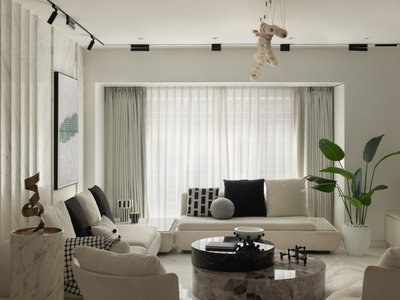
Inside a Timeless Mumbai Residence by Aether Studio
Aether Studio's 2,250 sq ft apartment in Malad, Mumbai uses marble, brass, boucle, and disciplined restraint to build a quiet retreat from the city.
ONA Threads Four Board-Formed Concrete Cabins Along a 260-Meter-Deep Site in Mendoza
At the edge of Argentina's wine country, a set of curved concrete lodges negotiate a razor-thin parcel between city and mountain.


Similar Reads
You might also enjoy these articles

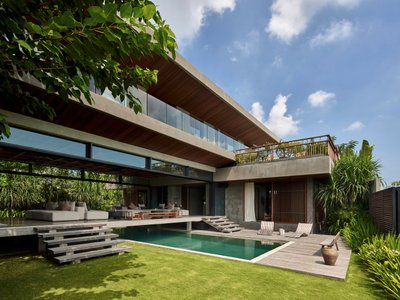
Freebird Residence by Alexis Dornier: A Tropical Modernist Sanctuary in Bali
Floating living pavilion above pool anchors H-shaped tropical villa, blending Japanese minimalism, sustainable strategies, lush landscape, and sculptural interiors.
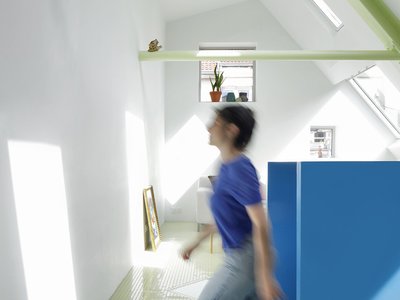
127af Flips a Tiny Bagnolet Rowhouse Upside Down with a Handcrafted Roof Extension
A 55-square-meter terraced house on the edge of Paris gains a luminous upper living floor through lightweight timber and steel.
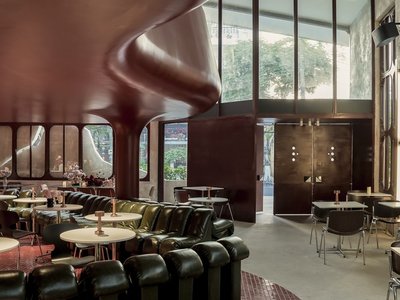
1.61 Design Workshop Wraps a 600-Square-Meter Café in Vietnam in Sculptural Burgundy Drama
Reden Café & Bistro pairs a helical staircase, mosaic floors, and deep red interiors to rethink Vietnamese hospitality space.

The Unbound Brain: A School Shaped by Cognitive Architecture
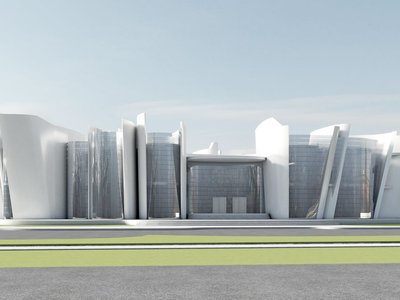
Cylindrical learning pods radiate like neurons from a central cortex, turning the floor plan into a spatial model of human thought.
Explore Sustainable Design Competitions
Discover active competitions in this discipline




The Global Benchmark for Architecture Dissertation Awards


Challenge to design mud housing for contemporary communities


Design challenge to reuse E-waste
Comments (0)
Please login or sign up to add comments
No comments yet. Be the first to comment!