

World-Renowned Firms Unite to Create Aarhus' New State-of-the-Art Stadium
Zaha Hadid Architects, Sweco, and Tredje Natur to Bring Cutting-Edge Design to Aarhus' Sports Scene

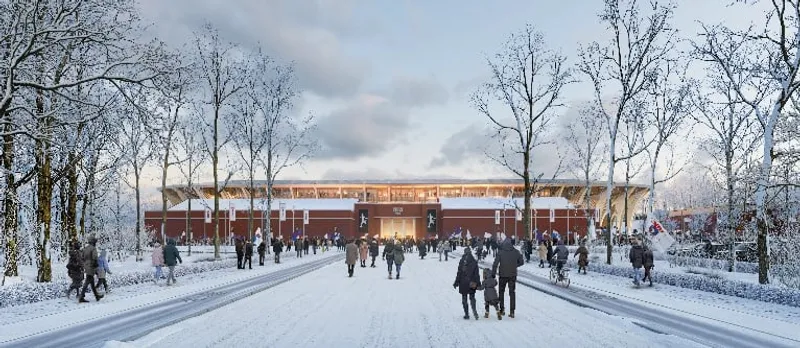
Zaha Hadid Architects, in partnership with architecture and engineering consultancy SWECO and landscape architects Tredje Natur, have emerged victorious in the competition to design and build the New Aarhus Football Stadium in Denmark.

The stadium, which will be situated within the city's Marselisborg forest, will boast a single-tiered seating bowl that will bring fans as close to the action as possible, creating an unparalleled match-day experience.
The design concept for the "Arena of the Forest" is inspired by the tall trees in the surrounding area, with heights reaching up to 47 meters. The stadium is meant to blend seamlessly with the forest, featuring vertical elements such as public colonnades and timber ribs on the façade. These vertical elements flow from the forest into the landscaped plaza and the concourses of the stadium. The use of an intricate hierarchy of timber ribs on the façade and roof helps to break up the large horizontal volume of the stadium, creating a more human scale and a sense of arrival for fans gathering in the nearby plazas.

The roof of the new stadium has been designed to provide optimal protection from the elements and enhance comfort in both the external plazas and internal concourses. This will establish a 360-degree protected walkway that is separate from the events taking place inside the stadium, creating inviting public spaces for various civic, recreational, and cultural activities for both the local community and visitors to the park.
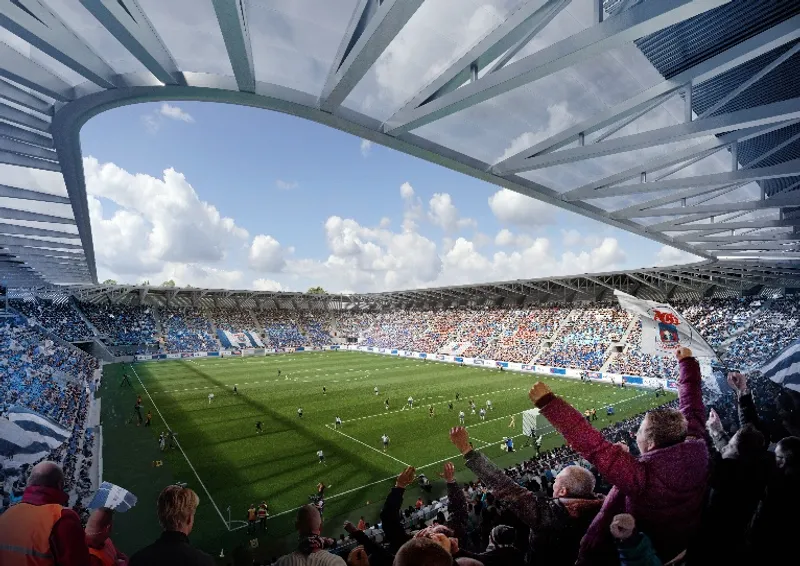
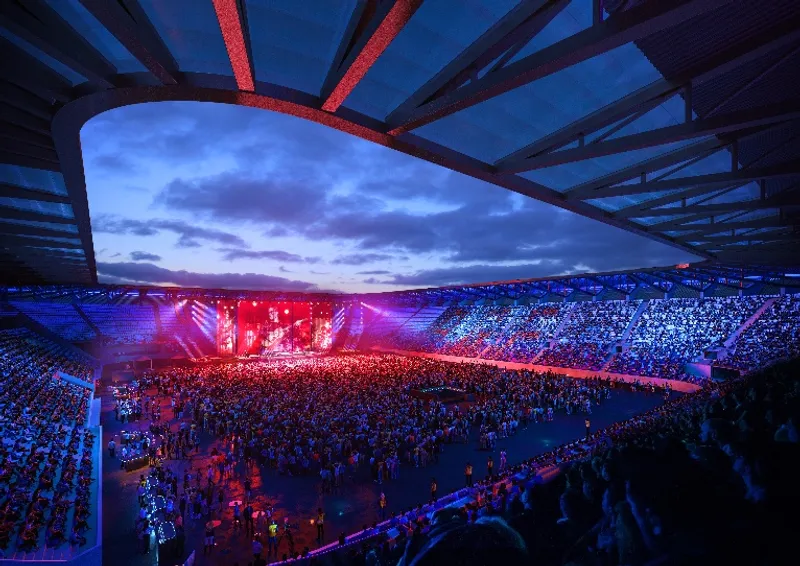
The new Aarhus Stadium will feature a transparent roof and gaps in the timber ribs of its façade that offer glimpses of the surrounding forest. The permeable colonnades will blur the boundaries between different programs and the east and west sides will have open colonnades that act as intuitive wayfinding to the main entrances and as an interface between public events and ticketed programs. The stadium will be able to host a variety of events year-round.
The new project will be built on the site of the existing stadium and has been optimized for environmental impact, functionality, and experienced value. The design, structure, and materials have been carefully chosen to minimize environmental impact and maximize functionality. The primary materials used will be concrete incorporating recycled aggregates for the columns, locally procured, upcycled, and recycled steel for the trusses, and timber from locally certified sustainable sources for the façade cladding.
The adjacent 'Stadionhallerne' building, which was completed in 1918 by architect Axel Høgh-Hansen, will also be refurbished. The intense red facades and white ornamentation will be retained to keep its historic soul that is cherished by the club.
The new building project for Aarhus Stadium is focused on utilizing as much of the existing stadium's materials and components as possible. Not only does this have a positive impact on the environment, but it also adds to the local significance of the project. The current Aarhus Stadium, home to the Aarhus Gymnastikforening (AGF) football club, has undergone several renovations since its opening in 1920, but no longer meets the requirements for hosting professional and international football matches or large cultural events. One major issue for AGF supporters is the distance between the spectators and the field, which detracts from the overall game experience.
The new stadium aims to rectify this by bringing fans closer to the action, creating a more immersive experience. The competition organizers praised the team's proposal for its incorporation of the stadium's location within the Marselisborg forest and its connection to the historic Stadionhallerne, stating that it is "inviting, reaching out to its surroundings and connecting well with the context."
Gianluca Racana, director of Zaha Hadid Architects said: “It is an honour to have been selected to build such an important project in Aarhus. Our proposal for the new Aarhus Stadium is inspired by its natural forest context and the club’s legacy. Providing a wealth of new public spaces for use 365 days a year, the stadium will be a new landmark for the city that incorporates the highest standards of environmental, economic, and social sustainability within in every aspect of its design and construction.”
Peter Kristiansen, case architect of Sweco said: “The new Aarhus Stadium aims to become a catalyst for fans and the local community, a new identity for the club, and a new landmark in the national and international football fraternity. We are thrilled to be awarded this prestigious project. We see it as a recognition of our local presence in the city and our understanding of the uniqueness of the place, the context, and the soul and identity connected to AGF and Aarhus. With our partners, we have designed a stadium that fits into the environment and with a Nordic profile. The stadium is carefully designed, and I guarantee that there will be a great experience from every seat.”
Ole Schrøder, a partner in Tredje Natur said: “Our proposal is celebrating the proud spirit of the club and its importance for the City of Aarhus. Paying tribute to both the architectural heritage on-site and the unique nature that surrounds it will serve as a welcoming gesture to the public. On any occasion!”
In December 2021, 42 teams of Danish and international architects applied for prequalification for a tender to design a new stadium in Aarhus. Six teams were selected for the first round of the competition, with three moving on to the second round. The final winner was announced by the City of Aarhus, in conjunction with the two main financiers, Lind Invest and Salling Fondene, and local football club AGF.
The winning proposal will be finalized during the first half of 2023, with collaboration between the City of Aarhus, the winning team, and AGF. Simultaneously, a contractor will be chosen to oversee the construction of the new stadium. In the second half of 2023, the construction plans will be detailed, and in 2024, the current stadium will begin to be gradually dismantled. The construction process will take place in four stages, with the new stadium expected to be inaugurated in 2026.
Press release and visuals courtesy of Zaha Hadid Architects

Popular Articles
Popular articles from the community


Singing Woman: An Opera House That Performs Before the Curtain Rises
Ovidiu Cristian Pavel's conceptual opera house translates Estonia's choral identity into a sculpted waterfront landmark facing the Baltic Sea.

Faces of the Soviet Avant-Garde: Turning Moscow's Street Names into an Open-Air Museum
A network of sculptural installations across a Moscow residential district transforms forgotten architect names into spatial encounters with cultural memor

Opera on the Sea: Driftwood Logic Shapes a Timber Opera House on Estonia's Coast
Trevor Orgill's opera house translates the entangled drift of floating timber into a civic building where wood, water, and music converge.
Temporary Home for Dogs: A Reversed Zoo Rethinks Animal Shelter Architecture
In Bucharest, a sinuous corridor and freed landscape flip the logic of containment, designing a shelter that works to make itself unnecessary.

Similar Reads
You might also enjoy these articles
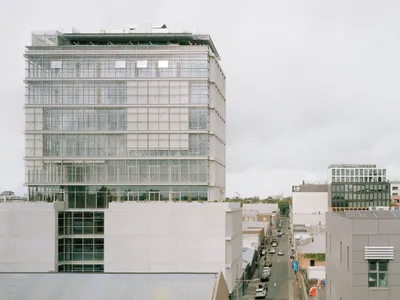
116 Rokeby Building, Collingwood
Sustainable Collingwood office building featuring double-skin façade, natural ventilation, rooftop amenities, and carbon-neutral design focused on wellbeing and longevity.
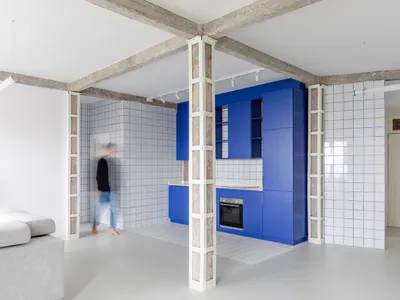
Contemporary Apartment Renovation in Spain: RV House by BIAN Opens Up to the Sea
A minimalist 1930s apartment in Santander is transformed into a flexible, sea-facing home through contemporary Spanish renovation.
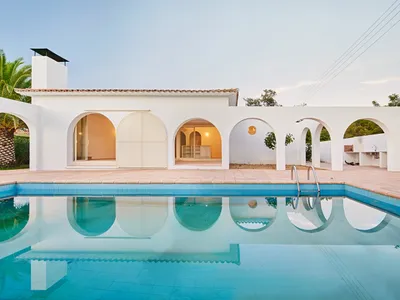
3 Marías House: A Contemporary Mediterranean Courtyard Retreat by Bajet Giramé + Burckhardt
Mediterranean courtyard home blending traditional architecture with modern design, terracotta flooring, flexible interiors, sustainable climate strategies, and garden integration.
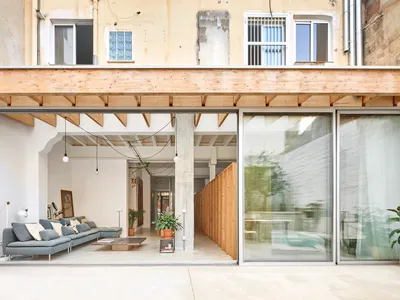
NZ10 Apartment by auba studio: Adaptive Reuse in Palma de Mallorca
Adaptive reuse apartment transforms bakery into light-filled home with patios, privacy layers, and wood interiors enhancing urban living experience.

Explore Stadium Competitions
Discover active competitions in this discipline


Challenge to reimagine the Iron Throne

Photograph architecture without architects

Illustrate the lost glory of Angkor Wat - Render Challenge

Bring back Drive In's
Comments (0)
Please login or sign up to add comments
No comments yet. Be the first to comment!