
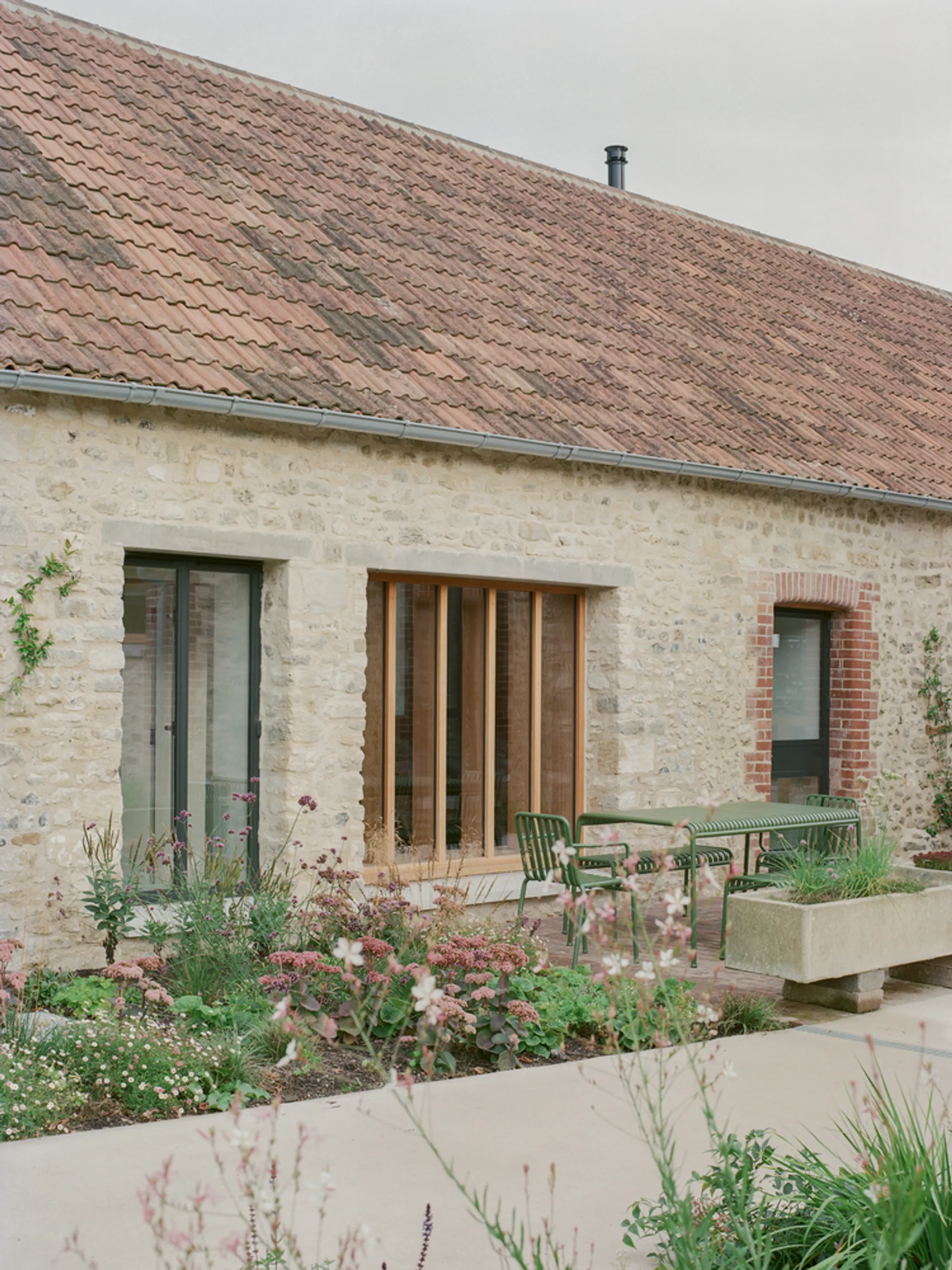
Clementine Blakemore Architects Turns a Somerset Barn into a Model for Inclusive Rural Living
Wraxall Yard restores a cluster of agricultural buildings in North Somerset with a focus on accessibility, honest materials, and quiet craft.


A barn conversion is one of the most repeated briefs in British architecture, and most of the time the results are predictable: glass boxes slotted into stone shells, open plans that ignore the original spatial logic, finishes chosen for a lifestyle magazine rather than habitation. Wraxall Yard, designed by Clementine Blakemore Architects in North Somerset, is none of those things. It is a careful, grounded piece of work that takes an agricultural compound and makes it genuinely livable, with inclusivity as a starting premise rather than an afterthought.
What makes the project interesting is its insistence that accessibility and architectural quality are not in tension. Too often, inclusive design is treated as a set of compliance boxes to tick. Here, the material palette, the spatial sequence, and the landscape strategy all serve the same goal: creating a place that can be inhabited by people with different physical abilities without ever feeling clinical or institutional. The architecture is warm, textured, and specific to its site. It also happens to be a quiet lesson in how to work with existing structures without either erasing them or fetishizing their ruin.
Stone, Brick, and the Logic of the Compound
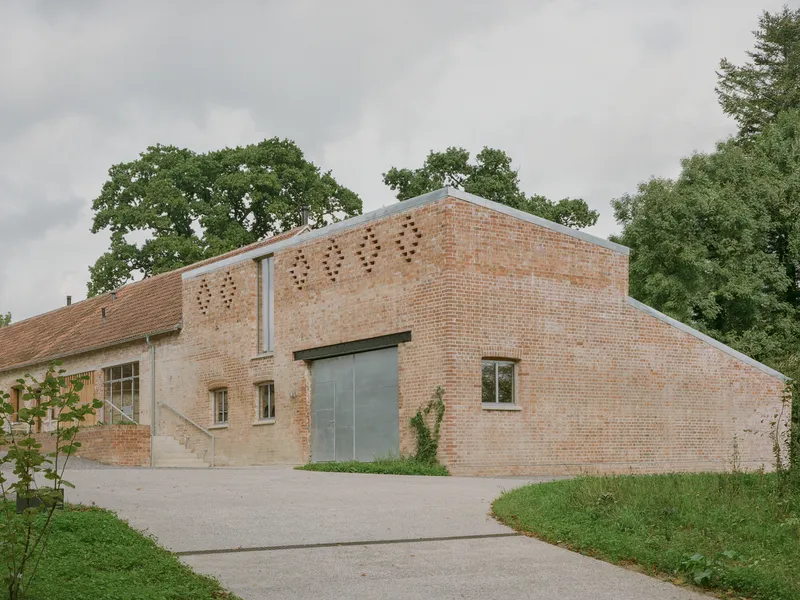
The project reads as a small agricultural settlement rather than a single building. Existing stone walls define the edges of a courtyard, and new interventions are inserted within and beside them. The gabled brick facade that greets you on arrival is one of these interventions: its patterned perforations let light filter through while giving the wall a decorative texture that feels handmade. Against the grey Somerset sky, it holds its own without shouting.
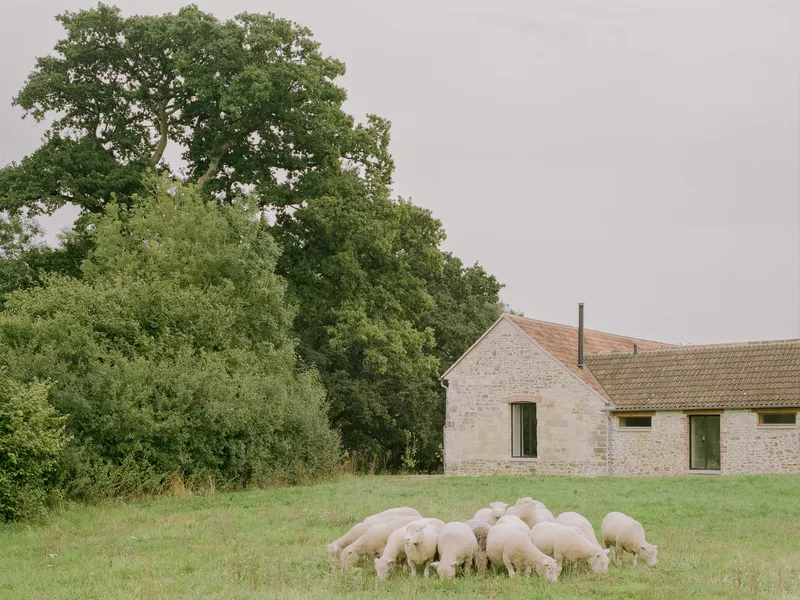
Seen from the meadow, the barn volume sits low under a clay tile roof, sheep grazing beside it. The proportions are right. Nothing about the building signals that it is new or precious. It belongs to the landscape in a way that only comes from disciplined restraint in massing and material choice.
Thresholds and Entries
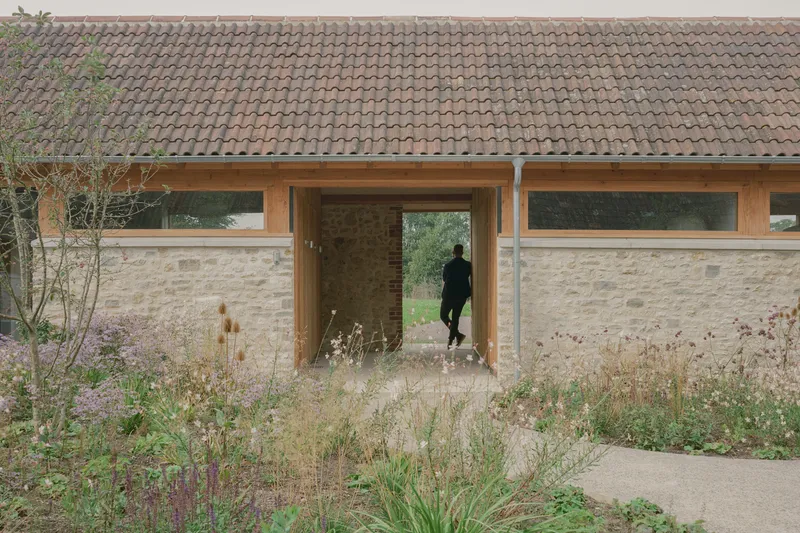
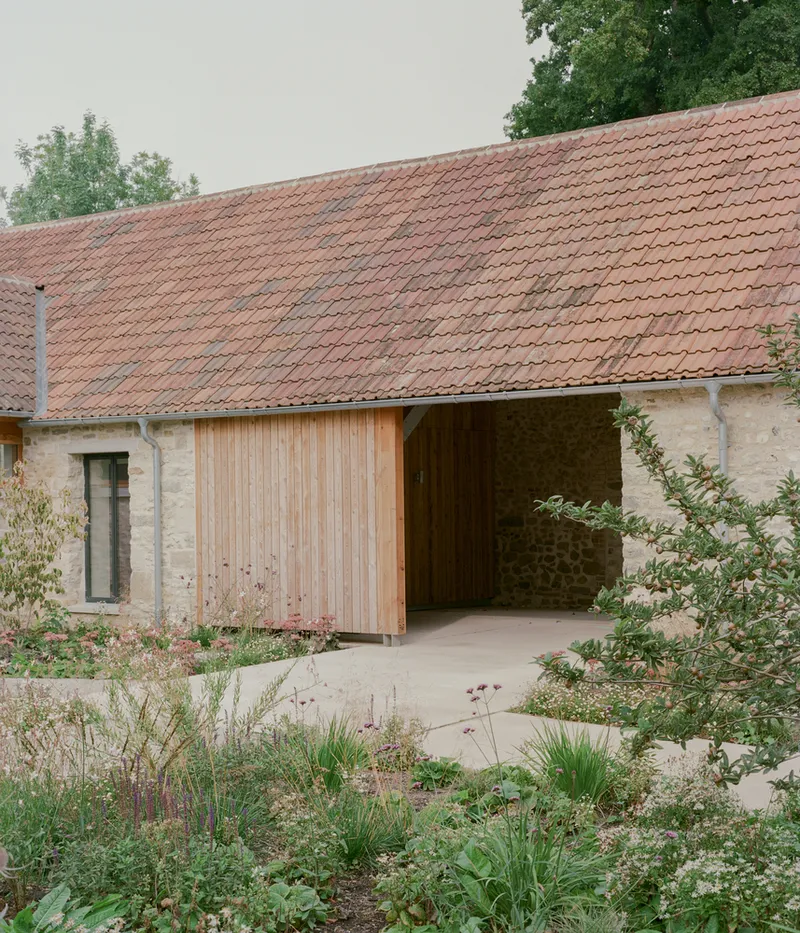
The entrances are where the inclusive agenda becomes spatially legible. Timber-framed openings are set generously into stone walls, with level thresholds that eliminate the typical step-up of barn doorways. Horizontal windows sit at a height that works whether you are standing or seated. Wildflower planting softens the transition from garden to interior, turning the threshold into a zone rather than a line.
A sliding timber door set beneath the terracotta roof tiles gives one entry a domestic, almost Japanese quality. The detailing is precise but unfussy. Raised planted beds in the courtyard bring the garden to accessible height. Every decision reinforces the same principle: comfort and dignity should be embedded in the architecture, not bolted on.
Living Under the Trusses
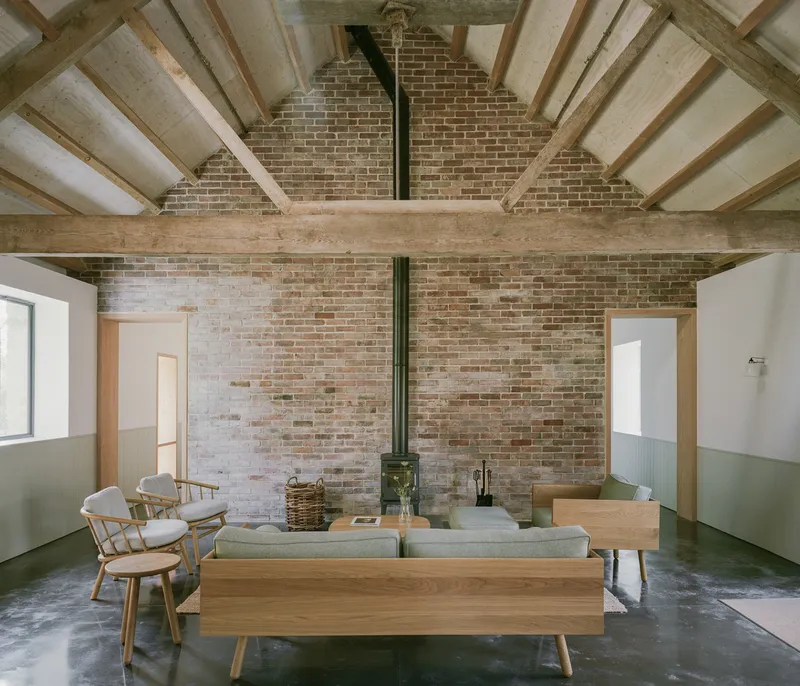
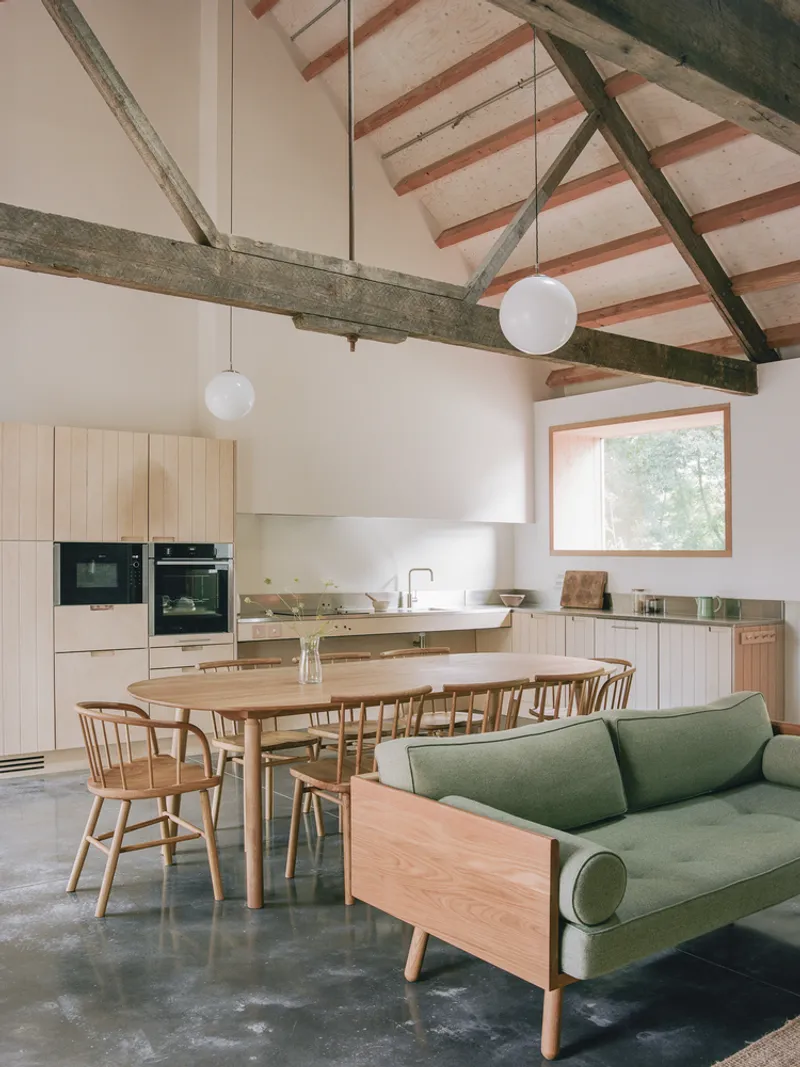
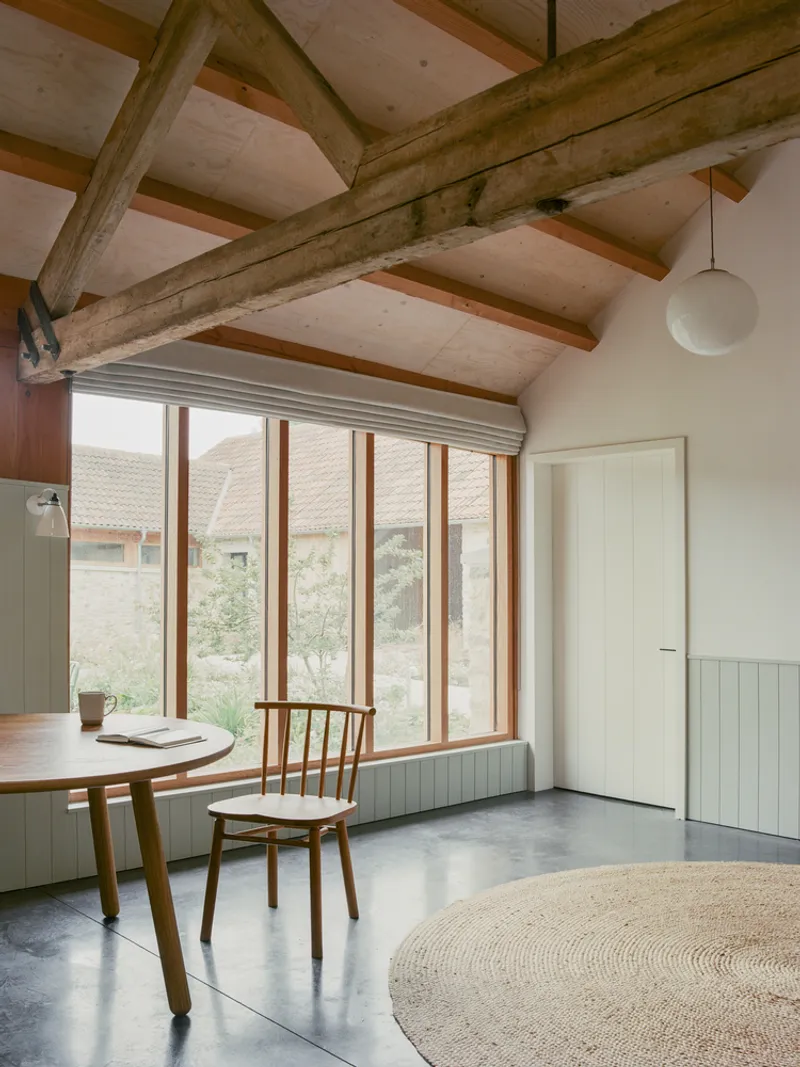
Inside, the exposed timber roof trusses are the dominant feature and the main source of spatial drama. The structure is left legible: king posts, tie beams, and rafters all visible, their geometry giving the rooms a vertical generosity that polished concrete floors and simple pendant lights keep grounded. A wood stove sits against the brick gable wall, anchoring the main living space with a point of warmth.
The kitchen and dining area occupy one long volume beneath the trusses. Vertical timber windows modulate light along the walls, casting changing patterns across the concrete floor throughout the day. The space avoids the barn-conversion cliché of the double-height void with a mezzanine gallery. Instead, it keeps its proportions honest to the original agricultural section: tall enough to breathe, contained enough to feel sheltered.
Interior Details and Quiet Craft
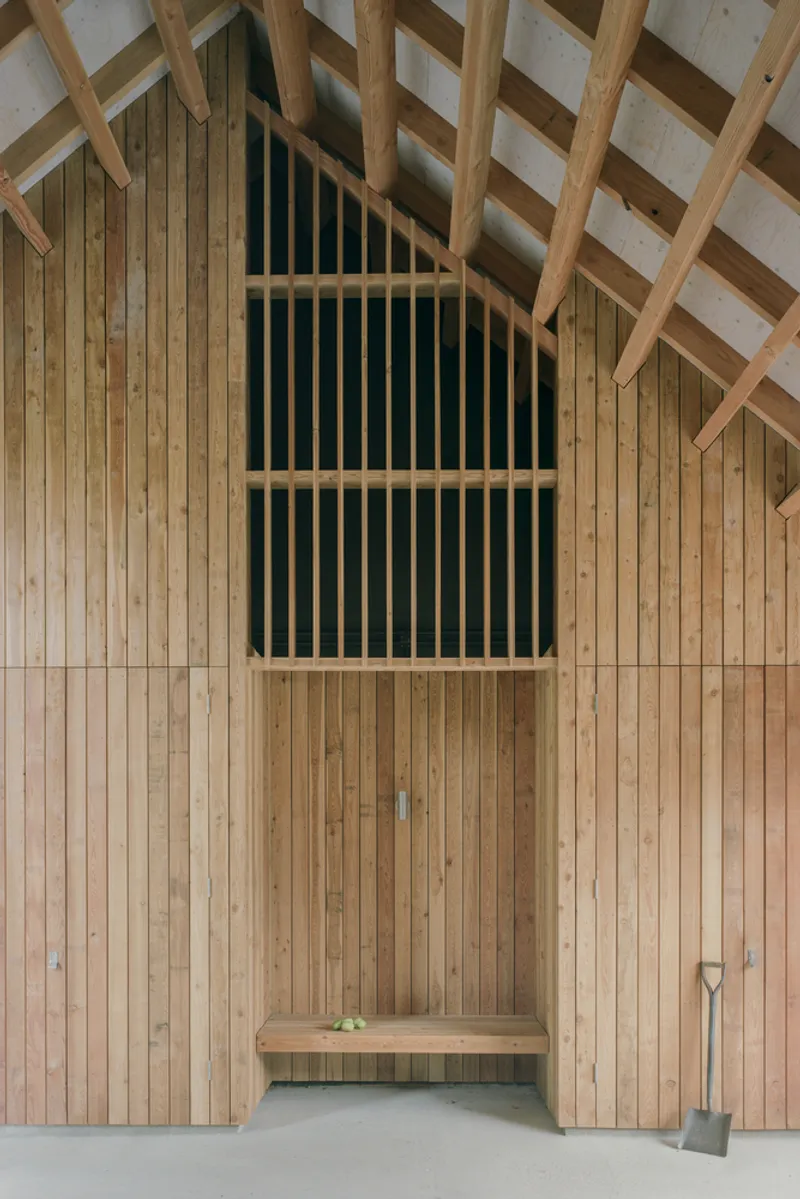
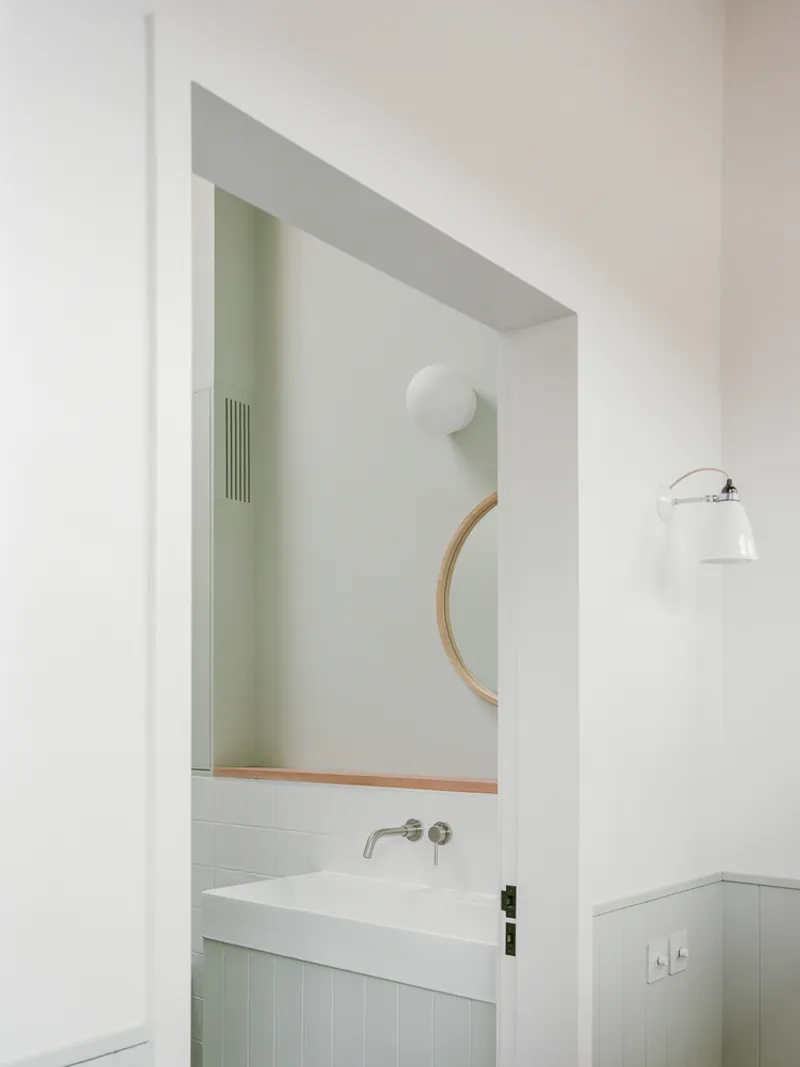
The entry hall reveals vertical wood cladding under a vaulted ceiling of exposed rafters. The timber has been left untreated or lightly oiled, aging with the building rather than frozen in a factory finish. It is a small choice that signals a bigger commitment to longevity over novelty.
A bathroom, visible through a recessed white plaster doorway, pairs a circular mirror with a simple wall sconce and a clean vanity. The palette is minimal: plaster, timber, ceramic. Nothing in the room is gratuitous, and nothing is missing. It is the kind of interior that rewards daily use rather than a single photograph.
The Courtyard as Organizing Device
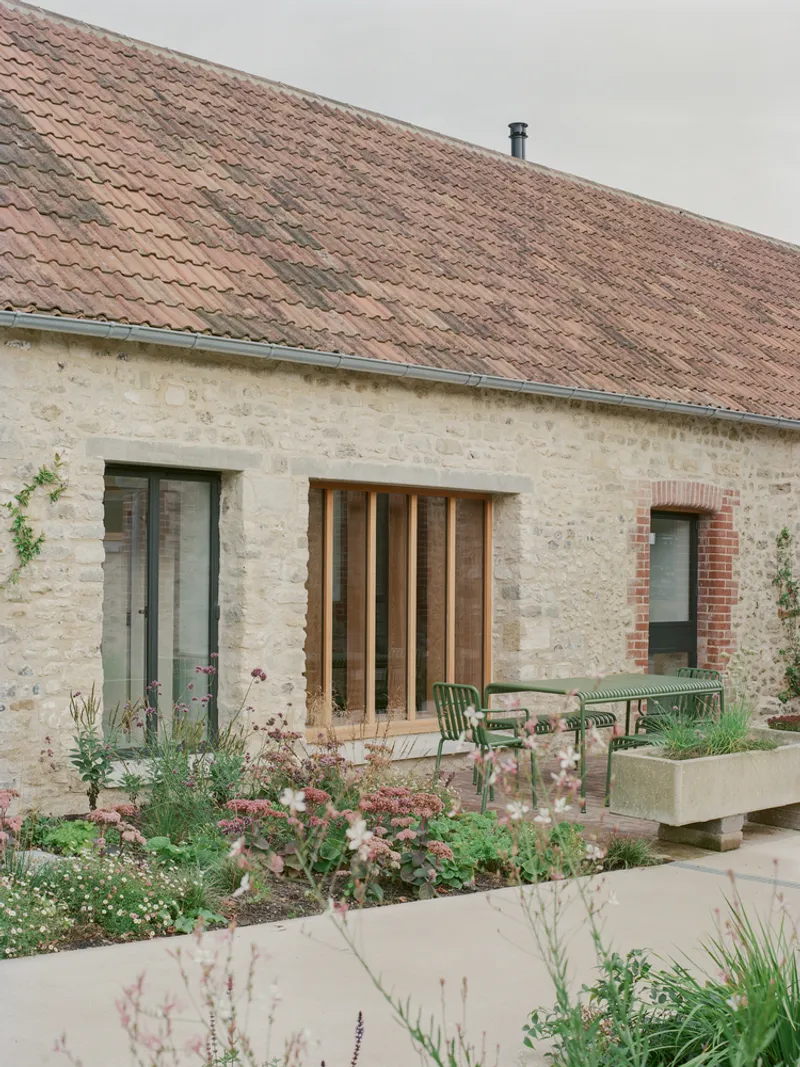
The courtyard is the social and spatial heart of Wraxall Yard. Restored stone facades with vertical timber shutters define its edges, and raised planted beds bring greenery to waist height. The shutters give each opening a degree of privacy and solar control while maintaining the rhythm of the original barn openings.
As an organizing device, the courtyard solves several problems at once. It creates a sheltered outdoor room in a climate that can be hostile. It provides clear orientation for residents navigating between buildings. And it gives the compound a communal center without requiring a single large interior. The result is a settlement that feels collective and intimate at the same time.
Plans and Drawings
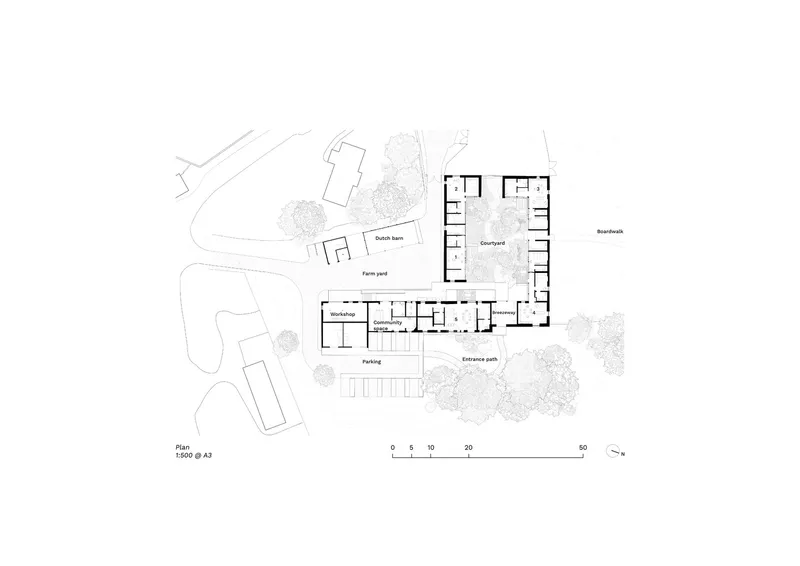
The site plan confirms what the photographs suggest: the project is a compound, not a house. Two outbuildings flank the main barn across a courtyard, with existing trees preserved around the perimeter. The drawing shows a clear hierarchy of spaces, from the semi-public courtyard to the private interiors, mediated by covered thresholds. The landscape is integral to the plan rather than decorative, with planting beds and pathways designed as carefully as the walls.
Why This Project Matters
Wraxall Yard matters because it demonstrates that inclusive design does not require a separate aesthetic. The buildings are beautiful on their own terms: well-proportioned, honestly detailed, rooted in their landscape. Accessibility is woven into the architecture so thoroughly that it becomes invisible, which is exactly the point. There are no ramps bolted to the side, no contrasting handrails signaling accommodation. The buildings simply work for everyone.
It also matters as a model for rural practice. Small-scale, community-oriented projects in the English countryside rarely receive this level of architectural attention. Clementine Blakemore Architects has shown that it is possible to be both rigorous and gentle, to respect the existing fabric without being paralyzed by heritage anxiety, and to advocate for inclusion without sacrificing spatial quality. That is a set of lessons the profession at large could stand to learn.
Wraxall Yard by Clementine Blakemore Architects. North Somerset, United Kingdom. Photography by Lorenzo Zandri.
About the Studio
Share Your Own Work on uni.xyz
If projects like this are the kind of work you want to make, uni.xyz is a place to publish your own, find collaborators, and enter design competitions.




Popular Articles
Popular articles from the community


Hill & Cross Opera: Sculptural Opera House Architecture Shaped by Tallinn’s Landscape and Identity
Hill & Cross Opera reimagines opera house architecture in Tallinn through its sculptural hill, civic plaza, glass wave and a luminous cross.

The Musturak Paradise: Senior Living Architecture for a Connected Future in Temara, Morocco
The Musturak Paradise reimagines senior living architecture in Temara via private homes, social spaces, culture, community, and shared care.

The Ocean Hive: Sustainable Architecture for a Self-Sufficient Civilization at Sea
The Ocean Hive imagines sustainable architecture at sea, where modular habitats, algae, wave power and ocean waste sustain a growing colony.

Co-Life: Senior Housing Design That Reconnects Older Adults With the City
Co-Life reimagines senior housing design through healing gardens, shared streets, workshops, and a sustainable community across generations.


Similar Reads
You might also enjoy these articles


Hodi-Mandai Geram
Project Function: Preservation and revitalization of the Intangible heritage and socio-spatial identity of the Hodi by Housing, Cultural Memory Center, Sacred Grove, landscape, local tourism economy


Olio Towers: A Mid-Rise for Performers That Fuses Housing, Rehearsal, and Stage
Located blocks from Houston's Theater District, this modular tower stacks living units around a central performance atrium.

Oasis: Modular Green Housing Carved into Dhaka's Urban Fabric
A shortlisted Plugin Housing entry reclaims unauthorized settlements in Dhaka with stepped concrete volumes, green roofs, and ventilation-driven design.

Black Hole: A Floating Megastructure for the Post-Physical Era
Emiliano Mazzarotto envisions a spherical, self-scaling arena where e-sports, digital hotels, and holographic stadiums replace traditional public space.


Explore Architecture Competitions
Discover active competitions in this discipline



Challenge to design public laboratory


Challenge to reimagine the Iron Throne


Photograph architecture without architects


Illustrate the lost glory of Angkor Wat - Render Challenge
Comments (0)
Please login or sign up to add comments
No comments yet. Be the first to comment!