

The Qu Peiqing Studio Weaves a Serpentine Campus into Xi'an's High-Rise Skyline
A high school expansion in Xi'an threads courtyards, bridges, and curved forms through one of the city's densest urban corridors.


Building a school in a mature Chinese city is rarely just a pedagogical exercise. It is an act of urban negotiation: reconciling program demands with lot constraints, noise, density, and the relentless proximity of residential towers. At Xi'an Gaoxin No.1 High School, the Qu Peiqing Studio confronts all of these pressures head-on, delivering an expansion that refuses to read as a single extruded block and instead distributes its mass across a network of connected volumes, courtyards, and elevated walkways.
What makes the project genuinely compelling is the decision to treat circulation as landscape. The serpentine bridges and painted ground-plane paths are not afterthoughts bolted onto a finished plan; they are the plan's organizing principle. Every route doubles as social space, every gap between volumes becomes a courtyard, and every rooftop that could have been dead area is activated with planting or timber decking. The result is a campus that feels far larger and more varied than its footprint would suggest.
Courtyards as the Core Strategy


Seen from above, the campus plan reveals itself as a field of courtyards rather than a cluster of buildings. Blue-painted pathways wind between planted beds, softening what would otherwise be hard concrete ground. The palette is deliberate: bright blues and greens stand out against the pale white volumes, giving students legible wayfinding cues while introducing color that reads well at the aerial scale of surrounding towers.
At ground level, the courtyards shift register entirely. Palm trees and tiered planters create enclosed garden rooms overlooked by white balconies on multiple floors. These are not ornamental buffers. They are outdoor classrooms, social decompression zones, and environmental regulators that pull daylight and breeze into the deep-plan volumes flanking them.
Bridges That Build Community

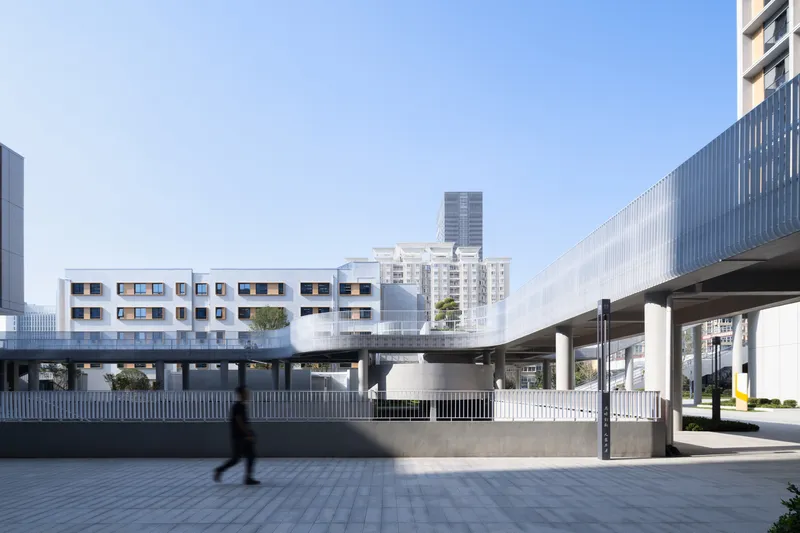

The elevated pedestrian bridges are the campus's signature gesture. Arcing between residential towers and academic blocks, they stitch the complex into a continuous loop that keeps students off grade-level roads and out of Xi'an's punishing summer heat. At dusk, the bridges glow from below, transforming functional infrastructure into something closer to a lantern string strung between buildings.
Structurally, the bridges are lightweight steel spans clad in the same white metal panels as the main volumes, punched with square window openings that frame views of the cityscape. Against the backdrop of high-rise towers, they assert the school's presence without competing for height. It is a smart concession to context: horizontal ambition where vertical ambition would have been tone-deaf.
A Facade Language of Curves and Cylinders


The exterior vocabulary leans on curved white metal cladding and cylindrical volumes that break up the massing into identifiable parts. An exterior staircase spirals along one of these cylinders, providing emergency egress but also acting as a sculptural marker at the plaza edge. The effect recalls industrial architecture more than academic convention, and that is probably intentional: this is a school that wants to signal innovation rather than tradition.
Up on the rooftops, timber decking and planted palms turn mechanical penthouses into garden terraces sandwiched between glass towers. These elevated green spaces are invisible from the street but visible from hundreds of surrounding apartments, a quiet public-relations move that makes the school a better neighbor.
The Library as Spatial Centerpiece

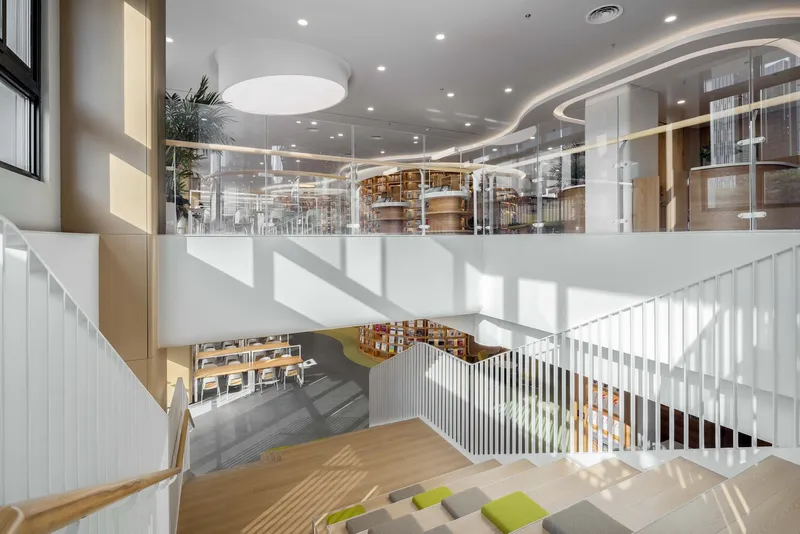
Inside, the library is the emotional heart of the campus. Circular wood bookshelves radiate outward beneath swirling white ceiling planes that fold and twist like paper caught in a breeze. Integrated strip lighting follows the curves, turning the ceiling into a topographic map of the space below. It is theatrical, yes, but the theatricality serves a purpose: it makes the library unmistakable, a destination students seek out rather than stumble upon.
Adjacent to the main reading room, a multi-level atrium with white vertical slat railings opens sightlines between floors. Shelving is visible on upper levels, and sunlight streams through generous glazing. The verticality here counterbalances the campus's predominantly horizontal organization, pulling the eye up and reinforcing the sense that knowledge quite literally stacks.
Sports and Assembly Spaces
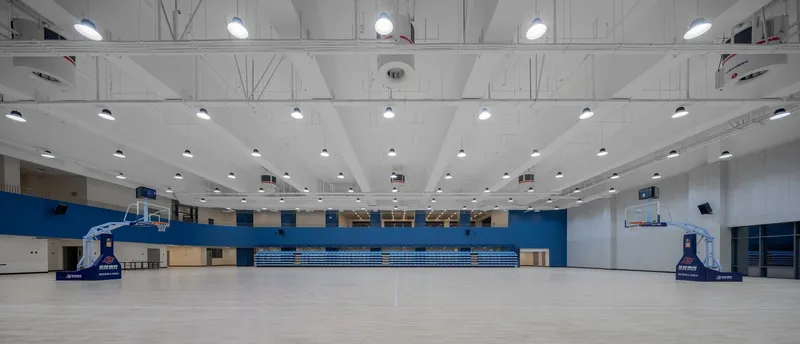


The basketball gymnasium features a clear-span truss ceiling, retractable bleachers, and flanking walls painted in bold blue accents. It is a straightforward, functional room, and that clarity is welcome after the formal complexity of the exteriors. A second, smaller sports court handles martial arts and group exercise under exposed concrete beams with pendant lights: honest materials, good proportions, zero pretense.
The auditorium rounds out the assembly program with red upholstered seats, curved ceiling panels, and recessed lighting that keeps the room feeling warm without veering into corporate banality. Together, these three spaces demonstrate that the studio knows when to perform and when to simply deliver well-proportioned enclosure.
Cafeteria and Everyday Interiors

The cafeteria relies on circular skylights and translucent wall panels to flood the room with diffuse light, reducing the need for artificial illumination during the day. Grey flooring and neutral furniture keep the space restrained, letting the architecture of the ceiling do most of the talking. For a room that must serve hundreds of students in quick succession, the calm atmosphere is a real achievement.
Why This Project Matters
Chinese educational campuses are frequently conceived as gated precincts that turn their backs on the city. The Qu Peiqing Studio's expansion of Gaoxin No.1 High School pushes back against that impulse. By distributing program across linked volumes separated by open courtyards, the project imports urban grain into an institutional typology that too often defaults to monolithic slabs. The bridges, the rooftop gardens, and the winding ground-level paths all reinforce the idea that a school should feel like a neighborhood, not a compound.
More broadly, the project offers a transferable lesson in density management. When site area is finite and program keeps growing, the instinct is to build up. Here, the architects chose instead to build across, threading connections between moderate-height volumes and letting daylight and planting fill the gaps. It is a strategy that prioritizes student well-being over floor-area efficiency, and in a country racing to expand its educational infrastructure, that distinction matters enormously.
Xi'an Gaoxin No.1 High School Expansion, designed by the Qu Peiqing Studio, Xi'an, China.
About the Studio
the Qu Peiqing Studio
Share Your Own Work on uni.xyz
If projects like this are the kind of work you want to make, uni.xyz is a place to publish your own, find collaborators, and enter design competitions.


Popular Articles
Popular articles from the community


GROUP A Strips a 1969 Rotterdam Harbor Headquarters to Its Frame and Wraps It in Timber Louvers
In Rotterdam's M4H harbor district, Ferro Offices reuses a 1969 frame, adds one timber storey and reaches BREEAM-NL Outstanding.

Jaramillo Van Sluys Arquitectura and Urbanismo Turn a Demolished Registry Lot in Quito into an Orchard Plaza
In Quito's Centro Histórico, a 2,800 m² plaza exposes the San Agustín convent wall and redraws its lost Augustinian orchard in volcanic stone.

U.GA Architects Wraps an Oval Rooftop Pool in Curved Board-Formed Concrete on Busan's Jeollidan-gil
In Busan's Jeonpo-dong, a 454 m² mixed-use block stacks a neighborhood facility, guest rooms and an oval rooftop pool inside spiraling concrete walls.

Architekt Andreas Gruber Scatters 23 Dark Timber Chalets Across a South Tyrolean Forest Edge
In Molini di Tures, Amonti Chalets breaks a resort into a hamlet of gabled timber houses, with parking, storage and services pushed into the slope.

Similar Reads
You might also enjoy these articles


Hodi-Mandai Geram
Project Function: Preservation and revitalization of the Intangible heritage and socio-spatial identity of the Hodi by Housing, Cultural Memory Center, Sacred Grove, landscape, local tourism economy


Olio Towers: A Mid-Rise for Performers That Fuses Housing, Rehearsal, and Stage
Located blocks from Houston's Theater District, this modular tower stacks living units around a central performance atrium.

Oasis: Modular Green Housing Carved into Dhaka's Urban Fabric
A shortlisted Plugin Housing entry reclaims unauthorized settlements in Dhaka with stepped concrete volumes, green roofs, and ventilation-driven design.

Black Hole: A Floating Megastructure for the Post-Physical Era
Emiliano Mazzarotto envisions a spherical, self-scaling arena where e-sports, digital hotels, and holographic stadiums replace traditional public space.

Explore Educational Building Competitions
Discover active competitions in this discipline

Challenge to design public laboratory

Challenge to reimagine the Iron Throne

Photograph architecture without architects

Illustrate the lost glory of Angkor Wat - Render Challenge
Comments (0)
Please login or sign up to add comments
No comments yet. Be the first to comment!