
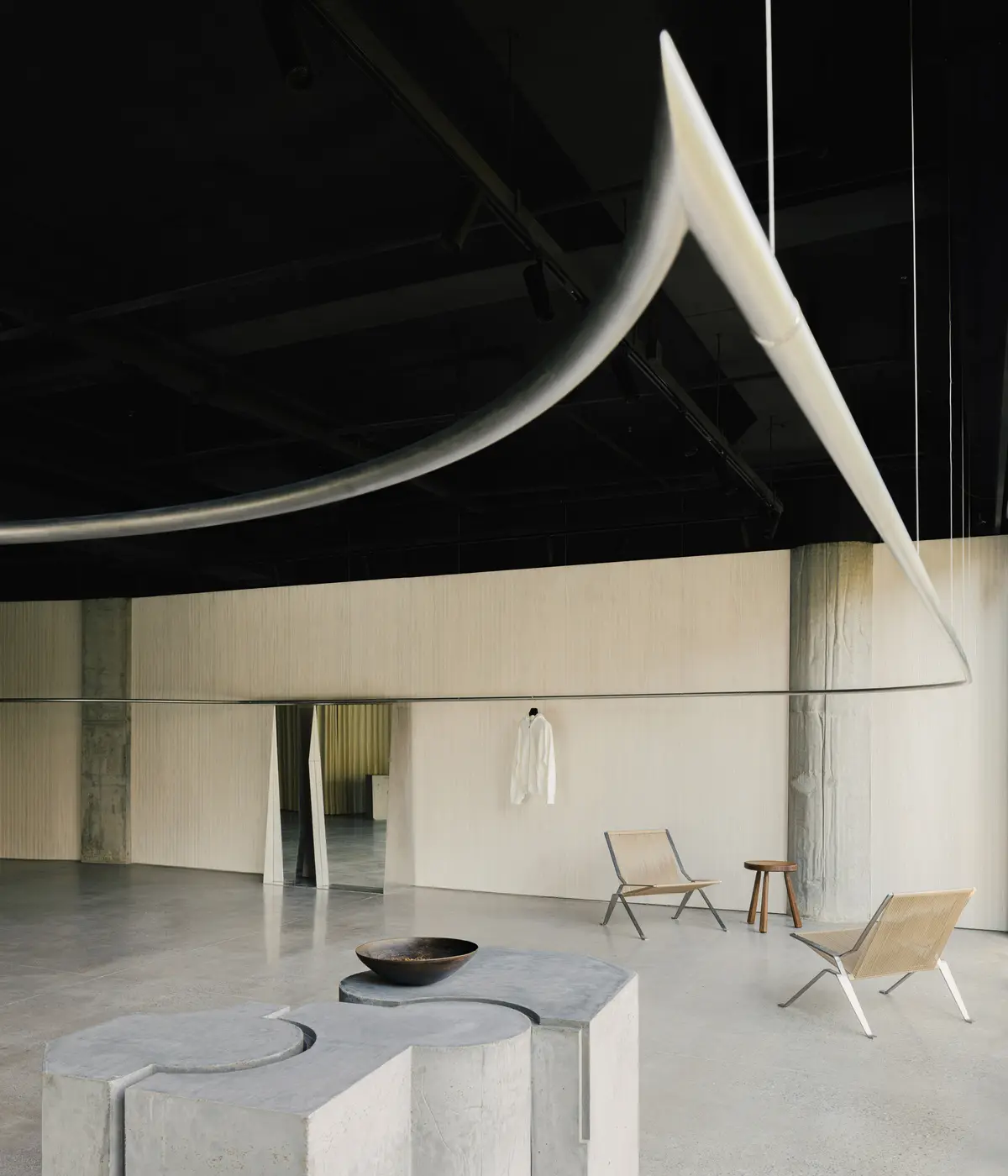
A Single Rail Defines YEARLY PLAN's Shanghai Home
SHISUO design office turns an irregular 226 sqm Shanghai site into a fashion showroom choreographed entirely around one continuous hanging rail.


Most retail interiors begin with a mood board of materials and finishes, then figure out where to hang the clothes. SHISUO design office reversed the order. For YEARLY PLAN's first Shanghai showroom, the studio treated the garment rail not as an afterthought but as the generative line from which every wall, opening, and surface follows. The result is a 226 square meter space that reads less like a shop and more like an inhabited sculpture, where architecture and display infrastructure are genuinely the same thing.
The site itself was a problem worth solving: an irregular footprint wrapped around existing concrete columns and flanked by dense foliage. Rather than fight those constraints, SHISUO leaned into them. Curved ribbed walls, trapezoidal doorways, and angled partitions feel inevitable rather than arbitrary because they all trace the path of a single continuous steel rail overhead. It is a simple premise executed with serious discipline, and the payoff is a showroom where movement through space and engagement with clothing become indistinguishable.
The Ribbed Wall as Organizing Surface
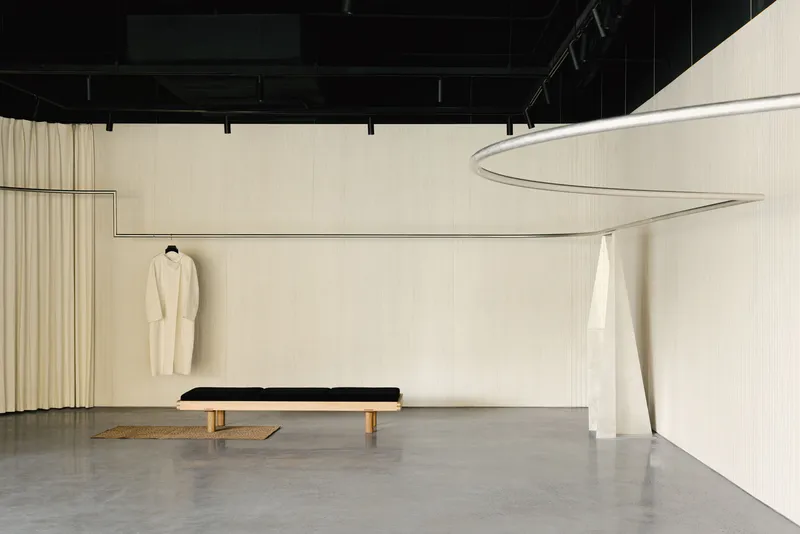


The pale, vertically ribbed timber panels that line the showroom are the project's most immediately recognizable element. They do triple duty: acoustic softening beneath the exposed black industrial ceiling, a warm visual backdrop for dark garments, and a continuous surface that conceals services and storage. The ribs catch raking natural light in ways that shift throughout the day, giving the walls an almost textile quality that mirrors the clothing on display.
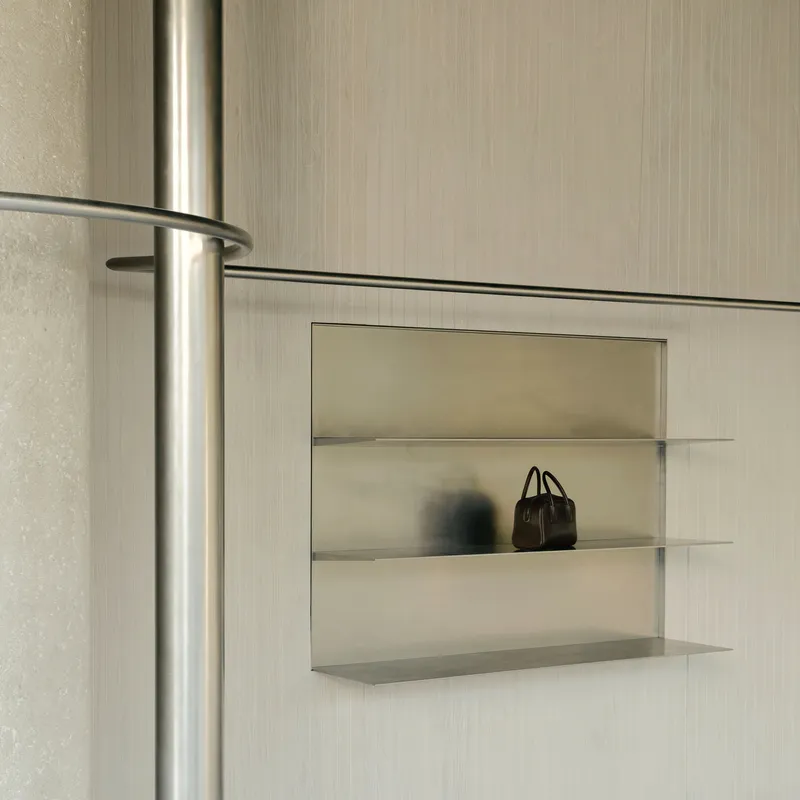
Where the panels curve, they create implied thresholds without doors. Where they stop, recessed niches with glass shelving appear. The wall is never just a wall; it is always working.
Thresholds as Events
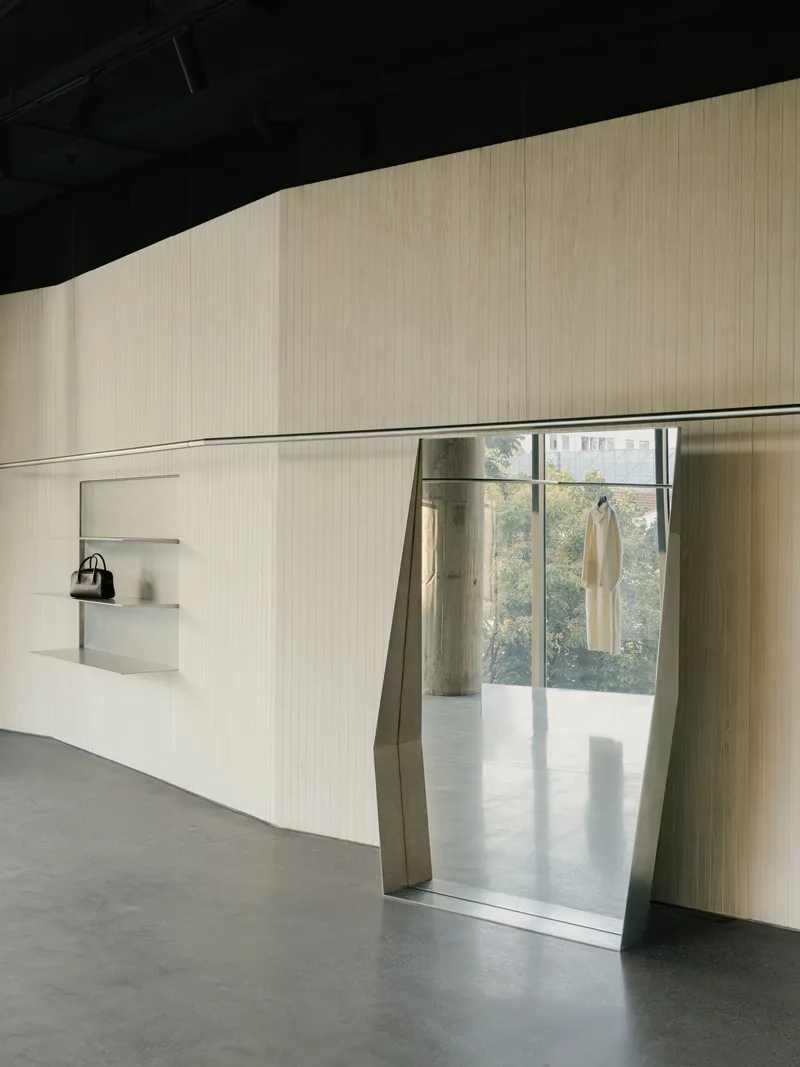
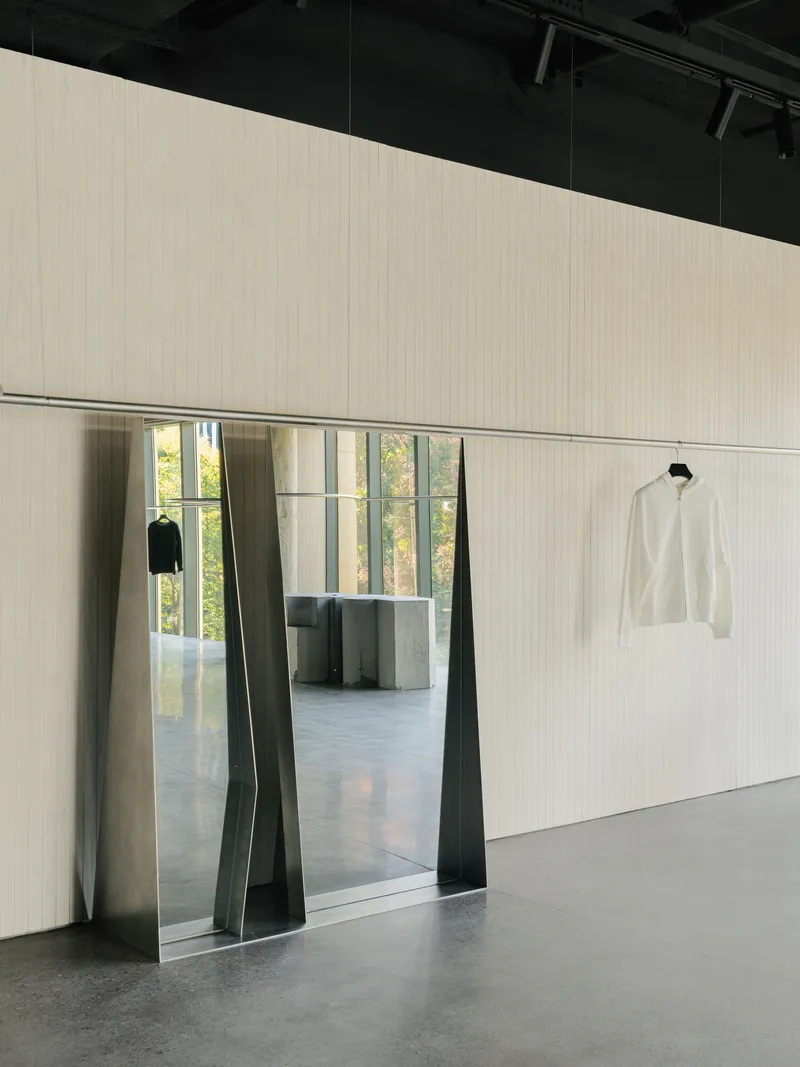
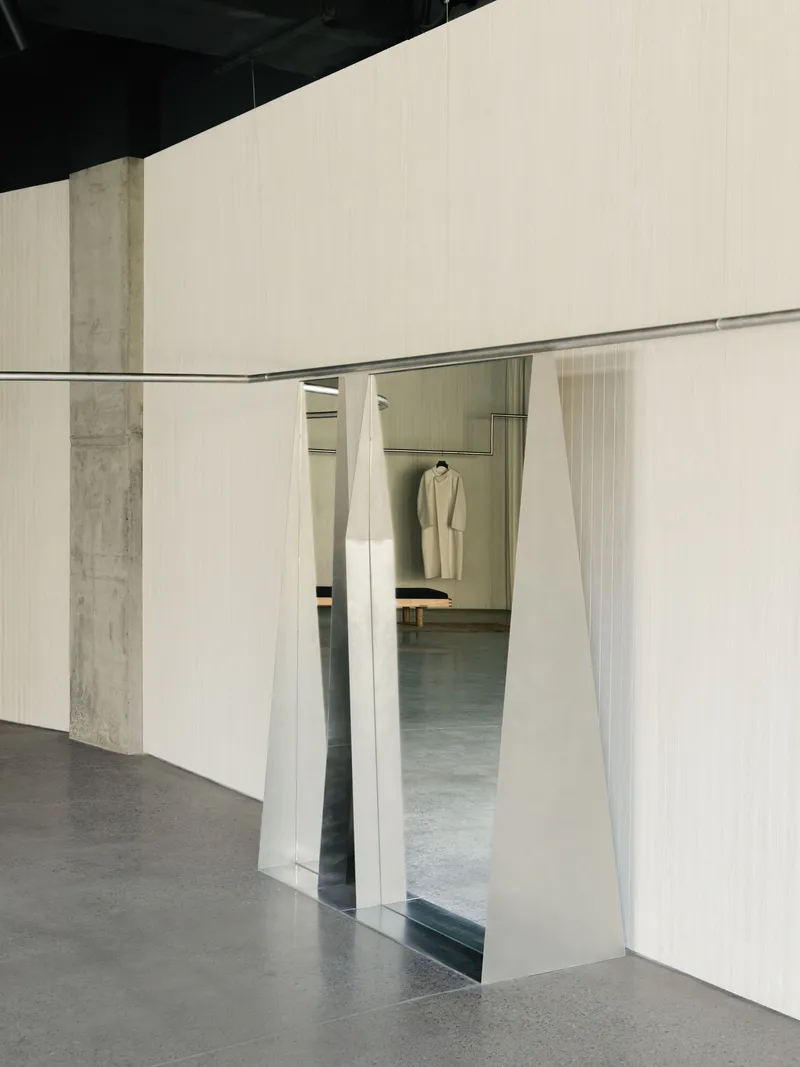
Some of the most considered moments in the showroom happen at the transitions between rooms. SHISUO shaped each doorway as a distinct sculptural condition: trapezoidal openings with folded metal jambs, curved apertures with splayed steel frames, angled cuts that compress and then release the sightline. None of these are standard rectangular pass-throughs. Each one frames a deliberate glimpse of the next space, a hanging garment, a patch of daylight, a sliver of courtyard green.
The effect is cinematic. You don't just walk into the next room; you are given a preview that pulls you forward. In a retail context, that sequential reveal is invaluable. It keeps visitors moving and looking without ever feeling herded.
Concrete and Steel: The Display Infrastructure
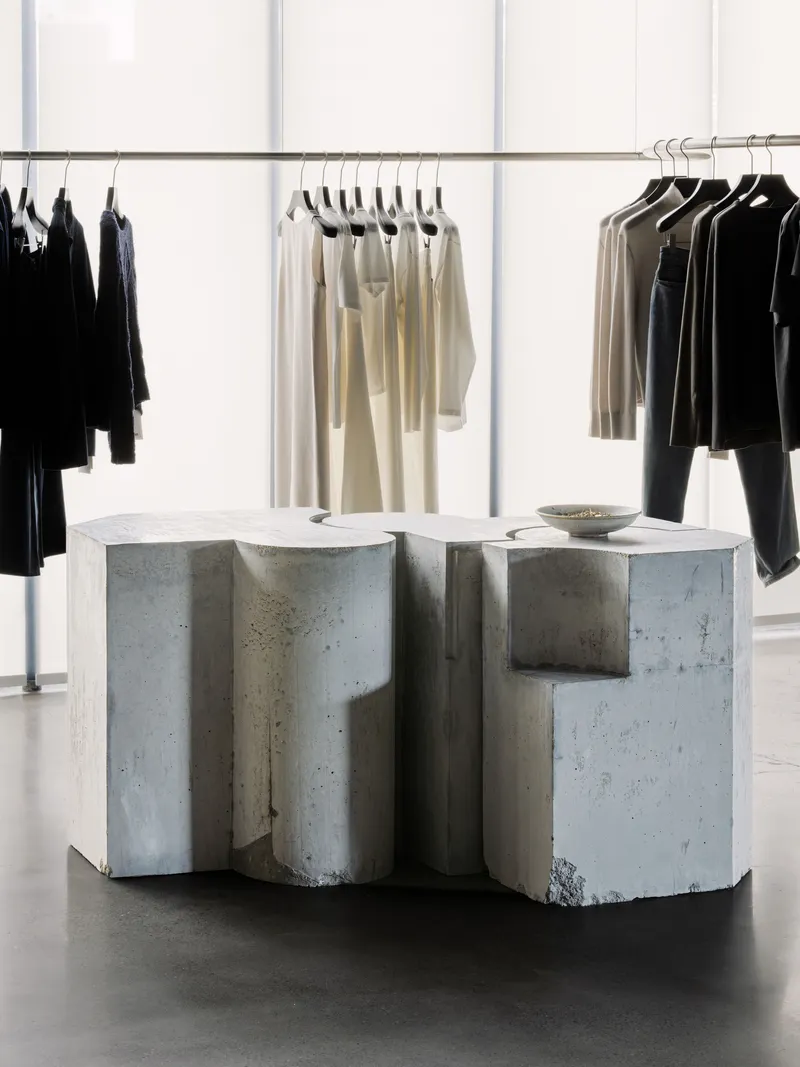
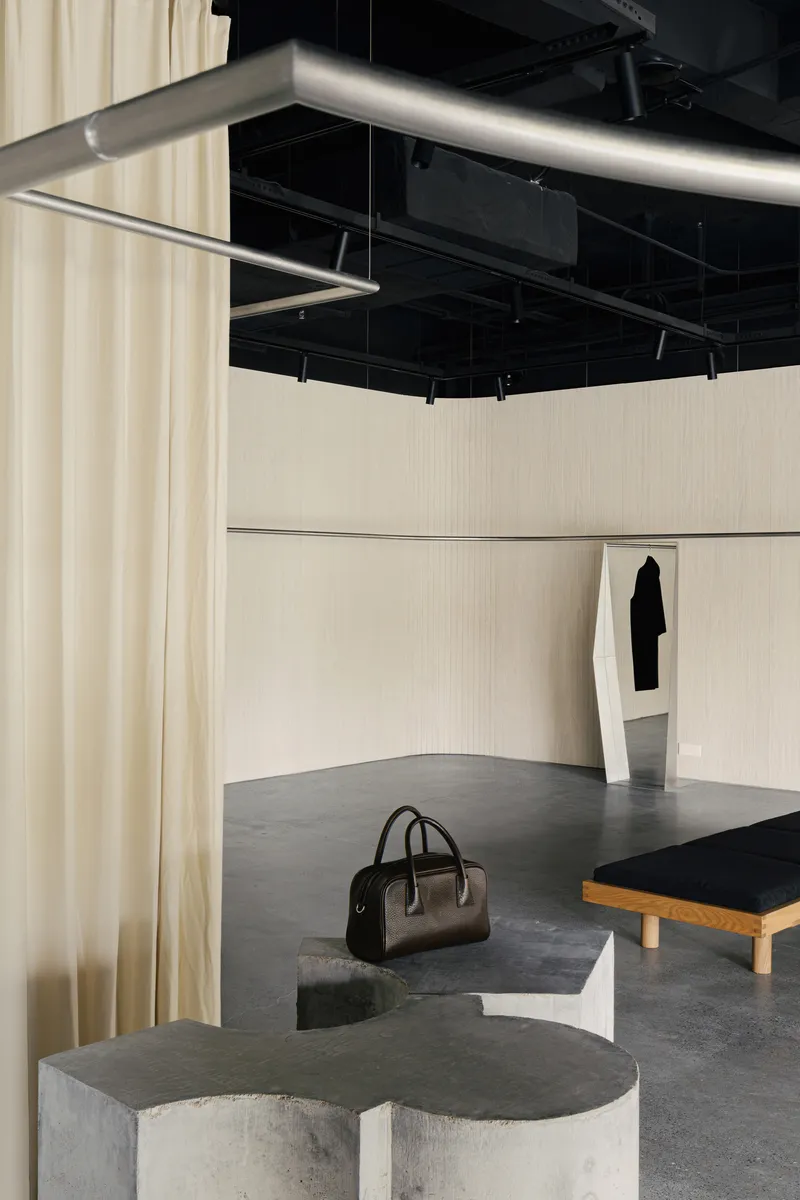

The continuous overhead steel rail is the project's thesis statement, and the concrete plinths and counters are its supporting arguments. Cast with undulating, faceted surfaces, these low volumes serve as display counters, seating, and spatial anchors simultaneously. Their weight grounds the room against the lightness of the suspended rail and sheer curtains above.
Details like the brushed steel handrail wrapping a concrete corner or the chamfered edges of interlocking concrete blocks reveal a material sensibility that is deliberately restrained. Nothing is polished to a luxury sheen. The finishes speak to craft rather than expense, which aligns well with the kind of contemporary fashion brand that values process over logo.
Borrowed Landscape
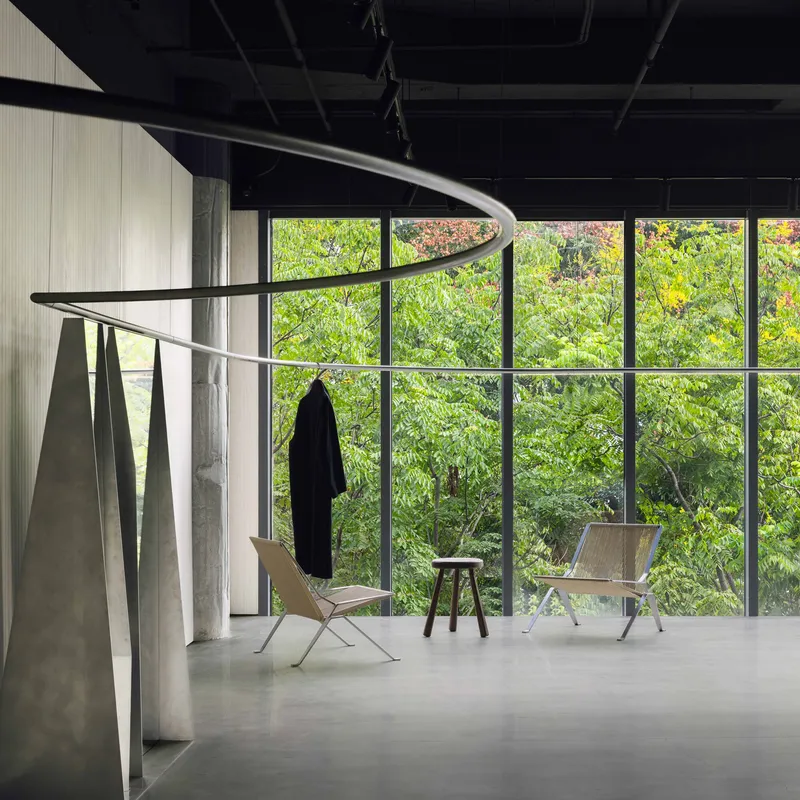

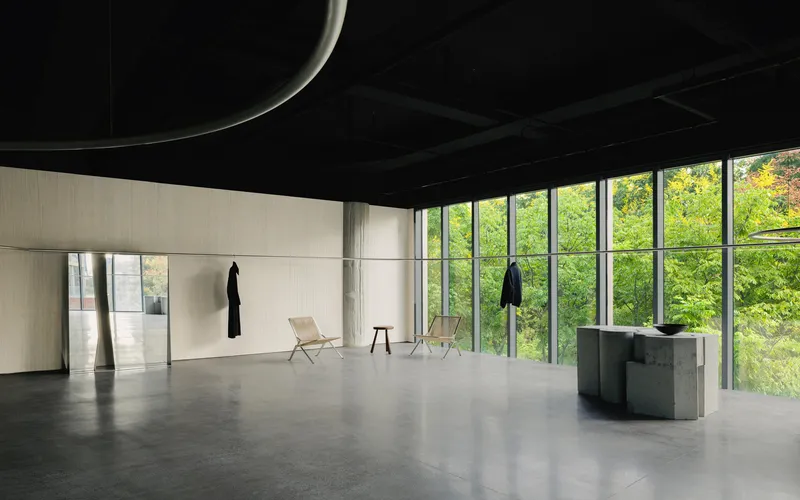
Shanghai retail spaces rarely get this kind of relationship with greenery. Full-height glazing on at least two sides frames dense foliage so close it almost touches the glass, turning the trees into a living wallpaper that changes with the seasons. The autumn palette visible in several views gives the interior a warmth that no artificial lighting could replicate.
SHISUO wisely kept the zones near the windows uncluttered. Polished concrete floors reflect daylight deep into the plan, and the decision to leave structural columns exposed maintains a visual connection between interior and exterior. Folding chairs and minimal hooks placed near the glass walls suggest a lounge atmosphere rather than a transactional one.
Curtains and Softness

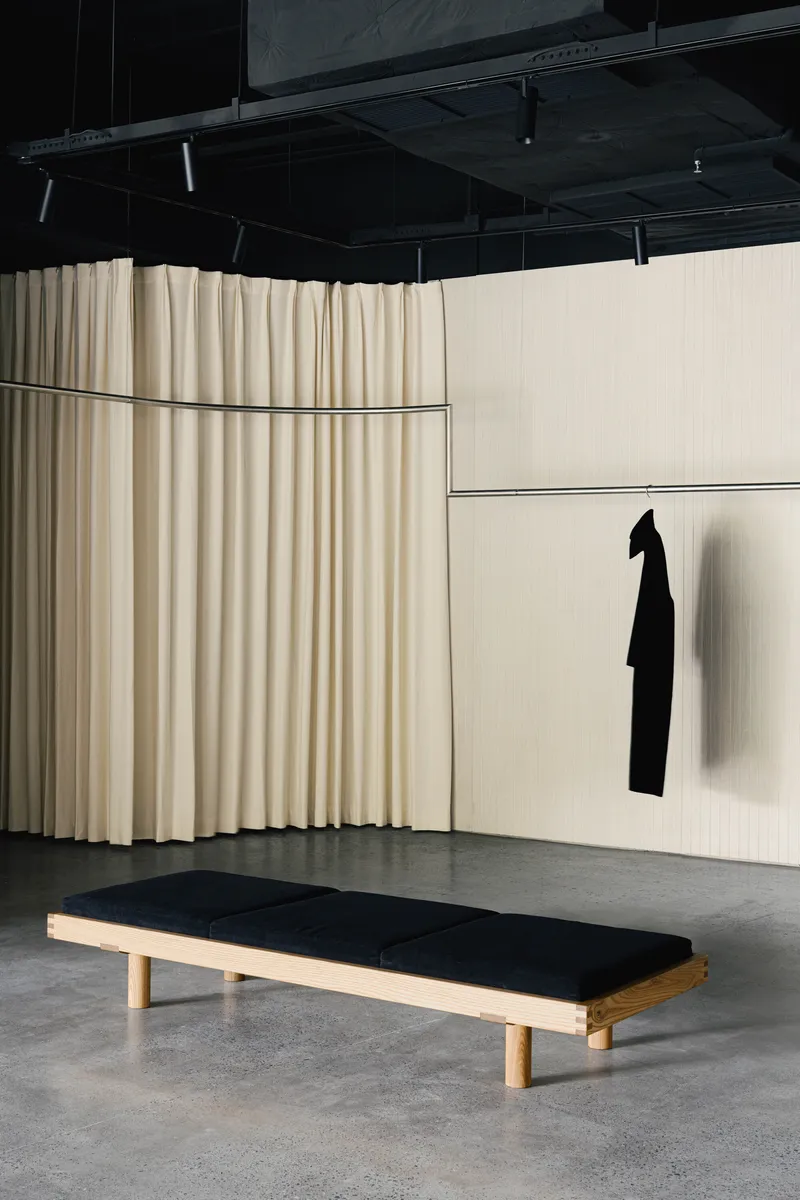
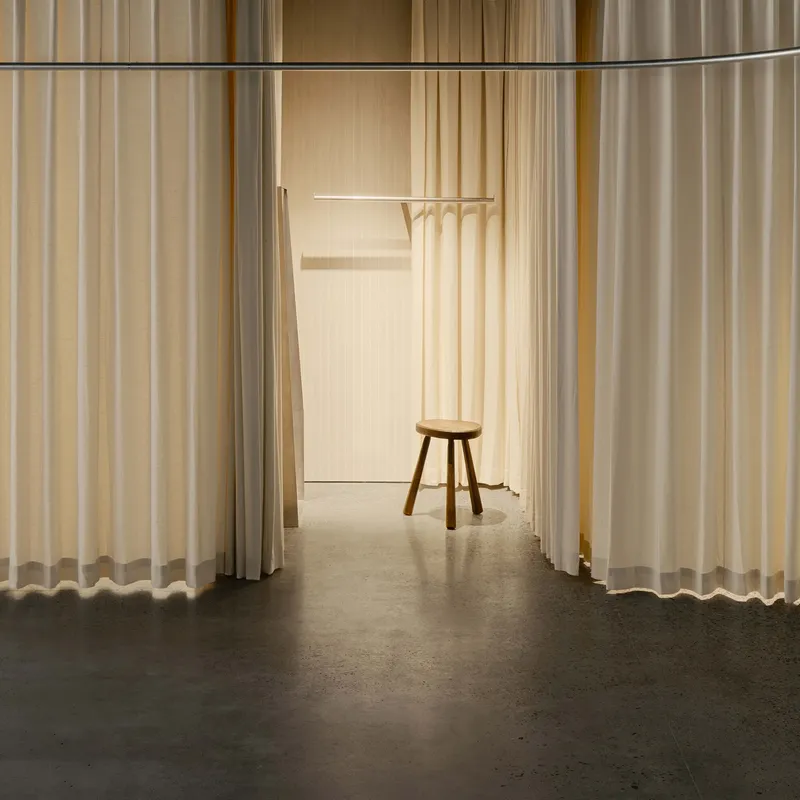
Against all the concrete and steel, SHISUO introduced pleated cream curtains as a flexible partition system that softens acoustics, diffuses light, and allows the showroom to reconfigure for different events. In the fitting area, curved fabric panels create intimate enclosures without the finality of built walls. A timber bench and exposed ceiling keep the space feeling honest rather than precious.
The curtains also reinforce the textile logic of the whole project. In a space designed to show clothing, the architecture itself drapes, folds, and hangs. That is not a superficial metaphor; it is a structural decision that governs how rooms are divided and how visitors experience privacy and openness in the same visit.
Objects and Vignettes

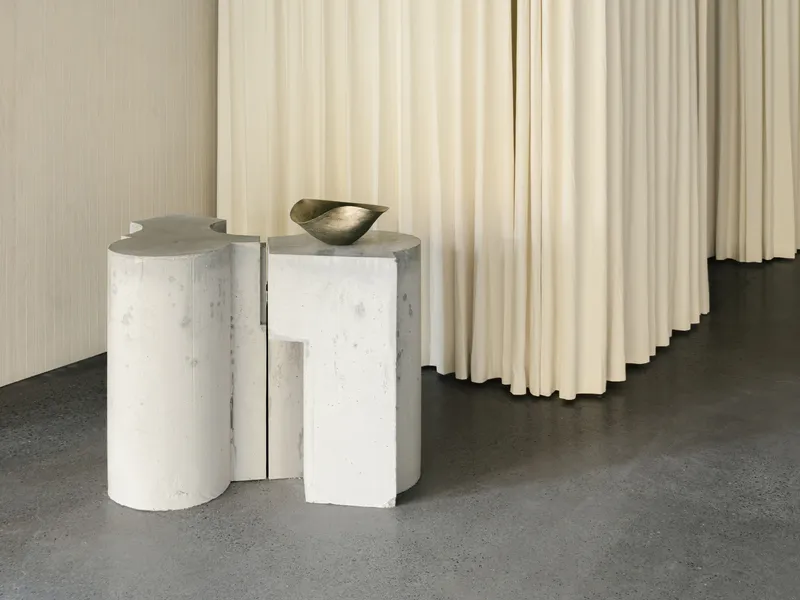

Retail interiors live or die on the small moments: a ceramic bowl on a concrete ledge, a black bag placed beneath a metal rail, white marble cylinder plinths catching the glow of sheer curtains. SHISUO curated these vignettes with the eye of a gallery installer. Each object sits in a considered relationship with its immediate background, whether that is a pleated fabric panel, a grooved wall, or open air.
The recessed display niches set into the ribbed walls deserve particular mention. Glass shelves lit from within turn the wall into a vitrine without interrupting its rhythm. It is a detail that rewards close attention and suggests the studio thought as carefully about what the space holds as about the space itself.
Plans and Drawings


The floor plan confirms what the photographs suggest: the showroom is organized as a loose sequence of rooms rather than an open loft. An entrance terrace feeds into display zones, a lounge area, and back-of-house spaces connected by the sinuous path of the overhead rail. The irregular site boundaries are visible at the plan's edges, and it is clear that the curved walls are not arbitrary gestures but direct responses to those constraints. Circulation is designed to loop, giving visitors a reason to pass through every zone without backtracking.
Why This Project Matters
YEARLY PLAN's Shanghai showroom is a case study in what happens when a retail interior commits to a single organizing idea and follows it relentlessly. The continuous rail is not a gimmick; it is the generative principle that produces wall geometry, threshold shapes, and spatial sequence. That kind of conceptual clarity is rare in commercial interiors, where briefs tend to fragment into competing requirements and design intent gets diluted.
SHISUO design office has delivered a space that respects the intelligence of both the clothing and the customer. The materials are honest, the light is real, and the architecture never shouts louder than the garments it holds. For a 226 square meter showroom in a city overflowing with retail spectacle, restraint turns out to be the most radical move.
YEARLY PLAN Shanghai Showroom by SHISUO design office. Lead architects: Sanif and Changshan. Shanghai, China. 226 m². Completed 2025. Photography by Xiaobin Lv.
About the Studio
Share Your Own Work on uni.xyz
If projects like this are the kind of work you want to make, uni.xyz is a place to publish your own, find collaborators, and enter design competitions.


Popular Articles
Popular articles from the community


Singing Woman: An Opera House That Performs Before the Curtain Rises
Ovidiu Cristian Pavel's conceptual opera house translates Estonia's choral identity into a sculpted waterfront landmark facing the Baltic Sea.


David Ortega Stacks a Two-Story Mexico City Penthouse Around a Steel Stair and a Pergola-Shaded Roof Terrace
In Colonia Roma, a 300 m² penthouse uses oak joinery, a planted steel stair and a slatted roof pergola to make a new-build apartment feel like a house.

Aquadapt: An Underwater Habitat That Rewrites Its Rooms by the Hour
Curved modules ring the seabed while one shell shifts from breakfast room to cinema, farm and football pitch as residents' needs change.

ETEH Reworks the Shared Spaces of São Domingos School in Brazil Around Timber, Color and Hanging Plants
At São Domingos School in Brazil, 436 m² of hall, refectory and library are recast with timber joinery, a yellow and blue code and trailing greenery.

Similar Reads
You might also enjoy these articles

LAVA Architecten Gives Vocational Education a Sawtooth-Roofed Face on a Mechelen School Campus
In Mechelen, Belgium, a 2,053 m² STEM school on a 6×6 m grid turns workshops and classrooms into rooms that can be rearranged as teaching changes.

KEMA Studio Turns a Derelict Marvila Attic into a 60 m² Lighthouse Apartment Above Lisbon
In Lisbon's Marvila district, a rebuilt roof, four skylights and two plywood volumes turn an unlivable attic into a bright home facing the Tagus.

Pixel Gardens: One Repeated Module Stacked Into a Terraced Social Housing Tower for Famagusta
Salem Bader's shortlisted housing tower builds a vertical neighbourhood from one repeated module, offsetting units to carve terraces, light and air.

Bao Huynh Watercolor Atelier: A Serene Art Retreat in Hội An
Bao Huynh Watercolor Atelier in Hội An blends multifunctional art spaces, sustainable design, local materials, and family-friendly living in a serene environment.

Comments (0)
Please login or sign up to add comments
No comments yet. Be the first to comment!