

Yggdrasills: Growing a World Tree from the Steel Bones of Abandoned Offshore Oil Rigs
Abandoned offshore oil rigs become paired towers that harvest marine debris, stacking research, ritual and manufacturing along a living vertical spine.


Thousands of offshore oil and gas platforms stand in the sea as monuments to extraction, and many of them are now abandoned. The usual answer is demolition. Yggdrasills refuses it. The project borrows the Norse "world tree," the axis that binds separate realms together, and uses it to argue that an obsolete rig can become a trunk from which a new offshore ecosystem grows. In this proposal the steel frame becomes a root system for habitation, research and ecological repair.
Designed by Tatiana Serdyukova, the project was shortlisted in Proximity Island 2019. Its starting point is the condition of the Mediterranean, which absorbs millions of tons of plastic waste every year, with a significant share concentrated in the Adriatic. The proposal reads that pollution and the region's industrial leftovers as two sides of one Anthropocene problem, and it answers both with a single piece of architecture built through adaptive reuse.
An Extraction Machine Recast as a Self-Sustaining Cluster
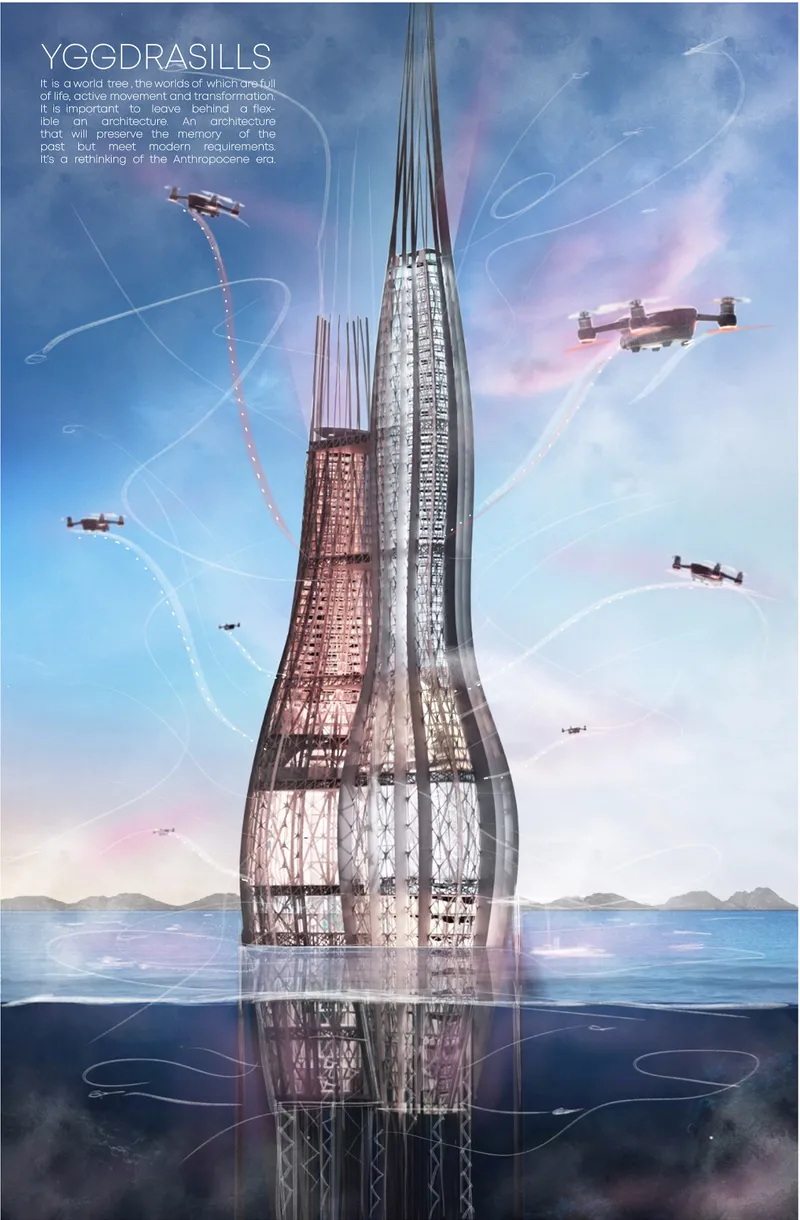
The central move is conceptual before it is formal. Serdyukova treats the rig as an autonomous cluster: a node of regeneration on the infrastructure that once served extraction. Residential and public programmes are grafted onto the industrial frame, so that living, working and research share the same structure. The rig is not simply converted to a new use. It is asked to carry a small society.
That autonomy is organised into two primary towers with distinct but complementary roles, one weighted toward scientific inquiry and the other toward social life. The pairing is the project's strongest organisational idea. It keeps the laboratory and the commons from collapsing into a single undifferentiated mass while making them depend on each other, which is how an ecosystem works.
A Vertical City Stacked from Chapel to Waste Plant

The sections show how far the vertical zoning goes. Religious centres, observatories, spas, manufacturing units and waste treatment systems sit on separate levels, each programmed precisely and each able to operate on its own. Placing a spa and a waste plant in the same tower is a deliberate provocation: the building does not hide its metabolism. The processes that keep it alive are stacked in plain view beside the spaces where people pray, look at the sky and rest.
Movement through this stack relies on lifts, staircases and connecting bridges between the towers, while drones and robotic systems handle logistics and servicing. Access works by both air and sea, which makes the cluster a multi-scalar hub rather than an isolated outpost. The bridges matter most. They are the branches that turn two trunks into one tree.
Stretched Geometry Shaped by Wind, Current and Sun


The towers take a fluid, organic form, produced through extrusion, stretching and adaptive façade modulation. The geometry is expressive, but the project insists it is also performative, tuned to wind, water currents and solar exposure. Offshore, those forces are the dominant design condition, so a form that bends to them makes more sense than a rigid, idealised volume.
The façade works as a dynamic skin that regulates climate and supports energy efficiency. Behind it, the structure sits within a lattice framework that allows modular growth and interchangeable materials. This is where the world-tree metaphor stops being decoration: the lattice lets the building add and replace parts over time, adjusting as its ecological and programmatic demands change.
Towers That Clean the Water They Stand In

Marine remediation is the project's reason for being. The towers act as active agents that clean ocean water and collect debris, and the waste is repurposed through manufacturing systems built into the structure. The intended result is a closed loop in which the pollution of the surrounding sea becomes raw material for the cluster itself.
The proposal also expects its own success to change it. As debris collection, its primary function, declines over time, the architecture is meant to evolve with it. Few competition entries plan for the day their main problem is solved, and that foresight gives Yggdrasills a maturity beyond its sculptural silhouette.
Why This Project Matters
Yggdrasills takes on one of the most awkward legacies of the industrial age, the offshore platform with nothing left to extract, and treats it as a resource rather than a liability. Its case for reuse rests on two grounds: that reuse is cheaper than removal, and that leaving the sea to absorb both plastic and steel is no longer acceptable. The world-tree image gives that argument a cultural weight that technical proposals often lack.
The project is speculative, but its parts are sound: paired towers that balance research and community, vertical zoning that puts the building's metabolism on display, a lattice designed for growth, and a closed-loop waste strategy that plans for its own obsolescence. For young designers looking at the oceans, it shows that the most radical move is sometimes to keep a structure standing and give it a new reason to exist.
View the Full Project
About the Designers
Designer: Tatiana Serdyukova
Enter a Design Competition on uni.xyz
uni.xyz runs architecture and design competitions year-round that reward proposals with spatial conviction and real site intelligence.
Project credits: Yggdrasills by Tatiana Serdyukova Proximity Island 2019 (uni.xyz).


Popular Articles
Popular articles from the community


David Ortega Stacks a Two-Story Mexico City Penthouse Around a Steel Stair and a Pergola-Shaded Roof Terrace
In Colonia Roma, a 300 m² penthouse uses oak joinery, a planted steel stair and a slatted roof pergola to make a new-build apartment feel like a house.


Manzana Morphosis: Stretching Barcelona's Grid into a Living Landscape for 2050
A radical reworking of the Eixample manzana turns density into a tool for generous public space, vertical ecology, and environmental performance.

Cube Design Draws an Ecological Corridor Between Two Shenzhen Hills with the Nankai Building
Beside Shenzhen's container docks, the Nankai Building pairs stacked balconies with a climbing green screen to connect two hillsides across its height.

The Amber Palace Opera: A Geological Fiction Surfaces on Tallinn's Baltic Waterfront
Pierre Brillard reimagines a Baltic legend as a public landscape, opera house, and waterfront promenade rooted in Tallinn's coastal identity.

Similar Reads
You might also enjoy these articles
Healing Façade: A Modular Chapel System That Restores Ethiopia's Sacred Forests
Winner of the Eco-Chapel competition, this circular timber façade collects water from air to rebuild soil and reforest degraded Ethiopian landscapes.
Kaffeebühnen: Where Coffee Shop Architecture Becomes a Civic Stage in Vienna
A linear sequence of timber boxes, transparent shells, and open yards turns the Viennese café tradition into a public performance space.
Eco Chapel: A Modular Forest Pavilion That Grows Like the Landscape It Protects
Hexagonal timber modules weave through existing trees, turning a chapel into a living system for prayer, education, and reforestation.


Urban Forest: A Vertical Ecosystem for 5,000 Workers in Singapore's Changi Business Park
Radially stacked pods and layered green decks turn a 7-acre plot into 47 acres of ecological workspace projected for 2040.

Explore Architecture Competitions
Discover active competitions in this discipline

Challenge to reimagine the Iron Throne

Photograph architecture without architects

Illustrate the lost glory of Angkor Wat - Render Challenge

Design challenge to reuse E-waste
Comments (0)
Please login or sign up to add comments
No comments yet. Be the first to comment!