

Yong Ju Lee Architecture Builds a Seoul Hotel from Vacuum-Formed Capsules and CNC-Cut Panels
On a tight Myeongdong side street, twenty-nine modular guest units generate the building's entire form from the inside out.


Most small hotels in Seoul's Myeongdong district accept their constraints: a narrow plot, a regulatory envelope, a corridor lined with doors. Hotel Myeongdong Station, designed by Yong Ju Lee Architecture, refuses to treat those givens as the end of the conversation. Instead of wrapping a generic box in a decorative skin, the team let the guest module itself become the building's primary architectural unit. Twenty-nine sleeping capsules, stacked and rotated, produce the facade, the massing, and the spatial character all at once. The envelope is not applied; it is accumulated.
Sitting on a 129-square-meter site alongside a side street off a six-lane artery, the building occupies roughly 215 square meters of gross floor area. That is small enough to qualify as micro-architecture, yet the ambition here is anything but modest. Yong Ju Lee and his team, including Kim Dohoon, Son Dajeong, and Studio Hade, explored initial forms through AI-based generation experiments before refining the design around hard programmatic variables: how light enters a sleeping pod, which direction a guest faces, and how storage integrates into wall surfaces. The result is a building whose intelligence is structural, not decorative.
A Facade That Is Also a Floor Plan
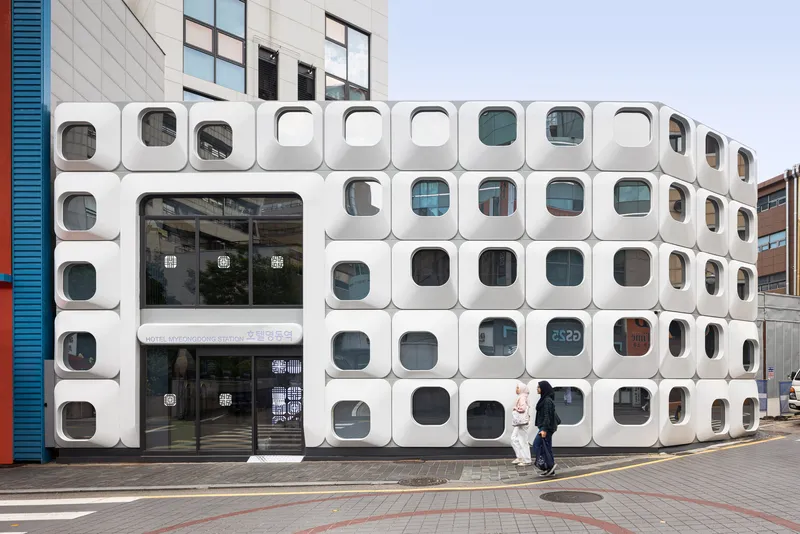
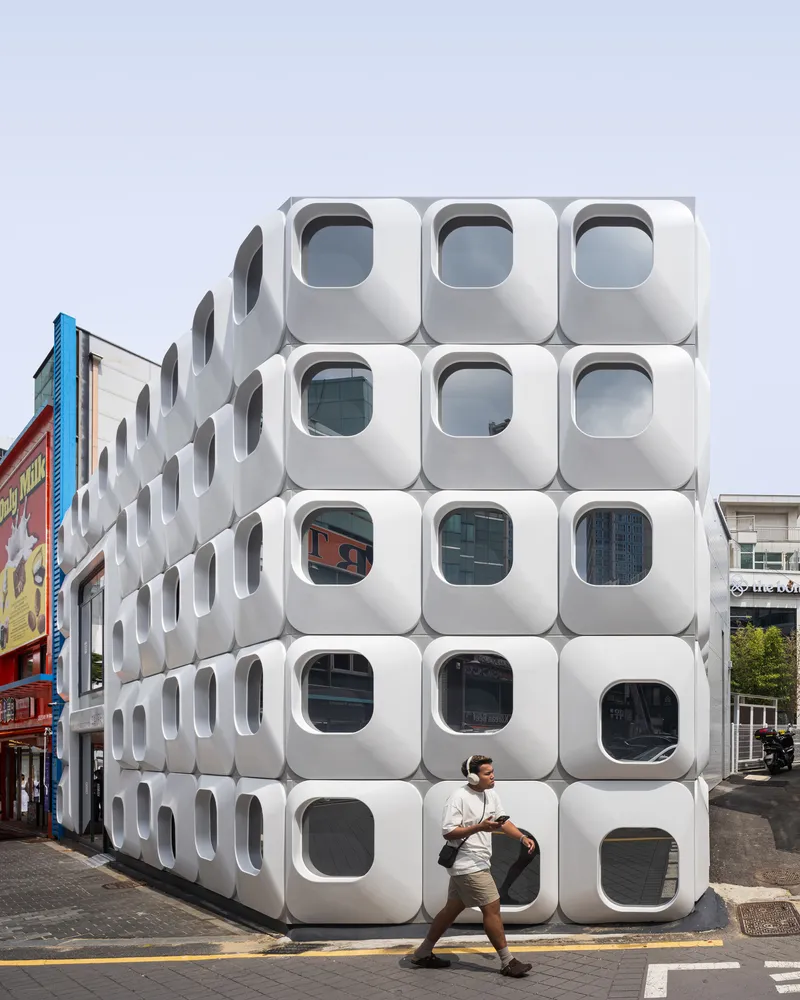
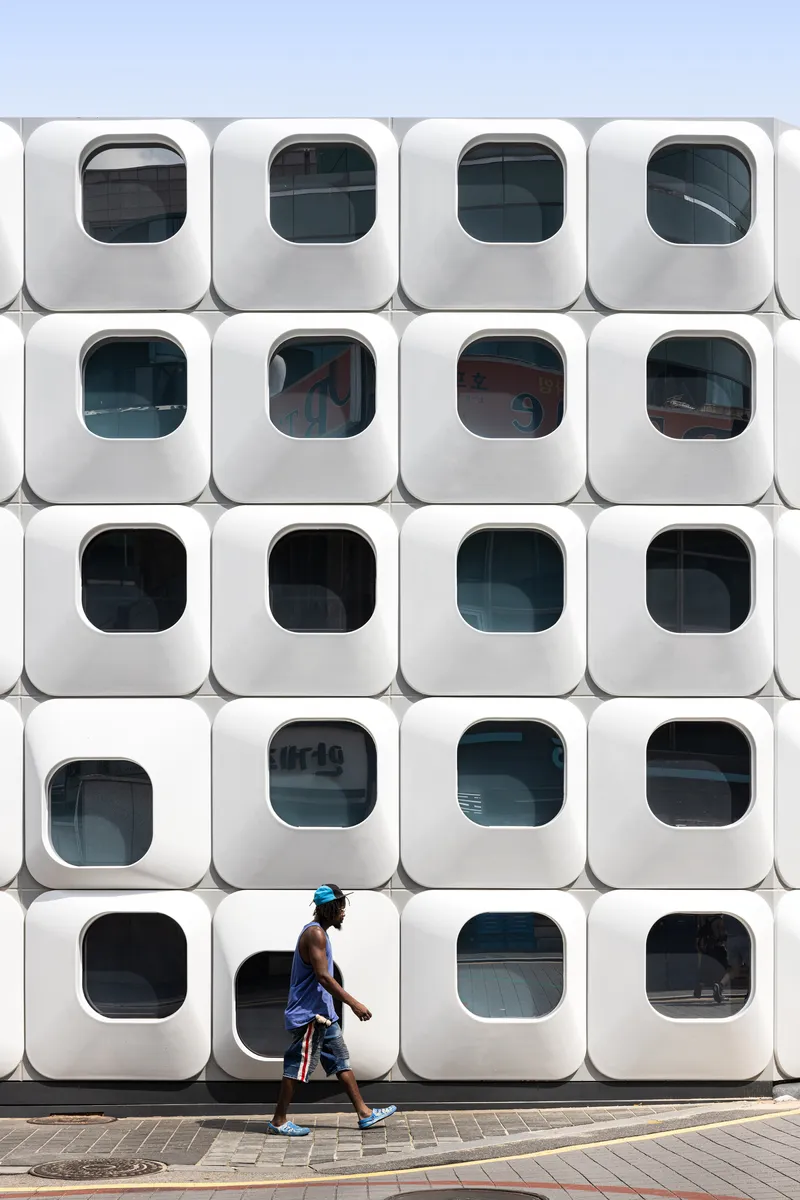
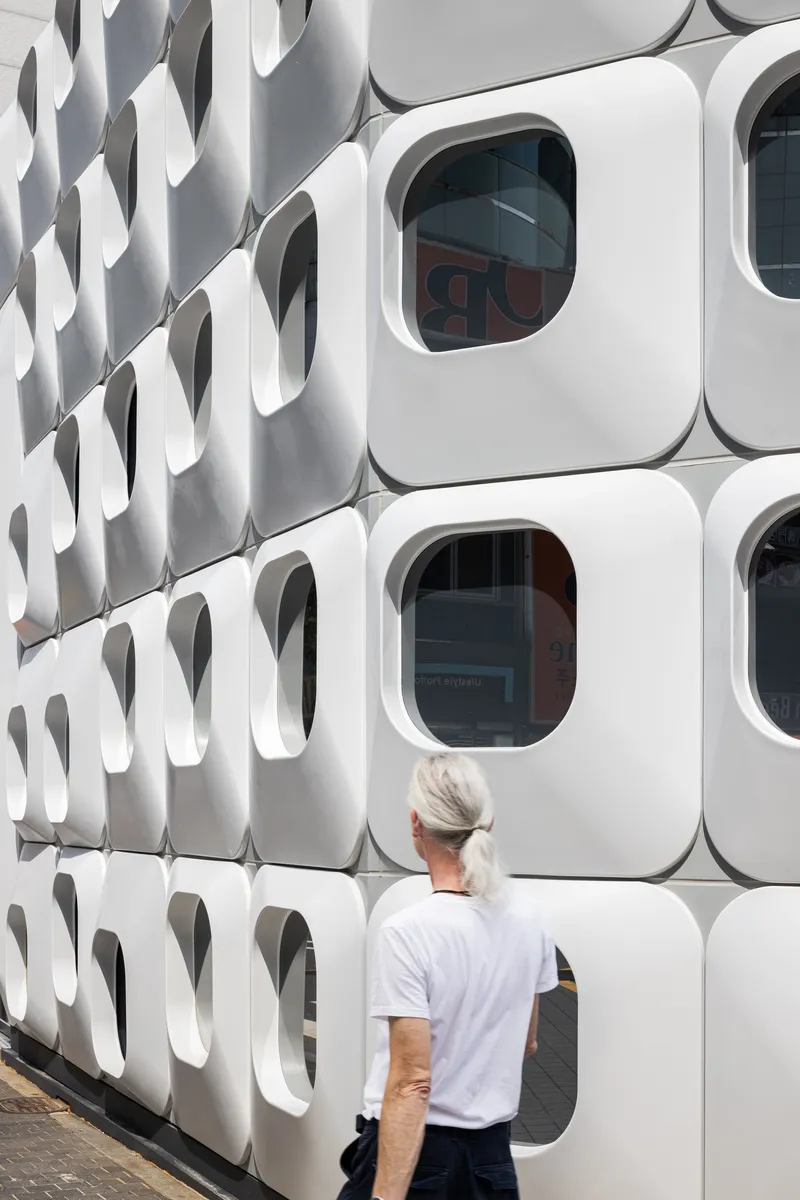
From the street, Hotel Myeongdong Station reads as a white grid of rounded-square openings, each one the glazed face of a guest unit. The curved ABS panels that form the envelope were vacuum-formed over CNC-machined dies and then given a fire-retardant finish. Only two panel types exist; rhythmic variation comes entirely from rotation and repetition. The effect is systematic yet lively, closer to a textile weave than a curtain wall.
What matters is that each porthole is not ornament but program. Behind every rounded frame sits a capsule with its own orientation, light condition, and view. The facade does not conceal the interior logic; it is the interior logic, projected outward. Walk past at street level and you can read the building's organization in a single glance.
Panel Depth and Material Precision
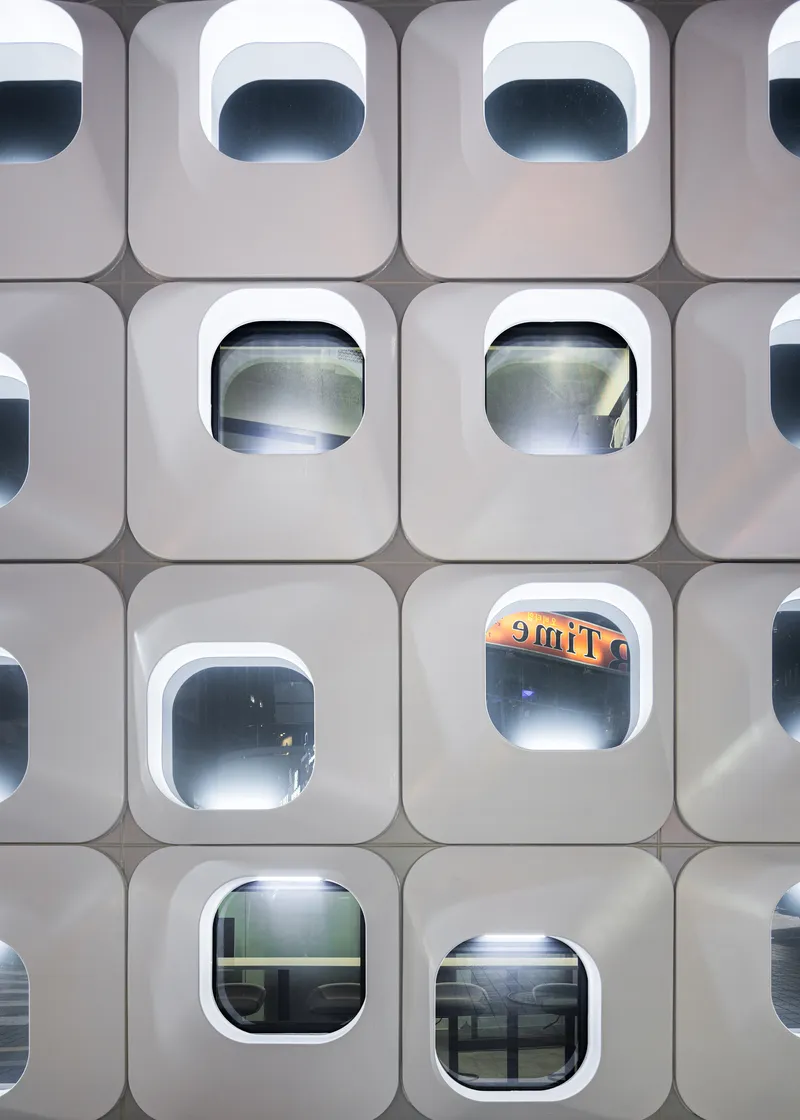
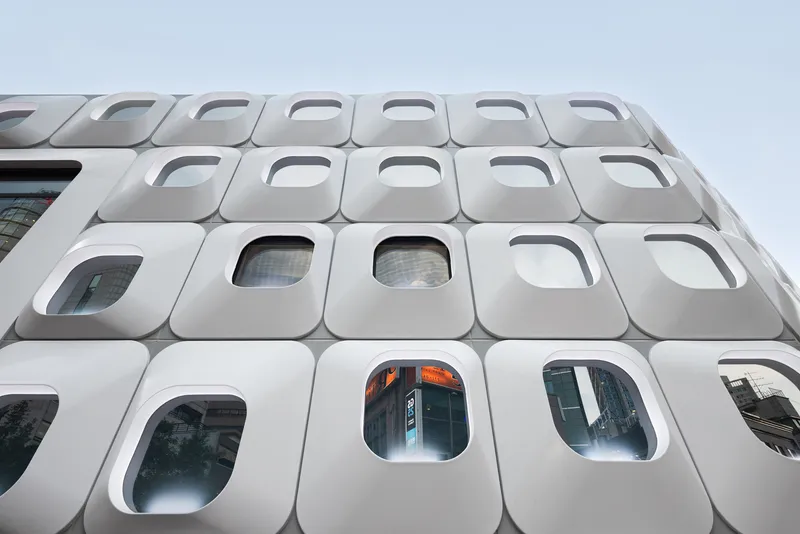
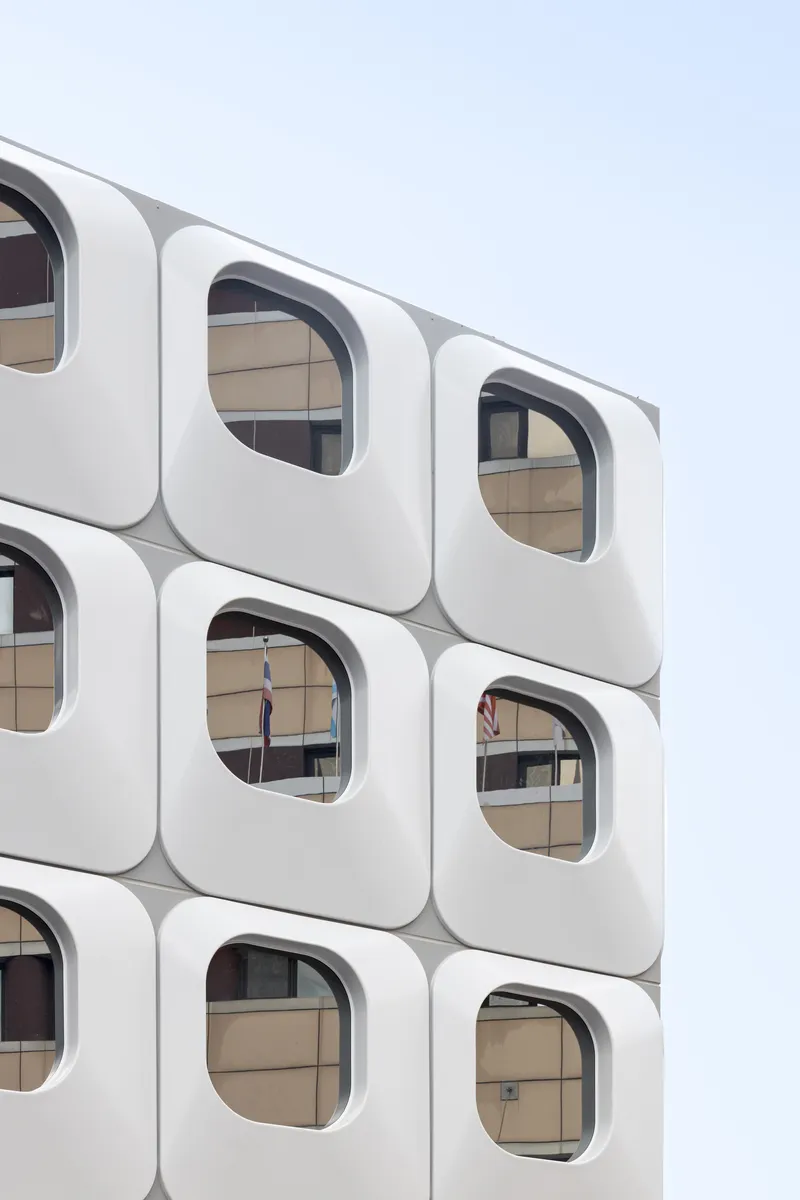
Close up, the panels reveal a surprising depth. Each rounded-square frame projects several centimeters outward from the aluminum subframe, creating shadow wells that shift with the sun and give the otherwise flat white surface a sculptural relief. The CNC-machined tooling ensures that every curve is identical, so the irregularity you perceive is atmospheric, not geometric.
The material choice is pragmatic. ABS is lightweight, inexpensive relative to cast concrete or folded metal, and well-suited to vacuum forming at this scale. Fire-retardant finishing addresses code requirements without adding visible layers. It is a convincing demonstration that digital fabrication does not need exotic materials to produce architectural specificity.
The Corridor as Threshold
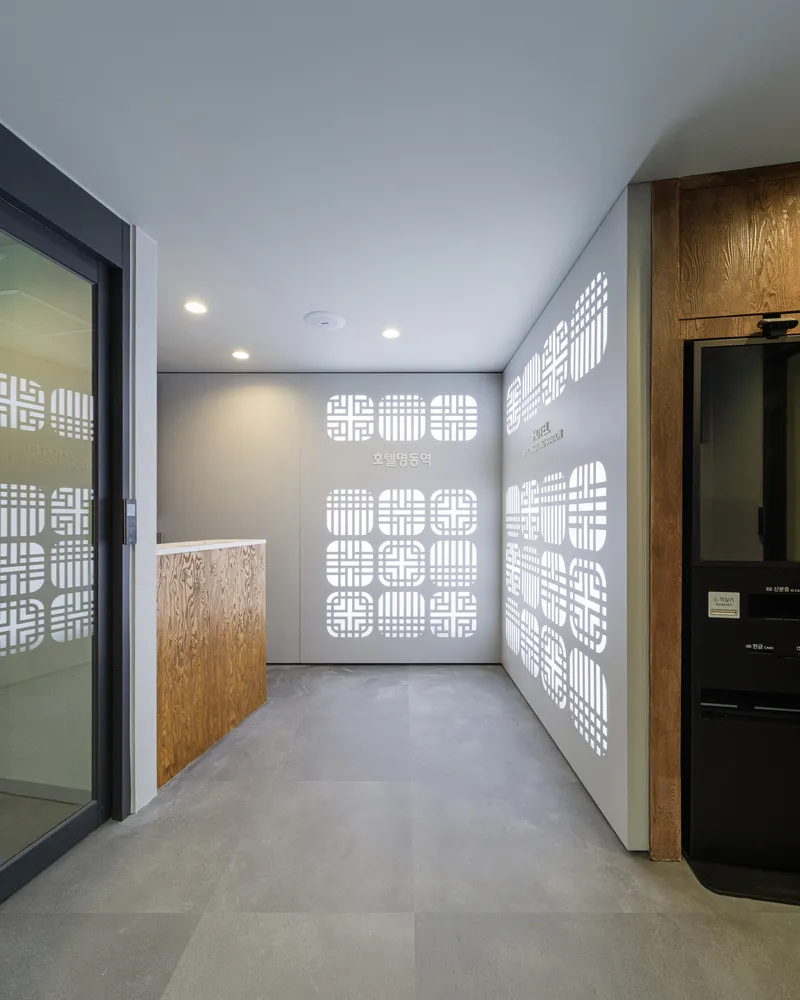
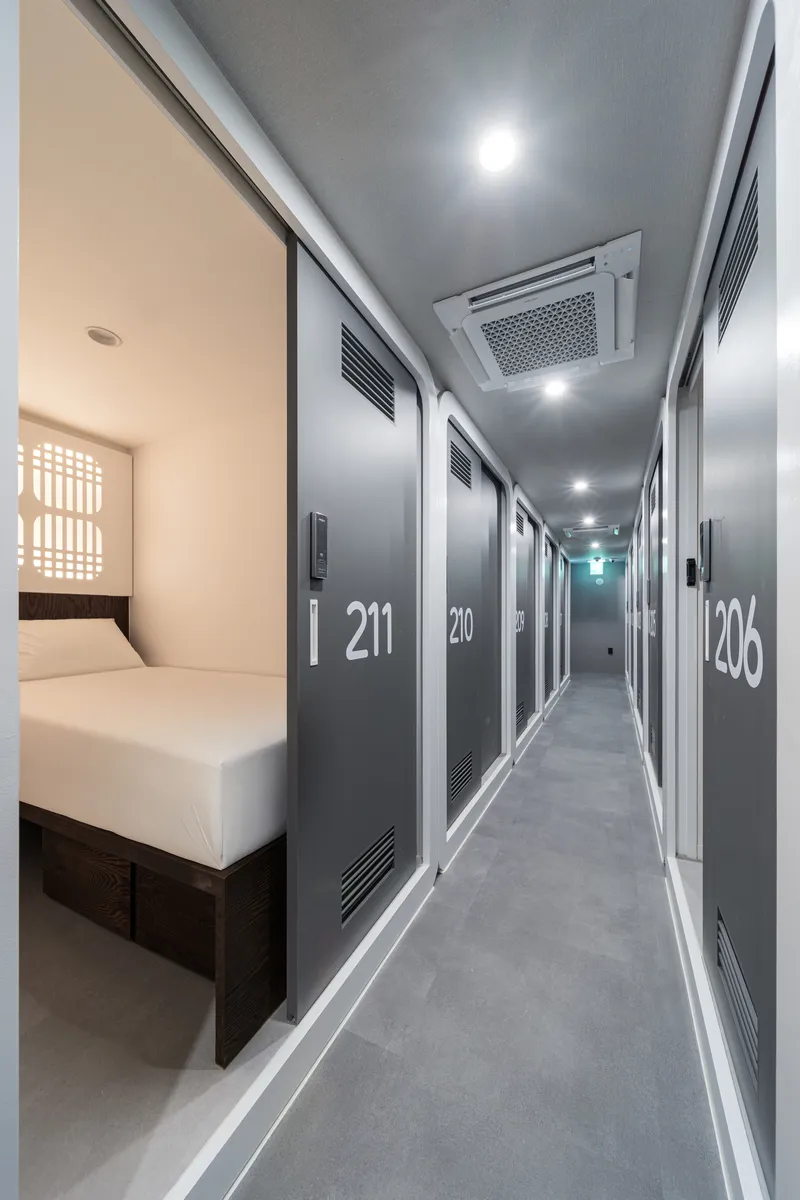
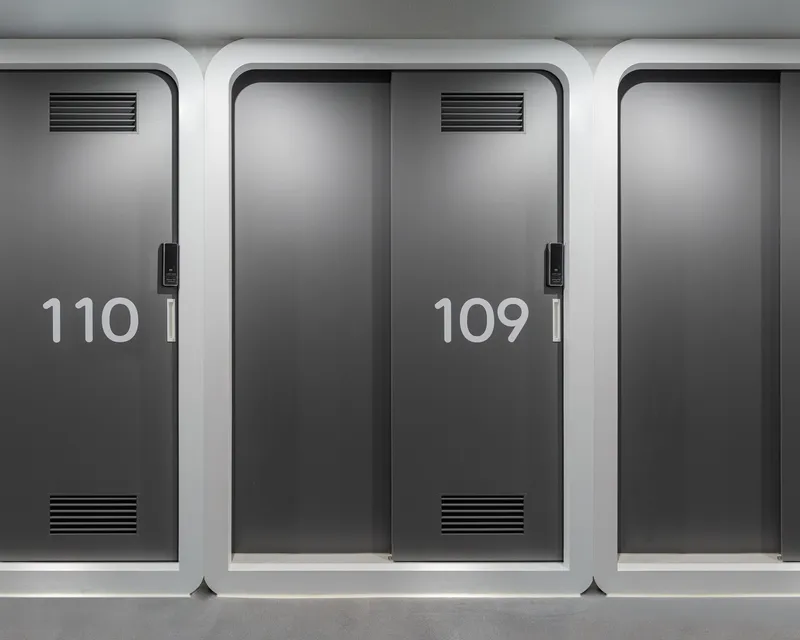
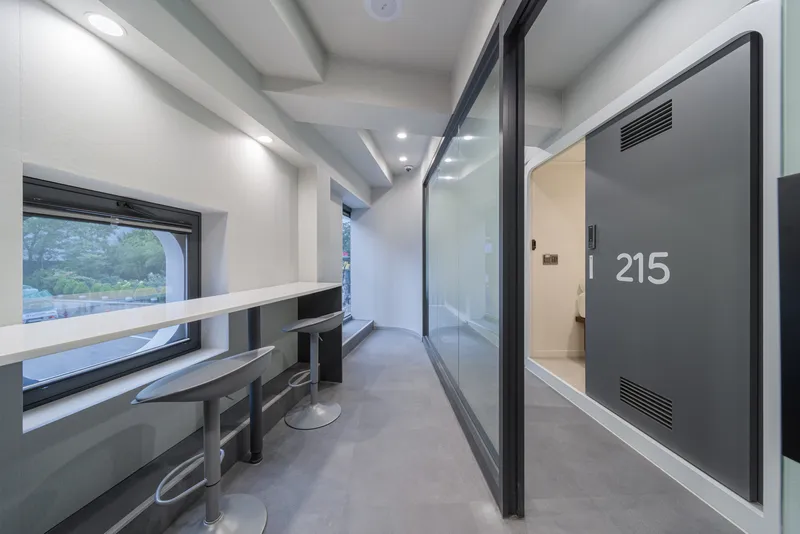
Inside, a central corridor organizes circulation between the capsule units. Polished concrete floors and recessed ceiling lights keep the palette restrained, while a perforated white wall panel near the entrance hints at the geometric language of the exterior without replicating it literally. Numbered grey sliding doors with ventilation grilles line both sides, each one scaled just wide enough for a single occupant to slip through.
The corridor is narrow by conventional hotel standards, but that compression is deliberate. It heightens the contrast between the shared passage and the private capsule beyond the door, making the threshold between public and personal space legible even without a lobby or lounge to mediate the transition.
Capsule Interiors: Sleeping, Working, Looking
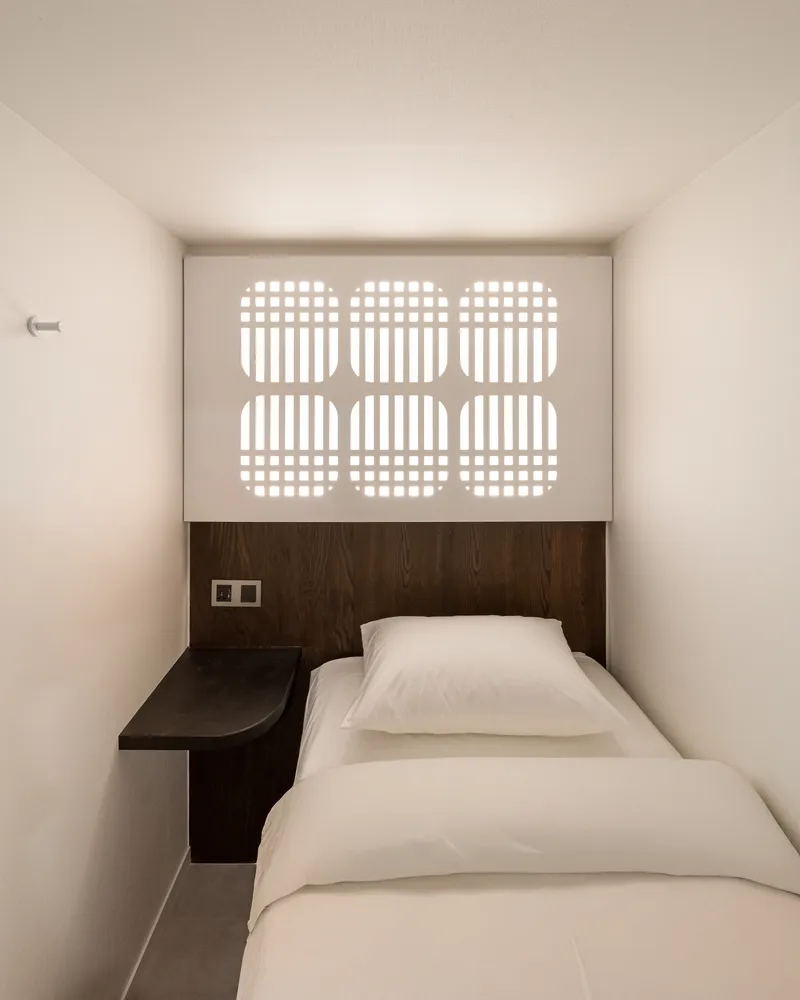
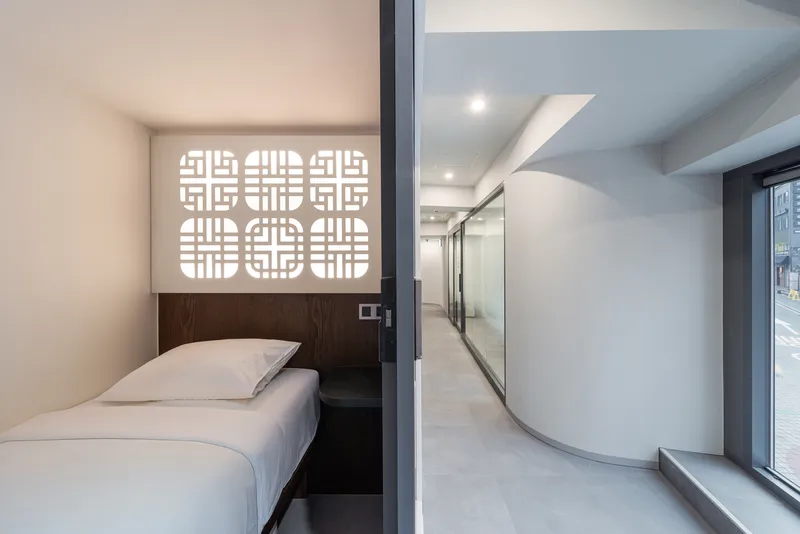
Each module integrates sleeping, resting, storage, and working functions into a single compact volume. Beds and tables are built into the walls, eliminating freestanding furniture and maximizing usable floor area. The dark wood headboard acts as more than a surface: a geometric perforated screen above the bed mediates light and frames specific views of the city. These headboard patterns draw from traditional motifs, a cultural reference that is subtle enough to register as texture rather than citation.
Through glass corridor walls, guests catch glimpses of curved partitions and neighboring windows, collapsing the distance between interior and exterior. Natural light enters not as a uniform wash but as a shaped condition, controlled by the orientation of the unit and the geometry of its porthole. The effect is intimate without feeling claustrophobic.
Urban Context and Street Presence
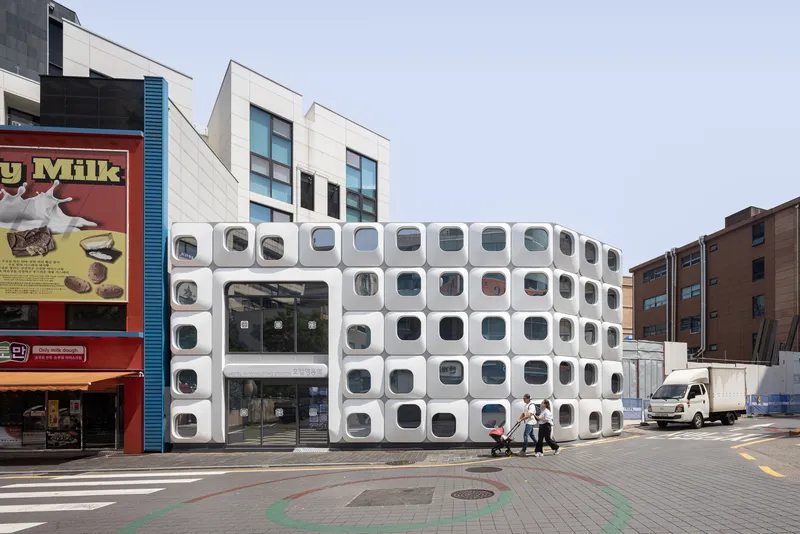
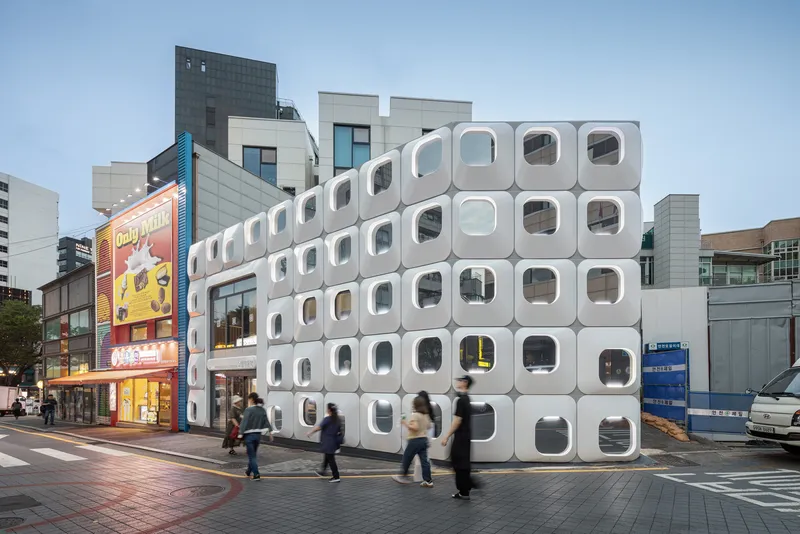
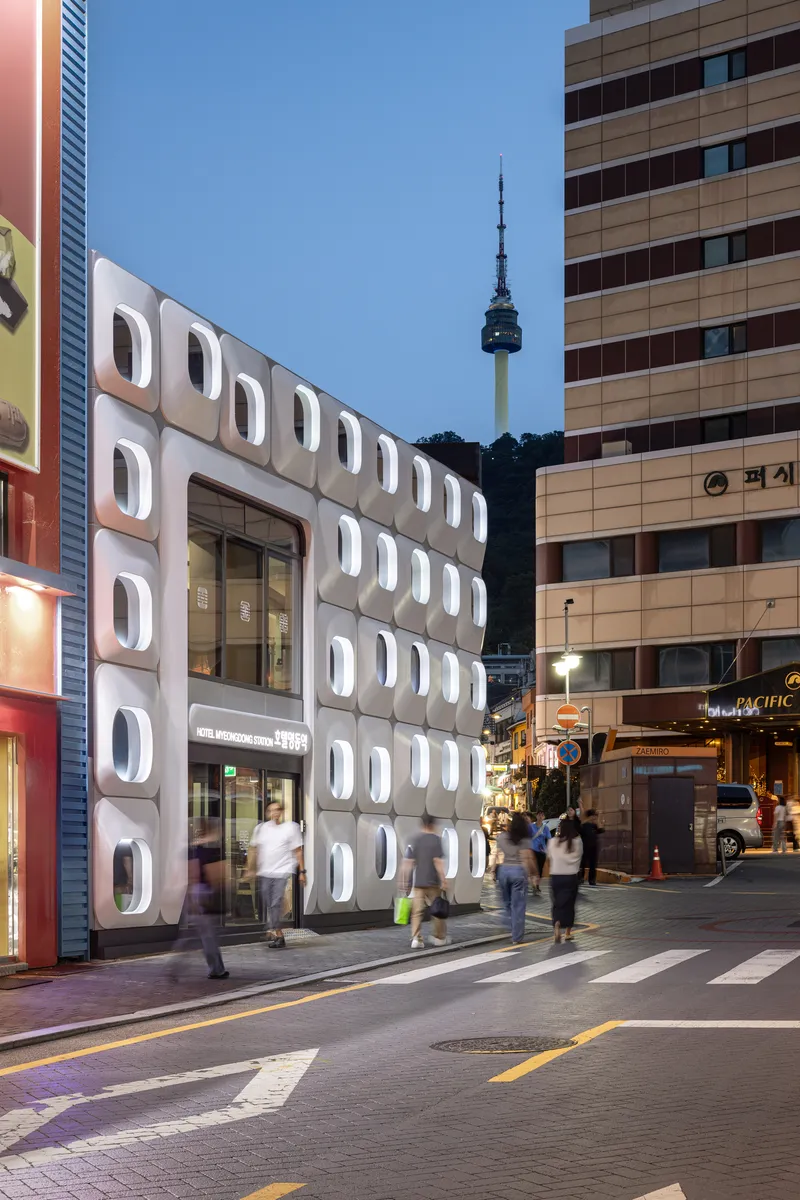
Myeongdong is one of Seoul's most commercially dense districts, a landscape of signage, neon, and relentless visual noise. Hotel Myeongdong Station is conspicuously quiet by comparison. The monochrome white envelope and repetitive geometry stand apart from the surrounding retail frontages without being hostile to them. At dusk, the porthole windows glow from within, and the building shifts from solid to lantern.
The entry canopy is modest, a simple horizontal plane that signals the ground-floor threshold. Pedestrians walk past, occasionally looking up, and the building accommodates their indifference. It does not demand attention; it rewards it. That restraint is rare in a neighborhood that profits from spectacle.
Dusk Studies and Atmospheric Shifts
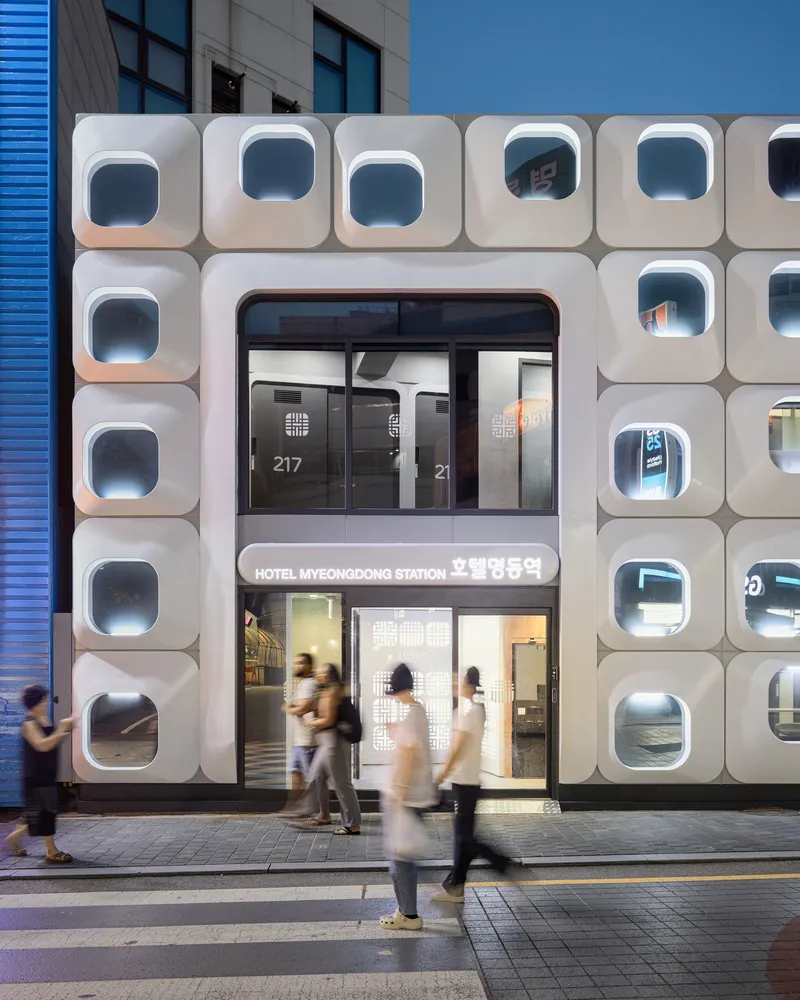
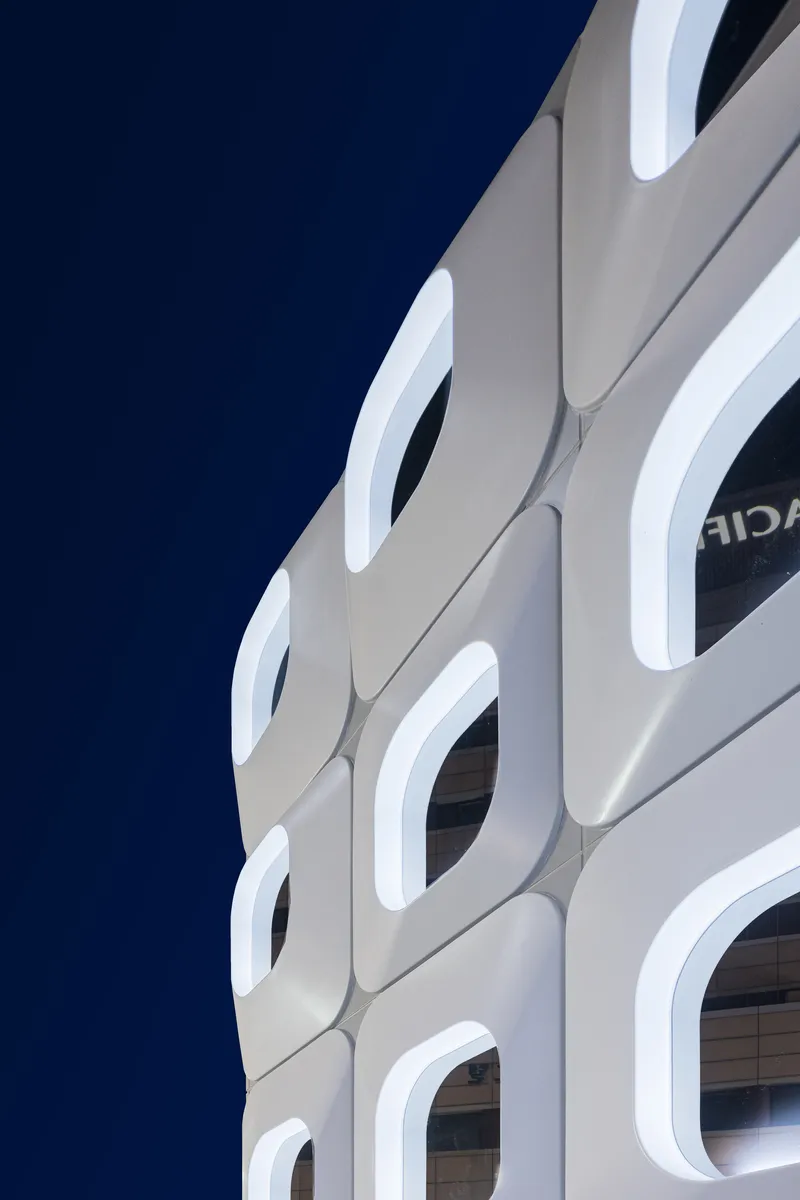
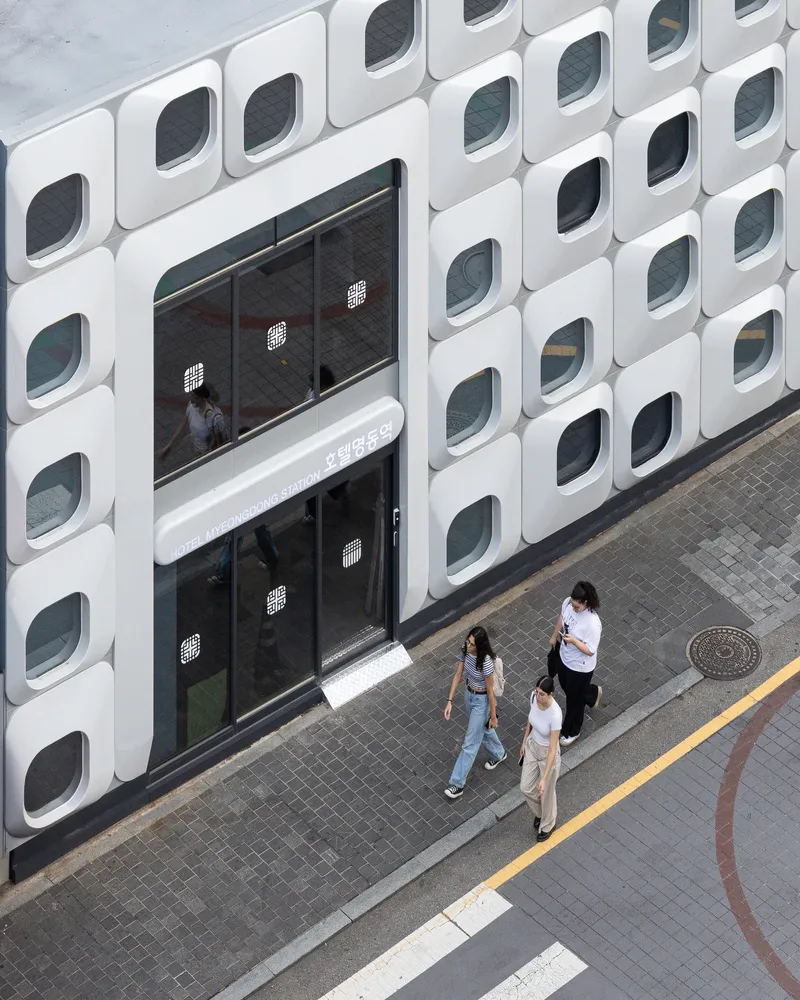
Photographer Bae Jihun captures the building across multiple lighting conditions, and the dusk images are particularly revealing. As the sky deepens, the shadow wells between panels flatten and the illuminated interiors take over, turning each capsule into a pixel in a low-resolution screen. The communications tower visible behind the roofline anchors the building in Seoul's vertical infrastructure, reminding the viewer that this is a city project through and through.
The motion-blurred pedestrians in several shots underscore the building's stillness. While Myeongdong moves, the hotel holds its grid. That tension between flux and fixity is central to the design's personality.
Plans and Drawings
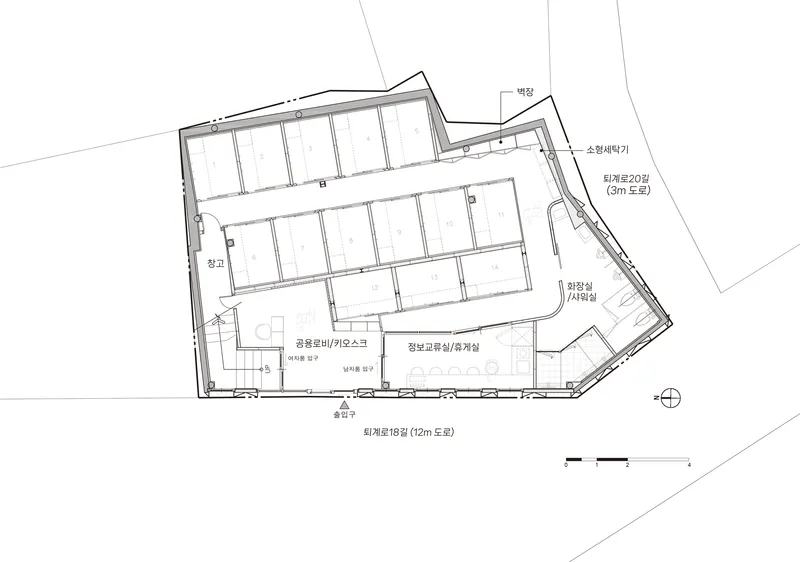
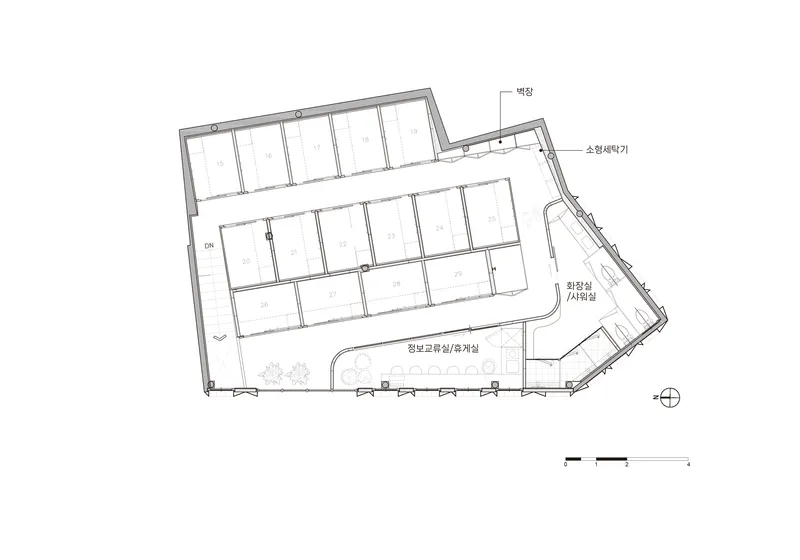
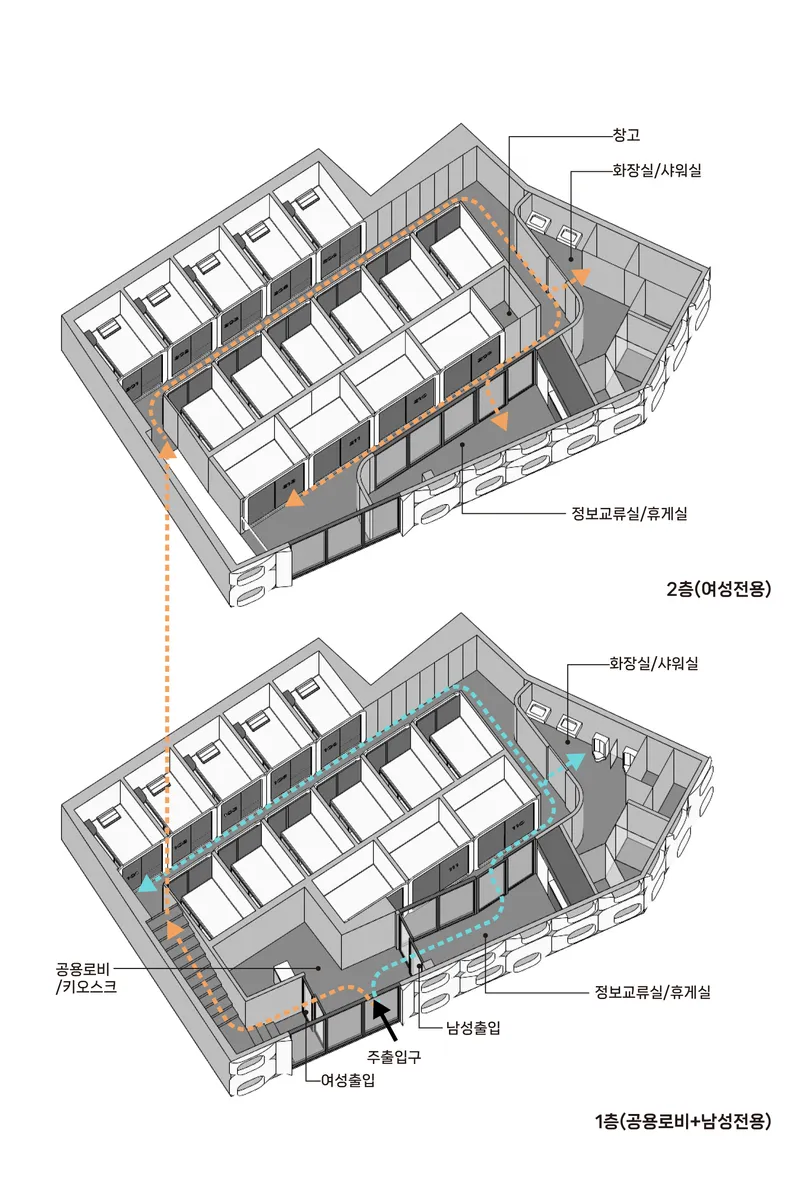
The floor plans confirm the angled site boundary that forces the building's slightly irregular perimeter. A central corridor runs the length of the plan, flanked by cellular rooms on both sides. The axonometric drawings separate each floor into its modular units, labeling service areas, shared bathrooms, kitchens, and the private lounge. The efficiency is startling: almost no circulation area is wasted.
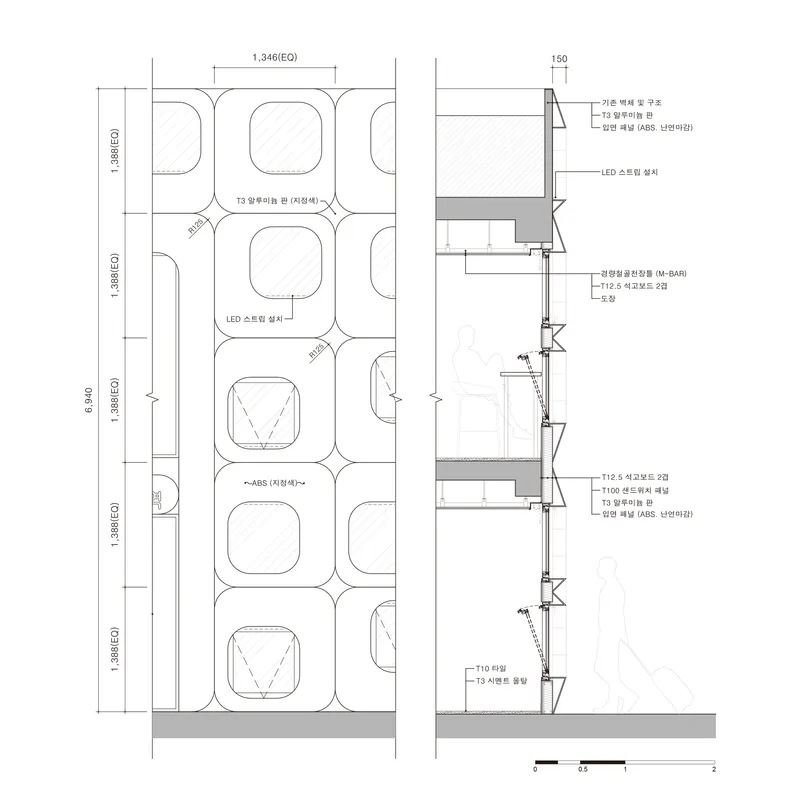
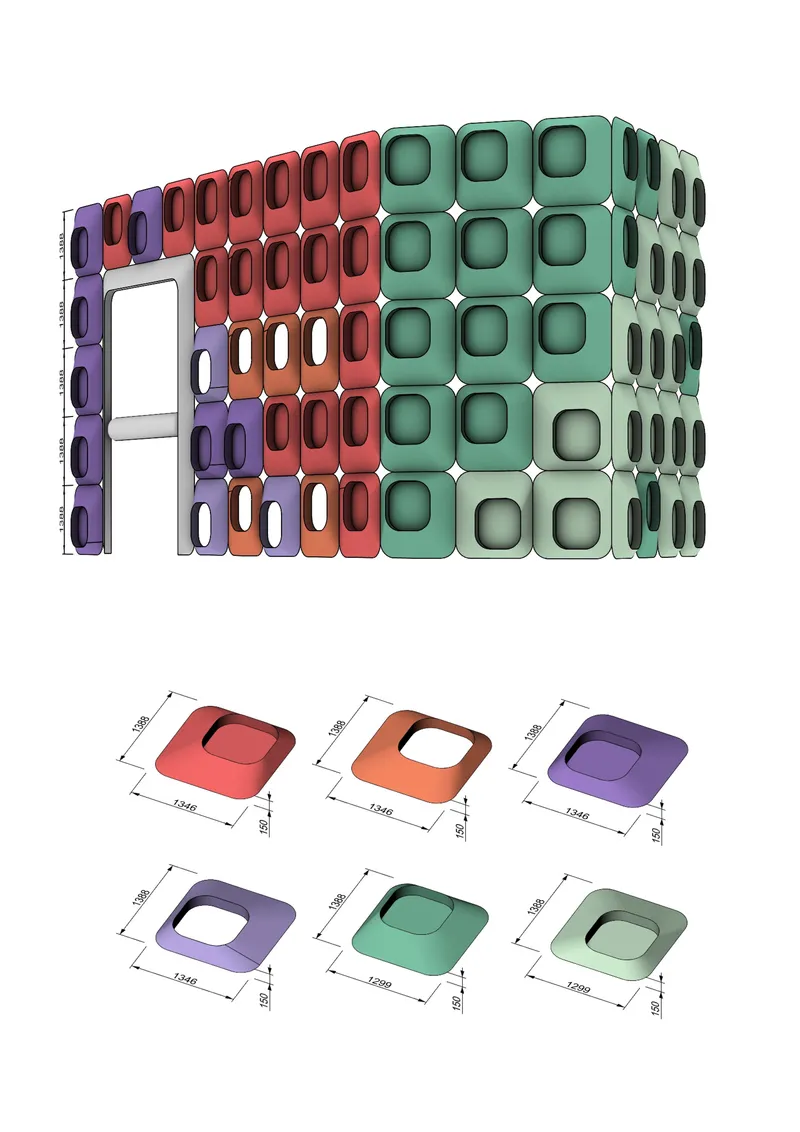
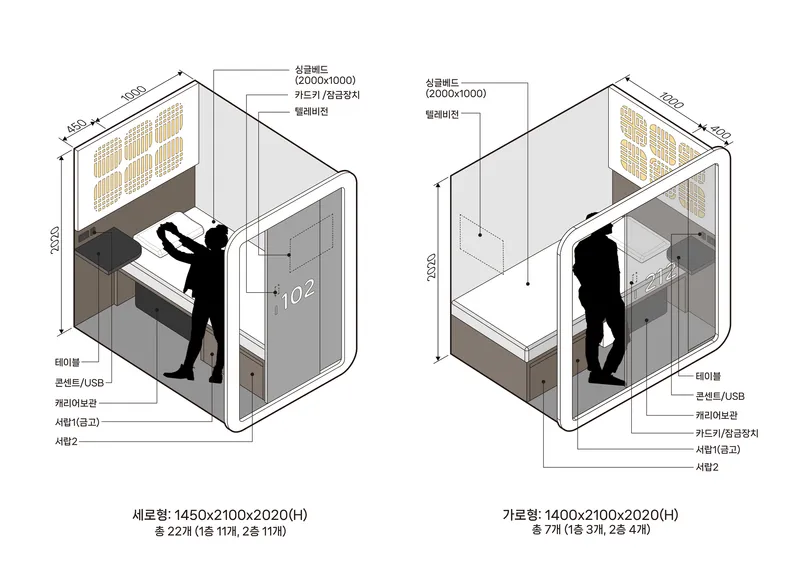
The elevation and section drawings detail the panel system at a technical level, showing mounting hardware, aluminum framing, and dimensional tolerances. An isometric rendering color-codes the two panel types to illustrate how rotation and stacking produce the full facade from minimal components. Cutaway drawings of two micro-unit configurations use silhouettes to demonstrate spatial use, proving that even at this scale, posture and movement were design inputs, not afterthoughts.
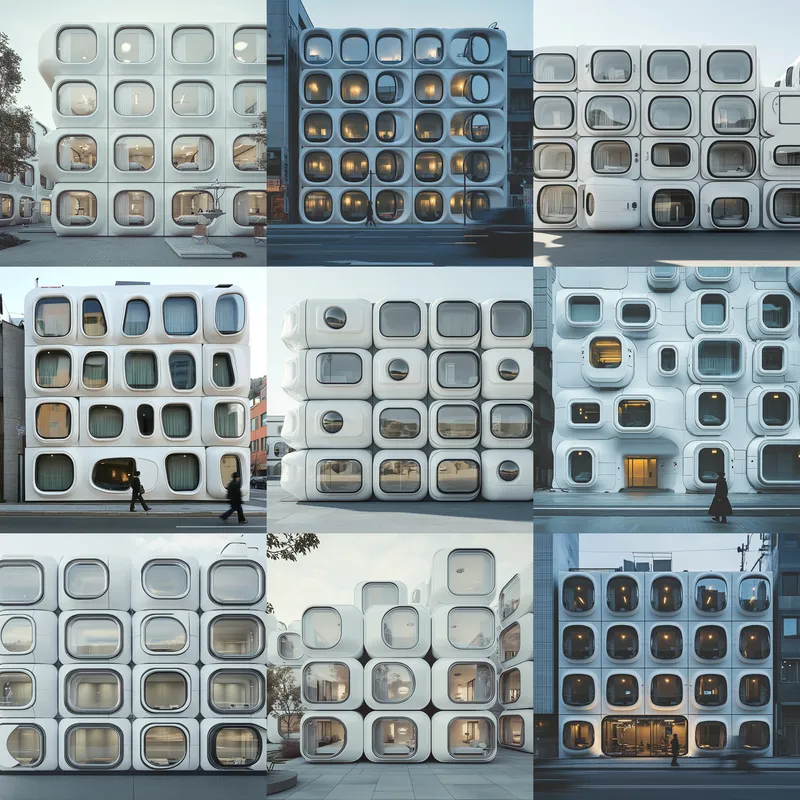
A grid of nine facade studies shows the rounded-square window system under varying light conditions and pedestrian activity, functioning almost as a contact sheet for the building's public face. These studies reinforce the point that the facade's character is not fixed; it changes with time of day, weather, and the presence of people.
Why This Project Matters
Hotel Myeongdong Station is a persuasive argument for letting program generate form rather than the reverse. In a market saturated with capsule hotels that treat the pod as furniture inside a conventional building, Yong Ju Lee Architecture treats the pod as a building block. The envelope, the massing, and the spatial experience all follow from a single unit repeated with discipline. That conceptual clarity is rare in hospitality architecture at any budget level.
The project also demonstrates that digital fabrication tools, CNC machining, vacuum forming, AI-assisted form finding, can serve rigorous architectural thinking rather than simply producing novelty geometry. On a 129-square-meter site in one of the densest neighborhoods in Asia, this building does more with less. It asks a question that every architect working at tight scales should take seriously: what happens when the room is the building?
Hotel Myeongdong Station, designed by Yong Ju Lee Architecture (lead architect: Yong Ju Lee; design team: Kim Dohoon, Son Dajeong, Studio Hade). Located in Jung-gu, Seoul, South Korea. 215 m². Completed 2025. Photography by Bae Jihun.
About the Studio
Share Your Own Work on uni.xyz
If projects like this are the kind of work you want to make, uni.xyz is a place to publish your own, find collaborators, and enter design competitions.


Popular Articles
Popular articles from the community


Opera on the Sea: Driftwood Logic Shapes a Timber Opera House on Estonia's Coast
Trevor Orgill's opera house translates the entangled drift of floating timber into a civic building where wood, water, and music converge.
Faces of the Soviet Avant-Garde: Turning Moscow's Street Names into an Open-Air Museum
A network of sculptural installations across a Moscow residential district transforms forgotten architect names into spatial encounters with cultural memor
Opera by the Sea Estonia: Three Shells Dissolving Architecture into Tallinn's Coastline
A winning opera house proposal replaces monumental form with interconnected shells that blur the boundary between building, park and Baltic Sea.

Manzana Morphosis: Stretching Barcelona's Grid into a Living Landscape for 2050
A radical reworking of the Eixample manzana turns density into a tool for generous public space, vertical ecology, and environmental performance.

Similar Reads
You might also enjoy these articles

Pixel Gardens: One Repeated Module Stacked Into a Terraced Social Housing Tower for Famagusta
Salem Bader's shortlisted housing tower builds a vertical neighbourhood from one repeated module, offsetting units to carve terraces, light and air.

Bao Huynh Watercolor Atelier: A Serene Art Retreat in Hội An
Bao Huynh Watercolor Atelier in Hội An blends multifunctional art spaces, sustainable design, local materials, and family-friendly living in a serene environment.

Atelier Macri Concept Store Interior Design by CASE-REAL
Atelier Macri store features a "ko" counter, walnut wood details, cork displays, blending retail, gallery, and seamless customer experiences.

Manuel Vargas Izquierdo Stadium and High-Performance Sports Center: Architectural Excellence in Jalpa de Méndez
The Manuel Vargas Izquierdo Stadium blends sustainable design, inclusive sports facilities, and cultural-inspired architecture, revitalizing Jalpa de Méndez’s public spaces.

Comments (0)
Please login or sign up to add comments
No comments yet. Be the first to comment!