
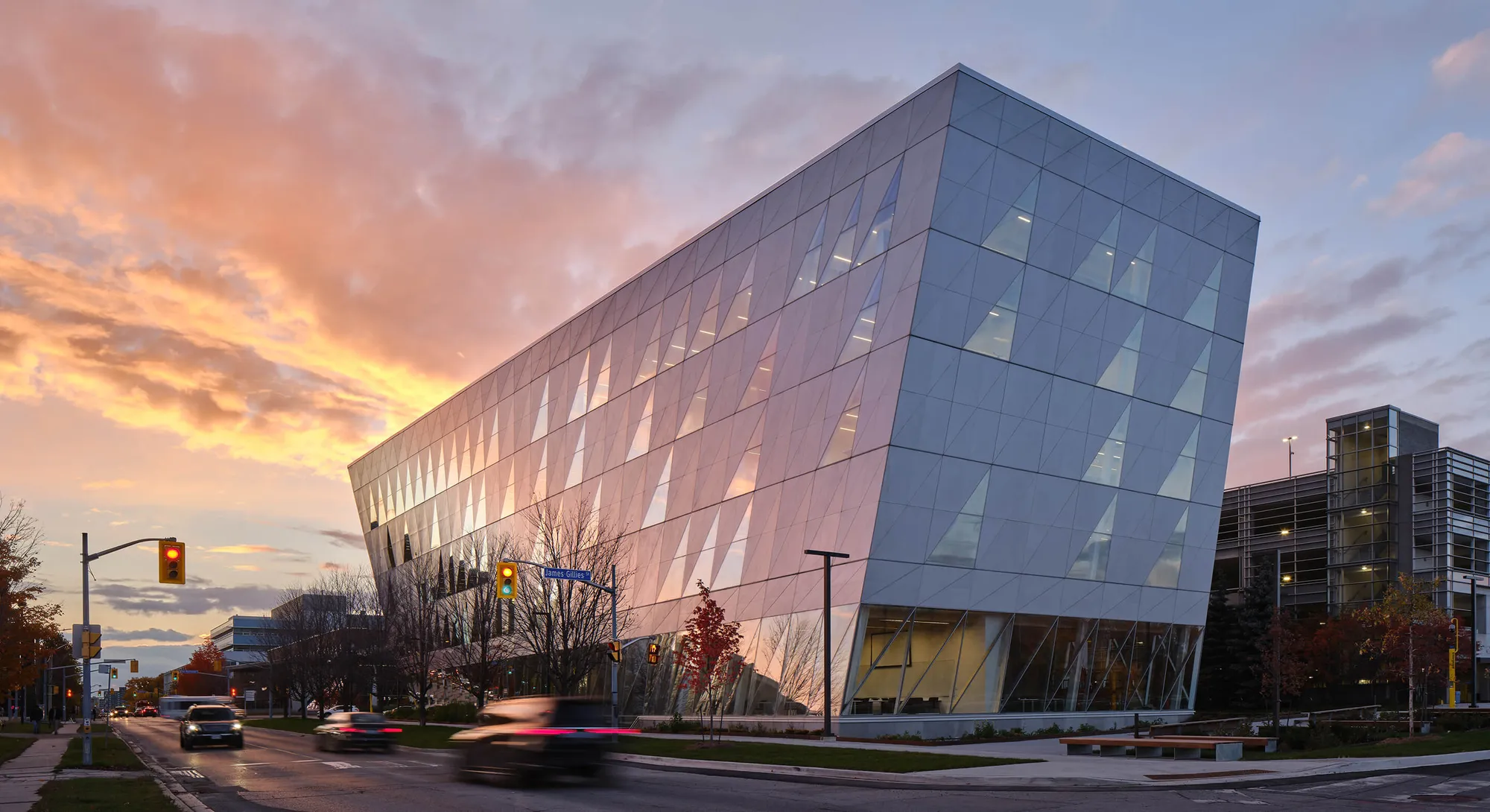
York University School of Continuing Studies by Perkins&Will
York University School of Continuing Studies by Perkins&Will features a twisting sustainable design with flexible learning spaces, community focus, and LEED Gold.


A Landmark for Lifelong Learning
The York University School of Continuing Studies in Toronto, designed by Perkins&Will, represents a bold architectural and cultural statement for the institution. Previously spread across temporary facilities, the School required a dedicated building that could strengthen its identity, foster collaboration, and meet ambitious sustainability goals.
Completed in 2022, this 11,200 m² academic building sits prominently on the southern edge of York University’s campus, acting as a gateway for students, faculty, and visitors. Its iconic twisting form not only distinguishes it from the surrounding context but also creates a new pedestrian plaza, seamlessly integrating the campus with the city.

Iconic Twisting Design
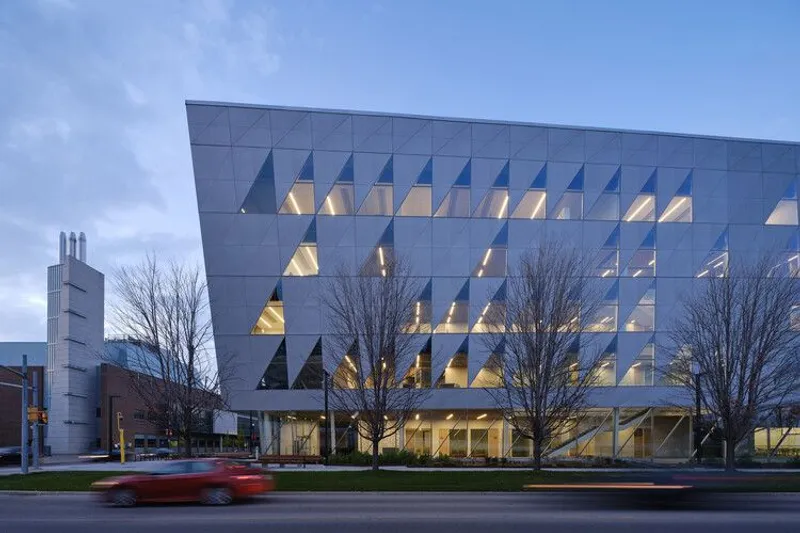
The design challenge was to create a landmark that balanced striking architecture with cost efficiency, flexibility, and sustainability. Perkins&Will achieved this through a rigorous geometric strategy: rectangular floor plates are rotated around a central axis, generating a dynamic twisting facade without relying on costly custom construction.
The result is a building that appears to move and shift as one walks around it, while inside, the layout maximizes natural daylight, collaborative spaces, and fluid circulation.

Flexible Learning Environments
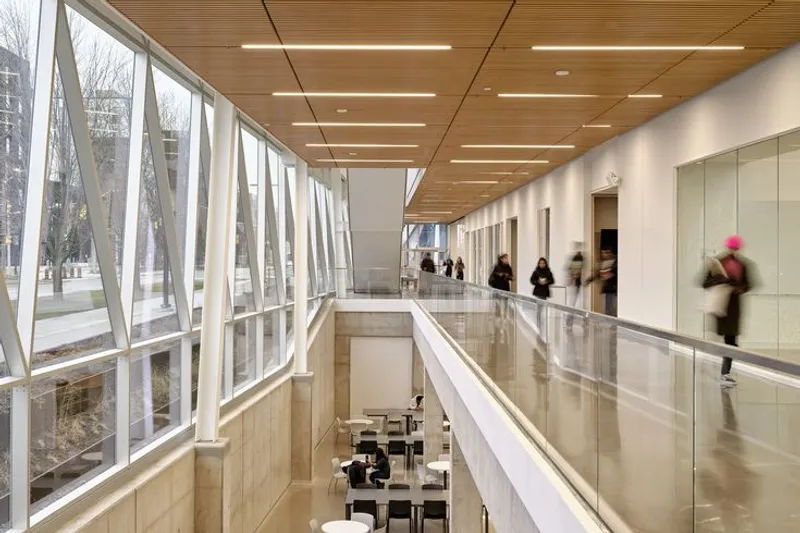
The School of Continuing Studies (SCS) is dedicated to lifelong learning, professional development, and reskilling—a mission reflected in the building’s highly adaptable spaces. The design includes:
- Flexible classrooms that can easily shift configurations
- Collaborative lounges and social hubs encouraging interaction
- Faculty offices integrated within the learning environment
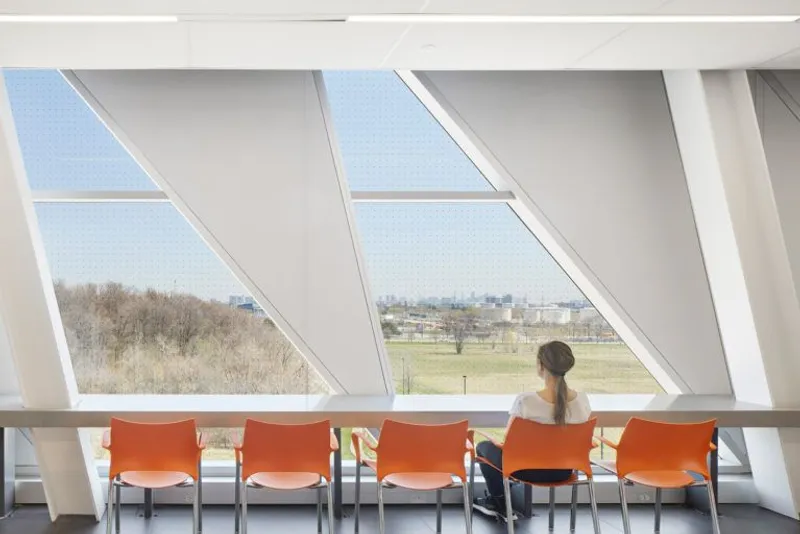
- Lofty, light-filled interiors that promote well-being and productivity
This mix of formal and informal spaces fosters community while reinforcing York’s identity as a leader in continuing education.

Sustainability and Net-Zero Goals
From the outset, sustainability was central to the design. Perkins&Will targeted LEED Gold Certification and explored pathways to Net-Zero Energy and Net-Zero Carbon performance.
Key strategies include:
- Passive House-inspired building envelope for superior insulation and airtightness
- Direct outdoor air ventilation to enhance indoor air quality
- Active chilled beams for energy-efficient cooling
- Highly efficient HVAC systems reducing operational energy demand
These features significantly lower the building’s carbon footprint while ensuring a healthy, comfortable environment for occupants.


Geometry and Innovation
The twisting form introduces two-way curves on the north and south facades, creating a striking visual identity while relying on standardized, repeatable panel components. This clever use of geometry balances aesthetic ambition with economic efficiency, proving that bold architecture can also be pragmatic and sustainable.
By rotating floor plates around a shared centroid, the architects generated a triangulated facade pattern, producing dynamic rhythms of glass and metal that respond beautifully to changing light conditions.


Conclusion
The York University School of Continuing Studies is more than just an educational facility—it is a symbol of transformation, resilience, and innovation. By combining sustainability, flexible learning spaces, and iconic design, Perkins&Will has delivered a project that redefines the role of continuing education in the 21st century.
This new campus landmark not only enhances York University’s global reputation but also sets a precedent for net-zero-ready academic architecture in Canada.


All the photographs are works of Doublespace Photography, Tom Arban Photography




Popular Articles
Popular articles from the community


Co-life: Sustainable Architecture for Age-Friendly Community Living
Co-life reimagines sustainable architecture for seniors through courtyards, rammed earth, shared gardens, and spaces designed for belonging.

Co-Life: Senior Housing Design That Reconnects Older Adults With the City
Co-Life reimagines senior housing design through healing gardens, shared streets, workshops, and a sustainable community across generations.

AL-JANNAH: Sustainable Architecture and Permaculture for Afghan Widows
AL-JANNAH uses sustainable architecture and permaculture to create resilient oasis of housing, learning, work and renewal for Afghan widows.

Conexión: Biophilic Design Reimagines High-Rise Living in Hong Kong
Conexión reimagines high-rise living in Hong Kong through biophilic design, green facades, shared spaces, daylight, water and nature within.


Similar Reads
You might also enjoy these articles


Hodi-Mandai Geram
Project Function: Preservation and revitalization of the Intangible heritage and socio-spatial identity of the Hodi by Housing, Cultural Memory Center, Sacred Grove, landscape, local tourism economy


Olio Towers: A Mid-Rise for Performers That Fuses Housing, Rehearsal, and Stage
Located blocks from Houston's Theater District, this modular tower stacks living units around a central performance atrium.

Oasis: Modular Green Housing Carved into Dhaka's Urban Fabric
A shortlisted Plugin Housing entry reclaims unauthorized settlements in Dhaka with stepped concrete volumes, green roofs, and ventilation-driven design.

Black Hole: A Floating Megastructure for the Post-Physical Era
Emiliano Mazzarotto envisions a spherical, self-scaling arena where e-sports, digital hotels, and holographic stadiums replace traditional public space.


Explore Educational Building Competitions
Discover active competitions in this discipline



Challenge to design public laboratory


Challenge to reimagine the Iron Throne


Photograph architecture without architects


Illustrate the lost glory of Angkor Wat - Render Challenge
Comments (0)
Please login or sign up to add comments
No comments yet. Be the first to comment!