
ZHY Design Studio Launches a 34-Meter Cantilever Over China's Deepest Sinkhole
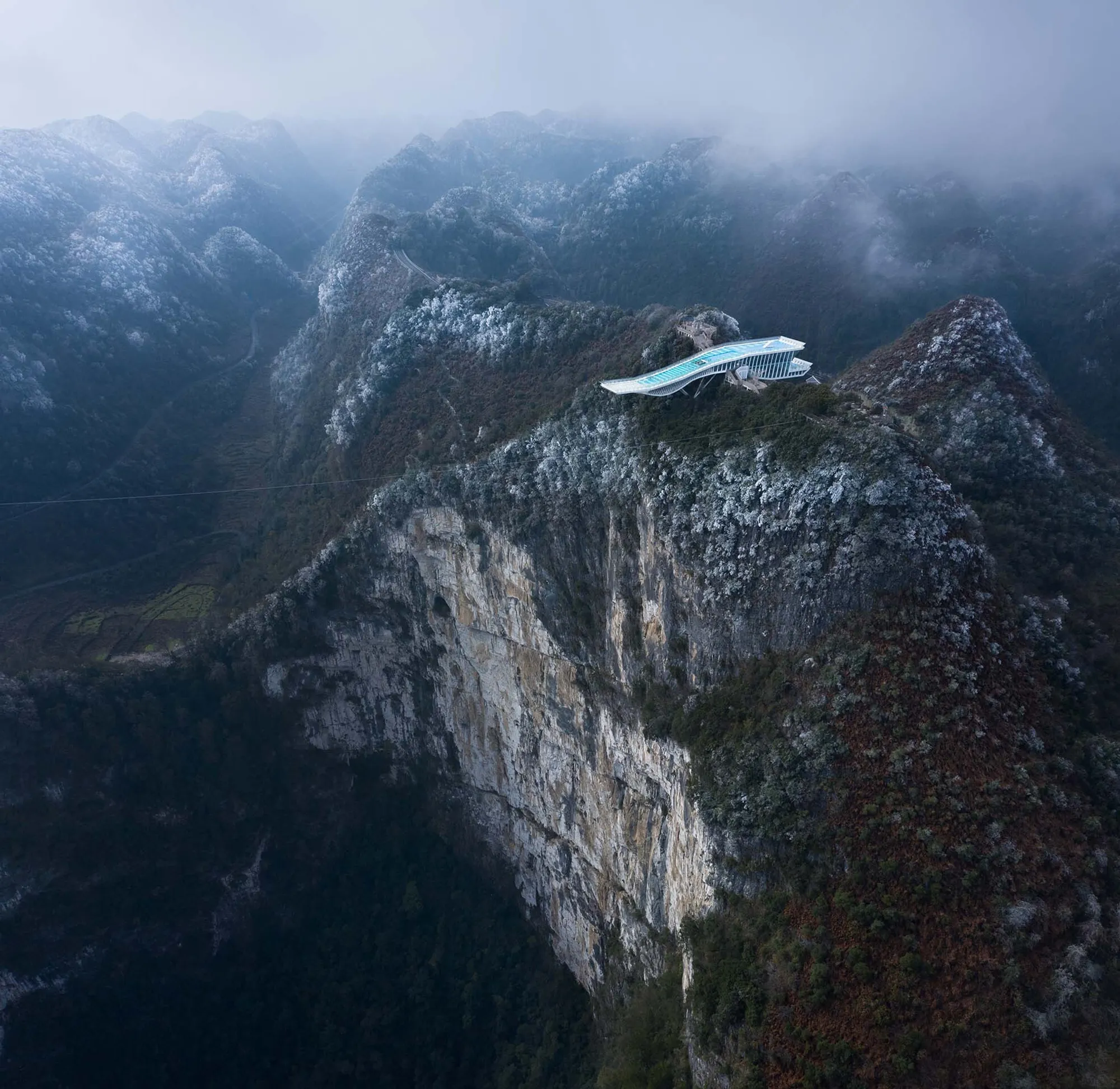
An 800-square-meter steel observation platform perches on a karst ridge above the 613-meter Dashiwei Tiankeng in Guangxi, China.


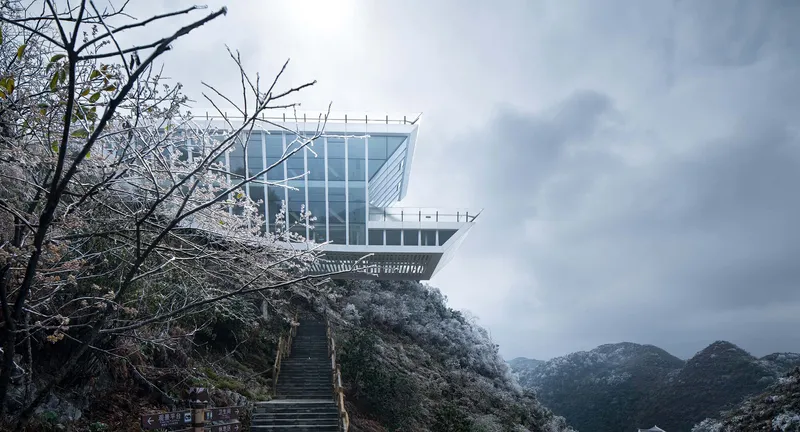
At the rim of the Dashiwei Tiankeng, a sinkhole that plunges 613 meters with near-vertical walls, ZHY design studio has wedged a narrow steel vessel onto a karst ridge. Called Sky Boat, the 800-square-meter viewing platform and coffee shop cantilevers 34 meters off one end and 22 meters off the other, hovering above the world's largest sinkhole group in Guangxi, China. The structure's 438 tonnes of steel were hauled to the summit by three tower cranes working in relay, a logistical feat that matches the ambition of the design itself.
What makes the project genuinely compelling is not just the spectacle of a glass-floored deck floating over a void. It is the precision of the structural logic required to get there: a prestressed arch at the front cantilever controls deflection, V-shaped supports channel loads inward, and the section of greatest deformation was deliberately moved back to the neck of the plan. Lead architect Huaying Zhong sized the 34-meter cantilever not from engineering bravado but from a calculation of psychological comfort, the distance at which visitors still feel stable standing above nothing. That distinction between structural showmanship and experiential calibration is what separates Sky Boat from the growing catalog of cantilevered lookouts worldwide.
Perched on the Edge of a Karst Abyss

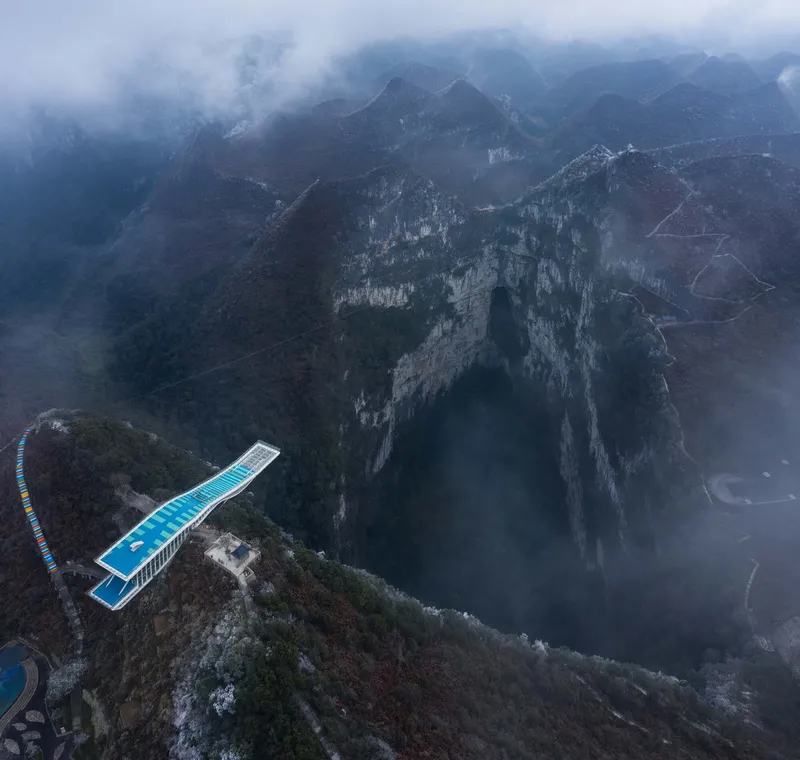
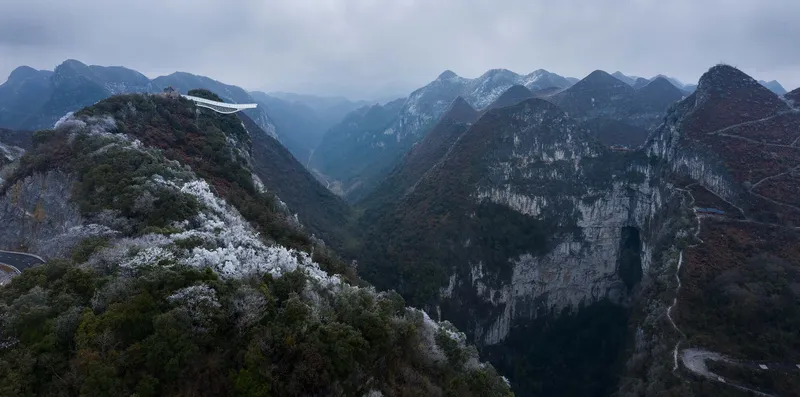
The aerial views make the site legible in a way ground-level photography cannot. The building reads as a narrow sliver, roughly 10 meters by 80 meters, straddling a jagged ridgeline with steep valleys falling away on both sides. A 400-meter-long fissure near the top of the ridge is the main source of geological instability, which means the structure's foundations had to negotiate fractured rock while the cantilevers extend into open air. At dusk, low clouds wrap the peaks and the platform appears to float, its blue roof catching the last light above a sea of mist.
Guangxi hosts China's most extensive karst terrain, and the Dashiwei group is its most dramatic expression. The site sits in a historically poor area of the Zhuang minority, and the viewing platform is part of a broader tourism development initiative. Whether or not one agrees with the premise of building on such sensitive geology, the result is a structure that takes the landscape seriously enough to minimize its footprint while maximizing the encounter.
The Cantilever as Structural Argument

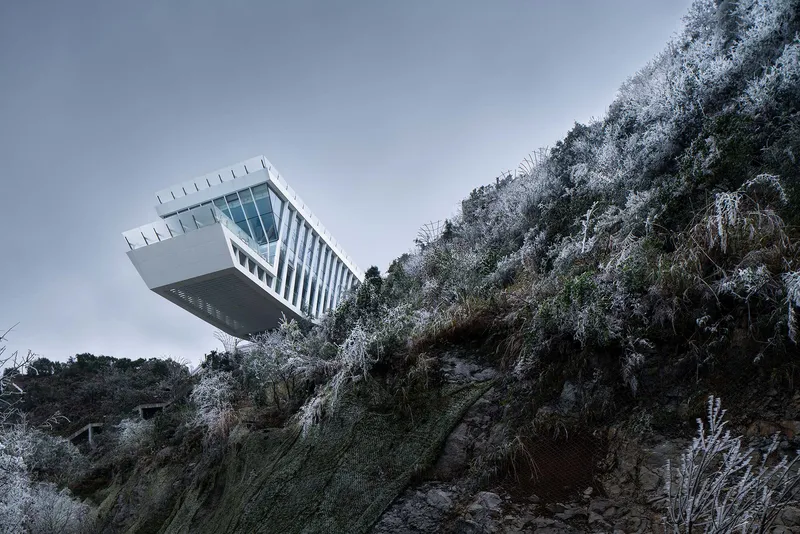
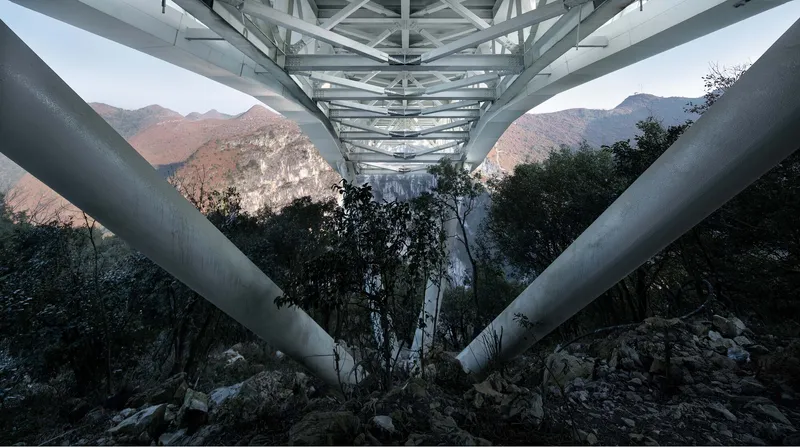
Seen from the side, the structural system becomes explicit. Diagonal white steel trusses form the primary skeleton, tapering toward the cantilever tips where the building leans inward on its bearing points. The prestressed arch at the front end is not decorative; it extends the effective column length and keeps deflection within tolerance across 34 meters of unsupported span. From below, the underside reveals a dense triangulated framework, the kind of honest structural expression that rewards a second look.
ZHY's decision to expose the truss geometry rather than clad it gives Sky Boat its visual identity. The white steel reads cleanly against both the dark winter rock and the green summer canopy, and the diagonal members create a rhythm that makes the cantilever legible as an engineered object rather than a magic trick. There is no attempt to disguise the fact that this building is working very hard to stay in place.
Glass, Timber, and the Interior Experience


Inside, the mood shifts from structural drama to something warmer. Timber ceiling insets and vertical wood slat screens temper the steel frame, and diagonal white columns march through the interior at oblique angles that echo the external trusses. The two-storey plan accommodates both the coffee shop and the observation deck, with the meandering double-curve plan creating varied spatial conditions along the 80-meter length. Views are framed differently at every turn: some panoramic through full-height glass, others filtered through the slat screens.
The glass floor panels at the cantilever tip are the obvious crowd-pleaser, offering a direct downward view to the mountain ridges below. But the more considered moments happen further back in the plan, where the building narrows and the framed views become tighter. The approach from the stone steps on the rocky summit sets up a procession that is deliberately slow, preparing visitors for the spatial release at the cantilever's end.
Seasonal Transformations

The photography captures Sky Boat across dramatically different conditions. In dense fog, the multi-level glass pavilion glows from within, its white frame dissolving into the cloud layer until only the lit volumes remain. In winter frost, the structure sharpens against a monochrome landscape of bare rock and ice. The building is not a single image; it is a sequence of appearances governed by altitude and weather, and the karst terrain's volatility makes every visit a different encounter.
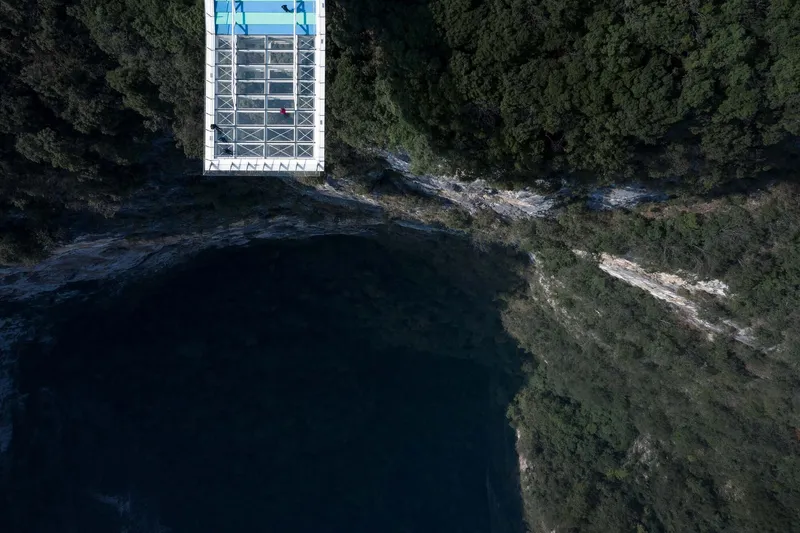
Few observation platforms are photographed from directly overhead, but the drone shots here reveal something the elevations do not: the glass roof reads as a dark rectangular void cut into the ridgeline, a geometric absence against the organic geology. That contrast, between the precision of the steel frame and the erosion-sculpted rock it sits on, is the project's strongest image.
Plans and Drawings
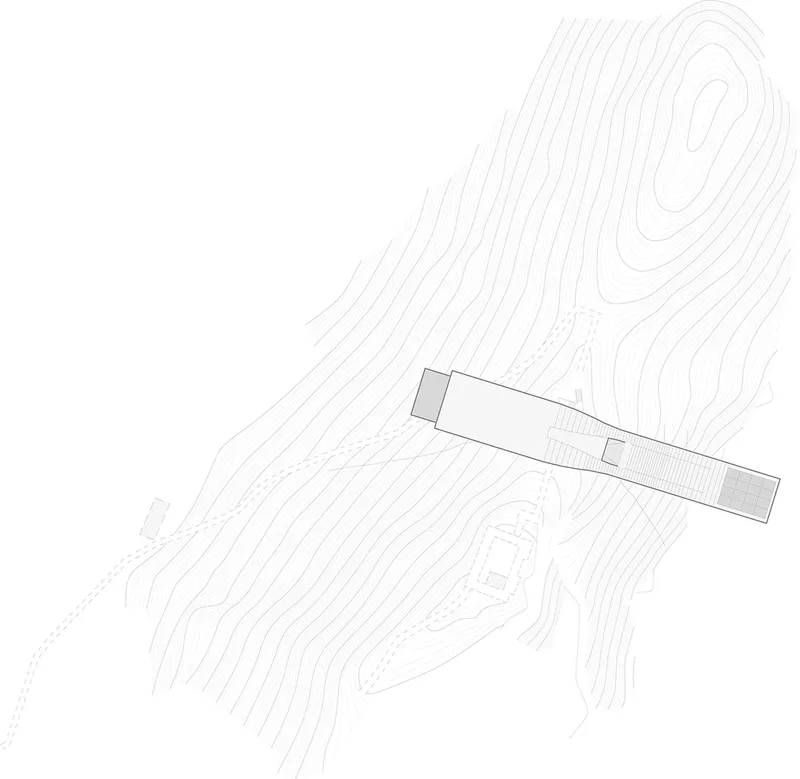


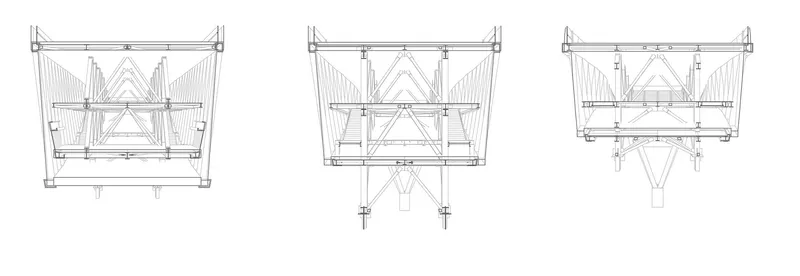
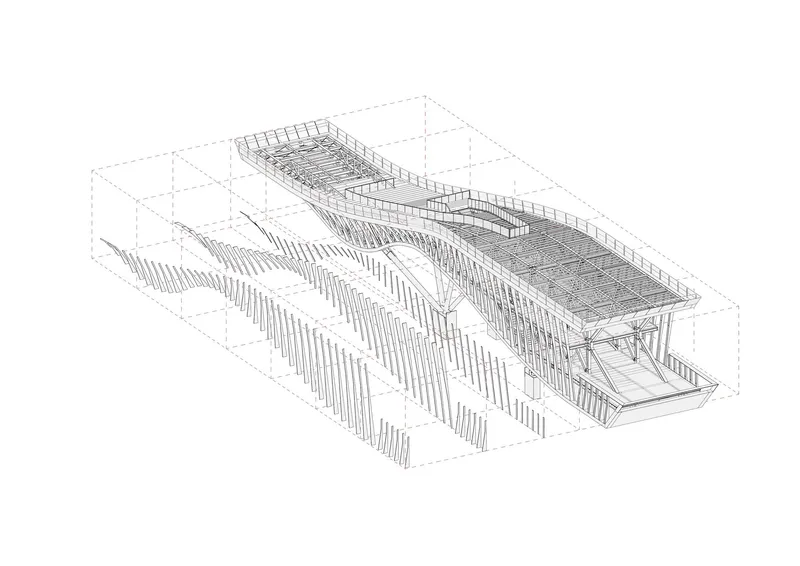


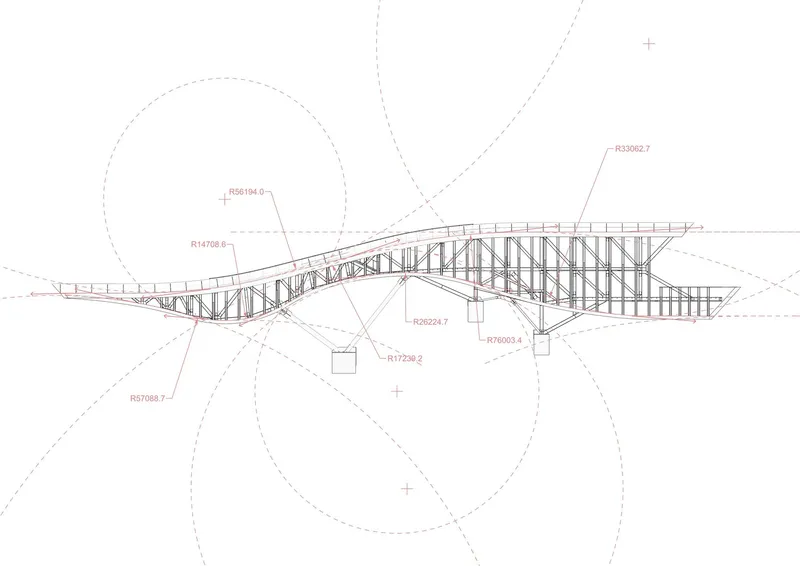
The drawing set is unusually thorough for a landscape architecture project and reveals the full complexity of what was built. The site plan confirms the linear strategy: a narrow volume laid across the contours, touching the ridge at its midpoint and launching into space at both ends. Floor plans show a tight interior partitioned into program zones within the 10-meter width, while the roof plan traces the undulating curve that gives the building its boat-like silhouette.
The sections are where the engineering story becomes legible. Triangulated trusses of varying depth span between cantilevered platforms, with the deepest sections concentrated at the neck where the V-shaped columns meet the superstructure. The transverse sections show three variations of the truss system, each responding to different span conditions along the building's length. Axonometric drawings pull the roof apart to expose the branching column heads and the diagonal bracing that stiffens the cantilevers against lateral loads. The annotated elevation, with its dimension strings, confirms the curved roof profile and quantifies the asymmetry between the 34-meter and 22-meter overhangs.
Why This Project Matters
Sky Boat enters a crowded field of cantilevered viewing platforms, from the Grand Canyon Skywalk to the Trolltunga installations in Norway. What distinguishes it is the rigor with which the structural system was calibrated to a specific psychological threshold. The 34-meter cantilever is not the longest possible span; it is the longest span at which visitors still feel safe. That restraint, paradoxically, makes the experience more intense than a longer cantilever would, because visitors trust the structure enough to walk to the edge and look down.
The project also raises questions worth sitting with. Building 438 tonnes of steel on a fractured karst ridge in one of the most geologically sensitive landscapes in southern China is not a neutral act. The economic argument for tourism infrastructure in a historically underserved Zhuang minority region is real, but the environmental cost of construction at this altitude and on this geology deserves scrutiny. Sky Boat succeeds as architecture precisely because it does not pretend the tension between spectacle and stewardship does not exist. The structure announces its own precariousness, and that honesty is what makes it worth visiting, and worth debating.
Sky Boat by ZHY design studio, lead architect Huaying Zhong. Located at Dashiwei Tiankeng Sinkhole, Baise, Guangxi, China. 800 m². Completed in 2022. Photography by Bowen Hou and Guangxi Leye Dashiwei Tourism Development Co., LTD.
About the Studio
Share Your Own Work on uni.xyz
If projects like this are the kind of work you want to make, uni.xyz is a place to publish your own, find collaborators, and enter design competitions.


Popular Articles
Popular articles from the community


The Earth Pod: 3D Printed Homes for Resilient Refugee Communities
The Earth Pod reimagines refugee housing through 3D printed homes made from clay, combining resilience, self-sufficiency, and rapid shelter.

Hill & Cross Opera: Sculptural Opera House Architecture Shaped by Tallinn’s Landscape and Identity
Hill & Cross Opera reimagines opera house architecture in Tallinn through its sculptural hill, civic plaza, glass wave and a luminous cross.

AL-JANNAH: Sustainable Architecture and Permaculture for Afghan Widows
AL-JANNAH uses sustainable architecture and permaculture to create resilient oasis of housing, learning, work and renewal for Afghan widows.

The Musturak Paradise: Senior Living Architecture for a Connected Future in Temara, Morocco
The Musturak Paradise reimagines senior living architecture in Temara via private homes, social spaces, culture, community, and shared care.
Similar Reads
You might also enjoy these articles

Bao Huynh Watercolor Atelier: A Serene Art Retreat in Hội An
Bao Huynh Watercolor Atelier in Hội An blends multifunctional art spaces, sustainable design, local materials, and family-friendly living in a serene environment.

Atelier Macri Concept Store Interior Design by CASE-REAL
Atelier Macri store features a "ko" counter, walnut wood details, cork displays, blending retail, gallery, and seamless customer experiences.

Manuel Vargas Izquierdo Stadium and High-Performance Sports Center: Architectural Excellence in Jalpa de Méndez
The Manuel Vargas Izquierdo Stadium blends sustainable design, inclusive sports facilities, and cultural-inspired architecture, revitalizing Jalpa de Méndez’s public spaces.

KAKR Buluh Awar Hall: Revitalizing Community and Ecology Through Bamboo Architecture
Community built bamboo hall revitalizes Buluh Awar village, empowering youth, restoring ecology, celebrating vernacular craftsmanship through sustainable architecture and culture.
Explore Architecture Competitions
Discover active competitions in this discipline


Challenge to design a portable theatre

Challenge to design a portable music platform

Challenge to design an open learning module for the elderly


Challenge to reimagine the Iron Throne
Comments (0)
Please login or sign up to add comments
No comments yet. Be the first to comment!