

ZIPPER HOUSE
ADAPTABLE STUDENT HOUSING

CHALLENGE
Students transitioning into college often face various challenges concerning moving away from home, buying books and supplies, and making new friends. But due to a lack of on-campus student housing at many colleges and universities in the U.S., having a place to live is a growing issue. Institutions that typically guarantee on-campus housing to freshmen and sophomores have been forced to instead place these students in off-campus housing, inns, and hotels. Living off-campus is not only inconvenient for getting to classes but, for some students lacking personal transit, it is impossible. This can lead to a myriad of issues like social isolation, lower academic performance, and poor nutrition.
Simultaneously, finding affordable housing options at these institutions is also difficult. Students dealing with financial issues can partially offset the cost with part-time jobs, scholarships, or assistantships.
CONCEPT
The urgency of these issues requires immediate housing solutions that are easily constructed, which makes a highly modular system of construction, like containers, an attractive option.
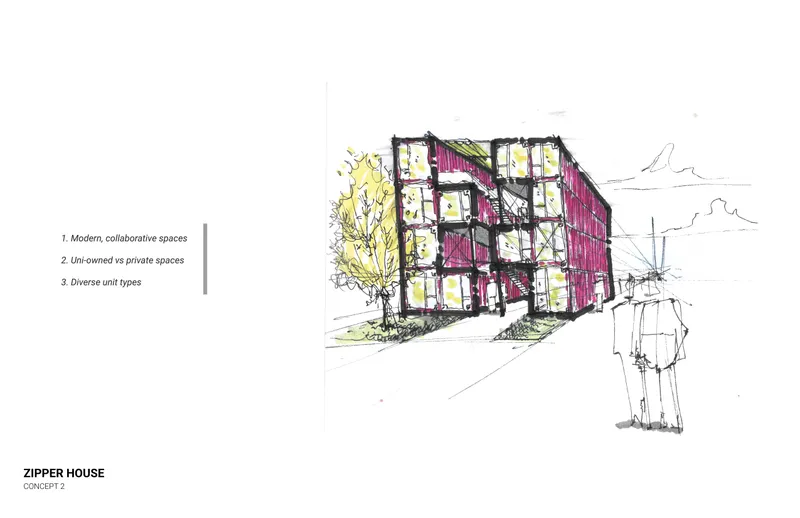
The Zipper House houses 23 to 30 students and addresses these issues by finding opportunities on campuses to expand college and university housing options. The project is designed with 15 containers and has a small 58’ x 40’ footprint. This configuration of containers is ideally located on underutilized parking lots, vacant parcels, and excess green spaces.
The project was conceptualized around the thought of someone unzipping their coat and revealing a surprising shirt. Likewise, the Zipper House appears as two interlocking housing blocks pulled apart to reveal a vibrant multi-story courtyard for everyday student use and gatherings.
Community and social interactions drive the organization of the design. On the ground floor, two containers are programmed as a commons area which can be retrofitted into an array of university programs including, cafes, gyms, bookstores, laundry, etc. This provides universities an opportunity to fill programmatic gaps across their campuses while simultaneously addressing student housing needs. A dorm and studio unit on the ground floor is mirrored opposite the courtyard. A cluster of 9 students (2 Dorm units, 1 Studio) occupy each of the upper levels. Because units are only equipped with a small kitchenette sink and microwave, each cluster of students has a shared kitchen and lounge to share meals, interact, and collaborate in. Shared kitchens are connected to the expanded balconies created with the 20’ x 8’ x 8’6 containers to increase gathering and social capacity.
DESIGN PROCESS
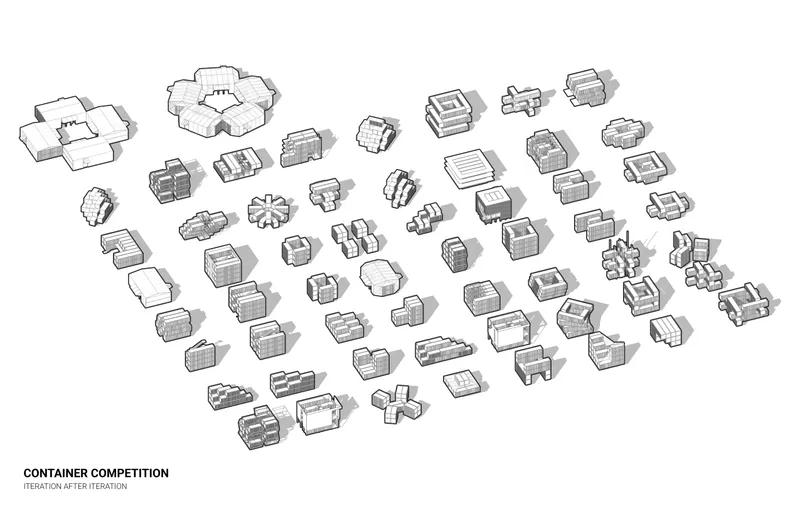
A multitude of iterations were explored through sketches and modeling before finalizing the design. During this process, several conceptual themes emerged, most notably, replicability, common courtyards, interactive walkways, and customization of programs. Also, it was intended from the beginning that the design could be multiplied to create an active living-learning village to promote social interaction between students of different backgrounds and ethnicities.
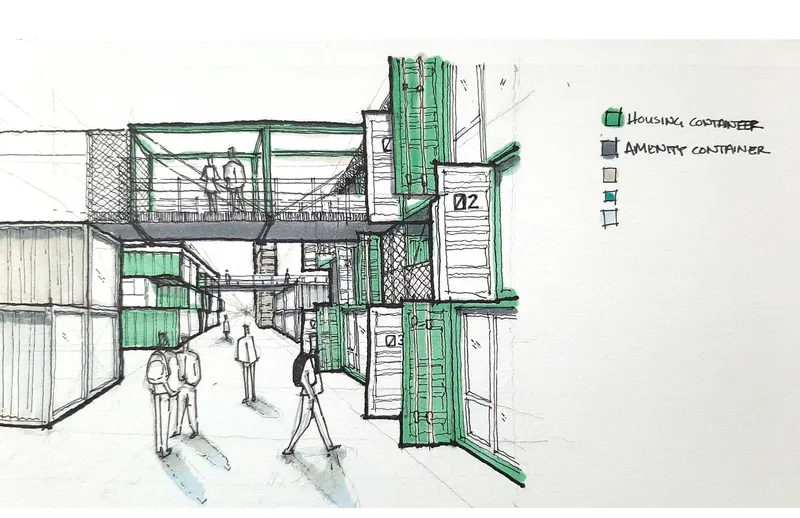
Even after the Zipper House concept was chosen, multiple changes were made to perfect and enhance these original values of the design. For instance, shared kitchens were included as a vision for students to share their cultures through food within their clustered or wider campus communities.
One of the more innovative aspects of the Zipper House was the development of the container module. The main question was, “How can two containers be cut then joined in a way where the orientation of the container wouldn’t matter? The proposed solution takes a 40’ x 8’ x 8’-6” container, divides it into thirds before cutting a 4’ opening from the top to the bottom of each section. The general rule was where openings align with other openings they are thresholds, where they align with a walkway, they are doors and everywhere else are windows. Lastly, bathrooms occupy the section of the container opposite of the standard container two doors which can be opened and mechanically fixed on site.
SUSTAINABILITY
Students’ needs and their quality of life are at the forefront of this design's sustainable practices. For example, potential sites were chosen based on proximity to campus and campus bus routes. This enables students to walk, ride a bike, or take a bus to class instead of using personal transit. Students are then encouraged to stay outdoors through the expanded walkways becoming balconies for seating and plants.
Inside the units, students are greeted to warm wood walls that can be recycled into other items and materials after use and each window is operable for cross air ventilation and temperature control. Toilets use greywater from sinks and showers with the potential to combine rainwater collection systems to increase sustainable water usage. These systems and the units themselves operate using solar energy from photovoltaic panels on the roof.
Many of the other components, much like the containers themselves, were chosen on basis of their recyclability such as the steel stairs and metal grating used for walkways.
As for the siting of the structure, the project is primarily supported at the 4 corners of each container. This allows rain and stormwater to infiltrate into the ground more easily.
PROJECT OVERTIME
By only supporting the containers at the four corners of each container, minimal impact is caused to the site once the Zipper House is removed which is the goal. This project is meant to be a temporary solution to address immediate student housing needs with community-oriented and quality housing. That said, the Zipper House construction could pair with college efforts to begin depaving swaths of parking as cars become less relevant on campus or other parking options are constructed. When more permanent housing is constructed on campus, the Zipper House is disassembled and transported to another institution or its components are recycled to become something else entirely.

Popular Articles
Popular articles from the community


Cloaked Colonization: A Mobile Underwater Habitat That Moves Like a Fish
Micah Abaya's shortlisted EHC Pacific entry reimagines ocean settlement as a dispersed network of self-sustaining architectural organisms.

Singing Woman: Contemporary Architecture Inspired by Estonia’s Voice and the Sea
Singing Woman turns Estonia’s song culture into flowing opera house architecture, blending public life, landscape, sea, and national memory.

Opera on the Sea: Driftwood Logic Shapes a Timber Opera House on Estonia's Coast
Trevor Orgill's opera house translates the entangled drift of floating timber into a civic building where wood, water, and music converge.

Faces of the Soviet Avant-Garde: Turning Moscow's Street Names into an Open-Air Museum
A network of sculptural installations across a Moscow residential district transforms forgotten architect names into spatial encounters with cultural memor

Similar Reads
You might also enjoy these articles

The Rhythm of Seasons
A Farmers' Market Connecting Nature and the City

More Than a Building-Designing a Living System
More Than a Building-Designing a Living System
Base Beyond
DESERT COMPOUND ARID: TOURISM OF ABSENCE AND ABUNDANCE

Explore Student Housing Competitions
Discover active competitions in this discipline


Challenge to reimagine the Iron Throne

Photograph architecture without architects

Illustrate the lost glory of Angkor Wat - Render Challenge

Design challenge to reuse E-waste
Comments (0)
Please login or sign up to add comments
No comments yet. Be the first to comment!