
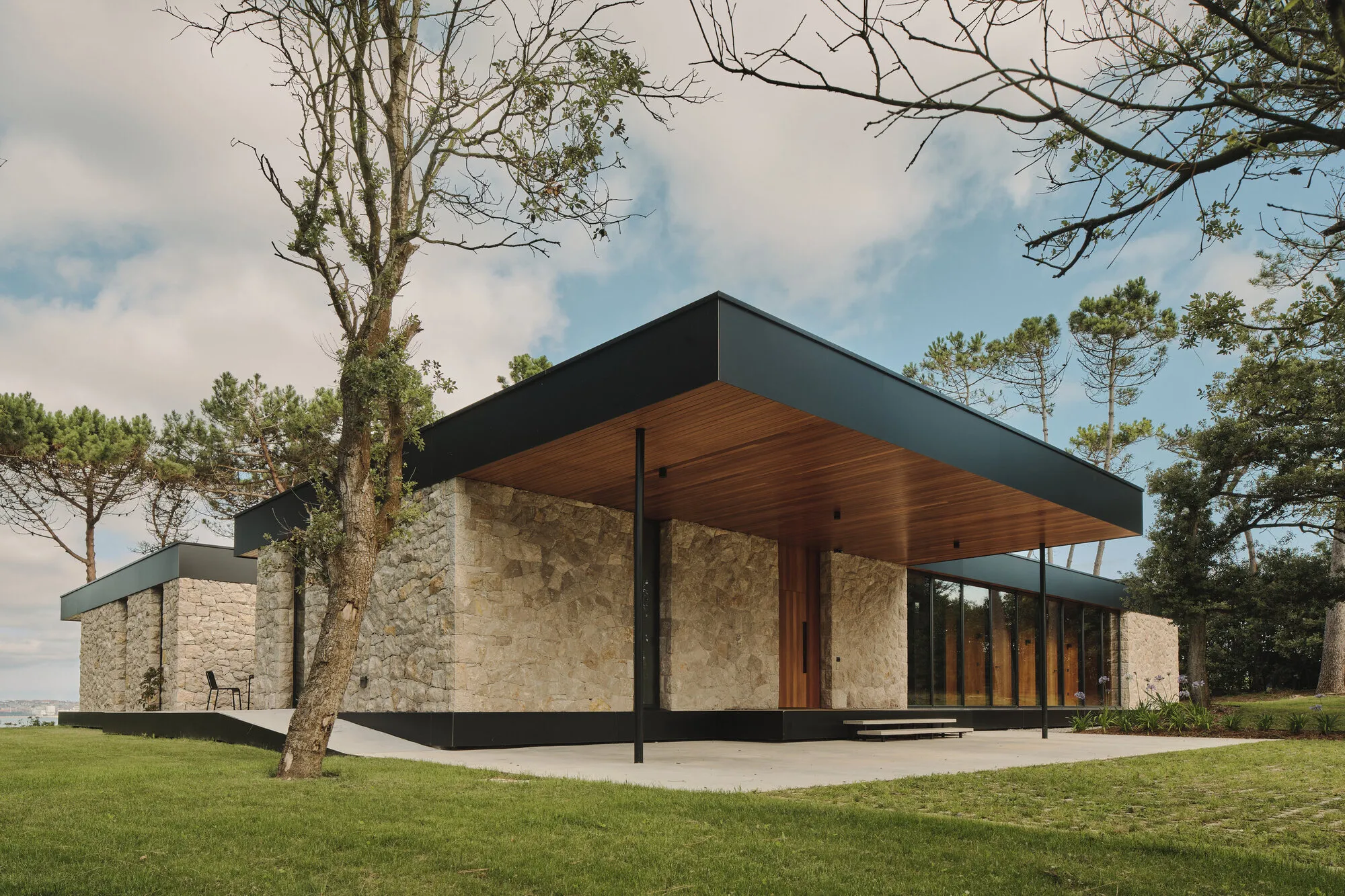
Zooco Estudio Reinvents Cantabrian Vernacular with a Stone and Timber Coastal House in Santander
Casa Loredo is the second chapter in a design series that distills the rural architecture of northern Spain into a modern seaside residence.


Regional identity in residential architecture is easy to claim and hard to deliver. Plenty of houses borrow a stone wall or a pitched roof and call it vernacular, but few practices commit to a sustained investigation of place. Zooco Estudio does exactly that with its "New Vernacular Architecture of the Cantabrian Coast" series, of which Casa Loredo is the second built installment. Set among pines on a gentle slope near Santander, the 350 m² house treats the coastal landscape of northern Spain not as scenery to be consumed through glass, but as a collaborator that shapes plan, section, and material palette.
What makes the project genuinely interesting is its refusal to resolve the tension between openness and enclosure. The house reads simultaneously as a cluster of heavy stone volumes and as a lightweight glass pavilion, depending on your angle of approach. Zooco Estudio achieves this by fragmenting the program into distinct masses, stone boxes of varying height, connected by glazed links and covered passages. The result is a house that feels rooted and porous at the same time, anchored in local construction traditions yet spatially fluid in a way those traditions never attempted.
A Cluster Among the Pines

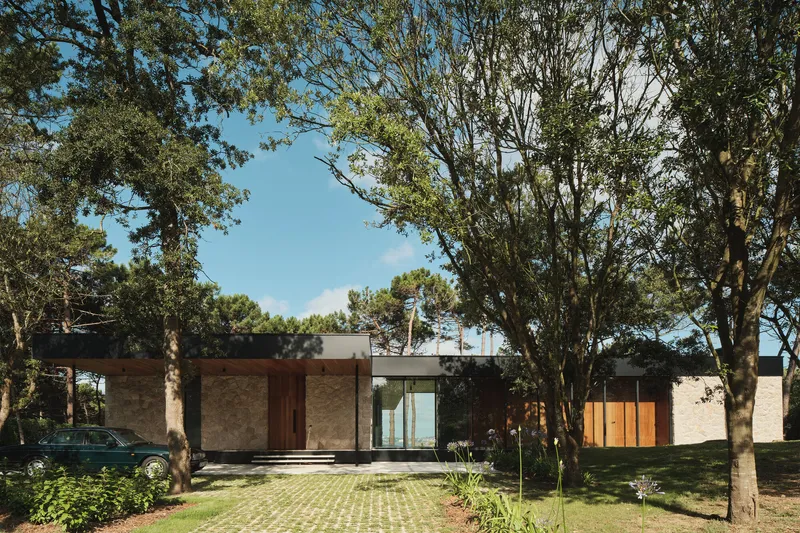

From the street, the house presents itself as a low, fragmented composition of coursed stone walls capped with dark metal fascia. The volumes are deliberately kept below the canopy line of the surrounding pines, which means the architecture defers to the landscape rather than competing with it. Flat roofs eliminate any silhouette drama, while the stone's warm ochre tones shift in value throughout the day, absorbing morning mist and glowing under afternoon sun.
The strategy of clustering rather than consolidating means that each stone mass retains a pavilion-like autonomy. You can walk around the house and read it as a small settlement, a group of buildings that arrived over time. This is the vernacular lesson Zooco Estudio draws from Cantabrian hamlets, where structures accumulate incrementally, and the spaces between them matter as much as the buildings themselves.
Stone, Timber, Concrete: Three Materials, One Logic
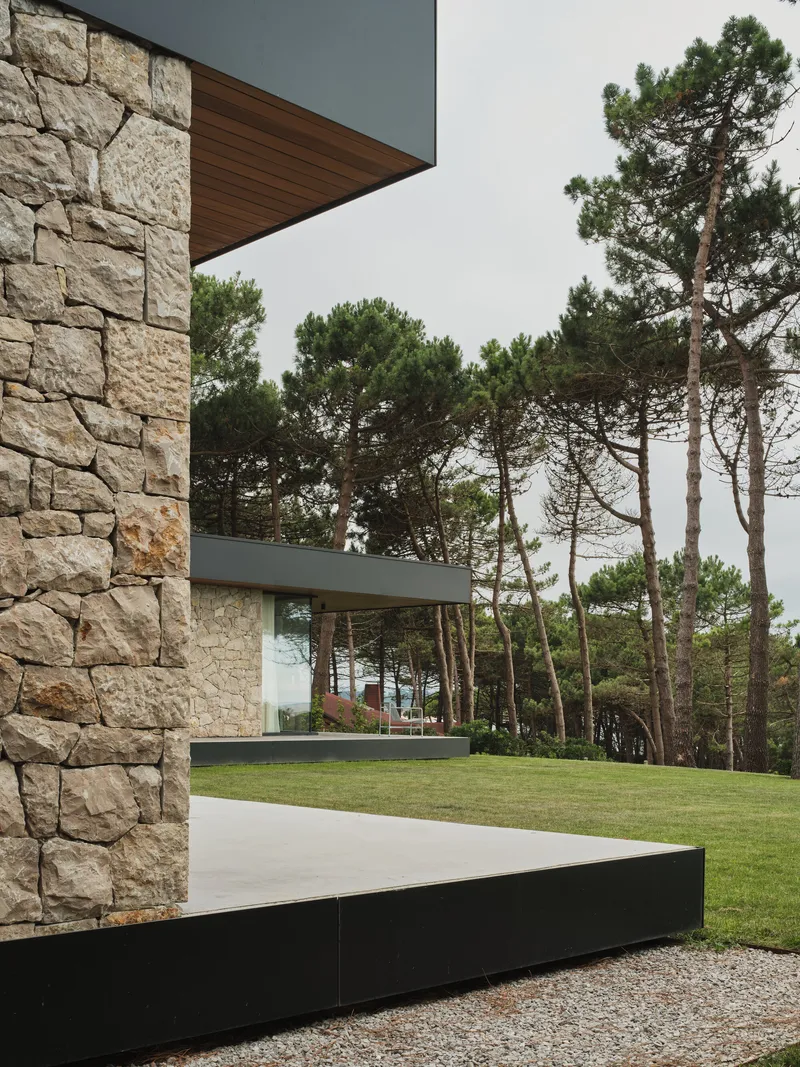


The material discipline here is strict: coursed local stone for the vertical masses, timber for the horizontal planes of soffits and ceilings, and board-formed concrete for select interior walls that mediate between the two. Each material carries a clear structural and atmospheric role. Stone signals gravity and permanence. Timber, typically left as warm slats or wide boards overhead, introduces warmth and domestic scale. Concrete appears only where the architects want to mark a threshold or anchor a feature wall, and its formwork texture echoes the grain of the timber above.
Look closely at the tower-like volume surrounded by gravel and pines, and you see how this triad works in section. The stone plinth rises from a black base, the timber soffit projects outward as a deep overhang, and the dark roof cap pins the composition together. No applied finishes, no color accents. The palette is monastic in its restraint, and the house is stronger for it.
Inside Out: The Living Spaces
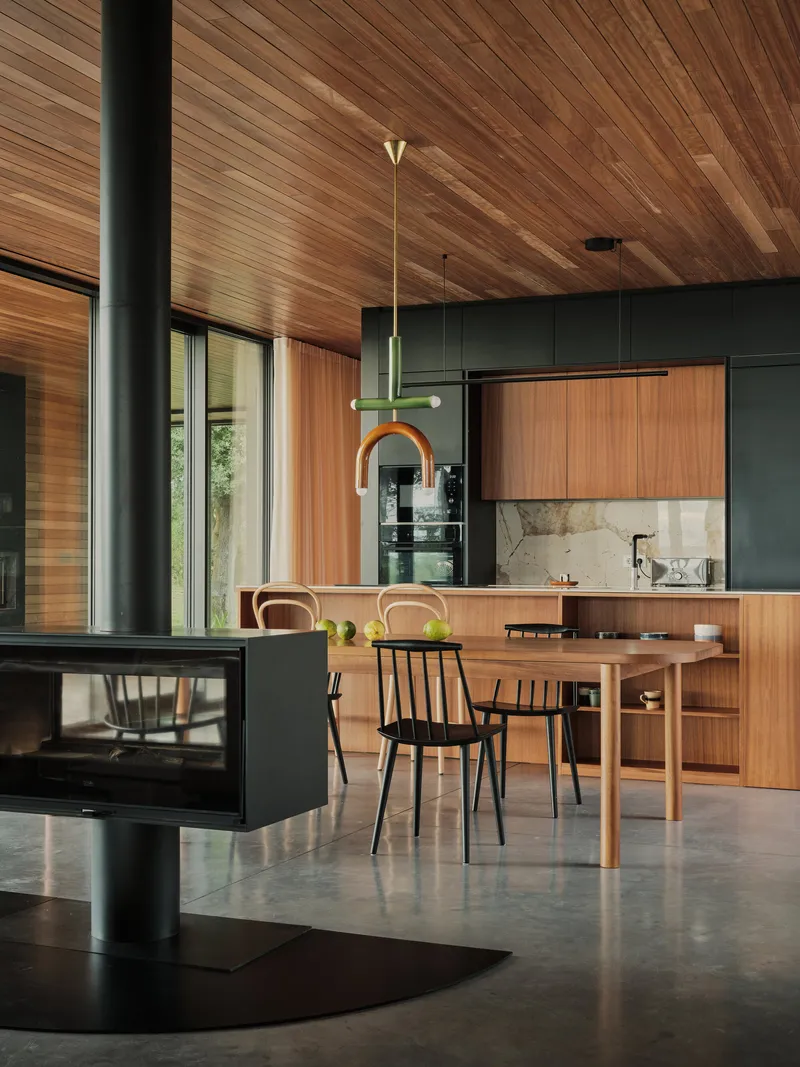
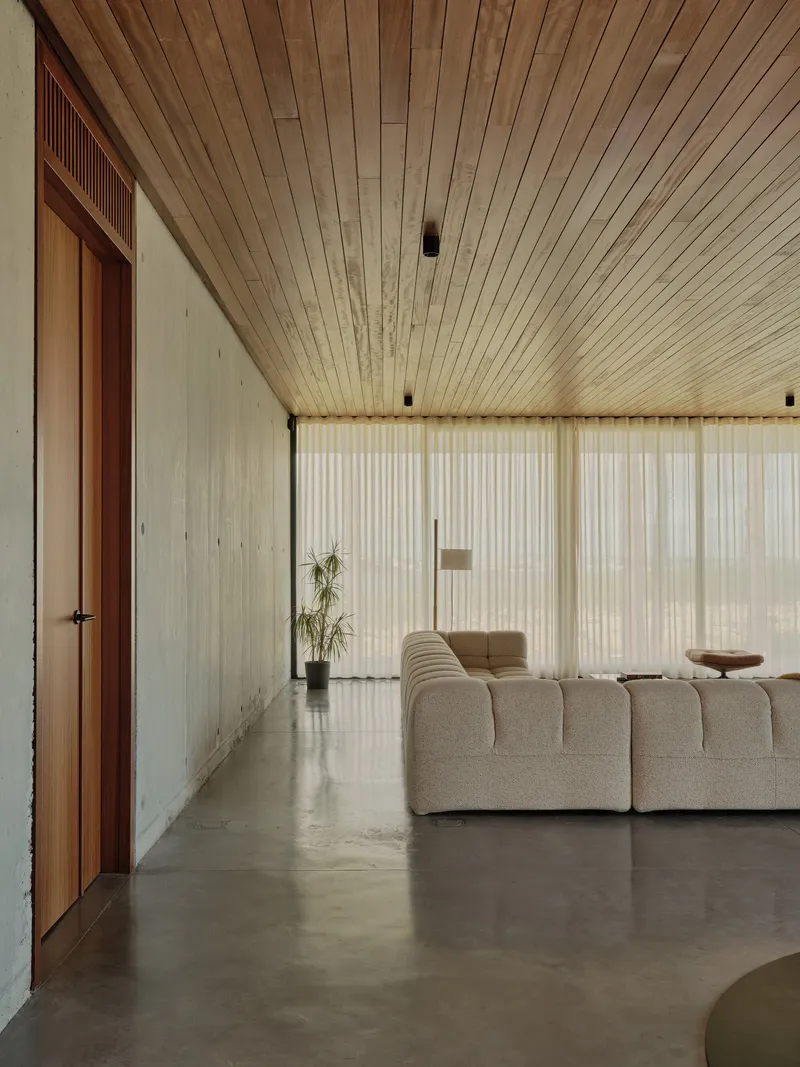

The open-plan living, kitchen, and dining zone occupies the heart of the plan, organized beneath a slatted timber ceiling that runs continuously from interior to covered terrace. A freestanding fireplace anchors the kitchen and dining area without interrupting sightlines. The effect is of one generous room with multiple orientations: toward the garden, toward the pines, toward a distant strip of water.
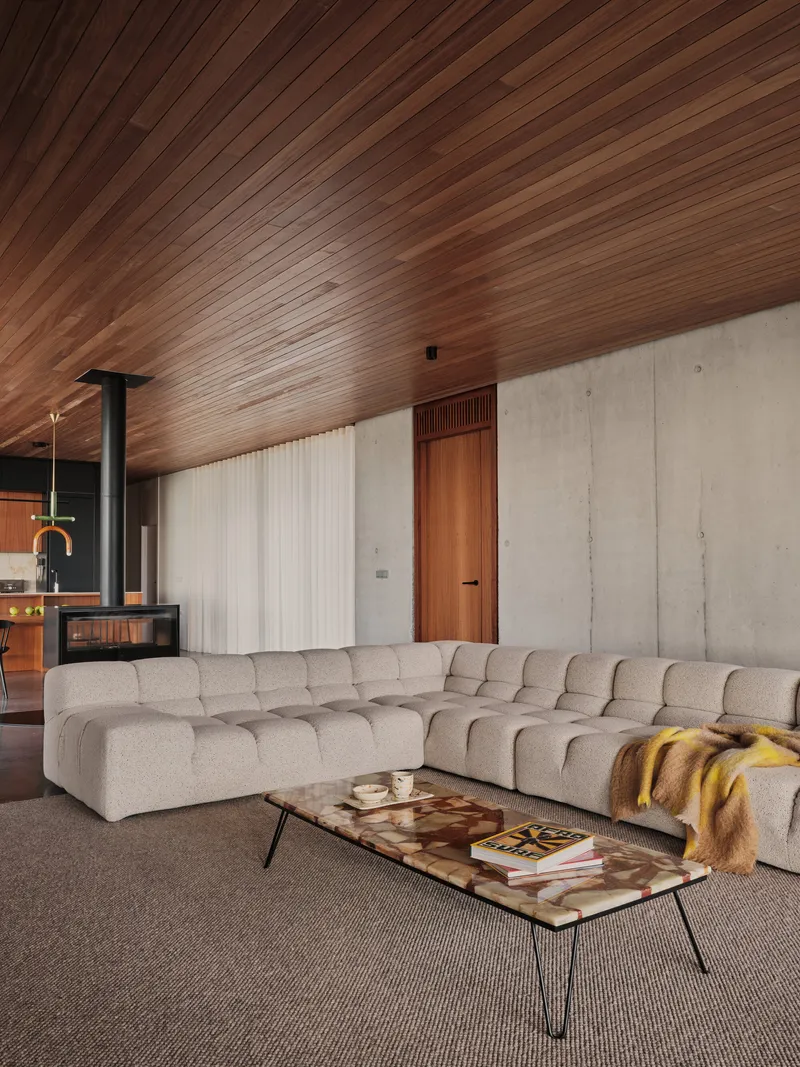
Board-formed concrete walls appear strategically in the living room, creating a denser, more protected zone for the sofa and media credenza. Sheer curtains filter the Cantabrian light, which even in summer carries a silvery quality. The interiors avoid spectacle; instead they foreground texture, the grain of the timber, the shadow lines of the slats, the rough imprint of formwork ties on the concrete. It is a house that rewards slow looking.
Thresholds and Covered Ground


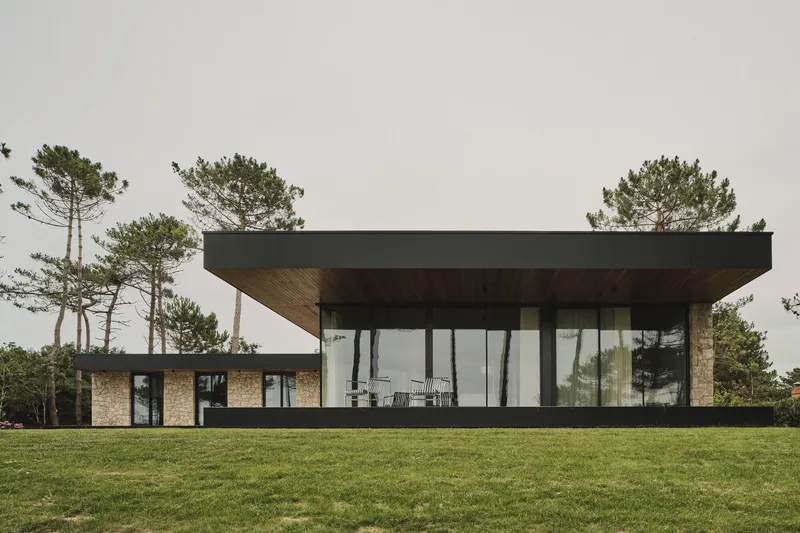
In a climate where rain is a daily companion for much of the year, covered outdoor space is not a luxury but a necessity. Zooco Estudio devotes significant area to deep terraces and timber-clad corridors that blur the line between indoors and out. The covered terrace facing the lawn is arguably the most compelling room in the house: stone wall on one side, open air on the other, a timber soffit overhead, and a long view toward water through a screen of pine trunks.
The glazed corridor connecting the bedroom wing to the living zone doubles as a kind of cloister, its polished concrete floor reflecting the forest canopy beyond the glass curtain wall. These transition spaces give the house its experiential richness. Moving through the plan, you are never simply in a room; you are always passing through conditions of light, enclosure, and view that shift with every step.
Entry and Private Quarters

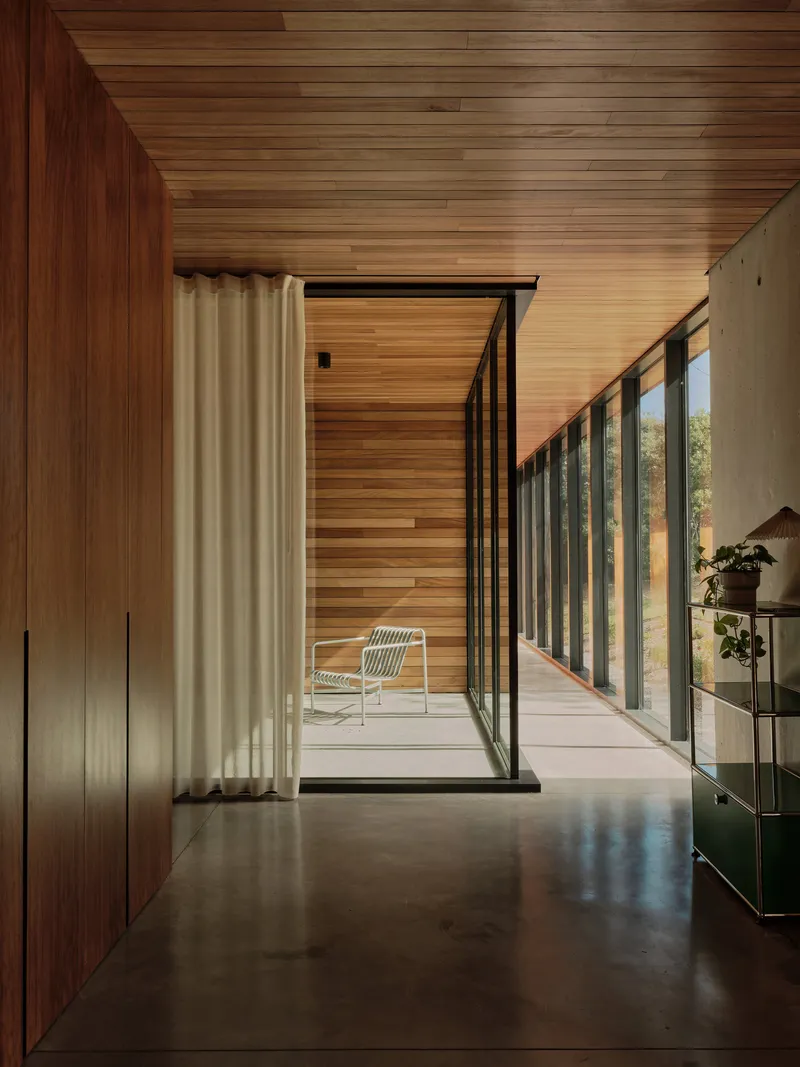
The entry sequence sets the tone immediately. A timber door flanked by stone walls opens into a corridor with a striped ceiling pattern and a surfboard casually propped against a wooden bench. The message is clear: this is a coastal house, lived in and loved, not a gallery. Further along, a timber-clad corridor leads to a private courtyard, separating the public and private realms of the plan with a moment of sky and greenery.
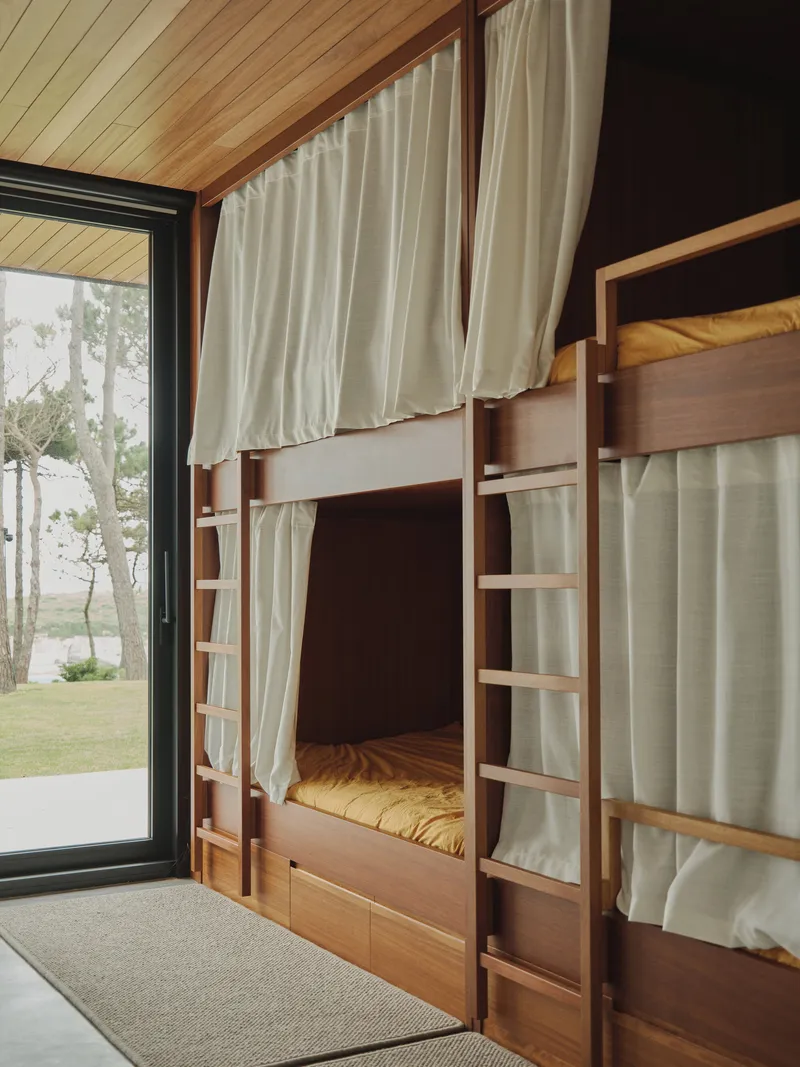
In the bedrooms, the architects deploy built-in timber bunk beds with linen curtains beneath a pitched ceiling, a move that recalls ship cabins or mountain refuges. Forest views fill the window beyond. These are compact, considered rooms that trade square meters for atmosphere, and the trade pays off. The intimacy of the sleeping quarters makes the expansiveness of the living spaces feel all the more generous by contrast.
Outdoor Living and the Garden Edge
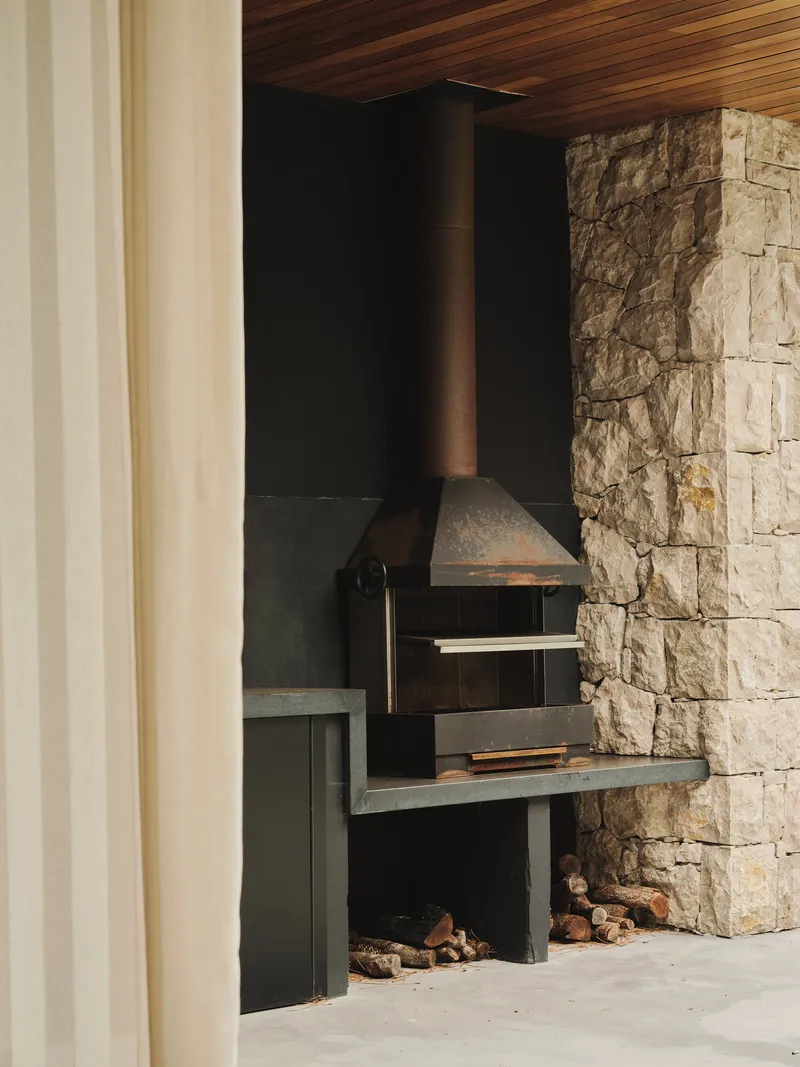

A dedicated barbecue pavilion with its own stone wall, timber ceiling, and metal grill extends the kitchen outdoors under warm afternoon light. Nearby, an outdoor terrace with a long table and benches faces a coursed stone wall fitted with a wall-mounted shower, a detail that acknowledges the beach life just minutes away. These are functional, well-detailed outdoor rooms, not decorative afterthoughts.
The rear elevation reveals the full spatial ambition of the project: a cantilevered roof shelters floor-to-ceiling glazing, while the timber soffit extends outward to create a deep, shadowed threshold between house and lawn. The building meets the ground plane decisively, its concrete terrace stepping down to grass in a clean horizontal line. There is no awkward negotiation between architecture and landscape. The two are resolved into a single composition.
Views and Atmosphere
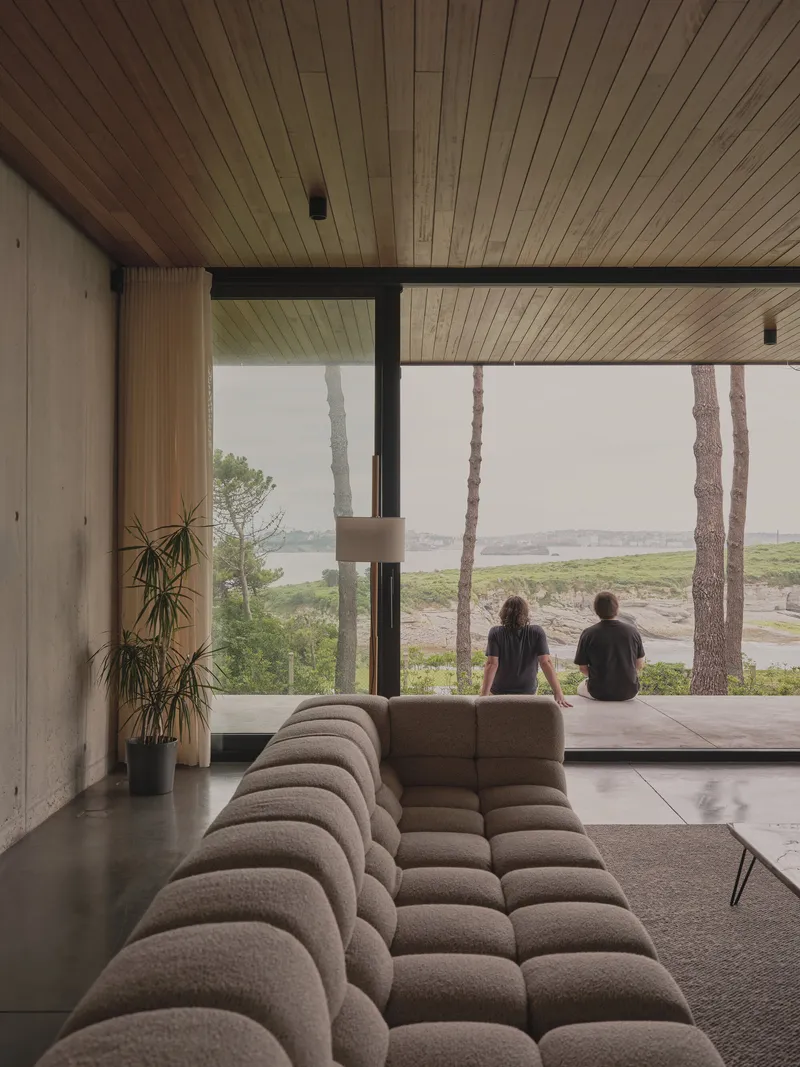

One image captures two figures seated at the glazed wall, looking out at the coastal landscape. It is the kind of photograph that tells you everything about the project's priorities. The house exists to frame this relationship between inhabitant and horizon. The architecture recedes; the landscape advances. Stone walls channel views like a camera obscura, while full-height glass panels dissolve the boundary altogether.
In the living room, a sectional sofa sits against the board-formed concrete wall, sheer drapery softening the light. It is quiet, almost monastic. The garden elevation, with its stone panel flanked by glazing beneath the flat roof overhang, shows how the architects calibrate solid and void to control exactly how much of the outside world enters each room. Nothing is accidental.
Plans and Drawings


The floor plans confirm what the photographs suggest: an L-shaped arrangement with clustered service rooms in one wing and an open living zone in the other, connected by a central hinge. The perpendicular bedroom wing creates a protected courtyard condition on the garden side, shielding outdoor living from prevailing winds while opening fully to the southern light.
The exploded axonometric is especially revealing. Three floor plates separate from a central level, exposing the interior room divisions and the structural logic behind the clustered volumes. You can see how the stone masses work as shear walls, allowing the glazed links between them to be structurally minimal. The drawing also clarifies the roof strategy: flat planes that cantilever beyond the walls to create the deep overhangs visible in every photograph. It is a plan driven by climate and topography, not by formal ambition.
Why This Project Matters
Casa Loredo matters because it demonstrates that vernacular architecture is not a style to be quoted but a method to be continued. Zooco Estudio's NAVC series treats the Cantabrian Coast as a living design brief, one that demands specific responses to wind, rain, light, stone, and tree. The result is a house that could not exist anywhere else. Its plan is shaped by the site's pine canopy, its materials drawn from local quarries, its overhangs calibrated to local rainfall. That degree of specificity is rare in an era when residential architecture so often defaults to generic modernism with a regional veneer.
More broadly, the project offers a credible model for how contemporary practice can engage with tradition without lapsing into nostalgia or pastiche. The stone walls are real, loadbearing, and locally sourced, but they frame rooms that are unmistakably of this century: open, light-filled, and connected to their landscape through glass. By committing to a multi-project research series rather than a one-off design, Zooco Estudio is building something more valuable than a single house. They are building an argument, one stone at a time, for architecture that belongs to its place.
Loredo House NAVC01, designed by Zooco Estudio, Santander, Spain. 350 m², completed 2024. Photography by David Zarzoso.
About the Studio
Share Your Own Work on uni.xyz
If projects like this are the kind of work you want to make, uni.xyz is a place to publish your own, find collaborators, and enter design competitions.




Popular Articles
Popular articles from the community


The Ocean Hive: Sustainable Architecture for a Self-Sufficient Civilization at Sea
The Ocean Hive imagines sustainable architecture at sea, where modular habitats, algae, wave power and ocean waste sustain a growing colony.

The Musturak Paradise: Senior Living Architecture for a Connected Future in Temara, Morocco
The Musturak Paradise reimagines senior living architecture in Temara via private homes, social spaces, culture, community, and shared care.

Co-life: Sustainable Architecture for Age-Friendly Community Living
Co-life reimagines sustainable architecture for seniors through courtyards, rammed earth, shared gardens, and spaces designed for belonging.
AL-JANNAH: Sustainable Architecture and Permaculture for Afghan Widows
AL-JANNAH uses sustainable architecture and permaculture to create resilient oasis of housing, learning, work and renewal for Afghan widows.


Similar Reads
You might also enjoy these articles

Bao Huynh Watercolor Atelier: A Serene Art Retreat in Hội An
Bao Huynh Watercolor Atelier in Hội An blends multifunctional art spaces, sustainable design, local materials, and family-friendly living in a serene environment.

Atelier Macri Concept Store Interior Design by CASE-REAL
Atelier Macri store features a "ko" counter, walnut wood details, cork displays, blending retail, gallery, and seamless customer experiences.

Manuel Vargas Izquierdo Stadium and High-Performance Sports Center: Architectural Excellence in Jalpa de Méndez
The Manuel Vargas Izquierdo Stadium blends sustainable design, inclusive sports facilities, and cultural-inspired architecture, revitalizing Jalpa de Méndez’s public spaces.

KAKR Buluh Awar Hall: Revitalizing Community and Ecology Through Bamboo Architecture
Community built bamboo hall revitalizes Buluh Awar village, empowering youth, restoring ecology, celebrating vernacular craftsmanship through sustainable architecture and culture.


Explore Residential Building Competitions
Discover active competitions in this discipline



Challenge to design a portable theatre


Challenge to design a portable music platform

Challenge to design an open learning module for the elderly


Challenge to design mud housing for contemporary communities
Comments (0)
Please login or sign up to add comments
No comments yet. Be the first to comment!