


Biomimicry
Design and architecture informed by natural systems, organisms, and ecological processes.
Biomimicry in architecture is design that learns from how nature works: it studies the forms, processes and ecosystems of living things and translates those strategies into structures, envelopes, materials and urban systems. Where biophilic design brings people into contact with nature, biomimicry treats nature as a teacher and a source of tested solutions to engineering problems such as cooling, strength and material use.
What is biomimicry?
The Biomimicry Institute describes the practice as emulating nature's "time-tested forms, processes, and ecosystems" to meet human needs. That phrase gives designers a useful map of three levels. At the level of form, a project copies a shape: a shell, a branching tree, a leaf that sheds water. At the level of process, it copies how an organism behaves: how a plant regulates its temperature, how a termite colony moves air, how a spider spins strong fibre at low energy cost. At the ecosystem level, it copies how whole living communities share energy, cycle materials and produce no waste.
The terms overlap. Biomimetics is the older engineering word for the same idea, and bio-inspired design is a looser umbrella. Biomorphism is different: it borrows the look of living forms for expressive reasons, without necessarily borrowing how they perform. A building that resembles a flower is biomorphic; a building that shades its own ground the way a desert plant does is biomimetic.
The most common confusion is with biophilic architecture. Biophilic design is about human experience: views of greenery, daylight, water and natural materials that support wellbeing. Biomimicry is about method: asking how nature would solve a problem and then designing to that answer. A planted atrium is biophilic; a facade that harvests water from fog the way a beetle or plant does is biomimetic. Good projects often do both, but the two topics ask different questions.
Janine Benyus, who co-founded the Biomimicry Institute, frames the goal as a habit rather than a style.
"We're awake now, and the question is how do we stay awake to the living world? How do we make the act of asking nature's advice a normal part of every day inventing?"
A short history of biomimicry
Designers have borrowed from nature for centuries, but the modern discipline has clear milestones. In the 1950s the American biophysicist Otto Schmitt developed the concept of biomimetics, and the word biomimicry was popularised by the biologist and writer Janine Benyus in her 1997 book Biomimicry: Innovation Inspired by Nature, which, as the biomimetics entry summarises, defines it as a science that studies nature's models and imitates them to solve human problems. Benyus co-founded the consultancy Biomimicry 3.8 in 1998 and the Biomimicry Institute in 2006.
In architecture, the most important early figure is Frei Otto. According to the Pritzker Prize biography, Otto founded the Biology and Building research group at the Technical University of Berlin in 1961, bringing architects, engineers and biologists together, and later led the Institute for Lightweight Structures at the University of Stuttgart. He always built physical form-finding models to determine the optimum shape of a structure, and the Pritzker jury noted that he drew on natural phenomena from birds' skulls to soap bubbles and spiders' webs. His membrane roofs for the 1972 Munich Olympic Park, realised with Günter Behnisch and Fritz Leonhardt, remain the best-known result.

Otto received the Pritzker Prize in 2015, and the jury summed up his method in one sentence.
"Taking inspiration from nature and the processes found there, he sought ways to use the least amount of materials and energy to enclose spaces."
A generation later, the Eden Project in Cornwall, which opened in 2001 in a former clay pit, gave the public a large-scale demonstration. The Eden Project's own account explains that because the pit was still being mined and the ground kept shifting, Grimshaw based the Biomes on soap bubbles, which adapt to any surface they settle on. The domes use a hex-tri-hex steel frame clad in inflated ETFE cushions, and the steelwork weighs only slightly more than the air the Biomes contain.

Eden also shows biomimicry at a smaller scale: its Core building, designed by Jolyon Brewis of Nicholas Grimshaw and Partners, bases its roof on the opposing Fibonacci spirals found in pinecones and sunflowers.
Key principles of biomimicry
The three levels the Biomimicry Institute describes (form, process and ecosystem) remain the clearest way to organise biomimetic design. The principles below take each in turn and add two working rules that follow from them.
Form: copy the shape that does the work
Some natural forms are efficient because of their geometry: shells spread load, branching structures carry weight to a few points, overlapping plates protect while allowing movement. The test is whether the borrowed shape performs the same job in the building.

Armadicar by haqi abdullah and farah augusta, which received the People's Choice Award as an entry to the Mobitecture competition, is a mobile habitat inspired by the armadillo, designed as an adaptive dwelling in a minimum space for a family of four on land and on water.
Process: copy how an organism behaves
Process-level work looks at what a living thing does, not how it looks. MORPHLUID by Sandesh, an Honorable Mention in the UnIATA '18 competition, is research into passive cooling systems that respond to climate, aiming to reduce reliance on artificial cooling; its journal compares the system with the way plants and people regulate temperature through fluid movement.
Ecosystem: copy how a whole system runs
The highest level asks how a building or district can behave like an ecosystem: running on current sunlight, cycling water and materials, and supporting other species. Here biomimicry overlaps with regenerative design. Healing Façade by Santruli Estudio, a winning entry in the Eco-Chapel competition, starts from the forest churches' belief in a chain of interdependence between humans and non-humans: its modular facade uses fibres that catch water from the wind to protect vegetation and foster reforestation.
Check the biology: the termite mound story
The most repeated example in architecture is the Eastgate Centre in Harare, Zimbabwe, an office and shopping building by the architect Mick Pearce with engineers Ove Arup and Partners, opened in 1996. Pearce drew inspiration from termite mounds, and the building is passively cooled: it harvests cool night air and distributes it through the interior during the day, with brick funnels that let warm air escape from the top. The biology behind the story is more complicated than the popular version suggests. The entry on mound-building termites notes that research on Macrotermes michaelseni mounds has found their primary role to be the exchange of respiratory gases, with airflow driven largely by daily temperature swings.

The lesson for designers is to treat an analogy as a starting hypothesis and check it against current biology and building physics, not as proof.
Measure performance, not resemblance
A biomimetic claim should be testable: less material, lower cooling load, more water captured. Simulation and computational design make that testing practical at student level.
Biomimicry on uni.xyz
Members use biomimicry most often to answer climate questions, especially heat and water, and to imagine habitats for extreme environments.
The most liked project in the topic is Embracing the Temporal Scar by Vedashri Kulkarni, which received the People's Choice Award as an entry to the UnIATA '26 competition. The thesis reimagines an abandoned quarry in Navi Mumbai as a healing ecosystem, using Voronoi systems to set Miyawaki forests and wetlands into the terrain so that natural succession, not architecture, leads. It is an ecosystem-level reading of the topic.

Flower of the Desert by Reza Ghadirian, Hamid Shahmohammadmirab and Nima Asadi Jozani received the Institutional Excellence Award as an entry to the Form Follows Climate 2020 competition. It studies Welwitschia, a long-lived plant of the Namib Desert whose leaves lie on the sand, keep the soil beneath cool and moist and reduce wind erosion. The journal on the project explains how that becomes a low, radial building with sunken courtyards that channel wind and cut heat gain.

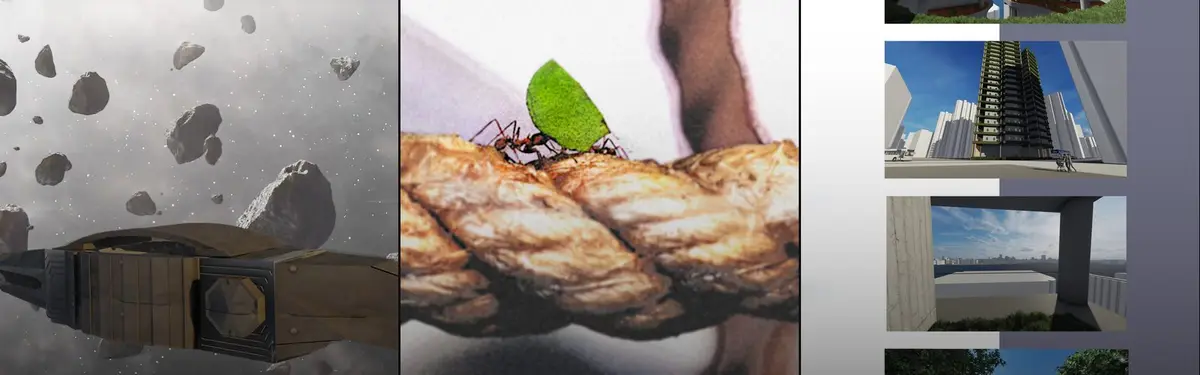
Pangolin can help mining by Misak Terzibasiyan and AMIR FEIZINEZHADGHESHLAGHI, an entry to the Leap competition that received a People's Choice Award, names the pangolin in its title and proposes a space habitat and spacecraft for asteroid mining. CATERPIE HAUS by Euna Song, an Honorable Mention in the Mobitecture competition, starts from the way a caterpillar gains momentum through movements of its whole body rather than rotating joints.
The journals add depth. Reuse the Nature covers a speculative 1,300 metre tower by Ecenaz Tütüncü and Selahattin Nacar that takes the operational logic of a tree, with a solar canopy, a wind-channelling trunk and root-like base clusters. Tidal Survival describes Nicholas Miller's shortlisted EHC - Pacific entry, a mobile, bioluminescent underwater dwelling whose form, light and movement are drawn from deep-sea organisms.

For a built reference, the livMatS Biomimetic Shell journal covers the 2023 research pavilion in Freiburg by the ICD and ITKE institutes of the University of Stuttgart with the livMatS cluster of the University of Freiburg. Inspired by the plate skeletons of sea urchins, its segmented timber shell of 127 hollow cassettes spans 16 metres, built by the same university where Otto once led the Institute for Lightweight Structures.
Challenges and future directions
The main risk is the shallow analogy: a project that names an animal and then delivers a conventional building in its shape. Juries and clients are increasingly asking what the biological model actually does and whether the design reproduces that function. The Eastgate story is a reminder that even celebrated examples rest on simplified biology.
A second challenge is translation across scale. A process that works in a leaf or a beetle shell, at the size of millimetres, may not work at the size of a facade, and materials rarely behave like living tissue.

Member research is moving towards adaptive envelopes that respond without motors. The MORPHLUID journal describes Sandesh's panels with liquid chambers that shift shape as they heat, and diagrams that set photosynthesis, transpiration and perspiration side by side as temperature regulation through fluid movement and phase change. The future of the field lies in this kind of tested, performance-led work, supported by better simulation and new bio-based materials.
Biomimicry for students and designers
Start with a problem, not an organism. Define what the building must do (shed heat, collect water, span a space with little material) and then search for organisms that already do it, using resources such as the Biomimicry Institute's AskNature database. Document the biological mechanism with a reliable source, show the design translation step by step, and test the result with simulation or a physical model.
Climate and extreme-habitat briefs suit this approach well; browse current uni.xyz competitions for a brief to test it on. Related topics worth reading alongside this one include passive cooling strategies and kinetic architecture.
Frequently asked questions
What is biomimicry in architecture?
It is the practice of designing buildings by learning from how nature works: copying the forms, processes and ecosystems of living things to solve problems such as cooling, structure, water and waste.
What is the difference between biomimicry and biophilic design?
Biomimicry imitates nature's strategies to make a building perform better. Biophilic design brings people into contact with nature, through daylight, plants, water and natural materials, to support wellbeing. A project can use both.
What are the three levels of biomimicry?
Form, process and ecosystem. Form copies a shape, process copies how an organism behaves, and ecosystem copies how a whole community of organisms cycles energy and materials.
What is the most famous example of biomimicry in architecture?
The Eastgate Centre in Harare, inspired by termite mounds, is the most cited, alongside Frei Otto's lightweight structures and the Eden Project's bubble-based Biomes. Each is worth reading about in detail rather than as a slogan.
Who coined the term biomimicry?
The word appeared in scientific writing earlier, but Janine Benyus popularised it with her 1997 book Biomimicry: Innovation Inspired by Nature.
References and further reading
- What is biomimicry?, The Biomimicry Institute
- Janine Benyus, The Biomimicry Institute
- Biomimetics, Wikipedia
- Frei Otto, 2015 Laureate, The Pritzker Architecture Prize
- Jury Citation: Frei Otto, The Pritzker Architecture Prize
- Architecture, Eden Project
- Eastgate Centre, Harare, Wikipedia
- Mound-building termites, Wikipedia


Popular projects
View all 56 projects





Latest journals
View all 57 journals
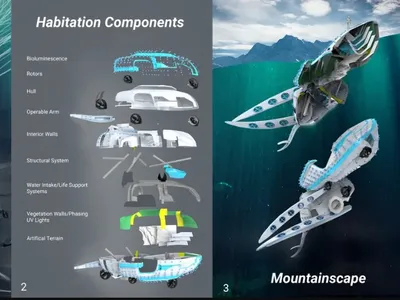
Tidal Survival: A Biomimetic Habitat That Glows, Moves, and Breathes Beneath the Ocean
Nicholas Miller's shortlisted EHC Pacific entry reimagines underwater habitation as a mobile, bioluminescent organism rather than a rigid capsule.
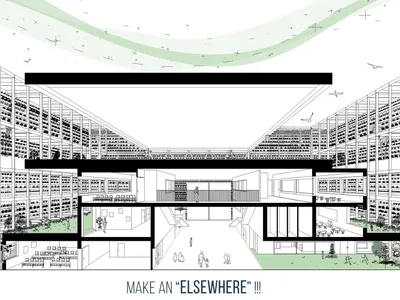
Make an Elsewhere: A Noah's Ark of Plants, Animals and Children Docked in the Dense City
Khanh Anh's shortlisted Education '20 entry wraps a school in planted shelves, sheltering plants, animals and children in one portable ecosystem.
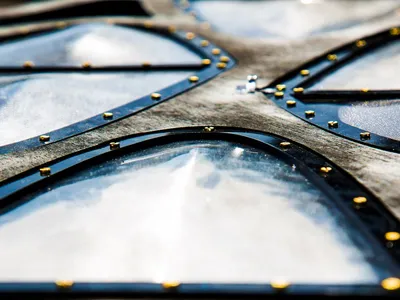
MORPHLUID: A Solar-Responsive Envelope That Shades and Breathes Through Liquid-Filled Panels
Sandesh's MORPHLUID uses sun-heated liquid chambers to morph panels, turning an envelope module into both a shading device and a ventilation system.

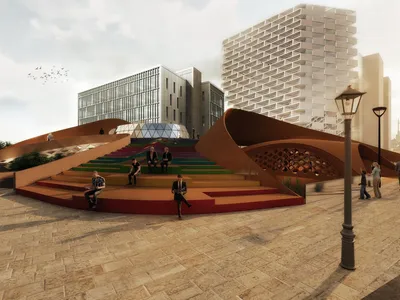
Flower of the Desert: Biomimetic Architecture That Breathes in Arid Heat
A petal-shaped public institution translates the survival strategies of a 1,500-year-old desert plant into climate-responsive courtyards and passive coolin


