


Floating City
Speculative and built projects exploring cities that float, drift, or exist in unconventional spatial relationships to land and water.
A floating city is a permanent settlement built on buoyant platforms that rest on a lake, river or the sea instead of on dry land, holding homes, workplaces, public space and the infrastructure that serves them. Unlike a single houseboat or a land reclamation scheme, it is planned as a whole neighbourhood that rises and falls with the water. Architects now study floating cities as one answer to rising seas, crowded coastlines and the shortage of buildable land.
What is a floating city?
The term covers a wide range of work. At the small end sit clusters of floating homes moored in a harbour or canal. At the large end sit offshore districts of several linked platforms with their own energy, water and food systems, joined to the shore by bridges or boats. What unites them is that the building rests on water that can move, so the architecture has to accept change in level, wave action and wind as part of its brief.
A floating city is different from floating architecture in general, which can mean a single pavilion, school or office on a pontoon. It is about urban questions: how streets work when they are canals, how a public square holds steady on a deck, how services reach every household. It also differs from artificial islands, where sand or rock is dumped to make new ground. A floating city creates usable area without filling the seabed, and it can in principle be extended, rearranged or towed away.
Two neighbouring ideas often get mixed in. Amphibious buildings sit on land in dry weather and lift on their foundations during a flood. Underwater habitats go below the surface, a branch our members explore under underwater habitat. Floating cities sit between the two: they live on the surface all the time.
The subject also ranges from built fact to pure speculation. Some floating neighbourhoods already exist in the Netherlands and on Lake Titicaca. Others are prototypes backed by governments. Many more are design proposals that use the floating city to ask what a community could be if it started again on open water.
A short history of floating cities
People have lived on floating ground for centuries. The Uru (or Uros) people of Lake Titicaca live on a still-growing group of about 120 self-fashioned islands near Puno, built from layers of totora reed, and according to the Wikipedia article on the Uru people the settlements were originally defensive because they could be moved if a threat arose. The reed islands show the two ideas that still drive the type: ground that can be made from local material, and a community that is not tied to one fixed spot.

The modern architectural idea took shape in post-war Japan. Kiyonori Kikutake proposed his Marine City in 1958, and it became part of the Metabolist Manifesto launched at the World Design Conference in Tokyo in 1960, as described on the Kiyonori Kikutake page. The Metabolists imagined cities as living systems that could grow and replace their parts, and the sea gave them open territory for that growth.
In the United States, Buckminster Fuller developed an offshore floating city named Triton City in 1967 and published a report on it the following year; models of the design were later placed in the Lyndon Baines Johnson Library and Museum, according to the Buckminster Fuller entry. Kikutake then got the chance to build a fragment of his vision. The centrepiece of Expo '75 in Okinawa was Aquapolis, a floating city he designed as a prototype for marine communities, built at a shipyard in Hiroshima and towed to the Expo site.
The idea returned to the policy agenda in 2019, when UN-Habitat convened the first round table on sustainable floating cities at UN Headquarters in New York. A prototype with a host city was agreed there, and in 2022 UN-Habitat, the Busan Metropolitan City and OCEANIX unveiled the design of OCEANIX Busan: linked platforms totalling 6.3 hectares for a community of 12,000 people, with BIG and SAMOO as lead architects.
"We cannot solve today’s problems with yesterday’s tools."
Key principles of floating city design
Every floating city proposal, built or speculative, has to answer the same handful of questions. The member projects below show how designers on uni.xyz have tackled each one.
Buoyancy and the platform
The platform is the ground of a floating city. It has to displace enough water to carry buildings, people and stored goods, and it has to stay level when loads shift. Most designers break it into units of a manageable size so that each can be built in a yard, floated into place and replaced when it ages. The platform sets the grain of the whole city in the way that a land plot does on shore.
Modularity and growth
Because platforms are made in pieces, floating cities tend to grow by addition. Floating Hive by 祥磊 孟, 方瑾 董 and 志涵 曾 bases its modules on the hexagon of a beehive, using the shape's stability and the ease with which hexagons splice together to make a sea home for Jakarta that can cope with rain and flood.

Movement with the water
A floating city does not resist water level change; it follows it. Moorings, guide piles and flexible connections let platforms rise and fall while bridges and service lines take up the difference. Proximity Island Frame by qiaoxi wu, an Editor's Choice entry in the Proximity Island 2019 competition, makes this its subject: the building glides vertically along an existing offshore column system as sea levels change.
Closed loops for energy, water and waste
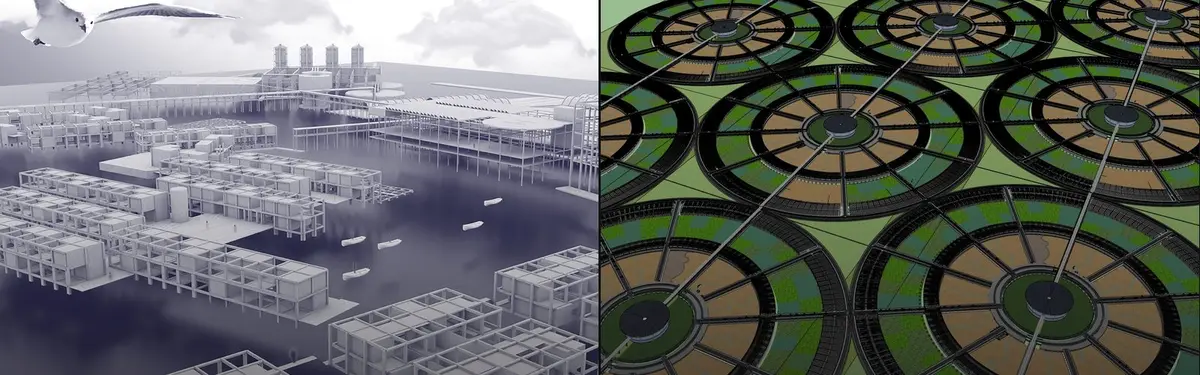
A settlement offshore cannot rely on a city's mains. It needs to make power, treat water and handle waste locally, which is why the Busan prototype lists six integrated systems, from net zero energy to closed loop water. Member projects pick up the same thread. AFLOATOPOLIS by Onur Asar, UZAY DENİZ YILMAZ, Ayça ZÜMRÜT and Şeyhmus Çelik, entered in the Afloat competition, proposes a new urban cross-section between water and land for cities that climate change threatens to sink.

Public life on the water
The hardest part of a floating city is making it feel like a city. Canals become streets, decks become squares and boats become buses. Good proposals give as much thought to the shared surface as to the private home, so that neighbours meet on the water and not only behind their own doors.
Floating cities on uni.xyz
Members have explored floating cities mainly through competitions that pose sea level rise, offshore infrastructure and coastal housing as design problems. The most liked project in this topic is Futuristic Floating Residents by soheib rahmani, kiana oveisi, elham akhgar and Kimia Esmaeili, which won a People's Choice Award in the Container City competition. The team argues that traditional land reclamation is not a practical long-term answer for coastal cities facing rising seas and that it harms ecosystems.
"Our approach to solve this problem was to adapt to environment and use floating structure against SLR impacts."
soheib rahmani, kiana oveisi, elham akhgar and Kimia Esmaeili, Futuristic Floating Residents project statement

The journal Afloat: A Floating Indonesian City That Uses Shared Housing to Ease Ethnic Tension reviews a shortlisted Afloat entry by 嵩琪 苑. It starts from a social question rather than a technical one: houses of a similar type, set along canals that belong to no one group, are meant to ease conflicts between communities with different habits and beliefs. Timber gables repeat across the water, boats sit at doorsteps and planted islets float between the homes.

Editable Floating Community by 浩良 陈 and Young Lee, an Editor's Choice entry in the Afloat competition, lets the community generate itself according to residents' wishes and change with the character of the ocean. FVOLUTION by ACHARIYA TIPNET, also an Editor's Choice entry in the same competition, imagines Jakarta transformed as flooding forces its people to adapt to rising water every ten years.
Offshore industry is a second theme. The journal Proximity Island: An Abandoned Oil Rig Reborn as a Vertical Cultural Ecosystem at Sea covers Sasha Pokidova's shortlisted entry in Proximity Island 2019, which turns an obsolete platform into a self-sufficient micro-city of galleries, research spaces and co-housing.
Built work appears too. Powerhouse Company Floats a 5,880 Square Meter Office on Rotterdam's Rijnhaven looks at the Floating Office Rotterdam, headquarters of the Global Center on Adaptation. The journal describes a three-storey, timber-clad building on a pontoon that rises and falls with the tides, with a public deck used as a swimming dock, café terrace and kayak launch.

Finally, Fluid Syntax by Amy Aguirre sketches a city that collaborates with water, with amphibious housing in its Ripple Quarters that floats and adapts as levels change.
Challenges and future directions
Floating cities face hard questions. Open sea brings storms, waves and corrosion that a sheltered harbour never sees, so most real projects stay close to the coast. Platforms are expensive to build and to maintain, and critics ask whether they will house the people most at risk from flooding or become enclaves for the few. Governance is unsettled too: who plans, taxes and polices a district that floats?
Ecology matters as much as engineering. A platform shades the water beneath it and changes the life of the seabed, so the better proposals treat the underside as habitat. The link between a floating district and its mother city, through bridges, ferries and shared services, will decide whether it works as a neighbourhood or an island.
"Floating cities can be part of our new arsenal of tools."
Amina Mohammed, UN Deputy Secretary-General, quoted by UN News (2019)
That framing is useful. Floating cities are one tool among many for places facing sea level rise, alongside managed retreat, defences and amphibious building, and they are most convincing when they extend an existing city rather than escape it.

Floating cities for students and designers
Floating cities make strong thesis subjects because they force decisions at every scale, from the joint between two platforms to the governance of a district. Promising angles include the retrofit of offshore rigs and piers, floating extensions to dense waterfront cities, social housing on water, and the ecology of the platform's underside. Begin with a real coast and a real community rather than an empty ocean. Related topics worth reading are ocean architecture and flood resilient architecture, and current briefs on water and climate appear among the open architecture competitions.
Frequently asked questions
What is a floating city?
A floating city is a planned settlement built on buoyant platforms on water rather than on land. It contains homes, work, public space and its own infrastructure, and it moves up and down with the water level.
Do floating cities exist today?
Small floating neighbourhoods exist, for example the reed islands of the Uru on Lake Titicaca and floating housing in Dutch cities. Larger schemes such as OCEANIX Busan were unveiled as prototype designs in 2022, and most other floating cities remain proposals.
How does a floating city stay afloat?
Its platforms displace enough water to carry their own weight plus buildings and people, in the same way a ship does. They are usually held in place by moorings or guide piles that let them rise and fall without drifting.
Can floating cities help with sea level rise?
They can add living space that adapts to changing water levels instead of being flooded by it. They are not a complete answer: they are costly, need sheltered water, and work best as extensions of existing coastal cities.
References and further reading
- Uru people, Wikipedia
- Kiyonori Kikutake, Wikipedia
- Expo '75, Wikipedia
- Buckminster Fuller, Wikipedia
- UN-Habitat and partners unveil OCEANIX Busan, the world's first prototype floating city, UN-Habitat
- 'Ground-breaking innovation' needed in cities, where battle for sustainable development will be won or lost, says UN agency chief, UN News


Popular projects
View all 49 projects


Latest journals
View all 52 journals

Afloat: A Floating Indonesian City That Uses Shared Housing to Ease Ethnic Tension
Timber gables, fishing grids and planted islets form a water district where a common way of living becomes the ground on which neighbors meet.
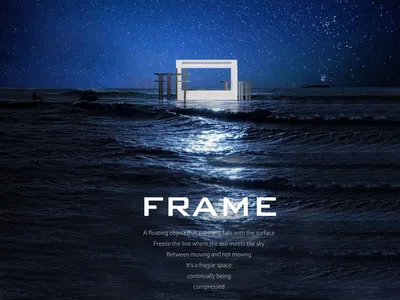
Proximity Island Frame: A Floating Platform That Holds the Horizon Still While the Sea Moves
qiaoxi wu's Editor's Choice entry rides existing offshore columns with the tide, framing the sea-sky line as a fixed datum in a restless ocean.
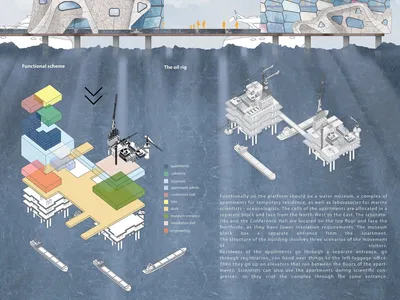
Proximity Island: An Abandoned Oil Rig Reborn as a Vertical Cultural Ecosystem at Sea
Sasha Pokidova stacks galleries, research spaces and co-housing cells inside a sponge-like hexagonal skin, turning offshore industry into a micro-city.


Powerhouse Company Floats a 5,880 Square Meter Office on Rotterdam's Rijnhaven
A timber-clad, solar-powered headquarters for the Global Center on Adaptation proves that climate-resilient architecture can also be inviting.


