


Landscape Art
Artistic and design-driven approaches to landscape creation, from gardens and installations to architectural interventions.
Landscape art is art made with, in and about the land itself: earthworks, stone circles, walked lines, planted forms and outdoor installations that only make full sense in the place where they stand. The term covers the land art movement of the late 1960s and 1970s and everything it opened up afterwards, from sculpture parks to landscape architecture that treats terrain, water and time as a medium.
What is landscape art?
In the narrow sense, landscape art means land art, the movement in which artists stopped painting the landscape and started working directly on it. Tate defines land art as art made directly in the landscape, either by sculpting the ground into earthworks or by building structures from natural materials such as rocks or twigs. In the wider sense used on uni.xyz, landscape art also includes the gardens, art parks, temporary installations and landscape projects that borrow those methods: reading a site, working with its own material, and letting weather and growth finish the piece.
Three things set it apart from neighbouring fields. Unlike a sculpture placed on a plinth, a work of landscape art cannot be moved without being destroyed, because the site is part of the work. Unlike most landscape architecture, it is not obliged to solve drainage, access or planting maintenance, so it can be useless in the productive sense and still matter. And unlike environmental art, which Tate frames around social and political questions about the environment, landscape art is first about form, scale and perception, even when it carries an ecological message. In practice the borders blur. A path designed for older visitors, a riverbank tribute or a field of nets strung between trees can all sit inside the topic, which is why designers, artists and students meet here.
A short history of landscape art
Land art grew out of the conceptual art of the 1960s. Two exhibitions mark its public arrival: "Earthworks" at the Dwan Gallery in New York in 1968, and "Earth Art" at Cornell University in February 1969, which brought together Walter De Maria, Michael Heizer, Richard Long, Robert Smithson and others. The open deserts of the western United States became a key testing ground for land artists, far from city audiences.
The defining work is Robert Smithson's Spiral Jetty, built in April 1970 on the Rozel Point peninsula of the Great Salt Lake in Utah. According to the Holt/Smithson Foundation, it is a counterclockwise coil of black basalt and earth, 1,500 feet long and 15 feet wide, that changes form as water levels, salt and time act on it. Smithson was interested in entropy, so the slow decay of the jetty was part of the idea rather than a failure of it. His partner Nancy Holt made Sun Tunnels (1973 to 1976) in the Utah desert, and Michael Heizer worked at such a scale and over so many years that his vast earthwork City was only completed in 2022.
"Size determines an object, but scale determines art."
In Britain the movement took a lighter path. Tate holds Richard Long's A Line Made by Walking (1967) and describes his method plainly: he simply walked up and down until he had made a mark in the earth. Long later laid out circles of stone, such as South Bank Circle (1991), also in Tate's collection. Andy Goldsworthy, born in 1956, works with whatever a site offers, from stone and twigs to leaves, snow and icicles, and most of his works are small and temporary. Wikipedia lists him with Long and Chris Drury as the most prominent non-American land artists.

Later the work moved from remote sites into places people could reach. Sculpture parks gave land art a permanent public home: Yorkshire Sculpture Park now describes itself as Europe's largest sculpture park, with 500 acres and over 90 artworks in the landscape. Landscape architects, in turn, took up the land artists' respect for found ground, as later sections show.
Key principles of landscape art
The site is the material
Land art starts from what is already there: rock, soil, water, the line of a slope. Smithson's jetty was built from basalt and earth collected on site, and Goldsworthy has said he cannot edit the materials he works with. Good student work does the same. The space of aqueous, a Ripple competition entry by 5903589Wipasorn Pumsawai and Warintorn Makotsa, sets out to give water a new role by using water itself to make art, so that people value it rather than only consuming it.
Scale and the body
Smithson's point about scale is a design lesson. A landform reads differently from a car park, from the path and from the air, and the work has to hold up at each distance. Earthworks are usually designed for walking: the visitor's route is part of the composition.
Time, weather and decay
Most land art accepts change. The Holt/Smithson Foundation describes Spiral Jetty as continuously changing form as nature, industry and time act on it, and Goldsworthy's ephemeral works survive mainly in his own photographs. Designers who borrow this idea plan for seasons, growth and weathering instead of fighting them.

Light touch and the temporary
Not every piece needs a bulldozer. Network Installation, by Ricardo Salazar and shortlisted in Elevate 2019, stretches coloured fishing nets between trees and over plazas so that they billow in the wind and throw orange and blue shadows on the ground, as the uni.xyz journal on the project describes. It changes a park without altering a single tree.

The journey as the artwork
Walking is the oldest land art method, and many landscape projects are really a sequence of approach, threshold and arrival. Garden of Life, an Editor's Choice entry in the Pearls of green competition by Sai Rohanth and Rachita Saxena, is built around a long path that branches into smaller spaces and reveals hidden views along the way.
Landscape art on uni.xyz
Members publish landscape art as competition entries, theses and journals, and the strongest pieces share the movement's habit of starting from the ground. The most liked project in the topic is TERRA, an Editor's Choice entry in the Pura competition by Tanya Prevezentseva, настя шкарупа, Наташа Селиванова and Jon Cogutiac. The team describes a site that returns visitors to a primitive, ancient world and its instincts, and makes the most basic of them, the need for water, the key to the concept.
Karan Anand's thesis Machine Made Landscapes is the closest thing in the topic to Smithson's interest in industrial ruins. The uni.xyz journal on the project explains that it targets the Betthalasuru White Rocks Quarry outside Bengaluru, a closed limestone quarry of roughly 152 acres that stopped working in 2008 and that the Bangalore Masterplan 2031 already designates for recreation. Instead of backfilling and planting until the extraction is hidden, the design keeps the cliffs, plateaus and flooded basins as its starting material.
"The project intends to invert the relationship between man and landscape by returning life to the quarry."
Karan Anand, Machine Made Landscapes, project statement on uni.xyz
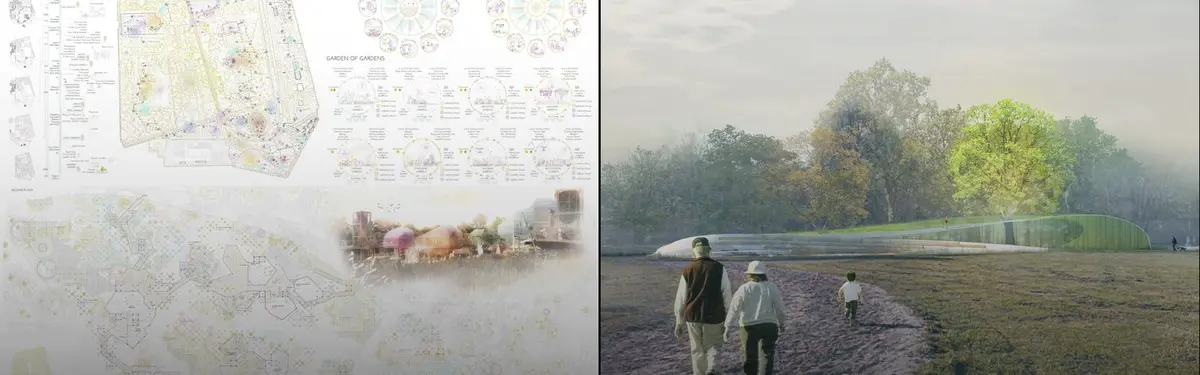
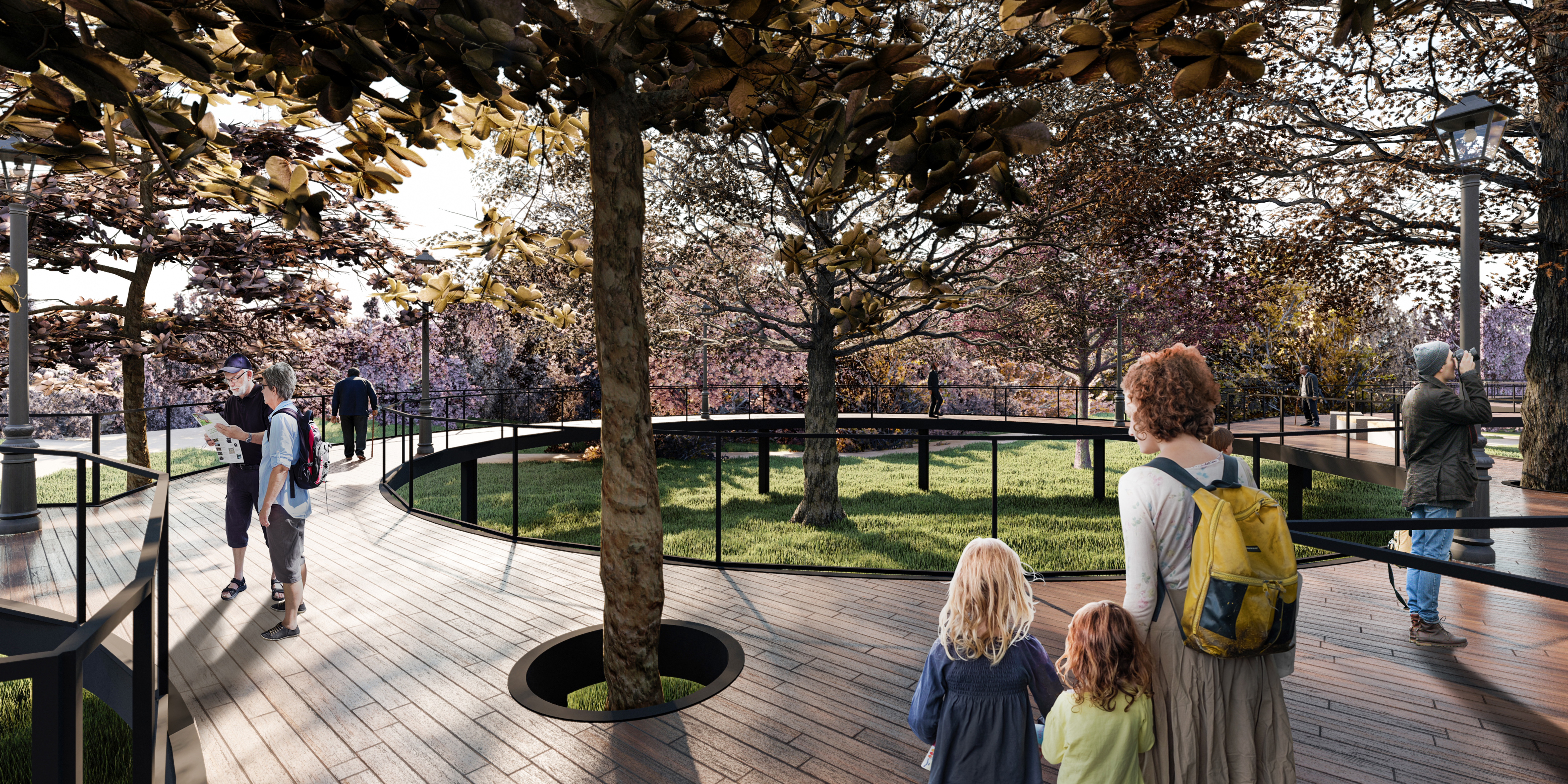
Platform Park by Luis Felipe Betancur Uribe and Juan Jose Vargas Castillo received an Honorable Mention in the Huddle competition. It is a park for older people that keeps its impact on the natural ground to a minimum and runs one continuous level out from the highest point of the lot, so that visitors can travel, contemplate and meet without a single irregular step.
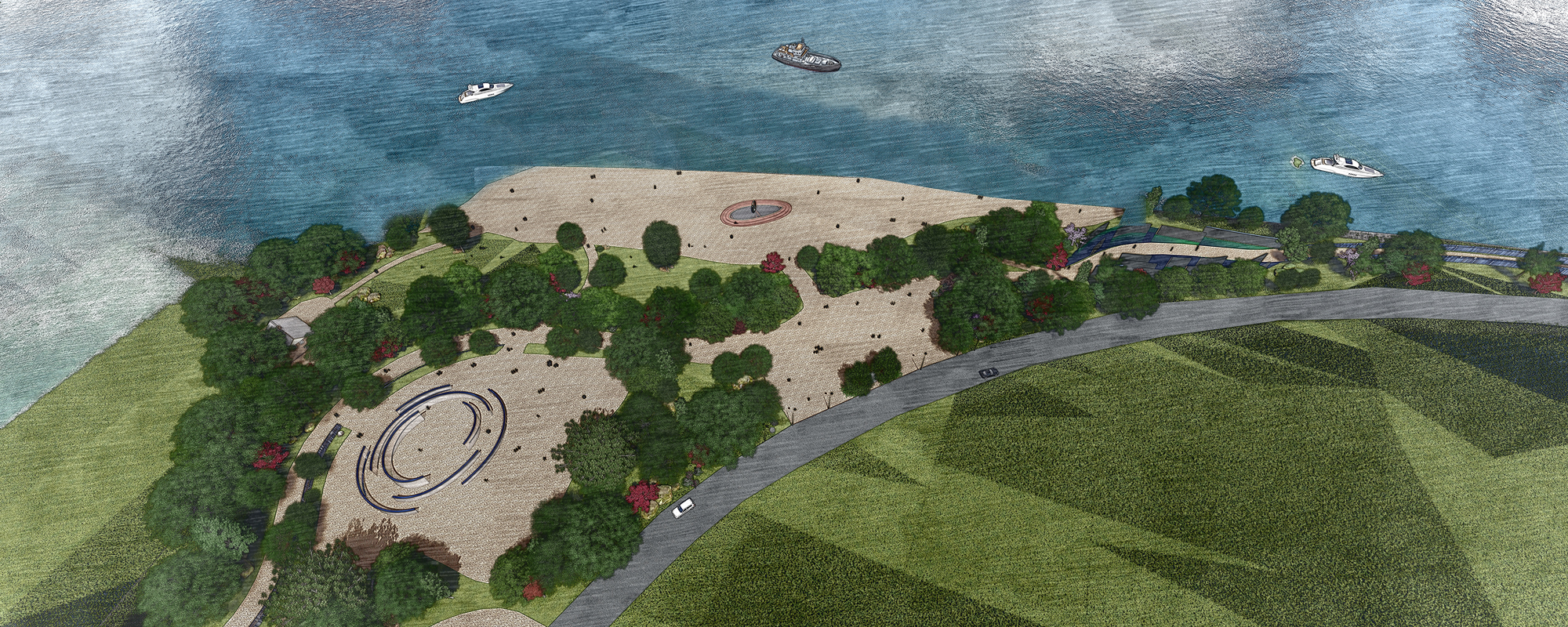
Giardino Dell'arno, an Editor's Choice entry in the Crested competition by Fakhrell Izzan, Naila Hisana Amira, Darien Ilham and Rizal Kurnia Ardi, is a tribute to the Arno as the giver and taker of Florence. Its terraces and arches step down to the water, which makes it a useful companion to the waterscape topic.

Art Wave, by Misak Terzibasiyan and Sepideh Kouroshy and an Editor's Choice in the Symbiotecture competition, argues that designing with pathways can produce more adaptive landscapes, folding building and site planning into a single landscape process.
The journals add built and proposed examples. One covers Pedro Terra Oliveira's landscape infrastructure for Mostardas in southern Brazil, a system of timber boardwalks, docks, observation points and modular lodges that lets visitors move through the RAMSAR-listed wetland of Lagoa do Peixe National Park without a signature building. Another describes Trace of Land by ELSE, made for the SMACH 2025 open-air art biennale in the Dolomites: a ribbon of hay that follows the contours of an alpine meadow in Val Badia, as if a hay bale had rolled down the slope.

Challenges and future directions
The first land artists had a contradiction built in. They wanted to escape the gallery, yet their works depended on private patrons, heavy machinery and photographs shown back in the gallery. Wikipedia notes that Walter De Maria's Lightning Field (1977) was commissioned by the Dia Art Foundation, and that this funding largely dried up in the mid-1970s. Some early earthworks were also made with mechanical earth-moving equipment, as Tate notes of Smithson, which reads differently in an age of ecological care.
The most promising direction today is the overlap between landscape art and post-industrial landscape architecture. At Landschaftspark Duisburg-Nord in Germany, production at the Thyssen ironworks ended in 1985, and a park of roughly 180 hectares was created to designs by Peter Latz and Partner, keeping the blast furnaces, bunkers and rail lines and letting vegetation grow wild among them. The park's own description of landscape architecture states that such a project is never truly finished, but a concept in development, which is exactly the land artists' view of time.

Landforms built from waste are another path. Northumberlandia, designed by Charles Jencks and completed in 2012 near Cramlington in England, is a reclining figure 400 metres long made from 1.5 million tonnes of overburden from a neighbouring surface mine, set in a public park. The open questions for the next generation are maintenance, access and who the work is for: a landform that nobody can visit, or that needs constant mowing to stay legible, is harder to defend than one that becomes everyday public ground.
Landscape art for students and designers
Landscape art makes a strong thesis because it forces you to read a site before drawing on it. Promising angles include reclaiming quarries, mines and landfills as public land, as Machine Made Landscapes does; temporary installations that test an idea for a season before anything permanent is built; and art parks that double as flood storage or habitat. Urban versions sit close to street art and murals, where the city surface is the canvas. Study the movement's documentation habits too: drawings, maps, walks and photographs were part of land art from the start, and they make a stronger portfolio than a single render. When you are ready, browse open briefs on uni.xyz competitions; past calls such as Ripple, Huddle and Crested produced several of the projects above.
Frequently asked questions
What is the difference between land art and landscape art?
Land art is the specific movement of the late 1960s and 1970s in which artists such as Robert Smithson, Nancy Holt, Michael Heizer and Richard Long worked directly in the landscape. Landscape art is the broader field it started, which also includes art parks, gardens and landscape design that treat the land as an artistic medium.
What is the most famous work of land art?
Tate calls Robert Smithson's Spiral Jetty of 1970 the most famous land art work. It is a coil of basalt rock and earth 1,500 feet long running out into the Great Salt Lake in Utah, and it is cared for by the Dia Art Foundation.
Is Andy Goldsworthy a land artist?
Yes. Goldsworthy, born in 1956, is usually grouped with Richard Long and Chris Drury as one of the leading British land artists. He works with natural materials found on site, from stone and twigs to leaves and icicles, and most of his pieces are small and temporary.
How does land art influence landscape architecture?
It taught designers to keep what a site already has, to work with time and weather, and to treat paths and landforms as experiences. Post-industrial parks such as Landschaftspark Duisburg-Nord, which kept its ironworks and let nature return around them, show that thinking at the scale of a whole city district.
Where can I see land art and landscape art?
Spiral Jetty on the Great Salt Lake can be visited, and the Holt/Smithson Foundation links to visiting details. Sculpture parks are easier to reach: Yorkshire Sculpture Park in England has more than 90 works across 500 acres, and many city parks hold permanent pieces like Richard Long's Braga Circle in Alcobendas, Spain.
References and further reading
- Land art, Tate
- Spiral Jetty, Holt/Smithson Foundation
- Land art, Wikipedia
- Andy Goldsworthy, Wikipedia
- Northumberlandia, Wikipedia
- Introduction and Landscape architecture, Landschaftspark Duisburg-Nord
- Yorkshire Sculpture Park, Yorkshire Sculpture Park


Popular projects
View all 55 projects





Latest journals
View all 50 journals

BRBB Architects Stack Timber Gables on a Concrete Plinth for an Elderly Couple's Mountain Retreat
In a small Gangwon Province village, two rotated volumes frame a valley, a stream, and a quieter chapter of life.

Machine Made Landscapes: Turning a Closed Bengaluru Quarry into a Public Ecological Park
Karan Anand treats the cliffs, pits and flooded voids of the 152-acre Betthalasuru quarry as ground to build on, not scars to erase.
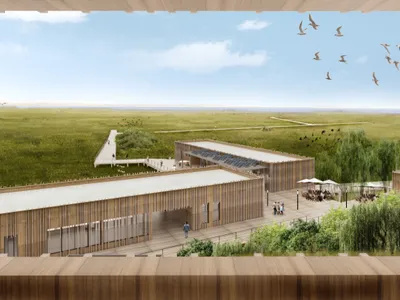
Landscape Infrastructure for Mostardas: Timber Boardwalks That Let the Wetland Set the Terms
Modular eucalyptus and pine walkways, observatories and research lodges thread Mostardas into the Lagoa do Peixe wetlands with a deliberately light touch.

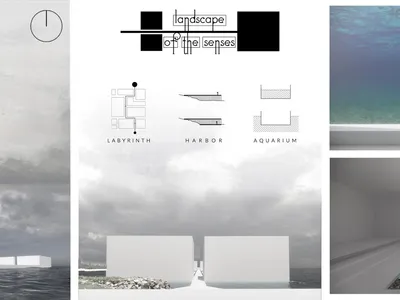
Landscape of the Senses: Architecture as a Multisensory Journey Along the Coast
Mateusz Mulica's conceptual project stretches white monolithic volumes into the sea, designing spaces for hearing, sight, smell, and touch.


