


Memorial Design
Design approaches to creating spaces and structures that honor memory, loss, and commemoration.
Memorial design is the practice of shaping places, objects and landscapes that help people remember a person, a group or an event, most often a death or a shared loss. It ranges from a single inscribed stone to national memorials commissioned through open competitions. A good memorial gives grief somewhere to go and gives the history behind it a permanent public address.
What is memorial design?
A memorial is built for remembering, and that sets it apart from two close relatives. A monument traditionally celebrates: a victory, a ruler, a founding. A memorial usually starts from absence, from people who are gone and an event that should not be forgotten. Many works sit between the two, and the words are often used interchangeably, but the difference shapes the design brief. A monument asks visitors to look up. A memorial more often asks them to slow down, read, touch or walk.
Memorial design also differs from funerary architecture. A cemetery or crematorium serves the body and the rituals around it, while a memorial can stand far from any grave. The old word for that condition is the cenotaph, which derives from the Greek kenotaphion, meaning "empty tomb": a marker for the dead whose remains lie somewhere else, or nowhere known.
The field draws on architecture, landscape, sculpture, typography and curation at once. Designers decide how a visitor arrives, what they see first, where names go, what the ground does underfoot, and how the place will look after fifty winters. Some memorials are civic and national; others are small, temporary or digital. The wider memorial topic on uni.xyz collects all of these, from war and atrocity memorials to climate memorials and spaces for private mourning.
A short history of memorial design
Commemoration is ancient. Burial mounds, inscribed stelae and cenotaphs for the lost at sea or in war all predate architecture as a profession, and they established the basic tools that designers still use: stone, inscription, an axis of approach and a place to pause.
The First World War changed the scale of the problem. With millions dead and many never found, Britain needed a national focus for mourning. Edwin Lutyens designed a temporary Cenotaph on Whitehall for the 1919 victory parade, originally intended to stand for only a week. Public feeling was so strong that it was rebuilt in Portland stone and unveiled on 11 November 1920. It is austere, with almost no decoration, and it carries no body.

"The Cenotaph is the token of our mourning as a nation; the Grave of the Unknown Warrior is the token of our mourning as individuals."
Lutyens went on to design the Thiepval Memorial to the Missing of the Somme, built between 1928 and 1932, whose piers carry the names of more than 72,000 men with no known grave. The name, rather than the statue, became the core of modern memorial design.
The design competition for the Vietnam Veterans Memorial in Washington, D.C. was won, by unanimous selection, by Maya Lin, a 21-year-old Yale architecture student. Her black granite wall, dedicated on November 11, 1982, lists the dead in the order they died. Peter Eisenman's Memorial to the Murdered Jews of Europe opened in Berlin in 2005 as a field of 2,710 concrete stelae. In 2018 the Equal Justice Initiative opened the National Memorial for Peace and Justice in Montgomery, Alabama, designed by MASS Design Group, with 805 suspended steel beams, one for each county where a documented racial terror lynching took place.
Key principles of memorial design
Names and the individual
Since Thiepval, the most powerful memorials have refused to let a number replace a person. On Lin's wall the names of the first men killed start at the apex and run in order until the last deaths meet the first at the centre, and directories nearby help visitors find a name. In Montgomery, each steel beam is engraved with the names of victims, and those whose names are unknown are remembered too.

Procession and approach
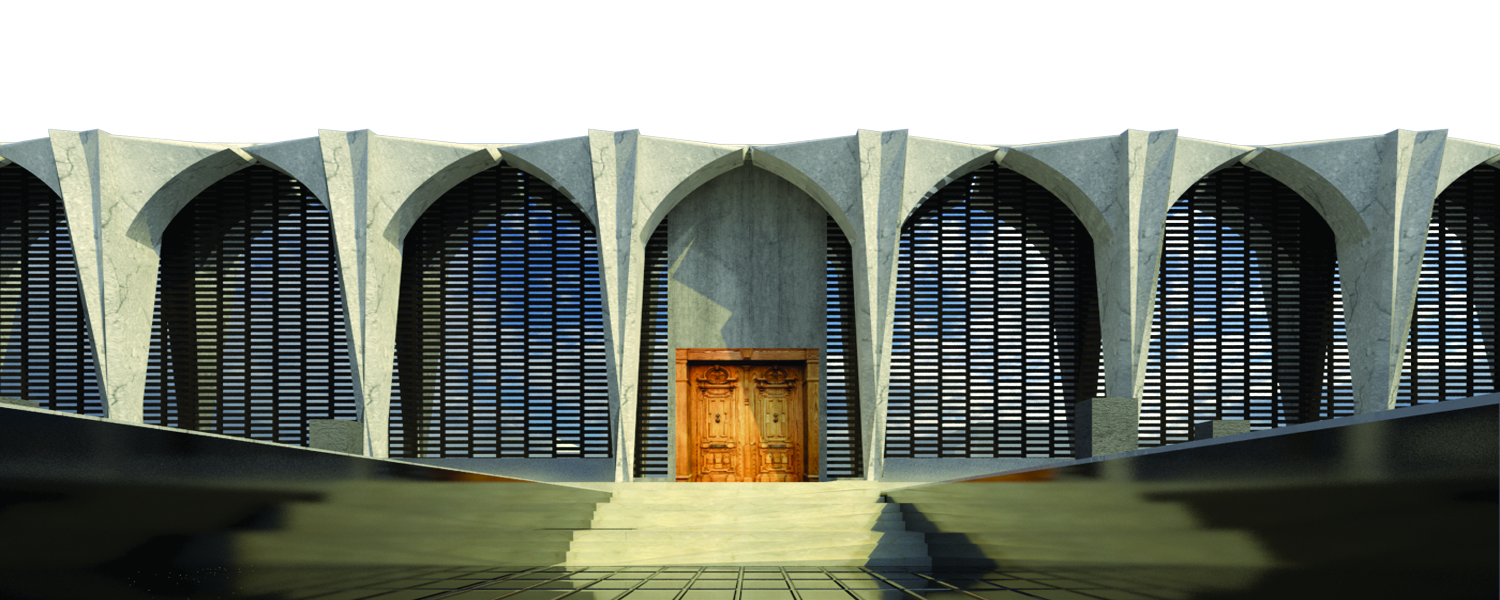
A memorial is experienced in sequence. Where the visitor enters, how long the path is, whether it descends or climbs: these choices carry meaning before any inscription is read. Requiem for a Dream, a proposal by Parizad Mohammadnamdar, Amirreza Movladost, Nima Danaeimehr and Hassan Ebrahimy, takes visitors down into a ruined tunnel, through a square water court and up onto raised concrete planes that peel away from the ground like a page being turned, a passage from rupture towards recovery.
Abstraction versus figuration
Figurative memorials show soldiers, mourners or victims. Abstract ones offer form, material and space, and leave interpretation to the visitor. The debate is old and still live: Lin's design proved controversial, and a flag and a figurative sculpture of servicemen were later added nearby. In Berlin, Eisenman's stelae are 0.95 metres apart, which allows only individual crossing of the grid, so each visitor moves through the field alone.

Materials and time
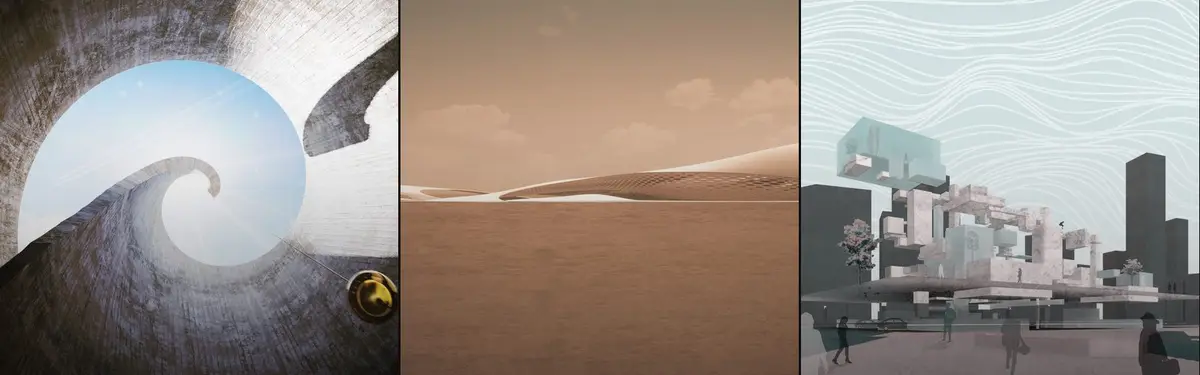
Memorials are promises about time, so material is never neutral. Portland stone, polished granite, weathering steel and concrete are chosen because they age slowly or age visibly. Some designers make decay part of the meaning. Timeless Variation, by Gregoire Boinay, Nathan Barré and Louise Aimonetto, lets the visitor witness the degradation of human interventions and the Earth regaining its rights, with stone inscriptions about climate change.
"Between ephemeral architecture and eternal homage, we do not know what will continue to exist in this memorial."
Gregoire Boinay, Nathan Barré and Louise Aimonetto, Timeless Variation, project statement on uni.xyz
Landscape and silence
Many recent memorials work with land rather than objects. In the uni.xyz journal on The Clearing at Sandy Hook, SWA Group's memorial in Newtown, Connecticut, centres on a spiralling woodland path, a granite water basin and a single young sycamore. It sits close enough to the rebuilt school that visitors can hear children at recess, so silence is never total.
Community participation
Memorials last when the people they serve feel ownership. The Clearing was publicly funded and community-led, chosen from 189 international submissions. In Montgomery, replicas of the steel beams set beside the memorial belong to the Equal Justice Initiative's Community Remembrance Project.
Memorial design on uni.xyz
Members publish memorial proposals from competitions, studios and theses, and our editorial team writes about built memorials. A few threads stand out.
The most liked project on this topic is The Memorial by Athamena Khaled, entered in a challenge category titled "Remember". It commemorates December 11, 1960, a moment in the history of liberation, through a large-scale installation that reproduces the instants and elements of that day in abstract form rather than through figures.

The Non-Memorial by Mohamed El-kurdi received an Honorable Mention in the Memory competition. It sets out to move beyond the traumatic memory imposed by monumental space, creating a place of social reconciliation through storytelling where the scars of war are turned, quietly, into beams of hope.

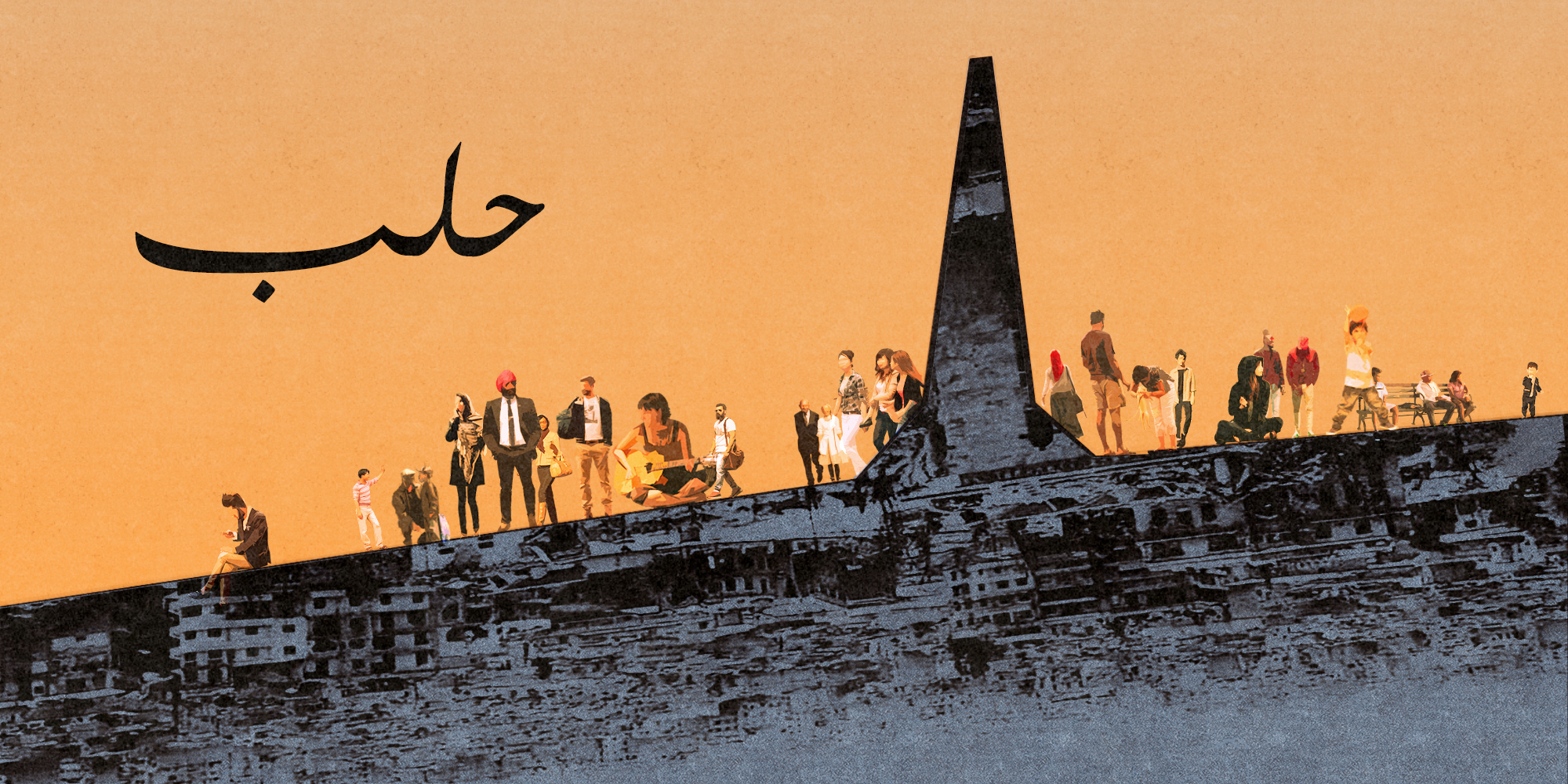
Aleppo is the subject of an unusually deep set of proposals. Regathering Memory, by Zsolt Vasáros DLA, Nouras Hamdan, Mazen Alameddin, Bertalan Kaczian and Borbala Kanyadi, leaves the footprints of destroyed buildings as voids filled with water, drawing on the Syrian gesture of pouring water to wish distance from pain, and reuses fragments of ruined buildings as seating. Related entries frame the city's layered history as a community plaza or a bridge between past and future.
Climate change has produced a new kind of memorial: one for losses still under way. In the Hourglass competition, Memory Mountain of Iceberg by Shida Wang, Danhua Liang and Weikun Dai, an Editor's Choice entry, places a white pyramid in the Egyptian desert. Inside, visitors find a pool of water, the sound of dripping, and a huge iceberg "corpse" at the centre of the exhibition hall.

Memento for Shah Jahan, by Nabila, Maherul and Anindya, received an Honorable Mention in The Black Taj competition. A glass cube on a red sandstone platform uses total internal reflection to conjure the legendary black counterpart of the Taj Mahal from daylight alone, a memorial to something that was never built.
In the Circle of Life competition, designers were asked to rethink death and the city, and several entries treat the cemetery itself as a memorial landscape. Is This The End? by Shayan Rakhshan, which received the People's Choice Award, turns a cemetery into a public plaza where holograms and audio-visual stories keep legacies accessible. Our journals also cover built work, such as the Puntas Carretas Memorial in Montevideo, a 24-metre steel visitation table engraved with the names of political prisoners, on the grounds of a former prison that is now a shopping centre. You can sit at it, eat lunch, or read a newspaper.
Challenges and future directions
Memory is contested. Every memorial chooses whose story it tells, in what words and on whose land, and those choices can divide the communities they are meant to unite. Even Lin's wall, now a model for the whole field, was contested when it was chosen. On a site like Punta Carretas, the question is sharper still: what should a place remember when its present use has moved on?
One response is the counter-monument, a term the scholar James E. Young used for German artists' work on the memory of the Holocaust. Jochen Gerz's 2146 Stones in Saarbrücken engraves the names of Jewish cemeteries on the underside of paving stones, a memorial that is present but cannot be seen.
"The memory of the Holocaust can never be nostalgia."
Peter Eisenman, on the Memorial to the Murdered Jews of Europe
Maintenance is the quieter challenge. Lutyens's temporary Cenotaph deteriorated within months. At Thiepval, when a missing soldier's body is found and identified, his name is filled in with cement, so the memorial keeps changing as long as the search goes on. Digital memorials, ecological burial and memorials to climate loss will raise similar questions about what should last, who looks after it, and for how long.
Memorial design for students and designers
Memorials make strong thesis subjects because they force a clear position on meaning, sequence and material in a small program. Useful angles include a memorial for an event in your own city that has none, a memorial to climate loss, a post-conflict landscape that serves daily life, or a digital layer that keeps names searchable. Research the community first: interviews and archives often shape the design more than form-finding does.
The journal Between Memory and Oblivion shows how a senior thesis by Konstantina Lola, Despoina Tsonidi and Maria Karatsiompani, entered in UnIATA '18, became a cemetery for refugees on Lesvos carved into the land. Look at funerary landscape projects for ways ground, water and planting can carry grief, and browse open architecture competitions for memorial briefs.
Frequently asked questions
What is memorial design?
Memorial design is the design of places, structures and landscapes that commemorate people or events, usually a loss. It combines architecture, landscape, sculpture and inscription, and it focuses on how visitors approach, read and spend time in the place.
What is the difference between a memorial and a monument?
A monument traditionally celebrates a person, victory or idea, while a memorial commemorates loss and asks for reflection. In practice the words overlap, and many modern memorials are deliberately anti-monumental: low, quiet, and built around names rather than heroic figures.
What makes a memorial design effective?
Effective memorials honour individuals, control the sequence of arrival, choose materials that age with dignity and leave room for personal response. They are also shaped with the affected community, not only for it.
What is a counter-monument?
A counter-monument questions the traditional monument. It may disappear, hide its content, invite participation or refuse permanent form. Jochen Gerz's 2146 Stones in Saarbrücken, with names engraved on the hidden underside of paving stones, is a well-known example.
How do I approach a memorial design competition?
Start with the event and the people, not the form. Decide what the visitor should feel at each stage of the route, test your idea in section, and explain how names, materials and maintenance are handled over decades.
References and further reading
- The Cenotaph, Wikipedia
- Thiepval Memorial, Wikipedia
- Vietnam Veterans Memorial overview, U.S. National Park Service
- Memorial to the Murdered Jews of Europe, Foundation Memorial to the Murdered Jews of Europe
- National Memorial for Peace and Justice, Wikipedia
- Countermonument, Wikipedia


Popular projects
View all 58 projects


Latest journals
View all 64 journals

Jim Caumeron Design Lifts a Muntinlupa Family Mausoleum Toward the Sky So Mourners Look Up Instead of Down
A private family tomb in Muntinlupa, Philippines, where a cantilevered white shell, a travertine descent and a cross-cut skylight reframe grief as uplift.
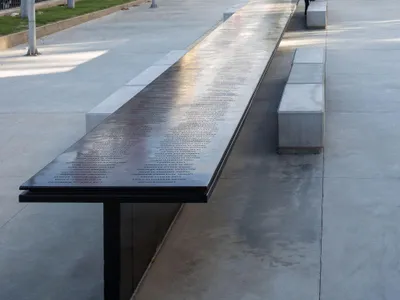
Three Studios Turn a Prison's Visitation Table into a 24-Meter Memorial in Montevideo
On the grounds of a former political prison turned shopping center, a steel table inscribed with prisoners' names reclaims public memory.
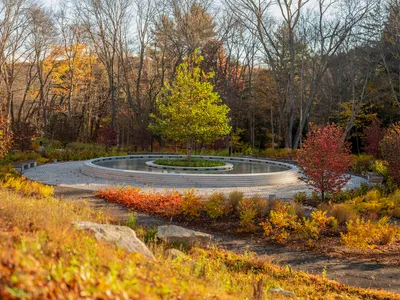
SWA Group Spirals a Landscape Memorial into the Woods of Sandy Hook
A 1.8-acre clearing in Newtown, Connecticut, honors 26 lives lost with water, stone, and a single sycamore tree.

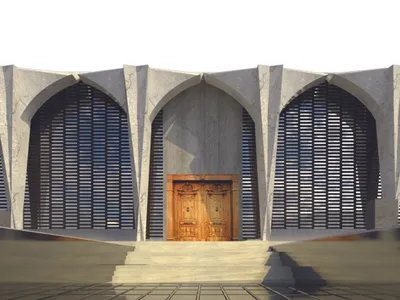
Requiem for a Dream: A Syrian Memorial That Splits the Ground to Grow an Olive Tree
Raised concrete scales, Aleppo-inspired arches and a descent through a ruined tunnel turn Syria's war into a passage from rupture toward renewal.


