
Three Studios Turn a Prison's Visitation Table into a 24-Meter Memorial in Montevideo
On the grounds of a former political prison turned shopping center, a steel table inscribed with prisoners' names reclaims public memory.


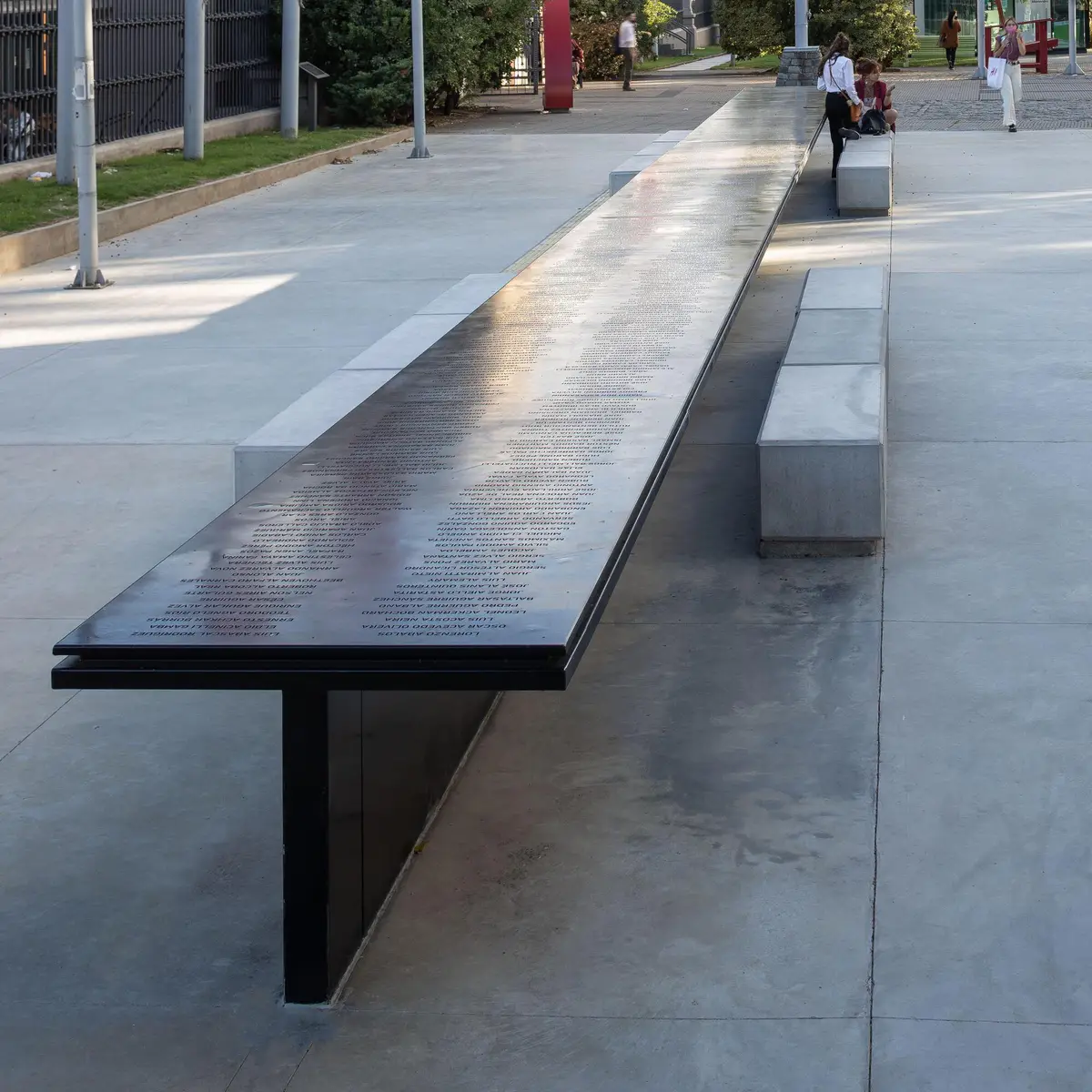
From 1915 to 1986, the Punta Carretas site in Montevideo operated as a prison. Between 1968 and 1985, hundreds of political prisoners were held there during Uruguay's authoritarian period. Today the old jail is a shopping center, and the esplanade beside it is a place where people walk dogs, drink coffee, and wait for buses. The Puntas Carretas Memorial, a competition-winning collaboration between Federico Lagomarsino, Federico Lapeyre, and TATÚ Arquitectura, inserts a single piece of urban furniture into this everyday landscape and, in doing so, forces the site to remember what it was.
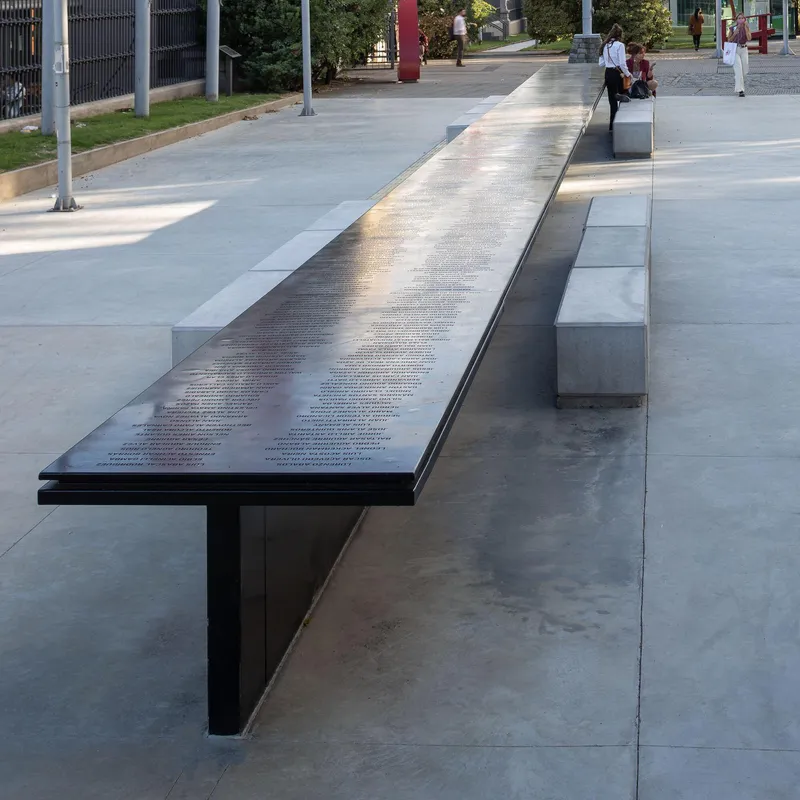
The concept is disarmingly direct. The memorial takes the form of a visitation table: the furniture of reunion, the object around which prisoners and their families sat across from each other during visiting hours. Scaled up to 24 meters in length and fabricated from four steel plates on a T-shaped support, the table occupies the edge of the esplanade parallel to Ellauri Street. It is operational. You can sit at it, eat lunch, read a newspaper. But when you look down at its surface, you find the names of every political prisoner engraved into the steel. The memorial refuses the distinction between monument and infrastructure, and that refusal is its sharpest move.
A Table You Can Use

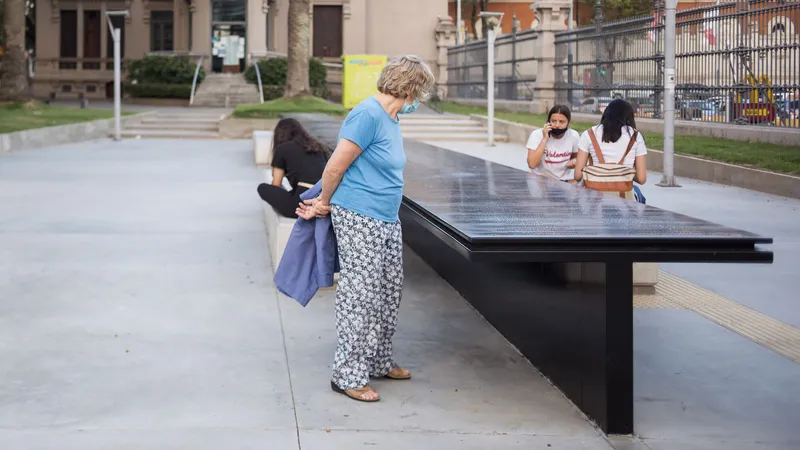
Most memorials ask you to stop and contemplate. This one asks you to sit down. The steel surface is flanked by high-resistance concrete slabs that form continuous benches on either side, turning the entire assembly into a long communal table. Visitors gather naturally, some reading the inscriptions, some ignoring them entirely. That tension is productive. The memorial does not demand reverence; it embeds memory into the routine of civic life, trusting that proximity to the names will do its own work over time.
The domestic scale of a table, stretched to urban dimensions, creates something uncanny. It is recognizable enough to invite use but large enough to register as a public gesture. The architects describe this as "maximum scope with minimum effort," and the economy of means is genuine: very few custom elements, a clear structural logic, and no theatrical staging.
Inscriptions as Surface
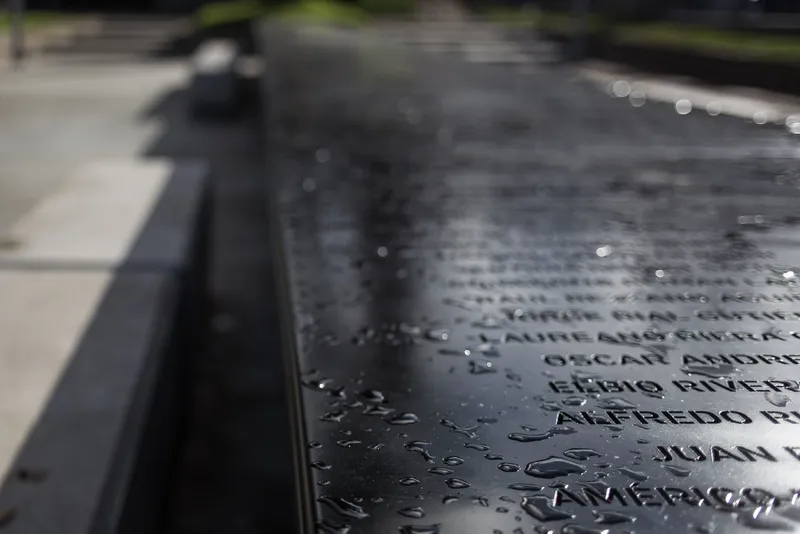
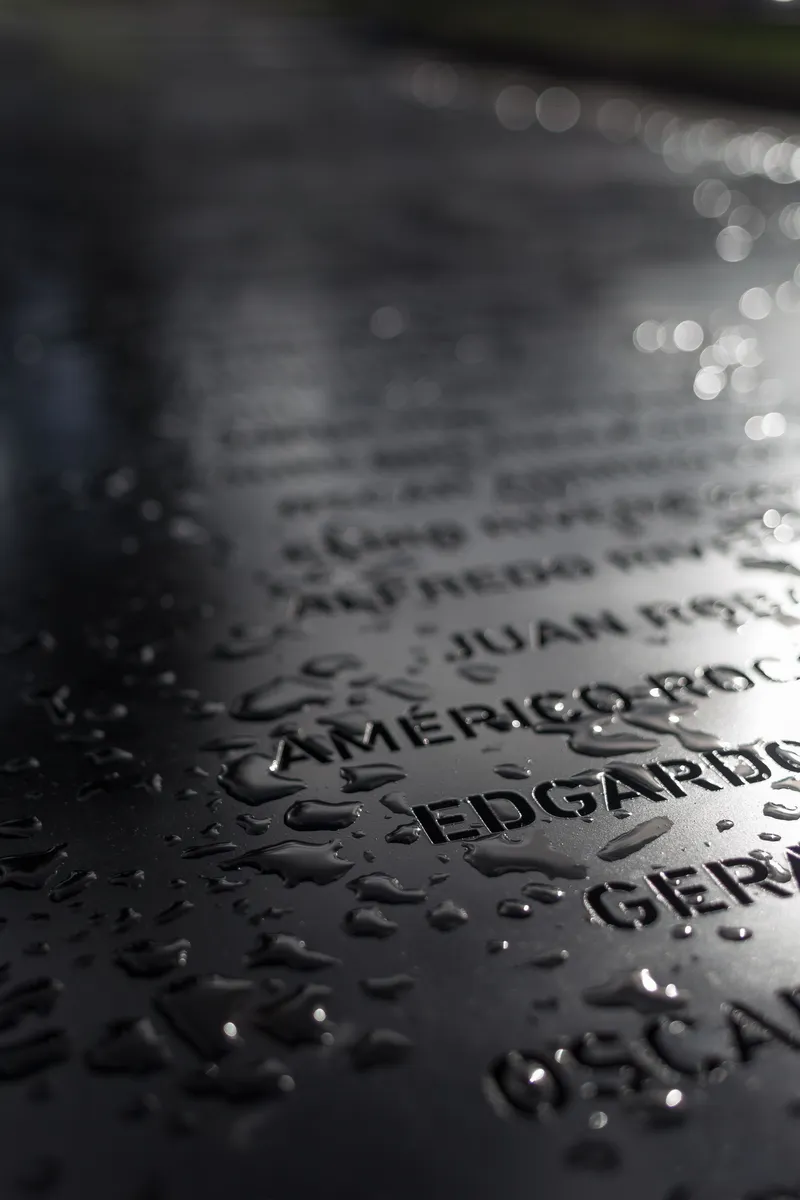
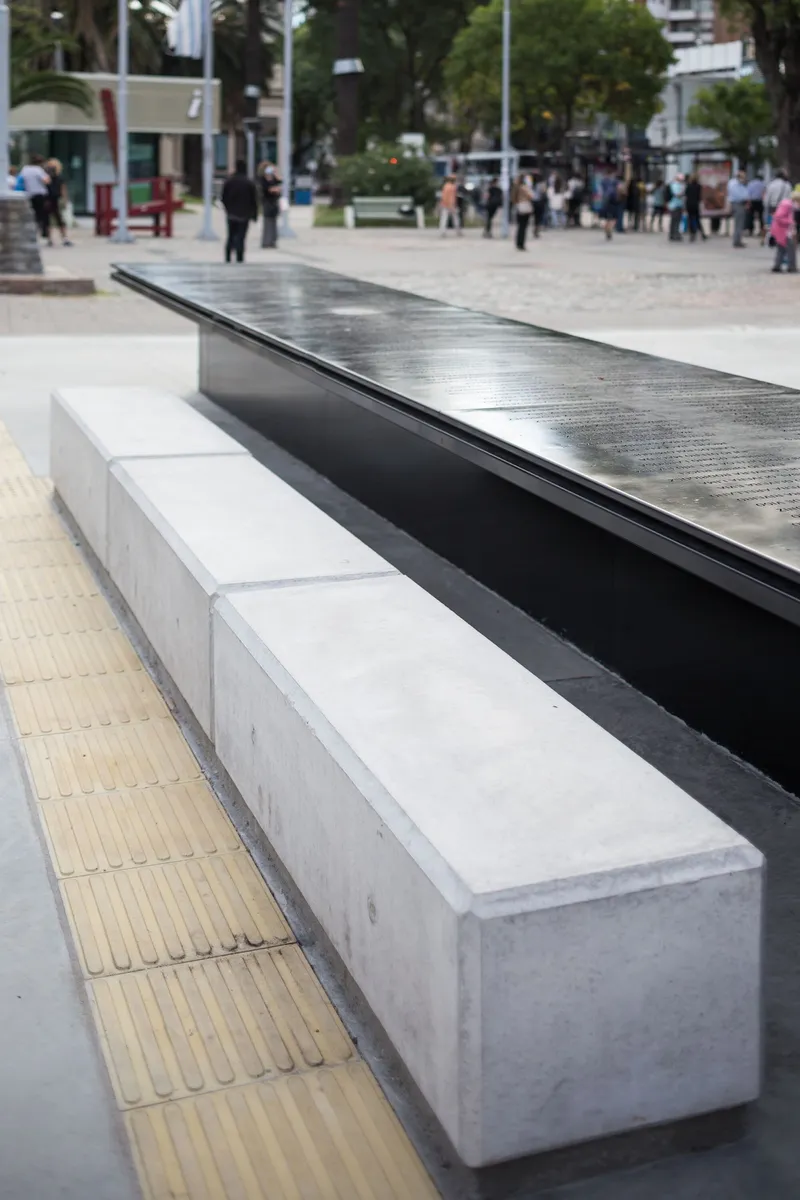
The names are not on a wall. They are not arranged alphabetically on a plaque behind a hedge. They are under your hands, under your coffee cup, under the rain. When water pools on the steel surface, the raised letterforms emerge with a clarity that dry conditions partially obscure. This is a memorial that changes with weather, that reveals itself differently in different light, that insists on physical contact rather than optical distance.
Placing the names on a horizontal surface rather than a vertical one collapses the hierarchy between viewer and viewed. You do not look up at the dead or the imprisoned. You look down, as you would at a table. The posture is intimate, conversational. It recalls the exact posture of a visiting family member leaning across to speak to someone on the other side.
The Long Line on the Esplanade

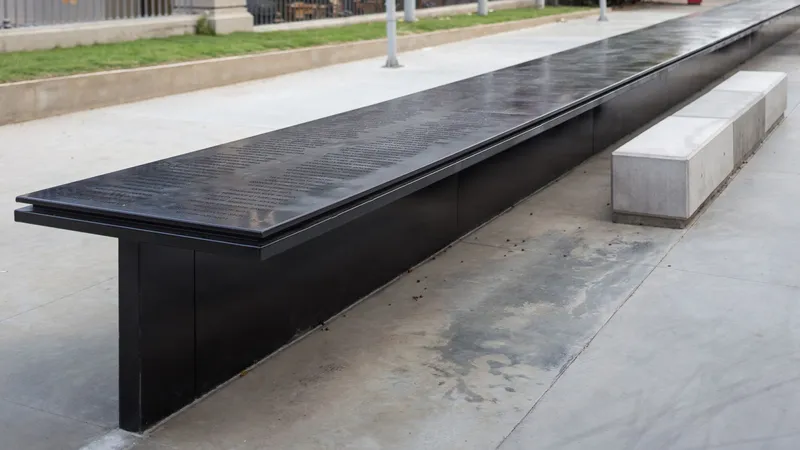

Seen from a distance, the memorial reads as a single dark line running through a field of white concrete and green canopy. The 24-meter extrusion is striking in its simplicity. The T-shaped support columns are deliberately minimal, so the steel plane appears to float just above the pavement. Palm trees and existing plantings frame the composition without competing with it. The architects relocated some shrubs and added new plantings along the fence facing the shopping center, creating a soft screen that subtly separates memorial from commerce.
The rear grass quadrant of the original square has been replaced with a continuous pavement that extends the usable area and integrates the memorial into a larger civic surface. Tactile paving strips along the edges signal the transition between standard walkway and memorial zone, a quiet accessibility detail that also reinforces the object's linearity.
Steel Against Concrete
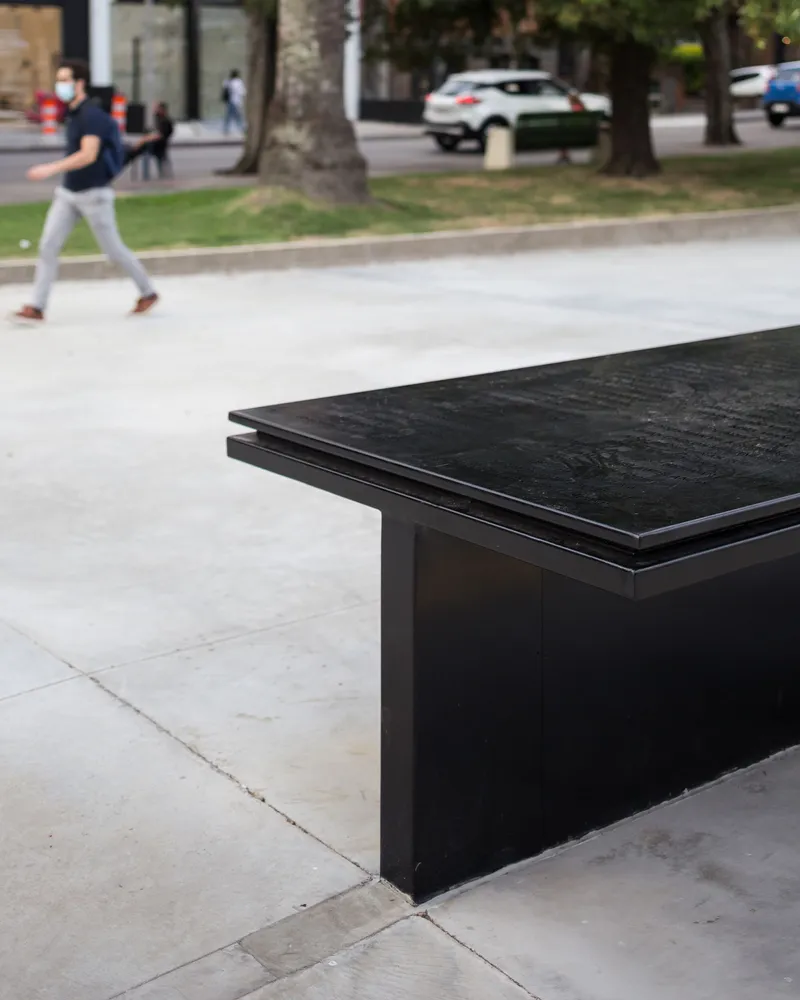

The material palette is binary: black steel for the table, white concrete for the benches and pavement. The contrast is legible at every scale, from the aerial view where the dark stripe cuts through pale ground, to the close-up where the matte finish of the steel meets the aggregate texture of the concrete blocks. There is no granite, no bronze, no polished stone. The materials are industrial, direct, and honest about their fabrication. The steel will weather. The concrete will stain. The memorial will age alongside the neighborhood.
Site and History
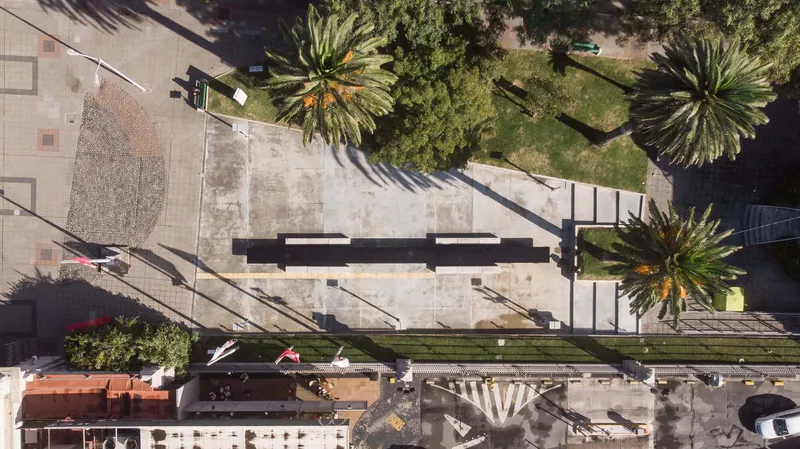
The aerial view makes the paradox visible. On one side, the shopping center that occupies the former prison. On the other, the memorial that names the people who were confined there. The two programs coexist with a tension that no design resolution could or should eliminate. The memorial does not attempt to undo the commercial reuse of the prison; it simply insists on marking what happened. Its placement on the esplanade, at the threshold between shopping center and city street, means that it catches people in transit, not just those who seek it out.
Montevideo's relationship with its authoritarian past is still contested and evolving. A memorial that functions as a bench, a table, a gathering place, stakes a particular position: that remembrance is not separate from daily life, and that the best way to keep memory alive is to make it useful.
Plans and Drawings


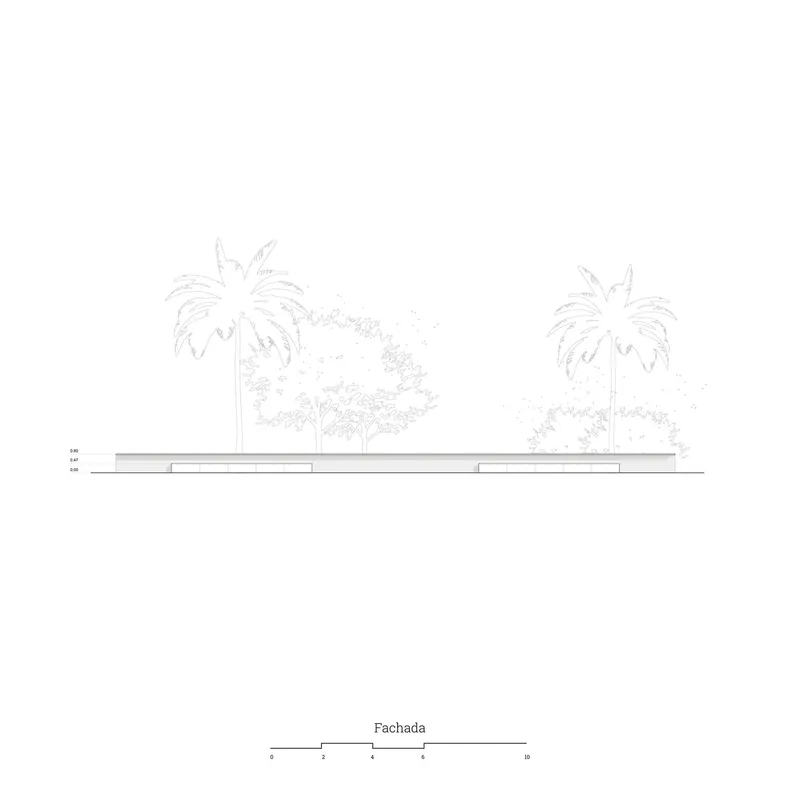
The floor plan reveals the angular footprint and the diagonal axis along which the table is oriented, threaded between planted areas. The axonometric drawing makes the T-section support legible, showing the sloped beam and two recessed openings along its length. Section and elevation drawings confirm the extreme horizontality of the intervention: the structure barely rises above seated eye level, keeping the memorial subordinate to the trees and the sky. Everything about the drawing set reinforces the project's commitment to constructive simplicity.
Why This Project Matters
Memorials to political violence face a persistent problem: they tend to either overwhelm their surroundings with solemnity or disappear into polite abstraction. The Puntas Carretas Memorial sidesteps both failures by choosing an archetype, the table, that carries its meaning without explanation. You understand a table. You understand sitting across from someone. You understand the weight of names. The design does not need interpretive signage or guided tours to function.
What makes the project genuinely instructive for architects working on public memory is its discipline. Three studios collaborated on a 5,000-square-foot intervention and resisted every temptation to overdesign it. The result is a piece of civic infrastructure that earns its permanence not through monumental scale but through daily use. People will sit at this table for decades, and every time they do, the names will be there, just below the surface of an ordinary afternoon.
Puntas Carretas Memorial by Federico Lagomarsino, Federico Lapeyre, and TATÚ Arquitectura. Montevideo, Uruguay. 5,027 sq ft. Completed 2020. Photography by Marcos Guiponi.
About the Studio
Share Your Own Work on uni.xyz
If projects like this are the kind of work you want to make, uni.xyz is a place to publish your own, find collaborators, and enter design competitions.


Popular Articles
Popular articles from the community


U.GA Architects Wraps an Oval Rooftop Pool in Curved Board-Formed Concrete on Busan's Jeollidan-gil
In Busan's Jeonpo-dong, a 454 m² mixed-use block stacks a neighborhood facility, guest rooms and an oval rooftop pool inside spiraling concrete walls.

Cube Design Draws an Ecological Corridor Between Two Shenzhen Hills with the Nankai Building
Beside Shenzhen's container docks, the Nankai Building pairs stacked balconies with a climbing green screen to connect two hillsides across its height.

LT2A and OPEN Architectes Thread a Brick and Glass High School Through a Wooded Belgian Campus
In Braine-l'Alleud, a 3,000 m² wing for Collège Cardinal Mercier pairs pale brick with a glazed colonnade, deferring to a small chapel and a dense wood.

Architekt Andreas Gruber Scatters 23 Dark Timber Chalets Across a South Tyrolean Forest Edge
In Molini di Tures, Amonti Chalets breaks a resort into a hamlet of gabled timber houses, with parking, storage and services pushed into the slope.

Similar Reads
You might also enjoy these articles


LAVA Architecten Gives Vocational Education a Sawtooth-Roofed Face on a Mechelen School Campus
In Mechelen, Belgium, a 2,053 m² STEM school on a 6×6 m grid turns workshops and classrooms into rooms that can be rearranged as teaching changes.

KEMA Studio Turns a Derelict Marvila Attic into a 60 m² Lighthouse Apartment Above Lisbon
In Lisbon's Marvila district, a rebuilt roof, four skylights and two plywood volumes turn an unlivable attic into a bright home facing the Tagus.

Pixel Gardens: One Repeated Module Stacked Into a Terraced Social Housing Tower for Famagusta
Salem Bader's shortlisted housing tower builds a vertical neighbourhood from one repeated module, offsetting units to carve terraces, light and air.

Bao Huynh Watercolor Atelier: A Serene Art Retreat in Hội An
Bao Huynh Watercolor Atelier in Hội An blends multifunctional art spaces, sustainable design, local materials, and family-friendly living in a serene environment.

Explore Memorial Design Competitions
Discover active competitions in this discipline

Challenge to design locus for the upliftment of human rights

Design challenge to reuse E-waste
Comments (0)
Please login or sign up to add comments
No comments yet. Be the first to comment!