
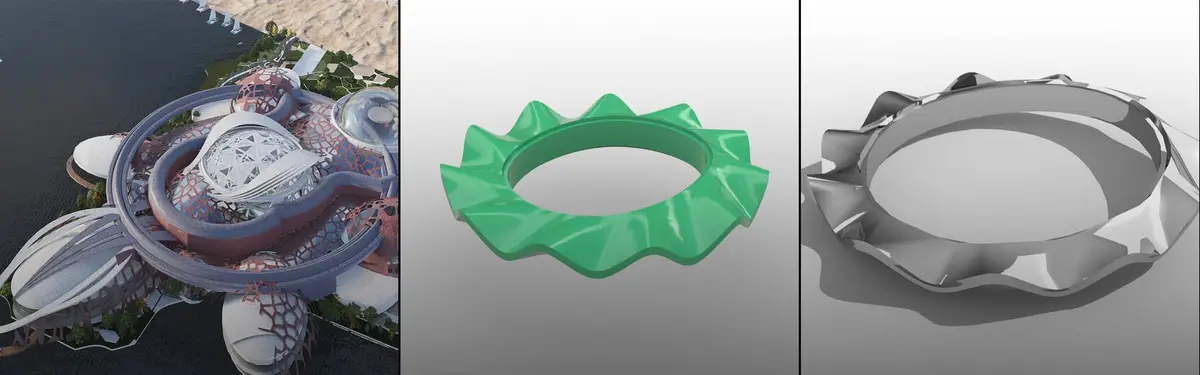


Parametric Design
Parametric Design is a cutting-edge approach in architecture and design that uses algorithms and computer-aided techniques to create complex, customizable forms and structures.
Parametric design is a way of designing in which a form is generated by rules and adjustable inputs instead of being drawn line by line. The designer defines the relationships between the parts of a building or object, then changes the parameters (a height, an angle, a density, a sun position) and lets the model update every dependent element at once. The result is less a single design than a family of related designs, from which the strongest is chosen.
What is parametric design?
At its core, parametric design separates the logic of a design from any one instance of it. A facade is no longer a drawing of 400 panels but a rule that says how each panel should respond to its position, its orientation or the light it receives. Change the rule and all 400 panels change. Wikipedia's entry on parametric design describes it as a method in which building elements and engineering components are shaped by algorithmic processes rather than by direct manipulation.
The term overlaps with two neighbours. Computational design is the broader field: any use of algorithms, simulation or scripting to support design decisions. Parametric modelling is one technique inside it, built on chains of dependencies. Parametricism is narrower again. It is a style and a theoretical position named by Patrik Schumacher of Zaha Hadid Architects, who presented his manifesto at the Dark Side Club during the 11th Architecture Biennale in Venice in 2008. In his Parametricist Manifesto he wrote:
"Parametricism is the great new style after modernism."
Patrik Schumacher, Parametricism as Style: Parametricist Manifesto (2008)
You do not have to accept that claim to use parametric tools. Many designers who work parametrically produce calm, orthogonal buildings, and use the method for structure, daylight or fabrication rather than for flowing curves. The useful distinction is between a way of working (parametric) and a look (parametricism).
A short history of parametric design
Parametric thinking is older than the computer. One of the best known early examples is Antoni Gaudí's hanging model for the church of the Colònia Güell near Barcelona. Gaudí suspended strings weighted with birdshot, so that gravity pulled them into curves that would stand in pure compression once turned upside down. By moving a weight or shortening a string he could change one arch and watch its neighbours adjust, which is exactly how a parametric model behaves.

The digital lineage starts in 1963, when Ivan Sutherland submitted his MIT dissertation on Sketchpad, a man-machine graphical communication system. Sketchpad stored the topology of a drawing: move one vertex of a polygon and both adjacent sides followed. Users could also apply conditions, such as making two lines parallel, and the program rearranged the drawing to satisfy them. Constraints and dependencies, the grammar of every parametric tool since, were there from the start.
In parallel, the German architect and engineer Frei Otto spent decades finding form through physical experiment. According to the Pritzker Architecture Prize, which honoured him in 2015, Otto always built physical models to determine the optimum shape of a structure, and his engineers were early adopters of computers for structural analysis, with the input data coming from those form-finding models. His roofs for the 1972 Munich Olympics, with Günter Behnisch and Fritz Leonhardt, and the grid shell of the Mannheim Multihalle (1974) remain reference points.

"Herein resides his deep influence: not in forms to be copied, but through the paths that have been opened by his research and discoveries."
Pritzker Architecture Prize jury citation for Frei Otto (2015)
The last step was accessibility. Visual scripting tools such as Grasshopper, which its makers describe as a graphical algorithm editor tightly integrated with Rhino's 3D modelling tools that needs no knowledge of programming, put rule-based modelling within reach of students, not only specialists.
Key principles of parametric design
Rules before shapes
A parametric model starts with a relationship, not a form. The designer decides what should drive what: floor height drives stair geometry, sun angle drives shading depth, structural span drives member size. The shape is an output of those decisions.

Porosity, a facade study by kunj, shows the idea in its purest form. A single rule governs it: panels are dense and private at ground level and become more open and daylit as they rise. Because the system is built on a 1.2 m module, it can be applied to a different building without redesigning the logic.
Variation without redrawing
Once the rules are set, producing ten or a hundred options costs almost nothing. This is why parametric work is usually presented as a series of iterations rather than one image. The Fallen Leaves journal on uni.xyz puts it well:
"What results is not a single vase but a family of geometries, each one a different reading of the same natural phenomenon."
UNI, Fallen Leaves: Translating the Physics of a Leaf's Descent into Parametric Form (uni.xyz journal)
Performance as an input
The most convincing parametric projects feed real data into the model. Cocoon, a children's play project by Baver Bekiroğlu, dogan kalak and salih özalp, evaluated environmental data alongside the Reggio Emilia teaching method in Grasshopper. Jakub Kolomanski's journal on acoustics for music practice rooms describes a parametric form-finding process for shaping surfaces that diffuse sound, balancing absorption, reflection and room volume.

Fabrication-aware geometry
A curved form is only as good as the way it is built. Parametric models can output cutting files, node geometry and part numbers directly, so that hundreds of unique pieces can be made without hundreds of hand drawings. This is where digital fabrication and parametric design meet.
Patterns borrowed from nature
Many parametric tools come with ready-made algorithms for natural patterns: Voronoi cells, differential growth, branching. CIRVO, an urban seating concept by M. Kemal Adro and team, wraps a cylindrical base in a Voronoi pattern, then extrudes parts of it to different heights to create seats for resting, climbing and meeting.
Parametric design on uni.xyz
The parametric work on uni.xyz runs from jewellery to airports, and the most useful examples are the ones that explain their process. These are the members' projects and journals we would point a student to first.
GLACIER METAMORPHOSIS by Aasish Aasish is the most-liked project listed under this topic and an Editor's Choice entry in UnIATA '20. It responds to the retreat of the Swiss glaciers and the water shortages their uneven runoff can bring, and is tagged with Rhinoceros 3D and Grasshopper 3D.
Nautilus by Kseniia Bondarets and Belgi Ozdemir won Best in Category in the Beegraphy Design Awards. It is a walnut and brass coffee table, inspired by the geometry of a nautilus shell, whose parametric, movable segments fold it from a working table into a sculptural form.

Fallen Leaves, a journal on Amir Ahmed's vase, follows a design from a basic curve to a sine wave to a leaf-derived profile, all built in BeeGraphy's parametric editor. It is one of the clearest step-by-step explanations of parametric logic on the platform. The Wave Bracelet by Pranav Raghavan applies the same thinking at the scale of a wrist.

The Petal Pavilion journal looks at Epiphany Architects' 64 square metre pavilion in Chengdu, completed in 2023. Its shell uses 300 individually shaped wooden elements, and because every lightbox meets its truss at a unique angle, the team produced 600 distinct connectors through a fully parametric pipeline of node design, data output and CNC machining.

Parametric Design in Small Spaces studies Cœur Tagesbar, a 62 m² bistro in Munich by Martino Hutz Architecture, where differential growth patterns organise a very small interior. Network Installation covers Ricardo Salazar's shortlisted Elevate 2019 entry, which uses algorithmic thinking to stretch coloured fishing nets into canopies over parks and plazas.
Two journals extend the topic into building technology. CORA Installation describes IAAC's timber structure built to house a KUKA milling robot at the Valldaura Labs campus near Barcelona, a link to robotic fabrication. AI in Architecture examines architectScripta's Butterfly Residential Building in Athens, whose form came from topological geometries derived from mathematical models.
Challenges and future directions
The first challenge is meaning. Because parametric tools make complex form cheap to generate, it is easy to produce surfaces that are intricate but say nothing about the site, the climate or the people inside. Juries increasingly ask what a parameter actually represents. A pattern driven by daylight, airflow or structural force is defensible; a pattern driven by a slider that looked good is not.
The second is construction. A model can contain thousands of unique parts, but each one has to be cut, numbered, delivered and fixed, and tolerances in real materials are never zero. The projects that survive this step, like Frei Otto's grid shells, treat fabrication as part of the design logic from the first sketch.

The third is authorship. As scripting tools absorb machine learning, designers will set goals and constraints and let software propose options. That makes the brief, the choice of parameters and the judgement between options more important, not less. The likely direction is quieter: parametric methods used for nature-inspired structure, reuse of components, low-carbon optimisation and facades tuned to climate, rather than for spectacle alone.
Parametric design for students and designers
For a thesis, the strongest parametric projects make one clear argument and show the rule behind it. Good angles include a climate-responsive facade where every panel answers to orientation, a timber structure with unique joints designed for CNC cutting, an acoustic interior shaped by simulation, or a reef or landscape structure that grows from a module. Present the process, not only the render: diagrams of inputs, the logic in between and several outputs side by side.
Open design competitions on uni.xyz are a good place to test that kind of work against a brief and a jury. Related topics worth exploring are Grasshopper 3D, facade design and kinetic architecture.
Frequently asked questions
What are some examples of parametric design?
Classic examples include Gaudí's hanging model for the Colònia Güell church and Frei Otto's roofs for the 1972 Munich Olympics, both found through physical form-finding. On uni.xyz, Porosity's facade, the Nautilus table and the Petal Pavilion's 600 unique connectors show the method at the scale of a wall, a piece of furniture and a pavilion.
What software is used for parametric architecture?
Grasshopper, a visual algorithm editor for Rhino, is widely taught and appears in several projects in this topic. Other parametric editors such as BeeGraphy, scripting languages and BIM tools with parametric families are also widely used. The software matters less than learning to think in relationships.
What is parametricism?
Parametricism is the name Patrik Schumacher gave in 2008 to a style built on parametric methods, which he presented as the successor to modernism. Parametric design is the broader working method, and it can produce buildings that look nothing like the flowing forms associated with the style.
How is parametric design used for facades?
A parametric facade links each panel to a variable such as height, orientation or sun exposure, so the whole elevation can be retuned by changing a few inputs. Porosity on uni.xyz is a clear example: panel openness increases with height on a 1.2 m module, and the model stays ready for fabrication.
Is parametric design only about complex curves?
No. Rules can just as easily control a rectilinear grid, a stair, the spacing of columns or the depth of a sunshade. Curved forms are simply where the benefit is most visible, because they are hardest to draw by hand.
References and further reading
- Parametric design, Wikipedia
- Parametricism as Style: Parametricist Manifesto, Patrik Schumacher
- Sketchpad: A man-machine graphical communication system (Ivan Sutherland), University of Cambridge Department of Computer Science and Technology
- Frei Otto, 2015 Laureate, The Pritzker Architecture Prize
- Jury Citation: Frei Otto, The Pritzker Architecture Prize
- Grasshopper: algorithmic modeling for Rhino, grasshopper3d.com


Popular projects
View all 66 projects




Latest journals
View all 43 journals

Fallen Leaves: Translating the Physics of a Leaf's Descent into Parametric Form
Amir Ahmed's vase turns sine curves and computational logic into a customizable sculptural object inspired by organic motion.

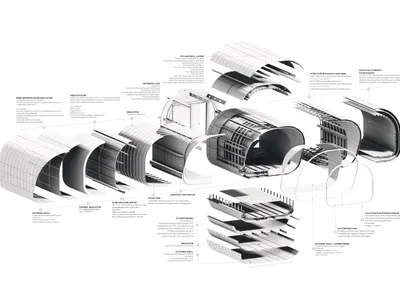
Requariements for good acoustic
Acoustic Optimization in Music Practice Spaces: Parametric Design and Form-Finding Approaches

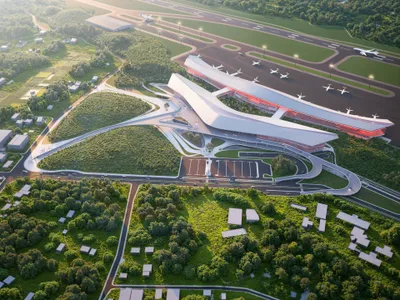
Osmani International Airport: A Dialogue of Place and Passage
Holistic approach to designing an Airport in Bangladesh

More Than a Building-Designing a Living System
More Than a Building-Designing a Living System


