


Product Design
SKLDesign and development of physical products, from everyday objects to innovative solutions addressing user needs.
Product design is the discipline of conceiving and developing physical objects, from chairs, lamps and tools to appliances and packaging, so that they are useful, safe, desirable and possible to manufacture. It sits where engineering, ergonomics, materials and aesthetics meet, and it covers everything from the first sketch of a user's problem to the prototype that proves a solution works.
What is product design?
A product designer decides how an object looks, how it is held or sat on, what it is made of, how its parts go together and how it will be produced and eventually disposed of. The term overlaps almost completely with industrial design; in practice "industrial design" tends to stress mass production and engineering, while "product design" is used more broadly for any designed object, including furniture, lighting and objects made in small batches.
Product design differs from architecture in scale and in its relationship with the user. A building is entered; a product is touched, carried, adjusted and repaired. That closeness makes ergonomics, tactile quality and durability central concerns. It also differs from digital product design, which shapes apps and software interfaces. On uni.xyz the topic means physical objects, and it meets furniture design more often than any other field, because architects and interior designers so often design the furniture that completes their spaces.
The work usually moves through research, concept, prototyping and refinement. Good product design is rarely about a single striking form. It is about the fit between object, user and context: a bench that works for a person with a laptop, a seat that folds onto a train handrail, a lamp that dims when you close it.
A short history of product design
Furniture gives one of the clearest starting points. Michael Thonet's No. 14 chair, introduced in 1859, was made from six pieces of steam-bent wood, ten screws and two nuts, and was shipped disassembled to save space. It is often described as the world's first mass-produced item of furniture, and its logic of few parts, standard joints and compact transport still shapes flat-pack furniture today.

In Britain the reaction to cheap industrial goods came from William Morris. In 1861 he and his friends founded the interiors company Morris, Marshall, Faulkner & Co., where everything was to be crafted by hand, a principle that set the firm against industrial "progress", as the Victoria and Albert Museum explains. His insistence on honest materials and good making fed the Arts and Crafts movement.
"Have nothing in your houses that you do not know to be useful or believe to be beautiful."
The modern profession took shape in Germany. In 1907 the electrical company AEG retained Peter Behrens as artistic consultant, and he designed its entire corporate identity, from logotype to products, which is why he is often called the first industrial designer. The same year he was a founding member of the German Werkbund, which brought artists and manufacturers together.

The Bauhaus, founded by Walter Gropius in Weimar in 1919, set out to unify art, craft and technology and to train artists to work with industry. Objects associated with the school include Marianne Brandt's tea infuser (1924) and Marcel Breuer's Wassily Chair. After the Second World War, Dieter Rams carried a similarly rational, user-first approach into consumer products for Braun, and his ten principles for good design are still widely cited.
Key principles of product design
Start from the user
Every strong product begins with a specific person and situation. The Design Council's Double Diamond describes the first phase as helping people understand, rather than simply assume, what the problem is, by spending time with those affected. Upgrade by Anna Ebert and Michel Plusje starts from the discomfort of standing commuters: a compact, foldable seat that attaches to vertical handrails on public transport, becomes a swing seat when hooked to overhead rails, and also works as a free-standing stool.

Function and ergonomics
An object should fit the body and the task. Seat heights, grip diameters, reach and weight all decide whether a design is used or abandoned. Ergonomics is not only about comfort; it also covers how intuitive an object is to operate. Designers test this with full-size mock-ups early, because a few centimetres of difference in a seat or handle is easy to miss in a drawing and obvious the moment someone uses it.
Design for long life
Products that last, can be repaired and can be taken apart at the end of their life carry far less waste. The Ellen MacArthur Foundation argues that waste and pollution are the result of design decisions, which puts the responsibility on the designer's desk. HILT by Joe Miller, which received a Citation at the International Product Design Awards 2019, splits a toothbrush into a permanent handle and replaceable heads that users send back for recycling.
"Good design is long-lasting. It avoids being fashionable and therefore never appears antiquated."
Dieter Rams, ten principles for good design, published by Vitsœ

Material honesty
Materials should be chosen for performance and expressed rather than disguised. Sashi Malik's Jugnoo (Firefly) wall light is built mainly from bamboo with aluminium parts and LEDs, and is dimmed by physically opening or closing its hinged segments instead of by a switch.
Modularity and adaptability
Objects made from repeatable parts can be reconfigured, shipped compactly and repaired one piece at a time. Balco by Hanna Adamczyk and Adam Bieniek, an Editor's Choice entry in Retro - Fit 2020, applies this to the balcony: an origami-inspired modular product that can take different dimensions and change shape according to need.
Design for manufacture
A design is only finished when it can be made reliably at the intended scale and cost. Joints, tolerances, finishes and the number of distinct parts decide whether a prototype becomes a product.
Product design on uni.xyz
Members publish a wide range of objects on this topic, with furniture, lighting and urban seating the strongest groups.
PARINESS by Surbhi Ghoghari is the most-liked project on this topic and received the People's Choice Award in the Salut Paris competition. Ghoghari frames it around a social aim: to restore human connection at home for people who have become dependent on systems and applications to meet their needs.

'21 CHAIR by Gonzalo Morales is a winning entry in the Chair Challenge 2021 competition. It is a lounge chair that sets out to balance environmental sustainability and universal access with the need to relax at home after a day of work.
"Affordable. Detachable. Recyclable."
Gonzalo Morales, project statement for '21 CHAIR

Urban furniture is a recurring theme. PLATFORM by Aliakbar gulam husain wala, a winning entry in the Urbanscape 2018 competition, is a modular street seat of one to four places whose location is decided by studying the surrounding area. MFB by Jahnavi Manem and Avanitha Thaduri rethinks the plaza bench so that users can sit, lean, lounge, stretch or open a laptop.
Several projects come from the International Product Design Awards '19. The Blackbox open source 3D Printer by mrc s, which received a Citation, uses water-cooled printheads to allow true multimaterial printing while remaining accessible to ambitious makers. Gautam Muthuswamy's Rolls Royce Bespoke perfume bottle received a Special Mention.
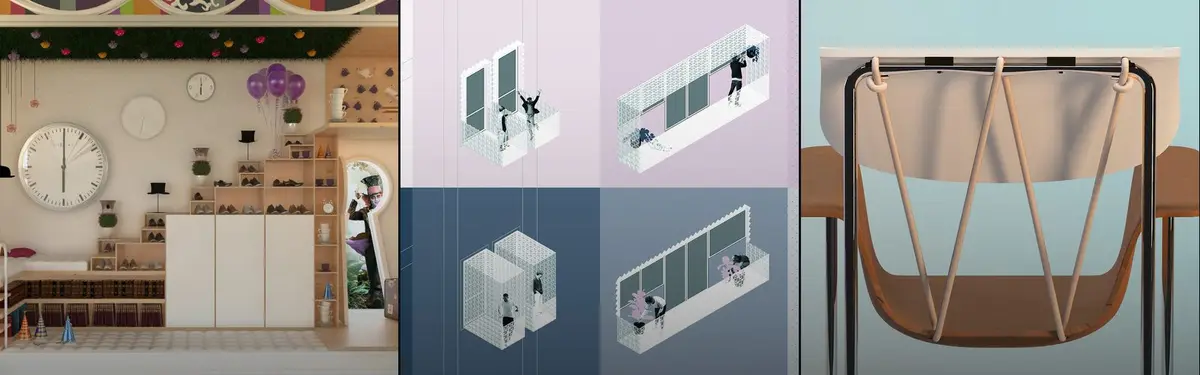
Compact living drives another cluster of work. MAD HATTER'S CLOSET by Mariel D and Raíces y Retoños CUU, which received the People's Choice Award in the Mad Hatter's Closet competition, builds a closet design around a colour palette drawn from the Mad Hatter of Tim Burton's story, set against white to evoke his madness. Wai Ho Cheung's Dimension, covered in our journals, splits the sofa bed into two linked modules that shift between chair, bench, bed and corner sofa for studio apartments. Ribbons of Growth by David Morgan, Nurul Azman and Lyana Ibrahim, a runner-up in Re-connect, proposes a modular system of urban furniture for social interaction with safe distancing.
The journals add depth on furniture and lighting. Badrinath Kaleru's Corolla & Stamen pairs a lounge chair and a floor lamp that borrow structure from a flower, with the chair's frame bent from slim 12 mm mild steel rod. Social Q by Hernan Gregorio, Dustin McDermott and Zachary Spearman, an Editor's Choice entry in Allcart, is a modular food cart made from simple, easily transported materials.

Challenges and future directions
The largest challenge is material and waste. Most products are still designed for a single life, and designers are being asked to plan for repair, disassembly and recovery from the first sketch. Service models are part of the answer. Ankur Gupta's Eazyfit builds furniture from bamboo rods joined by a 30 mm steel cube, and proposes a leasing model that keeps parts in circulation instead of in landfill.

Shrinking homes are a second pressure. Furniture now has to do more in less space, which is why convertible and modular pieces appear so often in student work. A third is accessibility: products that suit older users, children and people with disabilities widen a market rather than narrowing it. Finally, digital fabrication and open-source hardware are lowering the cost of prototyping, so small studios can test and sell objects that once needed a factory.
Product design for students and designers
Product design is an accessible thesis or portfolio subject because a working prototype can be built at full scale. Strong angles include a piece of urban furniture for a specific street, a convertible object for a studio apartment, a product redesigned for repair, or a lamp or tool made from local materials. Document the user research, the rejected options and the prototypes, not only the final render. Related topics to explore are lighting design, urban furniture and circular design. Chair, furniture and object briefs are regularly open in uni.xyz competitions.
Frequently asked questions
What is furniture product design?
Furniture product design is the branch of product design concerned with chairs, tables, storage, beds and seating. It combines ergonomics, structure and joinery with a clear idea of how and where the piece will be used, and it increasingly considers flat-pack transport, repair and recycling.
What is the difference between product design and industrial design?
The two terms overlap heavily. Industrial design traditionally refers to products made in large numbers by industrial processes, while product design is often used more broadly, including furniture, lighting and objects made in small batches.
How do you design products and equipment for kids?
Start with the child's size, strength and stage of development, then design out sharp edges, small detachable parts and pinch points. Products for toddlers should be stable, easy to clean and simple to understand, and they need to work for the parent or carer who assembles, moves and stores them.
What makes an award-winning product design?
Juries tend to reward a clearly defined problem, a solution that is simpler than expected, evidence of testing, and a credible route to manufacture. On uni.xyz, winning and awarded projects such as '21 CHAIR and HILT pair a precise user need with a clear position on materials and life cycle.
Are there product design competitions for students?
Yes. Product and furniture competitions run regularly, and uni.xyz hosts open design challenges in which students and professionals compete on the same brief. Check the competitions page for current calls.
References and further reading
- No. 14 chair, Wikipedia
- Introducing William Morris, Victoria and Albert Museum
- Peter Behrens, Wikipedia
- Bauhaus, Wikipedia
- The Double Diamond, Design Council
- Dieter Rams: ten principles for good design, Vitsœ
- Circular design, Ellen MacArthur Foundation


Open competitions in Product Design
See all Product Design competitions

Popular projects
View all 274 projects


Latest journals
View all 90 journals
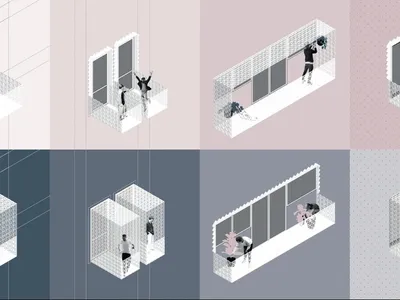
Balco: Modular Architecture Reimagines the Future Balcony Through Origami-Inspired Design
Balco transforms the balcony through modular architecture, origami-inspired flexibility, adaptable shading, privacy, and urban living.

Emergence: A Segmented Ring Habitat for Asteroid Miners Between Mars and the Belt
A shortlisted LEAP entry imagines a rotating chain of modules that grows, separates and reconnects as a deep-space mining community evolves.


Urban Nomads: A Reusable Steel Prototype That Turns Construction Site Jugaad into Dignified Worker Housing
A modular, stackable steel shelter for Mumbai's migrant builders that absorbs workers' own improvisations into a dignified, reusable housing system.


