
Aseman (Sky) Residential Project in Theis Senegal
Dwell House Crisis

At least 250 residential units have been considered for this project, and we faced many challenges in this process. The plan proposed for the plan includes one-bedroom, two-bedroom and three-bedroom units, of which 100 are two-bedroom units, 75 are one-bedroom units, and are 75 three-bedroom units.
The design process began with the analysis of the site, where climatic factors including wind speed and direction, precipitation, ambient temperature, humidity and sunlight were examined. In addition, floods in the region, accesses, culture and customs, vegetation, vernacular materials, architecture of the region, employment, agriculture, economy and policies of the region, future prospects, handicrafts and social sustainability are analyzed .
Using Climate Consultant software, we obtained Thies climate information and then by entering the climate information file (EPW) into Design Builder software, we output the annual energy consumption, outdoor air flow (CFD), lighting factor and daylight (Illuminanc amd Annual daylighting).
Due to the sunlight and the direction of the prevailing wind, the orientation of the residential blocks was according to the site's location. In a way that the northeast wind 45 degrees enters the site well and flows well in the site without any obstacles and the operation of ventilation and air circulation is done well. Given that we in this climate are in dire need of ventilation and natural air circulation.
The design of the buildings was completely modular and the plans were as follows: one-bedroom with three-bedroom and two-bedroom were arranged separately.
To provide the required number of units, the additional sections are considered as a separate unit, the dimensions of which are 6 by 6 meters, starting from our second floor, and there is 5 meters of free space below it, which is also possible to Commuting . And it provides easy and unobstructed access for the residents of the complex, and also a favorable shade is created under them, which helps to reduce the temperature of the open spaces of the site. In addition, it leads to the creation of tunnels for better wind flow. Also in the view from above and human vision has caused the integration of buildings and proper visual connection.
Another solution that we offered to increase the shadow and reduce the intensity of light shining on the surface of buildings was to create facades using local materials and patterns. Bricks that are placed next to each other with a full and empty structure and give us an attractive and climatic view. The reason for using bricks was that their construction does not require very sophisticated technology and is very durable.
We have proposed concrete for the structural skeleton of buildings. And for the parking lots, we have gone one floor underground and the residents come to the site with public and vertical access and go to their houses.
In this project, due to energy stability issues, we have placed solar panels on the roof of the blocks with sunlight and at an angle of 17 degrees, which is equal to the latitude of the region. The annual energy consumption of each building using design builder software was about 70,000 Kwh, which with the use of these solar panels, 23,000 Kwh of this energy consumption is compensated and a lot of energy costs are saved, and according to the economic conditions of the people of the region , it is very important.
Another sustainability system is considered in this project. This is a solar chimney system. In this way, in the outer wall of the stair boxes, a system has been designed that the wind enters from below, and due to the creation of positive pressure points and negative pressure at the top and bottom, the wind goes up . The roof flows to create a layer of thermal insulation to prevent energy loss.
For social sustainability, we have placed a public space in the center of the site at the entrance of the complex, so that on one side there are tall native trees that provide good shade when people gather under it, and this space can also be used for Celebrations or festivals used by the residents of the complex .
We have participated in this competition from Iran and named this project Aseman ( Sky ) . This is because in a conversation we had with the head of the virtual page of the Senegalese embassy in Iran, who was a Senegalese man and was completing his Phd studies in Persian, he said that the word "sky" came to Senegal from Iran in this way. That Iranians migrated to East Africa in ancient times and some of our words are rooted in Persian.



Popular Articles
Popular articles from the community

IDIN Architects Wraps a Hua Hin Hotel Around a Private Courtyard to Escape the City
Dusit D2 Hua Hin turns an urban infill site in Thailand's family vacation heartland into a self-contained resort through courtyard planning.
Foster + Partners Wraps a 200-Meter Shanghai Tower in Stainless Steel and Industrial Memory
The Suhe Centre Office Tower anchors a regenerated waterfront district in Shanghai with an all-steel structure that nods to local warehouse heritage.
Indiesalon Carves a Plywood Cave into a Seoul Bistro's Second Floor
Munhwa Bistro's second Seongsu branch wraps diners in a laminated timber vault laced with colored light and mirror illusions.
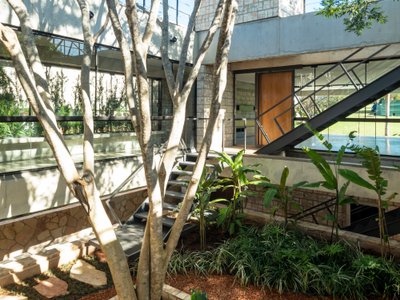
OMCM arquitectos Builds a Summer House in Paraguay from Quarry Waste Blocks and Three Sacred Trees
In the young hillside neighborhood of Altos, a 696-square-meter concrete volume hovers on six pillars around three preserved native Yvyraju trees.

Similar Reads
You might also enjoy these articles

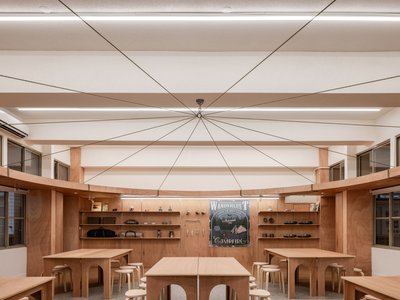
317studio Turns an 87 m² Classroom into a Forest Clearing for Scouts in New Taipei City
A rope canopy, student-made specimens, and campfire geometry replace rows of desks in this Scouting classroom in Xizhi District.
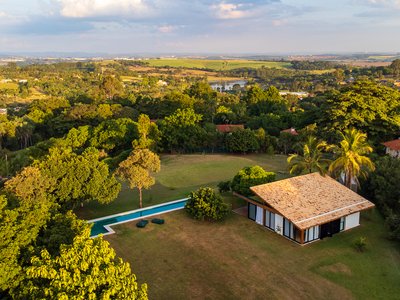
24 7 Arquitetura Builds a Timber Pavilion as a Family's First Act on a 5,000 m² Brazilian Plot
In Jaguariúna, a prefabricated glulam house nestles among mature trees as the opening move of a larger residential masterplan.
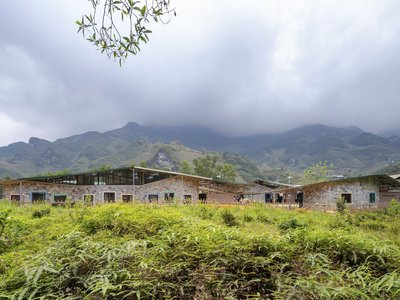
1+1>2 Architects Build a School from 900 Blocks of Hmong Stone on Vietnam's Rocky Plateau
On a barren valley in Ha Giang province, a community quarried its own stone to raise a kindergarten and primary school rooted in Hmong identity.
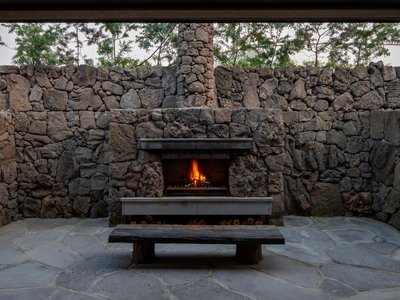
100A Associates Builds a Volcanic Stone Retreat on Jeju Island Rooted in Ritual and Restraint
Watarstay [Wa:Tar] in Bongseong-ri channels Jeju's basalt, reed, and hemp into a 150 m² hospitality space shaped by contemplation.

Explore Sustainable Design Competitions
Discover active competitions in this discipline




The International Standard for Design Portfolios


The Global Benchmark for Architecture Dissertation Awards


The Global Benchmark for Graduation Excellence


Challenge to reimagine the Iron Throne
Comments (0)
Please login or sign up to add comments
No comments yet. Be the first to comment!